

What Are the Best Practices for Negotiating Chiropractic Lien Reductions?
The first reduction offer from an attorney isn't a verdict. It's an opening bid.
Initial requests typically land in the 30-50% range. That's not a requirement. It's a starting position. Accepting it without a counter leaves substantial revenue on the table.
Effective negotiation starts with three structural components. A valid lien — a formal written agreement signed by the patient. Documentation that substantiates medical necessity and connects the injury to the treatment you provided. And proactive communication with the attorney's office before the settlement closes.
Attorneys argue for reductions based on contested medical necessity, limited policy caps, or comparative fault. Those aren't verdicts. They're negotiating positions that collapse when you present defensible records and maintain a professional relationship.
State statutes set the boundaries. In California, Civil Code § 3040 caps recovery at 50% of the net settlement after attorney fees if the patient has representation, or 33.3% if they don't. Those are statutory limits — not starting points. Understanding the framework lets you negotiate within the correct range instead of accepting arbitrary discounts below what the law allows you to recover.
The goal isn't accepting whatever's offered. It's recovering the full value of the care you delivered by documenting it clearly and communicating it consistently.
Last Updated: May 23, 2026
- Why Most Lien Negotiations Start at a Disadvantage
- Building Your Negotiation Position Before the Case Settles
- How to Respond to a Reduction Request
- What 'Getting Paid Completely' Actually Means
-
Frequently Asked Questions
- What is a reasonable starting point for a chiropractic lien reduction negotiation?
- Can an attorney legally ignore my chiropractic lien after a settlement?
- What specific documentation justifies the full value of a lien to an attorney?
- Is it a mistake to accept the first lien reduction offer I receive?
- How do state laws, like those in California, affect how much I can recover on my lien?
- What's the best way to respond when an attorney claims the settlement was too low to pay my full lien?
- Where This Leaves You
Why Most Lien Negotiations Start at a Disadvantage
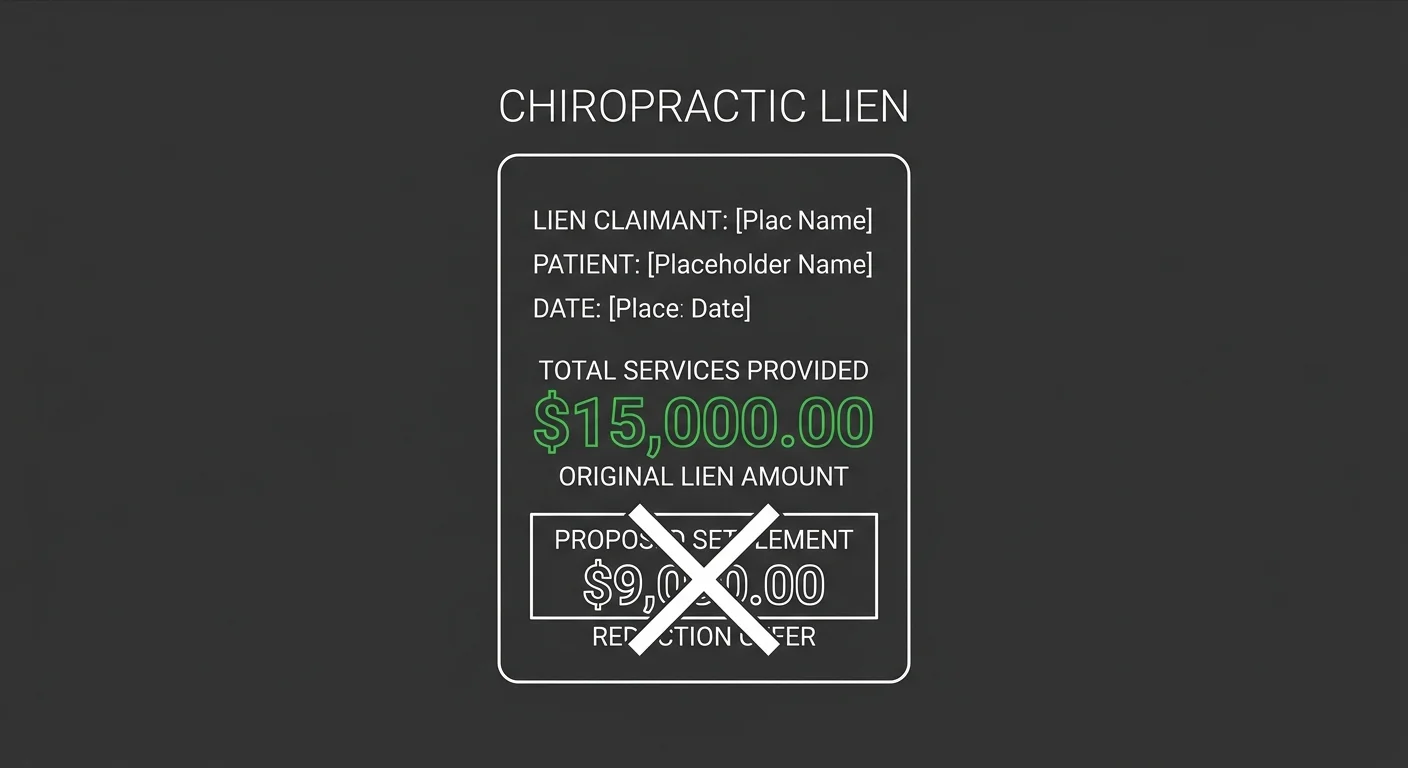
Most chiropractic practices enter lien negotiations at a structural disadvantage. They treat the process as administrative paperwork instead of revenue defense.
The attorney sends a reduction request. The practice accepts it without a counter. The file closes.
The practice moves on — unaware that the discount wasn't required.
That passivity isn't professionalism. It's a decision to leave money on the table before the negotiation even starts.
The disadvantage compounds when practices don't understand the other side's playbook.
Attorneys aren't trying to cheat you. They're trying to maximize the client's net recovery. Your lien is one of several competing claims against the settlement.
If you don't defend it, nobody else will.
The Attorney's Playbook
Attorneys argue for reductions based on contested medical necessity, limited policy caps, or the patient's comparative fault. The script is predictable.
The settlement was too small. The care wasn't fully necessary. The patient shares blame.
None of these are verdicts. They're opening positions. And initial reduction requests typically start in the 30-50% range — an anchor designed to set your expectations low before you've said a word.
Initial reduction requests from attorneys start in the 30-50% range. That's not a final verdict.
It's an opening bid designed to anchor your expectations low.
If you counter with documentation and justification, the number moves. If you accept the first offer without a response, you've signaled that your lien wasn't defensible to begin with.
The attorney closes the file. You've lost revenue you could've recovered.
The Documentation Standard
The documentation standard is where most practices lose the negotiation before it starts.
Attorneys don't reduce liens because they dislike chiropractors. They reduce liens when the treatment records don't connect the injury to the care provided.
If your notes don't explain why the patient needed the specific treatment you delivered, the attorney has no way to defend your full lien amount to their client.
Weak documentation creates weak negotiating positions. It's not about writing more. It's about writing clearly enough that someone outside your practice can follow the clinical reasoning.
A valid lien starts with legal requirements for medical liens — a formal written agreement signed by the patient and proper notice sent to the attorney and insurer. But enforceability and defensibility aren't the same.
An enforceable lien with weak clinical documentation still gets reduced. The attorney can't justify the full amount to anyone reviewing the file.
| Attorney Argument | What It Means | Why Practices Accept It |
|---|---|---|
| The settlement was too small to pay everyone | Multiple medical providers filed liens, and the total exceeds the net settlement after attorney fees and costs | Practices assume the attorney is stating a fact rather than positioning for a discount across all liens |
| Some of the care wasn't medically necessary | The attorney questions whether every visit was required or whether some treatment was maintenance rather than injury-related | Practices interpret medical necessity challenges as personal criticism instead of recognizing them as standard negotiating positions |
| The patient shares fault for the accident | Comparative negligence reduced the settlement, and the attorney argues all liens should absorb a proportional reduction | Practices don't understand that comparative fault doesn't automatically reduce lien recovery — it's a negotiating tactic, not a legal requirement |
| We need to close this file quickly | The attorney frames the reduction request as time-sensitive to discourage extended back-and-forth negotiation | Practices prioritize administrative convenience over revenue recovery and accept the first offer to avoid delaying the file |
| Your documentation doesn't support the full amount | The attorney states that treatment notes lack sufficient detail to justify the billed charges to their client or to a judge if the lien is contested | Practices recognize the documentation gap but don't realize they can supplement records or provide a narrative that strengthens the justification before accepting a reduction |
Building Your Negotiation Position Before the Case Settles

Effective negotiation doesn't start when the attorney sends a reduction request. It starts the day you file the lien.
The practices that recover full value build their negotiation position during treatment — not after the settlement closes. They document with justification in mind. They communicate proactively with the attorney's office. They track the case status so they're never caught off guard when the settlement check arrives.
The practices that accept steep discounts wait until the attorney calls asking for a reduction. Then they scramble to assemble a defense they should've built months earlier.
By then, the attorney's already decided the lien is negotiable. You're arguing from a deficit.
Establish Communication Early
Start building your position the day you file the lien.
Send the lien notice immediately after the patient signs. Introduce yourself to the attorney's office. Confirm they received it. Offer to provide records promptly when they ask.
You're not being pushy. You're signaling you understand their timeline and you won't ghost them when they need documentation.
Attorneys reduce liens on providers who disappear until settlement, then show up demanding full payment with no prior contact.
They negotiate fairly with providers who've been responsive from the start.
Proactive weekly communication with your billing partner keeps your lien status tracked and attorney requests answered fast.
Silence creates friction. Responsiveness builds trust. Trust moves your lien to the front of the payment queue when the settlement closes.
Document With Negotiation in Mind
Every treatment note should justify the care you provided and connect it directly to the injury.
If your notes don't explain why the patient needed the specific intervention you delivered, you're writing administrative records. Not defensible clinical justification.
Document objective findings, functional limitations, and clinical rationale for every modality.
Generic templates filled with repeated phrases don't defend a lien. Specific observations tied to the patient's injury do. The guidance on PI liens from the American Chiropractic Association sets this standard — document as if every note will be read by someone who has to justify your bill to a skeptical third party.
You're not writing for yourself. You're writing for the attorney who has to defend your lien amount to their client.
Make their job easy. Clear documentation creates strong negotiating positions. Vague documentation creates discount requests you can't counter.
Track the Case Proactively
PI cases settle on unpredictable timelines.
The practices that lose ground file a lien, go silent, and only check back when they notice the case hasn't paid out. By the time they re-engage, the settlement's already distributed and the attorney's moved on.
Check in with the attorney's office periodically to confirm your lien is still on file and your records are complete. If they request updated billing statements, send them immediately.
When you're visible and responsive throughout the case timeline, you're not a surprise expense at settlement. You're an expected partner who gets paid.
| Documentation Element | Why Attorneys Challenge It | How to Strengthen It |
|---|---|---|
| Treatment note lacks objective findings | Attorney can't justify the care was medically necessary rather than elective or maintenance | Document specific measurable findings at every visit — range of motion, pain scales, functional limitations tied directly to the injury |
| No clear connection between injury and treatment modality | Makes the care look speculative or unrelated to the accident, creating exposure for the attorney's argument | Explain the clinical rationale for every modality in plain language — why this patient needed this intervention at this point in recovery |
| Billing statement shows no treatment progression or variation | Suggests routine maintenance care rather than active injury treatment, weakening medical necessity | Vary modalities and frequencies as the patient's condition changes — document why treatment intensity increased or decreased at each phase |
| Lien notice sent late or incompletely | Creates enforceability questions and signals disorganization, making the lien easier to discount | File the lien immediately after the patient signs the agreement and confirm the attorney received it |
| Provider goes silent after filing the lien | Attorney assumes you're not tracking the case and won't push back on a reduction, positioning you as a low-priority claim | Check in periodically to confirm your lien is on file and provide updated billing statements promptly when requested |
How to Respond to a Reduction Request
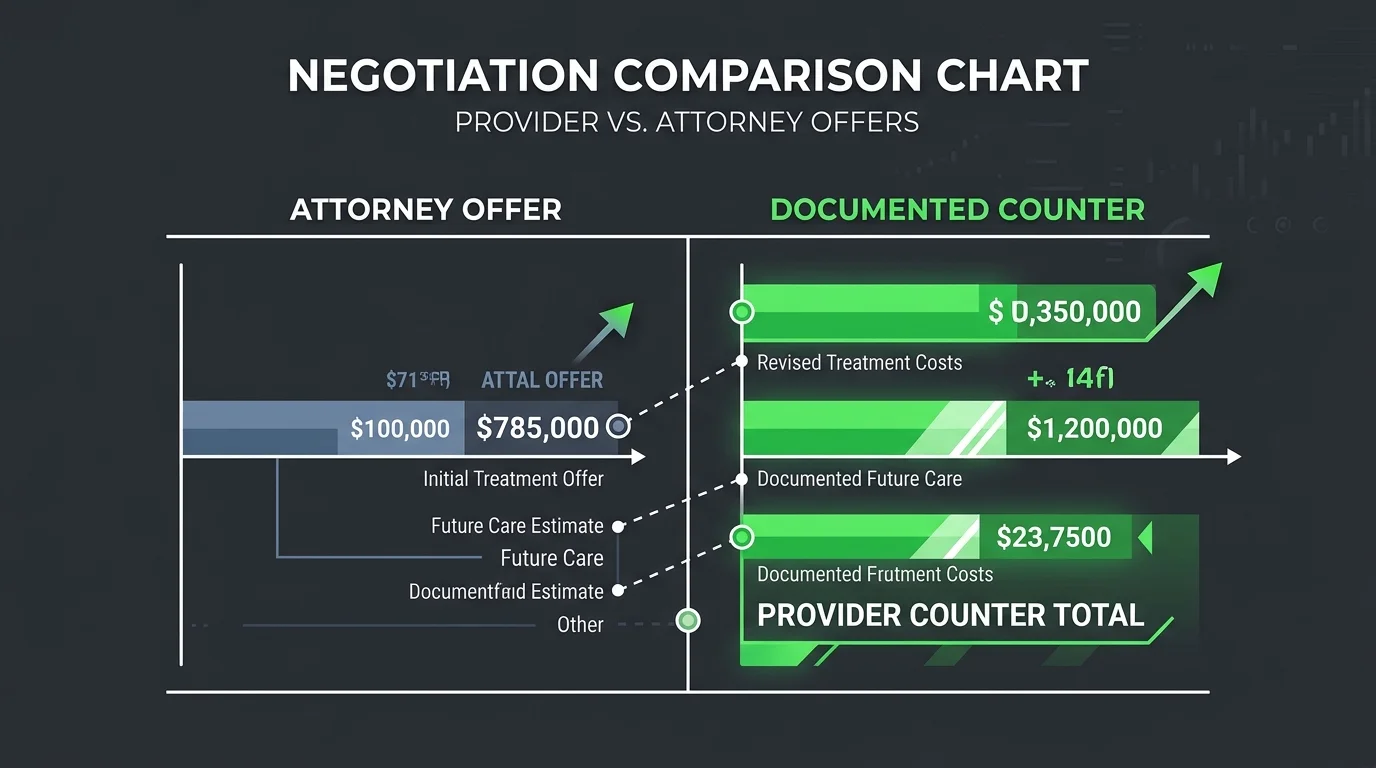
Don't accept the first reduction offer without a counter.
The attorney's opening number isn't a verdict. It's a bid. Your documentation and your response determine whether you recover full value or leave money on the table.
Accept it silently, and you've told them the lien wasn't worth defending.
Your response sets the tone. Accept the first reduction without justification, and you've signaled the lien wasn't defensible. Counter with documented reasoning, and you've forced the attorney to engage on the merits instead of assumptions.
The negotiation doesn't begin when the offer arrives. It begins with how you respond.
Evaluate the Offer Against the Facts
Before you write a single word, compare the reduction offer to the settlement amount and your documented care.
If the settlement is substantial and your care is well-documented, the reduction request is a negotiation tactic — not a financial necessity.
Initial reduction requests from attorneys start in the 30-50% range. That number isn't based on what's legally required or what your documentation supports. It's based on what providers accept without pushback.
The most common attorney objections to PI lien settlements follow predictable scripts — contested necessity, policy limits, comparative fault. Each objection is an argument you can answer with documentation.
If the reduction request claims the settlement was insufficient to pay all parties, ask for the settlement breakdown. If it claims your care wasn't fully necessary, pull your treatment notes and identify the objective findings that justify every visit.
The offer isn't a conclusion. It's the opening statement in a case you need to argue.
Respond With a Documented Counter-Position
Don't call the attorney and negotiate verbally.
Respond in writing with a documented counter-position that references your treatment records, the patient's injury timeline, and the care's clinical justification.
A strong counter-response includes three components: acknowledgment of the attorney's concerns, specific documentation that addresses each objection, and a revised lien amount with clear reasoning.
You're not arguing the attorney is wrong. You're showing them why your full lien amount is defensible to anyone reviewing the file. Understanding how attorneys approach lien negotiations helps you frame your response in terms they can present to their client.
If the attorney argues limited policy caps, acknowledge the constraint but ask for a breakdown showing all competing liens and how the settlement was allocated. If they argue medical necessity, reference specific treatment notes with dates and objective findings.
The goal isn't to win an argument. It's to make your lien the one the attorney pays in full because you've made it easier to justify than to reduce.
Know When Statutory Caps Apply
Some reduction requests aren't negotiation tactics. They're statutory requirements.
In California, Civil Code § 3040 caps recovery at 50% of the net settlement after attorney fees if the patient has an attorney, or 33.3% if they don't.
Those caps are legal limits, not starting points. If your lien amount exceeds the statutory cap, the attorney isn't negotiating — they're complying with the law.
California's specific medical lien statute sets the ceiling. You can't counter above it. But you can verify the calculation to ensure the attorney applied the cap correctly.
Ask for the settlement amount, the attorney fee percentage, and the net calculation. If the math doesn't match the statutory cap, you've identified an error worth correcting. If it does, your negotiation stops at the cap — not below it.
Knowing when statutory limits apply keeps you from wasting time arguing for a number you can't legally recover. It also keeps you from accepting less than the law allows.
| State | Statutory Recovery Cap | Condition |
|---|---|---|
| California | 50% of net settlement after attorney fees | Patient has legal representation |
| California | 33.3% of net settlement | Patient has no legal representation |
What 'Getting Paid Completely' Actually Means
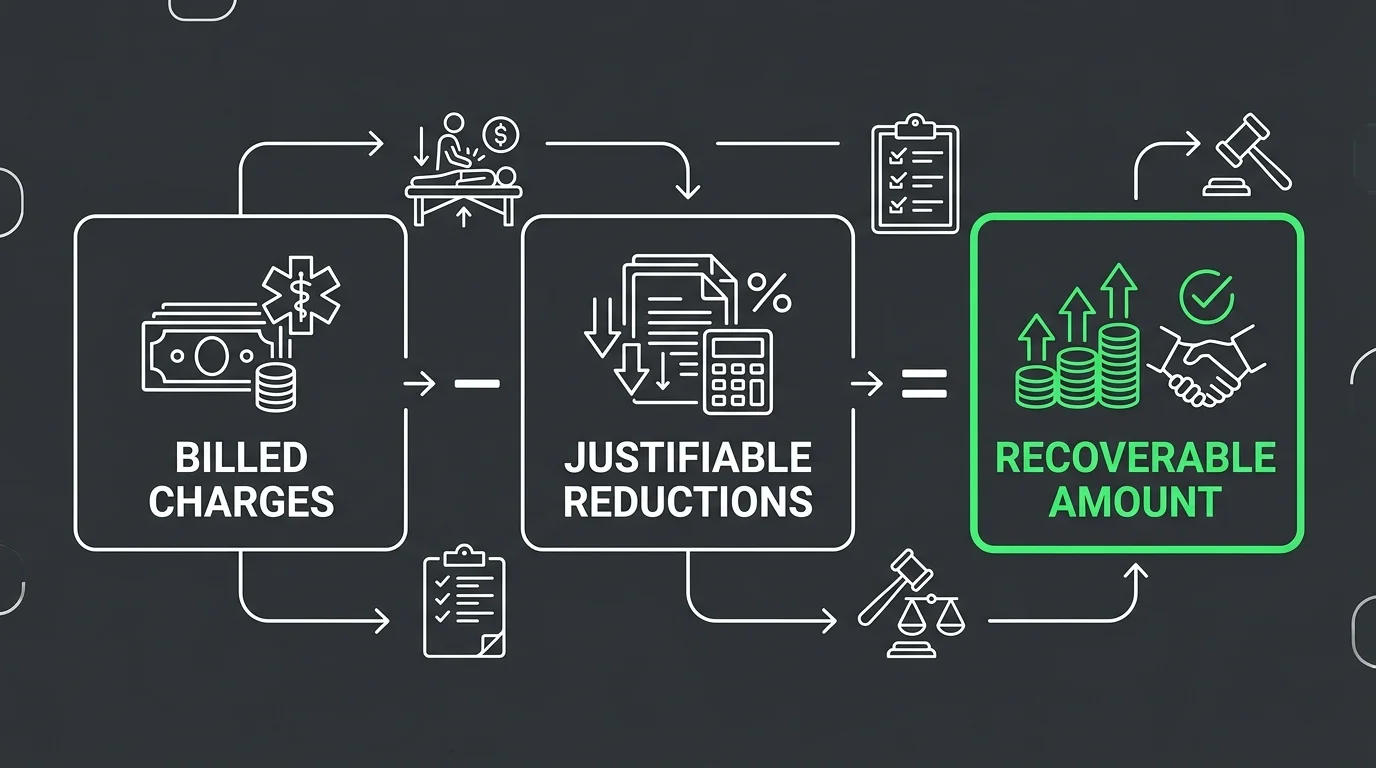
Here's the disconnect. Practices file liens expecting full payment, then accept steep reductions because they don't know what 'getting paid completely' actually means.
It doesn't mean collecting 100 percent of your billed charges in every case.
That's not the law.
Getting paid completely means recovering the maximum amount the settlement fund, the law, and your documentation support. Not passive acceptance of the attorney's first offer.
It means knowing when a reduction is justified by statutory limits or settlement constraints. And when it's a negotiation tactic you can counter.
The distinction is everything.
Full Recovery Versus Billed Charges
Full recovery is what you're entitled to under the law after accounting for statutory caps, settlement allocation, and documented care.
Billed charges are what you invoice.
These aren't the same number.
If your billed charges total $15,000 but the settlement is $30,000 with a 40 percent attorney fee and California's statutory cap applies, full recovery is capped at 50% of the net settlement after attorney fees. Not your full invoice.
That cap is a legal limit. You can't negotiate above it.
But you can verify the attorney calculated it correctly and didn't apply a reduction below the cap.
Our approach to Personal Injury (PI) lien billing focuses on ensuring you recover the maximum amount the law allows. Not passively accepting the first reduction without verifying the math.
If the statutory cap applies, we confirm the settlement breakdown and attorney fees match the calculation. If the reduction request is below the cap, we counter with documentation.
You don't leave money on the table because the attorney assumed you wouldn't check.
When a Reduction Is Justified
Not every reduction request is a negotiation tactic.
Some are legally or factually justified. If the settlement fund is genuinely insufficient to pay all competing liens and the patient's damages, the attorney isn't trying to shortchange you. They're allocating limited funds under the 'made whole' legal doctrine.
If your documentation has gaps that don't support the full scope of care, a reduction may reflect the weakness in your file. Not bad faith from the attorney.
Attorneys argue for reductions based on disputed medical necessity, limited insurance policy caps, or a patient's comparative fault. When those objections are grounded in the facts of the case, negotiating down from your billed charges is appropriate.
The difference between a justified reduction and passive acceptance is documentation. If you can't counter the objection with specific treatment notes and clinical justification, the reduction stands. If you can, you've defended your lien.
The first reduction offer from an attorney is not a verdict. It's an opening bid in a negotiation where your documentation and communication determine whether you recover full value or leave money on the table.
Frequently Asked Questions
The questions providers ask about lien reductions all track back to the same handful of tactical realities.
Here's what you need to know before your next negotiation.
These aren't hypotheticals.
They're the exact situations that decide whether you recover full value or accept less than your documentation supports.
What is a reasonable starting point for a chiropractic lien reduction negotiation?
There isn't one.
You don't walk into a negotiation with a discount already built in. Your starting point is the documented value of the care you provided. The full lien amount.
Initial reduction requests from attorneys frequently start in the 30-50% range. That's their opening position. Not yours.
If the attorney requests a reduction, your response starts with your documentation. Treatment notes, objective findings, clinical justification. You're not negotiating against your own lien. You're defending it.
The attorney makes the first move. Your job is to counter with evidence, not to meet them halfway before you've seen their reasoning.
Can an attorney legally ignore my chiropractic lien after a settlement?
No.
A valid and enforceable lien requires a formal written agreement, signed by the patient, authorizing payment directly from settlement proceeds. If you filed a properly executed lien and the attorney received notice, they're legally obligated to address it before disbursing settlement funds.
If an attorney ignores your lien, they're exposing themselves to liability.
But here's the distinction. Ignoring a lien isn't the same as disputing it.
If the attorney argues your lien should be reduced based on settlement constraints or documented care gaps, that's a negotiation. Not a refusal to pay. If they distribute settlement funds without responding to your lien at all, that's a legal violation you can escalate.
What specific documentation justifies the full value of a lien to an attorney?
Treatment notes with dates, objective findings, and clinical reasoning for every visit.
Attorneys don't reduce liens because they dislike chiropractors. They reduce them because the documentation doesn't support the scope of care billed.
If your notes show a clear injury mechanism, measurable functional deficits, and documented progress tied to specific interventions, the attorney has nothing to argue against. Sparse or repetitive notes give them room to push.
The stronger your documentation, the harder it is to justify a reduction.
You're not proving your care was valuable. You're proving it was necessary. Necessity is what survives scrutiny in a settlement negotiation.
Is it a mistake to accept the first lien reduction offer I receive?
Yes.
Initial reduction requests from attorneys frequently start in the 30-50% range. That's an opening bid. Not a legal requirement.
If you accept it without countering, you've signaled that your lien isn't worth defending. And you've left money on the table that your documentation may have recovered.
The first offer tests whether you'll push back. If you don't, the attorney moves on. If you counter with documented justification, you've shifted the negotiation from passive acceptance to active defense.
Not every case will recover the full billed amount. But accepting the first offer guarantees you won't.
How do state laws, like those in California, affect how much I can recover on my lien?
Significantly.
In California, Civil Code § 3040 caps recovery at 50% of the net settlement after attorney fees if the patient has an attorney, or 33.3% if they don't. Those aren't negotiation targets. They're legal ceilings.
If your lien exceeds the cap, you can't recover more than the law allows. But you can verify the attorney calculated the cap correctly.
Other states have different frameworks. Some allow full recovery with no cap. Some follow comparative fault rules that reduce liens proportionally.
Knowing your state's lien laws tells you whether you're negotiating within a legal cap or defending against a tactical reduction.
What's the best way to respond when an attorney claims the settlement was too low to pay my full lien?
Ask for the settlement breakdown.
If the attorney claims the settlement was too small to pay all liens, they're telling you the fund is insufficient. Not that your lien isn't valid. That's a factual claim you can verify.
Request the total settlement amount, the attorney fee percentage, the patient's damages allocation, and the list of competing liens. If the math shows the fund genuinely can't cover all parties, the reduction is a reality of the settlement structure. Not a negotiation tactic.
If the breakdown doesn't match the attorney's claim, or if your lien was disproportionately reduced compared to other providers, you've identified a problem.
Respond in writing with your calculation and ask for clarification. Attorneys don't ignore documented questions — especially when the numbers don't add up.
Where This Leaves You
The negotiation isn't over when the attorney makes the first offer. It's over when you decide whether to defend your revenue or defer to convenience.
Most practices choose convenience.
They accept the reduction because arguing feels harder than closing the file. That decision costs them thousands per case. Over time, it trains attorneys to lowball every lien because providers have signaled they won't push back.
Here's what works: reject the passive acceptance model. Build a proactive negotiation framework. Use defensible documentation and peer-to-peer communication to protect the full value of the care you delivered.
You don't win negotiations by hoping attorneys value your work.
You win by making your lien the easiest one to justify — with documentation they can't ignore and communication they can't avoid.
The first reduction offer from an attorney isn't a verdict — it's an opening bid in a negotiation where your documentation and communication determine whether you recover full value or leave money on the table.
Practices that recover full value don't accept less because it's easier. They counter with documentation. They verify statutory caps. They track cases instead of waiting for checks that never arrive.
And when they can't argue the merits? They accept the reduction — but only after they've confirmed it's justified by the law or the settlement fund, not by the attorney's assumption that no one will check the math.
The first reduction offer isn't a verdict. It's an opening bid. Most practices leave money on the table not because the lien was weak, but because their billing wasn't built for the high-friction reality of PI lien negotiation. The systems that handle routine insurance claims can't argue medical necessity with an attorney's office. They weren't designed to. A practice assessment shows you exactly where your lien revenue is being abandoned — and what it takes to recover it consistently without managing the negotiation yourself. Practices that know their numbers recover more. Practices that don't keep accepting the first offer.

© 2026 Bushido Billing. All Rights Reserved | Web Design by iTech Valet