

How to Scale a Multi-Location Chiropractic Practice Without Expanding Your Administrative Staff?
Every new clinic location is a new claim pipeline. Claim pipelines don't scale by adding bodies.
Scaling a multi-location chiropractic practice without expanding administrative staff means one thing: stop treating billing as a headcount problem. Every location added brings new payer contracts, new denial patterns, and new documentation requirements. Existing staff absorbs none of that gracefully. Hiring more front-desk generalists is the default response — and it compounds the problem fastest.
Chiropractic billing isn't general medical billing. It carries specialty-specific weight — Medicare AT modifier requirements, personal injury lien workflows, and the documentation standards that separate covered active care from non-covered maintenance. Generalist staff don't consistently apply these rules. The result is underpayment, claim abandonment, and aging AR that grows faster than the practice does.
And this is happening before a second location ever opens. Chiropractic clinic staff and providers already spend over 33% of their active workday on documentation and administrative revenue cycle tasks in a single-location practice. Scale that model across multiple sites without changing the structure, and the burden doesn't distribute. It multiplies.
The practices that grow without administrative collapse recognized this early. They stopped asking how many people to hire. They started asking what kind of billing infrastructure could handle the full claim lifecycle — submissions, denial review, appeals, and AR follow-up — across every location, under a single performance-aligned model where outcomes are tied to what the practice actually collects. That's the shift. Not faster hiring. Smarter infrastructure.
Last Updated: July 20, 2026
- • Why Adding Staff Is the Wrong Answer to a Billing Problem
- • Why Volume-First Billing Fails at Scale
- • Why Generalist Billers Cannot Handle Chiropractic Complexity
- • What an Embedded RCM Model Actually Looks Like
- • How an Embedded RCM Model Replaces the Headcount Loop
-
• Frequently Asked Questions
- • How does centralizing RCM prevent clinic staff from burning out as we scale locations?
- • What are the common points of failure when relying purely on EHR automation for multi-clinic billing?
- • How much administrative overhead can a multi-location chiropractic practice expect to reduce by transitioning to an embedded RCM model?
- • What integration challenges occur when transitioning to an embedded RCM partner across three or more clinics?
- • Why shouldn't a scaling multi-location chiropractic practice hire a generalist biller to manage growth?
- • What does HIPAA compliance look like when a third-party RCM partner has access to patient billing data across multiple clinic locations?
- • The Real Cost of Scaling the Wrong Way
Why Adding Staff Is the Wrong Answer to a Billing Problem
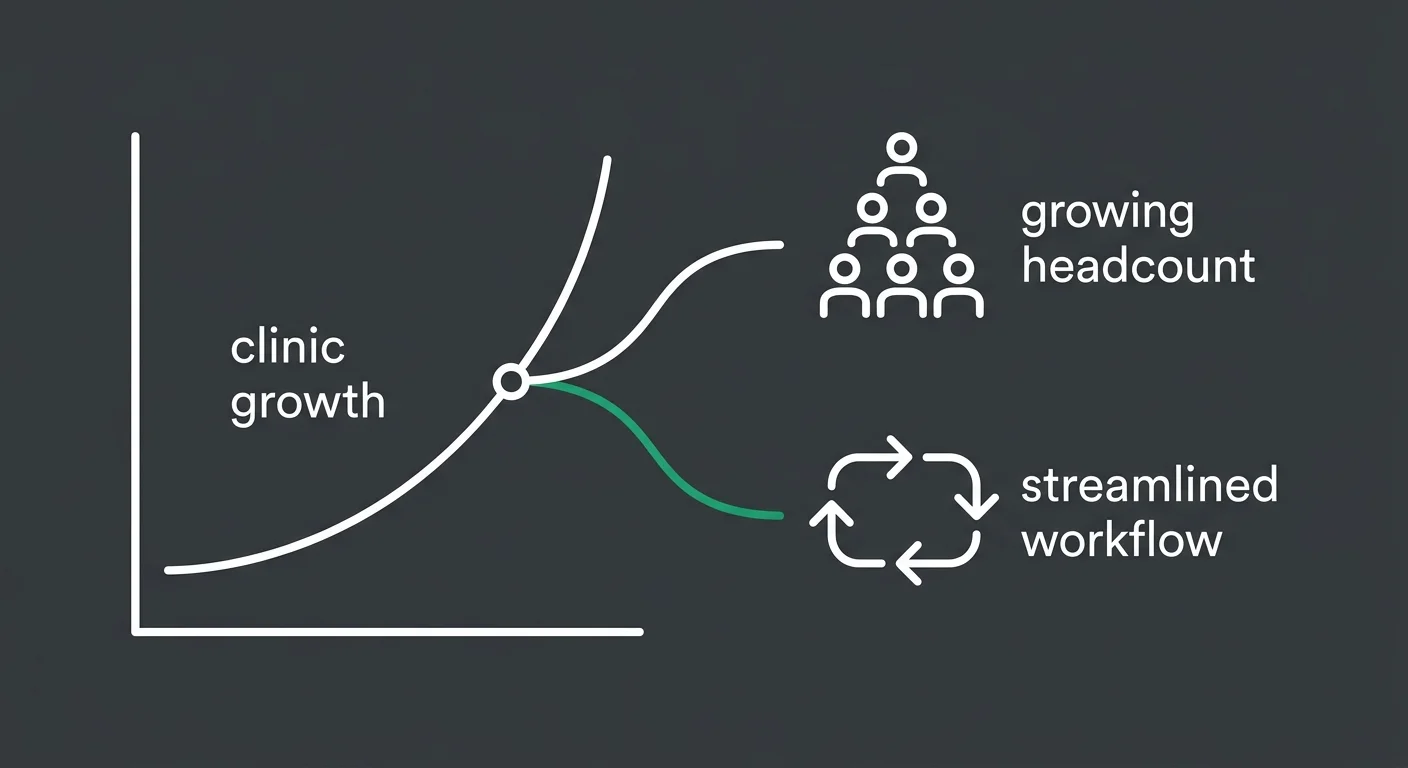
Most multi-location owners make the same move: add locations, add staff, solve the billing problem with headcount.
It feels like math.
It isn't. And every scale a multi-location chiropractic practice attempt built on that assumption hits the same ceiling — usually faster than the owner saw coming.
Administrative hiring is expensive, slow, and fragile.
Every biller you bring in needs training, supervision, and eventually a replacement. And in chiropractic billing — where specialty-specific rules determine whether claims get paid or quietly abandoned — generalist staff don't fill the gap. They delay the damage.
Healthcare administrative spending in the US has ballooned to approximately $265 billion in structural waste — driven by the exact billing complexity that generalist staff can't handle.
Adding bodies to that system doesn't fix the structural problem. It feeds it.
The Assumption That Breaks Multi-Location Growth
Here's what that belief actually produces: every new location triggers a new hire cycle. The billing problems that drove the hire never get fixed. They just get a new person sitting on top of them.
That's the capacity trap. Growth creates administrative need, administrative need creates administrative hires, and the underlying billing dysfunction runs untouched underneath all of it.
The loop doesn't break on its own. It gets more expensive.
The problem isn't headcount. It's infrastructure.
Chiropractic billing requires specialty-level knowledge that a front-desk hire or a generalist billing company won't consistently apply. When that knowledge is missing, the highest-value claims — AT modifier documentation, personal injury lien workflows, multi-step denial appeals — are the first to get dropped. Those are also the ones that matter most.
NIH research confirms that administrative revenue cycle tasks already consume over 33% of clinical staff time in a single-location practice. Scale that gap across multiple sites without changing the structure, and you're not distributing the burden. You're multiplying it.
The pattern repeats itself.
Owners hire to handle volume. Volume reveals complexity. Complexity defeats generalist staff. The practice hires again.
Every location. Every payer. Indefinitely.
The Hidden Cost of the Headcount Loop
There's a cost inside the headcount loop that payroll reports don't capture.
It shows up in aging AR. In denied claims that never got appealed. In revenue that sat long enough to age past the point of recovery — while everyone assumed someone else was working it.
Tracking the key revenue metrics for enterprise growth only reveals the damage after it's already compounded. By then, a meaningful portion of that AR is gone for good.
NIH-published research identifies administrative complexity — not clinical volume — as the primary driver of healthcare billing waste. That distinction matters.
The problem doesn't shrink when you hire more people. It shrinks when you replace a broken system with a better one.
More staff running a broken process is still a broken process. Just a more expensive one.
The practices Bushido Billing actually moves the needle for figured this out early: every hire added to patch a billing gap is a hire that doesn't fix the billing gap.
Salary. Turnover. Unrecovered revenue. That's the real price of treating RCM as a people problem.
Claim pipelines don't scale by adding bodies.
| Administrative Growth Trigger | Typical Owner Response | Why It Fails at Scale |
|---|---|---|
| New clinic location opens | Hire additional front-desk or billing staff at the new site | Each hire adds payroll cost and training overhead without fixing the specialty-coding gaps that drive denials and abandoned claims |
| Denial volume increases across locations | Assign existing staff to work denials on top of their current load | Generalist staff lack the chiropractic-specific knowledge to resolve complex denials; claims age out while the practice assumes they're being worked |
| Accounts receivable aging report grows | Hire a dedicated AR follow-up person | A single hire cannot reverse the structural pattern producing the AR problem; the backlog continues compounding at every location |
| Staff turnover disrupts billing continuity | Rehire and retrain replacement staff | Institutional billing knowledge leaves with each departing employee; retraining delays create revenue gaps that quietly widen before anyone notices |
| Payer contract complexity varies by location | Distribute payer management across site-level staff | Without centralized specialty expertise, payer-specific rules get applied inconsistently — producing different denial patterns at each location with no unified resolution strategy |
| Billing errors surface during payer audits | Task a practice manager with compliance review | Practice managers hired for operational oversight don't carry the coding specificity required for chiropractic claim defense; the audit risk persists unresolved |
Why Volume-First Billing Fails at Scale
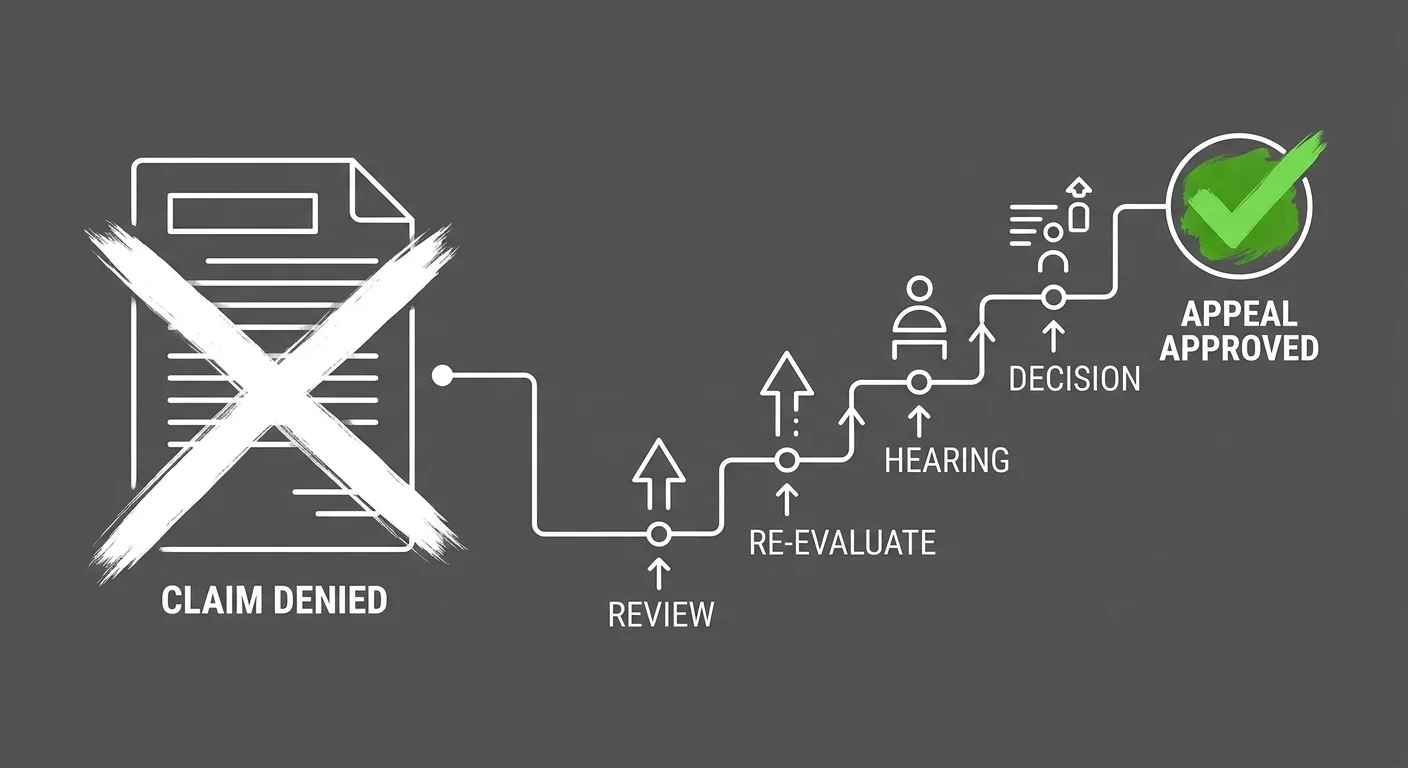
Volume-first billing optimizes for one thing: submission speed.
Not revenue recovery. Speed.
Those two metrics sound related. They aren't.
Here's what happens in a volume model: clean claims move fast, complex claims get shelved.
AT modifier documentation issues, PI lien workflows, multi-step denial appeals — those take real time to work. A throughput-first operation doesn't budget that time. So the claims that need it get pushed aside. Then they age. Then they die quietly in the AR while the practice assumes someone is handling them.
No one is.
The damage doesn't announce itself. It compounds.
By the time a multi-location owner sees it in the numbers, that revenue has already aged past the point of recovery. That's the structural failure of volume-first billing: it performs well on easy work and silently abandons the work that matters most.
Add more locations, and the gap doesn't stay the same size. It multiplies.
What EHR Platforms Actually Do — and Don't Do
EHR platforms are claim submission tools. That's their function.
And that's where their job ends.
The moment a claim comes back denied — a missing AT modifier, a documentation gap, a payer-specific coding conflict — the EHR logs it and stops.
It doesn't work the denial. Someone still has to pull the patient record, review the reason, build the appeal, and resubmit. In most practices, no one does that consistently. Practices that audit how to centralize billing workflows across locations find the same pattern every time: denied claims stacked up with no systematic follow-through.
The EHR made the stack visible. It didn't fix it.
Leaning on EHR platforms as billing solutions as a practice scales is the second default move — and it breaks in the same place as the first.
It handles volume on clean claims. It has no answer for complexity.
And in chiropractic billing, complexity is where the money lives.
Why Most Billing Companies Get This Wrong
Most billing companies fail chiropractic practices not because they're incompetent.
They fail because they're generalists operating in a specialty environment they don't fully understand.
Chiropractic billing carries rules that don't transfer from general medical billing.
Take the AT modifier requirement for Medicare reimbursement — the rule that separates covered active treatment from non-covered maintenance care. It's one of the most frequently misapplied rules in the specialty. A generalist biller may submit the claim. They won't necessarily recognize when the modifier is wrong, when the supporting documentation won't hold up on review, or what a payer will require on appeal.
That gap doesn't show up as an error code. It shows up as a denial that never gets worked.
The administrative burden is already punishing at one location. Chiropractic clinic staff spend over 33% of their active workday on documentation and RCM tasks — and that's before a second location opens, before payer contracts multiply, before denial patterns start diverging across sites.
A generalist billing company absorbs none of that complexity. It processes what it can process and moves on.
Everything else sits.
The result is a billing relationship that looks fine on the surface. Claims are going out. Some are getting paid.
But the highest-value work — high-friction claims, denied appeals, aging AR — quietly stalls. No one follows up. No one tells the practice what's happening. The owner assumes the system is working because no one has said otherwise.
That silence isn't professionalism. It's a structure that hides problems until they become cash flow crises.
| Billing Task | EHR Auto-Submission | Human RCM Specialist | What Happens When It's Missed |
|---|---|---|---|
| Clean claim submission | Automated — fast and consistent | Reviewed and submitted with payer-specific coding applied | Minimal — most clean claims pay regardless |
| AT modifier compliance | Submitted as coded — no documentation review | Documentation audited before submission to confirm active care support | Medicare denial with no appeal pathway — revenue lost silently |
| Denial identification and routing | Denial logged in system — no action triggered | Denial reviewed, categorized, and routed to appeal or correction | Claim ages in AR — no one works it, no one flags it |
| Multi-step denial appeals | Not supported — EHR has no appeal workflow | Appeal built from patient record, denial reason, and payer requirements | Claim abandoned — high-value revenue permanently unrecovered |
| Personal injury lien billing | Not supported — outside standard claim workflow | Managed through lien-specific documentation and follow-up protocols | Revenue deferred indefinitely or written off without specialist handling |
| AR aging follow-up | System flags unpaid claims — no outbound action | Proactive follow-up by payer, aging bucket, and denial pattern | AR compounds across locations — recoverable revenue ages past the point of return |
| Cross-location denial pattern tracking | Data exists in system — no analysis or escalation | Patterns identified across sites, payer behavior flagged, billing adjusted proactively | Same denial repeats at every location — systemic revenue leak with no correction |
Why Generalist Billers Cannot Handle Chiropractic Complexity
The automation failure and the generalist failure aren't two separate problems.
One offloads complexity to software that can't handle it. The other offloads it to staff who don't understand it. Different surface. Identical wreckage.
Chiropractic billing isn't general medical billing with a smaller patient population. It's a distinct specialty — its own coding logic, modifier rules, payer behaviors, and documentation standards that don't transfer from a generalist background.
Generalist billers can submit into that environment. What they can't do is work what comes back. And in chiropractic, what happens when claims come back is exactly where revenue lives or dies.
Specialized full-service insurance billing isn't an upgrade. It's the floor.
The gap between what a generalist processes and what chiropractic actually requires is where multi-location practices lose the most revenue — quietly, consistently, and with no one flagging it.
The Specialty Knowledge Gap
Here's where Medicare revenue disappears — and most practices never find out it happened.
The AT modifier separates covered active treatment from non-covered maintenance care. It's one of the most consequential rules in chiropractic billing. It's also one of the most frequently misapplied.
A generalist submits the claim. What they don't catch is when the AT modifier is missing, when the documentation won't survive payer review, or what a Medicare reviewer will require on appeal.
That gap doesn't show up as an error message. It shows up as a denial that never gets worked — and revenue that ages past the point of recovery while the practice assumes someone is handling it.
The same gap runs through personal injury lien workflows, payer-specific coding conflicts, and the documentation standards that separate active care from maintenance across different insurance contracts.
These aren't edge cases. They're the daily terrain.
And every time billing knowledge walks out with a departing staff member, the next hire starts from scratch — relearning the same specialty rules on live claims, at the practice's expense.
This Is Not the Right Fit for Every Practice
This model works for practices that show up as a working partner. EHR access, documentation turnaround, provider availability when a complex appeal needs clinical context.
That's not an administrative burden. That's the structure that makes specialty billing perform at the level multi-location practices actually need.
It doesn't work for practices that want billing managed at arm's length with no involvement on their end.
If the expectation is zero engagement — no documentation cooperation, no provider availability for clarifications, no visibility into claim status — the results will match that expectation exactly. Zero-engagement billing produces zero-engagement outcomes.
And there's a compliance layer here that passive hand-off ignores entirely. Every third-party administrative integration carries strict HIPAA technical and security requirements per FTC guidelines. That work requires active participation from the practice. There's no version of this where the practice disappears and everything still functions.
Practices that are primarily cash-pay — or that don't carry meaningful insurance billing volume — aren't the right fit.
The expertise runs deep in chiropractic and allied health insurance billing. That's where the performance-based model makes sense. If insurance billing isn't a real revenue channel for your practice, this isn't the right conversation.
| Billing Scenario | Generalist Biller Outcome | Chiropractic-Specialist Outcome | Revenue Impact |
|---|---|---|---|
| Medicare AT modifier — active care vs. maintenance | Claim submitted without verifying modifier accuracy or documentation sufficiency; denial logged, not worked | Modifier reviewed against clinical documentation before submission; appeal built with payer-specific requirements if denied | Unworked denials age past recovery window; specialty review keeps revenue in the collection cycle |
| Personal injury lien billing | Lien workflow unfamiliar; claim submitted through standard insurance pathway or skipped entirely | PI lien process managed through specialty-specific workflow with appropriate documentation and settlement tracking | Revenue lost to incorrect routing or abandonment; specialty handling preserves lien value through resolution |
| Multi-step denial appeal requiring clinical context | Denial closed or resubmitted without documentation correction; appeal abandoned when payer requires medical necessity argument | Appeal constructed with clinical record review and medical necessity framing specific to chiropractic payer standards | Abandoned appeals = permanent revenue loss; worked appeals convert denials into collected claims |
| Payer-specific coding conflicts across multiple locations | Uniform coding applied across all payers; payer-specific variation not identified until pattern of denials emerges | Payer behavior tracked per location and per contract; coding adjusted proactively before denial patterns compound | Generalist approach allows denial patterns to compound silently; specialist tracking intercepts revenue leakage early |
| Active care vs. maintenance documentation standards | Documentation reviewed for completeness only; distinction between active and maintenance care not applied at a specialty level | Documentation evaluated against both clinical and payer standards to ensure coverage criteria are met before submission | Insufficient documentation produces avoidable denials; specialty review prevents claims from failing on documentation grounds |
| AR follow-up on aging complex claims | Follow-up prioritized on clean, easy-to-collect claims; high-friction aging claims deprioritized or written off | Aging report worked by priority of recoverability; complex claims assigned active follow-up before they exit the recovery window | Volume-model triage silently writes off the practice's highest-value claims; specialty follow-up recovers revenue others abandon |
What an Embedded RCM Model Actually Looks Like
More software won't fix it. A bigger billing department won't either.
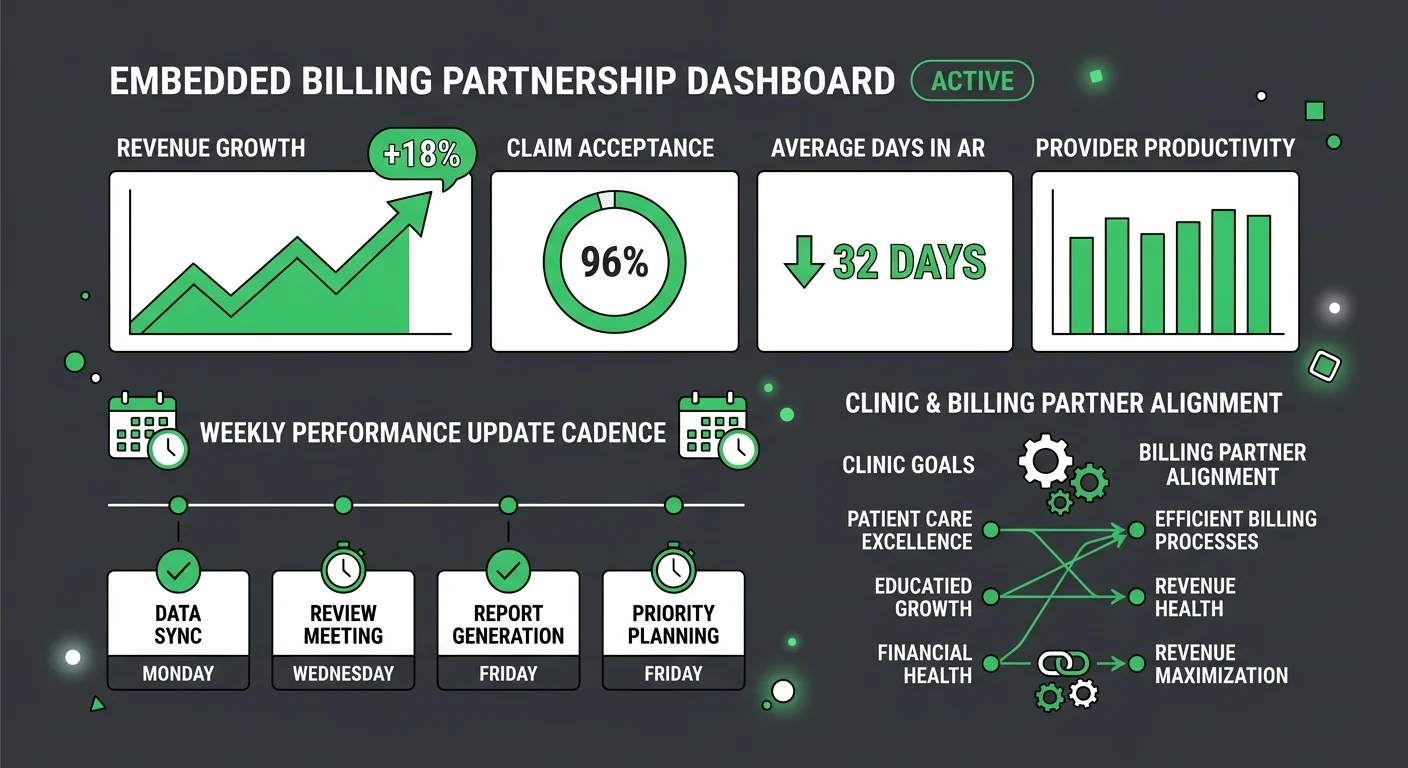
What fixes it is an embedded specialty billing partner — one biller assigned to the practice, dedicated communication built into the structure, and a performance model where the partner gets paid when the practice gets paid.
Not a vendor relationship. An operational layer.
That distinction gets sharper with every location added.
When the second clinic opens — then the third — the billing infrastructure either holds or it fractures. Practices that hold treated RCM as infrastructure before they needed it to be. Not after the AR report became a crisis.
Here's the question every multi-location practice eventually has to answer: centralize billing across all locations, or let each clinic run its own operation?
That's not a theoretical question — it's a structural one, and the centralized vs. decentralized billing decision gets answered differently depending on whether the billing model underneath can handle specialty complexity across multiple payer contracts at the same time.
Adding more staff to each site doesn't resolve it. The infrastructure does — or it doesn't.
Structure, Communication, and Performance Alignment
So what does it actually look like in practice?
One biller dedicated to the practice. Not a queue. Not whoever picks it up that day. One person who knows the payer contracts, knows the documentation patterns, and owns the account.
Weekly updates on billing performance — what's moving, what's stalled, what's driving the denials. Not a monthly summary that arrives after the damage is already compounded.
And a performance structure where the partner gets paid when the practice gets paid. That last piece isn't a marketing line. It's the mechanism that changes what actually gets worked.
That alignment piece is what most billing relationships don't have — and it's exactly why they quietly fail on the claims that matter most.
When a billing company's revenue isn't tied to what the practice collects, there's no structural reason to chase complex denials. No reason to push multi-step appeals that require pulling clinical documentation. No reason to work aging AR that's harder to recover than it is to ignore.
The volume model doesn't budget time for that work. The performance-based model can't afford to skip it.
Same claim. Different incentives. Different outcome.
Silence from a billing partner isn't professionalism. It's a structure that hides problems until they become cash flow crises.
And complex claims — the denials that require medical necessity arguments, the appeals that need clinical context, the PI liens that take months to resolve — are exactly where multi-location practices lose the most revenue. Quietly. Over time. While the practice assumes everything is fine because no one has said otherwise.
Weekly visibility isn't a reporting feature. It's how the practice finds out whether the model is actually functioning — before the AR report tells the story instead.
HIPAA Compliance as a Non-Negotiable Operating Layer
HIPAA compliance isn't something you check off at contract signing and hand off to the billing company.
Every third-party administrative integration requires active, ongoing technical and security safeguards. The practice has to stay engaged — not passive, not assuming it's handled because billing is outsourced.
The data still moves. The responsibility moves with it.
That means secure EHR access protocols, documented data handling procedures, and clear boundaries around how patient information moves between the practice and the billing operation.
Per FTC health privacy guidelines, the regulatory penalties for failing those requirements fall on the covered entity. That's the practice — not just the billing vendor.
Outsourcing billing doesn't outsource the liability.
Specialized chiropractic billing workflows compress the claim lifecycle and improve collection yields. But that only holds when the practice side of the relationship shows up.
Documentation turnaround. Provider availability when a complex appeal needs clinical context. Consistent EHR access that doesn't require three days of back-and-forth to obtain.
Those aren't asks. They're the operating conditions the model runs on. A billing partner with the right expertise and the right incentives still can't produce results when the practice treats the relationship as a drop box.
| RCM Model Feature | In-House Generalist Hire | Volume-First Billing Company | Embedded Specialist Partner |
|---|---|---|---|
| Biller Assignment | Rotating staff — whoever is available processes the claim queue | Shared team model — no single biller owns the practice relationship | Dedicated biller assigned to the practice — consistent, accountable, knows the payer mix |
| Communication Cadence | Reactive — practice calls when something goes wrong | Monthly summary reports, if anything | Weekly updates on what's moving, what's stalled, and why — before problems compound |
| Specialty Knowledge | General coding familiarity — not built for chiropractic-specific modifier rules or PI lien workflows | Broad claims processing capability — chiropractic is one specialty among many | Built specifically for chiropractic and allied health — AT modifier rules, PI lien workflows, and payer-specific documentation standards are the daily operating environment |
| Complex Claim Handling | Denials worked only if staff bandwidth allows — high-friction claims frequently age out | Volume model deprioritizes complex appeals — they cost more to work than the throughput model budgets for | High-friction, high-value claims are the priority — denial management and multi-step appeals are core to the model, not exceptions |
| Performance Alignment | Fixed payroll cost regardless of collections outcome | Fee structure tied to submissions, not recoveries | Performance-based — the partner gets paid when the practice gets paid; incentive is built into the structure |
| AR Visibility | AR aging depends on whoever is watching it — often no one is | Reporting provided on a schedule; proactive follow-up varies by volume and workload | AR status is tracked and communicated proactively — practices know what's aging and why before it's unrecoverable |
| Scalability Across Locations | Every new location requires additional headcount — overhead scales linearly with growth | Claims volume can grow, but specialty complexity across multiple payer contracts often degrades quality | RCM infrastructure scales with the practice — additional locations add claim pipelines, not administrative headcount |
| HIPAA Compliance Integration | Compliance depends on internal staff training and documentation habits | Third-party compliance protocols vary — practice retains regulatory exposure regardless | Rigorous technical and security safeguards maintained as an ongoing operating standard — practice engagement is required, not optional |
How an Embedded RCM Model Replaces the Headcount Loop
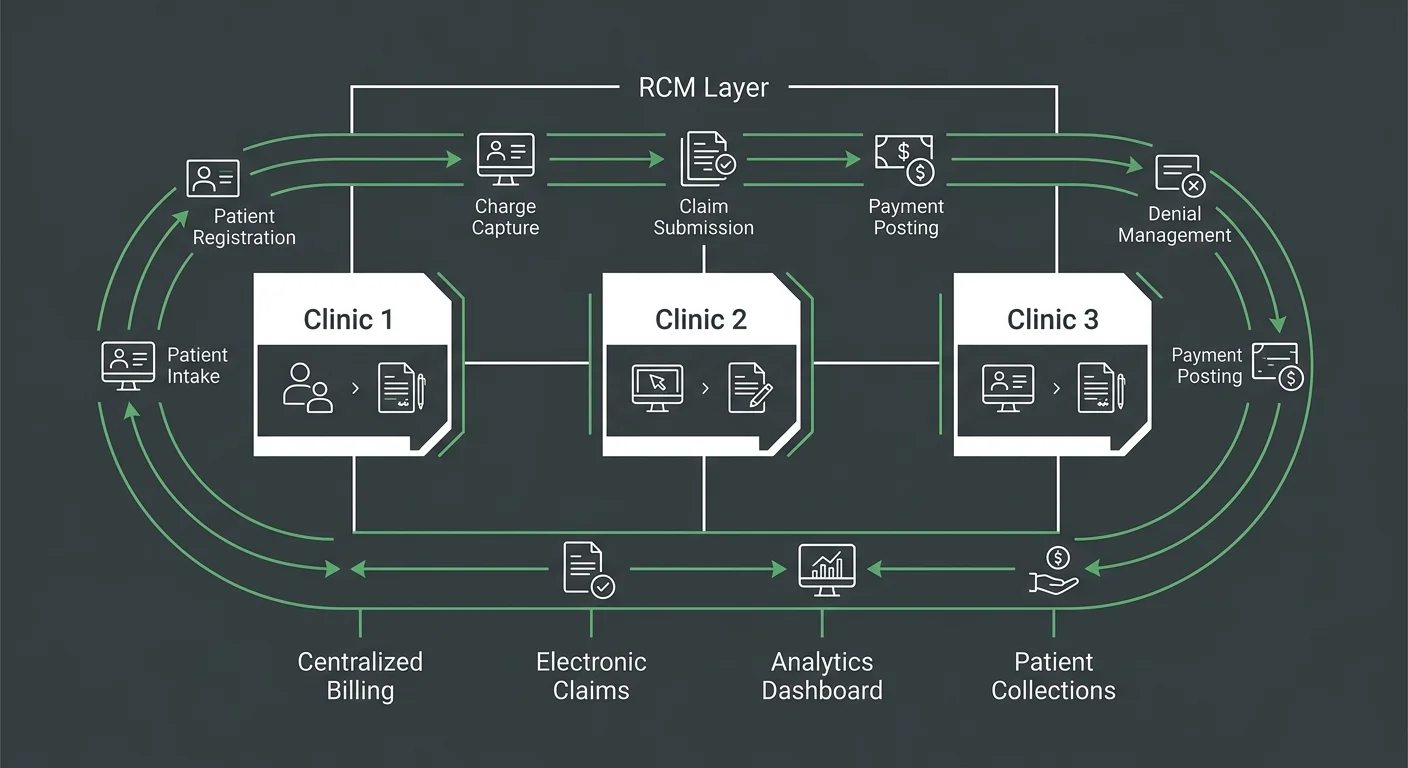
The loop is predictable.
A second location opens. Claims volume climbs. The practice hires another biller. A third location opens, payer contracts multiply, and now billing is running three parallel operations held together by whoever hasn't quit yet.
That's not a staffing problem. That's a structural failure.
Breaking that loop isn't about optimizing headcount. It's a different architecture entirely.
An embedded RCM model doesn't add bodies as locations scale. It adds depth. One dedicated biller assigned to the full practice — not a rotating queue. Structured weekly communication built into the model, not requested after something goes wrong. And a performance-aligned structure where the billing partner gets paid when the practice does.
That last part isn't a marketing line. It's the mechanism that changes what actually gets worked.
And that structure doesn't buckle at location three.
The claim pipeline stays with the same biller. Specialty knowledge doesn't walk out when someone resigns. The practice isn't rebuilding its billing relationship from scratch every six months because a key person left.
That's not a minor operational detail. That's the whole game.
What Changes Operationally Across Multiple Locations
Here's the operational risk that catches multi-location owners off guard.
At a single clinic, billing breakdowns are visible. Cash flow stalls and the owner notices. At two or three locations, the same breakdown runs silently — undetected across multiple sites — before anyone sees it in the numbers. Billers added through the headcount model are processing claims. They're not watching patterns.
That's the gap. And it widens with every location added.
An embedded model shifts that dynamic entirely.
When one dedicated biller is assigned across the practice's full footprint, denial patterns get tracked across locations — not just resolved individually at each site. A payer-specific coding conflict that surfaces at one clinic becomes a signal before it replicates across the rest. It gets caught — not stumbled into three times.
And centralize billing workflows across locations stops being a deferred goal. It becomes an operating reality.
Patient-facing revenue works the same way.
Practices that build consistent patient invoicing and collection workflows into the model from the start stop treating that revenue stream like something they'll get to eventually. It gets structured. Standardized. Handled — not delegated to whoever has five minutes.
Chiropractic clinic staff already spend over 33% of their active workday on documentation and administrative tasks, according to PubMed research on clinical workflow. Every manual invoicing process that gets systematized is time recovered for clinical work. Not absorbed into the headcount loop.
Key Performance Indicators That Signal the Model Is Working
Here's what healthy billing infrastructure looks like from the outside: boring.
Days in AR hold steady. First-pass acceptance rates don't erode as claim volume climbs. Denial rates stay flat — or decline — rather than compounding with every new location.
Practices that scaled without collapse measured those numbers before they needed them to explain a crisis. Stability in those indicators isn't luck. It's what a functioning model produces.
But when those numbers start moving — AR aging past 60 days across sites, denial volume spiking without a clear payer trigger, collections per visit quietly declining — the embedded model surfaces those signals early.
Not in a monthly report that arrives after the damage compounds. In real time, while there's still something to do about it.
Tracking key performance indicators for scaling isn't a reporting exercise. It's how an enterprise-stage practice knows whether its billing infrastructure is holding — before the AR report becomes the crisis.
McKinsey puts the systemic cost of billing and insurance complexity at approximately $265 billion in administrative waste across US healthcare.
Practices that scaled without the hire-overwhelm-turnover cycle didn't absorb that complexity. They embedded a model built to handle it — so it stopped landing on their staff.
Claim pipelines don't scale by adding bodies. The practices that figured that out early are still growing. The ones that didn't are still hiring.
| Phase | Operational Milestone | Who Owns It | What It Replaces |
|---|---|---|---|
| Foundation | Dedicated biller assigned to the full practice footprint — not a rotating queue | Embedded RCM partner | Anonymous claims processors cycling through shared work pools |
| Communication Structure | Weekly updates on claim status, denial patterns, and AR movement across all locations | Embedded RCM partner | Monthly reports that arrive after cash flow damage is already done |
| Performance Alignment | Partner revenue tied directly to practice collections — creating structural incentive to work complex claims | Embedded RCM partner | Flat-fee or volume-based billing relationships with no incentive to chase high-friction denials |
| Specialty Knowledge | Chiropractic-specific coding expertise — AT modifier compliance, PI lien workflows, maintenance vs. active care documentation — retained and applied across every site | Embedded RCM partner | Generalist billing staff whose knowledge walks out the door with every resignation |
| Scale Response | Depth added as locations grow — same model, same dedicated relationship, broader coverage | Embedded RCM partner | Headcount added as claim volume climbs — each hire restarts the learning curve |
| Pattern Recognition | Denial trends tracked across the full practice footprint — payer-specific coding conflicts surface as signals before they replicate | Embedded RCM partner | Site-by-site claim processing with no mechanism to detect cross-location patterns |
| Compliance Continuity | HIPAA-compliant data handling maintained as an ongoing operating standard, not a one-time setup | Practice and embedded RCM partner jointly | Billing vendors treated as a compliance transfer — risk stays with the practice regardless |
| AR Visibility | Real-time AR status across all locations — aging tracked proactively before claims compound past recovery | Embedded RCM partner | AR reports reviewed only after stalled claims surface as cash flow shortfalls |
Frequently Asked Questions
The model sounds clean on paper. But what owners actually want to know is whether it holds up when the last billing relationship promised results and delivered silence.
So here's what comes up most. Burnout. EHR limits. HIPAA across multiple locations. Why the generalist hire keeps breaking at scale. The answers aren't softened — they're what the operational reality actually looks like.
How does centralizing RCM prevent clinic staff from burning out as we scale locations?
Burnout at multi-location practices isn't a morale problem. It's structural.
Chiropractic clinic staff already spend over 33% of their active workday on documentation and administrative revenue cycle tasks — at a single location. That number doesn't shrink when a second clinic opens. It compounds.
When billing moves to a dedicated partner, the administrative load stops landing on clinical staff. Claim submissions, denial follow-ups, and documentation chases belong to a billing operation built to handle them — not to whoever's available between patients.
That's what actually prevents burnout. Not a wellness initiative. A structure that stops asking clinical teams to do two jobs at once.
What are the common points of failure when relying purely on EHR automation for multi-clinic billing?
EHR platforms submit claims well. The failure happens at the next step — when a claim comes back rejected and the software has no pathway to respond.
Denial management, AT modifier corrections, and multi-step appeals require human judgment. No EHR automates that. Specialized billing workflows compress the claim lifecycle and improve collection yields, but only when a person is actively working the complex claims that automation can't touch.
At three or more locations, the volume of those complex claims scales with the footprint. The EHR handles the clean ones. Everything else — the high-value, high-friction work — sits. It ages. Eventually it's unrecoverable.
That's not a platform limitation a software upgrade fixes. It's a structural gap that only human expertise closes.
How much administrative overhead can a multi-location chiropractic practice expect to reduce by transitioning to an embedded RCM model?
There's no honest universal number here. Anyone offering one is describing a projection — not your practice.
What the research consistently shows is the direction. Specialized billing workflows compress the claim lifecycle and improve collection yields. How much depends on how inefficiently that work was being handled before — by generalist staff, undertrained billers, or by no one at all on the complex claims.
But the more useful question isn't what the model saves. It's what the current model is actually costing.
Unworked denials, aging AR, and staff hours absorbed by billing triage are real costs. They're just harder to spot on a line item than a salary.
What integration challenges occur when transitioning to an embedded RCM partner across three or more clinics?
The biggest integration challenge isn't technical. It's operational.
Practices that expect a billing partner to plug in and run without engagement consistently underperform the ones that treat the transition as a working relationship from day one.
On the technical side, HIPAA compliance requires rigorous security safeguards for every third-party administrative integration. Documented data handling procedures, secure EHR access protocols, defined boundaries around how patient information moves between systems — those requirements don't disappear across three locations. They multiply.
On the operational side, the transition requires consistent documentation turnaround, provider availability for appeal clarifications, and EHR access that doesn't get blocked or delayed. Practices that don't hold up their end of that agreement don't get the results the model is built to deliver. That's not a warning — it's just how embedded billing actually works.
Why shouldn't a scaling multi-location chiropractic practice hire a generalist biller to manage growth?
A generalist biller can process a claim. That's not the same as understanding chiropractic billing.
The AT modifier — required for Medicare reimbursement to distinguish covered active chiropractic care from non-covered maintenance — isn't a general billing concept. It's a chiropractic-specific rule that demands documentation precision. Personal injury lien workflows, maintenance versus active care distinctions, and payer-specific modifier requirements don't transfer from general medical billing experience.
At one location, those gaps are manageable. At three or more, they replicate across every claim pipeline simultaneously. Denials accumulate. AR ages. And when the generalist leaves — which they do — the institutional knowledge about how the practice's specific payer mix behaves walks out with them.
That cycle doesn't resolve by hiring a better generalist. It resolves by removing the structural dependency on individual knowledge entirely.
What does HIPAA compliance look like when a third-party RCM partner has access to patient billing data across multiple clinic locations?
HIPAA compliance isn't a one-time setup. It's an ongoing operating requirement — and the regulatory penalties for failing those requirements fall on the practice, not just the billing vendor.
For a third-party RCM partner with access to patient billing data across multiple clinic locations, that means maintaining rigorous technical and security safeguards at every point of data contact. Secure EHR access, documented data handling procedures, defined protocols for how patient information moves between systems — these are federal requirements, not administrative formalities.
Per FTC health privacy guidelines, the compliance obligation doesn't transfer when billing does. The practice remains the covered entity.
That means the practice's role is active, not passive. Controlling access, maintaining documentation, and knowing that a billing partner treating HIPAA as a checkbox is a liability — not a service provider. The right partner maintains those safeguards as an ongoing operating standard. That's the baseline.
The Real Cost of Scaling the Wrong Way
The cost of scaling the wrong way doesn't announce itself. It accumulates.
A second location opens. Claims volume climbs. The practice hires another biller. The numbers look manageable — until a third location opens, payer contracts multiply, and the billing operation fractures quietly. Not in one moment. Across dozens of unworked denials and aging claims that nobody had time to chase.
The headcount model doesn't fail because the people in it aren't capable. It fails because the structure was never built for specialty complexity at scale.
AT modifier rules, personal injury lien workflows, maintenance versus active care documentation — these don't get easier to manage as locations multiply. They get harder. And every time a biller leaves, that institutional knowledge walks out with them.
The next hire starts over. On live claims. At the practice's expense.
The practices that scaled without collapsing made a structural call before the pressure hit. They didn't wait for the AR report to become unmanageable. They treated RCM as infrastructure — embedded a billing model built for chiropractic-specific complexity before the third location proved the old one couldn't hold.
That's the real distinction. Not between big practices and small ones. Between owners who recognized the structural problem early and those who kept reaching for the same broken fix.
Bushido Billing exists for the practices ready to make that decision before the next location opens.
The path forward isn't complicated. One dedicated biller covering the practice's full footprint. Weekly visibility into what's moving and what's sitting. A performance-aligned model where the billing partner earns more when the practice collects more.
That structure doesn't just survive multi-location scale. It's designed for it.
Claim pipelines don't scale by adding bodies. The practices still running on that assumption are already paying the price.
Billing doesn't scale by adding bodies. It scales by replacing a broken model with one that actually works — before the next location makes the choice for you. If that decision is already overdue, Book a Call.

© 2026 Bushido Billing. All Rights Reserved | Web Design by iTech Valet