

What Are the Key Performance Indicators (KPIs) for Scaling a Chiropractic Enterprise?
KPIs for scaling a chiropractic enterprise fall into three tiers: Revenue Metrics, Operational Metrics, and Compliance Metrics. Each tier measures a different dimension of billing health — and a weakness in any one of them compounds as a practice adds locations.
Revenue Metrics measure what actually gets collected. Net collection rate, Days Sales Outstanding (DSO), and accounts receivable aging by payer are the core figures. A DSO above 40 days signals a cash flow problem. A clean claim rate below 90% erodes profit margins faster than any single denial category.
Operational Metrics track where the revenue cycle breaks down. Denial rate by payer, denial rate by claim type, and resubmission turnaround time reveal the patterns. High denial rates on Medicare claims trace directly to documentation failures — federal oversight audits have found that chiropractic Medicare claims frequently lack the basic medical necessity documentation required for reimbursement.
Compliance Metrics govern regulatory exposure. Medicare covers only manual manipulation of the spine to correct subluxation under Section 1861(r)(5). Modalities like traction or ultrasound fall outside that coverage boundary. The AT modifier — required on CPT codes 98940, 98941, and 98942 to designate active treatment — must be applied correctly on every eligible claim. Improper AT modifier usage triggers automated denials.
Tracking all three tiers is the baseline. But a dashboard of clean metrics means nothing if the highest-value claims are aging out unworked. Administrative billing friction is one of the largest addressable cost drivers in outpatient healthcare — McKinsey estimates that administrative simplification could recover up to $265 billion in annual healthcare spending. For a scaling chiropractic enterprise, the gap between monitoring KPIs and acting on them is the gap between controlled growth and compounding revenue loss. Practices that close that gap do it with billing infrastructure that interprets the data, identifies the patterns, and works the complex denials by hand.
Last Updated: July 20, 2026
- • Why Most Chiropractic Growth Stalls at the Billing Layer
- • The Revenue KPIs Every Scaling Chiropractic Enterprise Must Track
- • Operational KPIs: The Administrative Load That Quietly Limits Scale
- • Medicare and Specialty Billing Compliance KPIs
-
• Frequently Asked Questions
- • How do multi-location chiropractic groups monitor billing leakage without disrupting clinical workflows?
- • How long does it take to transition a scaling practice to a dedicated, embedded billing model?
- • Why do traditional volume-first billing companies fail to capture complex personal injury and Medicare AT claims?
- • Is paying a performance-based percentage rate more expensive than hiring an in-house medical biller?
- • Do we need to switch EHR platforms to achieve transparent revenue cycle metrics across all locations?
- • Scaling Requires More Than a Dashboard
Why Most Chiropractic Growth Stalls at the Billing Layer
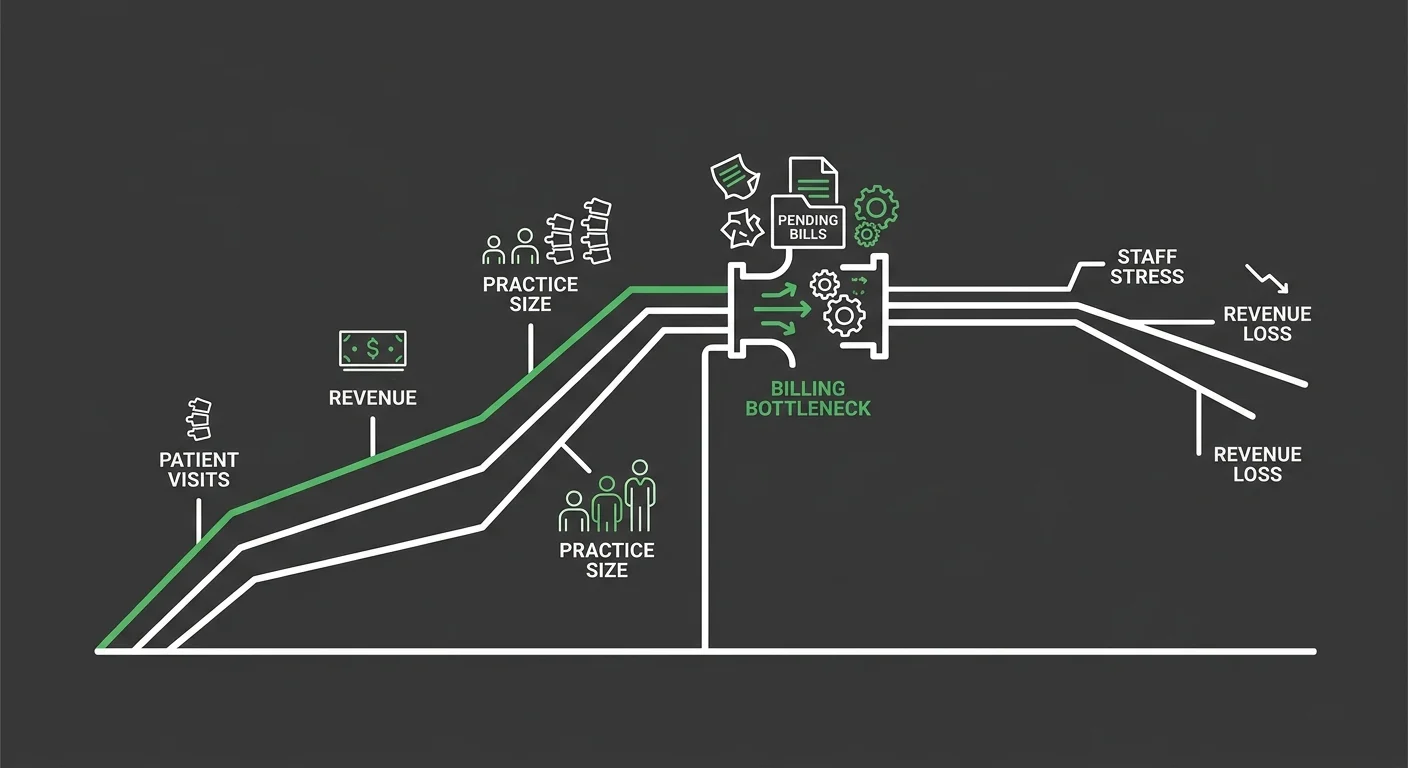
The ceiling isn't clinical. It's not provider capacity or patient volume or square footage.
It's the billing layer. And it compounds quietly while your attention is on growth.
Here's what it actually looks like: a group opens a second location, then a third. Visits climb. Revenue on paper tracks upward. And nobody notices that the billing operation underneath hasn't moved.
Documentation overhead grows with every provider added. The non-clinical team absorbs more friction with every new site. But the billing partner is still running the same volume-first process it used when the practice had one location.
The structure never changed. Only the exposure did.
McKinsey has documented administrative simplification as one of the largest addressable cost levers in healthcare. Billing and insurance-related expenses are the primary driver of outpatient practice overhead — and that overhead doesn't shrink when you add locations. It compounds.
The practices that scale across multiple locations without expanding administrative headcount treated billing as a structural constraint from the start. They fixed the foundation before it became a cash flow crisis.
Why Volume-First Billing Fails Scaling Enterprises
Volume-first billing is built for throughput. It measures success by how many claims go out the door.
Not by how much revenue comes back in. Those are not the same metric.
Clean claims move fine. Straightforward diagnosis, standard coding, no modifier complexity — the volume model processes those without friction.
But the moment a claim needs a medical necessity argument, a multi-step appeal, or a documentation correction, the model has no pathway. Working that claim costs more time than the throughput budget allows.
So it doesn't get worked.
Those claims sit. Then they age. Then they fall past the point of collectability.
The practice never sees that revenue. And in most cases, nobody tells them it's gone.
That's not a billing error. That's a structural feature of the volume-first model.
For a scaling chiropractic enterprise, the highest-value claims are the complex ones. Medicare AT modifier submissions. Personal injury liens. Multi-payer denials that need manual appeals. Those are exactly what a volume-first model deprioritizes — because working them costs more time than the throughput budget allows.
Those claims also determine whether your KPIs reflect real revenue recovery or just submission activity.
An embedded billing partner treats those claims as the priority. A volume-first biller treats them as a cost center it can't afford to work.
| Billing Model | How Performance Is Measured | What Gets Prioritized | What Gets Abandoned | Impact on Scaling Enterprise |
|---|---|---|---|---|
| Volume-First Billing | Claims submitted per day; submission speed | Clean, straightforward claims with standard coding | Complex denials requiring medical necessity arguments, multi-step appeals, or documentation corrections | KPIs reflect submission activity, not revenue recovery; high-value claims age out silently |
| Automation-Forward Billing | Software throughput; automated acceptance rates | Claims that clear automated scrubbing rules without human review | AT modifier submissions, personal injury liens, and payer-specific appeal pathways that require human judgment | Compliance Metrics degrade over time; Medicare and specialty claims accumulate denials with no resolution pathway |
| Generalist Billing | Overall claim volume across all specialties served | High-frequency, low-complexity claim types common across all practice types | Chiropractic-specific rules — AT modifier application, PI lien workflows, maintenance vs. active care documentation distinctions | Specialty compliance gaps widen as the enterprise scales; denial patterns repeat without correction |
| Embedded Billing Partner (Performance-Based) | Net collection rate; Days Sales Outstanding; denial resolution rate by claim type | High-value, high-complexity claims — Medicare AT submissions, PI liens, multi-payer denials requiring manual appeals | Nothing that is collectible — every workable claim receives active follow-through | Revenue Metrics, Operational Metrics, and Compliance Metrics all reflect real recovery performance; scaling adds locations without compounding billing failure |
The Revenue KPIs Every Scaling Chiropractic Enterprise Must Track
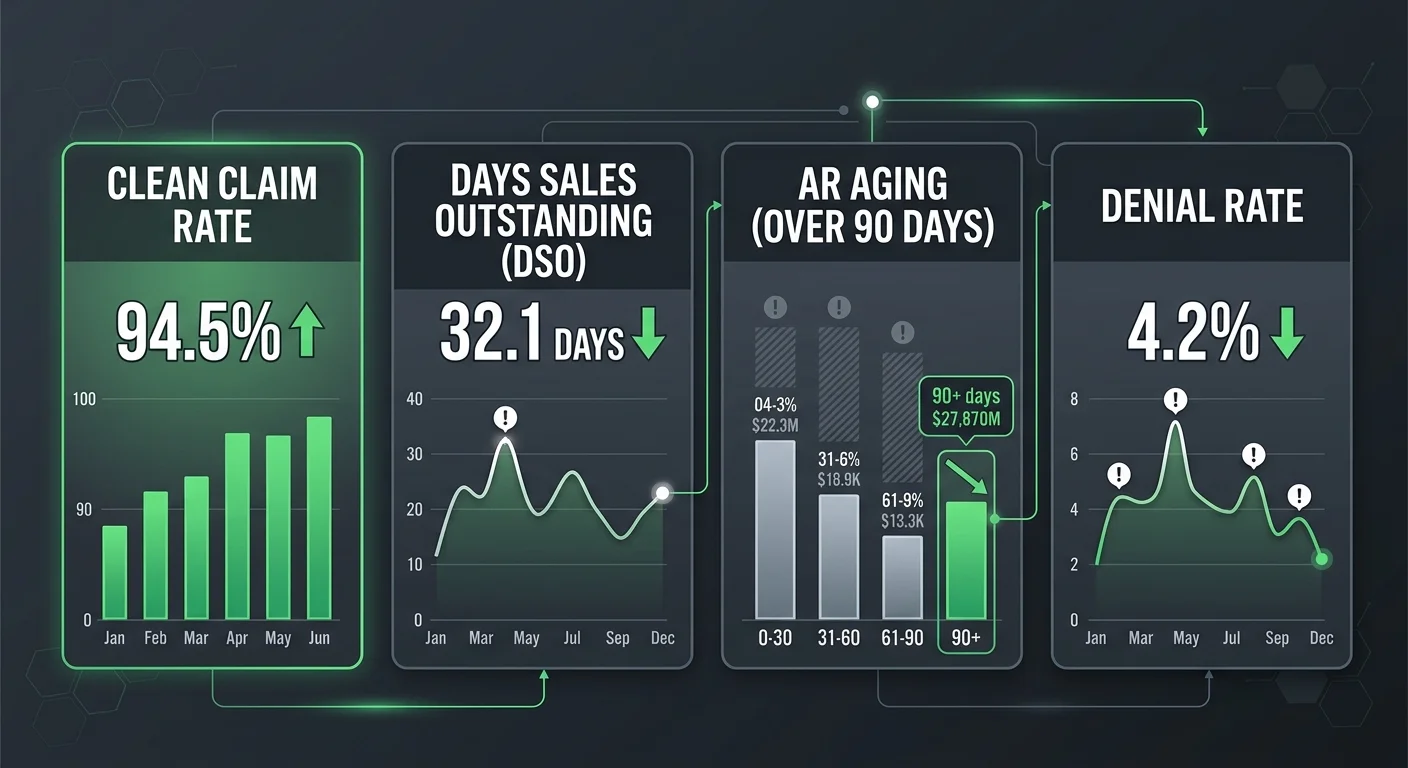
Green metrics on a dashboard mean nothing if your most valuable claims are quietly aging out.
Revenue Metrics are the tier that matters. They measure outcomes — not submission volume, not workflow activity. What percentage of billed charges actually came back as collected revenue? And how long did it take to get there?
For multi-location groups, these numbers don't just reveal billing performance. They reveal where the chiropractic revenue cycle management operation is silently losing ground. The three Revenue Metrics every scaling enterprise needs on its dashboard: clean claim rate, Days Sales Outstanding, and AR aging by payer.
Clean Claim Rate: The Baseline Everything Else Builds On
Clean claim rate is the foundation. Every other Revenue Metric is downstream of it.
A clean claim clears payer edits and adjudicates without manual intervention — no rejected coding, no missing modifier, no documentation deficiency. Clean claim rates below 90% significantly erode profit margins. For a multi-location group, a rate below that threshold isn't a billing nuisance. It's a compounding revenue problem that scales with every new site added.
Chiropractic billing has specific complexity drivers that pull clean claim rates down. AT modifier accuracy on Medicare submissions. Diagnosis code specificity. Maintenance versus active care documentation distinctions. A volume-first billing operation optimized for throughput doesn't have the bandwidth to catch those errors before submission. The clean claim rate reflects that gap directly.
Days Sales Outstanding: The Clock That Measures Cash Flow Velocity
Days Sales Outstanding measures how long it takes to turn a billed service into collected revenue. It's the clock that tells you whether cash flow is keeping pace with your growth — or falling behind it.
Standard collections models require DSO under 40 days to sustain multi-site operational growth. When DSO creeps above that threshold, money is sitting in the revenue cycle longer than it should — tied up in unpaid claims, pending appeals, unworked denials. At a single location, a DSO problem is annoying. Across a multi-location enterprise, it multiplies at every site simultaneously.
McKinsey has documented administrative simplification as one of the largest addressable cost levers in healthcare — up to $265 billion in recoverable spending. High DSO amplifies that overhead directly. The practice carries more administrative cost per dollar collected, at scale. Getting DSO under control requires a billing operation that works claims proactively. Not one that waits for payer remittances and reacts to whatever comes back.
AR Aging: The Map of Where Revenue Goes to Die
AR aging is where revenue goes to die. And it's where most billing operations stop looking.
AR aging reports break outstanding balances into time buckets: 0–30 days, 31–60 days, 61–90 days, 90-plus days. The older the bucket, the lower the probability of collection. Claims in the 90-plus day range require aggressive manual follow-up to recover — and a significant portion will not be recoverable at all. For a scaling enterprise, that aging AR isn't a historical artifact. It's a live measure of how much revenue is currently slipping toward zero.
The payer breakdown inside AR aging is where the real intelligence lives. When a specific payer's balance is consistently aging into the 60-plus day range, that signals a systemic issue — a documentation pattern, a modifier error, a credentialing gap — that won't resolve on its own. A billing operation that monitors AR aging by payer catches those patterns before they compound. One that doesn't surfaces the problem only when the revenue is already gone.
Denial Rate and Denial Patterns: The KPI Most Billers Never Surface
Most billing operations report denial rate as one aggregate number. That number tells you almost nothing.
Denial patterns tell you everything. Denial rate broken down by payer, by claim type, by denial reason code — that's the signal. An aggregate denial rate of 8% looks acceptable on a dashboard. But if 40% of those denials are concentrated on Medicare AT modifier submissions, that's not an 8% problem. That's a systemic documentation failure on one of the highest-value claim categories in the practice.
This is the KPI most billing operations never surface for the practices they serve. Surfacing it means tracking denials at the code and modifier level — not just counting how many came back rejected. It requires someone who understands that chiropractic Medicare denials follow specific, predictable patterns tied to documentation standards and modifier compliance. That understanding doesn't come from a generalist team running volume-first throughput. It comes from a biller who knows what to look for before the pattern compounds.
For a scaling chiropractic enterprise, denial patterns are the early warning system. They show where the revenue cycle is structurally failing — and they show it before AR ages past the point of return. A billing partner who reads those patterns and acts on them manually is the difference between a dashboard that drives decisions and one that just documents losses. That's not a dashboard feature. That's a people problem.
| KPI Tier 1 Revenue Metric | What It Measures | Healthy Benchmark | Warning Threshold | What Deterioration Signals |
|---|---|---|---|---|
| Clean Claim Rate | Percentage of submitted claims that adjudicate on first pass without manual intervention | 90% or above | Below 90% | Compounding revenue erosion across every site — modifier errors, documentation gaps, and coding deficiencies are entering the cycle uncorrected |
| Days Sales Outstanding (DSO) | Average number of days between a billed service and collected revenue | Under 40 days | Above 40 days | Cash flow is not keeping pace with operational growth — claims are sitting in unpaid, appealed, or unworked status longer than multi-site expansion can absorb |
| AR Aging by Payer | Outstanding balances segmented by time bucket (0–30, 31–60, 61–90, 90-plus days) and broken down by payer | Majority of balance in 0–30 day bucket; minimal 90-plus day exposure | Growing balances in 61-plus day buckets, especially concentrated in a single payer | Systemic payer-level issue — documentation pattern, modifier error, or credentialing gap — that is compounding without intervention |
| Billing and Insurance-Related Overhead | Administrative cost burden attributable to billing friction, rework, and insurance-related processing across all locations | Minimized through streamlined, specialty-specific billing processes | Rising overhead as a percentage of collections at scale | Billing friction is expanding with practice growth — administrative simplification opportunities are going unaddressed and overhead is consuming margin that should compound with scale |
Operational KPIs: The Administrative Load That Quietly Limits Scale
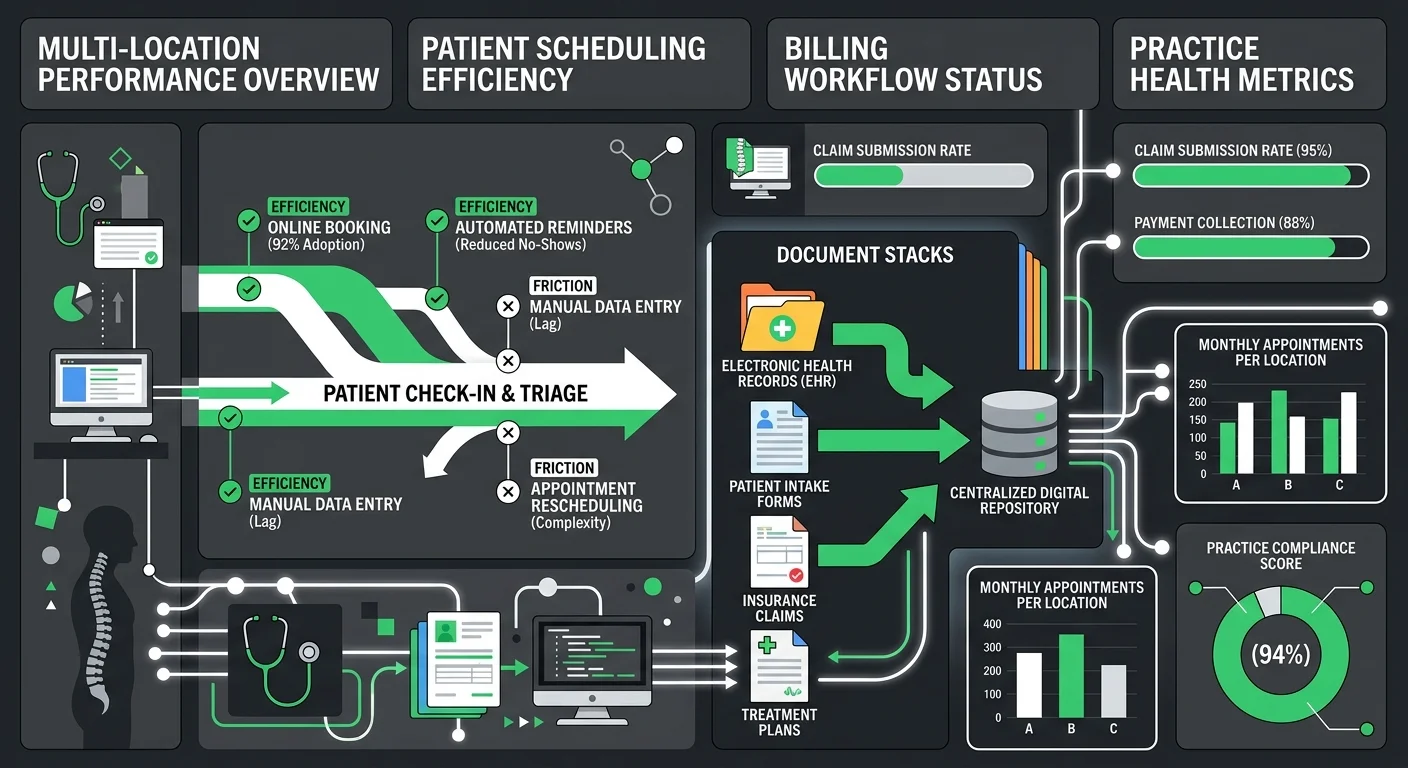
Revenue Metrics tell you the score. Operational Metrics tell you why the score wasn't higher.
The administrative layer is where a scaling chiropractic enterprise breaks first.
Every new location adds documentation volume. Every additional provider adds non-clinical overhead. Every claim that requires manual handling — a prior auth, a documentation correction, a payer follow-up — pulls a staff member away from everything else.
That friction doesn't announce itself. It accumulates.
Billing and insurance-related expenses are a primary driver of outpatient practice overhead — McKinsey has documented administrative simplification as one of the largest addressable cost levers in healthcare, quantifying the opportunity at up to $265 billion.
That overhead doesn't stay flat as a group expands. It scales with the practice. If the billing operation isn't built to absorb that load, the administrative cost per collected dollar rises across every site at once.
Operational KPIs exist to surface that friction before it becomes a cash flow crisis.
Documentation Burden and Compliance Exposure
Documentation burden is the operational metric most scaling practices never track. And it's almost never in the billing report.
Here's what makes documentation volume dangerous at scale: it's not just an efficiency problem. It's a compliance problem.
Medicare AT modifier submissions have to show visit-level separation between active treatment and maintenance care — on CPT 98940, CPT 98941, and CPT 98942. PI lien cases need chronological records that hold up through months of negotiation. These aren't filing formalities. They're what separates a paid claim from an abandoned one.
When documentation volume outpaces the practice's capacity to manage it, the complex claims fail first. Practices serious about revenue transparency in maintaining multi-site clinic profitability already know this: you can't identify where documentation failures are costing you money if you can't see inside your own billing cycle.
The practices that scale without breaking their clinical operation have made one key decision: documentation compliance is a billing infrastructure problem, not a provider behavior problem.
That reframe changes everything. It means the billing operation owns the tracking. It means failures get caught before they become denials. It means the KPI exists and someone is watching it.
Ignore it and it compounds. Track it and it becomes manageable. That distinction is where profitable growth separates from expensive growth.
Who This KPI Framework Is — and Isn't — For
This KPI framework is built for a specific kind of practice.
Groups that are growing — or planning to — across multiple locations. Groups that understand billing performance directly determines whether that growth is profitable.
But it's not for practices that want a billing arrangement that runs without their involvement.
Effective KPI monitoring requires the billing operation and the practice to function as an embedded unit — EHR access, documentation cooperation, provider availability for claim clarifications. A practice that disengages from its billing partner produces disengaged results.
The KPIs will show it.
And it's not for practices that pick a billing partner based on rate alone.
McKinsey put a number on it: up to $265 billion in addressable waste sitting inside healthcare's administrative layer. The practices that recover the most from that pile didn't win on rate. They won on capability — specialty-specific expertise, denial management discipline, proactive communication.
Rate determines cost. Capability determines what gets collected.
Those are not the same conversation.
| KPI Tier 2 Operational Metric | What It Measures | Scaling Risk When Ignored | Owner (Biller vs. Provider) | Frequency of Review |
|---|---|---|---|---|
| Prior Authorization Rate | Percentage of claims requiring pre-approval before service delivery | Untracked authorization gaps stall high-value claims and delay collections across every location simultaneously | Shared — biller initiates, provider supplies clinical documentation | Weekly |
| Documentation Deficiency Rate | Frequency of claims returned or denied due to incomplete or non-compliant visit records | Unresolved deficiencies on Medicare AT modifier and PI lien submissions allow the highest-value claim categories to age toward zero | Provider — identified and flagged by biller | Weekly |
| Payer Follow-Up Rate | Volume of claims requiring manual outreach to resolve after initial submission | High follow-up volume signals a systemic documentation or coding failure that compounds with every new provider and location added | Biller | Weekly |
| Resubmission Rate | Percentage of claims requiring correction and resubmission after initial denial or rejection | Elevated resubmission rates erode staff capacity and extend DSO — a single-location inefficiency that multiplies across a multi-site group | Biller | Monthly |
| Administrative Cost Per Collected Dollar | Total billing and insurance-related overhead relative to actual revenue recovered | Rising cost-per-dollar collected is the earliest indicator that the billing infrastructure is not scaling with the practice — and that revenue growth is being offset by operational drag | Biller — reviewed with practice leadership | Monthly |
Medicare and Specialty Billing Compliance KPIs
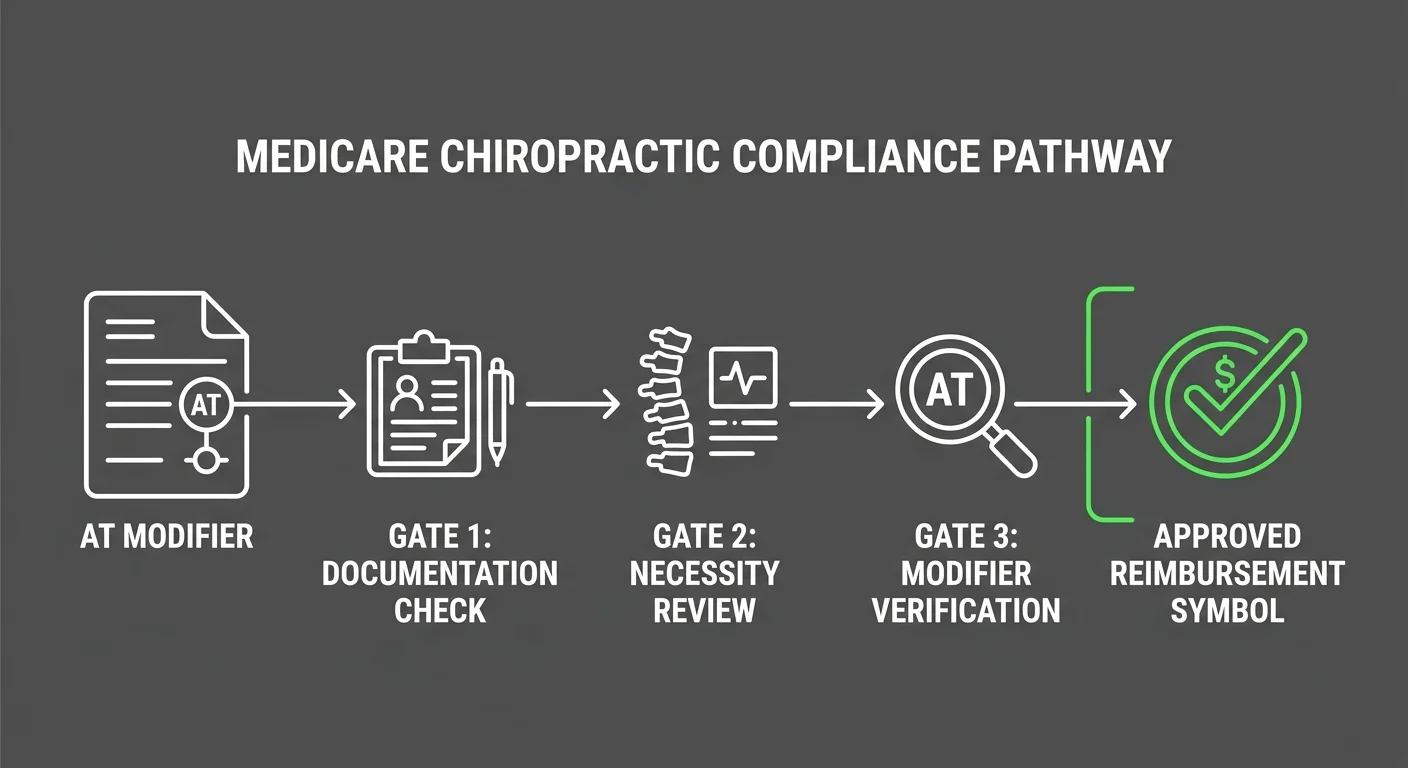
Good revenue metrics won't save you from a Medicare compliance problem. They won't even warn you one is coming.
Medicare is the most complex payer a chiropractic enterprise touches. And it runs on a documentation and modifier standard that most billing operations aren't built to track consistently — across one location, let alone five.
Compliance metrics are the third tier of this KPI framework. They're also the easiest to skip — until you can't.
Medicare's chiropractic coverage rules are narrower than most providers expect. When a billing operation misses them, nothing announces it. No rejection. No alert. Just aged AR, quiet denials, and audit exposure nobody planned for.
Federal oversight audits of chiropractic Medicare claims found a lack of documented medical necessity on up to 82% of reviewed services. That number, sourced from NIH data, isn't a fringe case.
It's what happens when specialty-specific compliance requirements meet volume-first billing that isn't watching the right KPIs. The errors aren't random — they follow patterns. And those patterns keep repeating until someone is specifically assigned to track them.
AT Modifier Accuracy Rate
AT modifier accuracy rate is the compliance metric that matters most for any chiropractic enterprise billing Medicare.
It tracks what percentage of spinal manipulation claims correctly apply the AT modifier on every claim — distinguishing active treatment from maintenance care across every visit, every provider, every location. That modifier gets appended to CPT codes 98940, 98941, and 98942. Get it wrong at one site and you've got a pattern, not a one-off.
Published modifier guidance from CMS is explicit: the AT modifier must be appended to CPT codes 98940, 98941, or 98942 on every Medicare claim for covered chiropractic services. Missing it triggers automated denials. Misapplying it triggers automated denials.
For a scaling enterprise billing Medicare across multiple locations, one AT modifier error isn't a one-claim problem. It replicates — across every provider, every site, every billing cycle — until someone traces it back to the source.
Tracking AT modifier accuracy isn't something software handles. It requires visit-level documentation review — not just confirming the modifier was submitted, but confirming the underlying notes actually support it.
The EHR doesn't catch this. A dedicated human biller does. That's what the proactive weekly update cadence is built for — surfacing AT modifier accuracy across every location before it becomes a denial pattern Bushido Billing has to work backward from.
Medicare Coverage Boundary Tracking
Medicare's coverage boundaries for chiropractic are strict. Manual manipulation of the spine to correct subluxation is the sole covered service under Section 1861(r)(5).
Modalities like traction or ultrasound are excluded from Medicare chiropractic reimbursement entirely. That line isn't flexible.
Medicare Coverage Boundary Tracking measures whether every claim stays within those limits — and whether the documentation is specific enough to survive what was billed.
This is where chiropractic Medicare risk concentrates. Under Section 1861(r)(5), a claim can bill a covered manipulation and still fail. If visit-level notes don't demonstrate active treatment necessity, the claim fails on the same standard federal audits have flagged repeatedly. The service was covered. The documentation wasn't sufficient. The outcome is the same either way.
A dashboard full of green revenue metrics means nothing if compliance metrics are unmonitored.
AT modifier errors, coverage boundary violations, documentation gaps — these are the claims that age quietly into uncollectability and reappear later as audit exposure no one planned for.
The enterprise that tracks all three tiers is building scale on a foundation that holds. The one that doesn't is borrowing against it.
| KPI Tier 3 Compliance Metric | Regulatory Standard | Common Failure Point | Consequence of Non-Compliance | How a Specialty Biller Tracks It |
|---|---|---|---|---|
| AT Modifier Accuracy Rate | AT modifier must be appended to CPT 98940, 98941, or 98942 on every Medicare spinal manipulation claim | Modifier missing, misapplied, or appended to a non-covered service | Automated claim denials across every location billing Medicare | Visit-level documentation review against modifier requirements each billing cycle; pattern flagged in weekly reporting |
| Medicare Coverage Boundary Compliance | Manual manipulation of the spine to correct subluxation is the sole covered service under Section 1861(r)(5) | Claims billed for excluded modalities (traction, ultrasound) or documentation that fails to specify spinal subluxation | Claim denial and audit exposure; excluded services are not recoverable through appeal | Claim-level audit against CMS coverage boundaries before submission; excluded-service flags surfaced proactively |
| Medical Necessity Documentation Rate | Every covered Medicare spinal manipulation requires visit-level documentation establishing active treatment medical necessity | Lack of documented medical necessity — federal audit identified this gap on up to 82% of reviewed services | Claim denial, recoupment demand, and escalating audit exposure across all Medicare-billing locations | Documentation sufficiency review per claim prior to submission; deficiency rate tracked as a standalone compliance KPI |
| Active vs. Maintenance Care Distinction | AT modifier distinguishes reimbursable active therapy from non-covered maintenance care on every Medicare claim | Active and maintenance care not separated in documentation, causing modifier to be applied without clinical support | Automated denial and potential recoupment if audited; pattern replicates across all sites until corrected | Visit-level documentation mapped against AT modifier status before claim submission; discrepancies escalated in weekly update |
Frequently Asked Questions
The framework is clear. What's harder is the operational reality — what a billing transition actually looks like, where standard billing models break down under scale, and how a practice acts on KPI data without pulling the clinical team into it.
These are the questions practice owners ask before they make a move. None of them require a hedge.
How do multi-location chiropractic groups monitor billing leakage without disrupting clinical workflows?
It doesn't. Billing leakage monitoring is a billing operation problem, not a clinical workflow problem. The right setup surfaces denial patterns, DSO movement, and clean claim rates by location through a structured reporting cadence — and it lands in front of practice leadership without anyone on the clinical side having to pull it.
A dedicated biller assigned to the enterprise tracks those metrics at the claim level. When clean claim rates fall below 90% at one location, the practice knows before that pattern spreads across the group.
The clinical team stays out of it. That's exactly what a proactive weekly update cadence is built to deliver.
How long does it take to transition a scaling practice to a dedicated, embedded billing model?
The handoff isn't what determines the outcome. What determines the outcome is how fast the billing operation gets full EHR access, locks in documentation protocols, and starts surfacing the denial patterns the previous model was quietly ignoring.
Done correctly, a billing transition reduces documentation burden — it doesn't stack on top of it. The practice provides EHR access and turns around documentation requests. The billing partner handles everything else.
Practices that stay engaged early close the KPI gap faster. Practices that go hands-off get slower results. The timeline is mostly a function of how much the practice participates — not how complicated the handoff is.
Why do traditional volume-first billing companies fail to capture complex personal injury and Medicare AT claims?
Volume-first billing is built for throughput. Clean, simple claims move fast. The moment a claim needs a medical necessity argument, a multi-step appeal, or a documentation correction — it costs more to work than the throughput model allows.
So it doesn't get worked. It ages. It quietly moves toward uncollectability while the practice assumes someone is on it.
CMS is unambiguous: the AT modifier must be appended to CPT codes 98940, 98941, or 98942 on every Medicare claim for covered chiropractic services. Improper usage triggers automated denials. No software resolves that. A human who understands chiropractic coding has to review the documentation, find the error pattern, and fix it at the source.
Volume-first operations aren't staffed for that work. The claims don't get recovered. They just stop showing up in the dashboard.
Is paying a performance-based percentage rate more expensive than hiring an in-house medical biller?
Stop comparing rates. Compare what gets collected.
An in-house biller carries a fixed cost regardless of what the billing cycle actually produces. A performance-based model ties the billing cost directly to collections — the billing partner gets paid when the practice gets paid.
The real cost question is what a volume-first or in-house model leaves on the table. Complex denials that never get appealed. AT modifier errors replicating across every location. PI liens aging without active follow-up. Those uncollected claims don't show up as a line item anywhere. They show up as a DSO that won't move and a revenue ceiling the practice can't break through.
McKinsey has documented billing and insurance-related expenses as a primary driver of outpatient practice overhead. Standard collections models require DSO under 40 days to sustain multi-site operational growth. A performance-based billing partner is structurally incentivized to keep that number where it needs to be. An in-house biller drawing a fixed salary is not.
Do we need to switch EHR platforms to achieve transparent revenue cycle metrics across all locations?
No. Platform compatibility is a basic requirement, not a differentiator. Any billing partner that only works with specific EHR systems is building its own limitation into the enterprise's infrastructure.
The KPIs that matter — clean claim rates, AT modifier accuracy, DSO, denial resolution rate — exist at the claim level. Not the platform level. The right billing operation extracts and surfaces that data regardless of which EHR the enterprise runs across its locations.
What the practice actually needs is a billing partner with full EHR access and the documentation discipline to use it. The platform is the tool. Revenue cycle performance is the outcome. Don't confuse the two.
Scaling Requires More Than a Dashboard
KPIs don't create scale. The billing infrastructure behind them does.
Clean claim rate, DSO, AT modifier accuracy, denial patterns by payer — these numbers tell you exactly where the revenue cycle is holding and where it's failing. Tracking them is an advantage.
But tracking them and having a billing partner who actually acts on what they reveal? That's a different operation entirely.
That gap is where scaling enterprises bleed the most revenue — and where they're least likely to notice.
Volume-first billing moves clean claims efficiently. That's what it's built for. But the moment a claim needs visit-level documentation review, a months-long PI lien negotiation, or a human who understands AT modifier rules well enough to construct a medical necessity argument — the model has no pathway. It deprioritizes. It stalls. It goes quiet.
Those are your highest-value claims. They're also the ones automation abandons and silence buries — until the collection window has already closed.
No dashboard retroactively recovers them.
Real enterprise scale needs a performance-aligned, specialty-specific embedded billing partner who treats the KPI framework as a decision-making tool — not a reporting artifact.
Bushido Billing is built for that role. The performance-based model means the incentive is always revenue recovery, not claim volume. Dedicated biller assignment means there's always a human accountable for what those numbers reveal. The structured weekly communication cadence means the practice never learns about a compliance gap, a denial pattern, or an aging AR cluster after it has already compounded.
A dashboard full of green metrics means nothing if your most valuable claims are quietly aging out.
The question isn't whether you have the KPIs. It's whether your billing infrastructure is built to act on what they show.
A dashboard full of green metrics means nothing if your most valuable claims are quietly aging out. So here's the real question: is your billing infrastructure built to act on what it shows — or just to report it? That's exactly where a discovery call with Bushido Billing starts. Not with a pitch. With your actual numbers.

© 2026 Bushido Billing. All Rights Reserved | Web Design by iTech Valet