

How to Centralize Billing Workflows Across Multiple Chiropractic Clinics?
Centralizing billing workflows across multiple chiropractic clinics means consolidating claim submission, denial review, documentation standards, and revenue tracking into one unified system managed by a single accountable billing operation. It is not a software installation. It is not a matter of connecting EHR systems and letting automation handle the rest.
A chiropractic group with three locations is not three billing operations running in parallel. It is one revenue system that either holds together or falls apart at the seams.
Every location generates claims. Every claim is subject to the same payer rules, the same documentation requirements, and the same consequences when something goes wrong. When billing is siloed by location, inconsistencies compound fast. One clinic documents active care correctly. Another uses a different SOAP note format. A third misses the AT modifier on Medicare claims — the CMS requirement that separates covered active spinal manipulation from non-covered maintenance care. The result is not three separate billing problems. It is one revenue system producing fragmented, unreliable outcomes.
Medicare audits of chiropractic claims have historically returned error rates exceeding 50% in targeted regional reviews. Missing documentation for active treatment is the primary driver. Across multiple locations, that risk multiplies. Geographic Practice Cost Indices cause identical CMT codes — 98940, 98941, and 98942 — to reimburse at different rates by location. Without centralized oversight, those differences go unmanaged.
Effective centralization requires three things: standardized clinical documentation protocols every provider follows, a single billing operation with specialty-level chiropractic coding knowledge, and proactive communication between the billing team and each clinic. Administrative health spending in the U.S. totals nearly $950 billion annually. Practices that fail to centralize carry overhead costs that scale directly against their revenue.
Centralization is not a project with a finish line. It is a discipline. The difference between a revenue system that holds together and one that quietly unravels is the quality of the billing partnership managing it.
Last Updated: July 20, 2026
- • Why Most Multi-Clinic Billing Setups Break Before They Scale
- • Building the Centralized RCM Operations Layer
- • The Documentation Standard That Makes Centralization Work
- • AT Modifier and CMT Code Compliance Across Multiple Providers
- • What Centralization Actually Requires from Your Practice
-
• Frequently Asked Questions
- • How do you centralize billing across multiple chiropractic locations without disrupting daily clinic operations?
- • What are the primary compliance risks when centralizing billing workflows for multiple chiropractic clinics?
- • How does centralizing RCM workflows affect AT modifier billing across different locations?
- • Can we use different EHR systems at each clinic and still centralize our billing workflow?
- • What administrative cost savings should a multi-clinic chiropractic group expect when centralizing billing?
- • How does a centralized billing model handle personal injury lien billing across multiple clinic locations?
- • Centralization Is the Decision, Not the Destination
Why Most Multi-Clinic Billing Setups Break Before They Scale
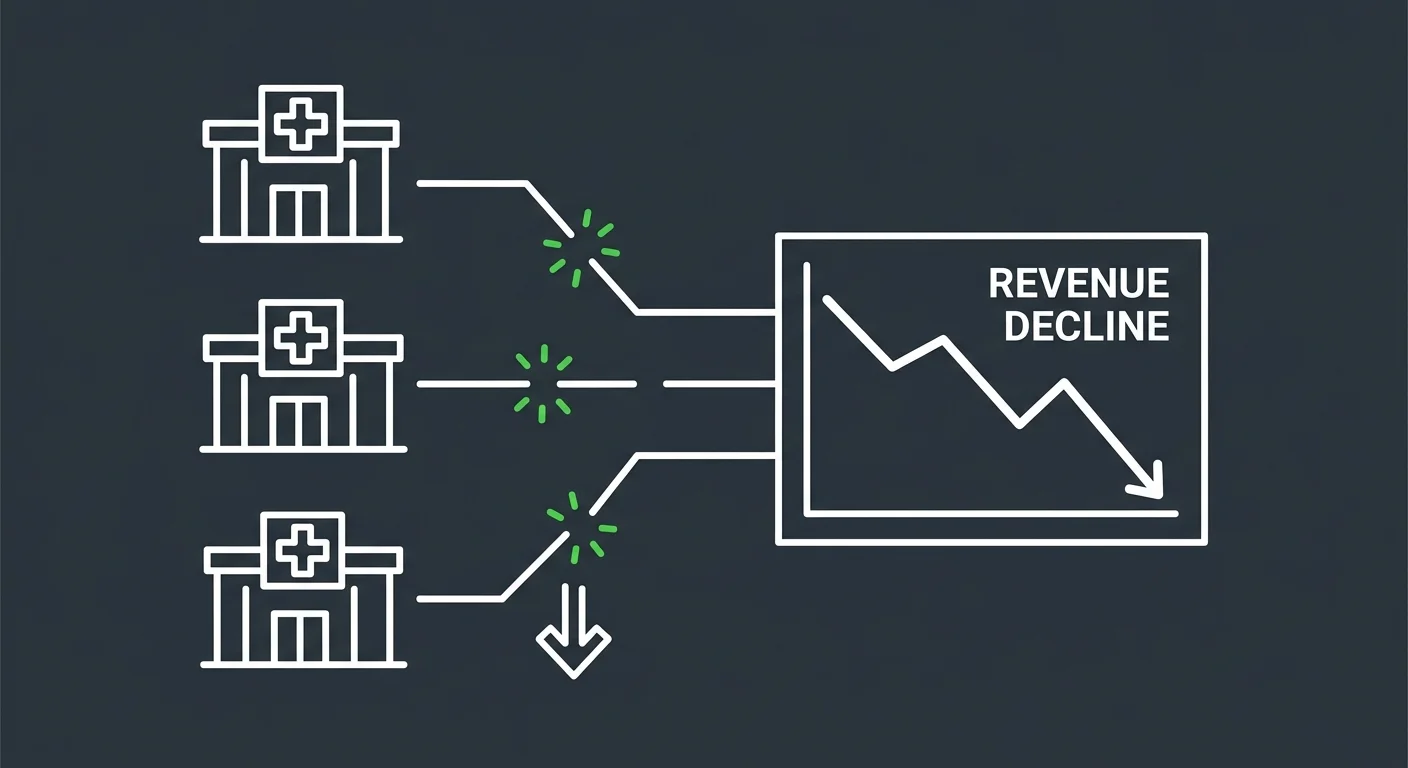
Most multi-clinic billing setups don't collapse from one catastrophic failure. They unravel quietly — across predictable seams — while the practice owner assumes everything is fine because nobody flagged anything.
The breakdowns happen in the same places every time. Documentation standards diverge between providers. Modifier rules get applied differently at each location. Denial patterns build quietly in one clinic's AR while the others look stable on the surface. By the time the problem is visible, the revenue has already been compounding in the wrong direction for months.
That's the problem centralization has to solve. Not a software gap. Not a staffing shortage. A discipline failure. A chiropractic group with three locations is one revenue system — and when it isn't managed as one unit, the seams are exactly where the money disappears.
Why Clinic-by-Clinic Billing Creates a Revenue Leak You Can't See
Clinic-by-clinic billing feels logical at the start. Each location has its own EHR, its own front desk, its own pace — so billing follows the same pattern. Local. Separate. Contained.
But siloed billing doesn't protect each clinic. It hides the group's collective revenue leakage. One location's denial patterns never get cross-referenced with another's. Trends that would be obvious at the system level stay invisible at the clinic level. Groups trying to scale administrative operations across locations without centralized billing visibility often don't find the problem until the AR aging report becomes impossible to ignore.
The revenue leak isn't loud. It's structural — built into how billing is organized, not how hard anyone is working. An embedded billing partner managing a group's RCM needs system-level visibility to find it. Most billing setups aren't built that way.
The Compliance Exposure That Multiplies Across Locations
Now add compliance exposure. Published audit data shows Medicare chiropractic claim error rates have historically exceeded 50% in targeted regional reviews. Missing active treatment documentation is the primary driver. That's the baseline risk at a single location — with consistent documentation habits.
Now multiply that across three or four clinics where documentation habits aren't standardized. Each provider's SOAP note patterns, each front desk's modifier workflow, each location's approach to distinguishing active care from maintenance — all of it feeds the same claims pipeline. The weakest documentation link doesn't stay isolated. It drives the group's collective audit exposure.
Here's the broader context: healthcare administrative spending in the U.S. runs nearly $950 billion annually. Administrative complexity isn't a billing inconvenience — it's a direct cost driver that scales with every location a group adds. Without centralized oversight enforcing consistent documentation standards across all providers, compliance exposure doesn't stay contained. It grows.
| Billing Structure | Visibility at Group Level | Denial Tracking | Compliance Consistency | Scalability |
|---|---|---|---|---|
| Siloed by location | None — each clinic sees only its own AR and claim activity | Isolated per clinic — patterns across the group stay invisible | Inconsistent — each provider follows their own documentation habits | Poor — every new location adds a separate billing operation with no shared oversight |
| Partially centralized (shared software, separate billing teams) | Limited — aggregate data exists but no single team is accountable for it | Fragmented — denial trends require manual cross-referencing across teams | Uneven — modifier and documentation standards vary by team and location | Constrained — growth multiplies coordination burden without improving control |
| Centralized under one billing operation | Full — one team monitors AR, denial trends, and claim status across all locations | Systematic — patterns are identified at the group level and addressed proactively | Uniform — documentation standards and modifier workflows enforced across all providers | Strong — adding a location adds volume to one system, not a new parallel operation |
Building the Centralized RCM Operations Layer
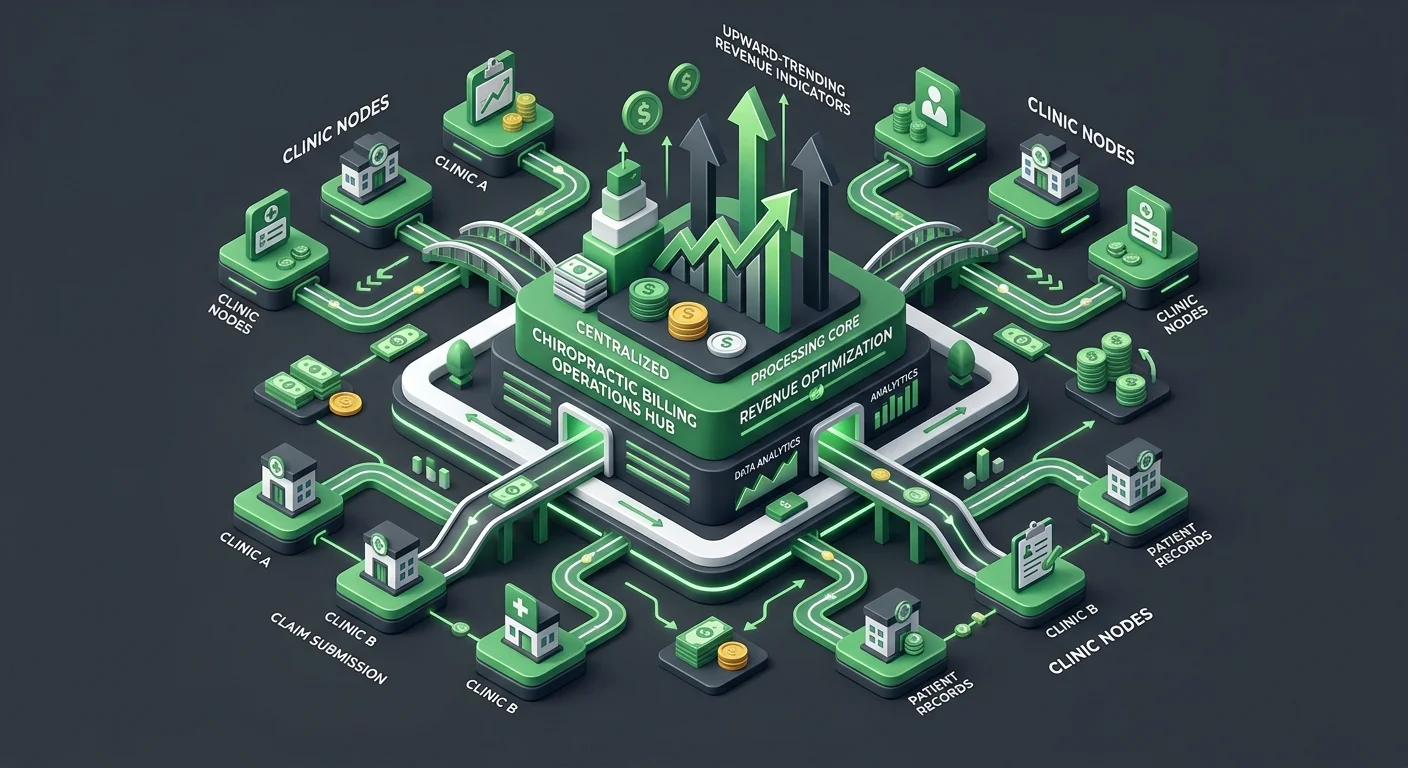
So what does a centralized billing architecture actually look like? Not what most multi-clinic owners assume it does.
Centralization isn't about adding another software layer on top of what each clinic already runs. It's about replacing location-level billing decisions with one accountable operation. Documentation standards, claim submission, denial review, revenue reporting — managed as a single system. Not federated. Not coordinated. Unified.
Administrative health spending in the U.S. runs nearly $950 billion annually. That number doesn't shrink when you add locations. It grows — because every new clinic adds another seam where complexity compounds and overhead hides.
The Core Components of a Multi-Clinic Billing Architecture
- A single enforced documentation standard — same SOAP note structure, same modifier logic, same active-versus-maintenance care distinction — followed by every provider at every location
- A centralized billing operation with chiropractic-specific expertise handling claims, denials, and AR across all locations
- A proactive, scheduled communication layer so the billing team and each clinic are always working from the same information
Here's what that looks like in practice: unified billing architectures cut redundancies and shorten claim cycles across every location. But that's not the part that matters most. The part that matters is catching denial patterns early — before they compound across three clinics and show up six months later in an AR aging report nobody can explain.
In practice, a centralized revenue cycle management operation means one billing team — with chiropractic-specific expertise — owns the documentation standard, works the denials, and monitors AR across every location. Reporting shows the group as a single revenue system. Not three separate performance summaries. One picture.
Why Software Alone Cannot Centralize Chiropractic Billing
Most multi-clinic centralization attempts break down at the same point: software. Connecting EHR systems across locations is not billing centralization. It's not even close to it.
Software handles what it can process cleanly. That's real, and it matters. But when a claim comes back denied — when a Medicare AT modifier is questioned, when a documentation deficiency has to be corrected before an appeal can go out — the software has no pathway. A person has to work it. And in most multi-clinic setups, nobody is doing that work consistently across all locations.
That's the gap software can't close. AT modifier rules. Personal injury lien workflows. Active-versus-maintenance care documentation distinctions. These aren't general billing skills — and no EHR learns them. A chiropractic-specific billing operation does. That's the difference between a group that recovers denied revenue and one that quietly absorbs the loss.
| RCM Component | Function in a Centralized Model | What Breaks Without It |
|---|---|---|
| Unified Documentation Standard | Enforces a single SOAP note structure, modifier logic, and active-versus-maintenance care distinction across every provider at every location — feeding one consistent claims pipeline. | Providers develop individual documentation habits. Modifier rules get applied inconsistently. Denial patterns build at the clinic level while the group has no visibility into the shared cause. |
| Chiropractic-Specific Billing Operation | A single billing team with specialty-level expertise in chiropractic coding handles claims, denial review, and AR recovery for all locations — working the high-friction claims that automation deprioritizes. | Complex denials — AT modifier disputes, maintenance-versus-active-care challenges, documentation deficiencies requiring appeal — go unworked. Revenue ages past the point of recovery with no one accountable. |
| Centralized AR Monitoring | AR aging is tracked as one system-level picture across all locations, allowing denial trends to be identified and addressed before they compound into cash flow disruption. | Each location's AR is reviewed in isolation. A pattern visible at the group level — a payer behaving poorly, a modifier error recurring across providers — stays invisible until aging reports become impossible to ignore. |
| Proactive Communication Layer | Structured, scheduled reporting keeps the billing team and each clinic working from the same information — claims status, denial drivers, AR movement — on a predictable cadence. | Clinics operate blind. Problems surface only at crisis points. The billing relationship defaults to silence, which is not professionalism — it is a structure that hides issues until they become cash flow emergencies. |
| Geographic Reimbursement Oversight | Centralized billing accounts for the fact that identical CMT codes reimburse at different rates across locations due to regional cost indices — ensuring no location's revenue is silently underperforming. | Rate differences go unmanaged. A location may be collecting less than it should for identical services with no awareness at the group level that a correction is possible. |
The Documentation Standard That Makes Centralization Work
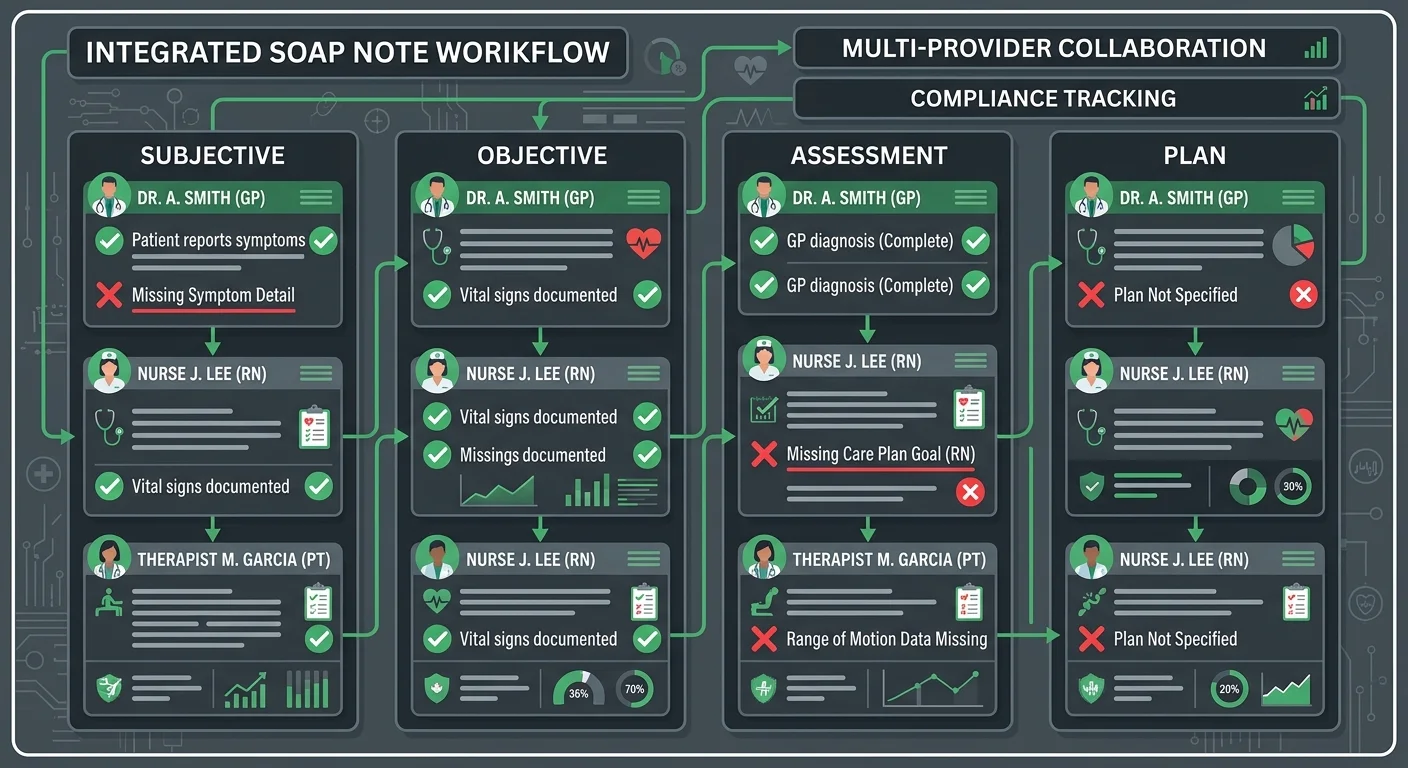
The operations layer only works when the documentation feeding it is consistent. And that consistency doesn't happen on its own. It has to be built — deliberately, across every provider, every location, every visit note.
Most multi-clinic groups get this wrong. They treat documentation as a billing department problem. But the claim is only as strong as the note behind it. When providers across locations document differently — inconsistent clinical language, variable modifier logic, different thresholds for distinguishing active care from maintenance — the billing operation inherits every one of those inconsistencies downstream.
That's where centralization either holds together or falls apart. Unified SOAP notes and coding logic across providers prevent the inconsistent claim reviews that compound into denial patterns at scale. Without that unification, every location is running its own documentation standard — and the billing operation is left stitching together three different versions of the same revenue system. It doesn't scale. It just breaks more expensively.
What Consistent SOAP Notes Mean for Multi-Provider Billing
A consistent SOAP note isn't a clinical preference. It's a billing infrastructure decision.
When providers document to a shared standard — same structure for subjective and objective findings, same logic for supporting spinal manipulation as active and medically necessary, same line between active care and maintenance — the billing team works every claim from the same foundation. That uniformity is what makes it possible to standardize documentation across multiple doctors while still processing claims from multiple locations without losing accuracy. Without it, every claim is a judgment call. And judgment calls at scale become denial patterns.
Structured clinical record-keeping correlates directly with lower audit exposure. That's not a theory. When every provider's note supports the same clinical threshold, the billing team submits claims with confidence — and defends them when challenged. When notes vary, that defense collapses. The payer doesn't care which location had the weaker documentation. The denial lands all the same.
How Documentation Gaps Become Denial Patterns at Scale
Here's the thing: a documentation gap at one location rarely stays contained to that location.
In a multi-clinic group, documentation inconsistencies all feed the same centralized claims pipeline. One provider's habit of omitting clinical indicators for active treatment. One location's inconsistent approach to the Medicare AT modifier. These don't produce isolated denials — they produce denial patterns. Medicare chiropractic claim error rates have historically exceeded 50% in targeted regional reviews, with missing documentation supporting active spinal manipulation identified as the primary driver. That number isn't a fluke. It's what happens when documentation standards aren't managed at the operation level.
And when documentation standards diverge, the denial pattern doesn't announce itself as a documentation problem. It shows up as a revenue problem — mounting AR, aging claims, reimbursement shortfalls that look like payer behavior until someone traces the denials back to their source. By then, the damage has been compounding for weeks. Structured record-keeping across every location is what prevents that. Not because it satisfies a compliance checklist — because it keeps the seams from splitting when the volume scales up.
| Documentation Element | Required Standard | Billing Impact if Missing | Audit Risk Level |
|---|---|---|---|
| SOAP Note Structure | Uniform format across all providers — consistent subjective findings, objective measures, and clinical rationale for spinal manipulation as active and medically necessary | Claim lacks clinical foundation; billing team cannot establish medical necessity from inconsistent or incomplete notes | High — incomplete notes are the primary trigger for Medicare chiropractic denials |
| AT Modifier Application | Every Medicare claim for spinal manipulation must carry the AT modifier with supporting documentation distinguishing active care from maintenance care | Modifier omitted or unsupported; claim fails Medicare coverage criteria on submission or audit review | Critical — missing or unsupported AT modifier is a direct path to denial and audit exposure |
| Active vs. Maintenance Care Distinction | Shared clinical threshold applied consistently across all providers — clear language in every visit note indicating active treatment status | Inconsistent thresholds produce conflicting claim logic; payers flag the discrepancy and deny or recoup payment | High — variation across providers creates pattern-level audit vulnerability, not isolated claim errors |
| Coding Logic Consistency | Unified CMT code selection criteria across all locations — same clinical indicators trigger the same procedure codes regardless of which provider or site submits | Mismatched coding across locations produces denial patterns that surface as payer behavior rather than documentation failures | Moderate to High — inconsistent coding across a multi-clinic group draws payer scrutiny at the group level |
| Clinical Indicators for Spinal Manipulation | Objective findings documented per visit to support the medical necessity of manipulation — not templated or copy-forwarded without clinical basis | Copy-forwarded or templated notes fail audit review; payers identify static language as evidence of non-individualized care | High — templated documentation is a known audit trigger for chiropractic claims under Medicare and commercial payers |
AT Modifier and CMT Code Compliance Across Multiple Providers
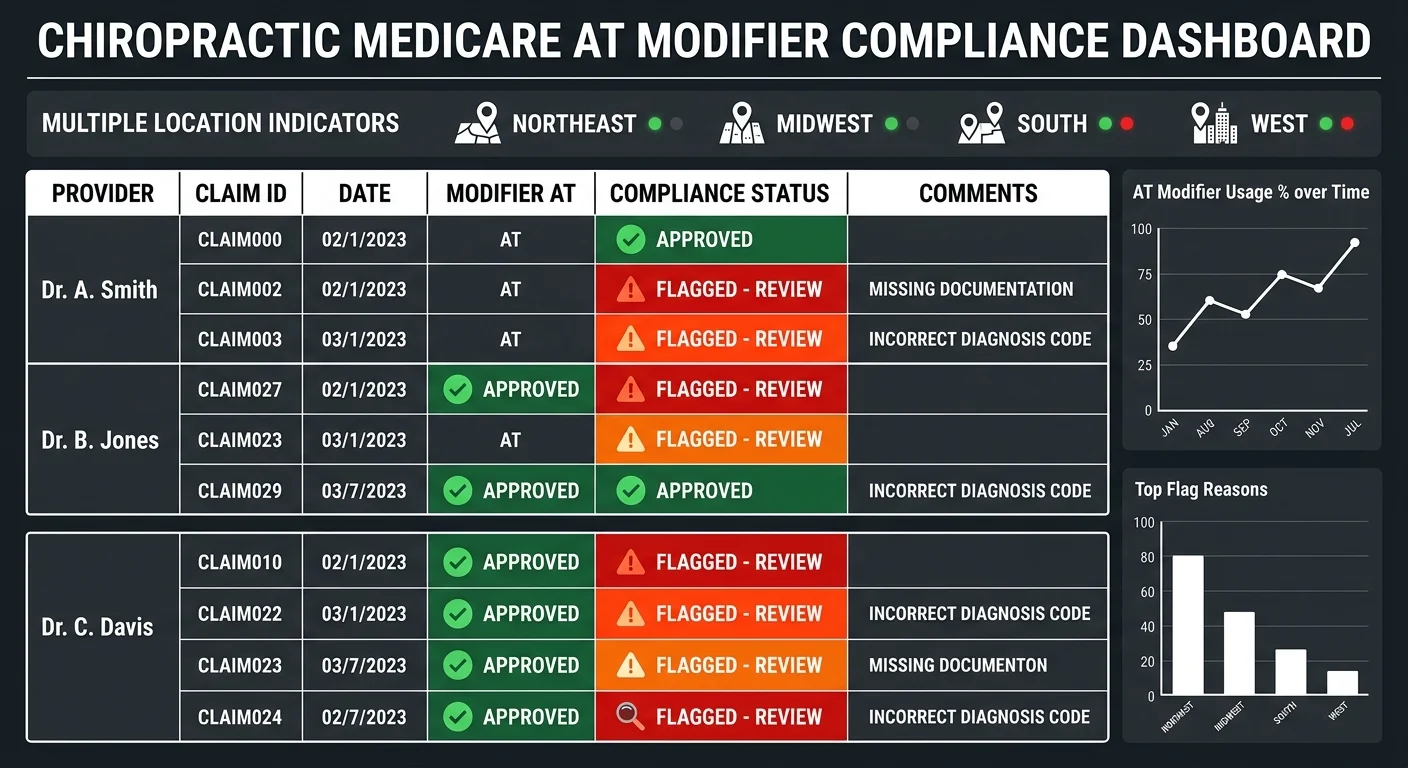
The AT modifier is where documentation failures become billing catastrophes.
Get it wrong once. Get it wrong consistently across four providers at three locations. Those are completely different problems — and only one of them is recoverable.
CMS guidelines don't leave room for interpretation here. Medicare covers chiropractic spinal manipulation only when active treatment is documented. Maintenance care is statutorily non-covered. That distinction has to be made on every claim, by every provider, at every location.
This isn't a billing step. It's a clinical documentation decision that happens before the claim ever leaves the practice.
So the real question isn't whether your team knows the rule. It's whether anyone is enforcing it consistently across every provider, every location, every claim.
Assuming each provider handles the distinction correctly on their own is not a billing strategy. At three or four locations, the gap between enforcement and assumption shows up fast — in denial rates, in AR aging, in revenue that doesn't come back.
Why AT Modifier Errors Compound Across Locations
AT modifier errors don't stay local.
That's the part most multi-clinic owners don't see until the pattern is already expensive.
Here's how it happens. One provider at one location develops a habit — a documentation shortcut, a misread of the coverage threshold, a workflow that bends under schedule pressure. That habit enters the centralized claims pipeline.
It doesn't stay contained at that location's AR report. It creates a denial pattern that looks, from a distance, like a payer behavior problem. Medicare chiropractic claim error rates have historically exceeded 50% in targeted regional reviews, with missing active treatment documentation identified as the primary driver.
Multiply that across multiple providers with inconsistent modifier habits. The liability scales with every new location you add.
This is where the decision between software versus managed revenue cycle oversight becomes the most consequential call a growing clinic group makes.
Software processes the modifier that's on the claim. It can't identify that the modifier is missing because the note didn't support active care. A chiropractic-specific billing operation catches that upstream — in the documentation review, before the claim ever submits.
That's not a feature upgrade. That's the difference between a 50% error rate and a defensible claim.
How Geographic Practice Cost Indices Affect CMT Code Reimbursement
Here's the thing most multi-clinic billing conversations skip entirely: identical CMT codes don't reimburse identically across locations.
Geographic Practice Cost Indices cause the same codes — 98940, 98941, and 98942 — to yield different reimbursement values depending on where each clinic operates. Medicare conversion factor adjustments scale those codes regionally.
A claim submitted correctly at one location may reimburse at a meaningfully different rate than the same claim submitted correctly at another. Without centralized oversight tracking those regional differences, a multi-clinic group is measuring revenue performance against the wrong baseline at every location.
That regional variation is why uniform CMT code processing across a multi-clinic group requires more than consistent modifier logic. It requires oversight that accounts for how the Medicare Physician Fee Schedule applies differently at each address.
A centralized billing operation with chiropractic-specific expertise manages that complexity as one revenue system — not four separate reports that get reconciled after the fact.
That's what centralization actually looks like when it's working.
| CMT Code | Spinal Regions Covered | AT Modifier Required | Common Documentation Failure | Reimbursement Impact |
|---|---|---|---|---|
| 98940 | One spinal region | Required on every Medicare claim for active manipulation | Active vs. maintenance distinction absent from visit note; clinical indicators for spinal manipulation not documented | Claim denied or downcoded; full reimbursement withheld until corrected documentation is submitted |
| 98941 | Two to three spinal regions | Required on every Medicare claim for active manipulation | Insufficient objective findings to support multi-region treatment; SOAP note does not reflect functional limitations addressed | Higher-value claim exposure; denial at this code level compounds revenue loss more than 98940 errors |
| 98942 | Four to five spinal regions | Required on every Medicare claim for active manipulation | Complexity of multi-region treatment poorly reflected in documentation; provider relies on habit rather than clinical justification per visit | Highest CMT code vulnerability; audit scrutiny increases with claim value; weakest notes carry the greatest financial risk |
| All CMT codes (Medicare, multi-location) | Varies by claim | Required across all locations — no provider exemptions | Modifier applied inconsistently across providers at different locations; no shared documentation standard enforcing clinical threshold | Regional denial patterns emerge; revenue shortfall misread as payer behavior rather than traced to documentation source |
| All CMT codes (GPCI-impacted locations) | Varies by claim | Required; reimbursement value also varies by clinic geography | Centralized billing team benchmarks all locations against one reimbursement baseline; regional fee schedule differences go untracked | Performance reporting skewed; clinic revenue measured against the wrong standard at one or more locations |
What Centralization Actually Requires from Your Practice
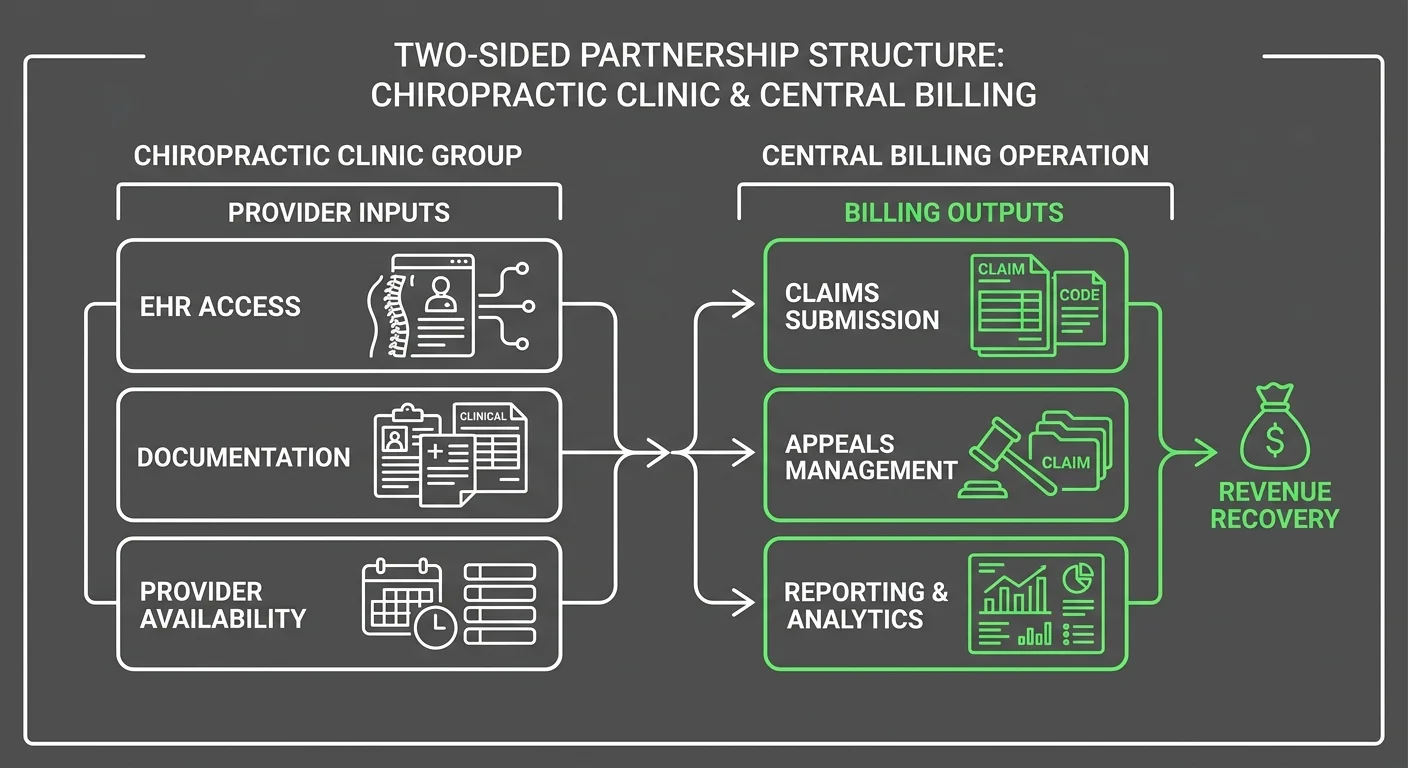
Centralization isn't just something a billing partner delivers to your practice. Your practice has to actively support it.
That second half never comes up in the sales conversation. It should be the first thing on the table.
Administrative health spending in the U.S. totals nearly $950 billion annually. The practices pulling the most out of that system aren't running the most sophisticated software. They're the ones where the clinical side and the billing side are working from the same playbook.
That alignment doesn't happen automatically. It requires the practice to show up as a working partner — not a passive account waiting for results.
To scale a multi-location chiropractic practice without losing revenue control at each new site, the practice has to make specific operational commitments. Signing a service agreement and assuming results follow isn't one of them.
What those commitments look like in practice is where most multi-clinic groups either build something that holds — or quietly inherit something that leaks.
The Practice-Side Inputs a Centralized Billing Model Needs
Start with EHR access.
A centralized billing operation can't catch modifier errors, review documentation, or correct deficiencies before a claim submits without direct access to the clinical record system. That's not a preference. Without it, upstream billing quality is impossible — full stop.
The second requirement is provider availability — and this is where most groups underestimate the ask.
When a claim comes back with a documentation deficiency, someone at the practice has to respond. Appeals require clinical support. Denials rooted in ambiguous notes require the treating provider to clarify intent.
A billing team that can't reach the provider can't build a defensible appeal. That's not a billing problem. That's a practice engagement problem — and it compounds across every location in the group.
Third: documentation turnaround discipline.
Providers who batch-document at the end of the week delay claims. Delayed claims age AR. And aged AR in a multi-clinic group compounds faster than it does at a single location — because the volume amplifies every inefficiency across the whole system.
Note completion isn't a clinical administrative preference. It's a revenue timing decision. Every day it slips is a day your AR ages in the wrong direction.
Who This Model Is Not Built For
Here's who this model isn't built for: practices that want billing to run silently in the background.
No EHR cooperation. No documentation support. No provider availability for appeals. That level of disengagement produces exactly the results it earns.
And it's not built for practices that resist visibility.
Structured clinical record-keeping decreases audit liability and standardizes billing behavior across every clinic in the group. But that structure only works when the practice is willing to see the numbers in real time — not in a summary that arrives after the revenue has already moved in the wrong direction.
Transparency isn't a feature of this model. It's how the model works.
The practices this model is built for already know the difference between billing that runs and billing that performs.
They want a partner who communicates without being asked. Who surfaces documentation patterns before they become denial patterns. Who holds the entire revenue system together across every provider, every location, every claim.
The practice side determines whether that system holds. Not the billing partner.
| Practice Input | Why It Matters for Centralized Billing | What Happens Without It |
|---|---|---|
| EHR access for the billing team | Enables upstream documentation review before a claim submits — modifier errors, missing active treatment indicators, and note deficiencies are caught at the source, not after a denial | Billing operates on what was submitted, not what was documented — errors that live in the clinical record never get corrected upstream, and the denial pattern repeats indefinitely |
| Provider availability for appeal clarification | Denials rooted in ambiguous or incomplete notes require the treating provider to clarify clinical intent — without that input, a defensible appeal cannot be built | Appeals stall or close without resolution; recoverable revenue ages past the point of return while the provider remains unaware the claim was ever in dispute |
| Consistent documentation turnaround | Notes completed on a timely, regular schedule allow claims to move through the billing cycle without delay — late notes delay submissions, which age AR across every location simultaneously | Batch documentation at the end of the week creates a predictable lag in the claims pipeline; in a multi-clinic group, that lag compounds because volume amplifies every inefficiency |
| Real-time reporting cooperation | Transparent AR visibility and weekly billing status updates allow the practice to see what the revenue system is actually doing — not a summary that arrives after the damage is done | Problems surface late, patterns go unaddressed, and the practice mistakes silence from the billing operation for stability — until a cash flow shortfall makes the real picture impossible to ignore |
| Uniform coding and modifier standards across all providers | When every provider at every location applies the same documentation logic — especially for coverage-critical distinctions like active versus maintenance care — the centralized billing operation can manage claims as one coherent revenue system | Inconsistent modifier habits at one location create denial patterns that look like payer behavior rather than documentation failures; without uniform standards, the root cause is invisible until the revenue impact has already scaled |
Frequently Asked Questions
The strategy is clear. What's left are the questions practice owners ask before they commit.
These are the friction points. Get them wrong and centralization unravels the first time growth creates pressure.
How do you centralize billing across multiple chiropractic locations without disrupting daily clinic operations?
The disruption risk is real — and it's concentrated in the transition window, not in ongoing operations.
Sequence is everything. Documentation standards and EHR access get established first. Claim submission workflows follow. That order lets the billing operation learn each clinic's patterns before anything changes at the front desk.
Clinics keep running. Claims keep moving. The centralized system layers in while each location stays in motion.
What actually disrupts operations isn't centralization. It's attempting centralization without a transition protocol.
What are the primary compliance risks when centralizing billing workflows for multiple chiropractic clinics?
The highest-risk area is AT modifier inconsistency across providers. CMS requires the AT modifier on every Medicare claim for chiropractic spinal manipulation where active care is documented. Maintenance care is statutorily non-covered.
When providers at different locations apply that distinction differently, the centralized pipeline doesn't inherit one error pattern. It inherits several, simultaneously.
The second risk is documentation lag. Delayed notes mean delayed reviews. Delayed reviews mean claims submit without correction.
Both risks compound at multi-clinic scale faster than they do at a single location. That's not a warning — it's a structural reality of how billing errors behave in a unified pipeline.
How does centralizing RCM workflows affect AT modifier billing across different locations?
Centralizing RCM workflows improves AT modifier consistency — but only when the billing operation has pre-submission documentation access. CMS mandates active treatment documentation to support the modifier on every covered claim.
A centralized billing operation with chiropractic-specific expertise reviews notes before submission. It catches missing or unsupported modifiers upstream — before the claim leaves the practice.
Without that pre-submission review, centralization doesn't fix the modifier problem. It aggregates the errors faster.
There's also the regional variable. Geographic Practice Cost Indices cause codes 98940, 98941, and 98942 to reimburse differently across locations. Centralized oversight tracks those differences so the group isn't measuring revenue performance against the wrong baseline at each address.
Can we use different EHR systems at each clinic and still centralize our billing workflow?
Yes — but it requires deliberate setup at each platform, not a one-time configuration.
Different EHR systems mean the billing operation establishes access and documentation review protocols separately for each location. That's additional setup work. It's not a reason to avoid centralization.
Here's where practices get this wrong: they assume the billing team can function without direct system access at every location. They can't.
Exported claim files don't carry the documentation context needed to catch modifier errors before submission. Whatever platform each clinic runs, the billing team needs to get inside it — not just receive what the system outputs.
What administrative cost savings should a multi-clinic chiropractic group expect when centralizing billing?
Administrative health spending in the U.S. totals nearly $950 billion annually. A meaningful portion of that overhead lives in duplicated billing functions, redundant staff, and uncollected revenue from unworked denials.
For a multi-clinic group, the savings show up in two places. First: reduced administrative headcount relative to location count. Second: improved recovery on complex claims that would otherwise be abandoned.
The specific numbers depend on current AR age, denial volume, and staffing structure. But the direction doesn't change.
Centralized billing recovers more and costs less to operate per location than distributed billing at scale. That's not a projection — it's what happens when one accountable operation replaces three fragmented ones.
How does a centralized billing model handle personal injury lien billing across multiple clinic locations?
Personal injury lien billing is one of the highest-friction, highest-value claim types in chiropractic. Most generalist billing operations deprioritize it. That's where the revenue disappears.
In a centralized model, PI lien billing has to be explicitly built into the workflow architecture — not treated as something someone figures out when a case comes in.
That means tracking lien status across multiple attorneys, coordinating case timelines across locations, and confirming each clinic's documentation meets the evidentiary standard the lien requires.
A centralized billing operation without chiropractic-specific PI lien experience will stall those cases. The revenue is real. The process is complex. And silence on lien status across three or four locations compounds into a significant AR problem that stays invisible — until it isn't.
Centralization Is the Decision, Not the Destination
Centralization isn't the finish line. It's the operating standard a multi-clinic group either holds itself to — or abandons the moment growth creates pressure to move fast and figure out billing later.
The practices that get this right aren't the ones with the most locations. They're the ones that decided, early, that the revenue system would scale alongside the clinical operation.
Not lag behind it.
Here's the verdict. A chiropractic group with multiple locations isn't three billing operations running in parallel. It's not a collection of independent AR reports someone reconciles at the end of the month.
It's one revenue system that either holds together or falls apart at the seams.
Software processes what's on the claim. Human expertise catches what's missing before the claim ever submits. That gap — between what went out and what should have gone out — is where the revenue disappears. And you can't close it with a software upgrade.
The practices that stall on centralization aren't missing information. They're missing a clear directional answer.
So here it is. Every week a multi-clinic group defers the decision, documentation standards diverge a little further. AT modifier habits at each location grow a little more inconsistent. AR compounds in a direction that gets harder to reverse.
Bushido Billing exists for practices ready to stop deferring — and start running their revenue system like the single, unified operation it actually is. The only question left is whether your current setup is holding together at the seams, or quietly falling apart while you assume it isn't.
Multi-location billing either holds together as one system or it bleeds out through a dozen small gaps nobody's tracking. If you're not sure which one you're running right now — that's the call worth making.

© 2026 Bushido Billing. All Rights Reserved | Web Design by iTech Valet