

How to Automate Patient Invoicing and Collections Across Multi-Site Clinics?
Automating patient invoicing and collections across multi-site clinics takes more than billing software. It requires a deliberate structure that separates what automation can reliably handle from what it cannot — and assigns human oversight to the gap.
Automation performs well on clean claims. Eligibility verification, standard patient statements, and routine payment posting move faster through software than through manual workflows. At scale, those efficiency gains are real.
But clean claims are not where multi-site revenue disappears. Claim denial rates average between 5% and 15% across healthcare practices, and the cost to rework a single denied claim ranges from $25 to $118. At volume, across several locations, those numbers compound fast. Automation has no reliable pathway for denials that require clinical reasoning — medical necessity arguments, documentation corrections, modifier-specific appeals. Submissions go out quickly, straightforward claims come back paid, and the system looks like it's working. The revenue that never returns simply doesn't show up on the dashboard.
Chiropractic billing adds complexity that generic automation cannot account for. Medicare chiropractic claims require the AT modifier to demonstrate medical necessity during active care. Omit or misapply it, and the claim doesn't come back as a denial to appeal — it disappears as a non-covered service, flagged and moved past by software with no audit trail.
Patient-side collections add a second layer. Automated invoicing systems must operate within the boundaries of the Fair Debt Collection Practices Act, which restricts communication patterns across all patient contact. Multi-site deployments that automate patient outreach without those guardrails carry regulatory exposure across every location at once.
Administrative complexity in healthcare — billing and collections included — accounts for nearly $1 trillion in annual US spending. The goal of automation is to reduce that burden. Not to transfer it invisibly to write-offs and uncollected revenue.
Last Updated: July 20, 2026
- • What Automation Actually Does — and Where It Stops
- • Why Generic Billing Software Fails Chiropractic Multi-Site Clinics
- • Building a Compliant Multi-Site Collections Workflow
- • Regulatory Guardrails That Multi-Site Clinics Cannot Automate Around
-
• Frequently Asked Questions
- • What is the difference between claim submission software and actual patient invoicing automation?
- • How do multi-site clinics automate patient collections without violating the Fair Debt Collection Practices Act?
- • Can generic medical billing software handle chiropractic-specific modifier codes like the AT modifier?
- • Why do pure-automation billing systems frequently fail to resolve high-complexity claim denials?
- • What are the data security risks of automating patient invoicing across multiple clinic locations?
- • The Bottom Line on Multi-Site Billing Automation
What Automation Actually Does — and Where It Stops
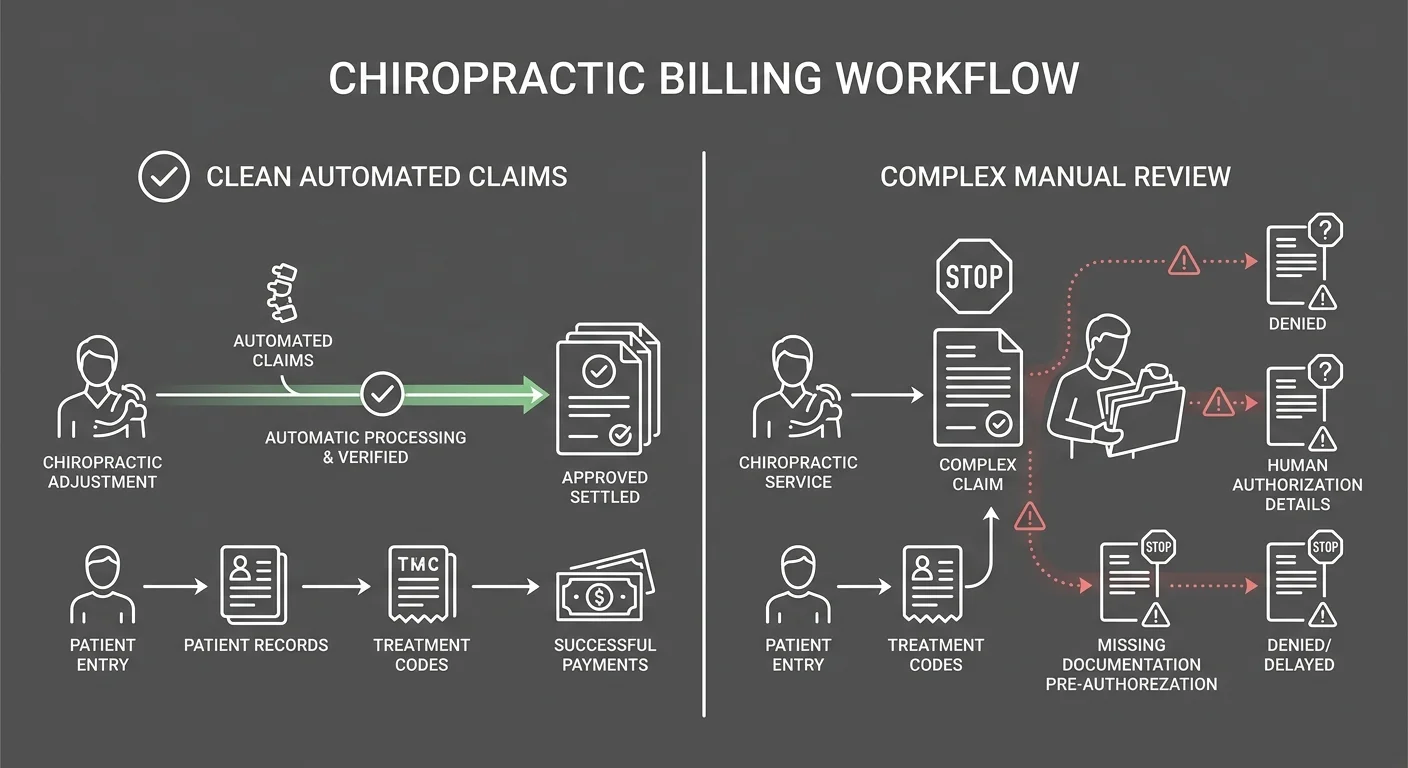
Automation does one thing well: it moves clean data through a predictable workflow. Eligibility checks, standard statement generation, routine payment posting — software handles those faster than any manual process. That part of the pitch is true. Just not the part that matters most.
But the pitch stops there. What most billing platforms call revenue cycle management is really automated submission. Submission gets the claim out the door. Revenue cycle management gets the money back. Those are not the same process — and the gap between them is exactly where multi-site clinics lose margin every month.
The efficiency gains hold — until a claim comes back denied. At that point, the workflow that looked like progress has moved the problem from a manual queue to a write-off column. Multi-site scale doesn't slow that transfer down. It speeds it up.
The Clean Claim Illusion
Here's the illusion in plain terms: automation looks like it's working because submissions go out fast and straightforward claims get paid. The dashboard looks healthy. But the revenue story isn't in the claims that came back paid. It's in the ones that never came back at all.
NIH research puts claim denial rates between 5% and 15% across healthcare practices. Reworking a single denied claim costs between $25 and $118. Now run that math across three, five, or eight clinic locations. The numbers compound fast. Manual follow-up can't absorb the volume at that scale. And automation can't resolve the denials that caused it.
The illusion breaks the moment someone pulls the aging AR report. Practices scaling across multiple sites without examining that report aren't running a billing operation. They're running a submission operation and calling it billing. The difference shows up in cash flow — and by then, it's already late.
Why Automation Cannot Argue Medical Necessity
Denials don't disappear. They compound. And the denials automation can't touch — the ones requiring clinical documentation review, medical necessity arguments, or modifier-specific corrections — carry the highest dollar value per claim. That's not a coincidence. It's the structure of the problem.
Software can flag a claim as denied. It can't read a patient file, assess whether the documentation supports medical necessity, and build a payer-specific argument for reconsideration. That takes human judgment — the kind built from understanding both the clinical context and the payer's criteria. Practices trying to deliver full-service insurance billing at scale can't automate past this problem. And practices that think scaling without expanding administrative headcount is purely a technology question will find the answer in their write-off totals.
Practices that discover this after opening a second or third location aren't dealing with a technology failure. They're dealing with a structural one. Automation was assigned work it was never built to do. The gap didn't announce itself — it just quietly aged into write-offs until the numbers were impossible to explain away.
| Workflow Stage | What Automation Handles | What Requires Human Judgment | Risk If Left Unmanaged |
|---|---|---|---|
| Eligibility Verification | Automated insurance eligibility checks before patient visits; real-time payer status confirmation across all locations | Resolving coverage disputes, coordinating benefits for complex multi-payer scenarios, and flagging documentation gaps before a claim fails | Claims submitted against lapsed or incorrect coverage; rejections that could have been prevented with a pre-visit review |
| Claim Submission | Formatting and transmitting clean claims through clearinghouses; applying standard codes to straightforward diagnosis-and-treatment encounters | Identifying modifier requirements specific to chiropractic care, including active care documentation standards, before submission — not after denial | Modifier errors submitted without review; claims that exit the system looking correct and return as non-covered rather than appealable denials |
| Patient Statement Generation | Producing and delivering standardized patient balance statements after insurance adjudication; scheduling automated payment reminders within regulatory parameters | Determining when a balance is genuinely patient-responsible versus a payer error; adjusting communication cadence for patients in active personal injury or lien cases | Patients billed for amounts that should have been appealed at the insurance level; statements sent in violation of case-specific legal holds |
| Denial Triage | Flagging denied claims by denial code and routing them into a work queue; logging denial patterns across locations for reporting purposes | Reviewing clinical documentation for medical necessity, constructing payer-specific appeal arguments, and determining whether a denial is worth the cost to rework | High-value complex denials sitting in a queue with no escalation path; denials aged past filing limits because the triage step was mistaken for resolution |
| Payment Posting | Applying electronic remittance data to patient accounts; reconciling payments across multiple location general ledgers automatically | Identifying systematic underpayments against contracted rates, flagging payer-specific payment patterns that indicate a contract interpretation dispute | Underpayments accepted at face value across high claim volume; payer behavior that should trigger a contract review going undetected for months |
| AR Follow-Up | Sending automated status inquiries on unpaid claims within standard timeframes; generating aging reports across all clinic locations on a scheduled basis | Deciding which aging claims to escalate, which to write off, and which require a phone-based payer conversation to resolve; prioritizing recovery by dollar value and claim complexity | Aging AR that produces reports but no action; write-offs accumulating on claims that were still recoverable at the time the report was generated |
Why Generic Billing Software Fails Chiropractic Multi-Site Clinics
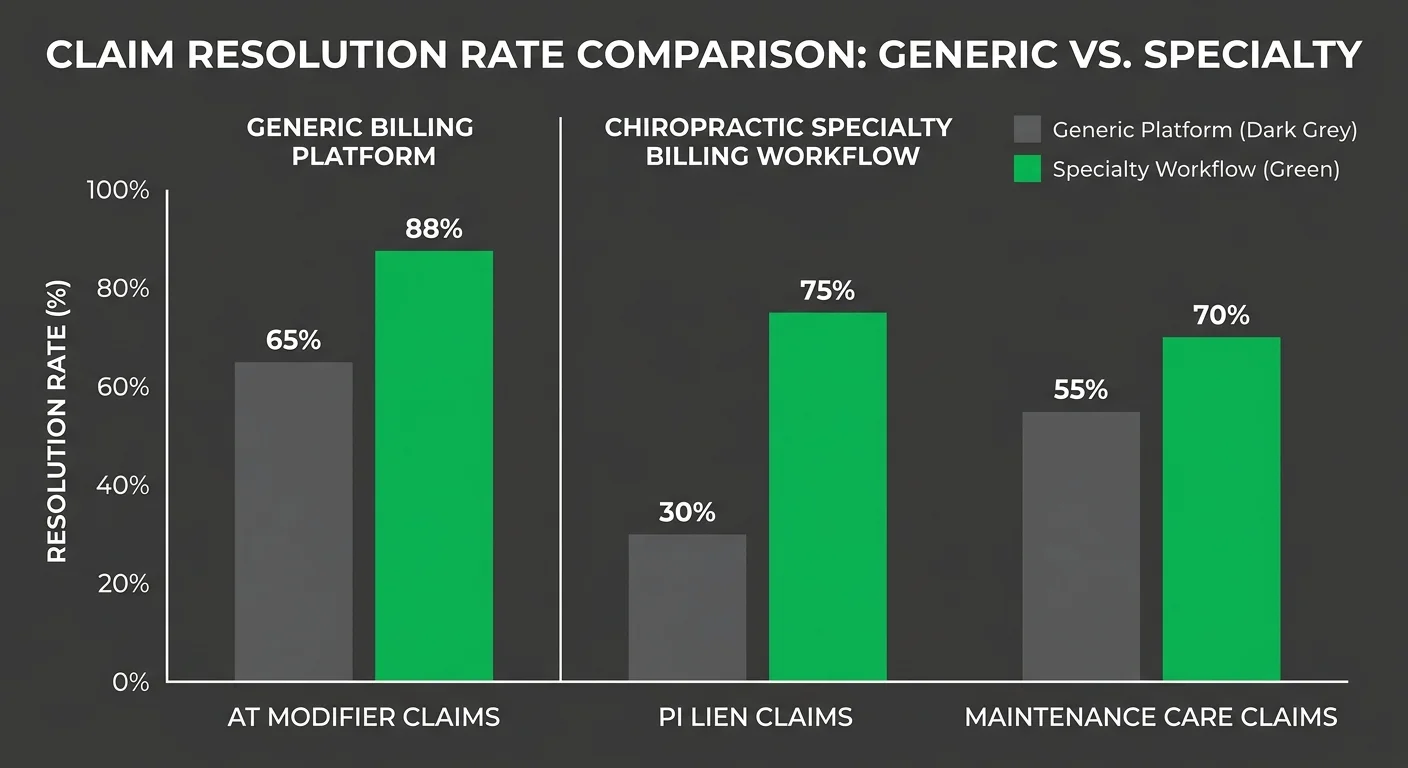
Generic billing software wasn't built for chiropractic. It was built for volume. And volume models are designed around one thing: processing the claims that move fast, not protecting the ones that cost the most to lose.
The problem isn't that the software performs poorly. It's that what it performs well — pushing clean claims through a submission pathway — is only half the job. The other half is recovery. Working denials. Correcting documentation. Appealing modifier errors. Chasing the claims that came back wrong or didn't come back at all. Generic platforms aren't built for that half. They were never designed to be.
For chiropractic and allied health practices, that gap isn't a minor inconvenience. It's where specialty-specific revenue disappears — quietly, consistently, and without any audit trail pointing back to the platform that let it walk out the door.
Why Volume-First Automation Abandons High-Value Claims
Here's what makes volume-first automation dangerous: it looks like it's working. Claims move. Submission rates look strong. The dashboard shows activity. And for clean, straightforward claims, it is working.
But high-complexity denials don't fit that workflow. Claims requiring documentation review, clinical context, or a payer-specific medical necessity argument take more time per claim than a volume model can justify spending. So they get flagged. Deprioritized. Written off. The software moves on. The revenue doesn't.
Claim denial rates average between 5% and 15% across healthcare practices, according to research published by the National Institutes of Health. Reworking a single denied claim costs between $25 and $118. Run those numbers across a multi-site practice — every location, every month, every claim nobody followed up on — and you're not looking at a rounding error. You're looking at a structured revenue leak that compounds quietly until it shows up as a cash flow problem nobody can explain.
The practices that feel this most sharply are the ones that tried to centralize billing workflows across multiple chiropractic clinics using a single platform — only to find that centralization amplified the write-off problem instead of solving it. Consolidating a broken workflow doesn't fix it. It scales it.
The AT Modifier Problem Generic Platforms Miss
The AT modifier isn't a technicality. It's the difference between a paid Medicare chiropractic claim and a non-covered one. It has to appear on every claim where care is active and medically necessary — not maintenance, which Medicare doesn't cover. Get it wrong, and the claim doesn't come back as a denial you can work. It comes back as a non-covered service. That's a harder outcome to recover from, and in most volume-first workflows, nobody tries.
The CY 2024 Medicare Physician Fee Schedule makes the documentation threshold explicit — specific clinical standards must be met before a claim is eligible for coverage. Generic software doesn't check that. It routes the claim through the submission pathway regardless of whether the underlying documentation actually supports the modifier being billed. The claim goes out. The rejection comes back. And because non-covered services often bypass the standard denial queue, no one follows up. The revenue just disappears.
No configuration update fixes this. The AT modifier problem is a specialty knowledge problem. Applying it correctly — and confirming the documentation supports it before a claim goes out — requires someone who understands both the clinical encounter and the payer's coverage criteria. That's not a workflow. That's judgment. It's what full-service insurance billing built around chiropractic requires, and it's the exact gap that Bushido Billing was built to close — because generic platforms leave it open every time, and volume models never notice.
| Claim Type | Generic Platform Behavior | Chiropractic-Specific Requirement | Likely Outcome Without Specialty Oversight |
|---|---|---|---|
| Standard clean claim (no modifiers, routine diagnosis) | Processes automatically through submission pathway; payment posted without intervention | Standard coding and documentation match payer criteria; no specialty knowledge required | Paid as expected — automation performs as advertised |
| Medicare chiropractic claim requiring AT modifier | Routes through standard submission pathway without verifying that clinical documentation supports active care status | AT modifier must reflect a documented medically necessary active care encounter — not maintenance care — to satisfy Medicare coverage criteria | Claim returned as non-covered service; bypasses standard denial queue; revenue written off without follow-up |
| High-complexity denial requiring medical necessity argument | Flags the claim as denied; deprioritizes rework because per-claim time cost exceeds volume model budget | Payer-specific appeal must reference clinical documentation and demonstrate that care met coverage criteria at the time of service | Denial ages past the rework window; claim written off; revenue lost without an audit trail linking the loss to the platform |
| Claim with documentation deficiency identified post-submission | No mechanism to review patient file, identify the documentation gap, or initiate a correction before the claim is adjudicated | Documentation must be reviewed against payer criteria before submission — not after rejection — to preserve the right to appeal | Claim returns underpaid or denied; correction window may close before any human reviews the account |
| Personal injury lien claim | Lacks structured lien tracking; processes claim through standard insurance submission pathway or flags it as unworkable | PI lien billing follows a separate adjudication timeline tied to case resolution — not standard insurance reimbursement cycles | Lien claim stalls or is abandoned; revenue sits uncollected indefinitely with no escalation pathway |
| Multi-site claim volume with location-specific payer contracts | Applies uniform submission rules across all locations without accounting for contract-level variation between sites | Each location may carry different payer contract terms, fee schedules, and modifier requirements that must be applied per claim | Underpayments go undetected; payer contract discrepancies compound across locations without a specialist reviewing reimbursement patterns |
Building a Compliant Multi-Site Collections Workflow
Compliance isn't a configuration setting. It's a discipline built into every layer of the workflow before the first automated message goes out.
Most multi-site collections don't fail because a practice picked the wrong software. They fail because automation went live without a compliance architecture underneath it.
Patient out-of-pocket costs are a growing share of commercial insurance liabilities. So more collection activity is now happening directly between the practice and the patient — not between the practice and the payer. The compliance requirements shift with it.
Automated patient outreach across multiple locations has to stay inside the boundaries FTC guidelines establish under the Fair Debt Collection Practices Act — communication frequency limits, contact pattern restrictions, the full stack.
Being compliant at one location doesn't make you compliant at five. Scale multiplies the exposure.
Delayed collections degrade cash flow predictability for multi-location groups. Automating faster doesn't fix that. It accelerates the wrong process.
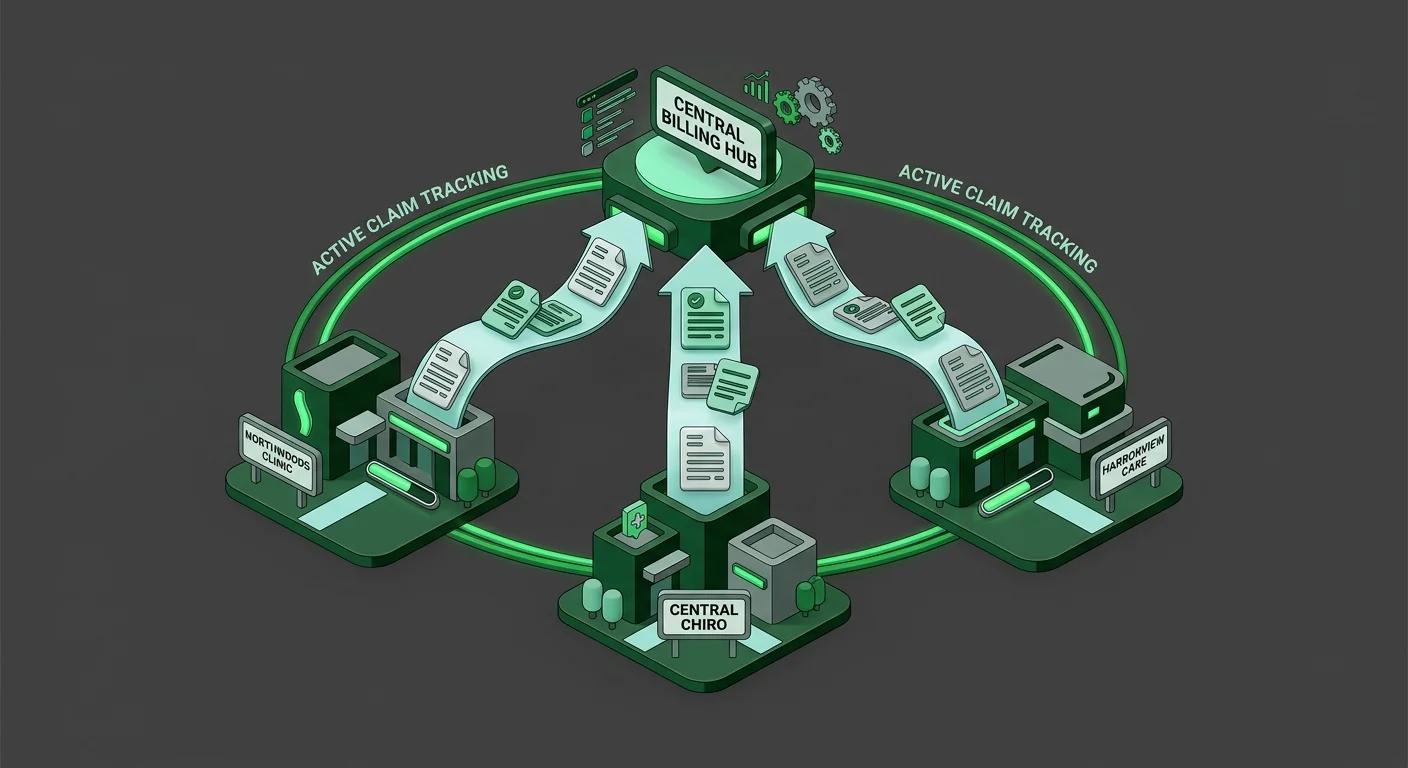
Build the collection sequence correctly once. Deploy it consistently across every site. That requires centralized workflow governance — not just centralized software.
Centralizing Billing Data Without Losing Clinic-Level Visibility
Centralizing billing data is not the same as centralizing billing decisions. Conflate those two things and you get a reporting dashboard that looks clean while individual clinics quietly stack up inconsistent documentation habits, modifier errors, and patient balance backlogs.
The central system can't see those problems until they've aged past recovery.
The goal is visibility without override. A central data layer that surfaces what's happening at each location — without flattening the clinic-level differences that actually determine how claims get coded and documented.
Practices that maintain revenue transparency across sites find something consistent: the locations with the cleanest billing operations are the ones where someone is reading the location-specific AR data. Not just the aggregate roll-up.
That clinic-level visibility is also what makes compliance auditable. When a patient invoicing dispute surfaces at one location, the practice needs a documentation trail specific to that site.
Not a system-wide export that buries the encounter-level detail. Centralized data architecture has to preserve the granularity — not eliminate it in the name of simplicity.
Who This Model Is Not Built For
This model is not built for practices that want a fully disengaged arrangement.
That's not a judgment. It's a structural fact.
Effective multi-site invoicing and collections requires EHR access, documentation cooperation from providers, and practice-side responsiveness when appeals or coverage questions surface.
Practices that expect zero-engagement billing — where the software runs and nobody at the clinic needs to be involved — will accumulate compliance gaps, modifier errors, and unworked denials exactly where human attention was absent.
A workflow that automates without a practice-side partner isn't a scalable billing system. It's a submission system with a write-off problem.
And if the first question about a billing arrangement is about rate rather than process, this model isn't the right fit either.
Administrative complexity in US healthcare accounts for nearly $1 trillion in annual spending, per McKinsey. Practices that evaluate billing partners on price alone are optimizing for cost, not recovery.
Recovery rate and compliance integrity don't show up as line items in a rate comparison. They show up in cash flow — or they don't show up at all.
What the Workflow Must Include at Every Location
- A compliant patient outreach sequence with built-in regulatory guardrails at every location
- Real-time eligibility verification completed before the encounter — not after the claim is denied
- A denial routing protocol that separates software-resolvable errors from judgment-dependent appeals requiring human review
- A location-specific AR aging review cadence so backlogs surface before they age past recovery
- A documentation feedback loop that catches modifier and coding errors before they become denial patterns
Patient outreach sequencing is where Fair Debt Collection Practices Act exposure is highest. Automated reminder cadences that vary by location — or that escalate contact frequency without built-in regulatory checks — create compliance liability across every site at once.
Standardizing the outreach protocol centrally, while keeping the ability to pause or adjust at the location level, isn't optional. It's the minimum viable compliance posture for any multi-site group.
The practices winning at multi-site billing aren't the ones with the most automation. They're the ones who know exactly which part of the workflow automation can't touch — and who have a human process ready for precisely those moments.
That's the payoff the clean claim illusion never delivers.
| Workflow Component | Automation Role | Human Oversight Role | Applies to All Locations? |
|---|---|---|---|
| Patient Outreach Sequence | Sends standardized payment reminders and balance statements at scheduled intervals across all locations | Reviews cadence for FDCPA compliance, pauses or adjusts contact at the location level when disputes or clinical circumstances require it | Yes — protocol must be centrally standardized before deployment |
| Eligibility Verification | Runs real-time insurance eligibility checks before each encounter to flag coverage gaps and benefit limits | Interprets edge cases, coordinates with the patient or payer when eligibility data conflicts with the clinical plan of care | Yes — must occur at every location before every encounter |
| Denial Routing | Sorts incoming denials by error type — separates clearinghouse rejections and data errors from coverage disputes and medical necessity challenges | Evaluates judgment-dependent denials, builds the clinical argument, and manages the multi-step appeal process that software cannot execute | Yes — routing logic is centralized; appeal decisions are location-specific |
| AR Aging Review | Generates location-specific and aggregate AR aging reports on a defined cadence | Reads location-level data to identify emerging denial patterns, modifier errors, or documentation gaps before they compound into write-offs | Yes — every location requires its own aging review, not just a roll-up |
| Documentation Feedback Loop | Flags claims where submitted modifiers do not match the documentation fields captured in the EHR | Reviews flagged encounters with the provider, corrects documentation habits at the source, and confirms medical necessity support before resubmission | Yes — modifier accuracy must be enforced consistently across all sites |
| Patient Balance Collection | Automates post-adjudication balance statements and payment plan enrollment for straightforward patient responsibility amounts | Manages exceptions — disputed balances, financial hardship requests, and any collection escalation that requires direct provider or clinic-level authorization | Yes — collection standards must be uniform; exception handling is clinic-specific |
Regulatory Guardrails That Multi-Site Clinics Cannot Automate Around
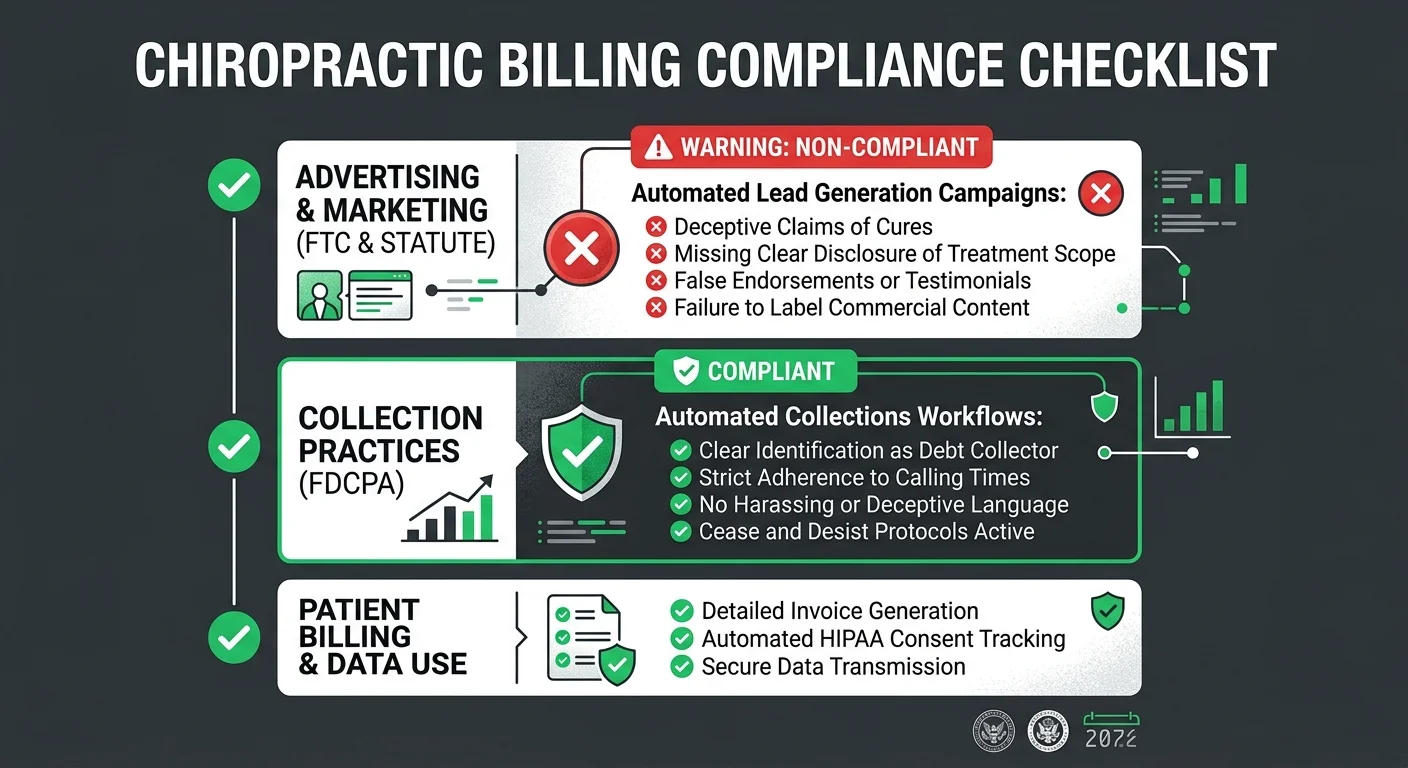
Automation doesn't eliminate regulatory obligations. It multiplies them — running the same workflow across every location, at the same time.
That's the part multi-site groups miss.
Here's the exposure single-location practices don't face: a compliance failure in one automated sequence doesn't stay at one site. It replicates.
The same misconfigured outreach cadence. The same missing breach notification protocol. The same documentation gap — executing identically at every clinic until someone with judgment catches it.
Software doesn't catch compliance failures. It runs them at scale.
Regulatory compliance isn't an add-on you layer onto automation after it's running. It's the foundation.
Practices that build the automation first and figure out the compliance later don't pay for that mistake in write-offs. They pay in civil penalties.
FDCPA Compliance in Automated Patient Collections
The Fair Debt Collection Practices Act applies to patient collections — and automated systems don't get a pass just because a human didn't send the message.
The FTC's FDCPA rules restrict collectors from communication patterns that cross into harassment territory. An automated reminder sequence that escalates contact frequency without built-in regulatory checkpoints creates that exact exposure — at every site, every time the workflow fires.
A compliant outreach sequence at one location is not automatically compliant at five. Timing, frequency, and escalation logic have to be governed from the center.
And someone still needs to be able to pause, adjust, or override that sequence the moment a patient's account enters disputed or sensitive status.
Automation doesn't read that context. It reads a status field.
Practices that want patient invoicing to scale without triggering Fair Debt Collection Practices Act liability need to standardize the outreach protocol first — then automate inside those guardrails.
Not the other way around. The compliance architecture has to exist before the automation layer runs.
Data Security Obligations Across Multiple Clinic Locations
Data breach obligations don't resolve themselves. Under FTC breach reporting rules, healthcare-related entities must report breaches involving patient billing records within 60 days of discovery. Every day past that window triggers direct civil penalties.
At a multi-site operation, patient billing data flows through a centralized platform that touches every location. A single breach event creates a compliance obligation across the entire group — not just the site where it originated.
This is where standardizing documentation across providers stops being a billing quality issue and becomes a data security imperative.
When patient records are inconsistently structured across locations, breach response slows down. Identifying the scope of compromised data means reconstructing what each clinic's records actually contained — under deadline pressure.
Consistent documentation architecture reduces that response time. It also makes the FTC-required notification process executable within the 60-day window.
No software configuration handles a breach response, a disputed patient balance, or a Fair Debt Collection Practices Act escalation on its own.
These aren't edge cases. At a multi-site practice running automated collections across hundreds of patient accounts simultaneously, they are predictable events. They happen. The only question is whether your oversight structure was in place before they did.
The practices that maintain revenue transparency through those moments built the human layer first. The ones that didn't are the ones paying the penalty — literally.
| Regulatory Requirement | Governing Authority | What It Restricts in Automated Collections | Penalty Exposure |
|---|---|---|---|
| Fair Debt Collection Practices Act (FDCPA) — Communication Limits | FTC | Restricts automated reminder cadences that escalate contact frequency into harassment territory; automated systems receive no compliance exemption because a human did not send the message | Civil penalties per violation; exposure replicates across every site running the same misconfigured outreach sequence simultaneously |
| Fair Debt Collection Practices Act (FDCPA) — Automated System Compliance | FTC | Requires automated patient invoicing systems to observe regulatory parameters; automation does not waive FDCPA obligations for the practice | Compliance penalties apply to the practice entity, not the software vendor — multi-site scale multiplies exposure per non-compliant outreach event |
| FTC Health Breach Notification Rule — Breach Reporting Window | FTC | Mandates that healthcare-related entities report patient billing record breaches to the FTC within 60 days of discovery; centralized multi-site platforms create a single breach event with group-wide compliance obligations | Direct civil penalties calculated per day of delayed reporting beyond the 60-day window |
| FTC Health Breach Notification Rule — Ongoing Penalty Structure | FTC | Updated rules hold entities accountable for each day compliance is delayed after a breach is discovered; no grace period exists for practices that are slow to identify or contain the scope of compromised billing data | Escalating per-day civil penalties from the date of discovery; multi-site data architecture that lacks clean documentation structure extends breach response time and increases penalty exposure |
Frequently Asked Questions
The framework is clear. The compliance stakes are documented. But when you're actually moving from evaluation to execution across multiple locations, you still have specific, operational questions. Here are the ones that come up most.
These are the questions multi-site chiropractic and allied health groups ask once the theory ends and the actual implementation begins.
What is the difference between claim submission software and actual patient invoicing automation?
Claim submission software gets the claim out the door. That is its entire job.
Patient invoicing automation handles what comes after — eligibility verification, patient balance calculation, outreach sequencing, payment posting, and AR follow-up. These are not the same workflow. One covers the front end. The other covers the part that requires continuous attention when something goes wrong.
Most EHR-integrated billing tools are submission systems with invoicing features bolted on. They can generate a patient statement. They cannot tell you whether a denial was a coding error, a documentation gap, or a payer-specific dispute — and they cannot route that decision to anyone. That gap is where multi-site practices bleed revenue. The submission system was never designed to cover it, and most practices don't realize that until the AR aging report makes the pattern impossible to ignore.
How do multi-site clinics automate patient collections without violating the Fair Debt Collection Practices Act?
Sequencing. Build the compliant outreach protocol first — then automate within it.
The Fair Debt Collection Practices Act applies to patient collections, including automated reminder sequences. Automation does not get a compliance pass because no human pressed send. FDCPA restricts communication patterns that cross into harassment territory. A misconfigured automated sequence fires that pattern at every location simultaneously.
Standardize timing, frequency, and escalation logic at the group level before you turn anything on. Build a human override process for accounts that enter disputed or sensitive status. Automation can execute a compliant sequence consistently. What it cannot do is recognize when a specific account needs a different approach. That recognition has to live with a person — not a status field in your platform.
Can generic medical billing software handle chiropractic-specific modifier codes like the AT modifier?
Not reliably. And for practices billing Medicare, that unreliability is not a minor inconvenience.
The AT modifier is required on Medicare chiropractic claims to confirm that care is active and medically necessary. Generic billing platforms do not carry the specialty-level logic to flag when the AT modifier is missing, misapplied, or unsupported by the documentation on file. They submit the claim. Whether the modifier is correct is a separate problem — and it shows up as a non-covered service, not a denial anyone is working.
The CY 2024 Medicare Physician Fee Schedule enforces specific documentation thresholds to avoid automated non-coverage determinations. Generic software does not interpret those thresholds in the context of a chiropractic encounter. It processes what the EHR sends. If the documentation doesn't meet the standard, the system submits a claim that was already going to fail — and in most cases, no one catches it until the AR aging report makes the pattern undeniable.
Why do pure-automation billing systems frequently fail to resolve high-complexity claim denials?
Because denial resolution is a judgment problem. Not a data problem.
Claim denial rates average between 5% and 15% across healthcare practices. Reworking a single denied claim costs between $25 and $118 in administrative overhead. Automation handles the claims that follow a predictable pattern — wrong eligibility, transposed digit, missing referral. Those resolve algorithmically.
The ones that don't resolve algorithmically require a medical necessity argument, a documentation correction, or a multi-step appeal with a payer disputing coverage on clinical grounds. These are exactly the claims a volume-based system deprioritizes — because they cost more to work than the model can justify. So they sit. Then they age. Then they fall past the point of recovery.
The submission dashboard looks healthy. The write-off column tells a different story. That is the clean claim illusion — and it is the most expensive thing a multi-site practice can mistake for a functioning billing operation.
What are the data security risks of automating patient invoicing across multiple clinic locations?
The risk is multiplication. Not isolation.
When patient billing data flows through a centralized platform touching every location, a single breach creates a compliance obligation across the entire group. Under FTC breach reporting rules, healthcare-related entities must report breaches involving patient billing records within 60 days of discovery. Miss that window and civil penalties accrue per day of non-compliance.
And the exposure compounds at scale. A misconfigured data access point, an insufficiently permissioned vendor integration, an inconsistently structured patient record across locations — each one creates a breach surface proportional to the number of sites running the same workflow. Automation does not shrink that surface. It standardizes it. A vulnerability in one location's configuration exists in all of them.
Practices that build consistent, well-documented data architecture across sites can identify breach scope faster, execute FTC-required notifications within the compliance window, and contain the damage before it spreads. That is a governance decision. And it has to be made before the automation layer goes in — not after.
The Bottom Line on Multi-Site Billing Automation
Here's the thing about the clean claim illusion: it's convincing because it's partly true.
Automation moves clean claims fast. It cuts manual entry. It gives multi-site groups a submission infrastructure that actually scales.
But submission isn't billing. Practices that confuse the two don't find out in their submission dashboard. They find out in their AR aging report — and by then, the revenue is already gone.
The clinics protecting their margins at scale aren't running the most automated workflows. They're the ones who mapped their billing process carefully enough to know exactly where automation helps and exactly where it costs them.
Modifier-dependent claims. Medical necessity arguments. Denial appeals. FDCPA-governed outreach. Breach response.
None of those are software problems. They're judgment problems. And no configuration setting resolves a judgment problem. Bushido Billing was built on that distinction — because the claims that require the most judgment are also the ones worth the most revenue.
Automation is a tool. A powerful one, deployed correctly.
But a tool isn't a strategy. A multi-site billing strategy built on automation alone will consistently write off the exact revenue it was supposed to protect — quietly, without a dashboard alert, long before anyone thinks to check the aging AR.
The practices that get this right build the human oversight layer first, automate within it, and never mistake a fast submission for a paid claim. The question isn't whether your automation is working. It's whether you know exactly where it stops.
Your AR aging report already knows the answer. The question is whether you've looked at it honestly — and whether someone's actually working the claims automation can't touch. If you want to see where your multi-site billing is drawing that line, Book a Call and find out what your current setup is actually recovering.

© 2026 Bushido Billing. All Rights Reserved | Web Design by iTech Valet