

What Should an Enterprise Clinic Look for in a Platform-Agnostic Billing Partner?
A platform-agnostic billing partner isn't a software integration. It's a revenue cycle team that works inside whatever EHR system a clinic already uses — without demanding a migration, a proprietary platform, or a technology overhaul.
But software compatibility is the floor. What enterprise clinics actually need to evaluate is what happens after a claim is denied.
The real criteria are vertical specialization, human expertise on high-complexity claims, and structural accountability for outcomes.
Chiropractic billing carries regulatory requirements that general billing firms cannot consistently meet. Centers for Medicare & Medicaid Services guidelines require the AT modifier to document active, corrective treatment — distinct from maintenance care, which Medicare does not cover. Missing or incorrect AT modifier application has historically driven chiropractic Medicare error rates above 50% in multiple Office of Inspector General audits. A billing partner without specialty-level knowledge of these rules isn't a neutral choice. It's a liability.
Any external partner managing protected health information must execute a Business Associate Agreement and comply with the full HIPAA Security Rule under 45 CFR 164.502(e). That's a compliance baseline, not a differentiator.
Denial management depth, communication cadence, and fee alignment are where the real evaluation happens. Administrative costs account for up to 30% of total healthcare expenditures. Inefficient denial workflows compound accounts receivable aging across every location. A partner paid on performance has a structural incentive to recover complex claims. A flat-fee model doesn't.
Software doesn't argue medical necessity. People do. What enterprise clinics should look for is a performance-aligned, specialty-trained billing team embedded directly in their existing environment — not a technology layer that processes clean claims and abandons the hard ones.
Last Updated: July 20, 2026
- • Why 'Platform-Agnostic' Is a People Question, Not a Software Question
- • Why Volume-First Billing Models Break Down at the Enterprise Level
- • The Real Evaluation Criteria: What to Actually Assess Before Signing
- • Compliance, HIPAA, and Documentation Standards at the Enterprise Level
-
• Frequently Asked Questions
- • How does a platform-agnostic partner handle denials without direct access to our EHR's built-in billing modules?
- • What is the expected timeline and operational disruption when onboarding an embedded billing partner?
- • How do we prevent communication gaps between our multi-location front desk staff and an external billing team?
- • Will switching to an external RCM partner disrupt our existing personal injury lien workflows?
- • How does a performance-based billing model structure accountability compared to a flat monthly software fee?
- • What HIPAA obligations does our clinic carry when sharing patient data with a billing partner?
- • The Bottom Line on Platform-Agnostic Billing Partners
Why 'Platform-Agnostic' Is a People Question, Not a Software Question
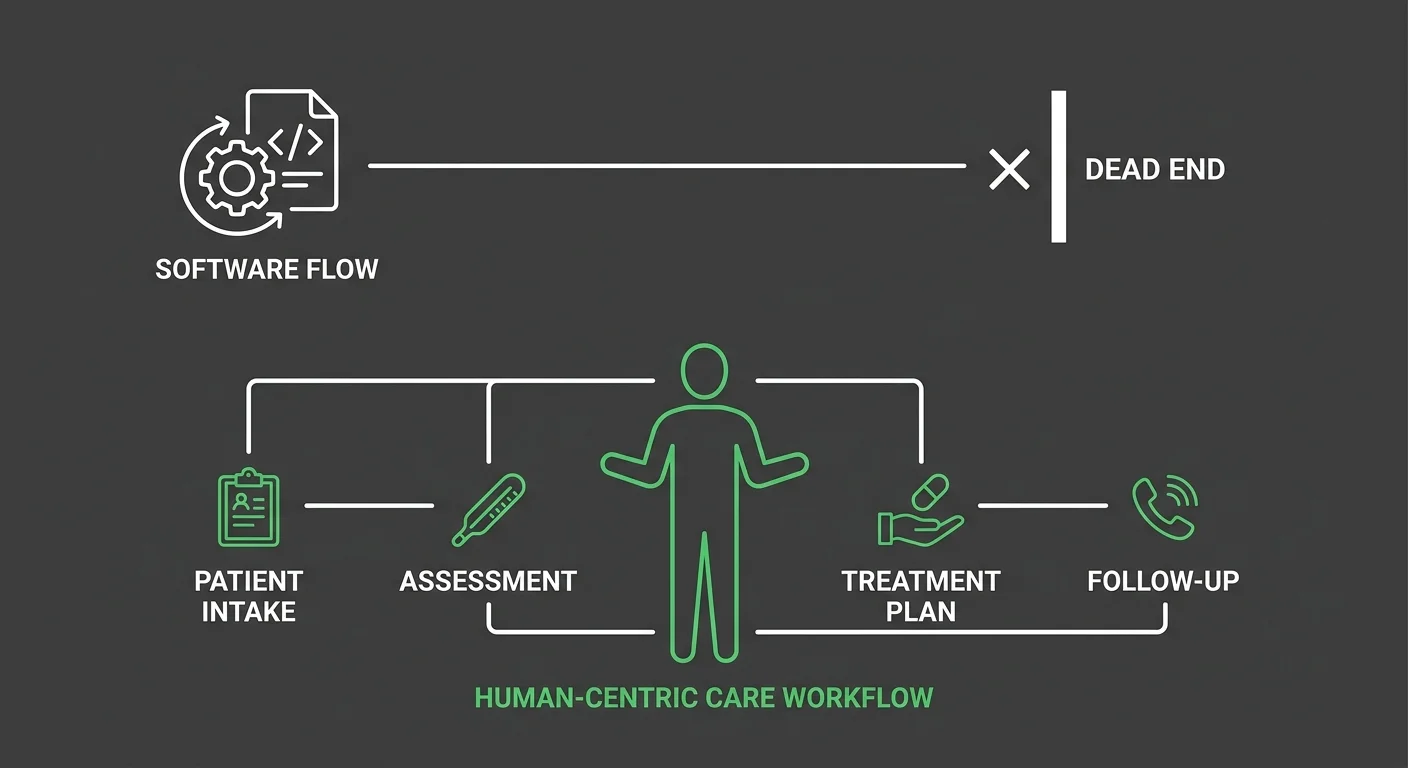
Most enterprise clinics start the conversation in the wrong place.
They ask about integrations. APIs. Data exports. Whether the billing partner can connect to their EHR.
Those are real questions. But they're not the first ones that matter.
Platform compatibility is a floor. A billing partner can operate inside any software system and still leave revenue on the table.
What drives recovery isn't which platform they can access. It's what they do once they're inside it.
For clinics already working out how to scale a multi-location chiropractic practice without expanding their administrative staff, this distinction is the difference between a billing partner and a billing problem.
The capability set is what protects revenue across every site. The software compatibility checklist is just the ticket to get in the door.
What Platform-Agnostic Actually Means in a Billing Context
In a billing context, platform-agnostic means the partner works inside whatever EHR platforms the clinic already uses. No migration. No proprietary software adoption. No renegotiated technology contract.
The partner adapts to the clinic's environment. Not the other way around.
That's not a feature. That's the baseline expectation.
Multi-location operations already deal with EHR interoperability gaps — redundant data entry, communication siloes, documentation that doesn't transfer cleanly between sites.
A billing partner that demands software consolidation adds friction on top of friction.
A true platform-agnostic partner absorbs that fragmentation. They bill through it without forcing an operational disruption the clinic never asked for.
Why Most Clinics Mistake a Tech Feature for a Partner Qualification
Most clinics make the same mistake.
The pitch leads with software compatibility — "we integrate with your EHR" — and the clinic treats that as proof of a capable billing partner.
It isn't.
Avoiding a forced platform migration isn't a differentiator. It's table stakes.
The real question is what the partner brings once access is established. Human expertise on complex denials. Specialty-level knowledge of chiropractic-specific billing rules. A dedicated biller who knows the practice's payer mix and catches problems before they age past recovery.
That's the capability set that protects revenue. The EHR handshake just gets them in the room.
Interoperability gaps already drive up administrative workloads. A billing partner that adds to that burden — demanding new technology, new workflows, new staff retraining just to get started — isn't solving the problem.
They're becoming one.
Platform-agnostic is the floor. Not the ceiling.
| What Clinics Assume It Means | What It Actually Requires | Why the Difference Costs Revenue |
|---|---|---|
| The partner can connect to our EHR system | The partner can work within the EHR without disrupting existing clinical workflows or staff responsibilities | Access without execution still produces unworked denials, aged AR, and communication gaps — the same problems the clinic had before |
| Software compatibility eliminates the need for a migration | True platform-agnostic operation means the partner absorbs EHR fragmentation across all clinic locations without demanding consolidation | A partner who avoids disruption at setup but demands workflow changes later adds friction at the exact point clinics can least afford it |
| API integration equals billing capability | Billing capability is determined by the human expertise applied once access is established — not by the connection itself | Practices that evaluate on integration depth miss the more consequential gap: whether the partner can argue medical necessity, work complex denials, and recover high-friction claims |
| Platform-agnostic means the partner is flexible about technology | Platform-agnostic means the partner brings specialty-level chiropractic billing knowledge into the clinic's chosen environment — without requiring the clinic to change anything | Flexibility without vertical expertise produces generalist outcomes inside a specialty environment — which is where the highest-value claims get abandoned |
| Any capable billing company can work inside our system | A capable billing partner brings a dedicated biller with deep familiarity with the clinic's payer mix, modifiers, and denial patterns — not just system access | Generic access to the EHR does not replicate the institutional knowledge of a dedicated biller embedded in the practice's specific revenue environment |
Why Volume-First Billing Models Break Down at the Enterprise Level
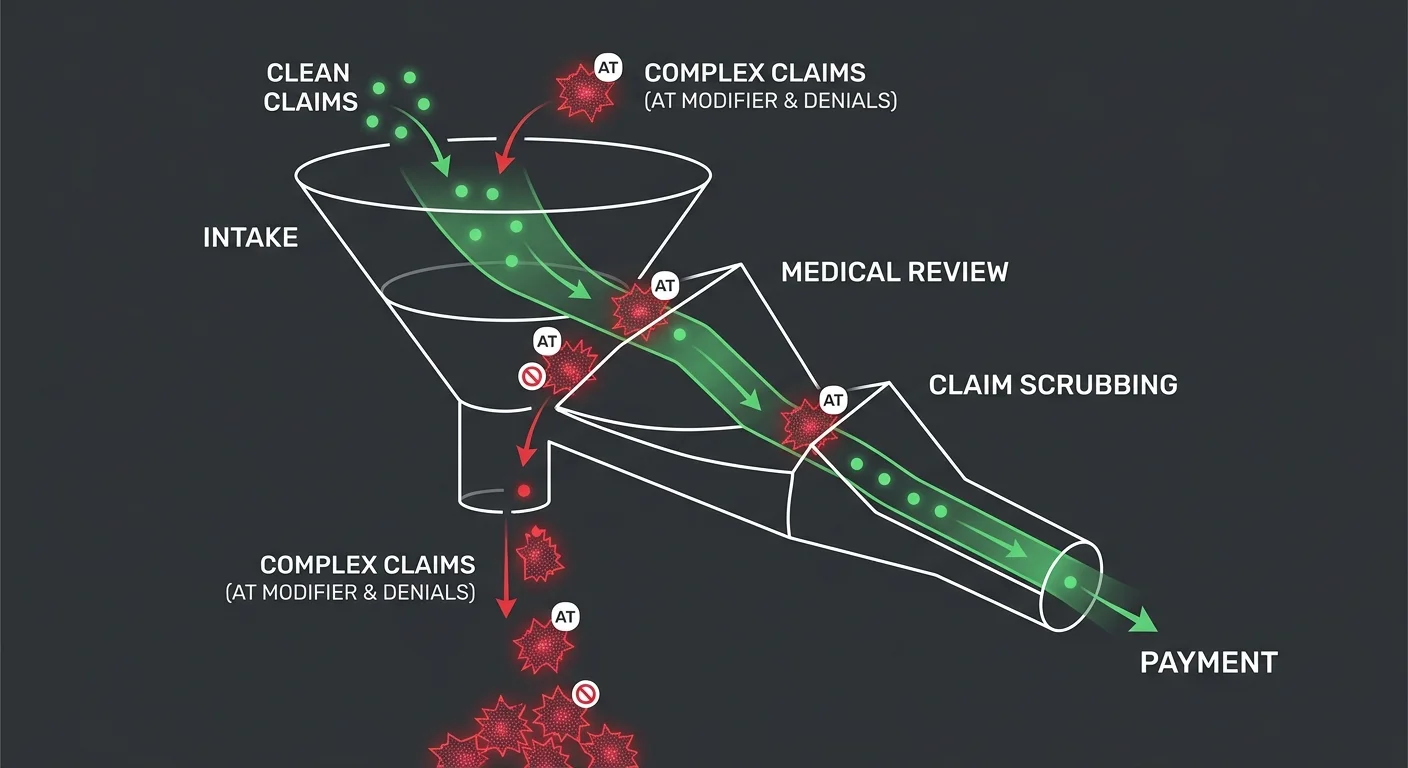
Volume-first billing works when claims are clean.
Straightforward coding. Standard payer rules. No modifier complications. Those claims move fast and get paid. That's the best-case scenario for the model — and it's also the only scenario the model was built for.
But enterprise chiropractic clinics don't run on clean claims alone. They run on AT modifier disputes, personal injury (PI) lien cases, and Medicare documentation requirements that demand human review.
The financial consequences compound fast. McKinsey's published analysis of revenue cycle systemic challenges confirms what clinics feel in their AR: administrative costs already account for up to 30% of total healthcare expenditures — and inefficient denial workflows only deepen that hole.
A volume model doesn't budget for the extra work those claims require. So that work doesn't get done.
So the complex claims get deprioritized.
Not because anyone made a bad call. Because working those claims is unprofitable inside a throughput model. The result is a growing pile of aged AR — and nobody tells the clinic until it's past the point of recovery.
Why Most Billing Models Fail Complex Chiropractic Claims
Chiropractic billing is not general medical billing. The regulatory requirements are specific. The audit exposure is real. The margin for documentation error is narrow.
The OIG has repeatedly targeted chiropractic Medicare claims — and the numbers are not subtle. Chiropractic error rates have historically exceeded 50% in multiple OIG audits, driven primarily by missing or incorrect AT modifier application.
That's not an anomaly. That's what happens when the people working the claims don't actually specialize in this.
Those errors aren't random. They follow patterns.
A billing model built around throughput reproduces those patterns. The people working the claims don't have the vertical expertise to catch them before they go out.
OIG audits on chiropractic billing focus specifically on maintenance therapy billed as active care.
That line — active treatment versus maintenance — is exactly where a generalist biller is least equipped to operate. It requires knowing the documentation standard, knowing the payer's interpretation, and knowing when a claim needs a medical necessity argument before it ever leaves the practice.
Software doesn't argue medical necessity. People do. And only people with chiropractic-specific training know when that argument is necessary.
That's not a software problem. That's a specialization problem.
It's why comparing billing software vs. managed RCM as competing options misses the real question: do the humans behind the billing model actually understand chiropractic well enough to protect the clinic from its most predictable revenue losses?
The Claims That Disappear Without Anyone Telling You
Here's what most enterprise clinics don't see until it's already costly.
The claims that disappear aren't rejected outright. They get deprioritized quietly — worked slowly, followed up inconsistently, and eventually aged past the point where recovery is economically viable for the billing company.
The clinic doesn't know. The biller never flags it. The AR report just keeps growing.
There's no notification. No report that says 'these 40 claims were abandoned this month.'
Communication silence is the structural default in volume-first billing. So the practice assumes the biller is working it — right up until the cash flow gap becomes impossible to ignore.
That's the hidden cost of the volume model at enterprise scale.
It's not one location losing a few claims. It's every location losing the same categories of complex, high-value claims — consistently, invisibly, in exactly the revenue tier where recovery would matter most.
| Claim Type | Volume-First Model Response | What the Clinic Loses | Recovery Likelihood |
|---|---|---|---|
| AT Modifier Dispute | Deprioritized — requires documentation review and medical necessity argument that exceeds the model's per-claim time budget | Active care revenue reclassified as uncollectable; audit exposure increases with each uncorrected pattern | Low — ages quickly without specialty-level intervention |
| Personal Injury (PI) Lien Case | Avoided or minimally worked — lien timelines extend beyond standard AR cycles and require case-specific follow-up | High-value settlements left unworked; lien positions weaken as cases close without billing pressure | Low — PI lien workflows require vertical expertise that generalist models do not carry |
| Medicare Maintenance vs. Active Care Documentation Error | Submitted as-is or written off — distinguishing active treatment from maintenance requires clinical knowledge the volume model does not budget for | Claim denied or recouped on audit; no corrective documentation loop initiated | Very low — without specialist review, the same error repeats across future claims |
| Multi-Payer Denial With Payer-Specific Appeal Requirements | Worked inconsistently — appeal requirements vary by payer and volume models lack the dedicated capacity for case-by-case research | Denial stands; revenue ages into the 90–120 day AR tier with no follow-up cadence | Low to moderate — depends on whether anyone in the billing operation flags the payer rule before the appeal window closes |
| Complex Coding Claim Requiring Modifier Clarification | Submitted without correction or resubmitted once — no escalation path exists when the first appeal fails | Revenue lost at the claim level; pattern not identified across locations, so the same coding gap recurs site-wide | Low — modifier-level complexity is exactly what throughput-optimized models deprioritize after a single failed resubmission |
The Real Evaluation Criteria: What to Actually Assess Before Signing
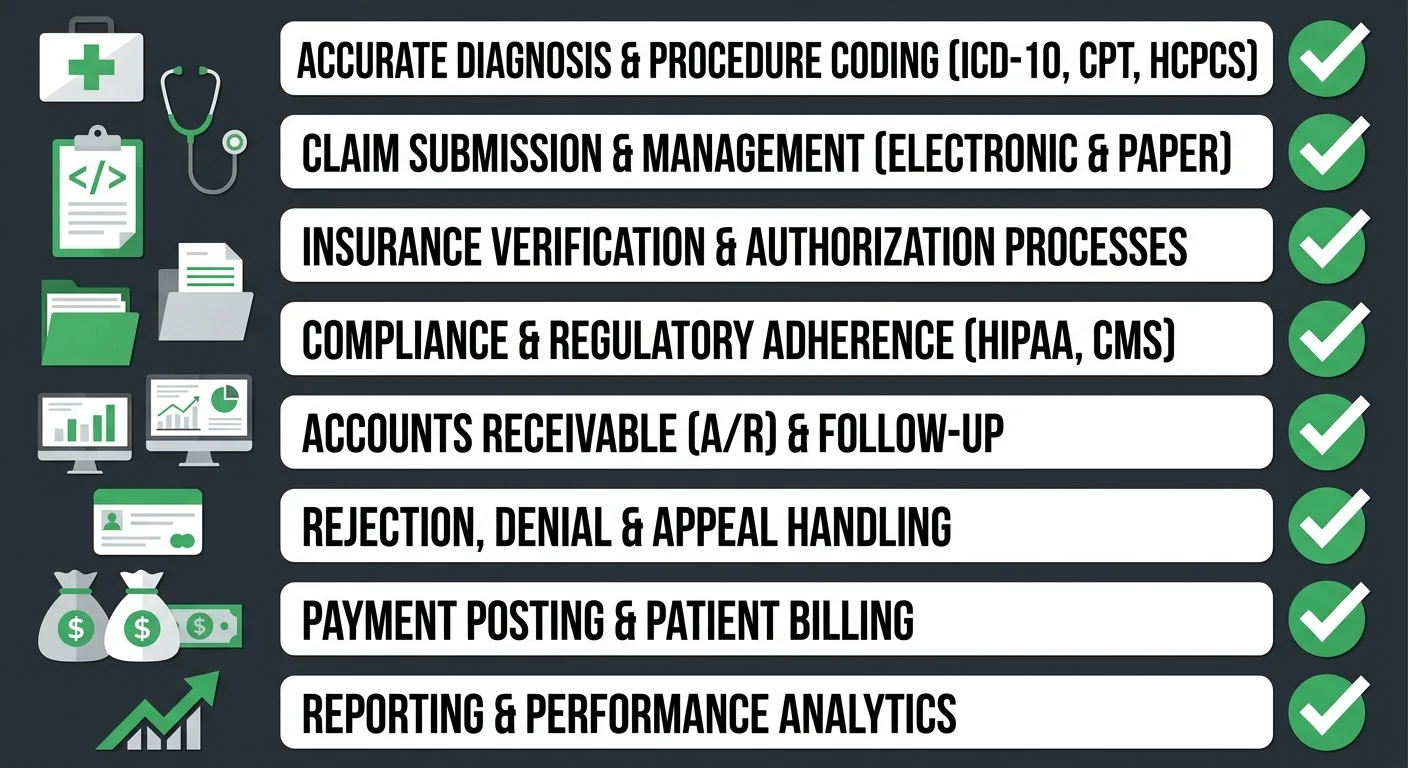
Most enterprise clinics start this evaluation with the wrong checklist.
Can you connect to our EHR? Does the integration work? Is the data transfer clean?
Those are table-stakes. They're not evaluation criteria.
The real evaluation starts after access is established.
Specialty knowledge. Denial depth. Communication accountability. Performance alignment.
Those are the variables that determine how much revenue a clinic actually recovers. None of them show up on a software compatibility checklist.
Clinics that evaluate a billing partner like a software vendor get a billing partner that performs like one.
It processes what it can. It abandons what it can't. It reports nothing either way.
The criteria below are the ones that change that outcome.
Vertical Specialization: Why Chiropractic Expertise Is Non-Negotiable
Chiropractic billing isn't a subset of general medical billing.
It's a distinct specialty — its own modifier requirements, its own regulatory exposure, its own audit patterns.
A billing partner without vertical expertise here doesn't just underperform. They reproduce the industry's most predictable errors, at scale, across every location.
The AT modifier is the clearest proof of this. CMS requires it to document active, corrective chiropractic treatment — distinguishing covered care from maintenance therapy, which Medicare won't reimburse.
That distinction demands documentation precision. The billing partner working a clinic's claims has to know that standard as well as the provider does. Not approximately. Exactly.
OIG audits have targeted chiropractic Medicare claims specifically because of what happens when they don't. Chiropractic error rates in this area have historically exceeded 50% in multiple audit cycles — driven almost entirely by missing or incorrectly applied AT modifiers.
A generalist billing partner can't hold that line reliably.
Knowing when a claim needs a medical necessity argument before it leaves the practice — that's a specialty skill. Knowing when documentation needs correction before submission, or when a denial reflects payer interpretation rather than a coding error — those are skills built from working chiropractic claims long enough to recognize the pattern.
For clinics already working through how to scale a multi-location chiropractic practice, the software-versus-expertise question resolves itself once AT modifier audit exposure is fully understood. Software doesn't argue medical necessity. People do.
Communication Structure: What Weekly Accountability Looks Like in Practice
Communication silence isn't a billing company personality trait.
It's a structural feature of models that don't budget for it. Volume-first operations treat client communication as overhead — time on a call is time not processing claims.
So practices go weeks without updates, assume things are working, and find out otherwise when the cash flow gap is already impossible to ignore.
Weekly updates aren't a premium add-on. They're the minimum accountability structure for a billing relationship that's actually working.
At enterprise scale — where a single week of unworked denials across multiple locations compounds fast — a partner who communicates consistently isn't going above and beyond. They're doing the job.
Ask directly: what does your weekly update process look like, and what does it show us? If the answer is vague, the communication structure doesn't exist.
This Evaluation Is Not for Every Clinic
This evaluation framework isn't for every clinic.
If a practice is primarily cash-pay, insurance billing complexity isn't the core operational problem. The criteria above don't apply.
This is for clinics where insurance revenue is the primary collection mechanism — where denial management, AT modifier precision, and AR visibility are live, active problems right now.
It's also not for clinics that want a fully hands-off arrangement.
An embedded billing partner working inside a clinic's EHR environment needs documentation cooperation, timely provider availability for appeals, and front desk alignment across locations.
Practices that bring zero engagement to the relationship won't see different results with a different billing company. The model requires participation to perform.
And it's not for practices that lead with rate.
The fee structure is relevant. It isn't the evaluation. Clinics that open with 'what's your percentage?' before asking about denial depth, specialty knowledge, or communication cadence are optimizing for cost over recovery.
That trade-off produces exactly the outcome it deserves: a lower fee on a smaller collection.
| Evaluation Criterion | What to Ask | Red-Flag Answer | Green-Flag Answer |
|---|---|---|---|
| Chiropractic Specialty Knowledge | How long has your team worked specifically in chiropractic billing — and who handles AT modifier disputes? | We handle all medical specialties and can adapt to chiropractic requirements. | Our billers work exclusively in chiropractic and allied health. AT modifier application and maintenance-versus-active documentation are core competencies, not edge cases. |
| Denial Management Depth | Walk us through what happens when a Medicare claim is denied for medical necessity. Who handles it, and what does the appeal process look like? | We flag it, give you the denial reason, and you can decide how to proceed. | We review the documentation, build the appeal, and submit with a medical necessity argument. The provider is contacted only when additional clinical detail is required from them. |
| Communication Structure | What does your weekly update process look like — what data does it include and who sends it? | We send reports on request, or your portal is always available if you want to check in. | Every location receives a structured weekly update covering claim status, denial activity, and AR movement — sent proactively by the assigned biller, not generated on demand. |
| Platform Compatibility | Which EHR systems does your team currently operate in — and what does the onboarding process require from our locations? | We prefer clients on our recommended platform, or we can help you migrate. | We work inside your existing EHR environment without requiring migration. Our team has operated across multiple chiropractic platforms and adapts to your setup, not the other way around. |
| Performance Alignment | How is your fee structured — and what happens when a high-complexity claim takes multiple appeal cycles to recover? | We charge a flat monthly fee regardless of collection outcomes. | Our fee is tied to collections. Complex claims that require multiple appeal cycles are worked to resolution because our revenue depends on recovering yours. |
| AR Visibility | How do you report on aging accounts receivable across multiple locations — and what is your process when a claim ages past 90 days? | AR reports are available in your portal. We flag claims that hit your internal write-off threshold. | Aging AR is reviewed proactively at each weekly update. Claims approaching the 90-day mark are escalated before they age past the point of viable recovery — and you are told about it before it becomes a cash flow issue. |
Compliance, HIPAA, and Documentation Standards at the Enterprise Level
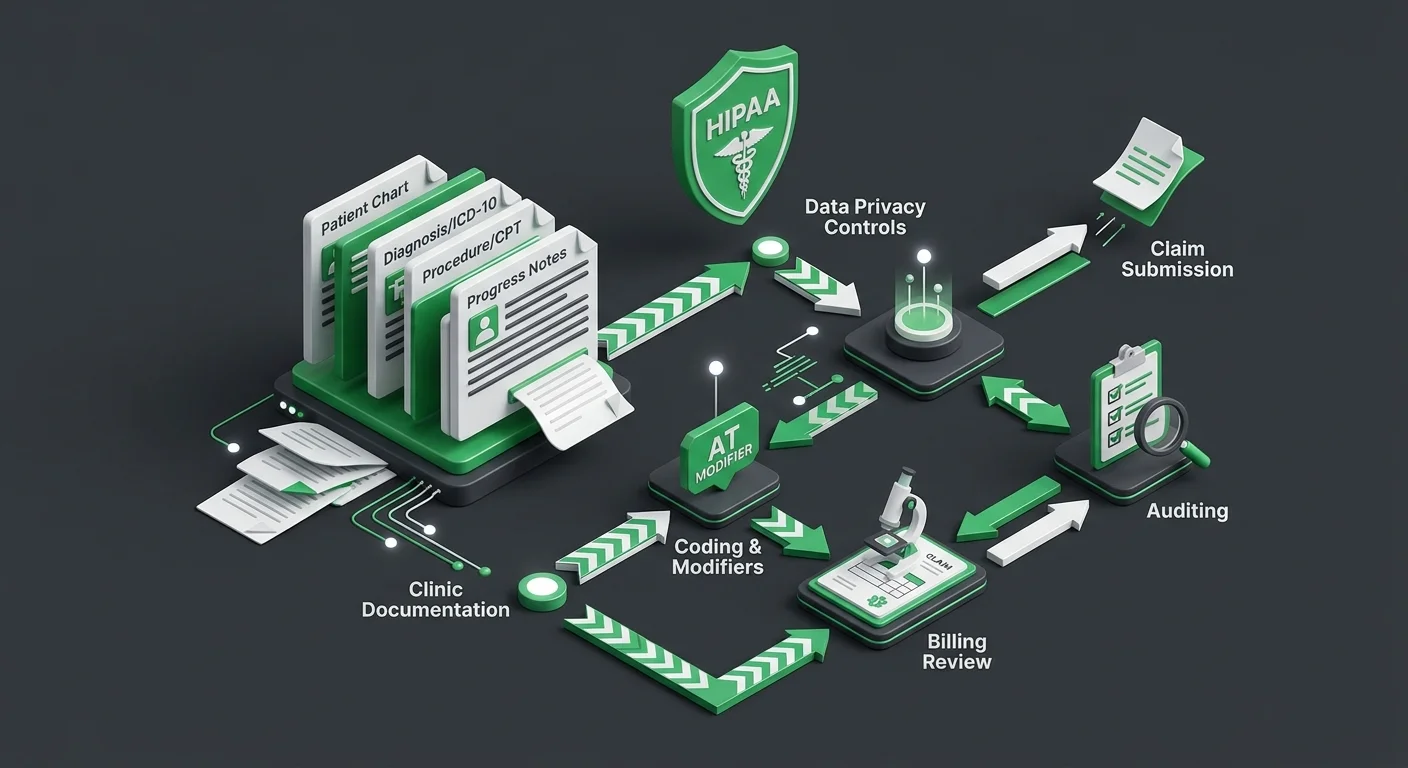
Compliance is where the abstract conversation gets real.
At scale — multiple providers, multiple locations, multiple payers — documentation requirements don't just multiply. They compound. And the billing partner inside that environment carries legal obligations most clinics never fully examine before they sign.
Two compliance layers matter here. Both have teeth.
First: HIPAA — specifically, what the law requires when a third party handles protected health information. Second: Medicare documentation — specifically, what CMS and the OIG look for when they audit chiropractic claims.
Neither is optional. Neither forgives a billing partner who didn't know the rules.
A billing partner who can't speak to both of those areas isn't a minor gap at the enterprise level. It's a liability with a multiplier.
Every location you add amplifies every compliance weakness in the billing relationship. The more providers you have, the more expensive that weakness gets.
BAA Requirements and What They Mean for Your Billing Relationship
Before a billing partner touches a single claim, a Business Associate Agreement must be signed. Not a formality. A statutory requirement under 45 CFR 164.502(e).
The BAA defines exactly how protected health information is accessed, stored, transmitted, and protected across the entire billing workflow. It's the document that tells you whether a billing partner has governance in place — or is making it up as they go.
Published business associate compliance guidance from HHS is explicit: violations of Business Associate standards can trigger direct civil penalties from the HHS Office for Civil Rights.
For enterprise clinics, that exposure isn't abstract. It scales with the volume of PHI the billing partner handles. Across a multi-location operation, that volume is significant.
Asking for a signed BAA isn't due diligence. It's the floor.
Here's what the BAA tells you beyond the legal checkbox: whether the billing partner has actually thought about how PHI moves through their operation.
An embedded billing partner working inside the clinic's EHR environment touches patient records constantly. The BAA establishes whether that access is governed or ad hoc.
Clinics that skip this conversation aren't just carrying compliance risk. They're operating with zero visibility into how their patients' data is being handled.
AT Modifier Compliance and Medicare Documentation Accountability
The AT modifier is not a billing technicality. It's the line between a covered Medicare claim and a denied one.
CMS requires it to document active, corrective chiropractic treatment — distinguishing it from maintenance therapy, which Medicare doesn't cover.
That distinction has to live in the documentation before the claim goes out. Not corrected after the denial comes back.
The OIG's enforcement record isn't ambiguous. Chiropractic error rates have historically exceeded 50% in multiple OIG audit cycles — driven almost entirely by missing or incorrectly applied AT modifiers and maintenance therapy billed as active care.
Those aren't edge cases. They're the predictable output of billing operations that don't have the specialty knowledge to draw the right line before submission.
For enterprise clinics managing documentation across multiple providers, the risk compounds with every physician added. Software doesn't argue medical necessity. People do. And at this scale, those people need to be specialists.
Practices that need to standardize documentation across multiple providers aren't dealing with an operational preference. They're dealing with a billing compliance issue.
When different providers in the same enterprise document active care and maintenance care differently, the billing partner is left interpreting inconsistency. Inconsistent interpretation under Medicare audit scrutiny produces exactly the error patterns OIG audits are built to find.
The billing partner's job isn't to accept whatever documentation comes through. It's to flag the gaps, correct the workflow, and make sure every AT modifier on every claim is defensible before it leaves the practice.
| Compliance Area | Regulatory Requirement | Billing Partner Obligation | Enterprise Risk If Unmet |
|---|---|---|---|
| HIPAA Business Associate Agreement (BAA) | Mandated under 45 CFR 164.502(e) — any third party handling PHI must execute a BAA before accessing patient records | Execute a signed BAA before the billing relationship begins; govern all PHI access, storage, transmission, and protection throughout the workflow | Direct civil penalties from the HHS Office for Civil Rights; enterprise exposure scales with PHI volume across multiple locations |
| AT Modifier Application (Medicare) | CMS requires the AT modifier to indicate active, corrective chiropractic treatment — distinguishing covered care from non-covered maintenance therapy | Apply the AT modifier correctly on every eligible claim before submission; flag documentation gaps at the provider level, not after denial | Denied Medicare claims; maintenance therapy billed as active care triggers audit scrutiny and revenue loss |
| OIG Medicare Audit Exposure | OIG audit reviews target chiropractic Medicare claims for missing or incorrect AT modifiers and maintenance therapy billed as active care | Enforce specialty-level documentation standards across all providers; ensure every AT modifier applied is clinically defensible prior to submission | Chiropractic Medicare error rates have historically exceeded 50% in multiple OIG audit cycles — enterprise multi-provider operations compound this risk with every physician added |
Frequently Asked Questions
These questions come from operators who've already been burned.
Not curious. Burned. They've been inside a billing relationship that didn't deliver, and now they're asking the right things before they sign anything again.
The answers below are direct. No 'it depends.' If a question fits your situation, it tells you exactly what to look for — and what to push back on.
How does a platform-agnostic partner handle denials without direct access to our EHR's built-in billing modules?
A platform-agnostic partner doesn't use the EHR's built-in billing modules. It logs directly into the clinic's existing system — pulling claim data, reviewing documentation, and submitting through the same workflows the clinic already runs.
That's the whole point. When billing is forced through incompatible systems, you get redundant data entry, broken communication, and claims that fall through the gaps. A true platform-agnostic partner skips that entirely by operating inside the existing environment — not around it.
Denials get worked the same way they would if the billing team sat in the clinic. Because functionally, they do.
What is the expected timeline and operational disruption when onboarding an embedded billing partner?
Transition disruption is almost always lower than clinics expect — and almost always higher than the billing company promises.
Here's the honest version: a partner who already works inside your existing EHR eliminates the biggest disruption category entirely. No platform migration. No staff retraining on new software. That overhead disappears.
What's left is calibration — getting the billing team aligned to your payer mix, documentation patterns, and provider preferences. That takes active cooperation from your side. Access, responsiveness, documentation turnaround. Practices that engage early stabilize faster. Practices that hand off and go quiet don't.
How do we prevent communication gaps between our multi-location front desk staff and an external billing team?
Communication gaps don't happen by accident. They happen when there's no defined protocol for how documentation issues, eligibility questions, and denial follow-ups move between the clinic and the billing team.
The fix is structural. Named points of contact at each location. Defined escalation pathways. A consistent weekly update covering what's pending, what's resolved, and what the clinic needs to act on.
Multi-location operations already deal with communication siloes between sites. A billing partner without scheduled, structured communication doesn't solve that problem. It adds to it.
Will switching to an external RCM partner disrupt our existing personal injury lien workflows?
Personal injury (PI) lien billing doesn't work like standard insurance billing. Timelines are longer. Documentation requirements are different. The payer is often an attorney, not an insurer. A billing partner without specific PI lien experience won't just slow things down — they won't know what they're handling.
Before any transition, ask a direct question: describe your PI lien billing process, how you track lien status across cases, and how you communicate when a case closes.
If the answer is generic, the experience isn't there.
How does a performance-based billing model structure accountability compared to a flat monthly software fee?
A flat monthly software fee is a fixed cost with no connection to what the clinic actually collects. The vendor gets paid regardless of denial volume, regardless of AR aging, regardless of what gets recovered.
A performance-based model inverts that. The billing partner's revenue is tied directly to the clinic's collections. That alignment doesn't guarantee outcomes — but it does mean the billing partner has a direct financial reason to work high-friction claims, follow up on aged AR, and push for resolution instead of letting complex cases sit.
The accountability question isn't which model costs less. It's which model produces more.
What HIPAA obligations does our clinic carry when sharing patient data with a billing partner?
Before a billing partner touches a single claim, a Business Associate Agreement must be signed. This is legally mandated under 45 CFR 164.502(e). It is not a formality.
The BAA defines how protected health information is accessed, stored, transmitted, and safeguarded throughout the billing relationship. Violations can result in direct civil penalties from the HHS Office for Civil Rights. For enterprise clinics sharing PHI across multiple providers and locations, that exposure scales with volume.
But the BAA tells you something beyond the legal checkbox. It tells you whether the billing partner has a governed, documented process for handling patient data — or whether access to records is essentially ad hoc. At scale, that distinction is the difference between a managed compliance posture and a liability waiting to surface.
The Bottom Line on Platform-Agnostic Billing Partners
Here's the only question that cuts through every sales conversation: is this a billing company, or a billing partner?
Not a semantic distinction. A functional one.
A billing company processes claims. A billing partner operates inside the clinic's environment, enforces documentation standards, flags compliance gaps before they become audit findings, and communicates every week — whether the news is good or not.
At scale, across multiple providers and locations, only the second version produces consistent revenue recovery.
Specialty expertise, compliance fluency, HIPAA accountability, AT modifier precision, proactive communication — none of these are premium features. They're the floor. Every partner you evaluate should clear them before the conversation goes any further.
Practices that lead with rate — before asking about denial depth, documentation standards, or communication cadence — will consistently underperform the clinics that evaluated on fit.
That's not bad luck. That's the predictable result of optimizing for cost over recovery.
Bushido Billing was built around the opposite principle: performance alignment, vertical specialization, and human expertise applied to the claims that matter most.
The clinics recovering the most revenue aren't running the most sophisticated software stack.
They're running a billing partner who understands what chiropractic care actually requires — at the claim level, the documentation level, the compliance level — and who treats that understanding as a working obligation, not a sales pitch.
Software doesn't argue medical necessity. People do.
If your current billing relationship can't prove it has those people, that's not a software problem worth solving.
Still not sure whether your billing partner has the right people working the hard claims? That's exactly the conversation a Bushido Billing discovery call is built for — not a pitch, not a demo, just a direct look at what's working and what isn't. Software doesn't argue medical necessity. People do. Find out whether you have the right ones.

© 2026 Bushido Billing. All Rights Reserved | Web Design by iTech Valet