

Billing Software vs. Managed RCM: Which One Provides Better Scalability for High-Volume Clinics?
Managed revenue cycle management outperforms billing software on scalability for high-volume chiropractic and allied health clinics. Not because it submits claims faster. Because it works the claims that come back.
Software submits. It doesn't recover.
Billing software automates clean claim submission. It applies CPT and ICD-10 codes and sends the claim out the door. What it cannot do is evaluate a denial rationale, construct a multi-step appeal, or argue medical necessity when a payer pushes back. That work requires human judgment — and human judgment doesn't scale inside an automated pipeline.
As claim volume grows, so does modifier complexity. Chiropractic billing carries specific requirements around active care documentation, maintenance care distinctions, and payer-specific modifier rules that software cannot interpret contextually. It processes what it can process. The rest gets deprioritized.
Up to 80% of medical bills in the United States contain errors. At high volume, those errors compound. The claims most likely to be abandoned are also the most valuable — complex modifier situations, documentation disputes, and high-friction payer decisions that require a structured response.
Managed RCM covers the full claims lifecycle. Submission is the starting point, not the finish line. A performance-aligned billing partner handles denial review, appeal construction, documentation correction, and accounts receivable follow-through. The billing and insurance-related administrative tasks that generate the most friction — and the most recoverable waste — require active human intervention.
For a high-volume practice evaluating scale, the question isn't which software has the most features. The question is: who is working the claims that come back denied? Software doesn't answer that question.
Last Updated: July 20, 2026
- • What Billing Software Actually Does — and Where It Stops
- • Why Software Submission Fails Chiropractic-Specific Claims
- • What Managed RCM Actually Covers That Software Doesn't
- • The Real Cost Comparison: Software Subscriptions vs. Performance-Based RCM
-
• Frequently Asked Questions
- • Is billing software or managed RCM better for a high-volume chiropractic clinic?
- • Can a multi-location clinic scale using just the EHR's built-in billing features?
- • Why does relying on billing software often lead to growing accounts receivable?
- • How does managed RCM handle chiropractic modifier rules differently than software?
- • What does a performance-based RCM model actually cost compared to a software subscription?
- • What does a practice need to provide for managed RCM to work effectively?
- • Submission Is Not Billing — And Scale Makes That Difference Permanent
What Billing Software Actually Does — and Where It Stops
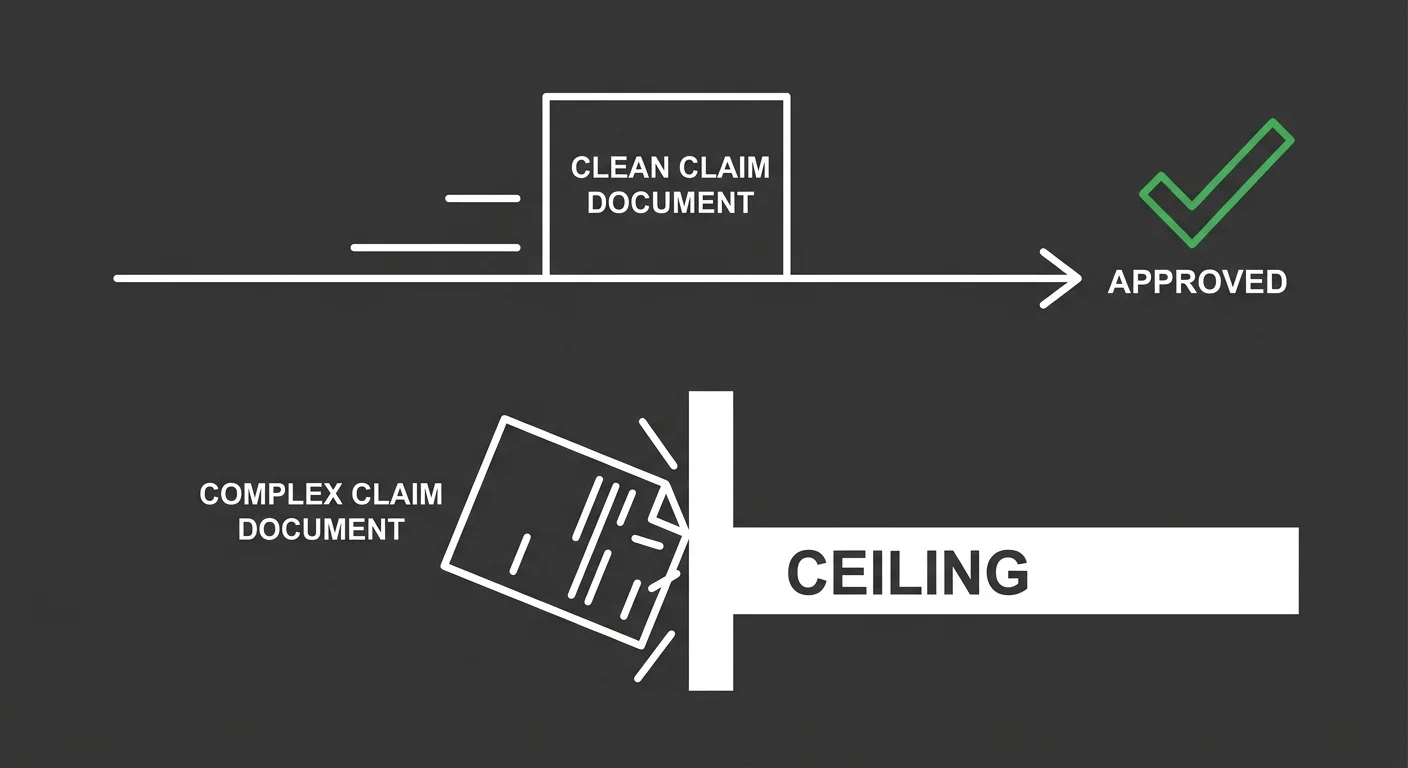
Billing software does one thing well: it moves clean claims through a payer's front door fast.
That's the pitch. That's also the ceiling.
Medical billing runs inside a strict coding hierarchy. CPT codes, ICD-10 modifiers, payer-specific logic — software is built to process that structure on the first pass.
But payers don't always agree with the submission. When they don't, the software has one move: route the denial to a queue.
In most software-only setups, nobody works that queue.
Understanding what revenue cycle management actually demands — beyond submission — is where most evaluations fall apart. Vendors lead with automation rates, clearinghouse connections, and dashboard visualizations.
They don't lead with what happens after the claim comes back rejected.
That's the part software doesn't cover. And that's the part that determines whether scale builds revenue or just builds volume.
The Submission Ceiling: Clean Claims Get Paid, Complex Claims Get Abandoned
Clean claims get paid. That's not a differentiator — that's table stakes.
The real test is what your billing infrastructure does with the claims that don't get paid on the first pass.
CMS mandates compliance with published EDI transaction standards — specifically ASC X12 Version 5010 — for professional claims processing. Software can be coded to submit within that standard.
What it can't do is interpret a payer's denial rationale. It can't construct a medical necessity argument. It can't work through the documentation corrections a multi-step appeal requires.
Those aren't software functions. They're judgment calls.
High-volume clinics hit this ceiling constantly. They just don't see it right away.
The submission dashboard looks healthy. Claims are going out fast. But pull the aging AR report and it tells a different story — complex claims stacking in the 90-day column, modifier disputes unresolved, high-friction payer decisions left completely uncontested.
That's not a volume problem. That's the submission ceiling in practice.
Why Most Practices Don't Notice the Ceiling Until Their AR Is Already Broken
Here's the thing about the ceiling — it's invisible while volumes are manageable. One location, moderate claim load, a part-time biller who knows which denials are worth chasing.
The system limps along. Nobody notices what's not being recovered.
But the moment a practice grows — a second location, a third provider, multi-location administrative complexity that outpaces the staff — the ceiling stops being invisible.
More claims means more complex denials. More complex denials means more unworked AR. And more unworked AR reveals the truth: what looked like a billing problem was a recovery problem the entire time.
By the time most practices notice, the AR is already broken. The 60-day column is full. The 120-day column has claims approaching the point of no return.
And the software dashboard still shows submissions going out on time — because it does. Submission was never the problem. Recovery was.
| Billing Function | What Software Handles | What Software Cannot Handle | Revenue Risk When Unworked |
|---|---|---|---|
| Clean claim submission | Formats and transmits standard claims through EDI clearinghouse connections on first pass | Cannot evaluate whether clinical documentation supports the billed service before submission | Low — clean claims typically pay; risk is in what software misses before the claim goes out |
| CPT and ICD-10 modifier application | Applies modifiers based on pre-configured rules and code mappings in the system | Cannot assess whether chiropractic-specific modifiers (e.g., AT modifier for active care) are clinically justified for the individual claim | High — incorrect or missing modifiers trigger denials that software has no pathway to resolve |
| Denial routing | Flags rejected claims and routes them to a denial queue for review | Cannot interpret the payer's denial rationale, draft a rebuttal, or initiate a structured appeal | High — denial queues without dedicated human follow-through age into uncollectable AR |
| Medical necessity arguments | None — software has no function for constructing or submitting medical necessity documentation | Cannot review clinical notes, identify documentation gaps, or build the case a payer requires to reverse a denial | Very high — medical necessity disputes are among the highest-value denial categories and require human judgment at every step |
| Accounts receivable follow-through | Generates aging AR reports and surfaces outstanding claim balances by time period | Cannot actively work aged claims, escalate unresolved disputes, or determine which claims are still recoverable vs. written off | Very high — aging AR compounds without active intervention; software surfaces the problem but does not solve it |
| Multi-step payer appeals | None — software does not support multi-step appeal workflows or payer-specific appeal documentation requirements | Cannot track appeal deadlines, compile supporting documentation, or resubmit with corrected clinical evidence | High — complex payer disputes left uncontested result in permanent revenue loss at the claim level |
| Personal injury (PI) lien billing | May support basic claim submission for PI cases in some platforms | Cannot manage the extended lien timeline, coordinate with attorneys, or apply jurisdiction-specific PI billing rules | Very high — PI lien cases carry significant per-claim value and require specialty expertise that generalist software workflows don't provide |
Why Software Submission Fails Chiropractic-Specific Claims
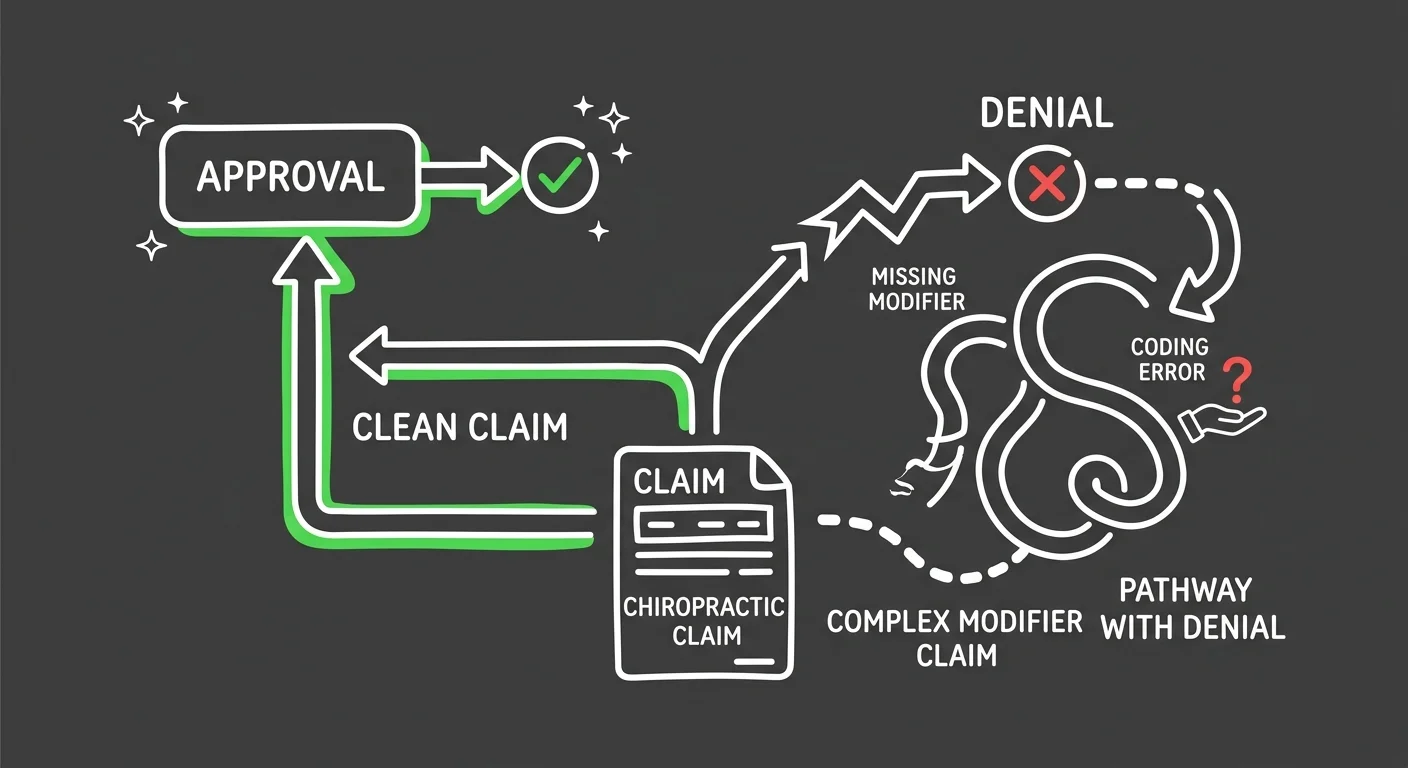
Chiropractic billing isn't general medical billing with extra steps.
It's a specialty coding environment with rules most billing software was never built to handle — and that most generalist billers don't know well enough to catch when they break.
The AT modifier. Personal injury lien workflows. Maintenance versus active care documentation standards.
These aren't edge cases. They're the claims that drive the most volume and carry the most risk. Research puts the U.S. medical billing error rate at up to 80% of all bills. In a specialty-coded environment, that vulnerability doesn't spread evenly across claim types. It concentrates exactly where complexity lives.
Software processes what its rule set allows. What falls outside that rule set doesn't get flagged, escalated, or corrected.
It gets rejected — and then it sits.
That's the submission ceiling applied directly to chiropractic claims. Not a general problem. A specialty-specific one that compounds with every location you add and every provider you bring on.
AT Modifier Rules, PI Lien Workflows, and the Coding Gaps Software Can't Close
The AT modifier isn't optional on Medicare chiropractic claims. It's the difference between payment and automatic denial.
It signals that care is active and medically necessary — not maintenance, which Medicare doesn't cover. Software can be configured to append it. What software can't do is evaluate whether the underlying documentation actually supports the modifier being there.
When a payer questions medical necessity on a chiropractic claim, the response requires clinical context. Someone reads the patient file. Someone constructs a structured argument. Someone connects the diagnosis to the treatment in terms the payer will accept.
That's not a rules engine problem. It's a judgment call. And it's precisely the kind of judgment that any enterprise clinic evaluating billing partners needs to pressure-test before signing with any vendor.
Personal injury lien billing adds another layer entirely. PI cases involve coordination between payers, attorneys, and settlement timelines that don't follow standard insurance claim workflows.
EHR platforms aren't designed to manage those workflows. Software submission tools aren't either. The clinical coding frameworks that govern these cases require specialty knowledge that generalist automation simply doesn't carry.
The Denial Pattern Software Creates — and Never Reports
Here's what software never tells a practice: which denial patterns are recurring, which modifier errors are systemic, and which payer behaviors are costing the most revenue month over month.
The dashboard shows what went out. It doesn't show what's quietly failing — or why.
The U.S. medical billing error rate runs as high as 80% of all bills. In a high-volume chiropractic practice, that error rate doesn't distribute evenly.
It concentrates in the complex claims — modifier-sensitive submissions, multi-payer PI cases, documentation-heavy Medicare filings. Those are the denials that software routes to a queue. Then leaves there.
The pattern becomes visible only when someone is actively tracking it.
A dedicated billing specialist — one working a specific practice's claims every week — notices when a particular payer starts rejecting AT modifier submissions at a higher rate than expected. They investigate. They correct. Software doesn't do that. It resubmits what it's told to resubmit and marks everything else as pending.
Who This Model Works For — and Who It Quietly Fails
Software-only billing works for practices where claim complexity stays low. Cash-pay-heavy models, high-volume straightforward diagnostics, minimal modifier variance.
For those practices, submission speed is the primary metric. Automation delivers it well.
But that profile doesn't describe most high-volume chiropractic and allied health practices. It describes the exception.
The practices that scale — multiple providers, mixed payer mix, Medicare patients, personal injury caseloads — are exactly where software-only pipelines quietly fail. Not all at once. Gradually, as unworked denials age and complex claims pile up in the 90-day column.
The practices this model fails most are the ones growing fastest. They add providers. They add locations. They trust the submission dashboard because the numbers look fine.
Meanwhile, the claims that live above the software's ceiling — modifier disputes, lien cases, medical necessity appeals — go unworked. Revenue doesn't disappear all at once. It bleeds out, claim by claim, until the AR report tells a story the dashboard never did.
| Claim Type | Software Default Behavior | Failure Mode | Downstream AR Impact |
|---|---|---|---|
| AT Modifier (Medicare Chiropractic) | Appends modifier based on configured rule set; submits claim | Cannot evaluate whether underlying documentation supports active care vs. maintenance; payer questions go unanswered | Medicare denials accumulate in 90-day AR column; unappealed modifier disputes age past recovery threshold |
| Medical Necessity Denial | Routes denial to pending queue; may auto-resubmit without correction | No clinical context read; no structured necessity argument constructed; no documentation correction initiated | Denial remains unresolved; claim ages; revenue is written off or abandoned without appeal attempt |
| Personal Injury Lien Claim | Processes claim against standard insurance workflow logic | PI lien timelines, attorney coordination, and settlement sequencing fall outside standard EDI transaction logic | Claims stall in limbo; lien resolution is delayed; settlement-period revenue goes uncollected |
| Maintenance vs. Active Care Documentation | Submits based on coding entered; no documentation review occurs | Cannot distinguish whether clinical notes support active care coding; miscoded claims trigger blanket rejections | Recurring payer rejections on the same documentation pattern go undetected and uncorrected across multiple claim cycles |
| Multi-Step Payer Appeal | Flags denial as requiring manual follow-up; no appeal pathway executed | Appeal requires clinical argument, documentation assembly, and payer-specific escalation — none of which software automates | High-value complex claims expire without appeal; recoverable revenue is permanently lost |
| Systemic Modifier Error Pattern | Resubmits individual claims without pattern analysis; each denial treated as isolated event | No tracking across claim cycles; recurring modifier errors from the same payer or provider go unidentified | Revenue leaks consistently on the same claim type month over month; practice never sees the pattern driving it |
What Managed RCM Actually Covers That Software Doesn't
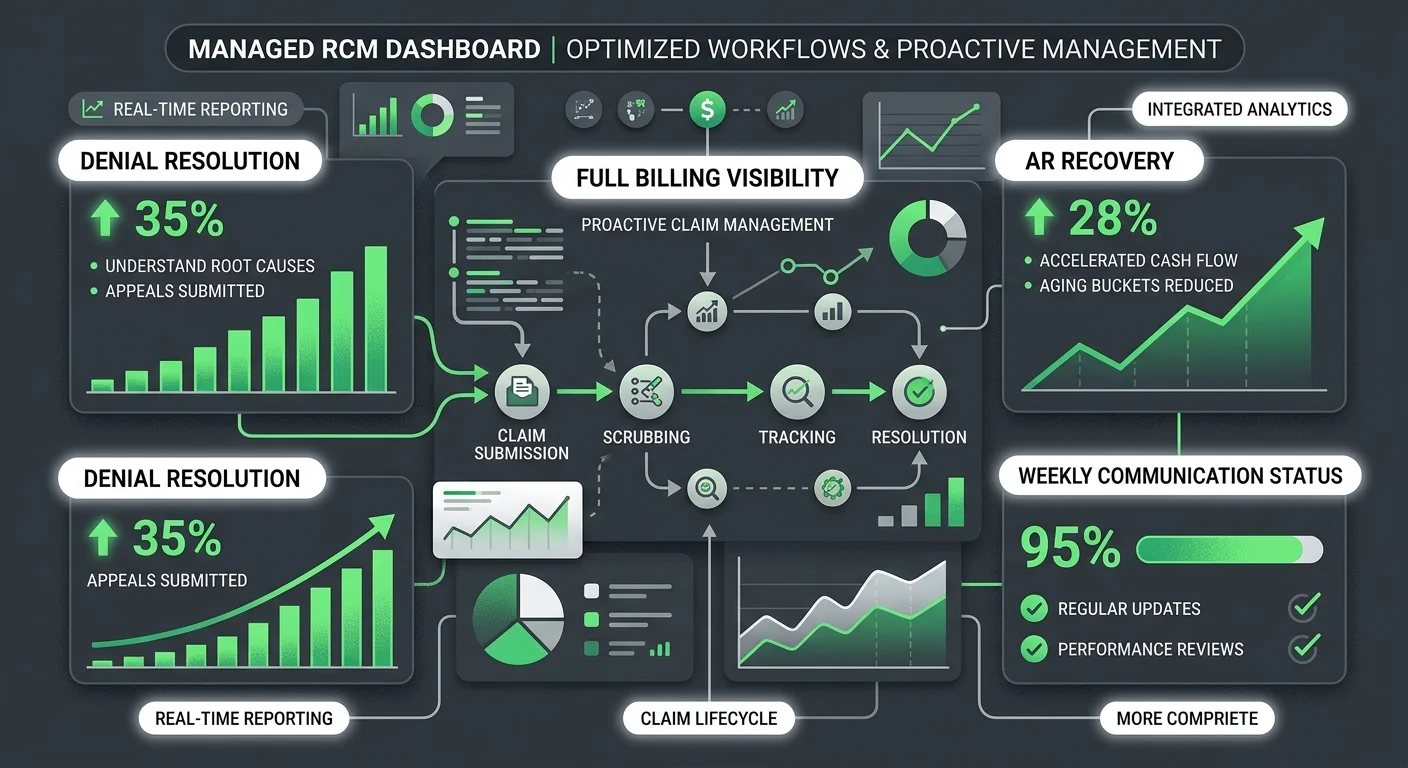
Software submits. It doesn't recover.
That's not a small distinction. That's the entire gap.
What sits above that ceiling isn't hard to describe. It's hard to execute.
Denial management. Medical necessity appeals. Proactive AR recovery. Structured communication. Specialty modifier expertise. These are the functions that determine whether a high-volume chiropractic practice builds sustainable revenue — or just a sustainable claim volume that flatters the dashboard while the money bleeds out.
An embedded billing partner covers this entire layer. Not as an upgrade. As the core function.
The difference between a billing vendor and a billing partner comes down to one question: are they accountable for what comes back — or only for what goes out?
Denial Management, Medical Necessity Appeals, and the Human Judgment Layer
When a payer denies a claim, the clock starts immediately.
Appeals have windows. Documentation has deadlines. A medical necessity argument requires someone who can read the patient file, identify the clinical support, and structure a response the payer's reviewers will actually accept.
That's not a software function.
It's a human judgment call — and it's exactly the call that software routes to a queue and leaves there. A managed RCM partner works that queue. Every week. Against every payer. For the specific practice they're embedded in.
McKinsey has quantified the potential to eliminate $265 billion in annual administrative waste in healthcare — with billing and insurance-related friction as the primary driver.
That number doesn't exist in the abstract. It's built from practices leaving high-friction denials unworked, assuming the software handled it, finding out months later it didn't. A managed RCM partner doesn't fix the system. It recovers the practice's share of that waste — claim by claim, before the window closes.
AR Recovery, Communication Cadence, and Visibility Into What's Actually Happening
AR recovery isn't a cleanup project. It's an ongoing function.
Claims age. Payer timelines expire. The difference between a recoverable claim and an unrecoverable one is often measured in days — and someone has to be watching.
A managed RCM partner brings a communication cadence that software can't replicate. Weekly updates. Denial pattern tracking. Clear visibility into which claims are moving, which are stalled, and which need immediate escalation.
Practices running on software alone don't get that. They get a dashboard showing what went out — and a silence that masks what isn't coming back.
The applicable federal privacy law security standards governing billing environments require vendors handling electronic protected health information to maintain specific administrative and technical safeguards. A managed RCM partner operating within those standards isn't just compliant — their processes are auditable, transparent, and built around accountability rather than throughput.
Visibility isn't a feature. It's the mechanism that keeps practices from discovering a cash flow crisis six months after it started.
When a billing partner communicates proactively — without being asked — the practice knows what's happening with its revenue before the AR report becomes the bad news.
What an Embedded Billing Partner Requires From Your Practice — and Why It Matters
Here's what most practices don't hear before they sign: managed RCM requires something from you.
Not a lot. But it's not passive.
EHR access. Documentation turnaround. Provider availability when a complex claim needs clinical clarification.
Those aren't optional courtesies. They're the inputs a billing partner needs to do the work software can't. When a denial requires a medical necessity argument, that argument gets built on actual clinical documentation. That documentation lives in your practice. Your billing partner needs to get to it — fast, without friction, without chasing anyone down.
Practices that disengage from their billing partner produce disengaged results. That's not a flaw in the model. That's the model working exactly as designed — both sides are in it, or neither side gets the outcome.
That's also the structural reason a managed RCM partner recovers what software leaves unworked. Accountability runs in both directions.
The FTC's 2023 enforcement action against a medical billing coordinator drew a clear line: billing partners that fabricate documentation or push unauthorized charges face serious regulatory consequences. A legitimate managed RCM partner operates in the opposite direction — documented processes, full transparency, and outcomes the practice can verify without asking twice.
| RCM Function | Billing Software | Managed RCM Partner | Why the Difference Compounds at Scale |
|---|---|---|---|
| Denial Management | Routes denied claims to a queue; resubmits what it's told to resubmit | Dedicated specialist reviews each denial, identifies the root cause, and works the appeal | At scale, unworked denials compound — each billing cycle adds new denials on top of aging ones the software never resolved |
| Medical Necessity Appeals | No pathway for narrative arguments; claim is marked as denied and moved past | Specialist reads the patient file, structures a clinical argument, and submits a documented response to the payer | High-volume practices generate more complex claims — the appeal gap widens as patient volume grows |
| AT Modifier Compliance | Can append the modifier; cannot evaluate whether the underlying documentation supports it | Reviews documentation against medical necessity standards before submission and during any payer challenge | Medicare chiropractic claims at volume mean modifier errors accumulate — systemic errors require human pattern recognition to catch |
| Personal Injury Lien Coordination | Not designed for PI workflows; standard claim submission only | Manages coordination across payers, attorneys, and settlement timelines specific to each case | PI caseloads grow with practice size — without specialty management, lien cases stall and revenue stays locked |
| AR Recovery | Reports on aging AR; does not actively work it | Tracks aging claims, identifies recovery windows, and escalates before payer timelines expire | Claims age past the point of return faster than software flags them — recovery requires active intervention, not passive reporting |
| Denial Pattern Tracking | Shows what was submitted and what was denied; does not analyze why patterns recur | Identifies payer-specific denial trends, modifier error patterns, and systemic documentation gaps driving repeated losses | At scale, recurring denial patterns become revenue-destroying if no one is identifying and correcting the source |
| Proactive Communication | Dashboard visibility only — practice sees what went out, not what's failing | Weekly updates on claim status, stalled items, and escalation flags — without the practice having to ask | Growing practices need more visibility, not less — silence from a billing vendor is a structural risk that compounds with every new provider added |
The Real Cost Comparison: Software Subscriptions vs. Performance-Based RCM
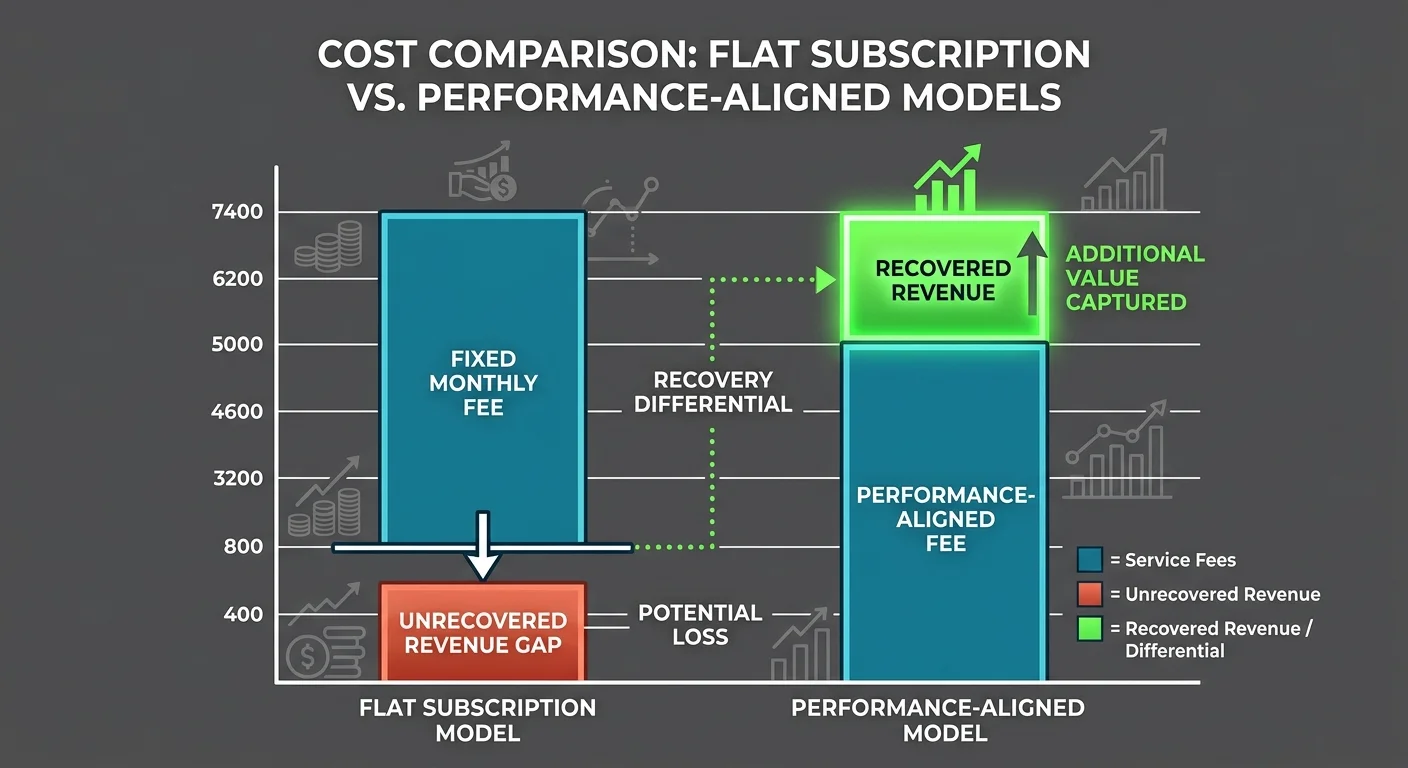
Cost is the first objection. It's also the most misunderstood one.
A flat software subscription looks cheaper on paper. It isn't. Not once you factor in what the software never touches. The real comparison isn't subscription fee versus RCM percentage — it's total revenue recovered versus total revenue submitted.
Those two numbers only match if you have zero modifier complexity, zero denials, and zero AR aging past 60 days. That practice doesn't exist at high volume. It barely exists at low volume.
What a Flat Software Fee Actually Costs When Complex Claims Go Unworked
A software subscription charges the same flat fee regardless of what it recovers. It costs the same whether your practice collects 70% of submitted revenue or 95%. There's no incentive built into that structure to work the hard claims — the modifier disputes, the medical necessity appeals, the aging lien cases. Those claims take time. Flat fees don't budget for time.
So the software queues the denial. The queue ages. The subscription bill arrives anyway. And nobody sends you a line item for the revenue that quietly disappeared — but your AR report is telling that story right now, if you know where to look.
Practices that track KPIs for scaling a chiropractic enterprise — collection rate by payer, denial rate by claim type, AR aging by provider — catch this pattern early. Practices running software-only pipelines usually catch it late, after the 90-day column has grown past easy recovery. By then, the question isn't how to fix the current setup. It's how much of that AR is still workable at all.
How Performance-Based Pricing Aligns Incentives — and What That Means for High-Volume Clinics
Performance-based pricing flips the entire dynamic. A managed RCM partner gets paid on collections — not submissions, not dashboard activity, not claim volume. Their revenue moves with yours. That's not a tagline. That's the reason complex claims get worked instead of abandoned.
When a denial comes back on a high-value chiropractic claim, a performance-based partner has a direct financial reason to appeal it. When a lien case is moving slowly through settlement, a performance-based partner has a direct financial reason to track it. The incentive doesn't need to be managed by your practice — it's built into the model. For clinics dealing with multi-location administrative complexity, that structural alignment matters more than the rate.
McKinsey put a number on the administrative waste problem in U.S. healthcare: $265 billion annually, with billing and insurance friction as the primary driver. A performance-based RCM partner doesn't address that in the abstract. It converts recoverable revenue back into practice collections — claim by claim — with accountability baked directly into every invoice.
| Cost Factor | Billing Software Model | Performance-Based Managed RCM | Scale Impact at High Volume |
|---|---|---|---|
| Pricing structure | Flat monthly subscription — fixed regardless of revenue recovered | Percentage of collections — partner earns only when the practice collects | At high volume, flat fees create zero incentive to work complex or aging claims |
| Denial appeal coverage | Routes denials to a queue; no human escalation pathway for complex claims | Dedicated billers review, build, and submit multi-step appeals per payer | As claim volume grows, unworked denials compound — software queues age silently |
| Modifier and specialty rule application | Rules engine applies standard coding logic; chiropractic-specific modifier nuance is not enforced at the human level | Specialty-trained billers apply AT modifier rules, maintenance vs. active care distinctions, and PI lien workflows per claim | High-volume chiropractic practices generate more modifier-sensitive claims — errors scale proportionally without human review |
| AR recovery function | Submission dashboard reflects what went out; aging AR is visible but not actively worked by the software | Continuous AR monitoring with proactive escalation before claims expire or become unrecoverable | At scale, even a moderate percentage of unworked AR represents significant recoverable revenue left on the table |
| Communication and reporting | Dashboard access showing submission status; no proactive outreach when claims stall or deny | Weekly updates, denial pattern reporting, and direct communication — without the practice having to ask | Multi-location and high-volume practices need visibility across all providers and payers; silence masks systemic problems until they become cash flow crises |
| HIPAA and compliance accountability | Software vendor maintains platform-level security standards; billing errors and process gaps remain the practice's liability | Managed RCM partner operates under documented, auditable workflows with shared accountability for process integrity | Regulatory exposure scales with claim volume; a partner with transparent, structured processes reduces that exposure across every payer relationship |
| Incentive alignment | No financial stake in what comes back — subscription revenue is independent of practice collections | Revenue tied directly to practice collections — complex claims get worked because the partner's income depends on it | At high volume, structural incentive alignment determines whether the hardest, highest-value claims get recovered or quietly abandoned |
Frequently Asked Questions
These aren't theoretical questions. They're the exact friction points that come up when a high-volume clinic is actually deciding whether to change its billing model.
The answers below are direct. High-volume clinics don't run on 'it depends.'
Is billing software or managed RCM better for a high-volume chiropractic clinic?
Managed RCM is better for high-volume clinics. Software handles clean claim submission well. It stops there.
At high volume, the claims that drive the most revenue — modifier disputes, medical necessity appeals, complex denials — require human judgment. Research puts the U.S. medical billing error rate at up to 80% of all bills. Software doesn't catch those errors on the back end. A managed RCM partner does.
The higher the volume, the more that gap costs.
Can a multi-location clinic scale using just the EHR's built-in billing features?
No. EHR billing features are claim submission tools. They're not denial management. They're not AR recovery.
Accurate CPT and ICD-10 modifier application is what keeps claims moving — and that's exactly the layer EHR platforms don't actively manage after submission. Multi-location complexity adds payer mix variation, provider-level coding differences, and AR aging across sites.
That's not a software problem. It's a people problem. Software doesn't solve it by getting bigger.
Why does relying on billing software often lead to growing accounts receivable?
Software submits and stops. When a claim comes back denied, it routes to a queue. The queue ages. Nobody works it.
That's not a glitch. That's how the model is built. AR grows because denied claims never get appealed — not because they weren't submittable. Research puts the medical billing error rate at up to 80% of all bills. When no one reviews what comes back, those errors compound into write-offs.
Six months into a software-only pipeline, aging AR isn't a surprise. It's the expected output.
How does managed RCM handle chiropractic modifier rules differently than software?
Software applies modifiers at submission based on rules logic. When a payer disputes that modifier, software has no response. There's no pathway. The claim just dies.
Chiropractic billing lives inside strict clinical coding requirements. When a payer pushes back on a modifier, someone has to read the patient file, build the clinical argument, and respond before the appeal window closes.
That's not a rules problem. It's a judgment problem. And software doesn't have judgment.
What does a performance-based RCM model actually cost compared to a software subscription?
A flat subscription costs the same whether the practice collects 70% or 95% of submitted revenue. The software vendor gets paid either way. That's the structural problem.
Performance-based pricing ties the partner's compensation directly to what the practice collects. McKinsey has identified the potential to eliminate $265 billion in annual healthcare administrative waste, with billing friction as the primary driver. At the practice level, that waste shows up as unworked denials sitting in an ignored queue.
The real comparison isn't the fee. It's total revenue recovered against total revenue submitted. A flat subscription has no stake in that number. A performance-based partner does.
What does a practice need to provide for managed RCM to work effectively?
Three things: EHR access, documentation turnaround, and provider availability when a complex claim needs clarification.
These aren't optional. A managed RCM partner can't build a medical necessity argument without the clinical documentation behind it. CMS mandates strict EDI compliance under ASC X12 Version 5010 for professional claims processing — a billing partner operating inside those standards needs the practice's data to do the job correctly.
Practices that disengage produce disengaged results. This model works because both sides are actually in it.
Submission Is Not Billing — And Scale Makes That Difference Permanent
Software submits clean claims well. Then it stops.
Everything above that ceiling — modifier disputes, medical necessity appeals, lien recovery, aging AR — doesn't get worked. It gets queued. Then it ages. Then it disappears.
At low volume, that loss is annoying. At high volume, it's permanent.
The practices scaling fastest are the most exposed to this gap. More providers. More locations. More payer complexity. More claims that need a human judgment call instead of an automated route.
Scaling a software-only pipeline doesn't close that gap. It widens it.
The submission ceiling doesn't move when a practice grows. The claims piling up above it just get older — and harder to recover.
Bushido Billing is built for what lives above that ceiling. Performance-based. Embedded in the practice's actual workflow. Accountable for what comes back — not just what goes out.
That's not a product feature. That's the difference between a billing vendor and a revenue cycle management partner.
Software submits. It doesn't recover. The only question is whether the billing model scaling with your practice is built to work the claims that submission alone will never touch.
Software submits. It doesn't recover. And if you're not sure whether your current billing model is actually working the hard claims — or just processing the easy ones and leaving the rest — that's the exact conversation Bushido Billing is built to have.

© 2026 Bushido Billing. All Rights Reserved | Web Design by iTech Valet