

How Can a Comprehensive Practice Audit Reveal Hidden Revenue in Your Current AR?
A practice audit reveals hidden revenue in your accounts receivable by identifying the specific claims your billing operation left unworked, miscoded, or abandoned. The audit does not create the problem. It is the first time someone looks.
Chiropractic billing fails in predictable patterns. Claims submitted without the Active Treatment (AT) modifier on CPT codes 98940, 98941, or 98942 are processed as maintenance care and denied outright. Documentation that omits precise spinal levels or measurable subjective progress markers triggers technical denials at the payer level. Initial evaluation records that do not establish clear clinical justification invalidate every downstream treatment claim built on top of them. Medicare reimbursement requires documented functional improvement — without it, post-payment clawbacks become a real exposure.
These are not random errors. They are structural gaps that repeat across every billing cycle until someone looks.
The accounts receivable aging report is where the clearest evidence lives. Unworked claims older than 90 days are systematically abandoned — not reviewed and closed, but written off because multi-step appeals require specialty knowledge that volume-first billing operations do not budget for. That unrecovered cash does not disappear. It compounds and ages past the point of return while the practice assumes the biller is working it.
A practice audit traces the full path of a claim — from the initial evaluation through every denial, every appeal attempt, and every write-off. It identifies whether documentation failures drove the denial, whether modifier rules were applied correctly, and whether aging AR was worked or quietly abandoned. The result is a clear picture of how much revenue is still recoverable and what billing failures produced the gap.
HHS OIG reviews have consistently flagged chiropractic billing for high error rates tied directly to missing documentation support. These are known failure points. A practice audit brings them into view — not as a compliance exercise, but as a revenue recovery strategy.
Last Updated: August 17, 2026
- • What a Practice Audit Is Actually Measuring
- • Why Volume-First Billing Hides the Revenue Gap
- • The Specific Revenue Signals a Chiropractic Audit Uncovers
- • How to Read an Audit Finding as a Revenue Recovery Roadmap
-
• Frequently Asked Questions
- • How does a practice audit identify chiropractic-specific revenue leaks?
- • Why do standard EHR platforms fail to recover aging accounts receivable?
- • What are the most common coding modifier errors that trigger chiropractic claim denials?
- • How far back can a comprehensive billing audit go to recover lost revenue?
- • What is the difference between a compliance audit and a performance-based revenue audit?
- • The Revenue Was Never Gone — It Was Just Unworked
What a Practice Audit Is Actually Measuring
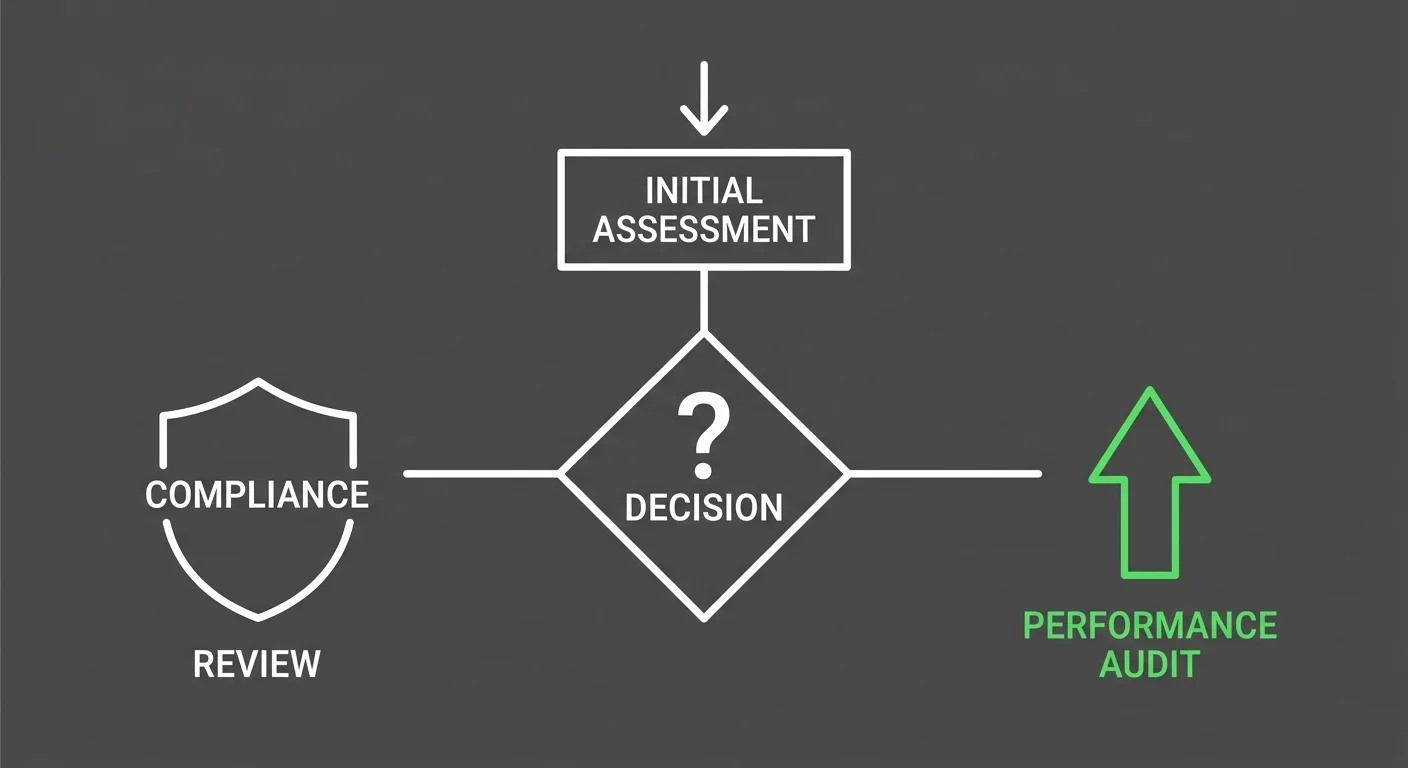
Most practices think a billing audit is about staying out of trouble.
That's the wrong frame. And it's exactly why the real revenue picture never surfaces.
A practice audit is a performance diagnostic.
It measures the distance between what a practice billed and what it actually collected — then traces exactly where that gap opened and why.
There are three layers the audit reads: documentation integrity, coding accuracy, and AR follow-through.
Every denial, every write-off, every aging claim that sat unworked — each one is a data point. Stack them together and you get a precise map of where revenue went. More importantly, you find out how much of it is still recoverable.
The Difference Between a Compliance Review and a Performance Audit
A compliance review asks one question: did the practice follow the rules?
A performance audit asks something different entirely: did the billing operation actually recover what the practice earned?
Those two questions produce different findings — and different price tags.
A compliance review surfaces documentation risk. A performance audit surfaces revenue loss. Practices that only run the first one never see the second picture. And the second picture is almost always the larger problem.
Published analysis of chiropractic billing patterns consistently flags missing active treatment modifier documentation as a primary driver of claim failure.
That's a performance failure. Not a compliance technicality. The care was rendered. The documentation gap blocked payment. A performance audit is the only lens that frames it correctly — because it asks who was supposed to catch that, and why they didn't.
The warning signs a chiropractic practice needs an audit are almost always sitting in the AR long before anyone thinks to look.
Why Most Billing Models Can't Find What They Lose
Volume-first billing is built for speed. Clean claims, fast submissions, high throughput — that's what the model optimizes for.
High-complexity claims don't fit that model. The ones needing modifier corrections, multi-step appeals, or documentation amendments cost more time than a volume operation budgets for them. So they don't get worked. They get written off — quietly, and without a line item in any report you'd ever see.
NIH-published research identifies documentation omissions — specifically incomplete subjective progress metrics and missing precise spinal levels — as primary drivers of technical denials at the payer level.
These aren't random errors. They're predictable gaps that volume-first operations never go back to fix.
The claim fails. The AR ages. Nobody flags it.
Bushido Billing's position is direct: a billing model that can't work the hard claims can't account for what it loses.
The audit changes that. It's the first time someone reads the complete record — not just the submission log, but every denial reason, every appeal gap, and every claim that aged past the follow-through window without a single person noticing.
| Audit Type | Primary Focus | What It Examines | Revenue Impact |
|---|---|---|---|
| Compliance Review | Regulatory risk exposure | Documentation rule adherence, coding standards, payer policy conformance | Identifies risk of audit penalties and clawbacks — does not surface unrecovered revenue |
| Performance Audit | Revenue recovery gap | Denial patterns, modifier application, appeal follow-through, AR aging by claim status | Reveals how much earned revenue was abandoned and whether any portion remains recoverable |
| Coding Review | CPT and modifier accuracy | Code selection against documented clinical findings, modifier usage per payer rules | Surfaces undercoding and modifier errors that reduce reimbursement on paid claims |
| AR Aging Analysis | Unworked claim volume | Claims by age bucket, payer, denial reason, and follow-up status | Identifies which aging claims are still workable versus written off without an appeal attempt |
| Documentation Integrity Review | Clinical record quality | Subjective progress metrics, precise spinal levels, functional deficit documentation, evaluation records | Determines whether documentation failures are driving denials or creating post-payment exposure |
Why Volume-First Billing Hides the Revenue Gap
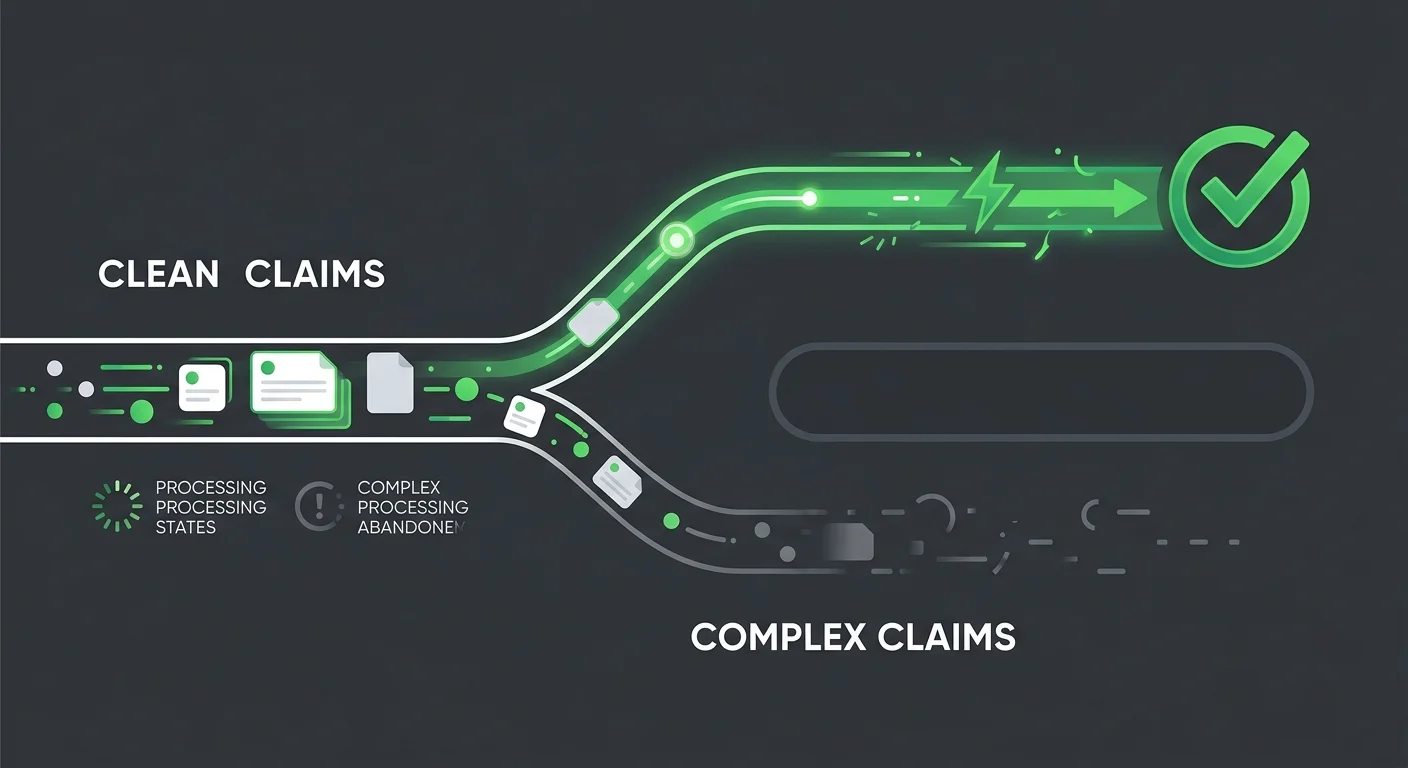
The revenue gap doesn't show up on a billing report. It hides inside one — buried in denial codes, aging buckets, and write-off categories that volume-first billing models were never built to question.
Volume-first billing is built for throughput. Clean claims move fast. Payers process them. Revenue lands. That cycle works — until a claim needs something more.
A modifier correction. A multi-step appeal. A documentation amendment. At that point, the model has no path forward. The claim stalls. Then it ages. Then it gets written off.
The practice never sees that revenue leave. No notification. No alert. No line item marked 'abandoned.' The claim stops moving, and the billing operation rolls into the next submission cycle like nothing happened.
Two failure points explain most of what disappears: modifier errors and AR aging patterns.
AT Modifier Errors: The Most Expensive Chiropractic Coding Gap
The AT modifier is not optional for Medicare chiropractic claims. It is a binary gate.
Append it to CPT codes 98940, 98941, or 98942, and the claim processes as active care. Miss it, and the claim gets reclassified as maintenance care — a category Medicare does not cover — and denied outright.
This is one of the most expensive and most preventable coding gaps in chiropractic billing. Published guidance on AT modifier requirements is explicit: the modifier must be present on CPT codes 98940, 98941, and 98942 to signal acute, medically necessary care — without it, the claim reclassifies as maintenance and Medicare denies it outright.
But volume-first billing isn't built for modifier-level auditing on individual chiropractic claims. That step doesn't fit the workflow. So the error doesn't get caught after the first denial — it compounds across billing cycles, quietly, until an audit runs the full history.
HHS OIG reviews have flagged chiropractic claims for high error rates tied directly to missing active treatment modifier documentation.
Not outliers. A structural pattern. And the audit is the first time anyone counts how many times that pattern repeated inside a specific practice's claim history — before anyone caught it.
AR Aging Patterns That Signal Abandoned Claims
AR aging reports don't lie. They show what a billing model actually prioritizes.
Unworked claims past 90 days don't sit there by accident. They sit there because working them requires specialty knowledge and follow-through that volume-first operations never budget for. Not reviewed. Not appealed. Written off.
The pattern runs the same way every time. A claim gets denied. Working it requires a multi-step appeal or a documentation correction. The billing model lacks the bandwidth or the specialty expertise to push it through.
The claim sits at 60 days. Then 90. Then past the window most payers will accept an appeal at all. Practices that run a full assessment of denied claims routinely find that a significant portion of their aging AR falls into exactly this category — recoverable at denial, unrecoverable by the time anyone looked.
An embedded billing partner with specialty-level chiropractic expertise works those hard claims before they age out. But the audit reveals what happened before that partnership existed.
How much aged. How much was written off. How much of that loss traces back to the same two failure points — modifier errors that triggered denials, and AR patterns that signaled abandonment.
That's not a theory about where revenue went. That's the record.
| Billing Model Behavior | What Gets Processed | What Gets Abandoned | Consequence for the Practice |
|---|---|---|---|
| High-volume clean claim processing | Standard CPT codes with complete documentation and no modifier complexity | Claims requiring modifier corrections, documentation amendments, or multi-step appeals | Revenue from straightforward visits is collected; revenue from complex or denied claims disappears into aging AR |
| Submission-speed optimization | First-pass claims that move through the payer cycle without friction | Denied claims that require a second or third appeal attempt with supporting clinical notes | Denial follow-through stops after the first rejection; the claim ages without resolution |
| Automated claim scrubbing | Formatting errors and basic coding mismatches flagged before submission | Modifier-level chiropractic rules — AT modifier application, maintenance vs. active care classification — that fall outside automated logic | Claims that pass the scrubber but fail the payer review generate denials the billing model has no pathway to correct |
| AR reporting without active follow-through | Claims in the 0–60 day aging window that remain within standard payer timelines | Claims past 90 days that require specialty knowledge and manual intervention to pursue | Aging AR is reported but not worked; write-offs accumulate as a structural outcome of the model, not as isolated mistakes |
| Generalist billing across multiple specialties | Routine visits coded under broadly applicable diagnosis and procedure codes | Chiropractic-specific claim types — personal injury lien billing, Medicare AT modifier claims, maintenance vs. active care distinctions | Specialty-specific revenue categories are either miscoded or abandoned because the billing model lacks the vertical expertise to navigate them |
The Specific Revenue Signals a Chiropractic Audit Uncovers
This isn't theoretical. The audit produces a record — claim by claim, denial by denial, write-off by write-off — of exactly what happened and why it happened.
Three signal categories surface in almost every chiropractic billing audit: documentation failures that triggered technical denials, modifier errors that reclassified reimbursable care, and AR aging patterns that show whether claims were actively worked or quietly abandoned.
Each one points to a specific breakdown. Together, they answer the question a practice should have been asking every quarter: how much of what we earned did we actually collect?
Here's what most practices miss: billing data isn't just a back-office record. It's a performance history — and any outside evaluator examining your practice reads it the same way an auditor does.
No assumptions. No deference to the submission log. Just what the numbers actually show.
Documentation Gaps That Trigger Technical Denials
Documentation failures aren't random. They follow a pattern — and the pattern is almost always the same two omissions: incomplete subjective progress metrics and missing precise spinal levels.
These aren't administrative oversights. According to PubMed, they're the primary drivers of technical denials at the payer level.
The problem starts at intake. CPT code selection and the clinical justification built in the first exam have to align exactly with every downstream treatment note.
When that alignment breaks, payers don't reject one claim. They reject every subsequent daily treatment built on an unsupported initial evaluation. One documentation failure at intake can wipe out an entire episode of care.
Published clinical documentation makes the standard explicit: chiropractic manipulative treatments are only reimbursable when patient records show measurable functional improvement. Not symptom reports. Not provider observations. Documented objective progress markers.
The audit cross-references every claim against that standard. When the documentation doesn't meet it, the denial wasn't a billing error. It was the predictable result of a structural gap nobody flagged.
Who This Audit Is Not Designed For
If the goal is to clear the backlog and return to the same billing model that created it, stop here. The findings don't change the outcome — they just document it again.
This process isn't built for practices that want a curated summary. What surfaces — claim-level denial patterns, unworked AR, modifier errors, write-off histories — is the full picture.
Practices that need revenue leakage from denied insurance claims visibility softened or selectively presented aren't the right fit. The audit doesn't edit what it finds.
Bushido Billing builds this audit as a relationship opener — not a transaction. The findings create a foundation for understanding exactly where a billing model broke down and what it takes to fix it structurally.
Practices ready to act on what surfaces will find it useful. Practices looking for confirmation that everything is fine won't find that here.
| Revenue Signal | Where It Appears in the AR | Root Cause | Recovery Action |
|---|---|---|---|
| AT Modifier Absence | Medicare denials bucket; reclassified as maintenance care | Volume-first workflow lacks modifier-level auditing on individual chiropractic claims | Retroactive modifier correction and appeal submission with supporting clinical documentation of active care necessity |
| Documentation Omissions at Initial Evaluation | Technical denials across the full episode of care linked to a single unsupported intake record | CPT code selection and clinical justification at first exam failed to align with downstream treatment notes | Documentation gap review at the intake level; appeal with corrected clinical record establishing the original justification for care |
| Missing Functional Improvement Markers | Post-payment clawback risk; claims flagged during payer audit or retrospective review | Treatment notes relied on symptomatic reports rather than documented objective progress markers required under CMS standards | Documentation audit against CMS functional improvement criteria; claims requiring correction flagged for provider review before re-submission |
| Unworked Aging AR Beyond 90 Days | Write-off category; claims no longer pursued after stalling at denial stage | Billing model lacked bandwidth or specialty expertise to execute multi-step appeals before payer deadlines closed the window | Identify claims still within appeal or dispute window; triage by payer and denial reason; work highest-value recoverable claims first |
| Personal Injury Lien Gaps | Unbilled or under-pursued lien balances in open case AR | High-friction lien workflow deprioritized or mismanaged by generalist billing operations without PI-specific process knowledge | Full PI lien audit against case settlement status; re-engage open cases with corrected lien documentation and updated demand letters |
How to Read an Audit Finding as a Revenue Recovery Roadmap
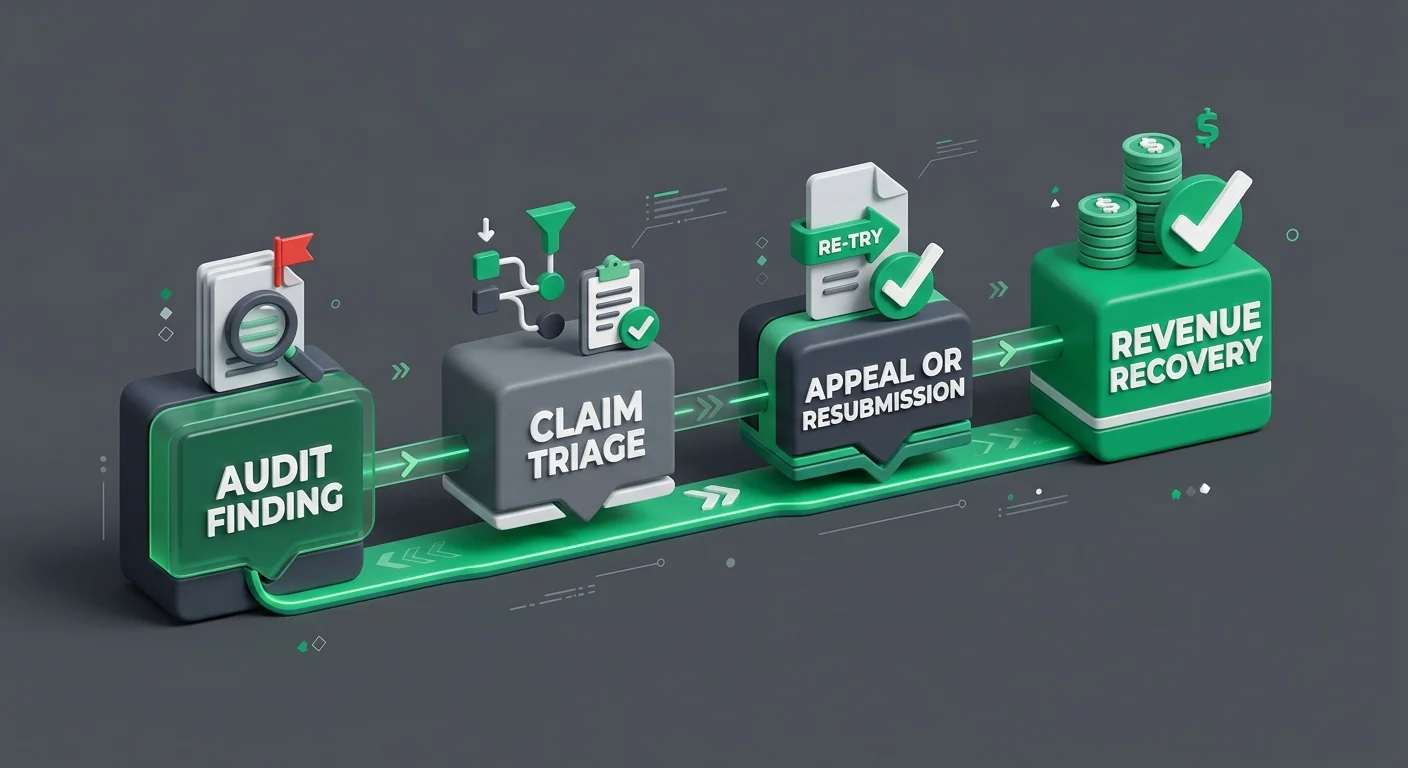
An audit finding is not a verdict. It is a map.
The question is whether a practice knows how to read it — and what it does next.
Every finding points to one of three things.
A claim denied for a correctable reason. A claim that aged past the recovery window. A documentation pattern that will keep generating the same denial on every future visit until someone changes the process.
Those three categories are not the same problem. They don't get the same fix. Treating them as a single cleanup job is how a practice misreads a structural failure as a one-time event — and how the same revenue disappears next quarter.
That distinction is exactly why the difference between a professional billing audit and software-generated reports matters.
Software surfaces submission data. It tells you a claim went out and came back denied. An audit tells you why it failed, whether that failure was recoverable, and what the pattern reveals about the billing operation that produced it.
One is a log. The other is an action plan.
Which Claims in Aging AR Are Still Workable
Not all aging AR is equal.
Some claims crossed 90 days because they were hard — a modifier correction was needed, a documentation amendment was required, or the payer demanded a multi-step appeal the billing model didn't have the bandwidth to execute.
Those claims aren't gone. They're unworked. That's a meaningful difference — and it's worth real money.
A practice reviewing unworked chiropractic aging AR reports needs to separate two populations.
Claims still inside the payer's appeal window. Claims that have aged past it.
The first group is recoverable revenue. The second is a permanent loss — but still an instructive one. It shows exactly how many times the same billing failure repeated before anyone stopped it.
CMS is not ambiguous on this. Chiropractic manipulative treatments are only reimbursable when documentation demonstrates measurable functional improvement — not subjective reports, not provider observations, but objective progress markers.
Claims that aged because the documentation never met that standard aren't recoverable through appeal. Reworking them wastes time. The real fix is upstream: change the documentation process so those claims don't fail at the source.
The audit draws that line clearly. A volume-first billing model doesn't draw it at all.
What Audit Findings Reveal About Your Billing Operation Going Forward
Here's what the findings actually reveal.
The practice doesn't have a denial problem. It has a billing operation that was never built to handle what chiropractic claims require.
Denials are the symptom. The audit exposes the structure underneath them.
Once the findings are in hand, the real question is accountability.
What changes so the same pattern doesn't repeat next quarter? A software upgrade doesn't answer that. A process memo doesn't either.
What answers it is a billing model with the specialty knowledge to catch modifier errors before submission, the human capacity to work multi-step appeals, and a proactive weekly update protocol that keeps a practice informed before problems compound into a cash flow crisis.
Think about what a clinician does after a patient intake. Handing someone a list of findings with no treatment plan isn't care — it's documentation.
The audit works the same way. Findings without structural follow-through produce a report. Not a recovery.
The practice that acts on what the audit surfaces — fixes its documentation process, works its recoverable claims, rebuilds its billing model around chiropractic complexity — stops losing the same revenue on the same problem every cycle. The audit didn't create the loss. It's just the first time someone looked.
| AR Age Bucket | Typical Recovery Likelihood | Required Action | When to Write Off |
|---|---|---|---|
| 0–30 days | High — claim is within standard appeal window for most payers | Review denial reason, correct the specific error (modifier, documentation gap, or coding mismatch), and resubmit immediately | Do not write off — every denial in this bucket has a correctable path |
| 31–60 days | Moderate — window is open but narrowing; payer responsiveness begins to decline | Prioritize by claim value; escalate complex modifier or medical necessity denials before they require a formal appeal process | Write off only after a formal appeal has been filed and denied with no further recourse |
| 61–90 days | Low to moderate — multi-step appeals are still possible but require specialty knowledge and documentation accuracy | Audit the underlying documentation against CMS functional improvement standards before filing; a weak appeal accelerates permanent loss | Write off if documentation cannot be corrected retroactively and the payer's appeal deadline has passed |
| 91–120 days | Low — most payers treat this bucket as abandoned; recovery requires exceptional documentation and persistence | Separate claims with correctable root causes (documentation amendments, modifier corrections) from those with no viable appeal path; work only the former | Write off claims with no correctable documentation or expired payer deadlines — but document the pattern for forward billing process changes |
| 120+ days | Minimal — claims in this range are systematically abandoned in volume-first billing models and rarely recovered | Treat this bucket as a permanent loss record, not a recovery opportunity; use it to identify the exact billing failure points that allowed claims to age this far without action | Write off and redirect focus to preventing the same pattern from generating the next 120-day bucket |
Frequently Asked Questions
These are the questions practice owners ask before they start an audit — and sometimes after it's done. No preamble. Just straight answers.
None of these answers hedge. The billing model either recovered what the practice earned — or it didn't.
How does a practice audit identify chiropractic-specific revenue leaks?
It cross-references claim-level denial data against the modifier rules, documentation standards, and payer criteria that general billing reviews aren't built to catch.
Here's the clearest example: CMS requires the AT modifier on every Medicare chiropractic spinal manipulation claim. CPT codes 98940, 98941, or 98942 submitted without it get reclassified as maintenance care and denied outright. A specialty audit catches that pattern in the claim history. Standard billing reviews don't flag it consistently — because they aren't built around chiropractic's specific rule set.
The audit also surfaces documentation omissions: incomplete subjective progress metrics and imprecise spinal level notation. These are primary drivers of technical denials at the payer level. General billing software doesn't distinguish them from other denial types. A specialty audit does. That distinction is exactly where the recoverable revenue lives.
Why do standard EHR platforms fail to recover aging accounts receivable?
EHR platforms send the claim. That's it.
What happens after the claim comes back — the denial review, the documentation correction, the multi-step appeal — requires human judgment. No EHR automates that. The platform records the submission. It doesn't record what was never worked after the denial landed.
Unworked claims older than 90 days get abandoned in volume-first billing operations. They produce permanent cash flow leaks that never show up in the submission log — because the log only tracks what went out, not what failed to come back. A retrospective AR audit is the only process built to surface that gap. The EHR can't find what it was never designed to look for.
What are the most common coding modifier errors that trigger chiropractic claim denials?
The AT modifier is the most consequential. Medicare claims for chiropractic spinal manipulation under CPT codes 98940, 98941, or 98942 require it to signal active, medically necessary care. Without it, the claim processes as maintenance — a non-covered service — and gets denied. No gray area. It's a binary gate.
The second most common error is documentation misalignment: incomplete subjective progress metrics and missing precise spinal levels that leave payers without the clinical justification to approve the claim.
And here's the part that should concern every practice owner: these two errors aren't random. They repeat on the same patients, the same visit types, and the same providers — every billing cycle — until someone maps the pattern and changes the process upstream. The audit maps the pattern. The volume-first billing model doesn't bother.
How far back can a comprehensive billing audit go to recover lost revenue?
It depends on payer-specific timely filing limits and the age of the claims.
But here's what the record consistently shows: claims older than 90 days that were never worked are where volume-first billing operations abandon complex appeals rather than pursue them. Inside the payer's appeal window, those claims are still recoverable. Beyond it, the revenue is gone.
The pattern those aged claims reveal, though — that's still worth finding. It tells the practice exactly how many times the same billing failure repeated before anyone stopped it. That finding is what prevents the next cycle from producing the same loss.
What is the difference between a compliance audit and a performance-based revenue audit?
A compliance-framed review asks whether the practice followed the rules. It measures regulatory risk. It's built around exposure, not recovery.
A performance-based revenue audit asks a different question: did the billing operation actually collect what the practice earned? Those two questions produce different findings. They need different expertise. And they serve completely different purposes.
A performance audit tells a practice where its cash flow went and whether any of it is still recoverable. That's the question a practice with aging AR and unexplained denial patterns needs answered. A risk assessment built around worst-case regulatory scenarios doesn't answer it. The practice that confuses the two ends up with a compliance report, no recovered revenue, and the same billing model running the same cycle next quarter.
The Revenue Was Never Gone — It Was Just Unworked
The revenue was never hidden. It was abandoned — claim by claim, modifier error by modifier error, appeal by appeal — by a billing model that was never built for what chiropractic actually requires. The audit doesn't create that loss. It locates it. And the only reason it needed locating is that no one was looking.
Here's what that abandonment looks like in real time. The AR ages. The same documentation failure repeats on every visit note. The cash-flow gap widens — quietly, without announcement. A practice running without a billing audit doesn't know any of this is happening. It just knows collections feel off. Bushido Billing builds the audit to find the structural failure underneath the denial pattern — not just the symptoms sitting on top of it. That's the difference between reading a billing report and understanding what it's been hiding.
So no — this isn't a defensive exercise. It's an offensive one. The practice that works its recoverable claims, fixes its documentation process, and builds a billing model designed for chiropractic complexity stops losing the same revenue on the same problem every cycle. That's not a projection. That's what Bushido Billing makes visible through the audit — and what skipping it guarantees will repeat.
The only question is whether your practice is ready to look. Because the audit doesn't create the problem. It's the first time someone looks.
The audit doesn't create the problem. It's the first time someone actually looks. What's sitting in your AR right now is either still recoverable — or it's aging past the point of no return while the same billing model runs the same cycle. Book a Call to see what's still recoverable in your AR

© 2026 Bushido Billing. All Rights Reserved | Web Design by iTech Valet