

What Are the Top 5 Warning Signs That Your Chiropractic Practice Needs a Billing Audit?
Five warning signs indicate a chiropractic practice needs a billing audit: denial rates increasing without explanation, Medicare AT modifier and documentation errors, accounts receivable aging past 90 days without movement, high-frequency codes billed without clinical variation, and no formal billing audit on record. Each pattern signals revenue leaving the practice — consistently, and without any system flagging it.
Chiropractic billing operates under a narrow set of payer rules. Medicare covers only spinal manipulation to correct subluxation. Every other service falls outside coverage. The AT modifier must appear on every active treatment claim to separate corrective care from maintenance therapy. When those requirements are missed or applied inconsistently, claims fail and the revenue gap does not announce itself.
The documentation problem runs deeper than most practices recognize. A peer-reviewed analysis of chiropractic records found that up to 83% of reviewed files lacked sufficient documentation to establish medical necessity. That is not a minor compliance gap. It is a structural exposure that follows a practice into every audit, every denial review, and every payer dispute.
The HHS Office of Inspector General has identified chiropractic services as carrying some of the highest improper payment rates in Medicare, historically exceeding 50% in multiple reviews. Chiropractic is one of the most scrutinized specialties in federal oversight. Practices that do not audit their own billing before a payer does are operating without a safety net.
Chiropractic clinics lose up to 15% of their total annual revenue to stagnant billing processes and unappealed denials. The warning signs are present long before that number appears on any report.
Last Updated: August 17, 2026
- • Why Chiropractic Billing Is a High-Risk Specialty — and What That Costs You
- • Why Most Billing Setups Miss These Warning Signs Entirely
- • Warning Sign 1: Your Denial Rate Is Climbing — and No One Is Explaining Why
- • Warning Sign 2: AT Modifier and Medicare Documentation Errors Are Appearing
- • Warning Sign 3: Your AR Is Aging Past 90 Days Without Movement
- • Warning Sign 4: High-Frequency Codes Are Appearing Without Clinical Variation
- • Warning Sign 5: Your Practice Has Never Had a Formal Billing Audit
-
• Frequently Asked Questions About Chiropractic Billing Audits
- • What triggers a federal chiropractic billing audit?
- • How do Medicare AT modifier errors lead to immediate claim denials?
- • What is the difference between active care and maintenance care under CMS rules?
- • How much annual revenue do chiropractic practices lose to unworked accounts receivable?
- • Can standard chiropractic EHR software replace a professional billing audit?
- • Your Billing System Has a Smoke Detector. What You Need Is a Fire Marshal.
Why Chiropractic Billing Is a High-Risk Specialty — and What That Costs You
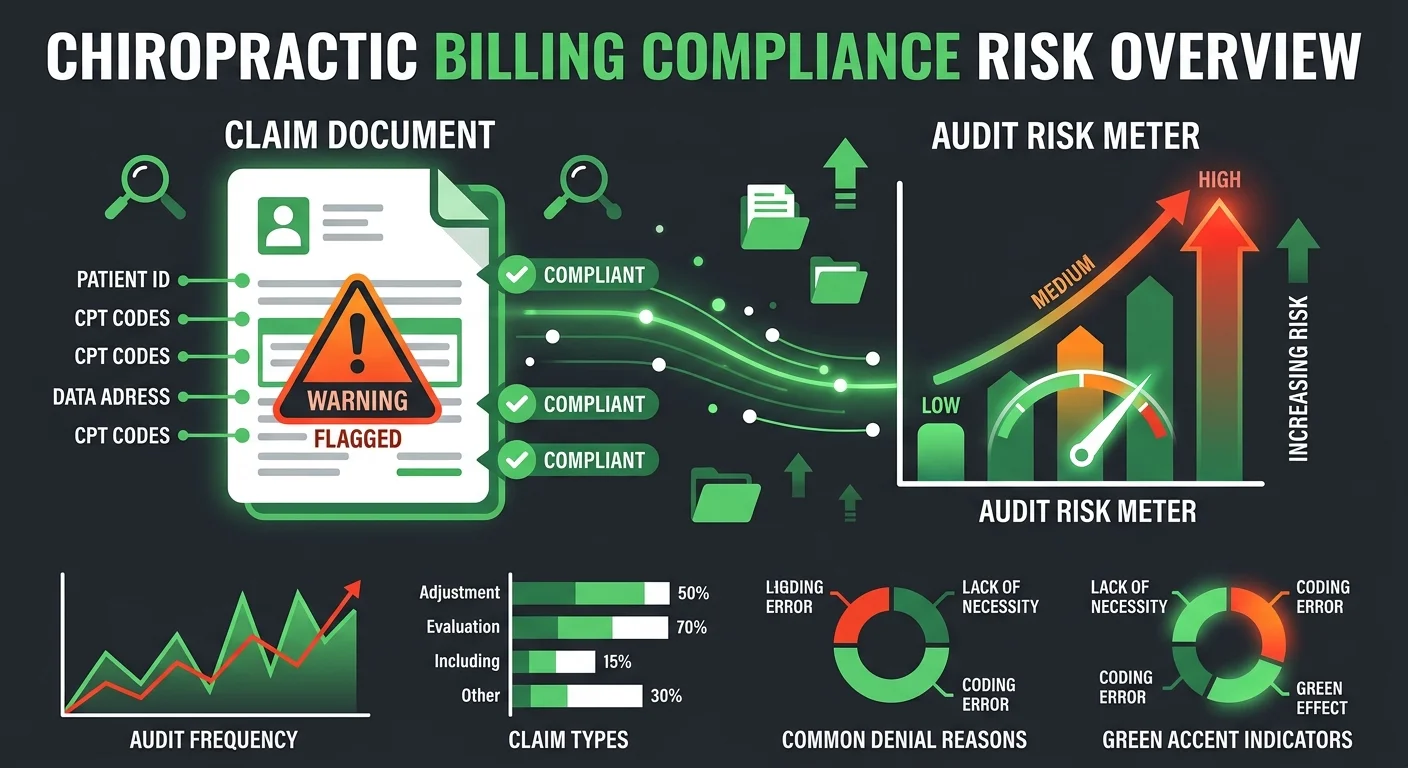
Chiropractic billing isn't general medical billing with a specialty label slapped on top.
It runs under a narrow set of payer rules that most billing processes were never designed to touch. When those rules get missed, revenue walks out the door — and the dashboard never tells you.
Medicare covers spinal manipulation to correct subluxation. That's it. The adjunctive therapies, the ancillary procedures — the things that feel routine inside the clinic — fall outside coverage entirely.
That boundary isn't gray. It's a hard line. And generalist billing processes cross it constantly without knowing it.
The result isn't an occasional denied claim. It's a revenue loss pattern embedded in the practice's billing workflow — repeating every submission cycle until someone actually stops to look.
Understanding what's recoverable from hidden revenue in your AR starts with one uncomfortable fact: chiropractic's compliance exposure is structurally different from every other specialty. The EHR was never built to show you that.
The Federal Audit Footprint on Chiropractic Claims
Federal oversight of chiropractic billing isn't incidental. It's sustained, it's targeted, and it's been running for years.
Published audit data shows that chiropractic services have historically carried some of the highest improper payment rates in Medicare — exceeding 50% in multiple federal reviews.
That figure does not represent isolated bad actors. It represents systemic documentation and coding failures across the specialty. Practices that assume they are compliant because no audit letter has arrived are not safe. They are unexamined.
Payers know exactly which documentation failures show up in chiropractic claims. Automated review systems flag the same errors repeatedly.
A practice billing without a formal audit process has no idea whether its records are part of that pattern. It finds out when a payer investigation surfaces it — not before.
Why Generic Billing Processes Fail Chiropractic-Specific Rules
Generic billing processes fail chiropractic practices for one specific reason: they were built to submit claims.
Not to manage specialty compliance. Not to apply human judgment at every coding decision. Submission isn't billing. They're different jobs, and practices that treat them as the same one pay for it every month.
An NIH-published analysis of chiropractic records found that up to 83% of reviewed files lacked the documentation needed to establish medical necessity.
That's not a record-keeping gap. That's near-total documentation failure — the predictable output of a volume-first process where no one is checking for clinical specificity.
Bushido Billing exists because this failure pattern is the rule in chiropractic, not the exception.
The AT modifier. Maintenance versus active care. Subluxation documentation. Visit frequency justification. These aren't concepts general billing workflows address consistently — they're the exact rules that determine whether a chiropractic claim survives a payer review.
When they're missed, the claim either fails outright or clears the first review and gets pulled back on audit. Either outcome costs the practice.
The full-service billing services that protect against this exposure are built around specialty rules — not adapted from a general medical framework that was never designed for chiropractic.
| Billing Risk Factor | Why It's Unique to Chiropractic | Consequence of Getting It Wrong |
|---|---|---|
| AT Modifier Requirement | Every Medicare active treatment claim requires the AT modifier to distinguish corrective care from non-covered maintenance therapy — a distinction that does not exist in general medical billing | Missing or inconsistent AT modifier use causes claim denials and flags the practice for payer review across all submitted claims in the same period |
| Subluxation Documentation | Medicare covers only spinal manipulation to correct subluxation — every other service falls outside coverage, and the documentation must establish subluxation on each visit independently | Undocumented or inadequately documented subluxation converts a billable service into an automatic non-covered claim with no path for recovery |
| Active Care vs. Maintenance Distinction | Chiropractic payer rules require clinical evidence of ongoing improvement to justify continued active treatment — a threshold general billing systems do not monitor | Billing active care codes beyond the point of documented clinical progress produces denials, overpayment demands, and sustained audit exposure |
| Visit Frequency Justification | High visit frequency without documented clinical variation signals upcoding patterns to payers — a risk specific to chiropractic's treatment cadence and one automated clearinghouses do not flag | Frequency patterns without supporting clinical change become the primary trigger for targeted payer audits and retrospective claim reviews |
| Medical Necessity Documentation | Chiropractic medical necessity requires functional outcome documentation at each visit — not a one-time diagnosis entry, but ongoing evidence of treatment rationale | Absent or template-generated necessity documentation fails payer review and renders entire claim batches undefendable in a dispute or audit |
| Federal Audit Targeting | Chiropractic services are among the most scrutinized specialties in federal Medicare oversight — OIG audit programs return to this specialty repeatedly because systemic documentation failures are well-documented | Practices operating without a formal internal audit process have no visibility into whether their records match the error patterns payers are actively investigating |
Why Most Billing Setups Miss These Warning Signs Entirely
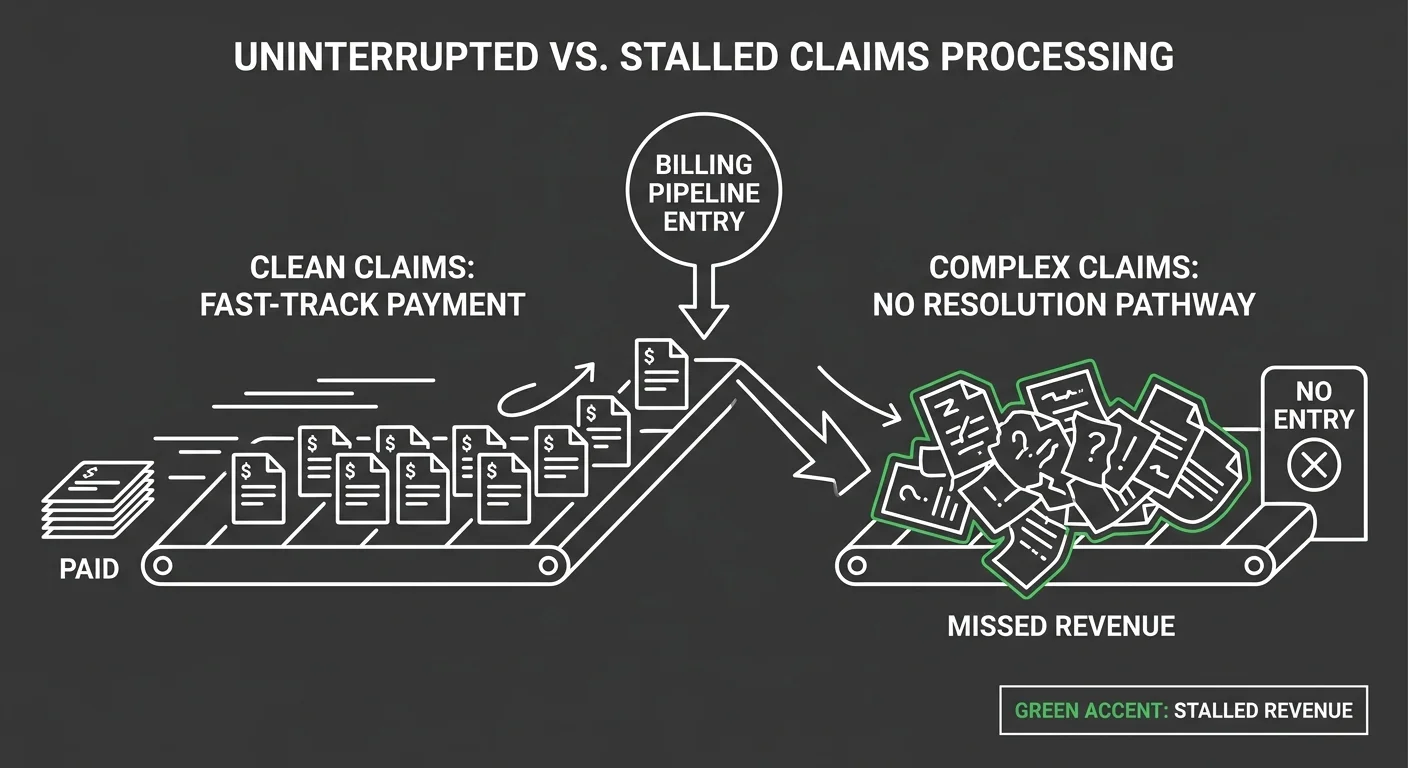
Most billing setups were never built to find problems.
They were built to move claims. That's a different job. And practices that confuse the two are the ones losing revenue they can't account for.
Your billing dashboard is a smoke detector — it tells you fire exists, not what's burning.
A clearinghouse report tells you a claim went out and came back rejected. It does not tell you why denials are clustering around certain codes. It does not tell you whether your AT modifier usage is building an audit pattern. It does not tell you how long your AR has been aging past the point of recovery.
It sees the alarm. It cannot find the fire.
That gap is where practices lose up to 15% of their total annual revenue.
Not in one catastrophic event. In a slow bleed — repeating on every submission cycle, invisible to any system that was never designed to look for it.
The Volume-First Model and Why It Abandons Complex Claims
The volume-first model has one performance metric: how fast claims go out.
Not how much revenue comes back. Those aren't the same thing. The gap between them is where chiropractic practices absorb the most damage.
Clean claims move fast. The volume-first model excels at those.
But the moment a claim requires a medical necessity argument, a documentation correction, or a multi-step appeal, the model has no pathway. Working that claim costs more time than a high-throughput operation can budget.
So it sits. Then it ages. Then it dies — and no one tells the practice.
Here's the pattern that gets practices flagged: billing high-frequency identical codes without documenting progressive clinical change.
A volume-first system doesn't catch that. It's measuring submission speed — not watching for clinical variation. The payer's automated review system, on the other hand, is watching for exactly that signal.
The practice gets flagged. The biller never warned them.
This is the structural failure behind every chiropractic billing audit warning sign.
It's not a mistake on a single claim. The entire model was optimized for throughput — not for the specialty-specific human judgment chiropractic compliance actually requires.
The HHS OIG has documented the outcome: improper payment rates in chiropractic Medicare billing have historically exceeded 50%. That's what submission-speed billing produces at scale when no one is auditing for clinical specificity.
This Is Not the Right Fit for Every Practice
Bushido Billing's approach isn't the right fit for every practice.
That's not a caveat. It's a qualification.
If your practice is primarily cash-pay with minimal insurance complexity, a specialty billing audit isn't what you need.
If you want billing that runs entirely behind the scenes — no EHR cooperation, no documentation turnaround, no provider availability for appeals — that's not how effective chiropractic billing works.
Effective billing is a working partnership. Practices that disengage produce disengaged results.
And if the first thing you want to know is what the rate is — this isn't the right conversation.
Rate determines cost. Process, communication, and specialty expertise determine how much of your revenue actually comes back. Those aren't the same conversation.
Practices that confuse them are still watching the smoke detector, wondering why the alarm keeps going off.
| Billing Setup Type | What It Optimizes For | What It Misses | Audit Risk Exposure |
|---|---|---|---|
| Clearinghouse / EHR Dashboard | Claim submission speed and volume throughput | Denial clustering patterns, AT modifier usage trends, documentation gaps that repeat across submission cycles | Claims pass first review but get pulled back on audit; no internal system flags the pattern before a payer does |
| Generic Medical Billing Service | Processing clean claims across multiple specialties efficiently | Chiropractic-specific rules — AT modifier requirements, subluxation documentation standards, active vs. maintenance care distinctions | High compliance exposure in Medicare billing; errors repeat on every submission cycle without correction |
| Volume-First Billing Model | Maximizing the number of claims submitted per period | High-friction denials requiring medical necessity arguments, documentation corrections, or multi-step resolution | Complex claims age past recovery without follow-up; practice loses revenue silently with no notification |
| In-House Billing Staff (Untrained in Specialty Rules) | Day-to-day claim entry and basic rejection follow-up | Specialty coding nuances — visit frequency justification, progressive clinical change documentation, PI lien workflow requirements | Staff flags what it recognizes; chiropractic-specific risk signals go undetected until a formal review surfaces them |
| Automated Denial Alerts | Notifying the practice that a claim was rejected | Why denials are clustering, what documentation pattern is driving them, and whether AR is aging past the point of recovery | Practices know an alarm went off — they do not know what is burning or how long it has been smoldering |
| Expert Chiropractic Billing Audit | Identifying the root cause of revenue loss and compliance exposure across the full billing workflow | Nothing — this is the investigation that finds what every other setup was designed to miss | Minimal; audit surfaces risk before a payer does and corrects documentation patterns at the workflow level |
Warning Sign 1: Your Denial Rate Is Climbing — and No One Is Explaining Why
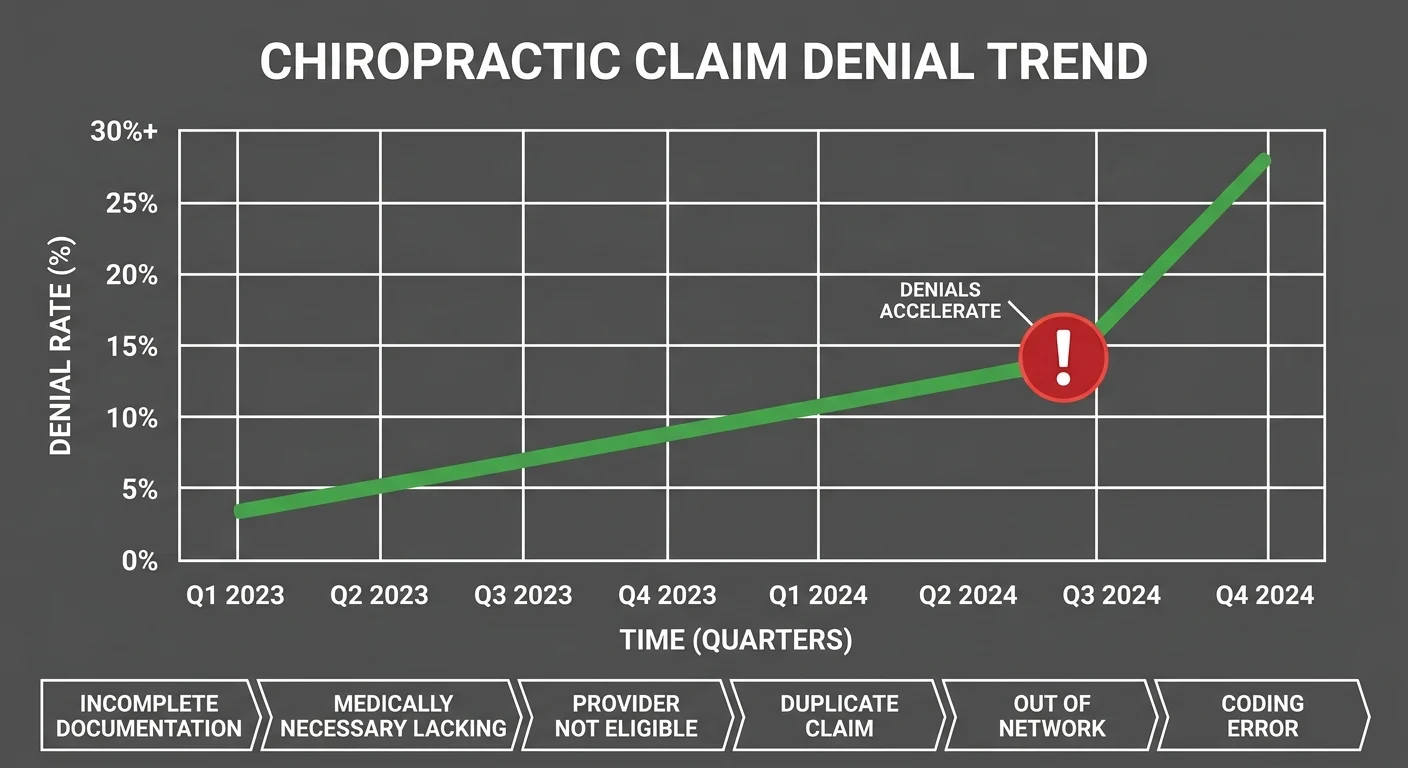
So here's what that smoke detector actually looks like.
Your denial rate is climbing. Nobody on your billing side has told you why.
A climbing denial rate isn't a billing inconvenience. It's a signal that something is broken in your documentation or coding workflow — and it's repeating on every submission cycle.
The practices most at risk aren't the ones that had one bad month. They're the ones where the rate has been drifting upward for quarters while the dashboard just shows numbers and nobody asks questions.
The warning sign isn't the denials themselves. It's the silence around them.
A clearinghouse report tells you a claim came back rejected. It doesn't tell you whether that's a one-time coding error or a systemic documentation failure repeating across your patient population. Those aren't the same problem — and treating them as if they are is exactly how practices quietly bleed revenue year over year.
What a Rising Denial Rate Actually Signals
Rising denials with no explanation don't mean random claims are bouncing.
They mean a payer has identified a pattern in your submissions. Your billing process hasn't.
Payer automated review systems are built to find what a volume-first billing model never looks for: documentation that doesn't establish medical necessity, codes recurring without clinical variation, modifier usage that signals maintenance care billed as active treatment.
The National Institutes of Health published an analysis of chiropractic records finding that up to 83% of reviewed files lacked the documentation required to prove medical necessity. That's not a documentation gap. That's the documentation standard a submission-speed billing model produces.
When a payer flags that pattern, denials don't arrive randomly. They cluster — same codes, same visit frequencies, same documentation failures repeating across your patient population.
That clustering is the signal. A rising denial rate with no attached explanation means nobody on your billing side is reading it.
How to Read Your Denial Data Before It Becomes an AR Problem
Reading denial data correctly starts with one distinction.
One-time rejections. Pattern denials. These are not the same thing.
One-time rejections are noise. A missing field, a transposed ID, a clearinghouse formatting error — administrative, not clinical. Fix it and move on.
Pattern denials are different. When the same code cluster is failing across multiple patients over multiple billing cycles, that denial isn't an error. It's a payer telling your practice that your documentation doesn't support the service billed. Practices that leave revenue uncollected year after year are typically the ones treating every denial as a one-time event — and never auditing for the pattern underneath.
Before a rising denial rate becomes an AR aging problem, the data is readable. Someone just has to be reading it.
Pull your denial reasons by code. Sort by frequency. If the same denial reason is appearing across more than a handful of claims, that's your audit entry point. That's where up to 15% of annual chiropractic revenue starts disappearing — not in a crisis, but in a pattern no one investigated while it was still recoverable. The hidden revenue in your current AR almost always traces back to a denial cluster someone called a one-time error.
| Denial Pattern | Likely Root Cause | Revenue Impact | Audit Action Required |
|---|---|---|---|
| Same CPT code failing across multiple patients | Documentation does not support the service billed — medical necessity is not established in the clinical notes | Recurring revenue loss on every submission cycle; claim volume amplifies the damage | Audit documentation standards against payer-specific medical necessity criteria; revise clinical note templates |
| Denials clustering around modifier usage | Active treatment billed with incorrect or missing AT modifier; maintenance care not differentiated in documentation | Medicare claims rejected outright; repeated submissions without correction produce an audit risk pattern | Audit every Medicare claim for AT modifier compliance; review active versus maintenance care distinctions in patient records |
| High denial rate on specific visit frequencies | Billing reflects identical visit cadence without documented clinical justification for continued treatment | Payer flags frequency as unsupported; claims fail on initial review or get pulled back post-payment | Audit clinical notes for progressive change documentation; ensure each visit justifies continued active care |
| Denials spiking after a payer policy update | Billing workflow was not updated to reflect new payer rules; coding or documentation requirements shifted without internal notice | Previously clean claims begin failing in volume; revenue drops without a clear internal trigger | Audit claim history against the payer's updated policy timeline; identify the exact date denials began clustering |
| Denials on diagnosis codes that previously paid | ICD-10 specificity requirements tightened; generic codes no longer satisfy payer criteria for chiropractic services | Sustained revenue loss on diagnoses that represent a significant portion of the practice's claim mix | Audit diagnosis code usage for specificity gaps; map each active diagnosis to current payer coverage criteria |
| No denial reason being tracked or categorized | Billing process treats every rejection as a one-time event; no systematic logging of denial reasons by code or payer | Pattern failures go undetected indefinitely; recoverable revenue ages out of workable range | Establish denial categorization by reason code, CPT code, and payer; run frequency analysis before the next submission cycle |
Warning Sign 2: AT Modifier and Medicare Documentation Errors Are Appearing
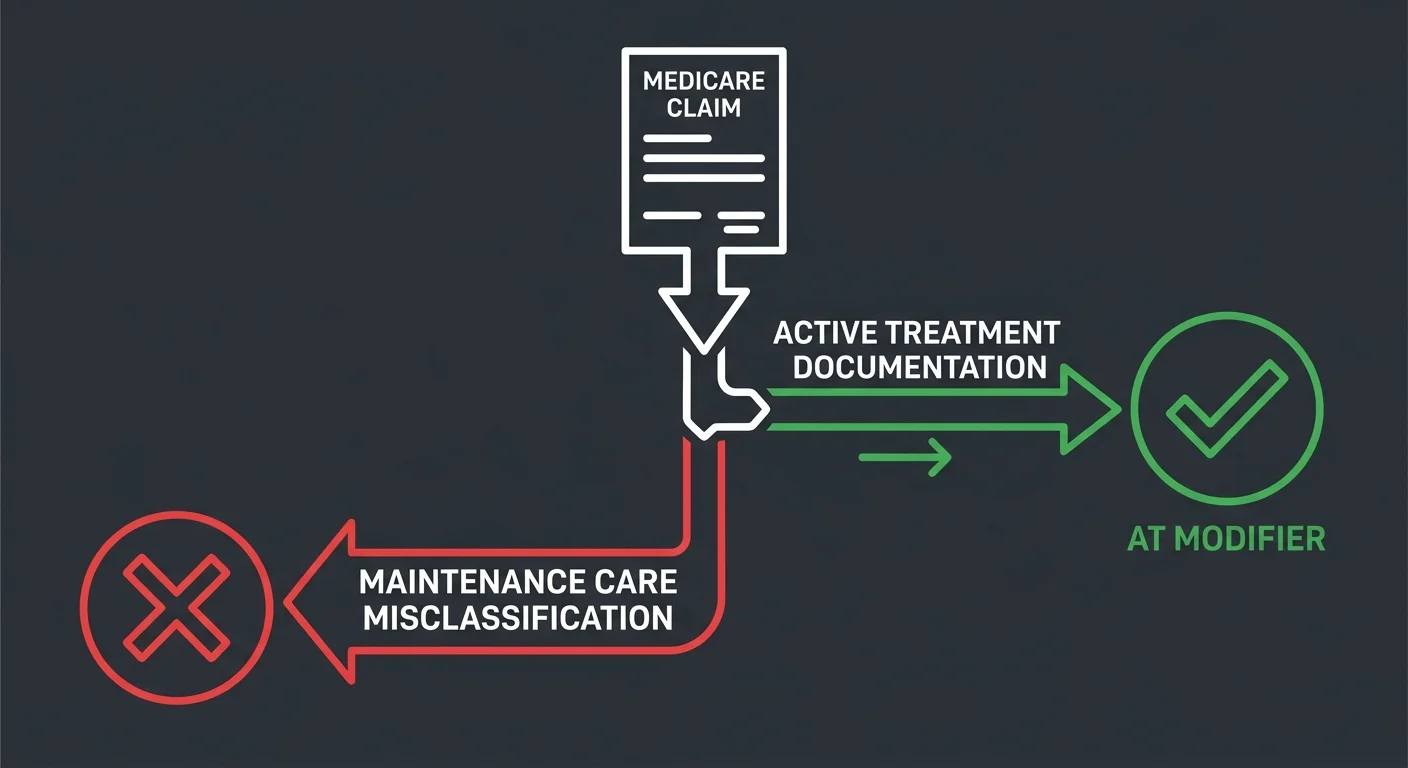
Pattern denials cost you revenue. AT modifier errors cost you revenue — and invite a federal audit to collect it back.
Those are not the same problem.
The AT modifier is not a box you check. Medicare policy documentation mandates its use on every claim where the service is acute or corrective. Miss it, misapply it, or apply it to care that the underlying notes do not support — and Medicare's automated review systems read that as maintenance care billed as active treatment.
That is exactly what OIG audits are designed to find. And when they find it, the exposure is not a single denied claim. It is a retroactive review of every Medicare claim in that billing window.
Here's what makes this Warning Sign 2 and not an afterthought: the financial damage arrives before the practice sees it coming. By the time denied Medicare revenue has aged past 90 days, the clean recoupment window has already closed.
Most practices only find out when the clawback letter shows up.
What the AT Modifier Actually Requires — and Where Claims Break Down
Here is what the AT modifier actually requires: a visit-by-visit clinical record showing the patient's condition is actively responding to treatment. Not plateauing. Not stable. Genuinely improving toward a measurable therapeutic goal.
That distinction has to live in the documentation — not just in the billing code.
Most claims break down at the documentation layer, not the coding layer. The modifier gets appended correctly. The underlying record does not support it.
A peer-reviewed analysis of chiropractic records found that up to 83% of reviewed files lacked sufficient documentation to establish medical necessity. That is not describing rare outliers. That is the documentation standard a submission-speed billing workflow produces when no one is auditing clinical specificity on each claim.
Your billing software sees the AT modifier on the claim and logs a submission. That's it. That's the whole check.
It doesn't verify that the clinical notes show active improvement instead of plateau-level care. That verification requires a human reading the actual record. Volume-first billing doesn't budget for that step — so it doesn't happen.
The practices most exposed here aren't cheating. They're doing exactly what their billing workflow was built to do — submit claims at volume, move fast, assume the documentation holds.
It often doesn't. And when it doesn't, they're spending time and money recovering denied revenue after the fact that a pre-submission audit would have protected in the first place.
Prevention costs a fraction of recovery. Recovery costs a fraction of clawback.
The Difference Between Active Care and Maintenance Therapy Under CMS Rules
Active care and maintenance therapy aren't two ways of describing the same thing. Under CMS rules, they're two different coverage categories — and only one of them gets paid.
That's exactly where AT modifier errors concentrate.
Under Medicare's fee schedule guidance, spinal manipulation to correct subluxation is the only covered chiropractic service. CMS explicitly excludes maintenance therapy — care that preserves a patient's current condition rather than producing measurable improvement.
So the documentation has to show, visit by visit, that what was billed was corrective. Not palliative. Not stable. Actively corrective.
When that distinction is absent or ambiguous in the clinical notes, Medicare treats the claim as maintenance. The AT modifier on the claim face doesn't override what the record actually says.
That's where AT modifier errors stop being a one-claim problem and become a pattern payer review systems are built to detect. When a practice's documentation doesn't consistently establish the active-versus-maintenance distinction across its Medicare population, that pattern is readable — and it's exactly what OIG audit algorithms look for.
A billing audit finds where that line is blurring in your records. Before the pattern becomes a clawback demand.
| Documentation Element | Required for Active Care (AT) | Required for Maintenance Therapy | Consequence of Missing |
|---|---|---|---|
| Visit-by-visit progress notes | Required — must document measurable improvement toward a therapeutic goal | Not required — only current condition status needs to be recorded | Claim treated as maintenance care; AT modifier unsupported; denial or clawback risk |
| Functional outcome measures | Required — objective indicators of active response to treatment | Not required — functional status documentation is optional | Absence signals plateau care; payer review systems flag the claim as non-covered |
| Treatment plan with defined therapeutic goals | Required — active care must target a specific, measurable clinical endpoint | Not required — no endpoint is expected for ongoing maintenance | Missing or vague goals collapse the active-versus-maintenance distinction in the record |
| Clinical justification for continued treatment | Required — each visit must justify why continued corrective care is medically necessary | Not applicable — maintenance is not a covered Medicare service regardless of justification | Gap in justification converts a covered claim into an uncovered one at review |
| Subluxation documentation | Required — spinal manipulation must be linked to documented subluxation correction | Not applicable — subluxation correction defines active, covered treatment | Absent subluxation documentation removes the clinical basis for Medicare coverage entirely |
| AT modifier placement on claim | Required — signals acute or corrective service to Medicare's review systems | Must NOT be present — applying AT to maintenance therapy is the core audit trigger | Incorrect modifier placement flags the practice for retroactive review across the billing window |
Warning Sign 3: Your AR Is Aging Past 90 Days Without Movement
Claim errors are one problem. What happens when nobody fixes them is a different problem entirely.
AR aging past 90 days without movement isn't a lagging indicator. It's a write-off in progress.
Claims that sit unworked don't pause. They compound. Every week that passes closes another appeal window, kills another refiling option, and shrinks what's still recoverable.
By the time a practice spots the pattern, part of what was workable is already gone.
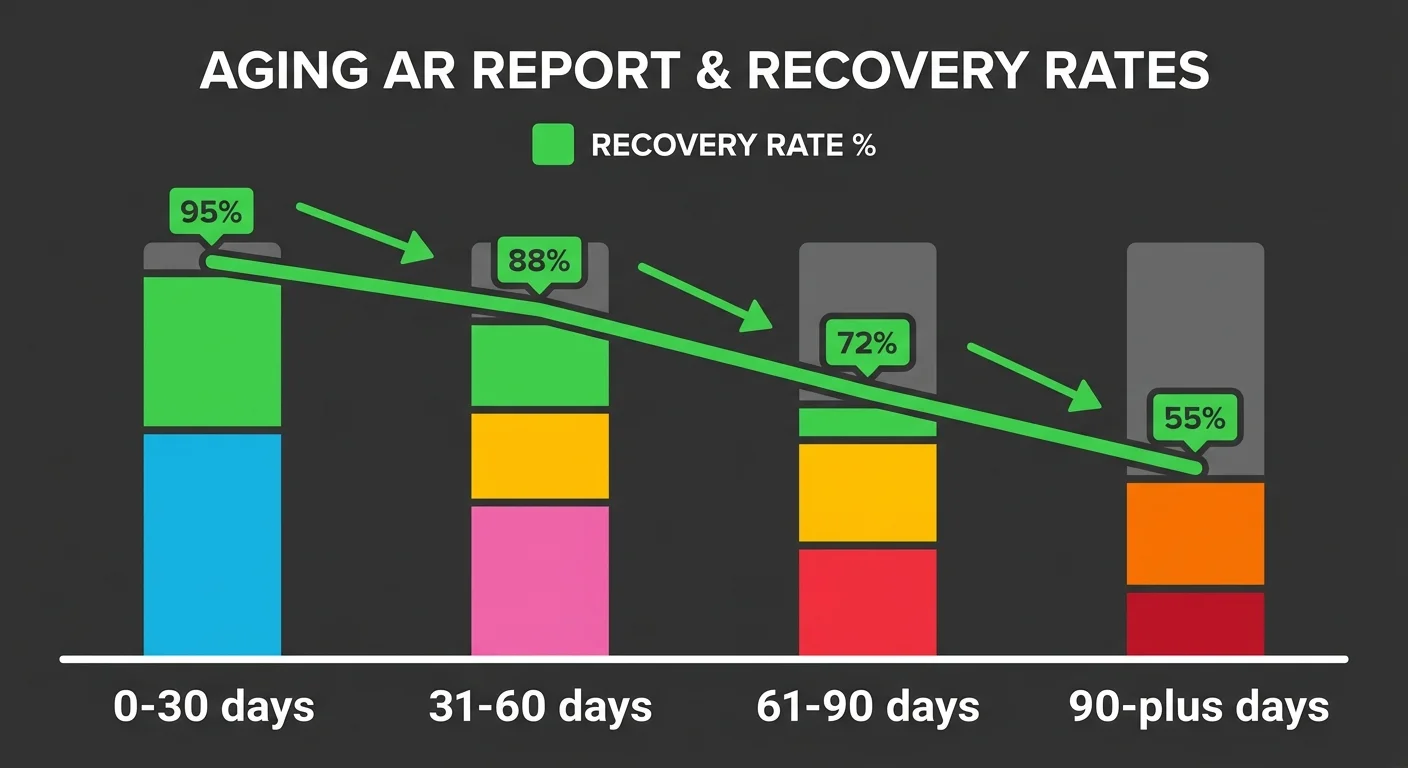
Here's what your AR aging report actually tells you: the columns. 30 days. 60 days. 90-plus.
Here's what it doesn't tell you: which accounts are still workable, which payers have already closed the appeal window, and what documentation failure caused the claim to stop moving in the first place.
That's the investigation. A dashboard can't run it. An audit can.
What Aging AR Actually Means for Recoverable Revenue
Aging AR is not lost revenue. Not yet. But the distance between those two things closes fast.
Claims between 30 and 60 days are still workable. Appeal windows are open. Documentation can be supplemented. Refiling is a real option.
Past 90 days, that window starts closing fast. Most major insurers enforce strict timely filing deadlines — and once those deadlines pass, the claim isn't a billing problem anymore. It's a write-off.
The practices that leave 15% of their revenue uncollected every year aren't losing it to dramatic audit clawbacks. They're losing it in accounts that aged past the recovery threshold while nobody was working them.
The sequence isn't complicated. A claim gets denied. Nobody follows up. Thirty days becomes 60. Sixty becomes 90-plus.
A billing model built around submission volume doesn't budget for aggressive AR follow-up. Working a complex denial takes more time than a high-throughput operation allows. So the account ages.
And the revenue disappears — one unworked claim at a time, without anyone flagging it.
The AR Aging Thresholds That Define What's Still Workable
Not all aging AR is the same. Treating it as one bucket is one of the most expensive mistakes a practice can make.
At Bushido Billing, every AR recovery engagement starts the same way: a threshold-by-threshold audit of what's still workable versus what's genuinely expired.
Claims under 60 days are high-priority. Appeal windows are open, payer contacts are reachable, and documentation corrections can still be filed in time to matter. Claims in the 60-to-90-day range need immediate triage — some are recoverable with prompt action, others are approaching the point of no return depending on the payer's timely filing policy.
Claims past 120 days get a different question entirely. Not "can we recover this?" but "what documentation or workflow failure caused it to land here — and is that same failure still active in current submissions?"
That last question is the one a submission-speed billing model never asks. It's watching what goes out. Not what comes back. Not what stops moving.
An AR audit isn't just about recovering old revenue. It's about identifying the stagnation pattern before the next 90-day cycle produces the exact same result.
The claim that aged past recovery last quarter is a data point. The billing problem is the pattern underneath it.
| AR Age Bucket | Typical Recovery Rate | Primary Action Required | Audit Priority Level |
|---|---|---|---|
| 0–30 Days | High — full recovery path open | Review denial reason, correct documentation, refile or appeal immediately | Urgent — act before appeal window narrows |
| 31–60 Days | Moderate to high — most payers still reachable | Triage by payer, confirm appeal deadlines, supplement documentation where needed | High — recovery still fully viable with prompt action |
| 61–90 Days | Variable — depends on payer timely filing policy | Immediate outreach to payer, assess whether corrected claim or appeal is the faster path | Critical — window closing; delay converts workable claims to write-offs |
| 91–120 Days | Low — most payer appeal windows closing or closed | Last-chance appeal where policy allows; begin write-off analysis for closed accounts | Triage only — focus audit energy on identifying what caused the stall |
| 120+ Days | Minimal — majority of standard appeal rights exhausted | Shift focus from recovery to root-cause audit; determine if the failure pattern is still active in current claims | Diagnostic — use as a data point to prevent the next aging cycle |
Warning Sign 4: High-Frequency Codes Are Appearing Without Clinical Variation
Aging AR tells you the bleeding happened. High-frequency identical codes tell you where the wound was opened.
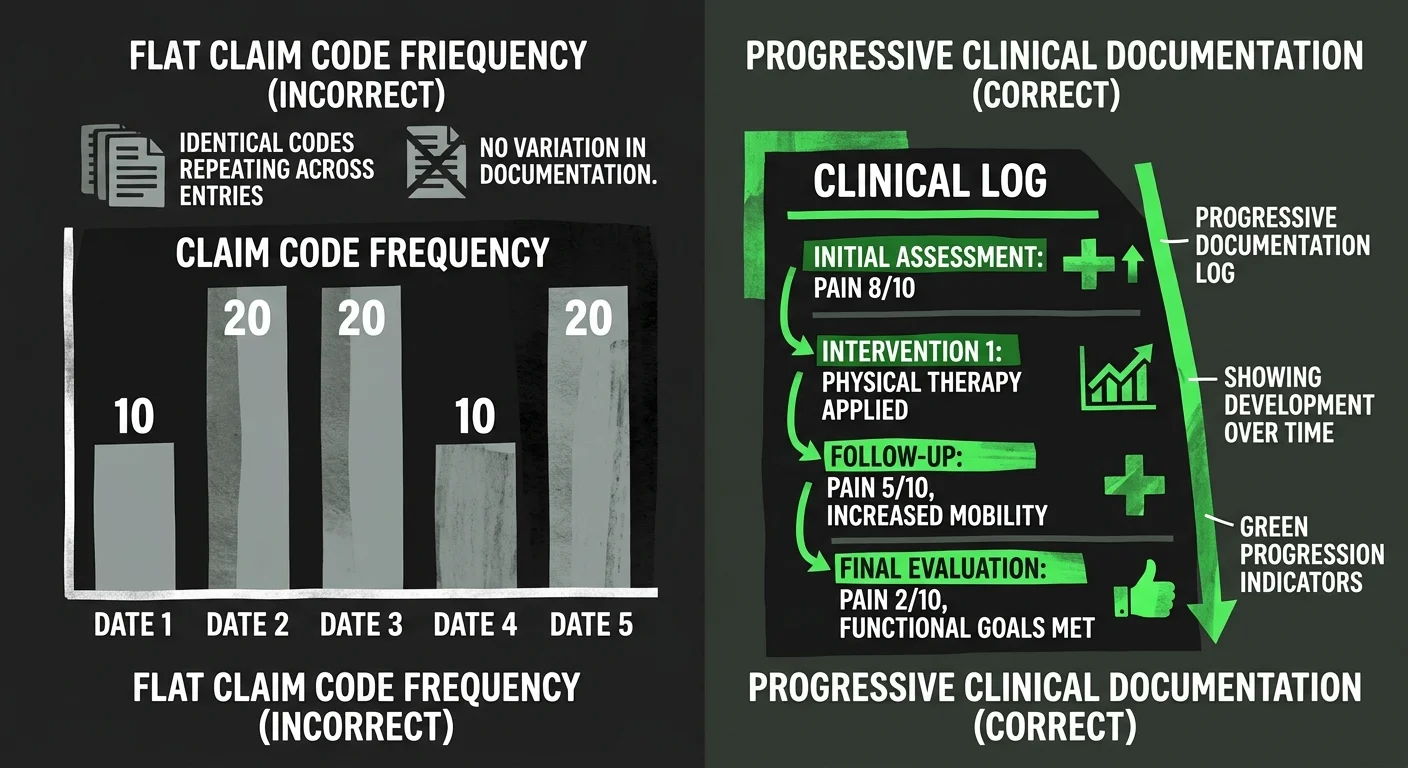
High-frequency codes without clinical variation live upstream of every other warning sign on this list. When a practice bills the same CPT codes, at the same frequency, across the same patient population — visit after visit, with no documented clinical change to justify the pattern — payers flag it. Not eventually. Immediately. Automated review systems are built to detect exactly this signal.
Research published through the National Institutes of Health confirms it: billing high-frequency identical codes without progressive clinical change is one of the clearest compliance risk signals payers track. But here's the problem. Your billing dashboard doesn't see that. It logs the submission. It shows the code. It does not show that every claim in that patient's file is a near-identical copy of the one before it — and that nothing in the record proves the patient's condition is actually changing.
Why Repetitive Coding Triggers Payer Scrutiny
Payers are not reading your claims by hand on the first pass. They're running them through algorithmic screens built to surface billing patterns that deviate from expected clinical norms. Identical codes at identical frequency, week over week — that is one of the primary deviation signals those screens are designed to find.
And the compliance risk isn't theoretical. A peer-reviewed analysis of chiropractic records found that up to 83% of reviewed files lacked sufficient documentation to prove medical necessity. A record that can't demonstrate clinical progression can't defend repetitive coding. When a payer's review system finds an indefensible pattern, it doesn't treat that as a clerical error. It treats it as a compliance signal.
Here's how it happens in most practices. A patient comes in with an acute complaint. Treatment starts. The coding reflects that accurately. Then improvement plateaus. The clinical picture stabilizes. But the coding doesn't change — because nobody in the billing workflow is cross-referencing the codes against the clinical notes to confirm the documented condition still justifies the billed intensity. The claim goes out. The payer logs another identical submission. The scrutiny accumulates. And by the time someone notices, the pattern is already three months deep.
What Proper Clinical Progression Documentation Looks Like
Proper clinical progression documentation does one thing a repetitive billing pattern can't: it creates a visit-by-visit record of change. Not just the code. The change.
That means your clinical notes need to show — specifically and measurably — how the patient's condition is different from the visit before. Range of motion improving. Pain scores decreasing. Functional limitations resolving. When those data points are absent or static, the documentation doesn't support the claim. Doesn't matter what code is on the face of it. A peer-reviewed analysis found that up to 83% of chiropractic records lacked the documentation required to establish medical necessity. That's not a coding problem. That's a documentation discipline problem — and no clearinghouse or EHR dashboard catches it before the claim goes out.
This is exactly where Bushido Billing's audit process is different from a submission review. A submission review checks whether the claim went out and whether it came back paid. A billing audit checks whether the documentation behind the code actually supports the code — and whether the pattern of codes across a patient's file tells a clinical story a payer's review system will find credible. Repetitive coding without clinical variation only becomes visible when someone looks at the record alongside the claim. Not just the claim in isolation. That's a different job than processing submissions. Most billing operations never do it.
Warning Sign 5: Your Practice Has Never Had a Formal Billing Audit
Four of these warning signs show up in your reports. Rising denials, AT modifier errors, aging AR, repetitive codes — all of them leave a data trail you can pull today.
The fifth one leaves nothing. Because nothing has ever been done.
If your practice has never had a formal billing audit, you do not have a gap in your reports. You have a gap in your knowledge about what those reports are not showing you.
That absence is the most reliable warning sign on this list.
Not because the other four don't matter. They do. But a practice that's never audited its billing has no baseline. It can't know whether its denial rate is high or just normal for the specialty. It can't know whether its AT modifier documentation would survive payer scrutiny. It can't know how much of its aging AR is still workable versus already gone.
Every one of those questions requires a formal review to answer. Without one, you're not monitoring your billing. You're assuming it's fine.
The HHS Office of Inspector General has identified chiropractic services as carrying some of the highest improper payment rates in Medicare — historically exceeding 50% in multiple reviews.
No audit history doesn't mean no problem. It means no one has looked.
That's not a clean record. That's an uninspected one.
What a Billing Audit Actually Reviews — and What It Finds
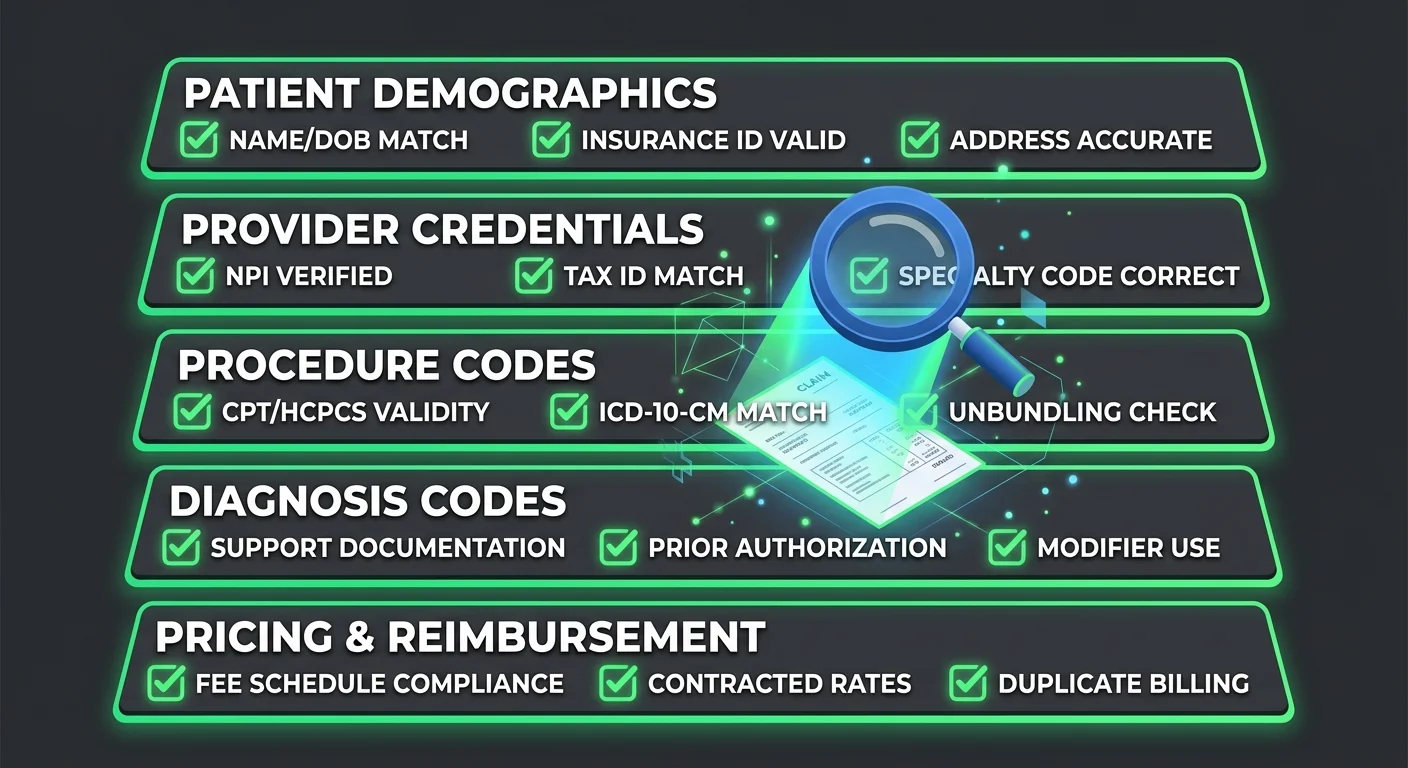
A billing audit is not a claims report.
It's a structured review of the documentation, coding patterns, and payer rules behind every category of claim a practice submits — measured against what those payers actually require to pay them.
That's a different job than running a clearinghouse summary. Completely different.
In practice, an audit checks whether the clinical notes actually support the codes billed — not just whether the codes went out and came back paid. It reviews whether the active-versus-maintenance distinction is documented consistently across the Medicare patient population. It checks whether the AT modifier on the claim face matches what the clinical record actually says.
It identifies which denial categories keep recurring — and whether those denials trace to a documentation pattern, a coding habit, or a workflow gap.
And it surfaces the AR accounts aging past recovery thresholds while still sitting open in the system. The ones the dashboard shows as pending. The ones the biller has never touched.
What an audit finds is almost always more specific — and more recoverable — than the practice expected.
Practices that have never audited aren't typically uncovering fraud. They're uncovering accumulated leakage: the claims that were undercoded, the denials that were never appealed, the documentation that was technically submitted but practically indefensible under scrutiny.
Chiropractic clinics leave 15% of their revenue uncollected annually. That's not one catastrophic failure. It's the slow accumulation of unreviewed patterns that a formal audit would have surfaced months earlier.
How Often Chiropractic Practices Should Conduct a Billing Review
There's no universal answer to how often a chiropractic practice needs a billing review.
But there's a clear floor: any practice that has never had one needs one now. Not next quarter. Not when the denial rate spikes.
Now. Before the pattern compounds further.
For practices with active billing operations, an annual review is the minimum.
Payer policies shift. Medicare rules update. Documentation requirements change. A billing process that was sound eighteen months ago isn't guaranteed to be sound today.
The AT modifier requirement itself doesn't change. But the documentation standards payers use to evaluate it do. Annual reviews catch drift before it becomes a systemic problem — before the pattern the payer has already flagged is the one your practice just found out about.
At Bushido Billing, the audit isn't a one-time transaction. It's the entry point to understanding where a practice's revenue is actually going — and what it would take to stop losing it.
Your billing dashboard is a smoke detector. It tells you fire exists. It cannot tell you what's burning, how long it's been smoldering, or which claims, codes, and documentation gaps are responsible.
That investigation is what the dashboard was never built to run. That's what the audit is for.
| Audit Component | What It Examines | Common Finding | Recovery Opportunity |
|---|---|---|---|
| Documentation Integrity Review | Whether clinical notes support the codes billed — not just whether codes were submitted | Notes lack visit-by-visit clinical progression; documentation is static or templated across multiple visits | Defensible records for future payer review; reduced exposure to retrospective audits |
| AT Modifier Compliance Check | Whether active-versus-maintenance distinctions are consistently documented across the Medicare patient population | AT modifier appears on claim face but clinical record does not corroborate acute or corrective care at time of service | Corrected documentation workflow that aligns modifier use with what the chart actually says |
| Denial Pattern Analysis | Whether recurring denial categories trace to a documentation habit, a coding pattern, or a workflow gap | The same denial reason repeating across multiple payers with no internal tracking or appeal process in place | Identified root cause; recoverable claims that were written off rather than appealed |
| Coding Pattern Review | Whether CPT code frequency across a patient population reflects documented clinical change | High-frequency identical codes submitted without measurable clinical variation noted in the record | Reduced payer scrutiny; coding that accurately reflects the clinical story and survives algorithmic review |
| AR Recovery Assessment | Which aging accounts are still within recoverable thresholds versus already past the point of return | Open AR accounts showing as active in the system that have aged past any realistic collection window | Prioritized recovery list; clear distinction between workable claims and write-off candidates |
Frequently Asked Questions About Chiropractic Billing Audits
Seeing a warning sign is one thing. Understanding what it's costing you — and what you can still recover — is a different conversation.
These are the questions that come up the moment a practice owner looks at their numbers and can't explain them away anymore.
Direct answers. No hedging. A practice that's been running blind deserves to know exactly what it's looking at.
What triggers a federal chiropractic billing audit?
Federal audits aren't random. The HHS OIG targets chiropractic claims when billing patterns cross specific thresholds — and historically, improper payment rates in chiropractic Medicare have exceeded 50% across multiple reviews.
Three patterns draw the most scrutiny: recurring denial categories, high-frequency identical codes billed without documented clinical progression, and notes that don't establish medical necessity.
A practice doesn't have to be doing anything intentionally wrong. It just needs a billing pattern that looks like one.
How do Medicare AT modifier errors lead to immediate claim denials?
The AT modifier tells Medicare that treatment is active and medically necessary. When it's missing, the claim fails immediately.
When it's present but the clinical notes don't corroborate active treatment, the claim fails on review. There's no gray area in between.
CMS covers spinal manipulation to correct subluxation — and nothing else. If the modifier doesn't match what the record actually shows, the payer doesn't pay. And the denial won't explain why.
What is the difference between active care and maintenance care under CMS rules?
Active care means the patient is progressing. The clinical record has to show measurable change — reduced pain scores, improved range of motion, resolving functional limitations.
Maintenance care means the patient has plateaued. CMS doesn't cover maintenance therapy. The AT modifier is what separates those two categories in the billing record.
When clinical notes stop reflecting progression but the modifier keeps appearing, that's not a coding error. That's the documentation failure audits are built to find.
How much annual revenue do chiropractic practices lose to unworked accounts receivable?
Practices leave 15% of their revenue uncollected annually — not from one bad audit, but from unworked AR, undercoded visits, and denial patterns no one reviewed while they were still recoverable.
That number doesn't appear on a dashboard. It accumulates quietly — claim by claim, month by month — until most of it has already aged past the point of return.
By the time it becomes visible, the window to recover it has usually closed.
Can standard chiropractic EHR software replace a professional billing audit?
An EHR sends claims. That's a different job than auditing them.
It doesn't evaluate whether the documentation behind a claim supports the code billed. It doesn't cross-reference coding patterns against clinical progression. It doesn't identify which denial categories are recurring — or why.
The software tells you something came back rejected. It can't tell you what's been quietly failing for the past twelve months. Bushido Billing audits what the software was never built to see.
Your Billing System Has a Smoke Detector. What You Need Is a Fire Marshal.
Your EHR tells you claims went out. Your clearinghouse tells you which ones came back denied. Neither one tells you why — or how long the problem has been running.
That gap is the smoke detector. It registers that something happened. It cannot tell you what has been smoldering for the past twelve months, or what it has already cost you.
The five warning signs in this article are not five separate problems. They are the same problem showing up in five different places.
Rising denials. AT modifier errors. AR aging past 90 days. High-frequency codes with no clinical variation. No formal audit on record. Every one of them traces back to documentation that does not support the claim — or a billing pattern nobody has checked against what payers actually require.
Practices that leave up to 15% of their revenue uncollected every year are not losing it in one event. They lose it visit by visit, code by code — through the weight of patterns no smoke detector was ever built to catch.
The fire marshal does not wait for the alarm. The fire marshal walks every system in the building and tells you which one is about to fail — before it does.
That is what a billing audit does. Not a submission review. Not a dashboard summary. A structured investigation into the documentation, coding patterns, and payer rules behind every claim category your practice submits — so what is recoverable gets found before it ages past the point of return.
Bushido Billing is built to run that investigation. And when it is done, you will know exactly where your revenue is going — and what it takes to stop losing it.
Your billing dashboard is a smoke detector — it tells you fire exists, not what's burning.
If any of those five warning signs hit close to home, you already know something's wrong. The question is whether you're ready to see exactly what it's costing you. Book a Call to find out what your numbers actually show.

© 2026 Bushido Billing. All Rights Reserved | Web Design by iTech Valet