

How to Use a Practice Audit to Identify Under-Coded Chiropractic Visits
Under-coding costs chiropractic practices real money on every visit that processes without a denial. A practice audit finds it by comparing submitted billing codes against the clinical documentation that supports them — and closing the gap between what was delivered and what was actually billed.
The safe claim is the costly one.
Clinicians bill lower-level spinal adjustment codes despite delivering multi-region clinical services. The claim pays. No denial, no flag — just systematically reduced reimbursement accumulating across hundreds of visits. That is the problem a practice audit is designed to find.
The scale is significant. An OIG review found that up to 82% of sampled chiropractic claims did not comply with Medicare documentation rules. Clinical records frequently omit the objective, functional improvement metrics required to establish medical necessity. When documentation is incomplete, coders default to lower levels of service — not because the care was limited, but because the record does not support a higher code.
The audit works in four structured steps: pull and sample the claim history, match clinical documentation to submitted codes, apply AT modifier and medical necessity standards, and identify systemic coding patterns versus isolated errors. Each step narrows the gap between what was delivered and what was billed.
Medicare adds a specific layer. The AT modifier must be appended to CPT codes 98940, 98941, or 98942 to indicate active therapeutic care. A missing or misapplied modifier on a covered visit is a direct revenue loss — and a compliance exposure point.
The audit does not create new billing. It aligns existing billing with the care that was actually provided. Once the gap between documentation habits and accurate code selection is visible, correcting it is a matter of process.
Last Updated: August 17, 2026
- • What Under-Coding Actually Costs a Chiropractic Practice
- • Why EHR Coding Tools Make This Worse
- • How a Practice Audit Surfaces Under-Coded Visits
- • What the Audit Findings Should Actually Tell You
-
• Frequently Asked Questions
- • How much clinical time does performing a thorough internal practice audit actually take?
- • Why do automated EHR coding recommendations often lead to under-coded chiropractic visits?
- • What are the most common documentation gaps that prevent a clinic from billing higher-level chiropractic codes accurately?
- • How do we transition our chiropractic team from defensive under-coding to compliant, accurate billing without increasing audit risk?
- • What are the immediate next steps after a practice audit identifies under-coded visits?
- • Stop Leaving Revenue on the Table
What Under-Coding Actually Costs a Chiropractic Practice
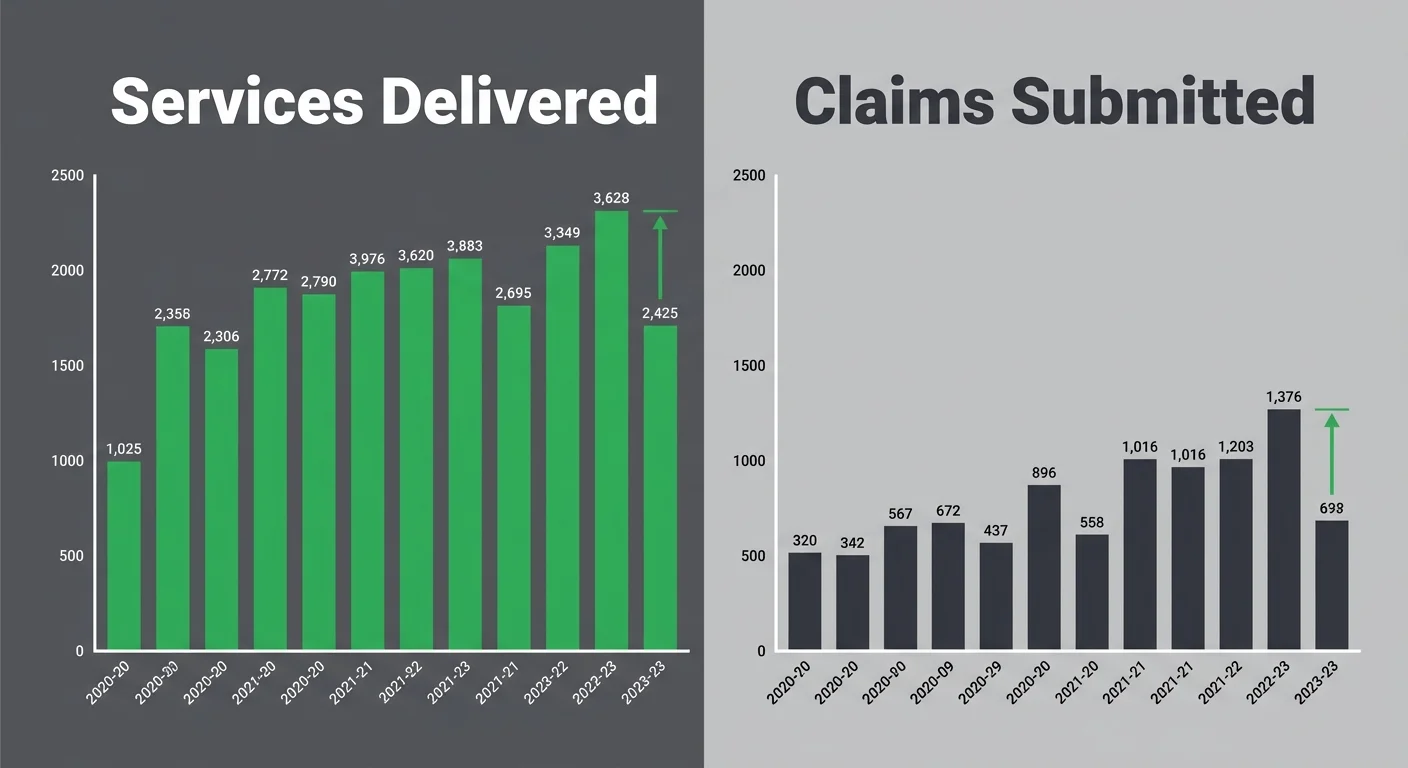
Under-coding doesn't announce itself.
No denial. No payer flag. No error message. The claim clears, the payment lands, and the practice moves on — with no idea that visit was worth more.
That's what makes it so damaging.
The lost revenue hides inside clean-claim volume. Nothing comes back denied. The billing looks functional. But the reimbursement is systematically lower than the care delivered — visit after visit, across the entire billing history.
Most practices don't find the gap until someone runs a direct comparison. That's exactly what a structured audit uncovers — and what it surfaces is almost always larger than the owner expected.
The Under-Coded Visit Problem
Here's how it plays out in the treatment room. A clinician delivers a three-region adjustment and bills a 98940. The care was a 98942. The reimbursement difference is real, documented — and gone.
And because the claim pays without friction, nobody catches it. The code isn't wrong on its face. It just doesn't reflect what happened. Clean payment is the camouflage.
Now multiply that across hundreds of visits. The same pattern, repeated across a full billing history, produces a gap between what was billed and what was warranted — and that gap stops being theoretical fast. It's the exact problem that chiropractic billing and revenue cycle management disciplines are built to find and correct.
Why Defensive Billing Became the Default — and Why It Stays That Way
So where did this start? Providers began billing conservatively because higher-level codes felt like they invited scrutiny. That instinct wasn't wrong. But a smart short-term adjustment became a permanent default — applied across every visit, regardless of what the documentation actually supports.
The fear has a real foundation. An HHS OIG review found that 82% of sampled chiropractic claims did not comply with Medicare documentation rules. When those are the stakes, billing low feels like the only rational move. So practices stay low. The habit calcifies. And nobody ever stops to ask whether the documentation has actually improved since the habit formed.
Here's the problem: defensive billing doesn't reduce audit risk. It reduces revenue.
Billing below what the documentation supports isn't protection. It's self-imposed loss. Accuracy is the protection. The audit is what proves it.
| CPT Code | Service Level Described | Common Under-Billing Pattern | Revenue Impact per Claim |
|---|---|---|---|
| 98940 | Single spinal region adjustment | Billed for single region when two or three regions were treated and documented | Lowest reimbursement tier — full multi-region care absorbed at single-region rate |
| 98941 | Two or three spinal region adjustment | Downgraded to 98940 when documentation mentions additional regions but lacks specificity in the clinical record | Mid-tier reimbursement forfeited; gap repeats across every visit where the pattern holds |
| 98942 | Four or five spinal region adjustment | Rarely billed even when complex multi-region care is delivered; providers default lower to avoid scrutiny | Highest reimbursement tier left unbilled; most significant per-visit revenue gap in the practice |
| 98940 with AT modifier missing | Active therapeutic care, Medicare patient | AT modifier omitted or inconsistently applied; claim processes as maintenance-level or non-covered | Active care reimbursement lost entirely; visit paid at reduced rate or denied without an appeal pathway |
| 98941 or 98942, billed as 98940 | Multi-region visit with medical necessity established in the record | Coder defaults to lower level because documentation language is present but functional improvement metrics are absent | Revenue gap is invisible — claim pays cleanly at the lower code while the higher code remained fully supportable |
Why EHR Coding Tools Make This Worse
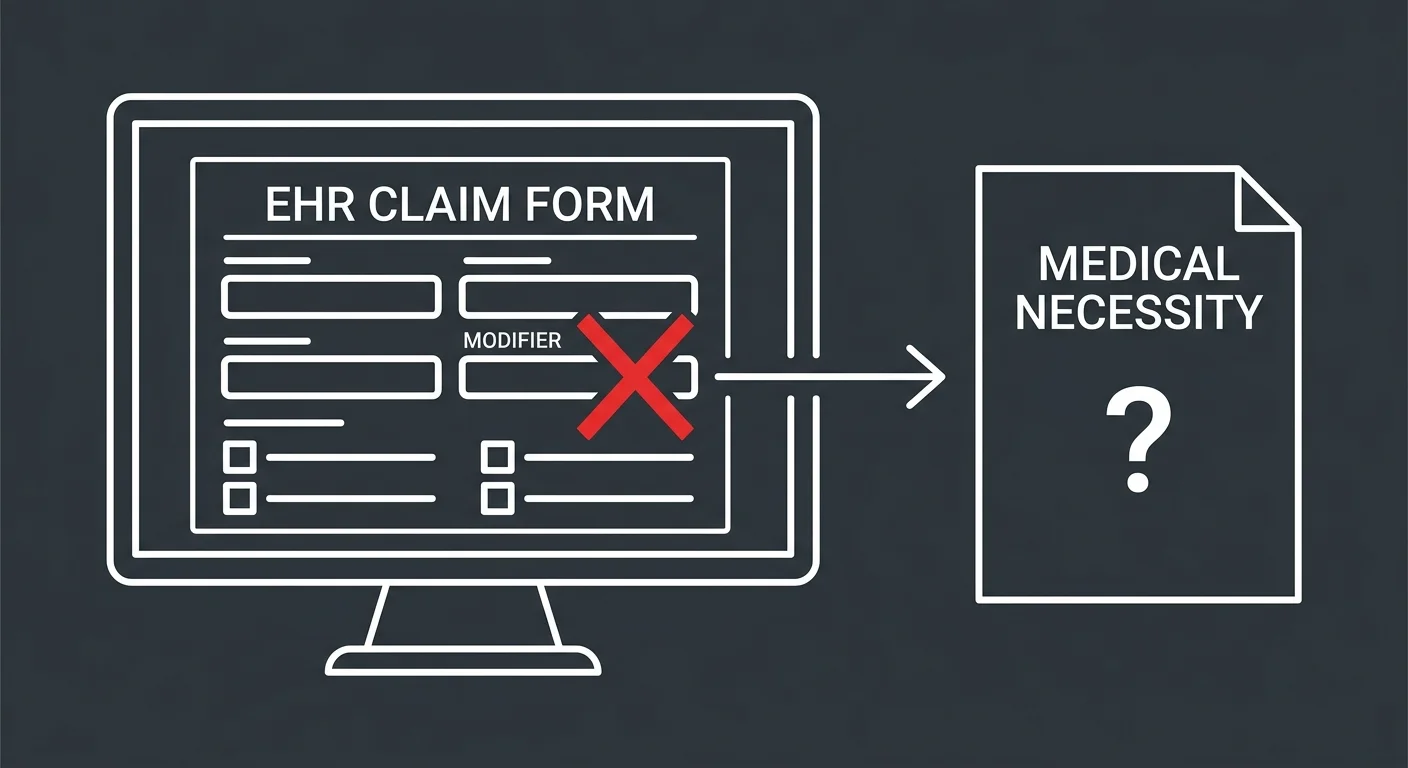
EHR platforms are not billing systems. That distinction gets glossed over — and it costs practices real money.
But most practices treat their EHR like it is handling both jobs. It isn't.
The tools most practices trust to guide coding are built to move claims through — not to maximize what those claims recover.
Clean, low-level claims process without friction. That is the EHR's performance metric. Whether the submitted code reflects the complexity of care that was actually delivered is a different question entirely.
The EHR is not designed to ask it.
That structural gap is exactly what a practice assessment corrects. Where chiropractic billing software shows what was submitted, a peer-led audit asks whether what was submitted actually reflected what happened in the treatment room.
Those are different questions. Only one of them recovers revenue.
What EHR Platforms Actually Do — and Don't Do
EHR platforms do certain things well. Patient records, SOAP notes, clearinghouse routing — those functions work fine.
What they don't do is evaluate whether the codes submitted match the complexity of care the clinical record actually documents. That is a different task entirely.
The coding suggestions built into EHR systems are rule-based. Missing modifiers, invalid code combinations, required fields left blank — those get flagged.
But whether a 98940 was submitted when the clinical record supported a 98942? That's a clinical judgment call. No software makes it. The EHR doesn't ask the question, so the revenue gap never surfaces.
Here's the deeper problem. NIH research confirms that chiropractic clinical records consistently lack the measurable goals and functional improvement metrics required to establish medical necessity.
EHR templates standardize the format of a note. They don't prompt clinicians to document the clinical rationale that justifies a higher service level.
So the note processes. The claim submits. And the documentation never quite supports the code the care warranted. When a revenue leakage assessment surfaces this gap, it's almost always larger than the practice expected.
The AT Modifier Gap That Software Misses
The AT modifier is the clearest place where EHR automation breaks down. Per CMS requirements, the AT modifier must be appended to CPT codes 98940, 98941, or 98942 to indicate active therapeutic care.
Without it on a covered Medicare visit, the claim denies outright — or processes as maintenance care. Maintenance care isn't a covered service.
That's not a minor submission error. That's a direct revenue loss on every affected claim.
EHR systems flag a missing modifier as a submission error. That part they handle.
What they don't assess is whether the clinical documentation actually supports active care status versus maintenance — the distinction that published modifier guidance requires providers to substantiate in the record itself.
An EHR cannot catch that gap. It doesn't know the difference between a note that mentions active care and a note that proves it. A peer-level audit does.
| Billing Function | EHR Platform Capability | What Still Requires Human Review |
|---|---|---|
| Claim submission | Routes completed claims to clearinghouses and payers automatically | Whether the submitted code reflects the actual complexity of care documented in the visit record |
| Modifier flagging | Detects missing or structurally invalid modifiers before submission | Whether the clinical documentation substantiates active care status versus maintenance — the distinction the AT modifier requires |
| Code suggestion | Applies rule-based logic to flag obvious errors and invalid code combinations | Whether the suggested code level matches the regions treated and the care complexity delivered in the room |
| Documentation templates | Standardizes SOAP note format and ensures required fields are completed | Whether the clinical rationale recorded actually justifies the level of service billed — not just that the fields exist |
| Denial alerts | Surfaces payer rejections and flags claims returned for correction | Revenue lost to systematic under-coding — clean claims that paid at a lower rate than the care warranted produce no alert |
| Coding pattern analysis | Generates reports on claim volume, submission timelines, and payer mix | Whether a recurring low-code pattern reflects a documentation habit or a legitimate service limitation — that distinction requires clinical judgment |
How a Practice Audit Surfaces Under-Coded Visits
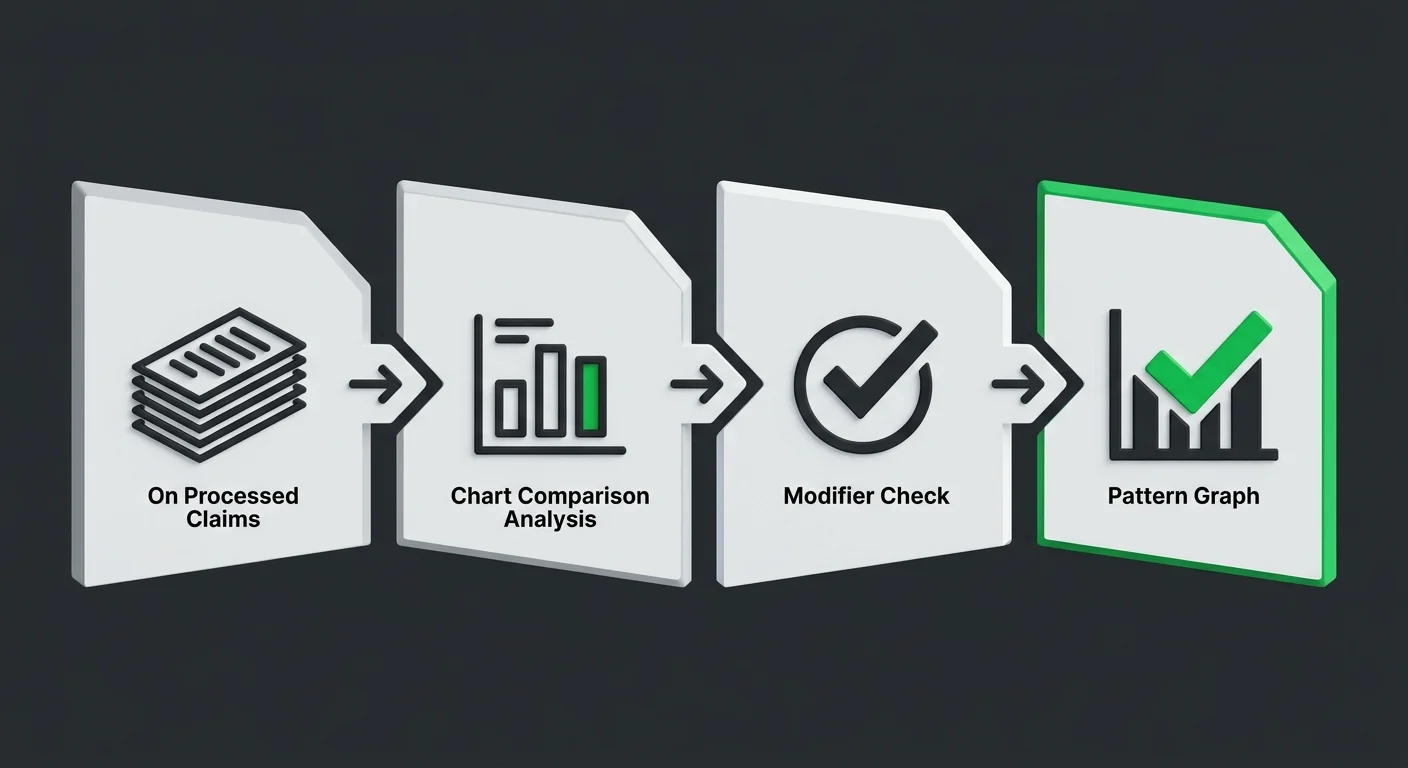
The audit doesn't theorize. It traces the gap between what was delivered and what was billed, step by step, claim by claim.
Four steps. Each one cuts to a different layer of the problem. Together, they move the practice from a defensive habit to billing that actually reflects the care delivered.
Step 1 — Pull and Sample Your Claim History
Start with what the practice already has. Pull a representative sample of submitted claims — across service types, payers, and time periods. That sample is the baseline. It shows what coding has looked like in practice, not in theory.
And that picture is almost always different from what providers assume.
The sample targets the visits most likely to be under-coded: multi-region adjustments, Medicare encounters, and high-volume CPT codes. Those are the visits where the gap between what was delivered and what was submitted is widest.
That gap is where the money went.
The OIG targets chiropractic services in recurring review cycles. So pulling this sample isn't just a revenue exercise. It also maps which claim categories carry the highest compliance exposure — and the audit works both problems at once.
Step 2 — Match Clinical Documentation to Submitted Codes
Here's where the gap stops being theoretical. Each sampled claim goes side by side with the clinical record behind it. One question: does the documentation actually reflect the care that was coded?
This is where documentation errors that cost clinics recoverable claims become impossible to ignore. Three spinal regions treated. Measurable functional findings. A clear clinical picture in the chart — and a 98940 submitted.
The claim doesn't come back denied. It just doesn't reflect what actually happened.
An OIG review found that up to 82% of sampled chiropractic claims failed to comply with Medicare documentation rules. That's not a collection of one-off mistakes.
It's a systemic disconnect between what clinicians document and what billing reflects. Step 2 quantifies that disconnect — so it gets corrected at the source, not flagged after a payer audit.
Step 3 — Apply AT Modifier and Medical Necessity Standards
Step 3 is where the regulatory layer enters. For Medicare visits, the AT modifier must be appended to CPT codes 98940, 98941, or 98942 to indicate active therapeutic care — not maintenance.
The audit checks two things: whether the modifier is on the claim, and whether the documentation actually supports active care status. Those are different questions. Both have to pass.
The AT modifier can be on the claim and still be unsupported by the record. When the chart reads like maintenance — no measurable functional progress, no active care narrative — the claim carries compliance exposure. Paid or not.
This step runs the same standard the OIG runs. Chiropractic modifier application and medical necessity documentation are high-error areas — that's why they stay on the audit priority list. Better to find the gap internally than wait for someone else to find it first.
Step 4 — Identify Systemic Coding Patterns vs. Isolated Errors
A single under-coded visit is an anomaly. The same under-coded pattern repeated across hundreds of visits is a structural habit.
Step 4 draws that distinction. And structural habits require structural correction — not a one-time fix.
This is what separates a real audit from a spot-check. Isolated errors get corrected one at a time. Systemic patterns get traced back — to a documentation template, a coder default, a provider habit of submitting conservatively no matter what the chart says.
The safe claim isn't free. When the pattern shows up across the full sample, the cost of staying low becomes just as concrete as the risk that defensive billing was designed to avoid. A revenue leakage assessment puts both numbers on the table at the same time.
| Audit Step | What You Examine | What You Are Looking For | Compliance Standard Applied |
|---|---|---|---|
| Step 1 — Pull and Sample Your Claim History | Submitted CPT codes across service types, payers, and time periods | Coding patterns that appear consistently across high-volume visit categories, particularly multi-region adjustments and Medicare encounters | Representative baseline — identifies which claim categories carry the highest exposure before the documentation review begins |
| Step 2 — Match Clinical Documentation to Submitted Codes | Clinical records placed side by side with each sampled claim | Gaps between what the chart documents and what the submitted code reflects — regions treated, complexity of care, functional findings recorded | CPT descriptor alignment — the code submitted must match the clinical activity documented, not simply process without rejection |
| Step 3 — Apply AT Modifier and Medical Necessity Standards | Medicare claims and modifier application on CPT codes 98940, 98941, and 98942 | Whether the AT modifier is present and whether the clinical record substantiates active therapeutic care status versus maintenance | CMS modifier requirements and OIG medical necessity documentation standards — presence of the modifier alone is insufficient without supporting documentation |
| Step 4 — Identify Systemic Coding Patterns vs. Isolated Errors | The full sampled claim set reviewed for recurring under-coding across providers, visit types, and time periods | Whether low-level code submission is an anomaly or a structural habit embedded in documentation templates, coder defaults, or provider behavior | Pattern frequency — a single miscoded visit is corrected individually; a repeated pattern traced to its origin requires a structural intervention at the documentation or workflow level |
What the Audit Findings Should Actually Tell You
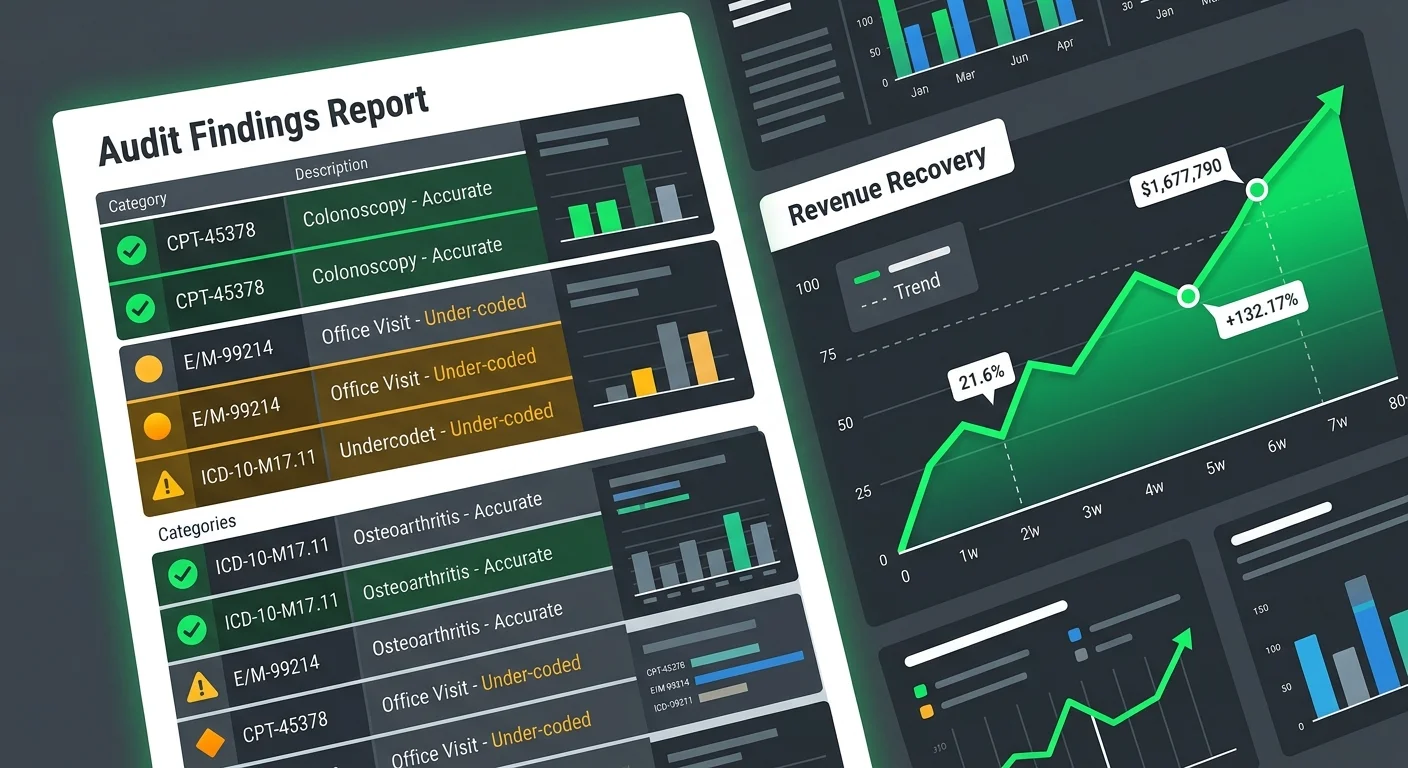
Numbers aren't findings. They're raw material.
The audit produces data. What you do with it — what it reveals about the gap between the care delivered and the revenue collected — that's where most practices stop short. And that's exactly where they lose the most.
A claim review gives you a list of errors. A peer-led audit gives you a pattern map.
Those aren't the same thing. One tells you what went wrong on a specific claim. The other tells you why the practice has been coding the way it has — and what that habit has cost across every visit in the sample.
Reading Your Coding Distribution
Start with coding distribution. It answers one direct question: across all submitted claims, how are service levels actually spread?
A practice treating complex, multi-region presentations should not have a claim history dominated by 98940. When it does, the distribution itself is the finding — before a single individual claim is reviewed.
When clinicians routinely bill 98940 for multi-region visits, the distribution doesn't just look off — it is off. That skew is the signature of defensive billing. Not accurate billing. The American Chiropractic Association is clear: failure to document treatment regions in line with CPT descriptors leads to systematic downcoding. The distribution is how that failure shows up at scale.
The gap between a 98940 and a 98942 is real money. Multiplied across hundreds of visits, it compounds into a recoverable revenue problem the billing record never surfaced — because nothing ever denied. That's the part that makes it invisible. And the part that makes it expensive.
Distribution also tells you which payers are carrying the heaviest under-coding. That answer matters.
Medicare claims deserve the closest look. That's where AT modifier requirements and active care documentation standards collide — and where regulatory anxiety most reliably produces conservative coding, regardless of what the chart actually supports.
When the distribution shows consistent low-level coding on Medicare claims specifically, that's not random. That's a structural habit. And structural habits don't correct themselves when you ignore them.
Transitioning From Defensive to Accurate — Without Adding Risk
Here's where most practices hesitate: they assume moving to accurate billing means taking on more audit risk. That's backwards.
A regulatory review checks whether your codes survived external scrutiny. A revenue recovery audit identifies where your documented, supported care went unbilled. Those are different problems. Conflating them is what keeps practices billing low and calling it safety.
Billing low isn't safe. It's just cheaper to defend — until you calculate what it cost you to get there.
Accuracy is defensible. That's the whole point.
When a higher-level code goes out and the clinical record fully supports it — functional goals documented, treatment regions specified, medical necessity established — that claim isn't a compliance risk. It's an accurate claim. The problem is that chiropractic clinical documentation consistently omits the objective, functional improvement metrics required to establish necessity in the first place. The audit identifies exactly where those gaps exist.
So the sequence matters: documentation gets corrected first. Then the code adjusts upward. That order isn't optional — it's what makes the change defensible when the next OIG review cycle arrives.
The code change follows the documentation correction. Never the other way around.
Chiropractic services are on OIG's targeted review list. Billing conservatively doesn't change that.
What accurate billing actually does: when a review hits, every code in the record has documentation behind it. That's the protection defensive billing was supposed to provide. It's the only version that holds up.
The safe claim was never protection. It was revenue loss with a compliance-sounding name.
Who Should Not Run This Audit Alone
Running this audit without a peer-level clinical perspective means missing the layer that determines whether the findings are actually usable.
Anyone familiar with CPT descriptors can compare a submitted code to a clinical record at the surface level. That's not the hard part. The hard part is evaluating whether the documented care — the complexity of presentation, the number of regions treated, the objective functional findings — actually warranted a higher code. That requires someone who understands what chiropractic treatment looks like in the room.
That's not a billing question. It's a clinical judgment call. And no one who has never treated a patient can reliably make it.
This is where generalist billing companies consistently fall short. They process what's submitted. They flag what rule-based logic catches. What they don't do is evaluate the clinical reasoning behind the code selection — because that requires specialty knowledge they don't carry.
An internal office manager running a claim comparison hits the same ceiling from a different direction. The comparison is only as useful as the clinical benchmark it's measured against. Without that benchmark, the findings are incomplete. And the pattern driving the under-coding stays invisible — which means it keeps happening.
And there's a direct qualification that applies here: if a practice wants a one-time claim comparison with no intent to address the documentation habits driving the pattern, the findings won't produce change. A report isn't an outcome.
What the audit actually enables is what comes next — corrected documentation standards, chiropractic documentation errors caught at the source before they hit a payer, and a billing workflow that finally reflects the care being delivered.
Practices ready to make that shift recover the revenue. Practices looking only for a printout walk away with data and nothing else. That's not a subtle distinction — it determines whether the audit changes anything.
| Finding Type | What It Signals | Corrective Action Required | Documentation Update Needed |
|---|---|---|---|
| Skewed coding distribution (heavy 98940, minimal 98941–98942) | Defensive billing habit — conservative code selection applied uniformly regardless of clinical complexity | Review CPT selection criteria against documented regions treated and complexity of presentation; establish case-by-case code selection standards | Ensure treatment records specify number of spinal regions addressed per visit with objective functional findings for each |
| AT modifier present but documentation does not support active care status | Compliance exposure — modifier application is not matched by clinical justification of active therapeutic need | Align modifier usage to documentation that establishes active care vs. maintenance distinction on every applicable visit | Add explicit active care indicators to clinical notes: measurable functional goals, progress benchmarks, and reason continued treatment is medically necessary |
| Documentation omits measurable goals or functional improvement metrics | Medical necessity cannot be established from the record — code level is unsupportable regardless of what was submitted | Correct documentation templates to require objective outcome measures before any code adjustment is made; documentation correction precedes code change | Integrate standardized pain scale scoring, functional assessment tools, and region-specific treatment notes into every visit record |
| Conservative coding pattern concentrated on Medicare claims specifically | Regulatory anxiety is driving code selection — provider is suppressing reimbursement on the highest-scrutiny payer rather than documenting to the standard | Separate payer-specific compliance review from general coding behavior; address Medicare documentation standards as a distinct corrective workflow | Ensure Medicare visit records fully satisfy active care criteria and AT modifier support requirements independent of other payer documentation habits |
| Same under-coded pattern repeated across hundreds of claims | Systemic structural habit — not isolated error; origin is likely a documentation template, a provider default, or a standing instruction to bill conservatively | Trace the pattern to its source: identify whether the habit originates at the documentation stage, the coding stage, or a combination; address the root, not the symptom | Redesign documentation workflow at the point of origin — update templates, retrain recording habits, and establish a post-audit verification check for code-to-documentation alignment |
| Isolated single-visit coding error | Anomaly — likely a data entry or single-encounter oversight rather than a systemic practice | Correct the individual claim; verify it does not appear as a recurring pattern across the broader sample before closing the finding | Minor update to the specific visit record; no systemic documentation change required unless the same error appears in multiple encounters |
Frequently Asked Questions
Before the audit raises revenue, it raises questions. Time. Documentation thresholds. What actually happens when the findings land. Those deserve straight answers — not the polished version.
What follows is the real version of this process. What it takes. What it finds. What you do next.
How much clinical time does performing a thorough internal practice audit actually take?
The claim pull is administrative. Anyone with billing system access can run a date-range export — no physician time required.
The documentation matching step is a different conversation. That's where clinical judgment enters. A provider or a billing specialist with deep chiropractic knowledge has to sit with the records and compare them against what was submitted. How long that takes depends on sample size.
A focused 90-day sample of 50–100 claims is a realistic starting point for most clinics. Large enough to surface systemic patterns. Small enough to complete without shutting down the week.
The heaviest lift is front-loaded. Once the patterns are named and the documentation standards are corrected, that correction gets built into the workflow — not added on top of it.
Why do automated EHR coding recommendations often lead to under-coded chiropractic visits?
EHR coding suggestions are rule logic. The system reads what's in the structured fields and recommends codes based on that input.
That's exactly the problem.
When a provider documents conservatively — leaving out functional metrics, understating complexity, omitting regions treated — the EHR reads that record and recommends a lower-level code. The recommendation is technically correct. It matches the documentation. But the documentation doesn't reflect what was actually delivered.
Research published in PubMed confirms what auditors see consistently: clinical documentation in chiropractic settings frequently lacks the measurable goals and functional improvement metrics required to establish medical necessity. The EHR doesn't flag that gap. It works with what it has.
So the automation validates the under-documentation instead of surfacing it. Conservative records produce conservative code recommendations. The habit compounds. And nothing in the system signals that anything is wrong.
What are the most common documentation gaps that prevent a clinic from billing higher-level chiropractic codes accurately?
Three gaps account for the majority of billing-level mismatches the audit surfaces. Each one is specific. Each one is correctable.
Missing treatment region documentation. CPT descriptors for spinal adjustment codes are defined by the number of regions treated. When the record doesn't specify which regions received treatment, the documentation can't support a higher-level code — regardless of what happened in the room.
Absent functional improvement metrics. Medical necessity requires objective, measurable findings. Pain scale ratings without functional outcome documentation don't meet the active therapeutic care standard. Subjective symptom reports alone don't get the job done.
No documented distinction between active care and maintenance. The AT modifier must be appended to CPT codes 98940, 98941, or 98942 to indicate active therapeutic care. When the record doesn't substantiate that distinction, the modifier carries compliance exposure — even when it's present on the claim.
How do we transition our chiropractic team from defensive under-coding to compliant, accurate billing without increasing audit risk?
The transition doesn't start with changing codes. It starts with correcting documentation. That sequence isn't optional.
Document the care completely first. Treatment regions specified. Functional findings recorded. Medical necessity established. Then let the code selection follow the record.
When the documentation fully supports the submitted code, the claim isn't a compliance risk. It's an accurate claim. That distinction matters more than most practices realize.
Chiropractic services are a consistent target of OIG review cycles. Billing conservatively doesn't reduce that scrutiny — it just means you're leaving money on the table while still being subject to it. What changes with accurate billing is simpler: when a review happens, every code on file is backed by the record. The AT modifier on CPT codes 98940, 98941, or 98942 isn't exposure when the documentation actually supports active therapeutic care. It's protection.
The transition feels riskier because the codes are higher. The reality is the opposite. The documentation now matches the care that was actually delivered. That's not a bolder position — it's a defensible one.
What are the immediate next steps after a practice audit identifies under-coded visits?
The first step after the findings land is documentation correction. Not code correction.
Every visit where the audit identifies a gap gets a prospective fix built into the clinical workflow — the template, the provider habit, or the field that was consistently left incomplete. That correction happens before any coding behavior changes. The sequence isn't flexible.
The second step is re-examining the payer mix findings. If the audit surfaced consistent under-coding on Medicare claims specifically — where AT modifier requirements and active care documentation intersect — those visits need a separate review of the documentation standard being applied to that payer.
The third step is establishing a baseline. The audit creates a before-state. The practice now has a documented claim profile to measure against going forward. That baseline is what makes future reviews meaningful — not just directional.
For practices ready to move from a one-time finding to a billing workflow that actually reflects the care being delivered, Bushido Billing's approach is built on exactly this structure: findings that convert to corrected documentation, corrected documentation that supports accurate coding, and a billing operation that stops leaving supported revenue on the table.
Stop Leaving Revenue on the Table
The safe claim was never protection. It was revenue loss with a compliance-sounding name.
Every visit where the documentation supported a higher-level code — and a lower one went out instead — cost the practice real, recoverable money. Not a billing error. A choice. Repeated across hundreds of visits until the pattern became invisible.
The audit doesn't create that cost. It just finally puts a number on it.
Accuracy is the protection. Not conservative billing. Not staying in the range where scrutiny feels unlikely.
When the clinical record fully supports the code submitted — treatment regions specified, functional findings documented, medical necessity established — the claim is defensible. That's not a higher-risk billing posture. That's the standard the audit builds toward.
And the sequence that gets you there isn't flexible. Pull and sample your claim history first. Match clinical documentation to submitted codes. Apply AT modifier and medical necessity standards. Identify systemic coding patterns versus isolated errors. Documentation gets corrected before code selection changes. That order is what makes every upward adjustment defensible when the next review cycle arrives.
Practices that run this audit and act on the findings recover revenue that was always theirs. Practices that skip it keep losing the same money on the same patterns — and keep calling it caution.
Bushido Billing's position is direct: under-coding is not a conservative strategy. It's a choice to leave supported, documented revenue uncollected.
The safe claim is the costly one. Now you know exactly how to find it.
The gap between what your records support and what you've been billing is recoverable revenue. The safe claim is the costly one. A call is where you find out exactly how much it's been costing you.

© 2026 Bushido Billing. All Rights Reserved | Web Design by iTech Valet