

Why Do Most Chiropractic Clinics Leave 15% of Their Revenue Uncollected Every Year?
Chiropractic practices lose an estimated 15% of collectible revenue annually — not through fraud, not through billing staff negligence, but through structural gaps in the billing lifecycle that volume-first workflows are not designed to close.
Medicare requires the Active Treatment (AT) modifier on every chiropractic claim to distinguish therapeutic care from non-covered maintenance therapy. Claims submitted without the AT modifier are automatically denied. Documenting medical necessity requires evidence of at least two of the four PART criteria — Pain, Asymmetry, Range of motion, and Tissue changes — and one of those two must be asymmetry or range of motion. OIG audits have identified missing clinical necessity documentation as the primary driver of billing errors across chiropractic claims.
Revenue exits at multiple stages of the billing lifecycle: front-end registration, procedure coding, clearinghouse scrubbing, and back-end denial management. Each stage carries error risk. When a claim is denied and the appeal window closes — commercial payers enforce 90-to-180-day limits — the revenue cannot be recovered. Accounts receivable aged past 120 days drops sharply in recovery probability.
The leakage stays hidden because EHR platforms continue submitting claims and reporting activity regardless of what is being recovered. High-complexity denials — those requiring medical necessity arguments, modifier corrections, and multi-step appeals — cost more to work than volume-based billing models budget for. They are deprioritized, aged, and written off without the practice being informed.
Recovering this revenue requires human expertise applied directly to chiropractic-specific modifier rules, documentation standards, and payer appeal timelines. Software submission speed does not solve a denial management problem.
Last Updated: August 17, 2026
- • The 15% Revenue Gap: What It Is and Where It Hides
- • The Modifier and Documentation Gaps That Quietly Kill Claims
- • Why the Volume-First Billing Model Is Built to Miss These Errors
- • What Happens to Denied and Unworked Claims Over Time
-
• Frequently Asked Questions
- • What are the most common coding errors that cause chiropractic claims to be denied?
- • Why does relying purely on EHR automation lead to uncollected revenue?
- • How does a dedicated, human-led billing review uncover aged accounts receivable?
- • What is the actual cost of ignoring denials past the standard appeal window?
- • How does a performance-based billing partner align incentives to recover aged AR?
- • The Revenue Your Practice Has Already Earned
The 15% Revenue Gap: What It Is and Where It Hides
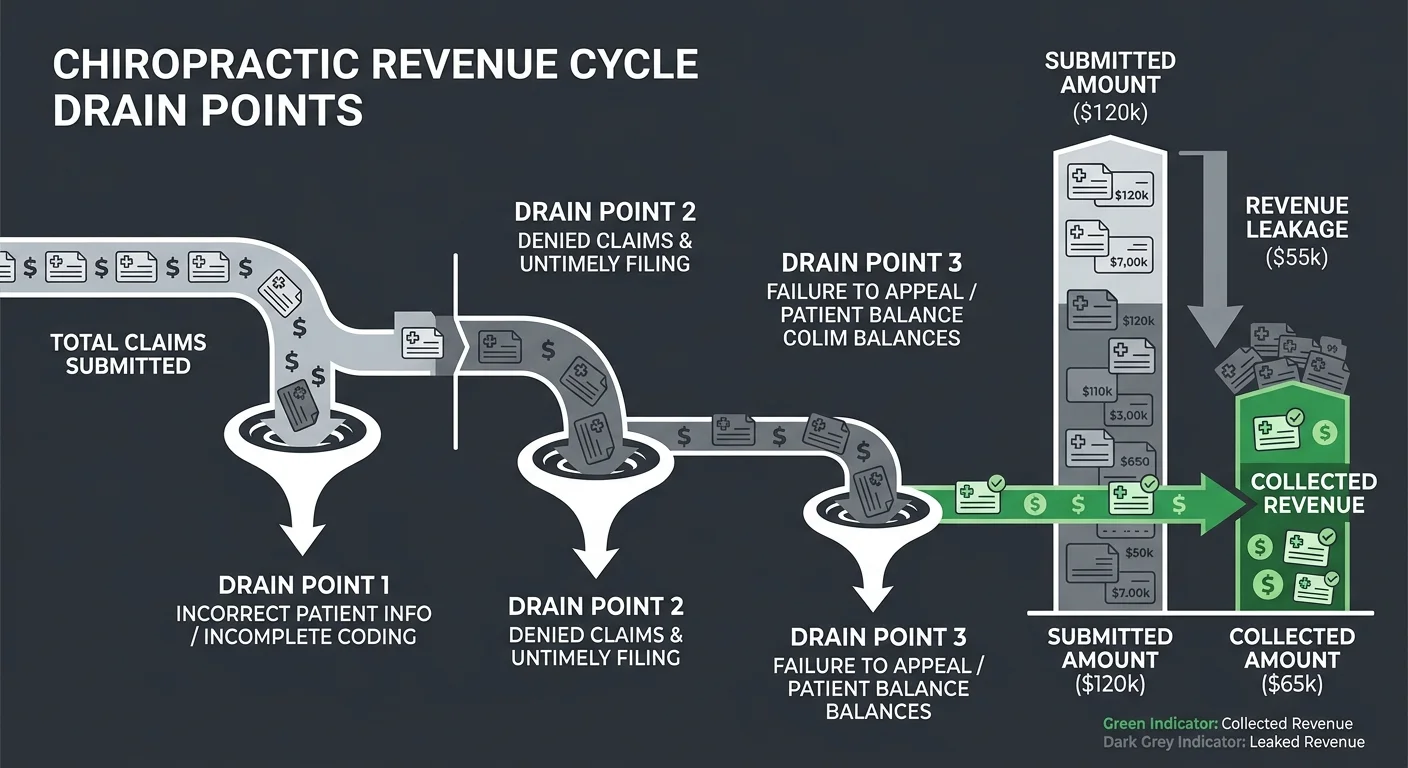
15% is not a rounding error.
It's not a bad month. It's not one difficult payer or one rough quarter. It's the predictable, repeatable output of a billing structure that was never designed to recover every dollar — only to move claims at volume and keep the dashboard green.
The leakage is structural.
Errors compound across front-end registration, coding, clearinghouse scrubbing, and back-end denial management. Every handoff is a potential exit point. And in a volume-first model, none of those exit points trigger an alarm — because no one is watching for them.
Here's what keeps this pattern running: the EHR never stops submitting.
The dashboard shows claim activity. The practice reads activity as payment. So the gap between what went out and what actually came back stays invisible — until someone decides to look at what a comprehensive audit reveals in aged AR.
Most practices never look. So the crack stays open.
How Revenue Leaks Without Triggering Any Alarm
Here's the design flaw: most billing workflows measure performance by what goes out, not by what comes back.
Claims exit cleanly. Denials return quietly. And in a high-throughput operation, a denial that needs human judgment to resolve doesn't get prioritized. It gets set aside — because working it costs more than the model allows.
So the denial sits. No one flags it. No one calls the payer.
The OIG has documented this pattern across federal audits: systemic documentation failures — particularly around clinical necessity — are the primary driver of denied chiropractic claims(https://oig.hhs.gov/oas/reports/region9/91803004.asp). This isn't an occasional oversight. It's what happens when a billing structure isn't built to catch it.
The practice never gets a warning. It just gets paid less.
That's how 15% disappears without a single dramatic event.
No crisis. No catastrophic audit. Just a slow, structural bleed — quiet enough that the practice assumes everything's fine because claims are still going out the door.
The Three Places Claims Quietly Die
Revenue doesn't vanish in one place.
It exits through three distinct failure points. Each one runs silently inside a billing workflow built for throughput — not recovery.
The first is the claim that never should have been denied — the one with a documentation gap a specialist would've caught before it went out.
The second is the denial that came back, got logged, and never got worked. It sat in the queue long enough to become someone else's problem — which usually means no one's problem.
The third is the appeal window that closed while the claim was still waiting. Commercial payers enforce strict 90-to-180-day timelines. Aged AR past 120 days drops sharply in recovery probability. When those windows close, the revenue isn't delayed. It's gone.
Every one of those exit points requires human judgment to close. Software can't make that call.
The full-service chiropractic RCM model Bushido Billing operates exists specifically to address all three — not by submitting faster, but by building the expertise to catch what automation skips and work what volume models quietly abandon.
| Leakage Source | Where It Occurs in the Billing Cycle | Why It Goes Undetected | Recovery Difficulty |
|---|---|---|---|
| Missing or incomplete AT modifier | Pre-submission coding | EHR submits the claim without triggering an error — the denial arrives weeks later, after the window for clean correction has narrowed | Moderate — requires documentation correction and resubmission before payer deadline |
| Insufficient medical necessity documentation | Clinical documentation before billing | The claim clears the clearinghouse scrub and reaches the payer — the deficiency only surfaces on the Explanation of Benefits, which may not be reviewed promptly | High — requires provider involvement to reconstruct or supplement clinical records |
| Denial logged but never worked | Back-end denial management | In a volume-first model, unworked denials accumulate without triggering alerts — they show as claim activity in the dashboard, not as lost revenue | High — recovery depends entirely on whether the appeal window is still open |
| Appeal window expired | Post-denial follow-up | No system flags the closing deadline — the claim ages past the commercial payer cutoff while still listed as pending in the AR queue | Permanent — once the payer deadline passes, the revenue cannot be recovered through standard appeal |
| Front-end registration errors | Patient intake and eligibility verification | Errors in demographic or insurance data pass through initial scrubbing and only surface as denials after submission — often attributed to 'payer issues' rather than intake failures | Low to moderate — correctable if caught before the claim ages, but requires staff time and payer resubmission |
| Maintenance care billed as active treatment | Coding and claim preparation | The distinction between active and maintenance care is clinical, not administrative — billing software cannot make this judgment, so misclassification passes through unchallenged | High — disputed claims require clinical documentation review and are frequently written off rather than appealed |
The Modifier and Documentation Gaps That Quietly Kill Claims
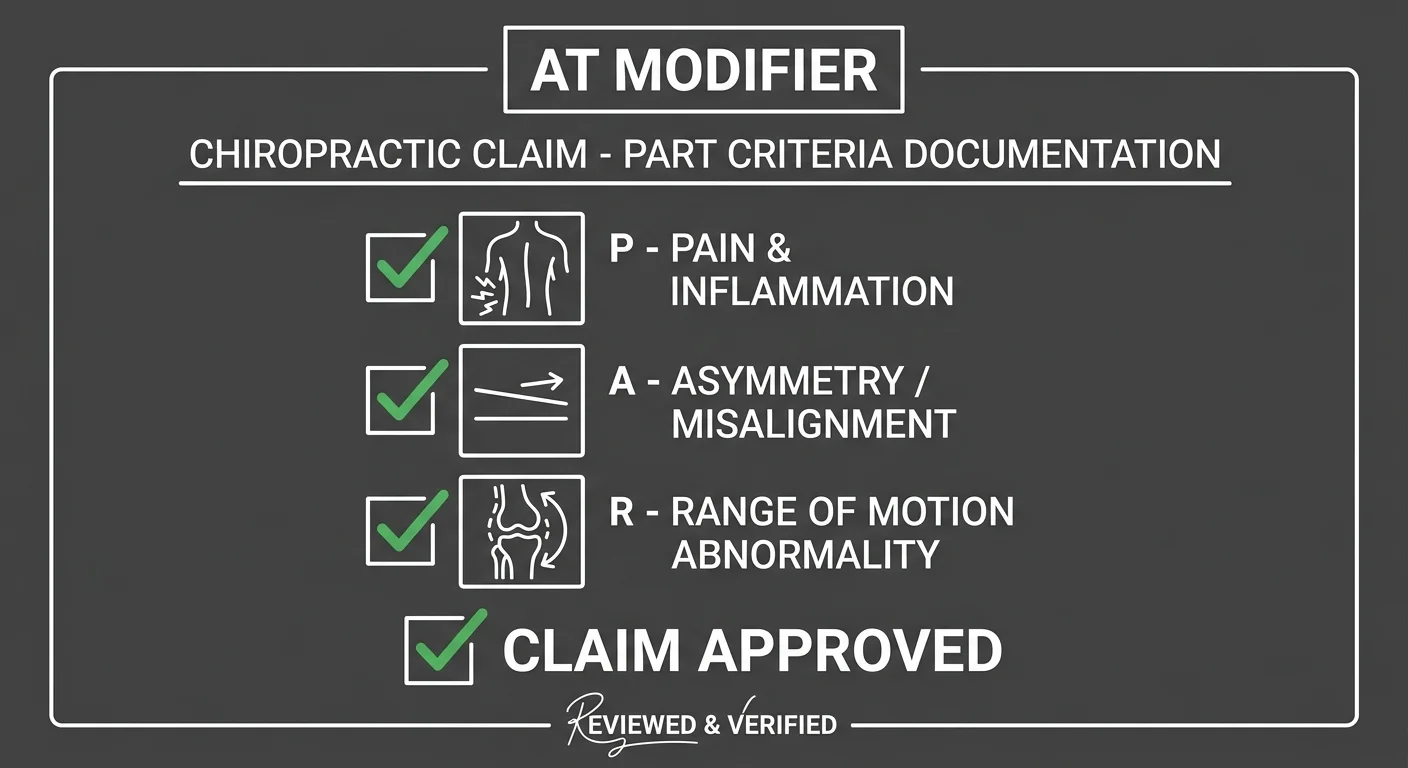
The leakage isn't mysterious. It has an address — modifier rules and documentation standards. And volume-first workflows are structurally built to miss both.
Chiropractic billing doesn't bend for generalist templates. The coding rules are exact. The documentation thresholds are defined. And when either one is off — even slightly — the claim doesn't get negotiated down. It gets denied. Quietly, automatically, without anyone in the practice knowing it happened.
Practices that start noticing the billing warning signs that surface first — aging AR, unexplained collection dips, payers that seem to deny more than others — are usually staring at downstream symptoms of upstream failures. The root cause is rarely dramatic. It accumulates quietly. And by the time it's visible, the revenue exit has been open for months.
Why the AT Modifier Is the Most Dangerous Three Characters in Chiropractic Billing
Three characters. That's the difference between a paid Medicare claim and an automatic denial.
Medicare requires the AT modifier — Active Treatment — on every chiropractic claim(https://downloads.cms.gov/medicare-coverage-database/lcd_attachments/29099_2/98940_codeguide.htm). It tells the payer the service is therapeutic and medically necessary, not maintenance care. Medicare doesn't cover maintenance care. The modifier has to be appended to HCPCS codes 98940, 98941, or 98942. Leave it off, and the claim is automatically reclassified as maintenance therapy and denied. No appeal. No nuance. Just a denial.
Here's what's actually happening: billers know the AT modifier exists. That's not the problem. The problem is that in a volume-first operation, the claim goes out fast — and a modifier check is a manual step that slows throughput. So it gets skipped. Or the EHR auto-populates the code without the modifier and nobody catches it before submission. Either way, the claim is gone. And the practice gets a denial code that takes a specialist to read — not an explanation anyone in the front office can act on.
The PART Criteria Problem: Documentation That Looks Complete but Isn't
Getting the modifier right doesn't save the claim. The documentation behind it still has to prove medical necessity. That's the second place the revenue exits — and it's just as quiet.
Chiropractic medical necessity requires documented evidence of at least two of four PART criteria: Pain, Asymmetry, Range of motion, and Tissue changes(https://www.ncbi.nlm.nih.gov/books/NBK534839/). One of those two has to be either asymmetry or range of motion. That's not a suggestion — it's the standard. A chart note that documents pain and tissue changes but misses asymmetry and range of motion doesn't come close. That claim is a denial waiting to happen, and the chart looks complete to anyone not reading it against payer requirements.
OIG audits found that a significant percentage of chiropractic claims reviewed failed to meet federal documentation requirements factClaim_02 — with missing clinical necessity documentation identified as the primary driver. This isn't a handful of underprepared practices. It's a pattern. PART criteria are specific enough that routine clinical notes — written for patient care, not payer compliance — fall short without deliberate review. Most providers don't know a note failed until the denial arrives.
Why Most EHR Systems Cannot Close This Gap
EHR platforms submit claims. That's what they do. They weren't built to audit documentation against payer-specific medical necessity standards before submission — and that gap is exactly where chiropractic EHR limitations create the most persistent revenue exposure. Practices assume the software is watching. It isn't.
The EHR confirms a claim was sent. It doesn't confirm the claim was sent correctly. It doesn't verify the AT modifier is present on every applicable Medicare claim. It doesn't check whether the chart note satisfies PART criteria before generating the code. Those are human judgments. And in a billing model built around automation and throughput, no human is assigned to make them consistently. So the gap stays open. The EHR keeps submitting. The revenue keeps leaving.
| Documentation Element | What Payers Require | Common Error Pattern | Denial Risk Level |
|---|---|---|---|
| AT Modifier (Active Treatment) | Appended to HCPCS codes 98940, 98941, or 98942 on every Medicare chiropractic claim to confirm the service is therapeutic and medically necessary — not maintenance care | Modifier omitted during high-volume submission or auto-populated incorrectly by EHR without pre-submission human review | Critical — claim is automatically reclassified as maintenance therapy and denied with no appeal pathway |
| PART Criteria Documentation — Asymmetry | At least one of the two required PART criteria must be either asymmetry or range of motion; asymmetry must be objectively documented in the clinical note | Routine clinical notes written for patient care document pain and tissue changes but omit measurable asymmetry findings | High — claim fails medical necessity threshold regardless of other documented findings |
| PART Criteria Documentation — Range of Motion | Objective range-of-motion measurement required as a primary PART criterion when asymmetry is not documented; must reflect the specific joint treated | Range-of-motion findings recorded generically or omitted when the treating provider prioritizes narrative charting over payer-compliance documentation | High — absence of this criterion alongside asymmetry produces automatic disqualification for medical necessity |
| Clinical Necessity Narrative | Chart notes must connect the patient's presenting condition to the specific chiropractic intervention billed; payers evaluate whether the treatment is supported by the documented diagnosis | Notes written at the point of care describe treatment performed rather than medical rationale — creating a documentation gap that triggers payer-level clinical review or denial | Moderate to High — insufficient narrative invites pre-payment audits and post-payment clawbacks |
| Active vs. Maintenance Care Distinction | Medicare and most commercial payers require clear differentiation between active therapeutic treatment and maintenance care; maintenance care is non-covered and must not be billed as active treatment | Billing submitted without explicit documentation distinguishing the phase of care — particularly in long-term chiropractic patients — creates ambiguity that payers resolve in their own favor | High — claims that blur the active-versus-maintenance line are denied outright or flagged for extended review |
| Payer-Specific Documentation Requirements | Individual commercial payers layer additional documentation requirements on top of federal standards; these vary by plan and are not universally reflected in EHR coding templates | Generalist billing workflows apply a single documentation standard across all payers, missing plan-specific requirements that trigger denials from insurers with stricter clinical thresholds | Moderate — denials accumulate silently by payer without pattern recognition unless a specialist is actively tracking denial codes by plan |
Why the Volume-First Billing Model Is Built to Miss These Errors
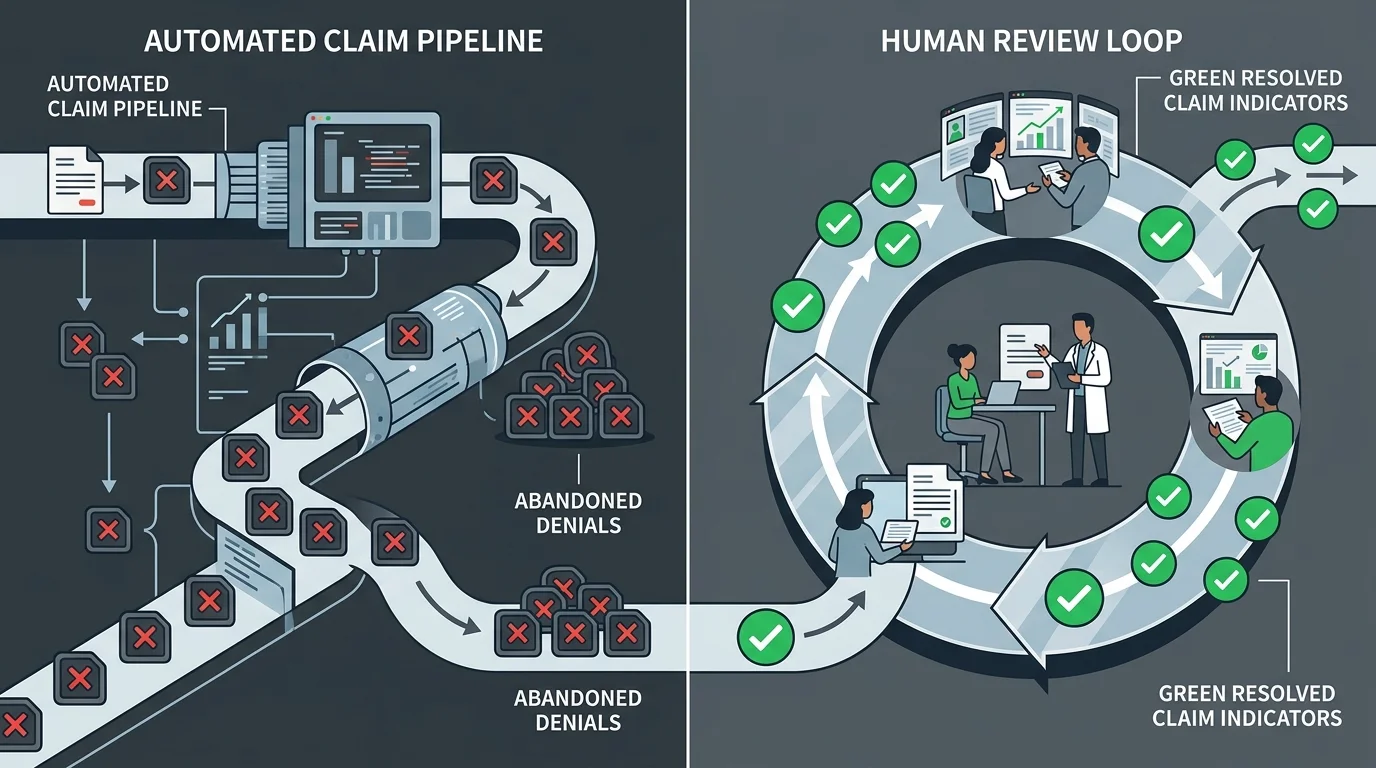
Coding errors don't survive in a vacuum. They survive because the billing model around them was built to move claims out the door — not to catch what's wrong before they go.
Volume-first billing tracks throughput. Claims submitted per day. Clean claim rates. Days in AR. These are real numbers — but they are numbers about activity, not about money actually recovered. That distinction is everything. And most practices never realize they're reading the wrong report.
When the performance standard is submission speed, the operation optimizes for submission speed. What it doesn't optimize for is what happens after the denial comes back. That's where the structural failure lives. That's where the 15% exits — quietly, claim by claim.
The Throughput Trap: Why High-Complexity Claims Get Abandoned
Here is the throughput trap in plain terms: a claim that requires human judgment to resolve costs more to work than a volume model budgets for. So it doesn't get worked. It gets logged. It sits in a queue. And eventually, the appeal window closes — and the revenue is gone.
The claims that trigger this trap are not edge cases. They are the high-complexity denials — the ones requiring medical necessity arguments, modifier corrections, documentation amendments, and multi-step payer follow-up. And not coincidentally, those are also the highest-value claims sitting in the AR.
Most claim denials are completely preventable. That's the bitter part. Preventing them — or recovering them after the fact — requires someone to actually look at each one. In a high-throughput operation, that someone doesn't exist. The model doesn't fund the role. So a preventable denial becomes permanent revenue loss, and nobody marks it as such.
So the denial sits. No one flags it. No one calls the payer. Manual appeals take real time — and in a volume model, that time belongs to no one. The claim ages past the recovery window. The practice keeps getting statements that look fine. The EHR keeps submitting. And the crack stays invisible.
Who This Billing Model Actually Serves — and Who It Doesn't
This model works fine for practices with clean payer mixes and low denial complexity. That's not most chiropractic practices. Chiropractic billing carries modifier-specific Medicare requirements, personal injury lien workflows, and maintenance-versus-active-care documentation standards that generalist templates were never built to police. The specialty requires specialty expertise. A generalist model doesn't provide it — and the revenue gap is the proof.
Practices that need every dollar recovered — not just the easy ones — aren't well-served by a model built for easy dollars. That's not a criticism of the model. It's a structural mismatch. And recognizing it is usually what explains why signs you need a billing audit show up as a slow pattern, not a single dramatic event.
If Your Billing Company Never Calls You, That's Not Professionalism
Silence from a billing company is not professionalism. It is a structure that hides problems until they become cash flow crises.
In a volume-first model, client communication is overhead. It costs time and slows throughput. So it gets minimized — a monthly report, or a call when something goes dramatically wrong. The practice reads the quiet as a good sign. It isn't. It's a sign that no one is watching closely enough to have anything to report.
Practices that catch their leakage earliest have proactive weekly updates built into the billing relationship — not as an optional add-on, but as how the model works. Weekly visibility means denial patterns get surfaced before they compound. Appeal windows don't close unnoticed. The crack in the pipe gets found before the floor is wet.
| Billing Model Feature | Volume-First Approach | Human-Expert Approach | Impact on Complex Chiropractic Claims |
|---|---|---|---|
| Performance Metric | Claims submitted per day; clean claim rate; days in AR | Revenue recovered per claim; denial resolution rate; appeal success rate | Complex chiropractic claims require recovery metrics — submission metrics never reveal what was silently abandoned |
| Denial Handling | Denials are logged and queued; high-complexity cases deprioritized when appeal cost exceeds throughput budget | Each denial is reviewed by a human, categorized by root cause, and worked through multi-step appeal if required | AT modifier errors, PART criteria gaps, and PI lien disputes require human judgment — queues don't provide it |
| Modifier Compliance | EHR auto-populates codes; modifier accuracy depends on template configuration, not active review | Dedicated biller verifies modifier presence on every applicable claim before and after submission | A missing AT modifier on a Medicare claim produces an automatic denial with no appeal pathway — catching it requires human eyes |
| Documentation Review | Chart notes are accepted as submitted; payer-specific medical necessity standards are not verified pre-submission | Documentation is reviewed against payer-specific thresholds — including PART criteria — before the claim goes out | A chart note that satisfies clinical care standards can still fail payer standards; only deliberate pre-submission review catches the gap |
| Client Communication | Monthly reports or exception-only alerts; silence interpreted as stability | Structured weekly updates surface denial patterns, appeal status, and AR movement in real time | Appeal windows close in weeks — a monthly reporting cycle means most complex denials are already unrecoverable before anyone is notified |
| Revenue Recovery Incentive | Billing company revenue tied to claim volume, not collection outcomes — high-complexity claims cost more to work than the model funds | Performance-based model aligns billing company revenue directly to what the practice collects — every unworked denial is shared lost revenue | Incentive misalignment is the structural root of abandonment; when the billing company gets paid regardless, hard claims don't get worked |
What Happens to Denied and Unworked Claims Over Time
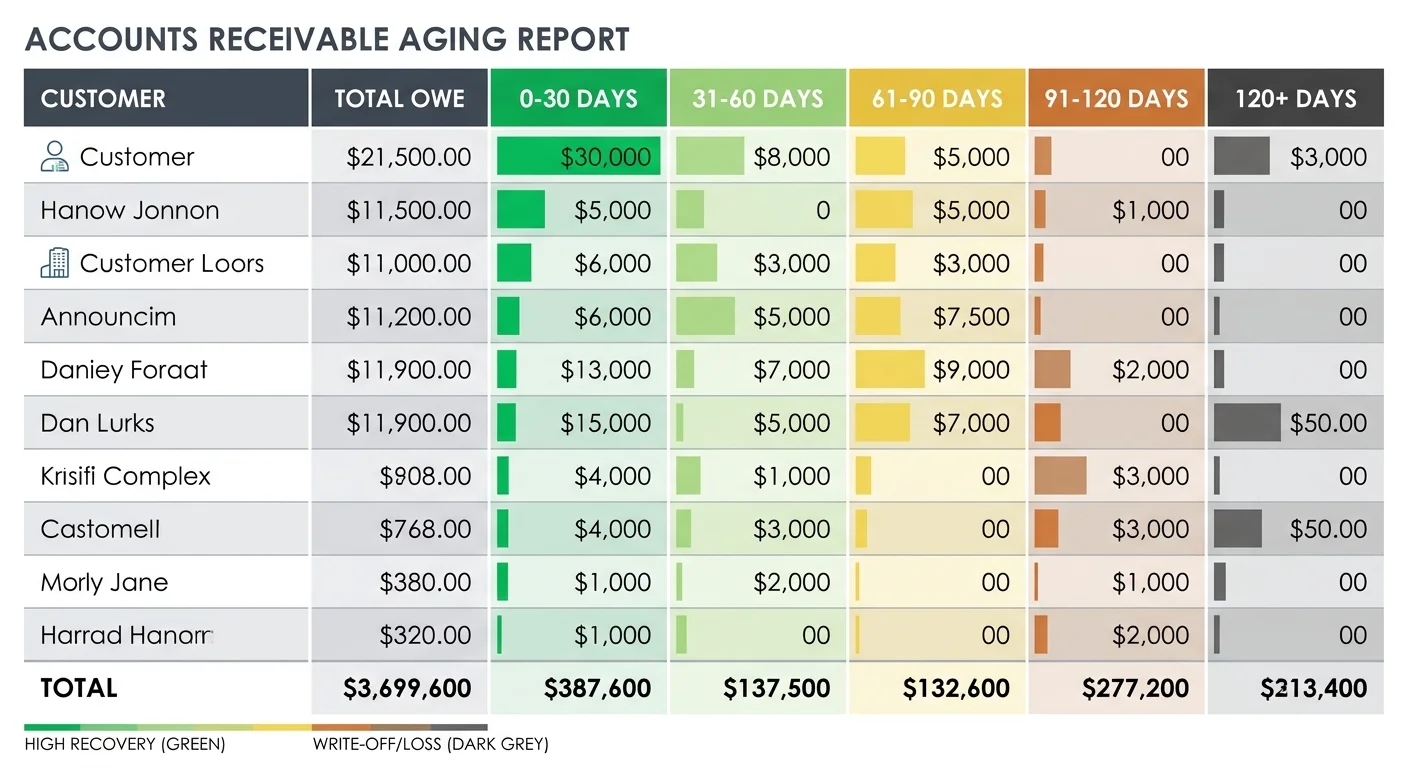
Unworked claims don't wait. They age — and aging in billing is a one-way door.
Here's what makes it worse. Every day a denied claim sits untouched, the payer appeal window narrows. And in a volume-first billing model, no one is assigned to watch that clock. Working a denial takes time — more time than the throughput model budgets. So the task belongs to no one. The claim keeps aging. The practice keeps assuming the billing is fine.
This is exactly what revenue leakage is designed to hide. It doesn't show up in submission reports. It shows up months later, in write-offs — after the window to fight for that revenue has already slammed shut.
The Appeal Window Is Not Optional — and Most Practices Miss It
Commercial payers enforce strict appeal windows — typically 90 to 180 days. That's not a suggestion. It's a hard cutoff. Miss it and the conversation is over.
Miss the window and the claim is gone. Not pending. Not recoverable with a better argument. Gone. According to NIH documentation, failure to appeal within payer-established timeframes results in permanent write-offs that cannot be reversed — regardless of the clinical validity of the original claim. The denial goes final not because the claim was wrong. Because no one moved in time.
The practices that lose the most revenue to expired appeal windows aren't the ones with the worst billing. They're the ones whose billing company never flagged that a window was open. Denial tracking is overhead in a volume-first operation. It slows throughput. So it doesn't happen consistently. Nobody watches the clock. And when no one's watching, it runs out.
How Aging AR Becomes Permanent Write-Off
Aged AR past 120 days drops sharply in recovery probability. That's the inflection point — where a workable denial becomes a probable write-off. And most practices don't know they've crossed it until it's too late.
But practices don't see that number in real time. They see collections totals. The aging columns look manageable. New claims fund enough cash flow that the aged AR stays invisible — and the EHR keeps submitting, which looks like health. Until the write-offs start stacking and there's nothing left to appeal.
What turns aging AR into permanent write-off isn't one bad claim. It's months of unworked denials — each one aging past its appeal window while the billing model treats it as a low-priority queue item. McKinsey research confirms that a large proportion of healthcare claim denials are completely preventable with clean billing operations. But prevention requires someone to act before the clock expires. In a high-throughput model, that someone doesn't exist. The model doesn't fund the role.
What a Billing Audit Actually Finds in a Neglected AR Report
When a billing specialist reviews a neglected AR — claim by claim, against appeal windows, payer-specific rules, and documentation status — the findings are rarely surprising. They're just specific. The categories of loss repeat across practices. The patterns are predictable. And that predictability is exactly what makes them fixable, if someone finds them in time.
Practices that go through a thorough review of denied claim patterns find the same categories of loss, again and again: expired appeal windows on high-value claims, AT modifier errors that slipped through post-submission, PART documentation gaps that sat unaddressed before the denial hit, and PI lien claims parked in a queue with no one following up. These aren't random failures. They're the predictable output of a billing model that was never built to work hard claims.
The revenue sitting in a neglected AR report isn't gone until it's written off. But it gets closer to gone every week that passes without action. Knowing what's still recoverable — and what already isn't — is how you stop the bleed. And that starts with uncovering hidden revenue in your AR before the windows close.
| AR Age Bucket | Typical Payer Appeal Deadline | Recovery Probability | Recommended Action |
|---|---|---|---|
| 0–90 Days | Window open — most payers allow appeals within 90 to 180 days | Highest — claim is fully workable with the right documentation and follow-up | Assign to a billing specialist immediately; build the medical necessity argument and file the appeal |
| 90–120 Days | Closing fast — many payers treat 90 days as a hard cutoff | Declining — every week without action narrows the window further | Escalate priority; confirm payer-specific deadline and file before the cutoff closes |
| 120+ Days | Expired or expiring for most payers | Drops significantly — recovery probability falls sharply past this threshold | Conduct claim-by-claim triage; identify any remaining payer exceptions before permanent write-off |
| Past Appeal Window | Closed — no recourse regardless of clinical validity | Near zero — failure to appeal within payer timeframes results in permanent write-offs | Document the loss; audit what caused the lapse; restructure denial tracking to prevent recurrence |
| Preventable Denials (Any Age) | N/A — these claims should never have been denied | High — if caught before submission, these generate clean payment with no appeal required | Implement pre-submission claim review; a large proportion of denials are completely preventable with clean billing operations |
Frequently Asked Questions
Chiropractic revenue leakage is not one big event. It is a series of small, specific failures — modifier errors, documentation gaps, unworked denials, appeal windows that closed while no one was watching. Each one is easy to miss in a monthly report. Together, they account for the 15%.
Below are the specifics — the exact errors, the exact costs, and what it actually looks like when a billing relationship is built around recovery instead of throughput.
What are the most common coding errors that cause chiropractic claims to be denied?
Three categories. They repeat across practices with striking consistency.
First: AT modifier errors on Medicare claims. The modifier must be appended to HCPCS codes 98940, 98941, or 98942 to signal active treatment. Without it, the claim is automatically categorized as maintenance therapy and denied. Not reviewed. Not queried. Denied.
Second: PART documentation gaps. Medical necessity requires documentation of at least two of the four PART criteria — Pain, Asymmetry, Range of motion, and Tissue changes — and one of those two must be asymmetry or range of motion. Claims submitted without meeting that threshold fail on medical necessity. Not on coding.
Third: maintenance-versus-active-care misclassification. This one is the hardest to catch because it often clears the EHR scrubber without triggering an error. It surfaces later — in a denial, or an audit — when it is already past the easiest point to correct.
Why does relying purely on EHR automation lead to uncollected revenue?
EHR software submits claims. That is what it is built to do.
What it cannot do is catch a missing AT modifier after submission, read a patient file to build a medical necessity argument, or call a payer before a 90-to-180-day appeal window closes. That work requires a human being assigned to do it — consistently, claim by claim.
This is not a technology gap that better software will eventually close. It is a structural one. Denial management, appeal filing, and AR follow-up require human judgment applied to individual claims. No EHR has an automation pathway for that.
Practices running on EHR automation alone are not running billing. They are running submission. The difference shows up in the aging AR — in the denials that never came back, the appeals that were never filed, and the revenue no one was assigned to recover.
How does a dedicated, human-led billing review uncover aged accounts receivable?
Pull every unworked denial. Sort it against the payer-specific appeal window. Commercial payers enforce strict 90-to-180-day limits — so the first job is separating what is still recoverable from what has already aged past the cutoff.
From there, each workable claim gets examined against its denial reason: AT modifier missing or wrong, PART criteria not adequately documented, maintenance-versus-active-care confusion, a PI lien claim parked with no follow-up. These are not random failures. They are patterns — and patterns are fixable once someone names them.
Aged AR past 120 days drops significantly in recovery probability. That is why the review has to happen before the clock runs out — not after the write-offs are already on the books.
What is the actual cost of ignoring denials past the standard appeal window?
The cost is permanent.
Commercial payers enforce appeal windows — typically 90 to 180 days. Miss the deadline and the claim cannot be recovered, regardless of the clinical validity of the original service. There is no exception. No goodwill extension. The denial becomes final not because the claim was wrong, but because no one acted.
Denials don't age gracefully. They die.
Aged AR past 120 days drops significantly in recovery probability. That is the inflection point. Before it, a skilled appeal has a real chance. After it, the probability drops fast — and once the payer window closes, there is no appeal left to file. The practices that lose the most to expired windows are not the ones with the worst billing. They are the ones whose billing company never flagged that the window was open.
How does a performance-based billing partner align incentives to recover aged AR?
In a performance-based model, the billing partner gets paid on collections — not on claims submitted. That single structural change eliminates the incentive to quietly abandon hard claims.
When recovery drives the operation, working a complex denial is not overhead. It is the job. AT modifier corrections, medical necessity arguments, PART documentation gaps that need to be addressed before refiling — these are the claims a performance-aligned partner has every reason to work. Because abandoning them costs the partner revenue too.
The appeal window still closes at 90 to 180 days. That deadline does not move. But in a model where someone is actually watching the AR, surfacing denial patterns, and acting before the clock runs out — the window gets used. Not missed.
The Revenue Your Practice Has Already Earned
The 15% is not a mystery. It's not bad staff, bad luck, or a bad quarter.
It's a decision. Made quietly, at the operations level of a billing company most practices never scrutinize. Build around submission speed — not revenue recovery — and every claim that dies in a queue, ages past its appeal window, or goes out without a modifier correction is the compounding cost of that call.
The practice didn't make that choice. But the practice is paying for it.
The crack doesn't seal itself. The EHR keeps submitting. The monthly report keeps showing collections. And the revenue that required a human to fight for — the modifier correction, the medical necessity argument, the denied claim that needed a call before the appeal window closed — keeps aging past the point of return.
That's the leakage. Not a blowout. A slow, structural bleed.
Bushido Billing was built to be the human in that equation. Dedicated expertise assigned to the hard claims. Proactive weekly updates that surface denial patterns before windows expire. A performance-based model where recovery — not throughput — drives the operation. The full-service chiropractic RCM model exists because the volume-first alternative quietly writes off the revenue a practice has already earned.
And as long as no one is assigned to check every claim, the crack stays invisible.
The revenue in an aging AR report is not gone. Not yet.
But it gets closer to permanent with every week that passes without someone reviewing it, working it, and filing before the clock runs out. AR past 120 days drops sharply in recovery probability — and that inflection point arrives whether anyone is watching or not.
So the question isn't whether your practice can afford a billing partner that does this work. The question is how much it has already lost by not having one — and whether that answer is sitting in your AR right now, waiting for someone to look.
Those denials sitting in your AR right now are either being worked — or they're aging past the point of return. Nobody's going to tell you which one it is unless someone's actually looking. That's where a discovery call with Bushido Billing starts.

© 2026 Bushido Billing. All Rights Reserved | Web Design by iTech Valet