

What Documentation Errors Are Costing Your Clinic Thousands in Recoverable Claims?
Documentation errors are costing chiropractic practices thousands in claims they already earned. The care was delivered. The codes were submitted. The revenue never arrived — and in most cases, nobody flagged it.
That is what makes this problem expensive. There is no alarm. Claims get denied, written off, or quietly underpaid, and the practice moves on. The leak is invisible until someone looks.
Four error types drive the majority of recoverable losses in chiropractic billing. Missing or incomplete initial clinical evaluations leave payers with no documented basis for approving payment. AT modifier misuse or omission — the AT modifier is the CMS-required designation that spinal manipulation constitutes active or subacute care — causes Medicare and commercial payers to treat the service as non-covered by default. Maintenance versus active care boundary failures strip payment eligibility entirely on visits where restorative goals were not documented in the record. Deficient daily SOAP note documentation eliminates the objective clinical evidence payers require and is a leading driver of retrospective recoupments.
These are not rare edge cases. Regional audit reviews found that up to 82% of reviewed chiropractic claims failed to document basic treatment necessity. The Office of Inspector General estimated $358.8 million in inappropriate Medicare payments for chiropractic services, with unsupportive documentation identified as the primary driver. Separate OIG audit reviews confirmed that initial clinical evaluations and formal plans of care are absent from patient records at a systemic level.
The recoverable portion of those losses is real. When documentation errors are identified through a structured billing audit, practices find claims that were denied or underpaid not because the care was wrong, but because the record did not support it. Correcting the documentation gap is what converts written-off claims into recovered revenue.
Last Updated: August 17, 2026
- • Why Documentation Errors Are a Revenue Problem, Not a Paperwork Problem
- • Why Generic Billing Software Won't Catch These Errors
- • The Four Documentation Errors That Drain the Most Recoverable Revenue
- • What a Billing Audit Actually Surfaces in a Real Practice
-
• Frequently Asked Questions
- • What are the most common documentation errors that trigger chiropractic claim denials?
- • How does AT modifier misuse directly affect a clinic's collected revenue?
- • Why does a generic EHR billing system fail to catch medical necessity errors?
- • What is the financial cost of failing to document active care versus maintenance therapy?
- • How can a proactive billing audit recover revenue from historically under-coded claims?
- • The Leak Has a Location — Now You Can Fix It
Why Documentation Errors Are a Revenue Problem, Not a Paperwork Problem
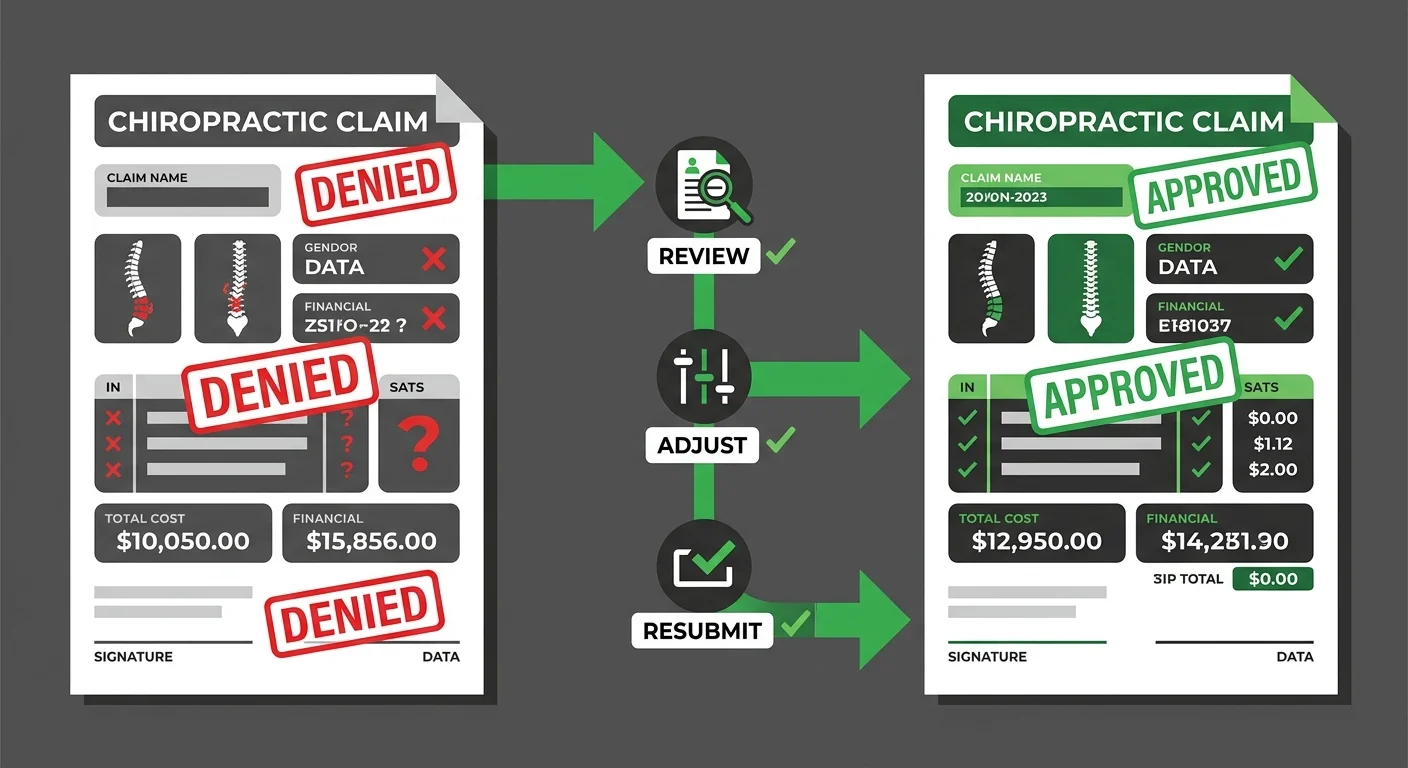
Documentation isn't paperwork. It's the variable that decides whether a submitted claim becomes collected revenue — or a write-off no one questions.
Here's the thing: most practices run billing and documentation as separate workflows. The clinician charts. The biller submits. But payers don't evaluate two separate workflows. They evaluate one record. If that record doesn't substantiate the service, the claim fails. That gap — between what was charted and what payers need to see — is exactly where the revenue disappears.
And that disappearance is quiet. It doesn't announce itself. Federal audit findings document $358.8 million in Medicare payments for chiropractic services deemed inappropriate — with unsupportive documentation identified as the primary driver. Those losses didn't happen in a single billing catastrophe. They accumulated across thousands of ordinary claims, from ordinary clinic days, where the documentation simply didn't hold.
The Gap Between Submitted and Collected
Every claim submitted carries a gap between what was billed and what actually gets collected. For most clinics, that gap is invisible. No line item reads 'lost due to documentation failure.' The money just doesn't show up.
But the gap is real. And it's large. Audit data confirms that up to 82% of chiropractic claims fail to document basic treatment necessity. The majority of reviewed claims lacked the foundational clinical evidence payers require before authorizing payment. That's not a fringe problem. That's the norm.
Those denied and underpaid claims don't disappear cleanly. They sit in AR. They age past the point where working them is straightforward. Practices that want to know what's actually recoverable often find the answer by examining hidden revenue in aging AR that documentation errors created in the first place. The longer it sits, the harder it gets.
Why Most Billing Companies Miss This — and Why It Costs You
Most billing companies aren't built to catch documentation errors. They're built to submit claims fast. Those aren't the same job.
Volume-first billing models optimize for throughput. Clean claims — standard coding, no modifier complexity, documentation that clears automatically — move fast and get paid. But the moment a claim requires a medical necessity argument, a modifier correction, or a clinical record review, the volume model has no cost-effective path forward. The claim gets denied. The denial gets logged. The revenue gets written off.
So practices end up with a billing company that's submitting claims and getting some of them paid — while a structural layer of documentation-driven denials builds underneath, unworked and unflagged. Nobody's catching it. Nobody's resolving it. The full-service chiropractic billing model that actually fixes these errors requires human clinical judgment. Faster automation doesn't solve a documentation problem.
That's what submission speed costs you. The claims that need the most expertise to save are the ones a volume model is least incentivized to touch. And because they age quietly — no alarm, no notification — the practice never knows what it's losing. The leak is invisible until someone looks.
| Documentation Gap | Payer Response | Revenue Impact | Recovery Potential |
|---|---|---|---|
| Missing or Incomplete Initial Clinical Evaluation | Payer has no documented basis for medical necessity — claim denied at adjudication or flagged for post-payment audit | Full visit value lost; no pathway to payment without a corrected or supplemented clinical record | High — when the evaluation is reconstructed with complete necessity documentation, denied claims become billable |
| AT Modifier Misuse or Omission | Medicare and commercial payers default to treating the service as non-covered; claim denied or paid at zero | Every affected visit is written off regardless of the clinical appropriateness of the care delivered | High — modifier correction on resubmission converts previously denied claims to paid status when underlying care qualifies |
| Maintenance vs. Active Care Boundary Failure | Payer classifies the visit as maintenance therapy and excludes it from covered benefits entirely | Payment eligibility is forfeited on all visits lacking documented restorative goals — losses compound across entire treatment episodes | Moderate — recovery depends on whether original clinical intent can be substantiated retroactively through chart review |
| Deficient Daily SOAP Note Documentation | Payer cannot verify clinical progress or objective outcomes; claim denied or subject to retrospective recoupment demand | Previously paid claims become repayment liabilities; future claims on the same patient are at elevated denial risk | Low to moderate — SOAP note gaps are the hardest to correct after the fact; prospective fix prevents ongoing losses more reliably than retroactive recovery |
Why Generic Billing Software Won't Catch These Errors
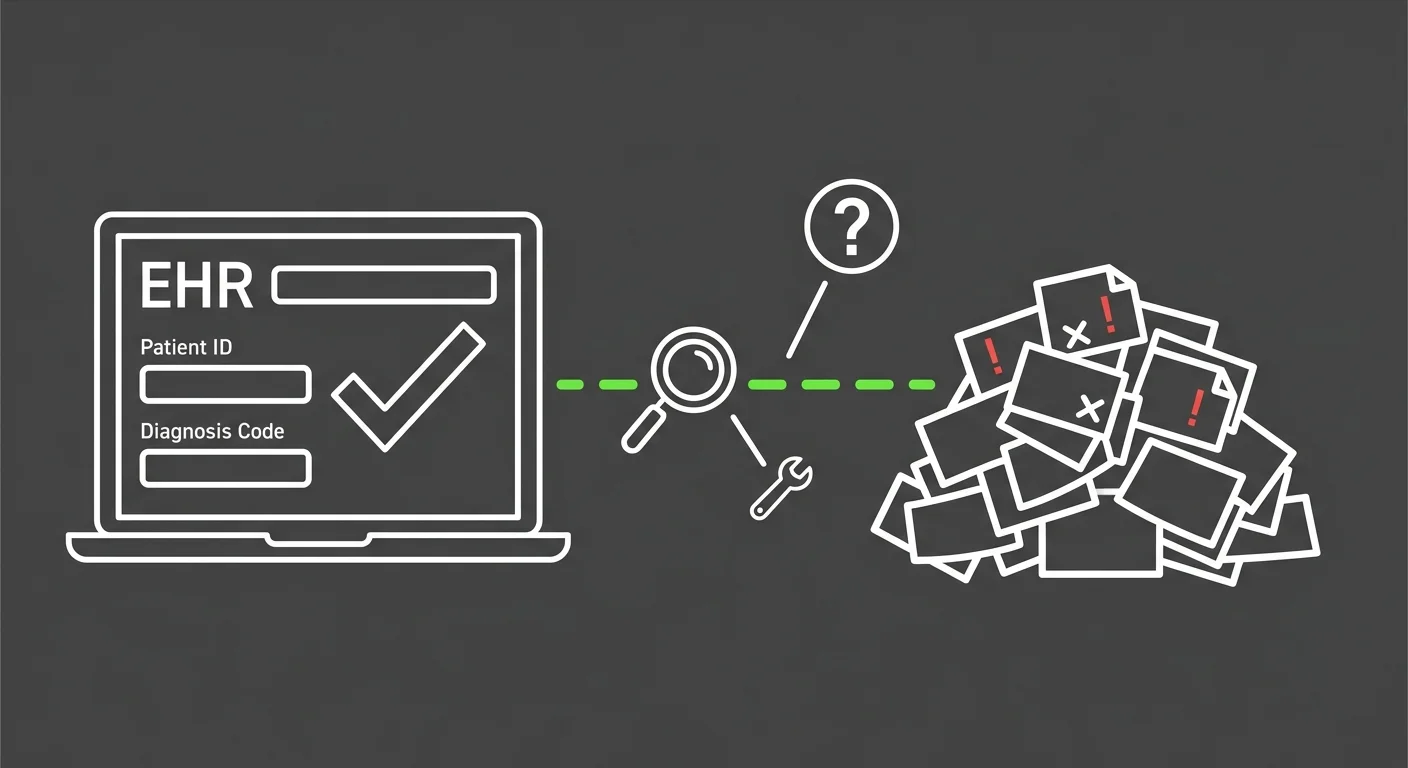
Here's what most practices never stop to question: the software already running looks like it's doing the job. Claims go out. Payments come in. The dashboard is green.
Software submits claims. It doesn't read them for clinical coherence. It doesn't check whether the documentation behind a code actually holds up under payer scrutiny. It processes what it receives — and when the record is deficient, it processes a deficient claim without blinking.
That's not a billing system working. That's a billing system appearing to work while documentation-driven denials pile up underneath it. The difference doesn't show up in the submission log. It shows up in AR — and only if someone is watching.
What EHR Platforms Are Actually Built to Do
EHR platforms are claim submission tools. That is their function — translate encounter data into a formatted claim and route it to a payer. Fast, structured, largely automated.
But submission is not the problem. Payers do not reject claims because they arrived slowly. They reject claims because the clinical record behind them does not substantiate the service billed. Audit findings confirm that initial clinical evaluations and formal plans of care are completely absent from patient records at a systemic level — a gap no EHR submission workflow is designed to catch.
So the EHR routes the claim. The payer denies it. The denial lands in a queue nobody's working. And the practice — staring at a dashboard that shows submissions out and payments in — sees nothing that reads as a problem. The submission tool did its job. The revenue left anyway. That's the gap. It's invisible precisely because the software is performing exactly as designed.
The Automation Cliff: Where Software Stops and Revenue Falls
Automation has a ceiling. Below it — clean codes, standard modifiers, complete documentation — it performs fine. Above it, where a claim requires clinical judgment, a modifier correction, or a medical necessity argument, the software has no pathway. It stops. And the revenue falls.
That ceiling sits directly above the four error types. Missing or incomplete initial clinical evaluations require a human to recognize what's absent and decide whether it's correctable — software doesn't know what's missing, only what's there. AT modifier misuse requires someone who understands the modifier's clinical standard, not just its code. Maintenance versus active care boundary failures require actually reading the record for restorative intent. Deficient daily SOAP notes require knowing what objective evidence a payer will accept as proof. None of those are software functions. Not one.
And the practices most exposed to this gap are usually the ones who believe their software is their billing solution. When a structured review examines visits flagged for undercoding, what surfaces isn't a random coding anomaly. It's a documentation pattern the software processed without question — visit after visit — until the revenue loss became structural and the AR reflected something the dashboard never did.
Billing software compatibility is the floor, not the ceiling. What matters is what happens after the claim leaves the system. The automation cliff isn't where the software breaks. It's where the revenue falls — quietly, consistently, without triggering a single alert.
| Billing Task | EHR Software Capability | Human Review Required | Revenue at Risk Without Human Review |
|---|---|---|---|
| Initial Clinical Evaluation Review | Formats and routes the encounter data as entered — no validation that an initial evaluation exists or meets payer standards | Identifies missing or incomplete evaluations before claims are submitted; flags records where foundational documentation is absent | Claims denied for lack of medical necessity baseline; no correctable record to support an appeal |
| AT Modifier Application | Appends modifier codes as mapped in the system — does not assess whether the underlying documentation substantiates active versus maintenance care | Confirms that modifier usage aligns with the clinical record; catches omissions and misapplications before the claim leaves the practice | Modifier errors trigger denials and payer scrutiny; incorrect omissions result in non-covered service classifications |
| Active vs. Maintenance Care Classification | Submits the code entered — cannot read the clinical record for restorative intent or flag visits where the care goal is undocumented | Reads the record for documented restorative goals; identifies visits where the boundary between active and maintenance care is unclear or absent | Visits billed without documented restorative goals lose payment eligibility entirely — revenue written off rather than corrected |
| Daily SOAP Note Completeness | Processes the claim based on what was entered in the EHR — does not evaluate whether SOAP note content meets the objective evidence standard payers require | Audits daily notes for clinical progress markers and objective outcome data; identifies patterns of deficiency before they trigger retrospective recoupments | Deficient SOAP notes expose the practice to retroactive recoupments from commercial and public payers on previously paid claims |
| Denial Pattern Recognition | Records denial reason codes as returned by payers — does not analyze patterns across claims or connect recurring denials to a shared documentation failure | Tracks denial patterns across claim types and dates of service; surfaces the root documentation error driving repeat failures | Unrecognized patterns compound over time — the same documentation gap produces the same denials, visit after visit, with no intervention |
The Four Documentation Errors That Drain the Most Recoverable Revenue
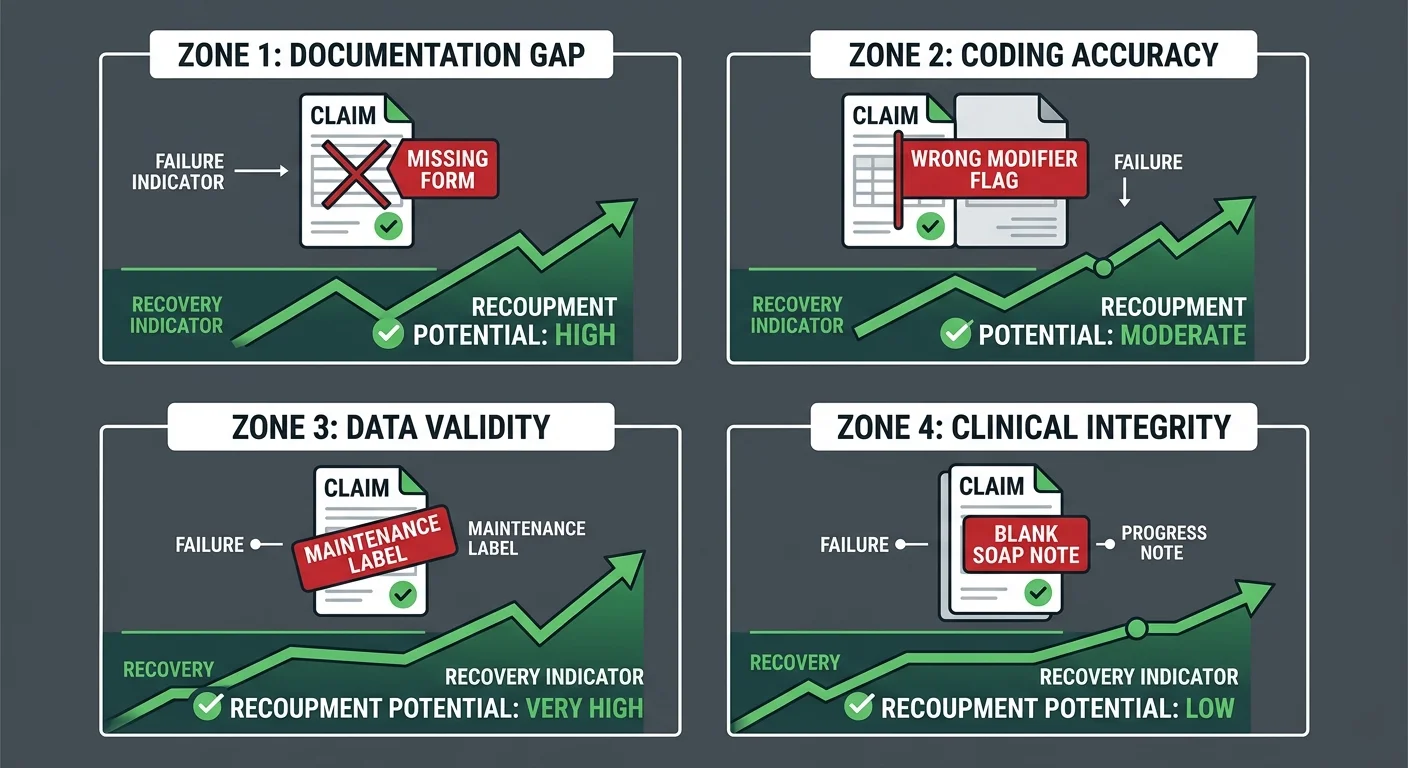
The gap isn't random. It has a shape. Four documentation error patterns show up across audit after audit — each one carving out its own category of recoverable revenue the practice never sees.
- Missing or incomplete initial clinical evaluation
- AT modifier misuse or omission
- Maintenance vs. active care boundary failure
- Deficient daily SOAP note documentation
Error Type 1: Missing or Incomplete Initial Clinical Evaluation
A missing initial clinical evaluation doesn't just fail that visit. Every subsequent claim in that patient's episode of care now sits on a foundation payers have legal grounds to reject. The evaluation isn't a formality. It's the clinical anchor that justifies everything billed after it.
And this isn't rare. OIG audit reviews confirm that initial clinical evaluations and formal plans of care are absent at a systemic level — not occasionally, but as a repeating pattern across reviewed practices. That's not a documentation quality problem. It's a structural gap in how chiropractic billing workflows get set up and supervised.
The cost compounds fast. One missing initial evaluation doesn't produce one denial — it creates retroactive exposure across the entire course of treatment. Payers gain grounds to question every claim tied to that episode. Practices that audit under-coded chiropractic visits consistently find this error sitting at the root of their largest denial clusters.
Error Type 2: AT Modifier Misuse or Omission
The AT modifier is a binary requirement. Active/corrective chiropractic treatment must carry it — it designates that the spinal manipulation is acute or subacute care. When it is missing, the claim does not read as maintenance care to a payer. It reads as an unsubstantiated claim. The denial follows.
So every visit where active corrective care was performed and documented — but the modifier was omitted — represents a billable service that wasn't collected. Not because the care was wrong. Not because the patient file was incomplete. Because one modifier field was missing.
This isn't a complex error to fix. But catching it requires reviewing the clinical intent of the visit — not just confirming a code got submitted. That's not how volume-first workflows operate. Automation processes what it receives. It doesn't ask whether what it received was clinically accurate.
Error Type 3: Maintenance vs. Active Care Boundary Failure
Medicare Fee-for-Service rules don't hedge on this: maintenance chiropractic therapy is excluded from coverage. The clinical record must document clear restorative goals to stay eligible for payment. When it doesn't, the claim fails. No gray area.
But in a daily clinical workflow, that line isn't always clean. Patients improve gradually. Treatment goals shift. And when the documentation doesn't reflect that clinical intent remains restorative, payers apply the published exclusion and deny. The Medicare coverage framework offers no ambiguity — payment eligibility requires documented restorative goals, not assumed ones.
And this one is particularly hard to recover after the fact. Once a claim is denied for maintenance-level documentation, correction requires producing clinical evidence of restorative intent that should have been in the record at the time of service. Sometimes that's correctable. Often the window has already closed — and the revenue is gone.
Error Type 4: Deficient Daily SOAP Note Documentation
Daily SOAP notes are the transaction record of chiropractic care. They're what a payer pulls when a claim gets flagged, audited, or appealed. When they're deficient — missing objective findings, lacking measurable progress markers, failing to connect the visit to an active treatment goal — the clinical record can't substantiate what was billed.
That deficiency drives retroactive recoupments. A payer doesn't have to catch the problem at submission. They can review a SOAP note months later — during a routine audit or targeted review — and demand repayment on claims already deposited. The practice received the revenue. Then it loses it. Because the documentation behind it didn't hold up.
OIG regional audit data puts a number on this: up to 82% of reviewed chiropractic claims failed to document basic treatment necessity. That's not a fraud statistic. It's a measure of how normalized deficient documentation has become across the specialty. Every one of those claims was rendered, billed, and submitted — without the clinical evidence required to protect the payment it generated.
| Documentation Error | CMS / OIG Rule Violated | Claim Outcome | Audit Recoupment Risk |
|---|---|---|---|
| Missing or Incomplete Initial Clinical Evaluation | OIG audit standard: initial clinical evaluations and formal plans of care must be present in patient records | Retroactive denial of all claims tied to that episode of care; payers gain grounds to question every subsequent visit | High — a single intake gap creates exposure across the full course of treatment |
| AT Modifier Misuse or Omission | CMS requirement: active/corrective chiropractic treatment must be appended with the AT modifier designating acute or subacute care | Claim denied as unsubstantiated; billable active-care visit not collected despite care being rendered and documented | High — every visit with omitted or misapplied modifier represents unrecovered billable revenue |
| Maintenance vs. Active Care Boundary Failure | Medicare Fee-for-Service: maintenance chiropractic therapy is explicitly excluded; clinics must document clear restorative goals to remain eligible for payment | Claim denied under published maintenance exclusion; retroactive correction requires reconstructing clinical evidence of restorative intent | Very High — revenue already paid is subject to recoupment; correction window closes over time |
| Deficient Daily SOAP Note Documentation | OIG audit findings: up to 82% of reviewed chiropractic claims failed to document basic treatment necessity | Claim passes initial submission but fails retrospective payer review; payments already received are subject to recoupment demand | Systemic — normalized across the specialty; affects claims months after payment, not just at submission |
What a Billing Audit Actually Surfaces in a Real Practice
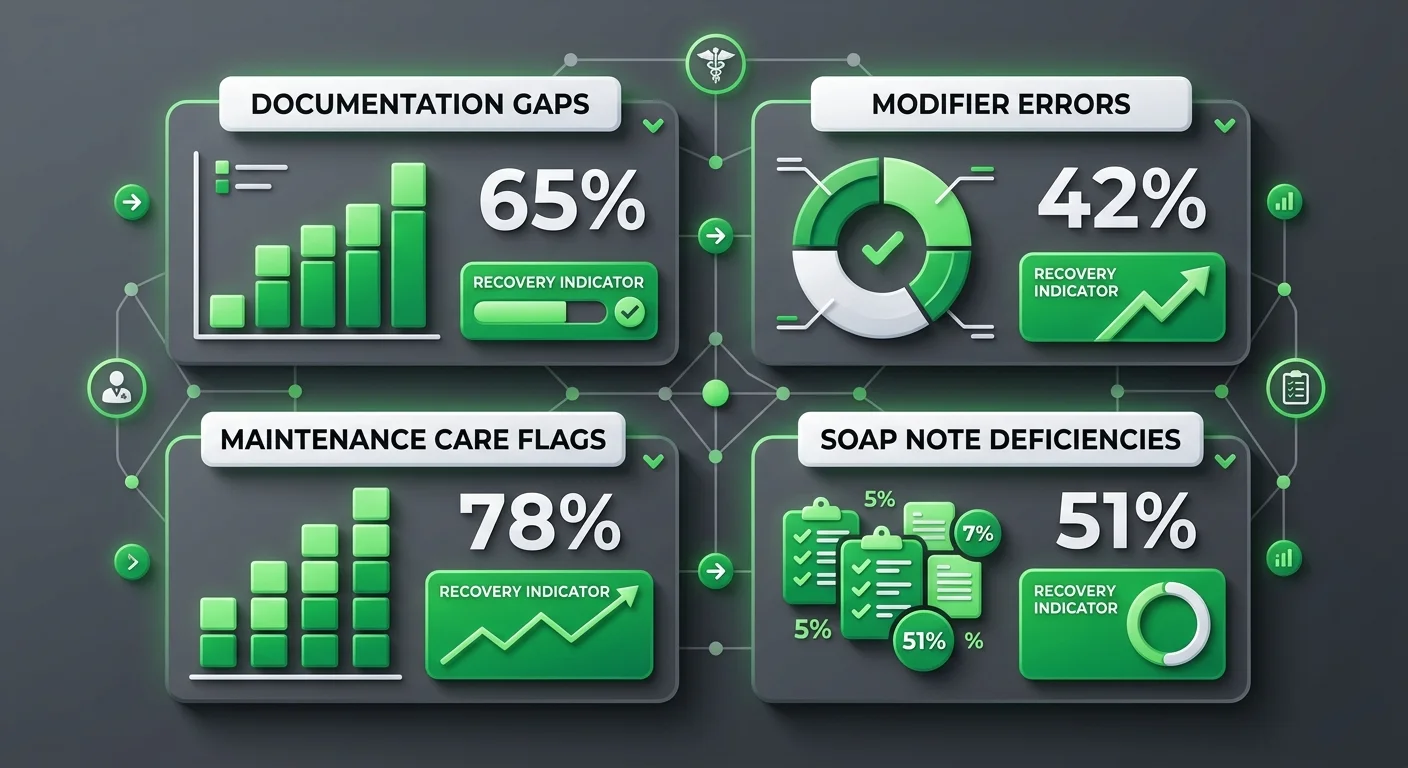
A billing audit doesn't find new problems. It finds the ones already running — quietly, claim by claim, visit by visit, without tripping a single alert in your dashboard. The leak was always there. Nobody looked.
Here's what a structured audit surfaces: not anomalies. Patterns.
The four error types — Missing or Incomplete Initial Clinical Evaluation, AT Modifier Misuse or Omission, Maintenance vs. Active Care Boundary Failure, and Deficient Daily SOAP Note Documentation — do not scatter randomly across a claim history. They cluster. They repeat. And because they repeat, the revenue loss is not incidental. It is structural, and it compounds every billing cycle the pattern goes unaddressed.
That's what separates an audit from a denial response. A denial response reacts to one claim. An audit reads the pattern behind dozens — and names the documentation behavior generating them. Catching the water in a bucket doesn't fix the pipe.
What Gets Flagged in the First 90 Days of AR
The first 90 days of AR is where the pattern stops being abstract. Claims in this window are still within the correction and resubmission timeline for most payers. That means the revenue they represent isn't written off yet — it's waiting. But it only stays recoverable if someone is reading the denial reasons with enough clinical context to understand what actually went wrong.
What gets flagged in that window is almost always one of the four error types. AT modifier omissions cluster around a specific provider, a specific visit type, or a period when documentation workflows changed. Initial clinical evaluation gaps appear at the front of patient episodes — and drag every subsequent claim in that course of treatment into question. Maintenance versus active care failures concentrate in longer patient relationships where restorative intent was never re-established in writing.
The audit doesn't guess at these patterns. It reads them directly out of the claim history. Practices that need to understand what the step-by-step recovery process looks like for denied claims approaching that 90-day threshold find that the audit is where the roadmap actually begins — not where it ends.
OIG audit findings show that up to 82% of reviewed chiropractic claims failed to document basic treatment necessity. That reframes what the first 90 days of AR actually contains — not isolated denials, but a concentrated inventory of claims submitted without the clinical evidence required to sustain them. The same OIG research tied $358.8 million in inappropriate Medicare payments directly to that documentation gap across the chiropractic specialty. The money was billed. The records didn't hold.
An embedded billing partner reads that inventory differently than a clearinghouse does. The clearinghouse processed those claims. The billing partner examines why they came back — and whether the documentation can be corrected before the recovery window closes.
Who Should Not Request a Billing Audit
Not every practice is in the right position for a billing audit. That's not a soft disclaimer. It's a structural reality — and it matters.
If the first question a practice brings to this conversation is what it costs — not what it surfaces, not what it corrects, not what the recovery looks like — the audit won't deliver its value.
The OIG documented $358.8 million in inappropriate Medicare payments tied to documentation non-compliance across the chiropractic specialty. That figure represents recoverable revenue at the industry level. At the practice level, it only becomes recoverable when a practice is willing to look at its own records honestly and act on what the audit finds.
And if a practice wants a one-time report with no follow-through — no correction of the documentation behaviors that produced the errors, no adjustment to the billing workflow going forward — the audit surfaces the leak and leaves the pipe open.
Knowing where Missing or Incomplete Initial Clinical Evaluations, AT Modifier Misuse or Omission, Maintenance vs. Active Care Boundary Failures, and Deficient Daily SOAP Note Documentation are happening only matters if the practice does something about it. The audit is the start of that work. It is not a substitute for it.
| Audit Finding Category | What It Reveals | Typical Claim Status | Next Step |
|---|---|---|---|
| Missing or Incomplete Initial Clinical Evaluation | Absence of the foundational clinical record that substantiates the entire course of treatment — every subsequent claim in that patient episode is exposed | Denied or at elevated denial risk across all related visits | Reconstruct or supplement the intake record where documentation windows remain open; flag the episode for billing review before resubmission |
| AT Modifier Misuse or Omission | Active corrective care billed without the required modifier designating acute or subacute treatment intent — the claim reads as unsubstantiated to the payer | Denied on submission or flagged for post-payment review | Audit visit-level clinical intent against submitted codes; correct and resubmit within the payer's correction window |
| Maintenance vs. Active Care Boundary Failure | Documentation that does not establish restorative clinical goals — payers apply the maintenance exclusion and deny payment regardless of the care delivered | Denied; retroactive recoupment risk on previously paid claims | Establish documented restorative intent going forward; assess whether prior claims in the episode can be supported with existing clinical evidence |
| Deficient Daily SOAP Note Documentation | Missing objective findings, absent progress markers, or no clear connection between the visit and an active treatment goal — the clinical record cannot sustain the billed service under payer review | Paid but vulnerable to retrospective audit and recoupment | Strengthen note-level documentation standards immediately; review recent claims in the 0–90 day AR window for patterns before the recovery timeline closes |
Frequently Asked Questions
The questions practices ask here aren't random. They trace the exact shape of the drain.
Here are the five that come up most. Answered straight.
What are the most common documentation errors that trigger chiropractic claim denials?
Four patterns show up across audit after audit: a missing or incomplete initial clinical evaluation, AT modifier misuse or omission, the active-versus-maintenance boundary failure, and deficient daily SOAP note documentation.
None of these are edge cases. Regional audit data shows up to 82% of reviewed chiropractic claims failed to document basic treatment necessity.
That number isn't shocking because the errors are rare. It's shocking because they're normal. Each one has its own denial trigger — but they all come from the same place. The documentation didn't capture what the clinician actually did.
How does AT modifier misuse directly affect a clinic's collected revenue?
Drop the AT modifier on a Medicare claim for spinal manipulation, and the payer doesn't see active care. It sees maintenance therapy. Medicare doesn't cover maintenance therapy. The service was rendered, the claim went out, and the payment never comes — or it comes and gets clawed back when an auditor looks at the record six months later.
These omissions don't scatter randomly across a claim file. They cluster. A specific provider, a specific date range, a workflow change that didn't get caught. A proper audit reads those clusters straight out of the history.
Why does a generic EHR billing system fail to catch medical necessity errors?
A generic EHR submits what you enter. That's it. It doesn't evaluate whether the clinical narrative behind those entries actually supports medical necessity.
It won't flag a SOAP note with no measurable objective findings. It won't catch a missing initial evaluation. It can't tell the difference between active care language and maintenance-level language — because that distinction requires someone reading the record, not just processing it.
So the claim goes out. The error goes with it. And the denial lands weeks later, when the correction window is already getting smaller.
What is the financial cost of failing to document active care versus maintenance therapy?
Medicare doesn't cover maintenance therapy. Full stop. When the clinical record doesn't show restorative goals — when there's no evidence the treatment is moving a patient toward a functional outcome rather than just holding them where they are — the claim gets denied on those grounds.
And it's not one visit. It's the entire episode. Every subsequent claim in that patient's treatment becomes harder to defend once restorative intent was never established in writing at the start.
The OIG put a number on what this costs at scale: $358.8 million in inappropriate Medicare payments tied to documentation non-compliance across the chiropractic specialty. That's what the boundary failure looks like from the outside.
How can a proactive billing audit recover revenue from historically under-coded claims?
A billing audit doesn't look for isolated bad claims. It reads the history for patterns — which of the four error types are driving the losses, where they're clustering in the record, and which claims are still inside the resubmission window.
Claims in the first 90 days of AR are the highest-priority targets. The denial reason is already documented. The error is identifiable. And for most payers, there's still time to act.
That's where the recoverable revenue actually lives. Not in the oldest, most-aged claims — those are mostly gone. In the claims submitted with correctable errors that haven't run out of time yet.
The Leak Has a Location — Now You Can Fix It
The leak has always had a location.
Missing initial clinical evaluations. AT modifier errors. Maintenance care billed as active. SOAP notes that don't hold up to a single payer review.
These aren't compliance abstractions. They're specific, repeating behaviors already inside your claim history — pulling revenue out, visit by visit, with no dashboard alert and no warning. The water disappears. The practice assumes the pipe is fine.
A billing audit changes that. Not by uncovering some hidden mystery — by making visible what was already there, waiting.
The four error types don't show up randomly. They cluster. They repeat. And because they repeat, the revenue drain isn't a fluke — it's structural. It stops when the source is named and corrected. Not before.
So the payoff isn't a report with general findings. It's a roadmap that names exactly where documentation broke down, which claims are still inside the recovery window, and what has to change in the billing workflow before the next cycle runs.
That's what Bushido Billing was built to do. Not as a one-time transaction. As an embedded billing partner that reads the clinical context behind a denial — not just the code that triggered it.
The four error types are correctable. The recovery window is real. But none of that matters if a practice keeps assuming the pipe is sound while the claim history says otherwise.
The leak is invisible until someone looks. The question is whether your practice is ready to be the one who does.
Your claim history already has the answer. The patterns are in there. The correctable errors are in there. The revenue still inside the resubmission window is in there. But none of it moves until someone with the clinical context to read it actually looks. That's what Bushido Billing does — and it starts with a single conversation.
Book a Call to see where your documentation is losing you money

© 2026 Bushido Billing. All Rights Reserved | Web Design by iTech Valet