

Why Do Most Chiropractic Billing Companies Stop Communicating After the Contract is Signed?
Most chiropractic billing companies go silent after the contract is signed because their business model makes communication a cost they cannot afford.
Before the contract, a billing company has every incentive to respond quickly, explain their process, and promise consistent updates. After the contract, that incentive evaporates. The practice becomes a line item in a portfolio. The contract is the trapdoor.
This is not a character flaw. It is structural. Volume-first billing operations are built to process as many claims as possible with minimal manual intervention. Proactive updates, denial explanations, and complex appeal follow-through all cost time. In a high-volume model, that time never gets budgeted for any single practice.
The math is direct. When a billing company earns revenue based on claim submission rather than collections performance, the most profitable path is to keep processing clean claims and quietly deprioritize the hard ones – the denials that require documentation review, medical necessity arguments, and multi-step appeals. Those claims take real labor to resolve. That labor does not fit the model.
The practice owner assumes silence means things are running smoothly. It rarely does. The HHS Office of Inspector General identified an estimated $358 million in improper Medicare payments for chiropractic services – the vast majority tied to documentation failures that an engaged billing partner would catch before submission. Up to 82% of reviewed Medicare chiropractic claims in one regional audit failed specifically because of unsupported active treatment modifier claims. These are not random errors. They are the predictable output of a billing model that has no margin to monitor, correct, and communicate.
Silence is not professionalism. It is a structure that hides problems until they become cash flow crises.
The Incentive Problem: Why Volume Models Punish Communication

Here’s the thing about the volume-first billing model: it isn’t broken.
It’s working exactly as designed. Just not for your practice.
When a billing company’s revenue depends on claim throughput, every operational decision flows from one constraint: how many claims can be processed per biller, per day.
Communication is not a revenue-generating activity in that model. It is overhead.
And overhead gets cut.
That’s the incentive problem. Your billing company isn’t ignoring you out of negligence. It’s following the economic logic of its own business model – where silence is cheaper than transparency, and complex claims are a liability, not an obligation.
How the Volume-First Business Model Actually Works
So what does the volume-first model actually optimize for? Clean claims.
Straightforward diagnosis codes. Standard modifier combinations. No documentation complications.
Those claims process fast, pay reliably, and generate consistent revenue with minimal labor per unit.
The moment a claim gets complicated, the math falls apart.
A denial requiring a medical necessity argument, a modifier flagged by automated NCCI edits, a documentation gap needing provider clarification – each one demands a dedicated biller with specialty knowledge. Not a general pool processing hundreds of accounts.
That kind of individual attention doesn’t fit inside a high-volume cost structure. So it doesn’t happen.
So the claim sits. Sometimes it gets a cursory resubmission. More often, it ages past the point of recovery.
The FTC enforcement action against a billing company for deceptive practices isn’t an outlier. It’s a signal – regulators see exactly what happens when billing operations prioritize throughput over actual revenue recovery for the practices they serve.
The model creates the conditions. The outcomes follow.
Why Silence Is the Rational Choice Inside a High-Volume Operation
Silence, inside a volume operation, is the rational choice.
Explaining a denial takes time. Walking a provider through a documentation correction takes more. Tracking a multi-step appeal across payer timelines – while managing hundreds of other accounts – takes resources the model never budgeted for.
So nothing gets said. Not because no one knows. Because saying something costs more than the margin allows.
Your billing company isn’t staying quiet because there’s nothing to report. It’s staying quiet because reporting costs time – and time isn’t in the budget.
The OIG’s findings on chiropractic claim failures put a hard number on what that silence produces. HHS OIG identified an estimated $358 million in improper Medicare payments tied directly to documentation failures.
That’s what happens when no one is watching, correcting, and communicating in real time.
Most practice owners assume silence means the billing is working. It rarely does.
When revenue is tied to actual collections – not submission volume – the billing partner’s incentive to communicate and resolve complex claims aligns directly with the practice’s incentive to get paid. That structural difference is the entire premise behind full-service billing that prioritizes recovery over throughput.
Change the incentive. Change the behavior.
| Billing Model Feature | Volume-First Operation | Performance-Aligned Operation |
|---|---|---|
| Revenue driver | Claim submission volume – more claims processed means more revenue | Actual collections recovered – revenue tied to what the practice gets paid |
| Communication incentive | Low – explaining denials and appeal status costs time with no direct revenue return | High – proactive updates protect the billing partner’s own revenue outcome |
| Complex claim handling | Deprioritized – high manual labor cost per claim does not fit the volume cost structure | Core obligation – complex denials are where recovery matters most |
| Denial follow-through | Cursory resubmission or quiet abandonment as claim ages past easy recovery | Multi-step appeal with documentation review and payer-specific arguments |
| Practice visibility | Minimal – silence is cheaper than transparency inside a high-throughput operation | Structural – weekly updates are a built-in feature, not an optional upgrade |
| Specialty knowledge requirement | General billing pool processing across many account types and specialties | Dedicated biller with chiropractic-specific expertise assigned to the practice |
| What gets optimized | Clean claims – fast, predictable, low-labor submissions that clear payer edits automatically | Revenue recovery – every claim worked to its fullest potential, including the hard ones |
Why High-Volume Billing Is Structurally Incompatible with Complex Denials
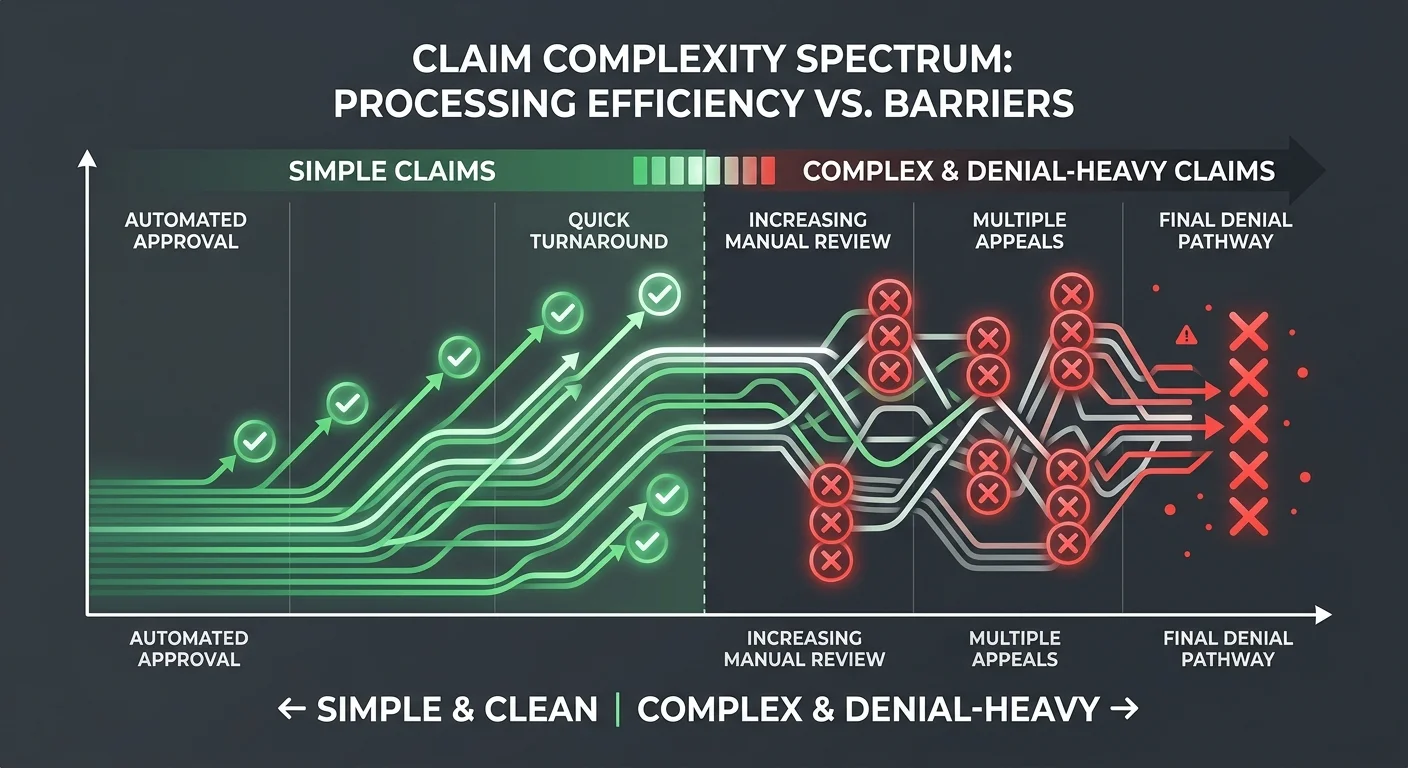
The volume-first model doesn’t fail because billers are lazy or indifferent.
It fails because the economics make complex claim resolution impossible to sustain at scale. Nobody built in the margin for that work.
Think about it from their side. When you’re running hundreds of accounts, every hour spent wrestling with a single difficult denial is an hour pulled from the throughput that keeps the operation solvent.
That math was never built in your favor.
So which claims absorb that cost? The hardest ones. The ones that require the most labor, the most expertise, and the most follow-through.
Those are also – not coincidentally – the most valuable claims in your AR.
What Makes a Claim ‘Complex’ – and Why That Label Matters
Not every denied claim costs the same to fix. That distinction matters more than most practice owners realize.
A clean-claim denial – transposed member ID, missing date of service, dropped referral – takes minutes. Correct the error, resubmit, done. The volume model handles those fine.
A complex denial is a different animal entirely.
Complex denials are where a payer disputes medical necessity, challenges an AT modifier application, or where published coding compliance standards have flagged a modifier combination that doesn’t clear NCCI logic.
These aren’t clerical fixes. Resolving them requires someone who can read a clinical note, build a coherent appeal argument, and track a multi-step dispute across payer timelines – sometimes over weeks.
That’s a specialist skill. It doesn’t exist in a general billing pool, and it can’t be automated.
Here’s what that label actually determines: what happens next.
A clean denial gets corrected and resubmitted. A complex denial gets evaluated for ROI – silently, without telling you.
In a high-volume operation, that evaluation ends the same way every time. The claim gets deprioritized. Then it ages. Then the filing window closes. Then it’s gone.
The Math Behind Claim Abandonment
Here’s the math a volume-first billing company runs internally – even when they’d never say it to your face.
A complex denial – an AT modifier dispute, a medical necessity challenge, a documentation gap that needs provider clarification – can take several hours of skilled labor to research, document, and appeal properly.
NIH clinical research confirms that the absence of structured documentation protocols directly exposes chiropractic providers to clawbacks and appeal failures. In one regional HHS OIG audit, up to 82% of reviewed Medicare chiropractic claims failed specifically because of unsupported active treatment modifier claims.
That’s not a documentation problem. That’s a labor-allocation problem – the direct result of a model that never budgeted for the work those claims actually require.
Understanding the benefits of consistent billing team communication makes the cost of that silence concrete.
Every week a complex denial sits unworked is a week of recoverable revenue your practice will never see – while the billing company’s submission numbers look perfectly clean on paper.
The abandonment is never announced. It happens in the gap between what was promised at contract signing and what the model can actually afford to deliver.
Who This Model Is Not Built For
To be clear: the volume-first model isn’t wrong for every practice.
If your clinic submits straightforward cases, uses standard coding, and rarely runs into modifier disputes or payer-specific documentation complexity – a high-throughput operation might serve you adequately.
But that’s a narrow profile. It’s not most chiropractic practices with Medicare patients or personal injury cases on the books.
For practices with Medicare patients, personal injury cases, or multi-payer complexity, the volume-first model is a structural mismatch – not a bad fit you can fix by asking for better service.
The silence after contract signing isn’t an anomaly. It’s the inevitable output of a business built around throughput, not recovery.
When billing companies stop communicating, it’s not a relationship problem. It’s an economics problem. And the only real fix is a model where the billing partner gets paid when you do – not when they submit.
| Claim Type | Time Required to Resolve | Revenue at Risk | Volume Model Response |
|---|---|---|---|
| Clean claim denial (transposed ID, missing referral, wrong date) | Minutes – clerical correction and resubmission | Low to moderate – straightforward recovery with minimal labor | Corrected and resubmitted quickly; fits volume model workflow |
| AT modifier dispute (active vs. maintenance care question) | Several hours – requires clinical note review, payer-specific appeal, provider clarification | High – Medicare reimbursement at stake; window closes with inaction | Deprioritized; sits in queue until it ages past the appeal window |
| Medical necessity challenge (payer disputing clinical justification) | Significant – requires building a coherent written argument tied to documented clinical findings | High – claim value often substantial; denial is final without a strong appeal | Assigned low ROI status; rarely worked to resolution in a high-volume operation |
| NCCI modifier flag (automated coding edit blocks claim at adjudication) | Moderate to high – requires specialty knowledge of modifier logic and payer-specific compliance rules | Moderate to high – automated denial is immediate; correction requires coding expertise | Resubmitted with surface-level fix if any; root cause rarely investigated |
| Documentation gap requiring provider input (missing clinical notes, incomplete exam findings) | High – depends on provider response time; biller must coordinate, collect, and rebuild submission | High – claim cannot move without provider cooperation; delay compounds aging | Communication overhead exceeds model budget; claim frequently abandoned |
| Multi-step payer dispute (denial, appeal, peer-to-peer review, secondary appeal) | Very high – spans weeks across payer timelines with multiple touchpoints required | Very high – often the highest-value claims in the AR; loss is significant if abandoned | Structurally impossible to sustain across hundreds of accounts; abandoned without disclosure |
The Claims That Go Dark: AT Modifier Failures and Documentation Gaps
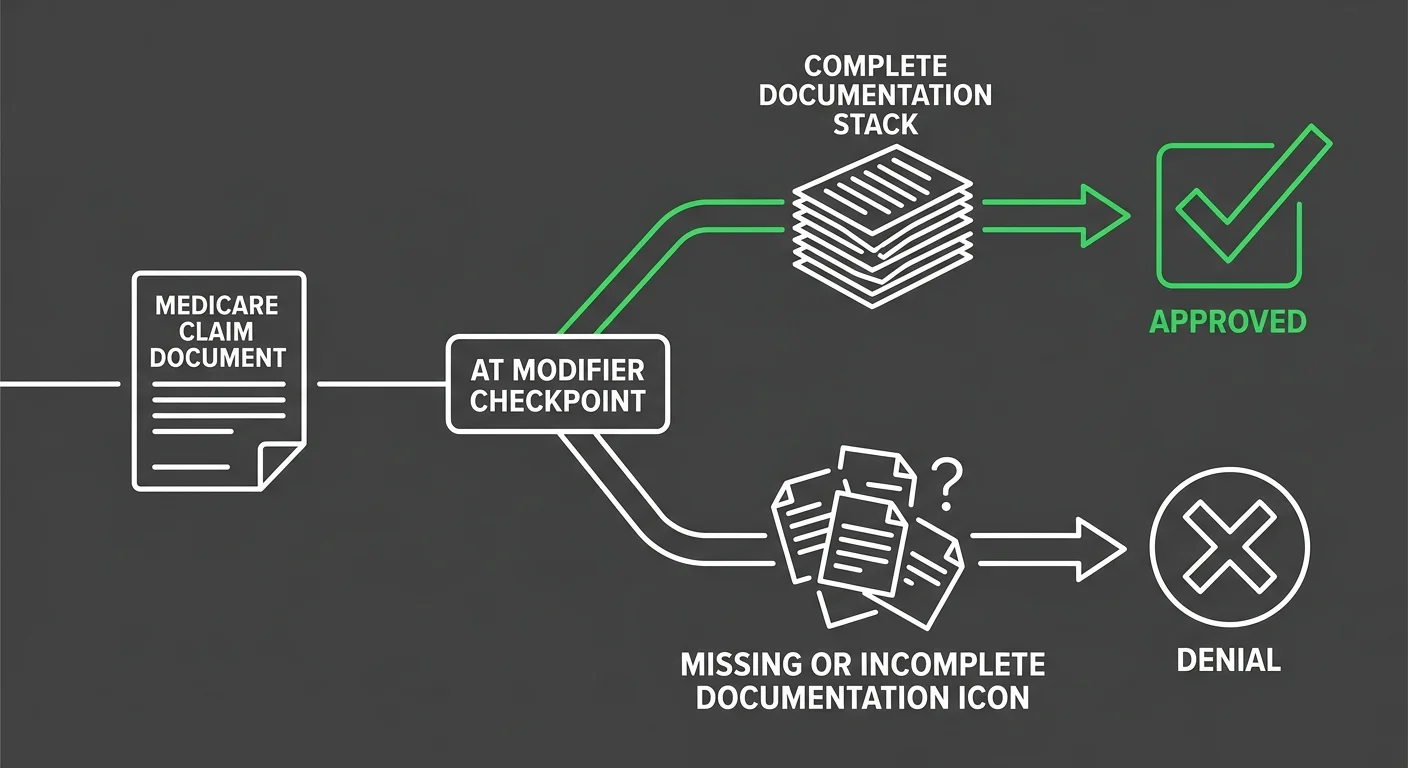
AT modifier failures aren’t edge cases.
They’re the most predictable, most expensive, and most systematically ignored category of chiropractic claim denials. And almost no one explains them to the practice owner.
That’s not an accident. It’s a structural outcome.
AT modifier disputes require specialty knowledge, documentation review, and a deliberate appeal built from scratch. In a volume-first operation, that work isn’t budgeted. So the claim goes dark – not because it was unworkable, but because working it costs more than the model can absorb.
That’s where the revenue goes.
Not in clean claims that process and pay. In the complex ones – the ones that require a human who understands chiropractic-specific payer behavior and has the time to act on it.
What the AT Modifier Actually Requires – and Where Billers Get It Wrong
Here’s what the AT modifier actually does: it tells Medicare that the care being rendered is active, corrective, and medically necessary. That’s the whole distinction. Active treatment gets covered. Maintenance care doesn’t. One modifier. Two completely different outcomes.
According to published Medicare billing policy, a chiropractor can only place the AT modifier on a claim when performing active, corrective therapy – and the clinical record has to support that in the documentation. The note must show the patient’s condition is improving, responding to treatment, and not simply holding at a stable level.
That’s a clinical documentation standard. Most generalist billers aren’t equipped to evaluate it.
So here’s what actually happens: the modifier gets placed, but the clinical note doesn’t clearly support active treatment status. The payer disputes the claim. The biller – without the specialty knowledge to build a coherent appeal – resubmits identically or walks away from it entirely.
In one regional audit, up to 82% of reviewed Medicare chiropractic claims failed specifically because of unsupported active treatment modifier claims. That isn’t a coding error. It’s a systematic failure to understand what the modifier actually demands.
How Documentation Failures Become Denial Patterns No One Reports
One denied AT modifier claim is a problem.
A pattern of them – across multiple patients, across multiple billing cycles – is a revenue crisis. The difference between those two outcomes is whether anyone is tracking the pattern and telling you about it.
In a high-volume operation, denial patterns rarely reach the practice owner. The billing company sees the denials. They might log them.
But translating that data into something usable – here’s what’s failing, here’s why, here’s what changes before the next submission – takes communication the model hasn’t budgeted for. Practices watching for signs of a failing billing relationship often discover that denial pattern data is exactly what was missing from every update they never received.
So the pattern compounds. Same documentation gap. Same denial. Same aging claim. Same evaporated revenue.
And the practice owner, getting no communication, reads the silence as confirmation that everything’s fine – right up until the AR report says otherwise.
The NCCI Edit Layer: When Automation Denies Before a Human Ever Reviews
Before a human reviewer ever sees a chiropractic Medicare claim, the automated system already has.
CMS uses National Correct Coding Initiative edits to detect and instantly deny modifier combinations that don’t meet compliance logic. The claim doesn’t enter a queue for human review. It gets rejected before that step exists.
NCCI edits catch modifier mismatches automatically. For the AT modifier, any combination the system reads as inconsistent with active treatment standards triggers an immediate denial.
A biller who doesn’t understand how NCCI logic evaluates chiropractic modifier pairs will keep submitting the same combination – and keep getting the same automated rejection – without understanding why it keeps happening.
Most practices never know this layer exists.
The denial comes back. The explanation is terse. The volume-first biller logs it and moves on. Nobody tells the practice that the rejection wasn’t a payer judgment call – it was an automated system response that requires a specific technical correction before the claim has any chance of clearing.
That’s the gap where recoverable revenue becomes permanently lost revenue.
| AT Modifier Requirement | Common Documentation Gap | Denial Outcome |
|---|---|---|
| AT modifier required to indicate active, corrective treatment – not maintenance care | Clinical note describes patient status without explicitly demonstrating measurable improvement or response to treatment | Payer disputes medical necessity; claim denied for failure to support active treatment status |
| Documentation must distinguish active care episodes from ongoing maintenance visits | Biller applies AT modifier to maintenance-phase visits where clinical notes do not reflect corrective progress | Medicare rejects claim outright; modifier flagged as inconsistent with documented care level |
| Modifier combination must clear NCCI automated logic before human review occurs | Biller submits AT modifier paired with a procedure code that triggers an NCCI edit conflict | Automated system denial before any human reviewer sees the claim; resubmission without technical correction produces identical result |
| Clinical record must demonstrate patient condition is actively responding – not simply being maintained at a stable level | Notes use templated language that does not document functional progress or objective improvement markers | Payer treats claim as maintenance care by default; appeal lacks the clinical specificity needed to overturn denial |
| Appeal must be constructed using chiropractic-specific payer criteria – not generic medical necessity arguments | Generalist biller submits a standard medical necessity appeal without referencing chiropractic-specific documentation standards | Appeal denied; claim ages past the payer’s filing deadline and becomes unrecoverable |
| Denial pattern must be identified and reported back to the practice to correct upstream documentation errors | Volume-first operation logs denial but does not communicate the pattern or root cause to the practice owner | Same documentation gap repeats across subsequent billing cycles; revenue loss compounds without the practice’s knowledge |
What the Silence Actually Costs a Chiropractic Practice
Silence has a price tag.
It shows up in your AR aging report. In denied claims that never got appealed. In Medicare revenue that crossed the recovery window while you assumed everything was fine.
The HHS OIG identified an estimated $358 million in improper Medicare payments for chiropractic services – every dollar tied to documentation that failed to support medical necessity.
That’s not a compliance statistic. It’s a revenue figure. Claims submitted, denied, and never successfully defended – because no one was tracking the pattern before it compounded.
That number didn’t happen because providers were careless. It happened because no one said anything.
For a practice getting zero communication from their billing company, that kind of loss is invisible until it’s too late to fix.
The silence doesn’t feel like a problem. It feels like the billing is handled.
But those are two very different things.
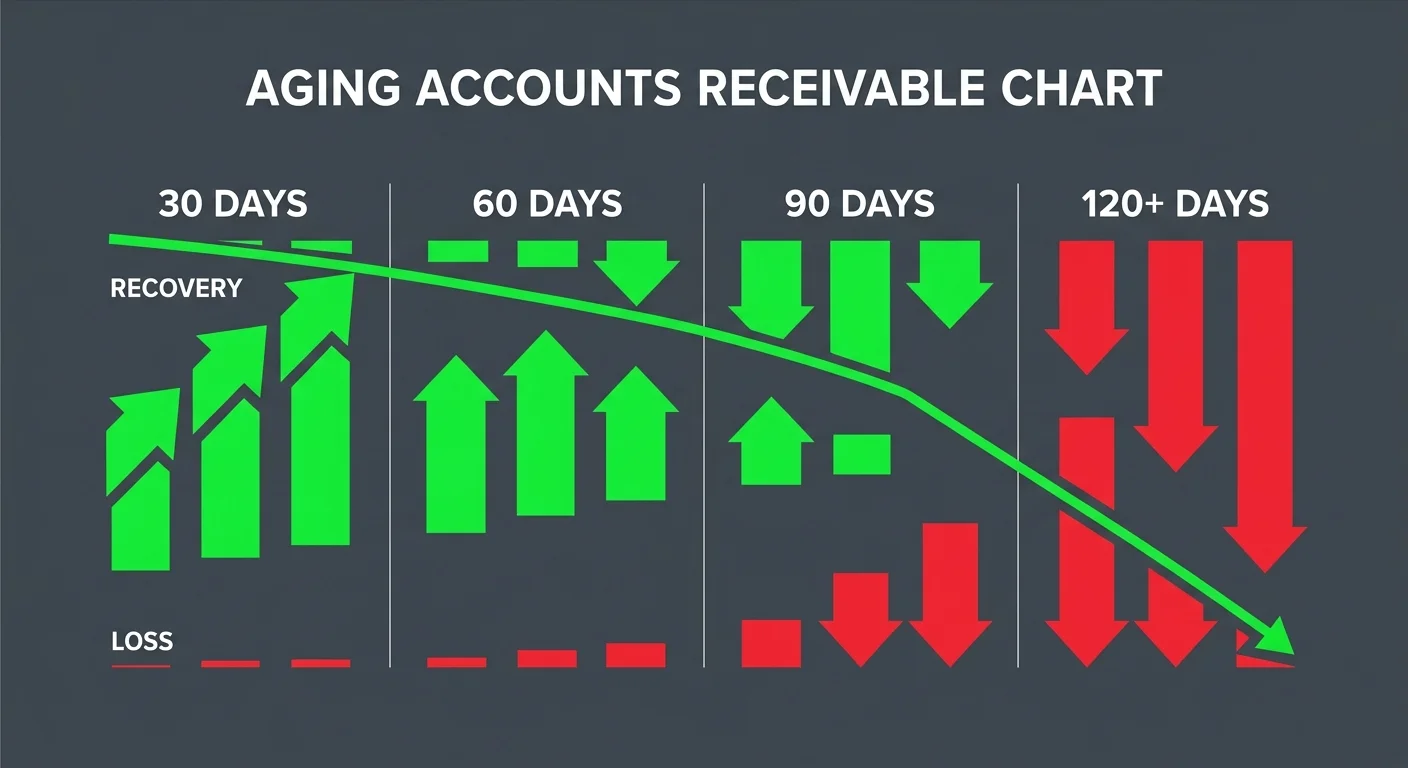
How AR Ages When No One Is Watching It
AR doesn’t wait.
Every unworked claim ages – 30 days to 60, 60 to 90, 90 to 120 and beyond. Each threshold crossed makes recovery harder. Payers enforce timely filing limits. Documentation windows close. The claim that was fully appealable at 45 days becomes legally unrecoverable at 180.
When no one is monitoring AR and reporting back to you, that aging happens without a signal.
A volume-first billing operation tracks submission counts and clean-claim throughput. Not complex, unresolved denials drifting through aging buckets.
Those claims don’t get flagged. They don’t get escalated. They get older – and then they’re gone.
Here’s what most practice owners find when they finally look: the AR didn’t disappear.
It just was never surfaced. Regaining real visibility into your billing starts with understanding that most of it was still workable – the window just kept closing while no one said anything.
The Reporting Gap: Why Most Practices Don’t Know What They’re Losing
Most practices don’t know what they’re losing because no one tells them.
The billing company has the data. They see the denials. They see the aging. But translating that into a clear, practice-specific breakdown – here’s what failed, here’s why, here’s what it’s costing you – takes time a volume-first model won’t spend.
So it doesn’t happen.
So you get a submission summary. Maybe a collections total.
What you don’t get: the denial rate by claim type, the AT modifier failure pattern, or the aging breakdown showing how much revenue has already crossed the point of no return. Without that reporting, there’s no way to correct the documentation before the next billing cycle repeats the same result.
The weekly updates that close this gap aren’t a luxury. They’re the mechanism that keeps recoverable revenue from becoming permanently lost revenue.
What Proactive Communication Actually Prevents
Proactive communication doesn’t just keep you informed.
It stops the compounding.
When a billing partner surfaces a denial pattern early – flags that AT modifier claims are failing consistently, that documentation isn’t clearly supporting active treatment status, that a specific payer has shifted its standard – you can correct it before the next cycle.
The denial that surfaces in week one is a fixable problem. That same denial, repeated across six billing cycles with no one reporting it, is a revenue crisis.
One HHS OIG regional audit found that up to 82% of reviewed Medicare chiropractic claims failed specifically because of unsupported active treatment modifier claims. Every one of those failures was, at some point, a correctable documentation gap. The practices that caught it early fixed it. The ones operating under silence didn’t.
That’s the real cost of silence. Not just the revenue that disappears – but the revenue that could have been protected if someone had said something.
A billing partner who communicates isn’t just reporting what happened. They’re preventing what happens next.
That’s the structural difference between a billing company that measures success by what it submits and one that measures it by what your practice actually collects. The benefits of weekly communication aren’t about staying informed. They’re about staying solvent.
| AR Age Bucket | Typical Recovery Rate | What a Silent Biller Does | What Active Management Does |
|---|---|---|---|
| 0-30 days | Highest – claim is fully workable and within timely filing windows | Logs the denial; queues it behind clean-claim volume | Flags the denial immediately; identifies root cause; initiates appeal or documentation correction |
| 31-60 days | Still recoverable – payer resubmission windows remain open for most claims | May resubmit identically without correcting the underlying documentation gap | Reports the pattern to the practice; corrects documentation before the next billing cycle repeats the denial |
| 61-90 days | Declining – payer scrutiny increases; documentation requirements tighten with age | Claim sits unworked; practice receives no update on its status | Escalates to formal appeal with supporting clinical narrative; practice owner is informed of timeline and risk |
| 91-120 days | Limited – most payers consider claims at this stage high-risk for non-payment | Claim ages further; no escalation; no communication to practice | Conducts final appeal attempt; documents recovery outcome; advises practice on documentation changes to prevent recurrence |
| 120+ days | Near zero – most timely filing limits have passed; claim is approaching or past legal recovery window | Claim is written off silently or abandoned without notifying the practice | Communicates write-off decision explicitly; provides practice with a clear accounting of what was lost and why |
Frequently Asked Questions
Practice owners have real questions. They just rarely get real answers – because the billing company that should be answering them stopped picking up the phone.
These aren’t theoretical. These are the questions that hit at 11pm when the AR report says something different than what you expected to collect.
Why do chiropractic billing companies stop responding after onboarding?
The silence is structural. It’s not personal – it’s math.
Volume-first billing models can’t absorb the labor cost of proactive updates. Every minute spent on a status call is a minute pulled from claim throughput. So once the contract is signed, communication is the first cost they stop covering.
The contract isn’t the beginning of the relationship. For most billing companies, it’s where the relationship ends.
What are the hidden costs of a silent billing relationship?
The costs are real and they compound. Denied claims age past timely filing limits. AT modifier failures repeat across billing cycles with no one flagging the pattern.
The HHS OIG identified an estimated $358 million in improper Medicare payments for chiropractic services – all tied to documentation gaps that nobody was surfacing.
That’s what silence costs. It doesn’t show up as a single catastrophic loss. It bleeds into the AR report, slowly, until the recovery window is gone.
How does the volume-first billing model encourage communication breakdown?
High volume and consistent communication aren’t just different priorities. They’re structurally incompatible.
A billing operation built around throughput measures success by submission speed – not by what the practice actually collects. Complex denials require manual review, documentation analysis, and multi-step appeals. None of that fits inside a volume-first margin.
So those claims get deprioritized. No one tells you. Communication breakdown isn’t a side effect of that model. It’s a built-in feature of it.
What are the signs that my billing company is ignoring complex claim denials?
Start with the AT modifier failure rate. One regional audit found that up to 82% of reviewed Medicare chiropractic claims failed because active treatment modifier documentation didn’t hold up. If your billing company isn’t flagging that pattern and explaining it back to you, the denials are being logged – not worked.
Other signals: no denial trend reporting, no aging breakdown by claim type, submission summaries that show volume without showing recovery.
Silence about denial patterns isn’t neutral. It means someone knows the pattern exists and decided not to tell you.
How should a chiropractic billing partner structure communication with your practice?
Weekly updates aren’t a premium feature. They’re the minimum standard for a billing relationship that’s actually working.
A real billing partner surfaces denial patterns before they repeat. They flag documentation gaps before the next cycle reproduces them. CMS policy mandates the AT modifier only for active, corrective treatment – and someone needs to be checking whether your documentation is meeting that standard every single week, not after the audit arrives.
If communication only happens when you initiate it, the structure is broken. You’re not a client. You’re a contract.
The Silence Was Never Accidental
The silence was never accidental.
It was engineered. A business model built on volume cannot afford the time it takes to work a hard claim. So it doesn’t. And it certainly doesn’t budget time to explain to you why that claim is sitting untouched.
Communication costs time. Time cuts margin. So silence becomes policy.
You sign the contract and feel relief. That’s the trap.
The billing company signs and starts protecting its margins. What feels like stability – no bad news coming in – is just no news at all. Denials age. AT modifier errors repeat across billing cycles. Claims cross timely filing thresholds and vanish.
You hear nothing. So you assume it’s working.
That’s not a failure of professionalism. It’s a failure of structure. A model built for submission speed cannot also be built for the manual, high-touch labor that complex chiropractic claims demand. Those two operating models are incompatible. If you’re inside one, you are always absorbing the consequences of the other.
The fix isn’t complicated. But it does require a different model.
A billing partner whose incentive doesn’t stop at the signature line. One that surfaces denial patterns before they compound, flags documentation gaps before the next cycle repeats them, and reports what’s happening in your AR every single week – without being asked.
That’s what Bushido Billing is built to do.
The contract is not a finish line. It’s not a handoff. It’s the starting point for a working relationship – one where communication is structural, not optional, and silence is never mistaken for success.
Because the contract is the trapdoor. And the only way out is a partner whose model makes it more expensive to go quiet than to stay in the conversation.
The silence after the contract isn’t a coincidence. It’s the model. So if your billing company has gone quiet – that’s not a rough patch. That’s how it works.
Bushido Billing structures communication differently. Weekly updates aren’t a perk. They’re the job. If you want to see what that looks like for your practice, Book a Call.

© . All Rights Reserved | Web Design by iTech Valet