

Centralized vs. Decentralized Billing: Which Model Supports Faster Practice Growth?
Centralized billing consolidates all insurance claims, denial follow-up, and revenue cycle management into a single specialized operation. Decentralized billing splits that work across front-desk staff at each clinic location – alongside phones, check-ins, and scheduling.
The structural difference isn’t minor. Revenue cycle management runs from patient registration through final collections. That scope demands focused expertise, consistent workflows, and proactive denial follow-up. A front desk can’t reliably deliver any of those three things.
Chiropractic billing makes this harder. Medicare claims require the AT modifier to confirm care is active and corrective rather than maintenance therapy. Reimbursement rates shift annually under federal fee schedules. Administrative billing complexity already drives significant overhead across the healthcare sector – and in a multi-location practice, that burden multiplies with every clinic added.
Centralized billing assigns that work to specialists who run the full revenue cycle without splitting their attention across clinical operations. The decentralized model asks the wrong people to do a job that outgrows them fast.
For a practice looking to scale, billing isn’t a back-office detail. It’s a growth constraint. Practices that centralize remove the ceiling on how many locations they can add without revenue leakage. Practices that don’t find that each new location adds administrative pressure without adding proportional collections.
The question isn’t whether centralized billing produces better outcomes. It does. The real question is whether you centralize before or after the revenue gap becomes a crisis.
Centralized vs. Decentralized Billing: What Each Model Actually Means
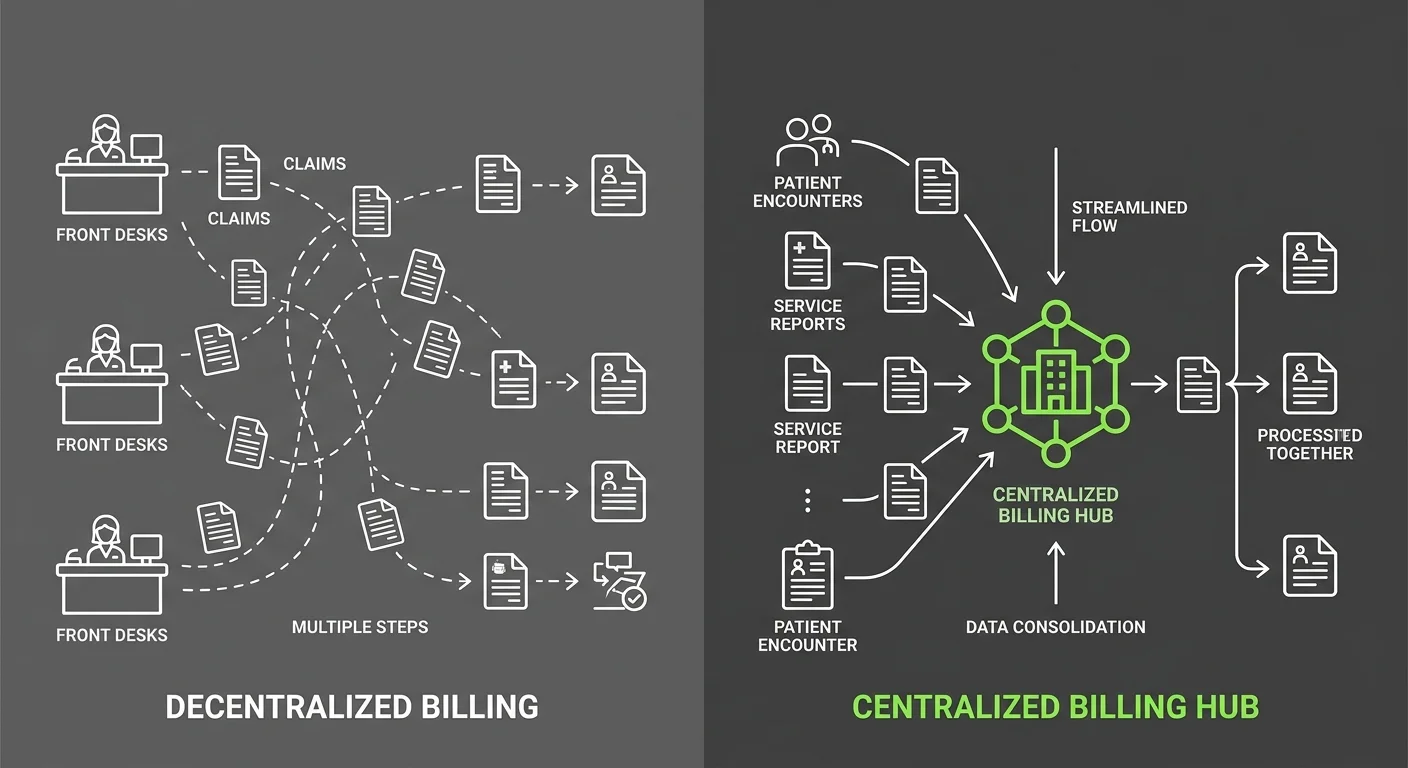
Most practices use these terms like they’re interchangeable. They’re not. And that confusion is where billing strategy collapses before a single claim goes out.
The real difference is structural. Decentralized billing means billing responsibility lives at each individual location – whoever’s available handles submissions, follow-up, and denials on top of everything else they’re already doing. Centralized billing means all of that work flows through one specialized operation. One process. One set of payer rules. One team accountable for the full revenue cycle.
That structural choice determines whether billing scales with the practice – or fights it at every turn. NIH research documents how administrative and billing complexity already drives significant overhead across the healthcare sector. In a multi-location chiropractic practice, the model you choose decides whether adding a new location means more revenue or just more administrative weight with nowhere to put it.
How Decentralized Billing Actually Operates
Here’s what decentralized billing looks like on the ground. Each location has a front-desk person – sometimes two – responsible for entering charges, submitting claims, and handling whatever the payers send back.
That same person is also answering phones, scheduling patients, and checking people in. Billing follow-up happens when there’s time. There usually isn’t.
So denials sit. Aging accounts grow. Payer-specific rules get missed because no one has the bandwidth to track them across every carrier. Practices that try to scale without adding administrative headcount at every new location find out quickly: decentralized billing doesn’t scale with the practice. It scales the problem.
How Centralized Billing Changes the Structure
Centralized billing pulls that work off the front desk entirely. One operation handles submissions, denial follow-up, aging AR, and payer-specific workflows across every location – without splitting accountability by site.
That’s what full-service chiropractic billing actually means in a multi-location practice. Not just submitting claims – managing the entire revenue cycle with the specialty knowledge chiropractic billing demands, consistently, across every location.
The front desk is built to serve patients. Centralized billing is built to recover revenue. Keeping those two jobs separate isn’t a preference – it’s the structural condition that makes growth sustainable.
| Structural Feature | Decentralized Model | Centralized Model |
|---|---|---|
| Who handles billing | Front-desk staff at each location – alongside patient-facing duties | Dedicated billing specialists accountable for the full revenue cycle across all locations |
| Workflow consistency | Varies by location, staff availability, and individual knowledge | Single standardized process applied uniformly across every clinic site |
| Denial follow-up | Handled when time allows – often delayed or skipped entirely | Worked proactively by specialists with payer-specific knowledge and no competing priorities |
| Aging accounts receivable | Grows unworked as front-desk bandwidth is absorbed by clinical operations | Monitored and pursued systematically as a core function of the billing operation |
| Payer rule expertise | General familiarity – depth depends on individual staff member and location | Specialty-level knowledge applied consistently, including chiropractic-specific coding and modifier requirements |
| Scalability as locations increase | Each new location adds billing burden without adding billing capacity | Additional locations fold into the same centralized operation – no proportional overhead added |
| Revenue cycle visibility | Fragmented – no unified view of claim status, denial patterns, or AR performance across locations | Consolidated reporting across all locations with full AR transparency and consistent communication |
Why Decentralization Works Against You as Your Practice Grows
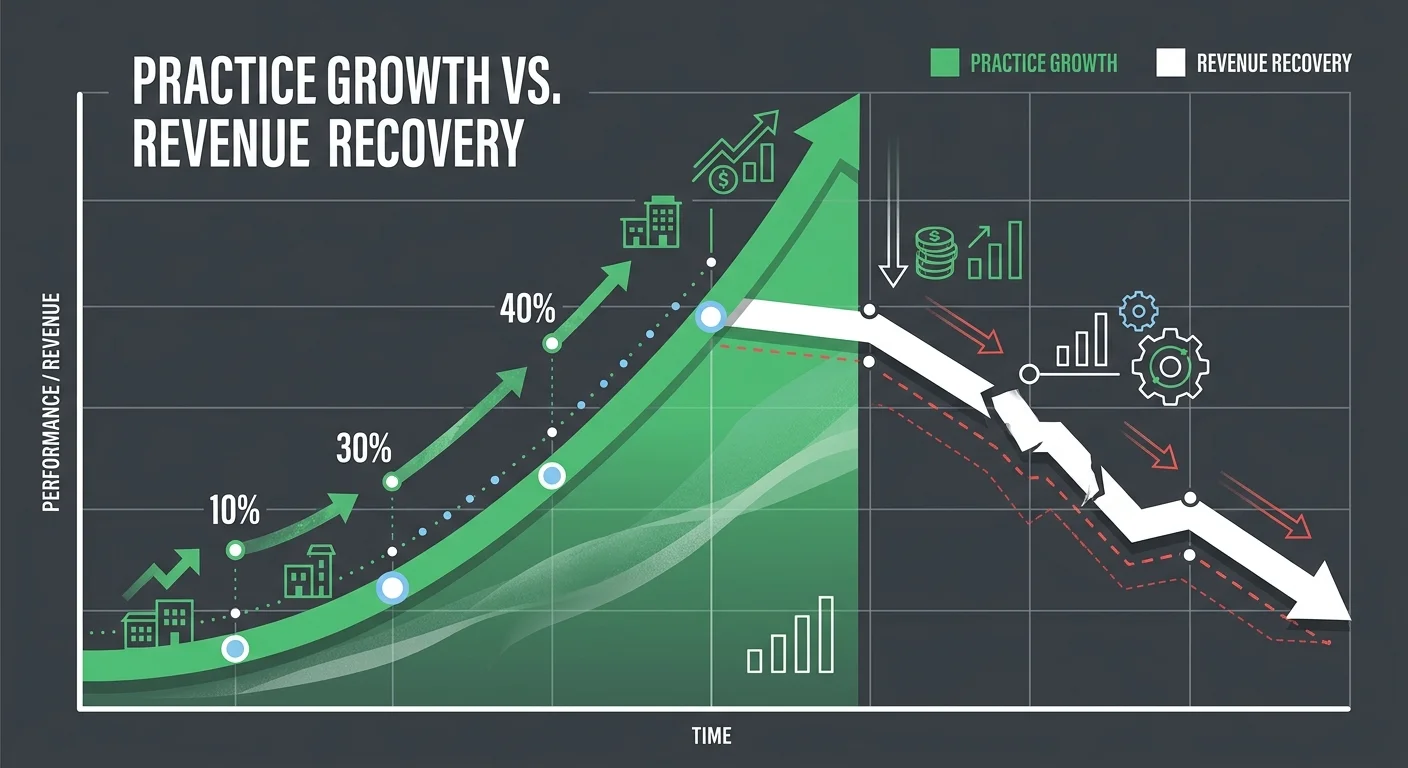
Decentralization doesn’t fail on day one. It fails slowly – and by the time the pattern is visible, the revenue gap is already compounding.
One location can survive front-desk billing for a while. Claims go out. Some come back paid. The gaps stay quiet – until the aging report tells a different story.
Add a second location and the cracks widen. Add a third and the whole thing collapses under its own weight. Billing complexity doesn’t scale evenly. In a multi-location chiropractic practice, decentralized billing multiplies that burden by every location added.
That’s the failure mechanism. Not one catastrophic breakdown – a slow accumulation of missed follow-ups, aging denials, and revenue that exits the practice quietly enough that nobody pulls the alarm.
Why Most Front-Desk Billing Setups Break Under Pressure
Here’s the problem most practice owners don’t see until it’s expensive. Front-desk staff aren’t billing specialists. They’re patient experience specialists who’ve been handed a billing function on top of everything else they’re already managing.
Clinicians and clinical support staff already spend over 15 hours per week on non-clinical administrative work. That number doesn’t shrink as the practice grows. It accelerates.
Every new location adds claim volume. More payer-specific rules to track. More denial follow-up that demands focused attention nobody at the front desk actually has time to give.
Here’s what that looks like on a busy Monday at a two-location practice. A denial came back from a payer six weeks ago. Nobody worked it. It sat. Now it’s aged past 90 days and the appeal window is closing.
Practices that centralize billing workflows across locations early close that gap before it becomes a cash flow problem. The ones that don’t find out what the front-desk model was quietly losing – after the fact.
The front desk wasn’t built to manage aging accounts receivable or argue medical necessity with a payer. Asking it to do that isn’t a staffing problem. It’s a structural one. And structural problems don’t respond to effort – they respond to structure changes.
The Volume Problem Decentralized Billing Can’t Solve
Volume is where decentralized billing breaks completely. A front-desk setup can keep pace with a manageable claim load. It cannot keep pace with the compounding complexity that arrives with each new location.
Every new location brings new claim volume, new payer contracts, new denial patterns, and new documentation requirements. That complexity doesn’t get absorbed by a decentralized model.
It gets distributed across staff who are already stretched – with no single point of accountability for what falls through the cracks.
That’s not a warning about what might happen. That’s a description of what’s already happening in most multi-location practices running decentralized billing.
The revenue gap isn’t theoretical. It’s in the aging report. It’s in the denial queue nobody’s working. And it’s in the claims that quietly expired while the front desk was managing everything else.
| Practice Growth Stage | Decentralized Billing Impact | Revenue Risk Level | Primary Failure Point |
|---|---|---|---|
| Single Location | Front desk handles submissions alongside scheduling and check-ins – gaps appear in aging AR but rarely trigger alarm | Low to Moderate | Inconsistent denial follow-up when clinical volume increases |
| Two Locations | Billing responsibility splits across two sites with no unified process – payer rule discrepancies begin accumulating by location | Moderate | No single point of accountability for denial tracking or aging accounts |
| Three Locations | Claim volume exceeds what front-desk staff can manage alongside clinical operations – denial queues go unworked for weeks | High | Appeals window closes on aging denials before anyone identifies the pattern |
| Four or More Locations | Decentralized model collapses under compounding complexity – each location adds payer contracts, denial patterns, and documentation requirements with no centralized oversight | Critical | Revenue exits the practice without a clear paper trail – the loss only surfaces in the aging report, often too late to recover |
| Any Growth Stage – Rapid Expansion | Adding locations accelerates claim volume faster than front-desk capacity – administrative pressure grows proportionally while revenue recovery does not | Critical | Structural fragmentation means no location receives consistent billing expertise or payer-specific follow-up |
What Centralized Billing Actually Fixes
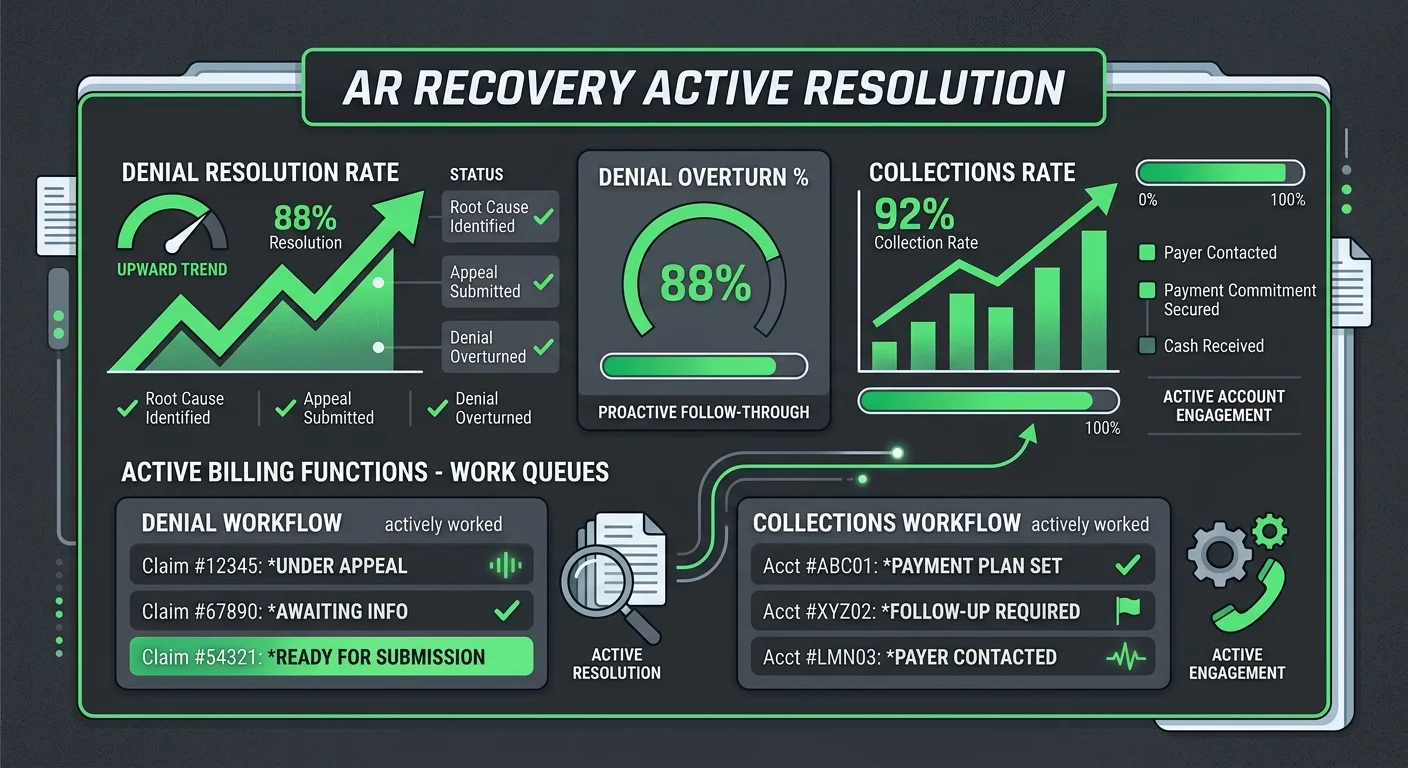
Decentralized billing doesn’t just create problems. It lets them compound – quietly, invisibly, until the practice is too deep in the hole to ignore.
Centralization doesn’t simplify chiropractic billing. The AT modifier still needs documentation. Payer rules still shift. The administrative complexity doesn’t disappear. What changes is accountability. Who’s responsible for working through that complexity – and whether they have the time, the tools, and the specialty knowledge to do it without also answering the phone and checking patients in.
A dedicated billing infrastructure doesn’t make the claims easier. It makes sure none of them vanish into an aging bucket nobody’s working. That’s the only structural shift that actually moves the number.
AR Recovery and Denial Follow-Through
Aging accounts receivable don’t recover on their own. They compound. Every week a denial sits unworked is a week closer to the appeal window closing for good.
Centralized billing puts dedicated attention on the claims that need it most – complex denials, aging accounts, payer-specific follow-up that a front-desk model consistently drops because something more immediate is always in the way. Revenue cycle management, as Gartner defines it, spans the full lifecycle from point of service through final collections. Every stage of that span needs someone accountable for it. Not just the submission.
AR recovery isn’t a cleanup you do once and move on from. It’s continuous – working denials before the appeal window closes, tracking payer patterns, closing the gaps a decentralized model leaves open every week. Practices that centralize billing workflows across their locations find out fast that denial follow-through is exactly where the structural difference between models shows up in actual revenue.
Communication as a Structural Feature, Not a Bonus
Here’s something the decentralized model structurally can’t provide: consistent, proactive communication about what’s happening with your claims. Not because front-desk staff don’t care. Because there’s no infrastructure for it.
When billing runs through a dedicated operation, reporting is a standard output – not a favor someone’s doing for you. Payer trends get tracked. Denial patterns get documented. The practice knows what’s aging, what’s been appealed, and what’s been recovered. The FTC enforces transparency standards in healthcare billing because opacity causes measurable harm to practices and patients alike. A centralized billing partner that communicates proactively isn’t a nice-to-have. It’s what a functioning operation looks like.
Silence from a billing operation isn’t professionalism. It’s a structure that hides problems until they become cash flow crises. Proactive communication – weekly updates, documented denial patterns, visible AR status – isn’t a premium feature. It’s the baseline condition for knowing whether your billing model is actually working.
| Billing Function | Decentralized Outcome | Centralized Outcome |
|---|---|---|
| Claim Submission | Claims submitted when front-desk capacity allows – volume and accuracy vary by location and staffing | Claims submitted consistently across every location, on schedule, with payer-specific requirements applied every time |
| Denial Follow-Up | Denials sit unworked until staff have capacity – most age past the appeal window without resolution | Denials are tracked, prioritized, and worked before the appeal window closes – by someone whose only job is billing |
| AT Modifier Compliance | Applied inconsistently – front-desk staff lack the specialty knowledge to catch documentation gaps before submission | Applied correctly on every Medicare claim, with documentation review built into the submission workflow |
| Aging Accounts Receivable | AR ages across multiple locations with no single point of accountability – gaps compound silently over time | AR is monitored continuously, with dedicated follow-up on aging claims before they exit the recovery window |
| Payer Rule Tracking | Payer contract rules and reimbursement changes tracked inconsistently – or not at all – across locations | Payer-specific rules are tracked centrally and applied uniformly, so a rule change at one payer doesn’t slip through at any location |
| Denial Pattern Identification | Patterns go undetected because denial data is fragmented across locations and staff with no capacity to analyze it | Denial patterns are documented and reported – giving the practice visibility into what’s driving revenue loss and how it’s being addressed |
| Communication & Reporting | No structured reporting – the practice learns about problems when cash flow is already affected | Regular updates on claim status, denial activity, and AR recovery are standard output – not a special request |
Specialty Claims Are Where Both Models Diverge Most
Chiropractic billing isn’t a variation of general healthcare billing. It’s its own discipline. And the practices that treat it otherwise pay for that assumption in denied claims they never recover.
The AT modifier. Personal injury liens. Medicare medical necessity documentation. These aren’t edge cases. They’re core revenue categories for most chiropractic practices – and they’re exactly where decentralized front-desk billing consistently fails to recover what’s owed.
That’s the real argument for centralization. Not efficiency. Not headcount. The fact that when a claim requires human expertise to recover, somebody has to do that work. In a decentralized model, nobody usually does.
The AT Modifier and Why It Requires Human Oversight
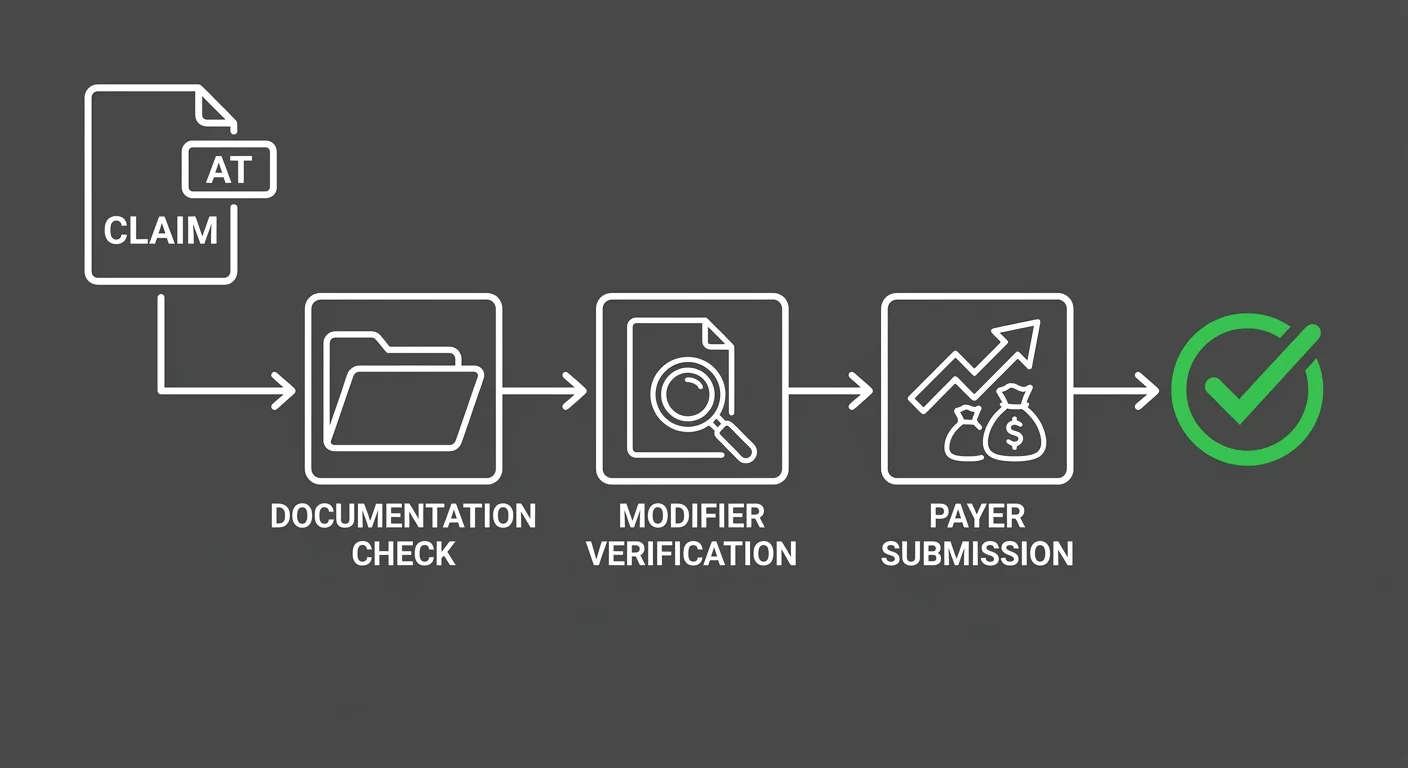
Here’s where most practices lose Medicare money without knowing it. Chiropractic services billed to Medicare require the AT modifier to demonstrate active, corrective treatment rather than maintenance care(https://www.cms.gov/medicare/payment/fee-schedules/physician). Maintenance care isn’t covered. Miss the modifier, misapply it, or fail to document medical necessity correctly – and the claim doesn’t just get denied. It gets denied as non-covered, which is a different recovery path entirely.
A front-desk staffer submitting claims isn’t tracking AT modifier compliance across every Medicare patient, every visit, every location. That’s not a knock on the staff – it’s the job description. They’re managing a waiting room, answering phones, and handling intake. The AT modifier requires active, consistent judgment about what qualifies as corrective treatment versus maintenance care. That judgment has to land correctly on every single claim. Front-desk billing doesn’t have the bandwidth for that – and the revenue gap shows it.
Centralized billing holds that standard because it’s the only job. There’s no waiting room to manage between claims. The work is tracking modifier compliance, flagging documentation gaps before submission, and catching the quiet errors that erode Medicare reimbursement month after month. Reimbursement values for chiropractic codes are updated and regulated annually through federal fee schedules(https://www.cms.gov/newsroom/fact-sheets/calendar-year-cy-2026-medicare-physician-fee-schedule-final-rule-cms-1832-f). A billing operation that isn’t current on those updates is miscoding claims – consistently, invisibly – until the revenue shortfall gets too large to explain away.
Personal Injury Liens and the Case for Specialized Handling
Personal injury lien billing is its own category. It’s not governed by standard payer contracts. The timelines are different, the documentation standards are different, and the appeal logic has nothing in common with a commercial insurance claim. Most billing operations – generalist or otherwise – don’t handle it well. Not because they’re careless. Because that expertise only develops from working those claims consistently, over time. You can’t fake your way through a PI lien.
When a new associate joins a multi-location group, the billing implications multiply immediately. New PI cases, new documentation habits, new claim patterns – all of it needs to be absorbed without dropping existing claim volume. Practices thinking carefully about integrating new providers into billing workflows already understand the problem: a decentralized model can’t absorb that complexity cleanly. A centralized billing operation can – because it’s already built for it.
Specialty claims don’t forgive structural weakness. The AT modifier doesn’t care that the front desk was understaffed. The PI lien timeline doesn’t pause for a location turnover. These claims require consistent, accountable follow-through – every time, not just when the workflow allows it. That’s exactly what Bushido Billing is built to deliver. The practices that recover the most from specialty claims aren’t the ones with the most people. They’re the ones with a billing infrastructure that treats those claims as a priority – not an afterthought they’ll get to eventually.
| Claim Type | Decentralized Handling | Centralized Handling | Revenue Recovery Risk |
|---|---|---|---|
| Medicare AT Modifier Claims | Front-desk staff submit claims without consistent modifier compliance review or documentation verification across visits and locations | Dedicated billing operation tracks modifier application on every claim, flags documentation gaps before submission, and monitors compliance across all locations | High – missed or misapplied modifier results in non-covered denial with a separate and more difficult recovery path |
| Medicare Medical Necessity Documentation | Documentation reviewed at point of care only; no systematic follow-up to verify that clinical notes support billing codes before submission | Billing team reviews documentation against medical necessity standards prior to submission, catching mismatches before they become denials | High – claims denied for insufficient medical necessity documentation face strict appeal timelines and require clinical-level substantiation to overturn |
| Personal Injury Lien Billing | Handled inconsistently or not at all; front-desk staff lack familiarity with lien timelines, documentation standards, and payer-specific appeal logic | Managed as a distinct workflow with specialized follow-through on lien documentation, settlement tracking, and payer-specific requirements | Very High – PI lien claims that go unworked or are mishandled do not recover through standard insurance appeal channels |
| Annual Fee Schedule Updates | Code updates applied reactively or inconsistently; no dedicated process to audit existing claims against revised reimbursement values | Billing operation monitors annual fee schedule revisions and audits active claim patterns to ensure codes reflect current reimbursement standards | Moderate to High – practices billing against outdated codes consistently undercollect without a visible error signal until the revenue shortfall accumulates |
| Maintenance vs. Active Care Distinction | Distinction applied inconsistently across providers and locations; front-desk staff lack the clinical-billing knowledge to flag borderline documentation | Centralized billing reviews claim context against coverage criteria, escalates documentation concerns to the provider before submission, and maintains consistent standards across locations | High – maintenance care claims submitted without proper active-care documentation are denied as non-covered, which requires significantly more effort to appeal than a standard denial |
How to Evaluate Which Model Fits Your Practice Right Now

So the structural case is made. Now the harder question: which model actually fits your practice – not in theory, but right now?
Given your volume. Your staff. Your denial patterns. Where you’re trying to go in the next two years.
A single-location clinic with low Medicare volume and minimal PI case load carries different billing pressure than a three-location group with rotating associates and a growing payer mix. The pressure points aren’t the same.
But the evaluation framework is. Look at what’s being lost. Look at who’s accountable for it. And ask whether that accountability structure can actually hold as you grow – or whether it’s already starting to crack.
Clinicians already spend over 15 hours per week on non-clinical administrative work. That’s not spare capacity waiting to absorb more billing complexity. That’s a team already at the ceiling.
The question isn’t whether the current model is working. It’s whether you can see clearly enough to know either way.
Warning Signs Your Current Billing Structure Is Costing You
First warning sign: you don’t know your denial rate by payer. Not approximately. Specifically.
If that number requires someone to pull it manually, the billing model isn’t producing the reporting infrastructure you need to run a practice. It’s producing a guess dressed up as management.
Second warning sign: aging AR that nobody’s actively working. Not AR that exists – every practice has AR. Aging AR sitting untouched past 60 days while front-desk staff manage everything else.
That’s the revenue gap in its most visible form. When billing complexity lands on staff without the time or specialty knowledge to work it, the AR aging report stops being a management metric and starts being an obituary for recoverable revenue.
Third warning sign: reimbursement rate changes catching the practice off guard. CMS updates chiropractic reimbursement values annually through the federal fee schedule. If the billing operation isn’t tracking those updates and adjusting claim submission accordingly, the practice is miscoding – consistently – without knowing it.
That’s not a documentation problem. It’s a structural accountability problem. It doesn’t announce itself with a denial letter. It just quietly drains the revenue report month after month until someone finally pulls the numbers and asks why collections are down.
Questions to Ask Before Changing Your Billing Model
Before changing anything, ask one question first: who is accountable for a denied claim – from the moment it’s rejected to the moment it’s resolved or written off?
If the answer isn’t a specific person with a defined process and a tracked timeline, you don’t have a billing model. You have a submission process with nothing behind it.
Second question: what does the practice know about its billing performance right now, without asking anyone?
If getting that answer requires a conversation with the front desk or a manual EHR pull, the model isn’t producing visibility. It’s producing hope. Practices that start exploring billing software integration quickly learn that reporting infrastructure is the first indicator of whether a billing operation is built to perform – or just built to submit.
The question isn’t whether to centralize. It’s whether you do it before or after the revenue gap becomes a crisis.
Practices that make this move proactively don’t wait for the aging AR to force the answer. They ask the right questions first. Then they act on what the numbers are already telling them.
| Evaluation Criteria | Questions to Ask | What the Answer Reveals |
|---|---|---|
| Denial rate visibility | Can you pull your denial rate by payer right now – without asking anyone or running a manual report? | If the answer requires a conversation or a manual EHR pull, the billing model is producing hope, not reporting. A practice that can’t see its denial patterns can’t fix them. |
| AR accountability | Who is actively working claims past 60 days – and what’s their defined process for resolution? | If there’s no specific person with a tracked timeline, the practice has a submission process with nothing behind it. Aging AR is the revenue gap made visible. |
| Reimbursement currency | Did the billing operation adjust claim submissions when the most recent federal fee schedule update took effect? | Annual CMS updates change reimbursement values for chiropractic codes. A billing model that isn’t current on those changes is miscoding claims without knowing it. |
| Specialty claim handling | Who is responsible for AT modifier compliance and PI lien follow-through across every location? | If the answer is the front desk – or nobody specific – these are the claims most likely being denied, abandoned, or written off. Specialty claims require dedicated accountability. |
| Scalability under growth | If a new associate or location were added tomorrow, what would break in the current billing structure first? | The answer identifies the structural ceiling. A model that can’t absorb a new provider without dropping existing claim volume isn’t built for growth – it’s built for today’s volume only. |
| Communication cadence | When did the billing operation last proactively surface a problem – without being asked? | Silence isn’t stability. If the practice only learns about billing issues when cash flow drops, the model hides problems rather than surfacing them. Proactive reporting is a structural feature, not a personality trait. |
Frequently Asked Questions
The comparison is clear. The hesitation is usually what’s left. These are the questions practice owners ask after the billing report, after the AR review – after the moment they realize the current model has a ceiling and nobody told them.
Answer them now. Waiting for the AR to force the conversation just means the revenue gap is already writing the answer for you.
What is the difference between centralized and decentralized billing in chiropractic practices?
Centralized billing means one dedicated operation handles all claims, all denial follow-through, and all revenue cycle reporting – across every location, under unified coding standards and consistent accountability. Decentralized billing distributes that work to individual clinic sites, where front-desk staff manage submissions on top of scheduling, phones, and patient check-in.
The operational difference is real. But the accountability difference is what actually costs practices money. Revenue cycle management spans the full arc from patient registration through final collections. Centralized billing owns that entire arc. Decentralized billing owns submission – and assumes the rest works itself out.
Why does decentralized billing increase denial rates for multi-location clinics?
Because no one is tracking patterns across locations. A modifier error at location one and the same modifier error at location three are the same problem – but in a decentralized model, they never see each other. Each site works its own denials in isolation. The pattern never surfaces. The fix never comes.
Multi-location practices carry more payer variability by default: different contracts, different associate documentation habits, different claim volumes by site. Without one operation watching all of it, the same errors repeat across locations with nothing central to catch them. Research published in PubMed identifies billing complexity as one of the primary structural cost drivers across the U.S. healthcare sector. A decentralized model absorbs that complexity without the infrastructure to manage it – and the denial rate reflects exactly that.
Can a practice centralize its billing without hiring more in-house staff?
Yes – and that’s usually why practices make the shift. A specialized billing partnership replaces in-house billing responsibility. The practice doesn’t hire more people. It stops asking existing staff to absorb a job that has grown past what their role can reliably hold.
The more useful question is what the practice is already paying to maintain the decentralized model – in staff hours, missed reimbursements, and aging AR that nobody’s working. That’s the real cost comparison. Not whether centralization adds overhead. Whether the current model is quietly costing more than it shows on the spreadsheet.
How does centralized billing support faster overall practice growth?
Growth adds locations, associates, payer contracts, and claim volume. Every one of those variables adds billing complexity. A decentralized model doesn’t scale with that complexity – it degrades under it.
Centralized billing grows with the practice because the infrastructure is already built to absorb the volume. Specialty claims – Medicare AT modifier submissions and personal injury lien billing – don’t get deprioritized when volume climbs. They get worked the same way they were worked at one location: by people whose only job is the revenue cycle, with dedicated follow-through that doesn’t depend on the front desk having a quiet afternoon. That consistency is what protects revenue during the growth phase – which is exactly when most practices are most exposed to losing it without noticing.
What are the risks of relying on automated EHR billing instead of a specialized billing partner?
EHR platforms submit claims. That’s the job they’re built for. What they don’t do is read a denial, determine whether it’s a documentation gap or a medical necessity argument, construct the appeal, and track it through resolution.
Automation handles clean claims efficiently. It has no pathway for the ones that require human judgment – and those are the claims carrying the most revenue risk. CMS updates and regulates chiropractic reimbursement rates annually through the federal physician fee schedule. A billing operation that isn’t current on those updates isn’t flagging the gap. It’s consistently miscoding the affected claims while the revenue drains quietly – no alert, no report, just a shortfall that compounds month over month.
Is decentralized billing ever the right model for a chiropractic practice?
For a single-location practice with low Medicare volume, minimal personal injury case load, and a stable payer mix – decentralized billing can hold. For now. The structural pressure is lower. A focused front-desk staff member can manage the claim volume without consistent breakdowns.
But ‘working right now’ and ‘built to scale’ are not the same evaluation. The moment a second location, a new associate, or a growing Medicare patient base enters the picture, the decentralized model starts accumulating the exact pressure points this comparison describes. The question was never whether decentralized billing can work. It’s whether it can keep working as the practice grows – and the structural evidence on that question is consistent: it can’t.
The Billing Structure Decision Is a Growth Decision
This isn’t an admin problem. It’s a growth decision wearing admin clothing. And the practices that file it under "back-office stuff" find out the difference the moment the aging report stops being a management headache and starts being a cash flow emergency.
Every section of this comparison points to the same structural truth. Decentralized billing doesn’t fail because front-desk staff aren’t capable. It fails because chiropractic billing complexity – the AT modifier, personal injury lien timelines, annual fee schedule shifts, denial appeal work – grows faster than any front desk can absorb.
The model that holds at one location starts breaking at two. It doesn’t recover at three. And by the time the revenue gap is visible in the report, a significant portion of it is already unrecoverable.
Centralized, human-driven billing isn’t the cautious choice. It’s the precise one. It treats specialty claims as priorities – not overflow tasks handed to whoever’s least busy at the front desk – and keeps the revenue cycle accountable across every location.
The practices that scaled without losing revenue didn’t stumble into this structure after a crisis. They built the billing infrastructure before the complexity outran the model.
So here’s where it lands: The question isn’t whether to centralize – it’s whether you centralize before or after the revenue gap becomes a crisis. Every week that question sits unanswered, the aging report is already writing the answer for you.
You already know something in your billing isn’t keeping up. The question is whether you fix it before it becomes a cash flow problem – or after.
Bushido Billing is ready when you are.

© . All Rights Reserved | Web Design by iTech Valet