

How Do I Fix a High Denial Rate in My Chiropractic Practice in 2026?
Fixing a high denial rate starts with understanding what's actually causing your denials.
In most chiropractic practices, the root causes fall into three categories: documentation gaps, coding errors, and follow-up breakdowns. Once you identify which category is driving your specific denials, the path forward becomes much clearer.
Here's the encouraging part: most chiropractic denials are preventable. And many that slip through can still be recovered.
Research shows that around 30% of initial chiropractic claims submitted to Medicare face denial. But the majority of these can be overturned with proper documentation and appeals.
The key is developing a systematic approach to denied claims rather than addressing each one individually as it comes up.
The 2026 billing landscape has brought some changes worth understanding. The Medicare Physician Fee Schedule now operates with two conversion factors. And while Congress provided temporary relief from scheduled cuts, documentation requirements have tightened across most payers. Margins remain tight for chiropractic practices, making every denied claim more impactful.
A denial rate above 10% typically indicates room for improvement.
The practices seeing the best results are the ones with clear systems in place. Not necessarily working harder—just working more strategically.
This guide walks through the complete process: understanding your current denial patterns, addressing the root causes, and building sustainable systems that protect your revenue over time.
Understanding Your Current Denial Landscape
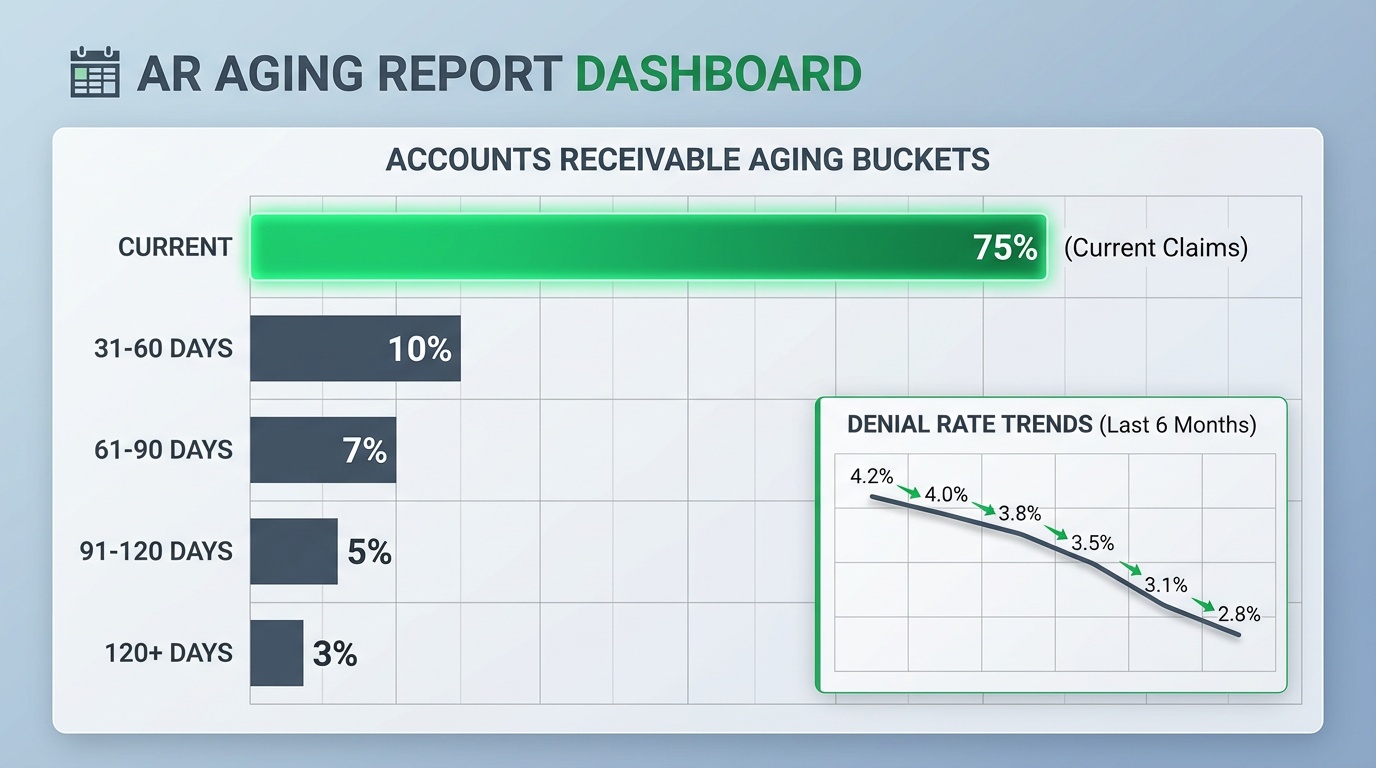
Before making changes to your billing processes, it helps to get a clear picture of what's actually happening with your claims.
Running reports is one thing. Understanding what they're telling you is where the real value comes in.
Most practices find their denial data scattered across multiple systems. This can make patterns hard to spot.
Taking time to pull everything together gives you a foundation for targeted improvements.
How to Run Your Denial Rate Analysis
The first step is calculating your actual denial rate. You'll need data from both your practice management system and your clearinghouse.
The formula is straightforward: divide the total number of denied claims by the total claims submitted over the same period, then multiply by 100.
For a meaningful analysis, use at least 90 days of data. This smooths out month-to-month variations and gives you a reliable baseline.
- Denial Rate Calculation - Total denied claims divided by total submitted claims times 100. Industry benchmarks suggest below 5% is optimal, 5-10% is average, and above 10% indicates opportunity for improvement.
- First-Pass Acceptance Rate - Claims accepted without rejection on initial submission. Target 95% or higher according to HFMA benchmarks. Below 90% suggests systematic coding or eligibility verification opportunities.
- Denial by Payer - Breaking down denials by insurance company often reveals useful patterns. In many practices, one or two payers account for most issues.
- Denial by Code Category - Group denials by reason code. Are most related to medical necessity (CO-50), missing modifiers (CO-4), or eligibility issues (CO-27)?
If you're using Jane App, the Insurance Policies Report and Claim State Tracking features provide this visibility.
ChiroTouch users can access similar data through the Practice Ledger and claims management dashboard.
The Five Denial Categories That Matter Most
Denial codes can feel overwhelming at first.
But for chiropractic practices, most denials fall into five predictable categories. Understanding these helps focus your improvement efforts.
| Denial Category | Percentage of Issues | Primary Cause | Prevention Approach |
|---|---|---|---|
| Medical Necessity | 38% | Documentation doesn't demonstrate functional limitation | Use outcome assessments and document measurable improvement |
| Modifier Errors | 31% | Missing AT modifier on Medicare claims | Automated modifier attachment and regular audits |
| Subluxation Documentation | 19% | Missing motion palpation findings | Standardized templates with baseline comparisons |
| Primary Diagnosis | 17% | M99 not listed first | Pre-visit verification for every patient |
| Eligibility/Authorization | ~10% | Coverage lapsed or prior auth missing | Pre-visit verification for every patient |
Medical necessity denials represent the largest category at around 38%.
These occur when payers determine the documentation doesn't adequately justify the treatment provided. Particularly common when functional limitations aren't described in measurable terms.
Modifier-related denials account for about 31%.
The AT modifier requirement for Medicare chiropractic claims is the most frequent culprit. Without it attached to codes 98940-98942, Medicare automatically denies the claim as maintenance therapy.
Subluxation documentation issues cause roughly 19% of denials.
Medicare and many commercial payers require specific evidence of subluxation, including findings from motion palpation and baseline comparisons.
Primary diagnosis errors make up about 17%.
For Medicare claims, the M99 subluxation code needs to be listed first. Secondary diagnoses supporting medical necessity should follow in logical order.
Reading Your AR Report for Denial Patterns
Your accounts receivable report can tell you quite a bit about the health of your billing processes.
Learning to read it effectively helps identify where claims are getting stuck.
The importance of running an AR report goes beyond knowing your total outstanding balance. You want to see how claims age over time.
MGMA benchmarks suggest keeping AR over 90 days below 12-15% of total receivables.
Higher percentages may indicate that denied claims aren't being worked as aggressively as they could be.
Look for patterns in your aged AR. Are the same denial codes appearing repeatedly? Are certain payers consistently slower to pay?
This kind of analysis points directly to where your systems might benefit from adjustment.
The Most Common Chiropractic Denial Codes in 2026

Denial codes are the insurance industry's shorthand for explaining why a claim wasn't paid.
Understanding what these codes mean helps you respond appropriately and prevent similar issues in the future.
AT Modifier and Medicare Compliance
The AT modifier deserves special attention. It's involved in a significant portion of chiropractic denials.
Understanding proper Medicare billing for chiropractors starts with getting this modifier right.
The AT modifier tells Medicare that chiropractic treatment is active therapy rather than maintenance care.
Medicare covers active treatment when there's an expectation of functional improvement. Once a patient reaches maximum therapeutic benefit, Medicare coverage ends—regardless of whether symptoms continue.
Every claim using codes 98940, 98941, or 98942 submitted to Medicare needs the AT modifier. Without it, the claim will be denied automatically.
The documentation behind the modifier matters equally. You need to demonstrate measurable progress toward specific functional goals.
The 12-visit re-evaluation requirement adds another layer.
Every 12 visits or 30 days, Medicare requires reassessment showing at least 15% improvement and revised treatment goals. A large portion of visits denied beyond 12 visits lack adequate documentation of ongoing medical necessity.
When maximum benefit is reached, the appropriate approach involves issuing an Advance Beneficiary Notice (ABN) and obtaining patient signature.
The GA modifier is used when you expect a denial but have the signed ABN. The GY modifier applies to services Medicare doesn't cover.
The Office of Inspector General has noted that a significant portion of overpayments to chiropractors involve billing maintenance care as active treatment. Something that's easily avoided with proper systems in place.
Medical Necessity Documentation Requirements
Medical necessity denials often happen when documentation describes what treatment was provided but doesn't clearly explain why it was necessary.
Payers want to see a clear connection between the patient's functional limitations and your treatment approach.
Strong medical necessity documentation includes specific functional limitations described in measurable terms.
"Low back pain" tells the payer very little. "Patient unable to sit longer than 15 minutes without significant increase in pain" provides the context that justifies ongoing treatment.
Use standardized outcome assessment tools consistently.
The Oswestry Disability Index, Neck Disability Index, and Visual Analog Scale provide objective measures that payers recognize. The American Chiropractic Association provides guidance on documentation standards that meet payer requirements.
Document baseline scores at the start of treatment. Track changes over time.
Your SOAP notes should connect each visit to the overall treatment plan. The assessment section should address whether the patient is progressing, plateauing, or regressing—with specific evidence.
Maximizing chiropractic revenue through documentation isn't about writing more. It's about including what payers need to see.
Each claim should answer the implied question: "Why does this patient need this treatment today?"
| Denial Code | Description | Common Cause in Chiropractic | How to Address |
|---|---|---|---|
| CO-4 | Modifier required | Missing AT modifier on Medicare CMT | Resubmit with AT modifier and supporting documentation |
| CO-16 | Missing information | Incomplete patient demographics or NPI | Verify all fields are complete before resubmission |
| CO-50 | Medical necessity | Insufficient documentation of functional limitation | Appeal with clinical notes showing objective improvement |
| CO-97 | Bundled service | Billing separately for included procedures | Review bundling rules and bill correctly combined services |
| CO-27 | Expired coverage | Patient eligibility lapsed | Verify eligibility before every visit |
| CO-29 | Timely filing | Claim submitted past deadline | Note payer deadlines and submit within 24–48 hours |
| CO-167 | Not covered | Service outside plan benefits | Bill patient directly or use GY modifier for Medicare |
Building a Denial Prevention System

Preventing denials is always more efficient than appealing them afterward.
The average cost to rework a denied claim runs around $25 in staff time alone. That doesn't count delayed revenue or potential timely filing issues.
An effective denial prevention system addresses potential problems at three stages: before the patient arrives, before the claim is submitted, and after patterns emerge from your denial data.
Pre-Visit Verification That Prevents Denials
Insurance verification before the patient walks in catches eligibility problems that would otherwise become denials.
A thorough insurance verification process goes beyond just confirming active coverage.
Complete verification includes checking remaining benefits and visit limits.
Many plans cap chiropractic visits at 10-20 per year. Knowing this upfront allows for proper patient communication and prevents surprise denials later.
Prior authorization requirements have expanded across many commercial payers.
UnitedHealthcare and Cigna now require outcome assessment documentation within 30-day intervals. Some Blue Cross plans have implemented pre-payment reviews for high-volume providers.
Coordination of benefits verification prevents CO-22 denials.
When patients have multiple insurance policies, claims need to go to the primary payer first. Getting this right from the start avoids delays and denials.
Real-time eligibility checking through your clearinghouse provides the most current information.
Claim.MD and similar clearinghouses offer eligibility verification for hundreds of payers. This can be accessed through their portal or integrated into your practice management system.
Claim Scrubbing Before Submission
Claim scrubbing catches coding errors, missing modifiers, and demographic issues before they become denials.
This process ideally happens automatically for every claim.
Modern practice management systems include built-in scrubbing features that check for common errors.
ChiroTouch's Compliance Scan validates notes and diagnoses against billing codes. Jane App's Claim State Tracking identifies potential issues through integration with Claim.MD.
Your scrubbing process should verify that diagnosis codes match procedure codes appropriately.
Understanding chiropractic billing code differences between similar CPT codes prevents bundling denials and helps ensure appropriate reimbursement.
Required modifiers should attach automatically based on payer and service type.
The AT modifier for Medicare CMT claims, the 59 modifier for distinct services, and the 25 modifier for significant E/M services each have specific requirements that scrubbing should catch.
Verify that all required fields contain valid data. NPI numbers, patient demographics, dates of service, and place of service codes all need to be accurate.
Even small errors trigger rejections that delay payment.
Creating Feedback Loops from Denial Data
The practices with the lowest denial rates treat every denial as useful information about their systems.
Not just a claim that needs attention.
Monthly denial analysis should identify trending issues.
If medical necessity denials are increasing over several months, documentation practices may need adjustment. If a specific payer's denials spike, their policy changes may require workflow updates.
Share denial patterns with your clinical team.
Providers don't always see the billing consequences of documentation choices. When clinical staff understand which documentation elements matter most for reimbursement, quality tends to improve naturally.
Track resolution rates alongside denial rates.
Your denial rate is only half the picture. What percentage of denied claims do you successfully appeal? How long does resolution take?
These metrics show whether your follow-up processes are working effectively.
The Appeal Process That Recovers Revenue
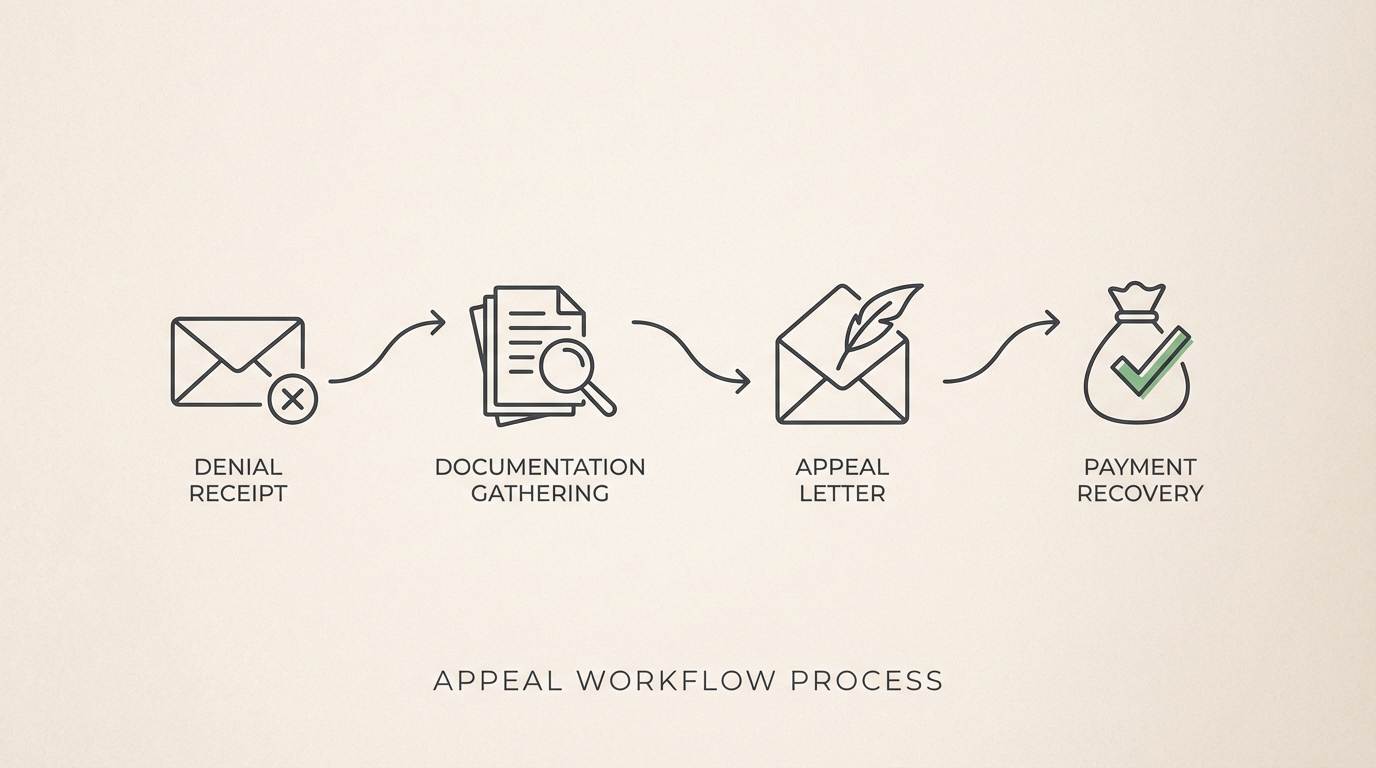
When prevention doesn't catch everything and denials do occur, a clear appeal process determines whether that revenue gets recovered.
Many practices have significant opportunity here simply because they don't have a consistent approach to appeals.
Studies suggest that around 63% of initially denied claims can be recovered through proper appeals.
For chiropractic practices, the recovery rate depends heavily on having the right documentation and understanding what each payer requires.
When to Appeal vs. When to Move On
Not every denial warrants an appeal.
Strategic prioritization focuses your efforts on claims where recovery is realistic.
Appeals make sense when the denial reason can be addressed with additional documentation, when the claim amount justifies the effort, and when you're within the payer's appeal deadline.
Most payers allow 30-60 days for internal appeals.
High-value claims and recurring denial patterns are worth pursuing.
A single successful appeal on a complex denial can recover hundreds of dollars. More importantly, winning an appeal can establish precedent that helps prevent similar future denials.
Moving on makes sense for small claims where staff time would exceed potential recovery. Also for denials that correctly identify policy exclusions, or claims where the documentation genuinely doesn't support medical necessity.
Being realistic about documentation gaps helps focus energy where it's most productive.
Structuring Effective Appeal Letters
Appeal letters work best when they're clear, direct, and focused on the specific denial reason.
Payers review many appeals daily. Yours needs to communicate efficiently.
Start with essential identifiers: patient name, date of birth, claim number, date of service, and the specific denial code being appealed.
This prevents your appeal from being misrouted or requiring follow-up calls for basic information.
State your argument clearly.
Explain why the denial should be reconsidered and what evidence supports your position. Reference specific policy language if you're arguing that the payer misapplied their own rules.
Attach supporting documentation systematically.
Include relevant SOAP notes, outcome assessment scores showing improvement, the treatment plan with functional goals, and any prior authorization if applicable.
Organize attachments with a cover sheet listing contents.
Close with a clear request: "We respectfully request reconsideration and payment of this claim based on the enclosed documentation demonstrating medical necessity."
Managing Appeals Across Multiple Payers
Different payers have different appeal processes, timelines, and preferred formats.
Managing this complexity is easier with organized systems.
Create payer-specific appeal templates that include the correct mailing address, fax number, or portal submission process for each major insurance company you bill.
Note their specific deadlines and any forms they require.
Track every appeal from submission to resolution.
Note the date submitted, method of submission, any acknowledgment received, and follow-up actions needed. Some practices find that appeals get submitted but never followed up—tracking prevents this.
For interpreting insurance denial codes, keep a reference guide that your team can access quickly.
Understanding what each code means prevents effort spent on appeals that aren't likely to succeed.
Set calendar reminders for follow-up if you haven't received a response within 30 days.
Payers occasionally lose appeals in their systems. Consistent follow-up often produces results.
Choosing the Right Technology and Partners

Your technology choices have a real impact on denial rates.
The right platform makes prevention more automatic. Gaps in integration create opportunities for errors.
Equally important is whether you handle billing in-house, work with a billing company, or use a hybrid approach. Each model has tradeoffs that affect denial management.
Evaluating Your Current EHR and Billing Integration
Your EHR and billing systems work best when they communicate seamlessly.
When they don't, manual data entry creates opportunities for errors.
Strong integration means clinical documentation flows directly into claim creation.
Diagnosis codes selected during charting should populate automatically on claims. Treatment codes should link to documented services without re-entry.
Jane App integrates insurance billing through the Claim.MD clearinghouse.
This enables eligibility checking, claim submission, rejection tracking, and ERA posting within a single platform.
ChiroTouch offers similar integration through CT MaxClear, connecting charting directly to billing for smoother submissions.
Consider whether your current setup catches errors proactively.
Does your system alert you to missing modifiers before submission? Does it verify eligibility automatically? Does it flag claims that don't match documentation?
If you're checking these items manually, your technology may not be working as hard as it could.
Reporting capabilities matter as much as submission features.
Can you easily pull denial rates by payer, by code, by provider? If generating these reports requires hours of work, you probably won't run them often enough to catch problems early.
Human Intelligence vs. Automated Billing Solutions
The billing industry increasingly offers AI-powered solutions that promise to reduce denials through automation.
Understanding where automation helps and where it has limitations informs smarter decisions.
Automation excels at rules-based checking.
Verifying that required fields are complete, that modifiers match payer requirements, and that codes are valid. For clean, straightforward claims, automated scrubbing catches errors efficiently.
Automation has more difficulty with nuanced judgment calls that chiropractic billing frequently requires.
Medical necessity arguments involve interpreting clinical situations, not just matching codes. Maintenance care vs. active treatment distinctions require understanding patient histories and treatment trajectories.
Appeals particularly benefit from human expertise.
Crafting arguments that address specific denial reasons, interpreting payer policies, and knowing when to escalate requires knowledge that current automation can't replicate.
The most effective approach often combines automated efficiency for routine tasks with human expertise for complex situations.
Automation handles the volume. Humans handle the judgment.
When to Consider Working with a Billing Partner
Working with an external billing team or denial management specialist makes sense in certain situations.
The decision depends on your current denial rate, staff capacity, and the complexity of your payer mix.
If your denial rate stays elevated despite internal efforts, outside expertise may identify patterns your team hasn't spotted.
Fresh perspectives on your processes sometimes reveal opportunities that become hard to see when you're immersed in daily operations.
Staff turnover creates billing disruptions that external support can help address.
When an experienced biller leaves, you face weeks or months of training before someone new reaches full productivity. During that transition, denials often increase and follow-up may suffer.
Complex billing scenarios—Medicare, personal injury claims, workers' compensation—require specialized knowledge.
If these represent a significant portion of your revenue but you don't have in-house expertise, targeted support for these claim types may deliver better results.
When evaluating any billing service, ask specifically about their denial management process, appeal rates, and how they handle claims that require extra effort.
The right partner treats denial management as a core service, not an afterthought.
Measuring Success and Maintaining Improvements
Fixing a high denial rate isn't a one-time project.
Maintaining low denial rates requires ongoing attention and continuous refinement of your processes.
The practices that sustain improvement tend to treat billing metrics with the same attention they give clinical outcomes.
Regular review prevents backsliding and catches new issues before they grow.
Key Performance Indicators to Track Monthly
Beyond your overall denial rate, several metrics provide early warning of emerging issues.
| KPI METRIC | TARGET BENCHMARK | WATCH LEVEL | WHAT IT INDICATES |
|---|---|---|---|
| Clean Claims Rate | 95%+ | Below 90% | Submission quality opportunities |
| Denial Rate | Below 5% | Above 10% | Systematic billing improvements needed |
| Days in AR | Under 45 days | Over 60 days | Collection process delays |
| Net Collection Ratio | 96-97% | Below 95% | Potential revenue recovery opportunities |
| AR Over 90 Days | Under 12-15% | Above 20% | Aged claims needing attention |
| Appeal Success Rate | 60%+ | Below 40% | Appeal process refinement opportunity |
Clean claims rate measures the percentage of claims accepted without rejection on first submission.
A target of 95% or higher is reasonable. This metric catches submission problems faster than denial rate because it includes rejections that never reach the payer for adjudication.
Days in AR indicates how quickly you're collecting on claims.
MGMA benchmarks suggest keeping this below 45 days. If your average days in AR is climbing, claims may be getting stuck in payer review or follow-up may need attention.
Net collection ratio shows how effectively you collect what you're owed after contractual adjustments.
MGMA reports that high-performing practices achieve 96-97% collection ratios. Below 95% may indicate revenue recovery opportunities somewhere in your process.
Appeal success rate reveals whether your appeals process is effective.
If you're appealing but rarely winning, either the denials aren't recoverable or your appeal approach may benefit from adjustment.
Building Denial Review into Your Weekly Workflow
Monthly metrics catch trends. But weekly attention catches individual issues before they age out of recoverable range.
Designate time each week specifically for denial review.
This includes pulling new denial reports from your clearinghouse or practice management system, assigning claims for appeal or correction, and following up on pending appeals.
Create accountability for denial resolution.
Whether you handle billing in-house or work with an external team, someone should own the denial follow-up process with clear expectations for turnaround time.
Reading insurance EOBs should be a routine skill for anyone involved in your billing process.
When your team understands what each section of an EOB means, they can triage denial responses more effectively and escalate appropriately.
Use denial patterns to inform provider communication.
If certain documentation patterns drive recurring denials, brief conversations with your clinical team can address the root cause rather than repeatedly appealing the same issues.
When Your Denial Rate Indicates Broader Issues
Sometimes a high denial rate points to issues beyond billing processes.
Recognizing these situations helps avoid spending effort in the wrong areas.
If denial rates stay elevated despite process improvements, it may be worth reviewing whether your fee schedule needs updating.
Charges that significantly exceed usual and customary rates can trigger automatic reductions that show up as denials.
Consistently high medical necessity denials across multiple payers may indicate a documentation opportunity.
This is worth a clinical conversation, not just a billing fix.
A sudden spike in denials from a previously reliable payer often means policy changes have occurred.
Reaching out to your provider relations contact to understand what's changed helps you adjust workflows accordingly.
If your team is stretched thin from constant denial management, the volume may have exceeded what in-house handling can sustain well.
This is often the point where external support makes financial and operational sense.
Frequently Asked Questions
What is an acceptable denial rate for a chiropractic practice?
Industry benchmarks suggest keeping your denial rate below 5% as optimal. The 5-10% range is considered average.
Chiropractic practices sometimes see higher rates due to medical necessity requirements and modifier complexity.
Any rate above 10% typically indicates an opportunity for meaningful improvement.
MGMA reports an aggregate denial rate of 8% across single-specialty practices. Chiropractic practices targeting this benchmark benefit from strong documentation systems, consistent modifier usage, and proactive eligibility verification.
Keep in mind that denial rate alone doesn't tell the complete story.
A 6% denial rate with 90% appeal success indicates a healthy process with good recovery. A 6% denial rate where claims aren't being appealed represents money that could potentially be recovered.
How do I appeal a chiropractic insurance denial for medical necessity?
Start by gathering your clinical documentation.
This includes SOAP notes, outcome assessments, and the original denial letter.
Write a clear appeal letter explaining why the treatment was medically necessary. Reference specific functional limitations and measurable improvements.
Include supporting evidence that demonstrates the patient's baseline condition, treatment goals, and documented progress.
Outcome assessment tools like the Oswestry Disability Index or Visual Analog Scale provide objective measures that strengthen your argument.
Submit within the payer's appeal deadline, typically 30-60 days from the denial date.
Follow up if you haven't received a response within 30 days. Persistence often matters as much as the initial submission.
What are the most common chiropractic denial codes in 2026?
The most frequent denial codes include CO-4 (modifier required), CO-16 (missing information), CO-97 (bundled services), CO-50 (medical necessity), and denials related to maintenance care classification.
Missing AT modifiers on Medicare claims remain the single most common preventable denial for chiropractors.
This modifier needs to accompany every CMT code (98940-98942) submitted to Medicare, with documentation supporting active treatment status.
Medical necessity denials (CO-50) require the most effort to resolve.
They involve clinical documentation review and carefully crafted appeals. Prevention through thorough initial documentation is more efficient than appeal.
How does the AT modifier affect Medicare chiropractic denials?
The AT modifier indicates active treatment versus maintenance care.
Without it, Medicare automatically denies chiropractic manipulation claims. Improper modifier use accounts for approximately 31% of chiropractic claim denials.
Every 98940-98942 code submitted to Medicare needs to include the AT modifier.
The documentation behind the modifier matters equally. Medicare requires evidence of expected functional improvement from continued treatment.
When patients reach maximum therapeutic benefit, the AT modifier no longer applies.
At that point, proper procedure involves issuing an ABN, obtaining patient signature, and transitioning the patient to self-pay or discontinuing billing for that condition.
Why might my billing company not be addressing denied claims?
Some billing companies operate on models where straightforward claims receive more attention than complex denials.
Complex denials require additional research and follow-up time.
If your AR report shows aging denials without resolution, it's worth having a direct conversation with your billing partner.
Ask specifically about their appeal process, success rates, and how they prioritize claims that need extra effort.
Understanding their workflow helps you set appropriate expectations or identify if a change might be beneficial.
The billing partners that deliver the best results tend to view denial management as a core service rather than an extra.
How do I track denials in Jane App or ChiroTouch?
In Jane App, use the Insurance Policies Report and Claim State Tracking features available with the Insurance Billing Add-On.
The platform integrates with Claim.MD clearinghouse, providing real-time status updates and rejection alerts.
ChiroTouch users can access denial data through the Practice Ledger and claims management dashboard.
Filter by claim status to identify denials, and use the reporting features to analyze patterns over time. CT MaxClear integration provides similar clearinghouse connectivity.
Both platforms can export data for deeper analysis if needed.
Monthly export and review often reveals patterns that aren't obvious from day-to-day operations.
Does AI billing increase or decrease denial rates for chiropractors?
AI can reduce denials for clean, straightforward claims through automated code verification and eligibility checks.
For routine submissions, AI-powered scrubbing catches errors efficiently before they become denials.
However, chiropractic billing often requires nuanced medical necessity arguments that benefit from human expertise.
Complex denials involving maintenance care disputes, Medicare appeals, and PI claims typically see better outcomes with human judgment and clinical understanding.
The most effective approach often combines automated efficiency for routine tasks with human expertise for complex situations.
Neither fully automated nor fully manual approaches tend to optimize results on their own.
Can a billing partner recover aging accounts receivable?
Yes, though recovery rates depend on claim age and documentation quality.
Claims under 90 days typically see 60-70% recovery rates with proper follow-up. After 120 days, recovery becomes more challenging as timely filing limits expire.
A thorough AR cleanup can identify which claims are worth pursuing and establish systems to prevent future aging.
The process typically involves categorizing aged claims by recoverability, prioritizing high-value items, and working systematically through the backlog.
Beyond cleanup, the more valuable outcome is implementing systems that prevent AR from aging excessively in the first place.
One-time cleanup without process improvement tends to delay the next accumulation rather than solving the underlying issue.
Moving Forward with Your Revenue Cycle
Addressing a high denial rate involves attention at every stage of the billing process.
Before the patient arrives. When the claim is created. After denials occur. And through ongoing monitoring of results.
The practices that see the best results aren't necessarily working harder. They're working more systematically.
They verify eligibility before visits. Scrub claims before submission. Appeal denials with clear processes. Track patterns to prevent repeat issues.
The 2026 regulatory environment makes these systems more valuable than ever.
With Medicare conversion factors in flux and payers refining their review processes, practices with clear billing workflows tend to see better results than those without.
Start with your current state.
Run the reports. Calculate your denial rate. Identify your top denial categories.
Then address the biggest opportunities first. Systematic improvement tends to deliver better results than scattered effort.
For many clinic owners, getting billing right means finally being able to focus on what matters most—taking care of patients without wondering whether claims are getting paid correctly.
That's a weight off anyone's shoulders.
If you're looking at your AR report and thinking "I know there's money in here somewhere, but I don't have time to chase it all down," you're not alone.
Most practices we work with started in exactly the same place.
If this all makes sense but finding time to implement it feels challenging, that's understandable. Most clinic owners we talk with felt the same way before they got clarity on what was actually happening with their billing.
That's why we offer a free discovery call.
It's a chance to talk through your current billing situation and get a clear picture of what's working, what could be improved, and what your options are.
We'll help you understand:
- Where your claims might be getting stuck
- What's contributing to denials or delays
- Whether your AR is healthy or needs attention
- How your current process compares to what we typically see
- What working with Bushido would actually look like
Book a Call — no pressure, no obligation, just a straightforward conversation about your billing.
Because the goal isn't just fewer denials. It's being able to focus on your patients knowing that the billing side is handled.

© 2026 Bushido Billing. All Rights Reserved | Web Design by iTech Valet