

How to Find the Root Cause Behind Recurring Payer Denials
Learn how to read remittance advice codes, spot denial patterns and find the root cause behind recurring payer denials in chiropractic billing.
On a remittance advice, Medicare uses three sets of codes at the claim or service line level: Claim Adjustment Group Codes, Claim Adjustment Reason Codes (CARC) and Remittance Advice Remark Codes (RARC). Medicare uses a standardized national code set on remittance advice to explain financial adjustments, such as denials, payment reductions or payment increases. The American Medical Billing Association (AMBA) says you need to understand both the group code and the CARC when you decide whether a balance can legally be billed to the patient. Change Healthcare says that a focus on fixing individual denials, instead of analyzing root causes, fails to reduce the number of denials.
Start With the Remittance Advice
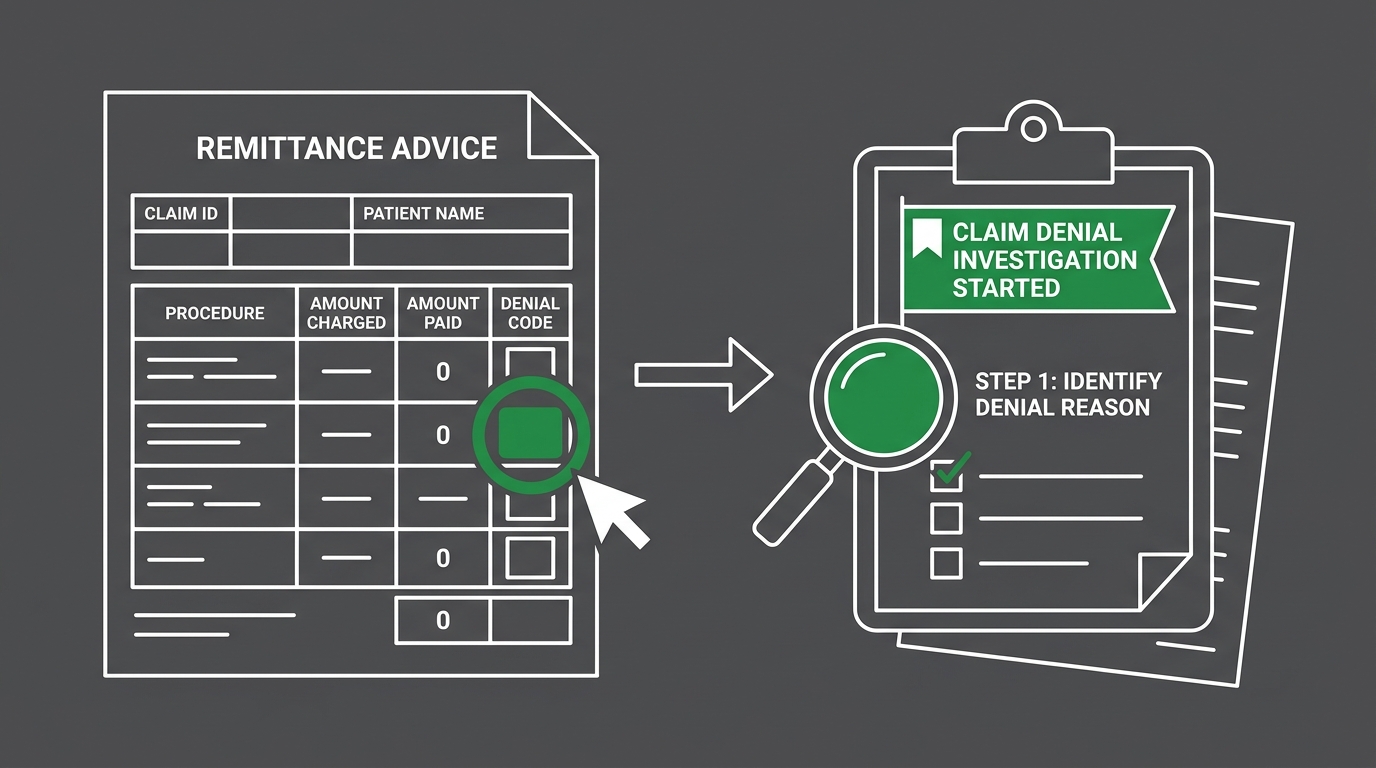
Every denial hunt starts with the payment notice. After Medicare processes a claim, it sends either an electronic remittance advice (ERA) or a standard paper remittance (SPR). The notice gives the final decision on the claim and the payment information. Noridian Healthcare Solutions’ page Remittance Advice (RA) – JE Part B says a remittance advice gives the final details of a claim. It also includes codes with messages that explain how the claim was processed.
The Centers for Medicare & Medicaid Services (CMS) says the ERA or SPR reports the reason for each adjustment and the value of each adjustment. CMS counts an adjustment as any of these:
- Denied
- Zero payment
- Partial payment
- Reduced payment
- Penalty applied
- Additional payment
- Supplemental payment
One transmission of the remittance advice can report payments and adjustments for many claims.
The three code sets
On a remittance advice, Medicare uses three code sets at the claim or service line level, according to Noridian. They are Claim Adjustment Group Codes, Claim Adjustment Reason Codes (CARC) and Remittance Advice Remark Codes (RARC).
Group codes tell you who has to pay the unpaid part of a claim balance. CO (Contractual Obligation) puts the responsibility on the provider. PR (Patient Responsibility) puts it on the patient. The American Medical Billing Association (AMBA) says understanding both the group code and the CARC is critical when you decide whether a balance can legally be billed to the patient.
Reading CARC and RARC Denial Codes
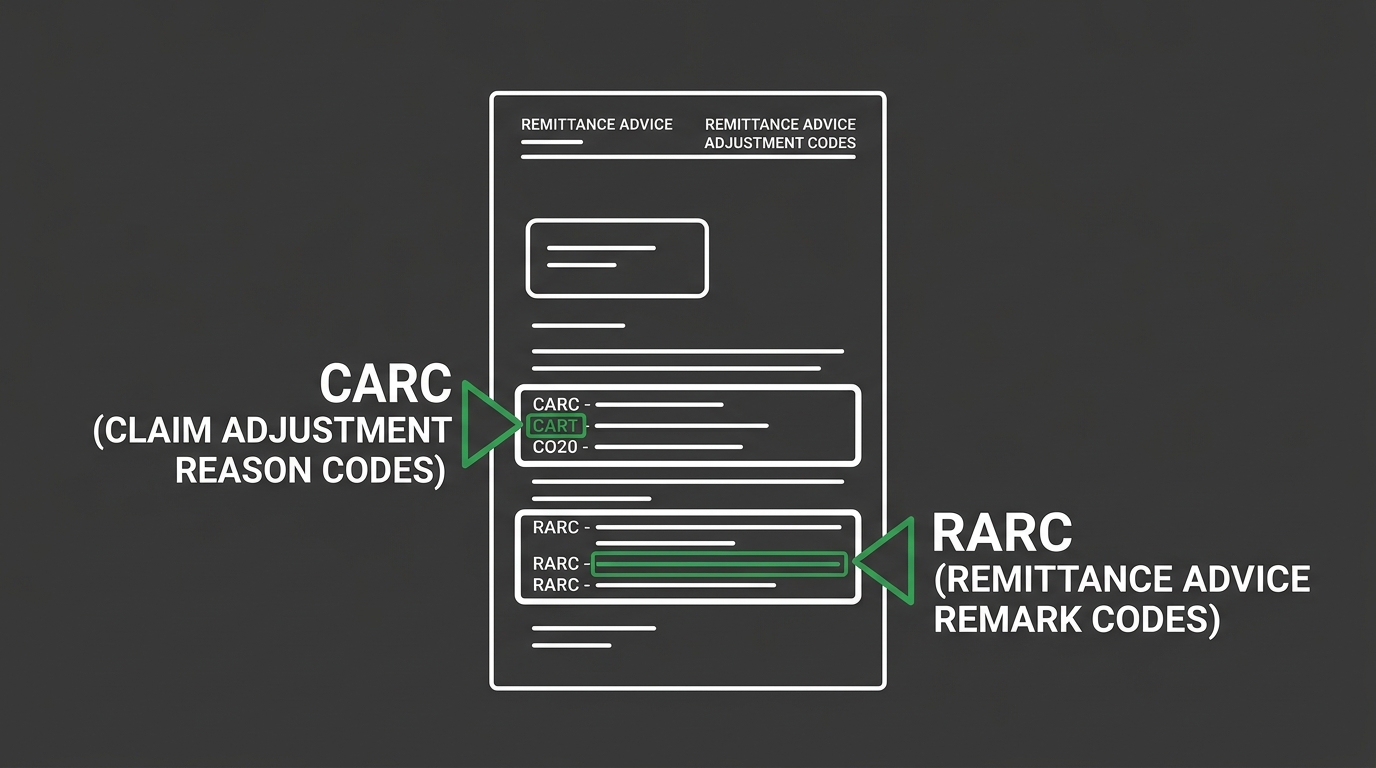
Noridian says Medicare uses a standardized national code set on remittance advice to explain financial adjustments, such as denials, payment reductions or payment increases.
What each code type tells you
CMS says CARCs explain why a claim or service line was paid differently from how it was billed, and RARCs add more explanation for the remittance. The AMBA describes CARCs as the money reason a payer reduced, denied or otherwise changed the amount it paid on a claim.
The AMBA boils it down: the CARC tells you what happened, and the RARC tells you why it happened or what action to take. Noridian adds that remark code alerts give general information about how a claim was decided. They don’t add more explanation for a specific adjustment.
The next step for common codes
Many codes point to a clear next step, and the AMBA’s Updated RARCs and CARCs lists them. CO-45 means the charge is more than the fee schedule or contracted amount, so you apply the contractual adjustment. CO-96 means a non-covered charge, so you review the payer’s coverage policies. CO-97 means the payment was included in another service, so you review the National Correct Coding Initiative (NCCI) edits and bundling rules. N130 means to consult the plan benefit documents, so you review the payer’s policy.
The table below lines up five more codes from the same list, with what each one means and what you do about it.
| Code | Meaning | Action |
|---|---|---|
| CO-16 | Claim/service lacks information | Correct and resubmit with missing information |
| CO-22 | Payment adjusted because another payer is primary | Bill the correct primary payer |
| CO-109 | Claim not covered by this payer or contractor | Verify insurance eligibility |
| N30 | Patient ineligible for this service on date billed | Verify eligibility and benefits |
| N290 | Missing documentation | Submit requested records |
Track Patterns, Not Single Claims
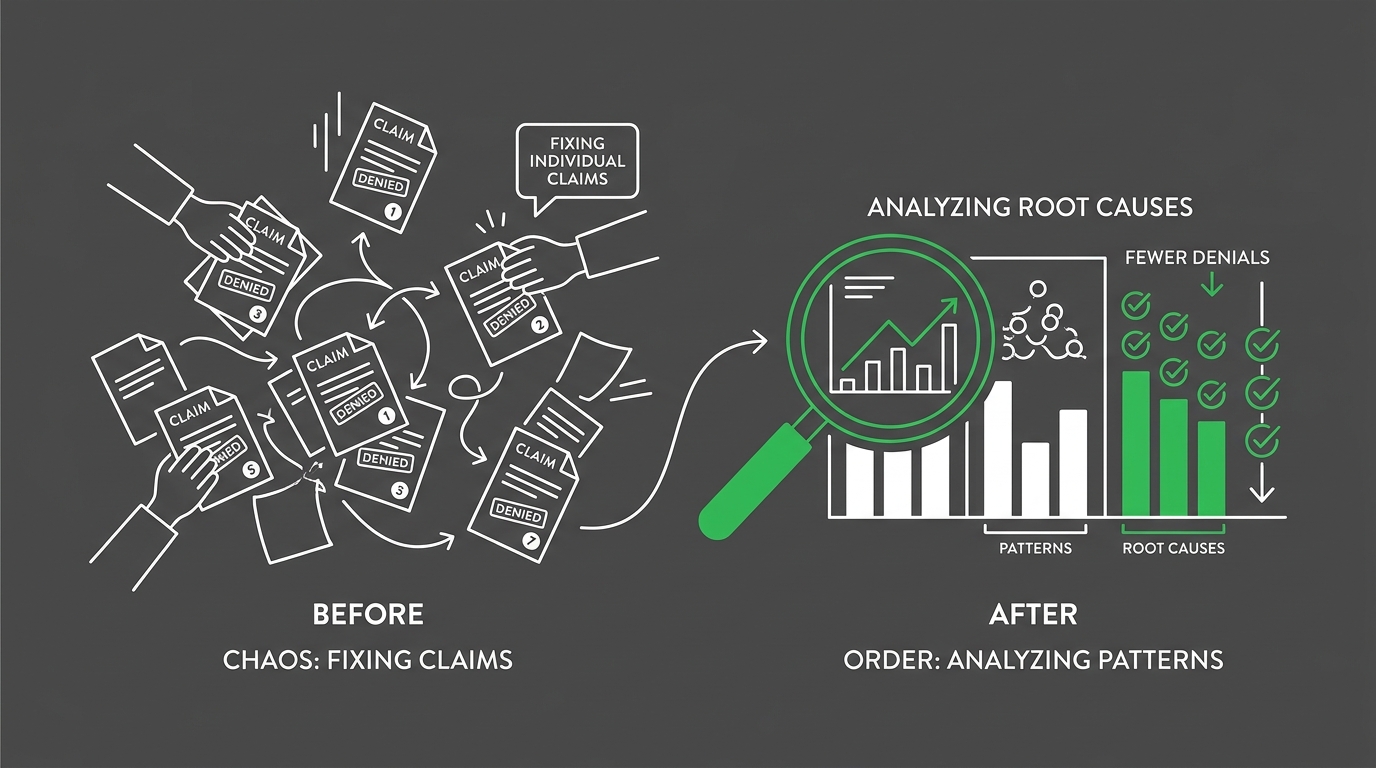
Change Healthcare says that a focus on fixing individual denials, instead of analyzing root causes, fails to reduce the number of denials. Its report, The Change Healthcare 2022 Revenue Cycle Denials Index, names a barrier: inadequate access to data for root cause analysis, and to expertise on interpreting it.
What lowers denial volume
Training your team to flag and understand root causes will lower your preventable denial rates, says Change Healthcare. It also says data and insights only help if action is taken. Make sure a proper feedback loop exists so your team acts to improve processes and workflows.
Noridian’s Denial Code Resolution page lets you view common claim submission error codes, descriptions of the issues, and possible solutions.
Common Root Causes Behind Recurring Denials
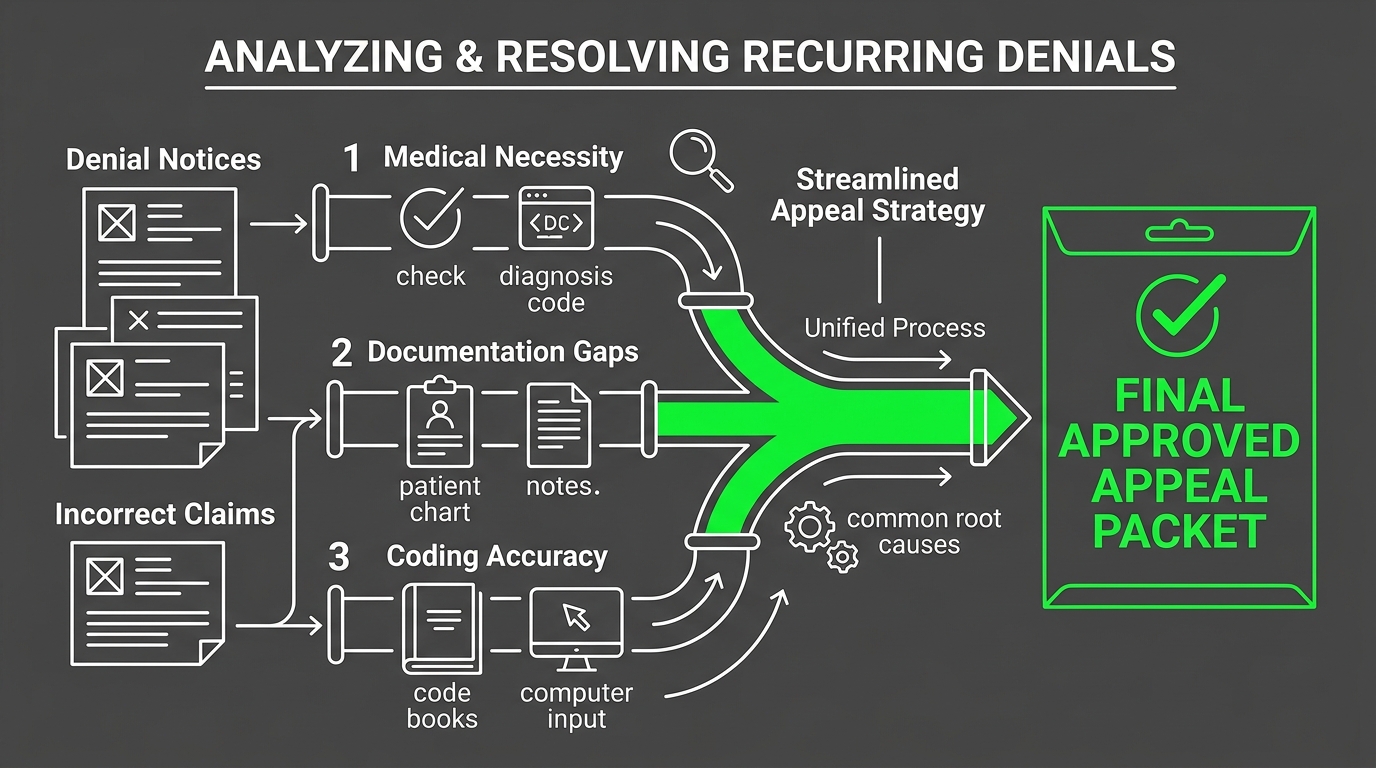
Most improper payments come from three root causes, according to the Illinois Chiropractic Society in a piece republished from the American Chiropractic Association:
- Documentation and administration errors
- Authentication and medical necessity errors
- Verification errors
Documentation is the big one. In 2022, about 64 out of 100 improper payments (63.6%) were due to insufficient documentation.
What the denial data shows
The Change Healthcare 2022 Revenue Cycle Denials Index breaks denials into groups. Change Healthcare notes that its data may or may not be representative of other parts of healthcare or other types of providers. The Change Healthcare 2022 Revenue Cycle Denials Index breaks denials into groups.
- Registration/eligibility is listed at 22%. Within it, coordination of benefits is 45%, benefit maximum is 34%, plan coverage is 14% and patient eligibility is 7%.
- Medical documentation requested is listed at 14%. Within it, missing/invalid documentation is 97% and medical records requested is 3%.
- Authorization/pre-certification is listed at 13%. Within it, invalid authorization is 58%, authorization denied is 30%, services exceed authorization is 7% and no prior authorization is 4%.
CMS also publishes Guidance on Required Remittance Advice Remark Codes. For what to do once a claim is denied, see Handling Denied Chiropractic Claims and Appeals: A Complete Guide.
Chiropractic Claims Have Their Own Denial Patterns
The CMS Medicare Documentation Checklist & Guidelines for Chiropractic Doctors (MLN1232664, April 2025) says failure to respond is a major reason claims get denied. It lists other common reasons too:
- Missing or inadequate treatment plans
- An unclear chief complaint
- Failure to document all treated spinal regions
The same checklist tells you to check the specific Local Coverage Determination (LCD) for your jurisdiction, since coverage and requirements may vary. It also notes that Medicare typically reimburses only 1 chiropractic manipulation for a patient each day.
How CMS measures chiropractic billing accuracy
The 2024 Medicare Fee-for-Service Supplemental Improper Payment Data puts the improper payment rate for chiropractic services at 33.6%, about 1 in 3. The projected improper payment amount is $178.3 million.
In CMS Reports Lower Chiropractic Documentation Error Rates, the Illinois Chiropractic Society explains that rates for each type of provider are used to judge how well providers follow Medicare’s billing and coding rules.
Back in 2015, CMS began to standardize the reason codes and statements for certain services. The result is that providers see more continuity, and denials are easier to understand.
I wouldn’t hand your chiropractic claims to a biller who covers every specialty, because I expect middling results from that setup. Chiropractic has its own demands, and I trust only specialists to meet them every time.
What Software Catches and What Needs a Person
The American Medical Association says managing electronic remittance advice (ERA), the electronic payment explanations from payers, will never be 100% automated, because health care business issues are difficult. But as much as 80% of that processing can and should be handled without human intervention. Ideally, your staff only looks at the ERAs your practice management system can’t process on its own.
Automatic posting
CMS says the amount payable for each line or claim can be posted automatically to accounting or billing applications from an ERA. So can each adjustment applied to a line or claim. That removes the time and cost for staff to post this information by hand from an SPR.
Where a person comes in
I’m happy to let software post the routine, error-free claims. When a claim needs judgment, like showing why care was medically necessary or writing a tailored appeal after a denial, I put a skilled person on it. Tech gets a real role, but a limited one.
I also don’t call electronic health record (EHR) software a billing operation, even though it gets claims out the door. Denials, appeals and chasing unpaid insurance balances stay with people, because I haven’t seen a tool handle that judgment well on its own.
What to Expect From a Billing Partner on Denials
Bushido Billing says you will get a detailed report. It shows claims billed, payments posted, outstanding questions, a live link to your insurance accounts receivable, insurance denials and next steps, and the status of both current tasks and finished items. You can read how the work is done on the Medical Billing Services page.
Judge the partner by money that lands
I don’t treat a sent claim as the finish line. Judge a billing partner by denials resolved and paid, not by claims sent or how busy the team looks.
Regular reports on denial patterns
When your billing firm raises a problem, don’t read it as weakness. I read it as a partner working the account. I want denial patterns reported on a steady schedule, because I’d rather you hear about an issue early than let silence leave it sitting until it turns into a cash flow emergency.
Frequently Asked Questions
Do all payers use the same denial codes?
No. The AMBA says not every payer uses every code. Each insurance company determines which standardized codes are appropriate based on its claims processing systems, benefit plans, contracts and payment policies. A payer’s own internal codes, edit numbers and messages are not standardized. They usually apply only to that one payer.
How often are the CARC and RARC code lists updated?
Three times a year. Official updates to the claim adjustment reason codes and remittance advice remark codes generally come out on March 1, July 1 and November 1.
Can an experienced biller tell the next step from the codes alone?
Often, yes. Instead of calling the payer right away, experienced billers can often tell the right next step just by reading the adjustment codes and remark codes.
What share of denials are avoidable, and can they all be recovered?
No, they can’t all be recovered. Change Healthcare says almost 31 out of 100 denials (almost 31%) are unequivocally avoidable. Of those, 43% cannot be recovered. Its takeaway is that prevention is the key to avert revenue loss.
Get Help Finding Your Denial Root Causes
Root-cause work means reading codes, tracking patterns and acting on them. I treat the silence in typical billing setups, where you hear nothing unless you chase it, as a problem built into the arrangement. So I fix it with structure, not excuses. At Bushido Billing, weekly communication is standard practice. We help practices with credentialing with insurance companies, staff billing training and as-needed billing help. Want to walk through your denial patterns with us on a call? Book a Call.