

How to Locate a Missing Chiropractic Payment From a Commercial Payer
Learn how to find a missing chiropractic payment from a commercial payer: read the remittance, match the deposit with the trace number, and ask for claim status.
The electronic remittance advice (ERA) is an electronic version of a payment explanation that a health plan sends to a provider. It explains the payment a provider receives for a service claim. If a claim is denied or the payment adjusted, the ERA contains the required explanations. The provider must then match the electronic payment to its ERA by using a reassociation trace number. A health care claim status inquiry and response transaction is a communication between a provider and a payer about a health care claim.
Start With the Remittance Advice
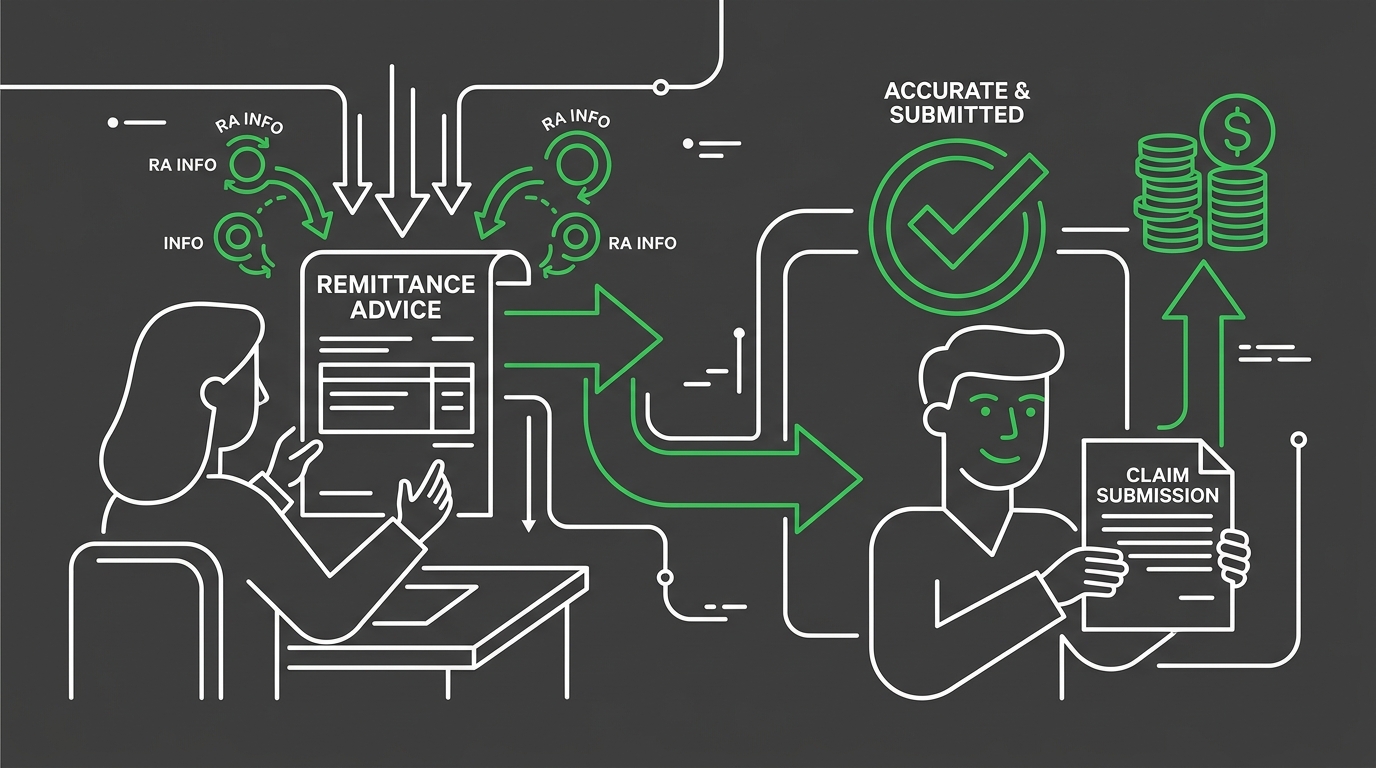
Start by reading your remittance advice. The electronic remittance advice (ERA) is the electronic payment explanation a health plan sends you. CAQH CORE says it explains the payment you receive for a service claim. If the plan denied a claim or adjusted the payment, the ERA holds the required explanations.
Paper remittances have a standard format too, the standard paper remittance (SPR). The Centers for Medicare & Medicaid Services (CMS) says an SPR, like an ERA, reports the reason for each adjustment and the dollar value of each adjustment.
An ERA saves you work, too. CMS says the amount payable for each line or claim, and each adjustment, can post automatically into your accounting or billing programs. That removes the time and cost of your staff typing it in by hand from an SPR.
If a claim has sat unpaid for a long time, Resolving Aged Chiropractic Insurance Balances: A Complete Guide goes further on older balances.
What Automated ERA Posting Handles, and What Lands With Staff
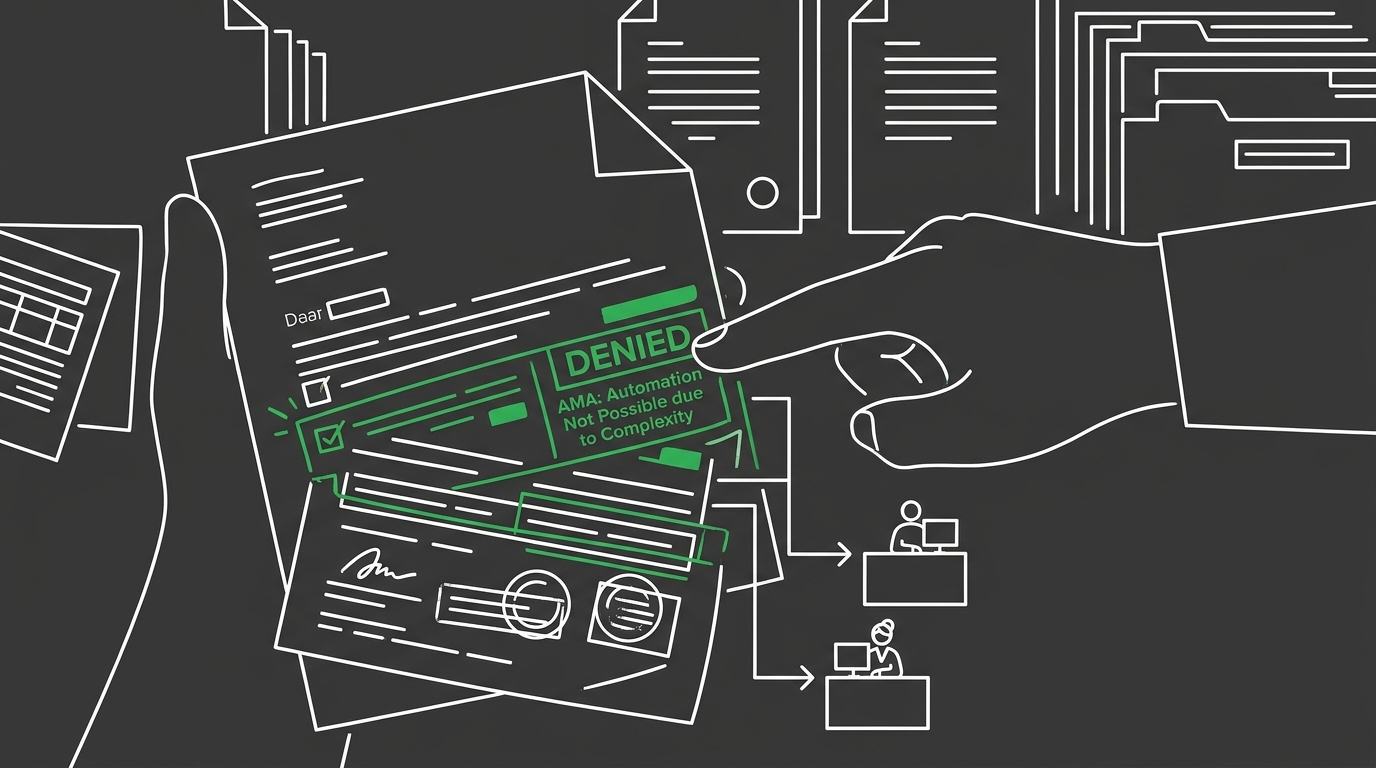
The American Medical Association (AMA) says managing ERAs will never be 100% automated, because of difficult health care business issues. But as much as 80% of the processing, or 4 out of 5, can and should be handled without a person stepping in.
The AMA also says that ideally, your staff should only have to look at the ERAs your practice management system (PMS), the software that runs your office work, can’t process on its own.
Let software post the routine, error-free ERAs, and put a biller on every exception. Anything that needs judgment, like showing why care was medically necessary or writing a tailored appeal after a denial, goes to a skilled person, not a tool.
Matching the Deposit to Its Remittance With the Trace Number
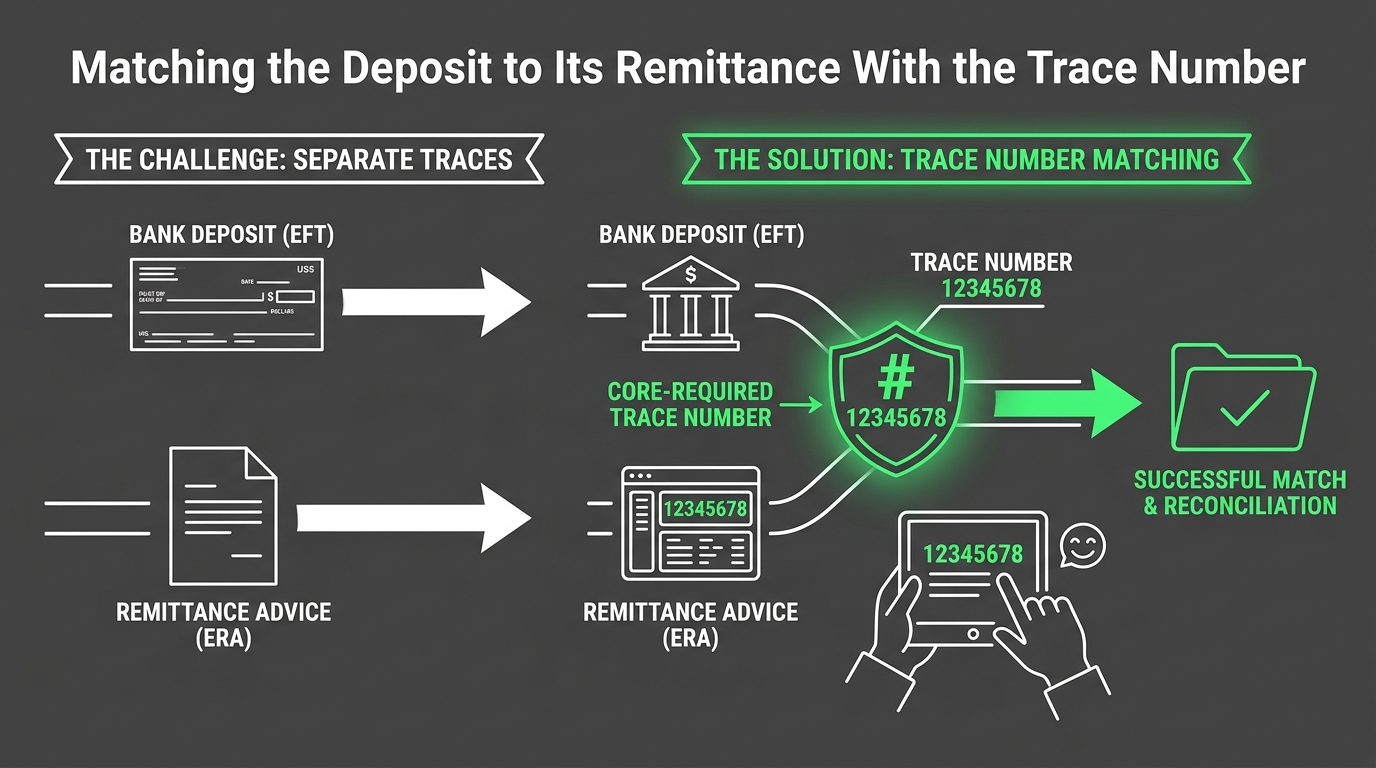
CAQH CORE says that with the HHS-adopted Healthcare EFT Standards, the electronic funds transfer (EFT) and the ERA travel to the provider separately. The provider must then reassociate the EFT and ERA by using a reassociation trace number. CAQH CORE also says providers report this reassociation of remittance data to payment data as a significant problem.
The table below sets out each step and why it matters.
| What happens | Why it matters |
|---|---|
| The EFT payment and the ERA travel separately | The provider must then reassociate them |
| The practice matches them by the reassociation trace number | That number is what the provider uses to reassociate the EFT and ERA |
| Providers report matching as a significant problem | Providers themselves name reassociation as a significant problem |
| Consistent matching rules | Help mitigate unnecessary manual follow-up, faulty electronic secondary billing, inappropriate write-offs of billable charges and incorrect billing of patients for co-pays and deductibles |
You can read the rule itself at the CAQH CORE Payment & Remittance (CCD+/835) Reassociation Rule.
I don’t treat electronic health record (EHR) software as a full billing operation. I use it to get claims out the door, and I treat pairing a deposit with its remittance as human follow-up. I put a person on denials, appeals and open receivables. I don’t leave them to a tool on its own.
When the Payer Leaves Out the Trace Number or the Bank Replaces It
Health plans frequently leave the ASC X12 EFT Reassociation Trace Number from the v5010 X12 835 off the EFT payment. That’s according to CAQH CORE.
The match can also break at the bank. If the reassociation trace number goes in the Automated Clearing House (ACH) trace number field, the Originating Depository Financial Institution (ODFI) will replace it.
Asking the Payer for Claim Status
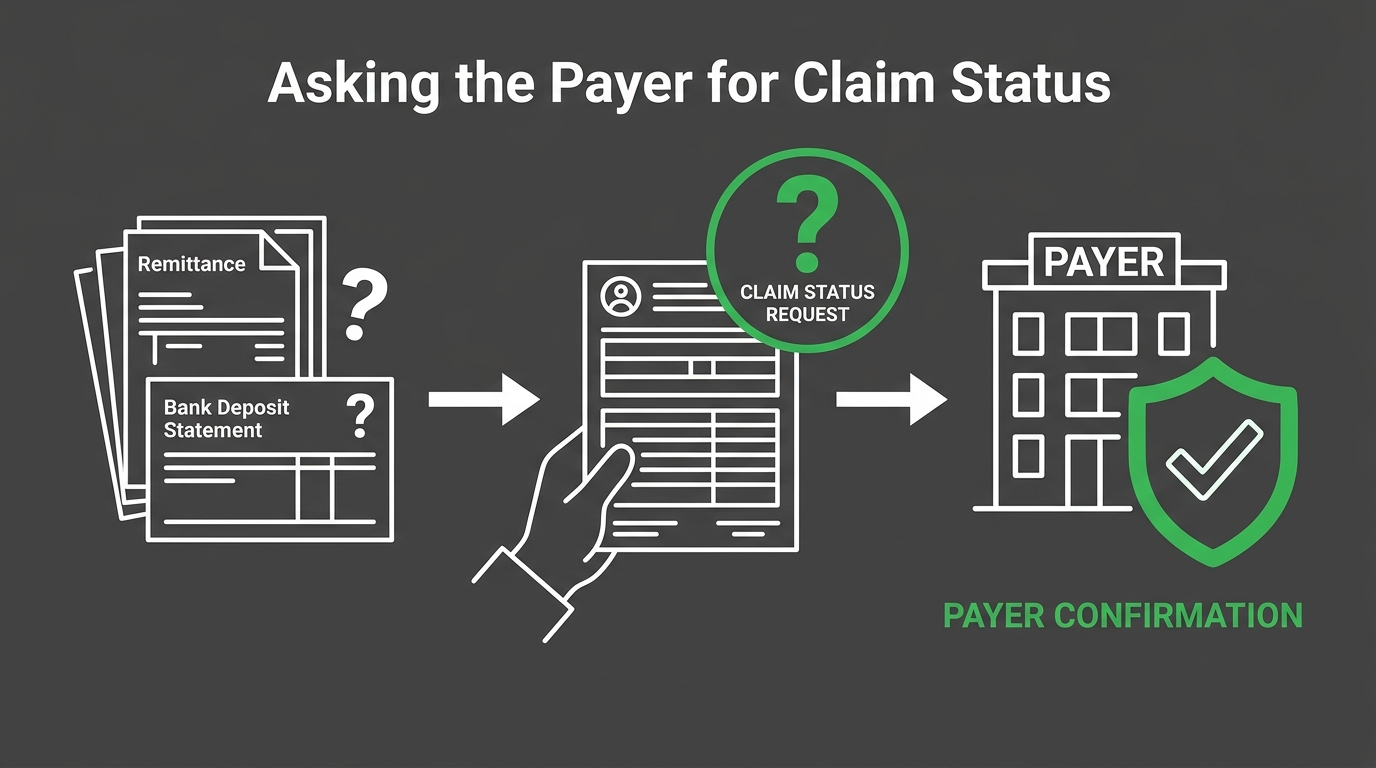
When the remittance and the deposit don’t settle it, you can ask the payer directly. A health care claim status inquiry and response transaction is a communication between you and a payer about a health care claim.
The Centers for Medicare & Medicaid Services (CMS) says the claim status standard has two parts:
- The 276 transaction is for provider inquiries about claim status.
- The 277 transaction is for health plan responses about claim status.
The CMS page Claim Status Basics explains the standard. Our Medical Billing Services page explains how we do this work.
Frequently Asked Questions
Are EFT and ERA faster than paper checks and remittances?
Typically, yes. When you get paid by EFT and receive an ERA, handling the payment and the remittance advice is typically much faster than when a paper check and a paper remittance advice come in. That’s from CAQH CORE.
Do payers have to answer claim status requests quickly?
There is a time requirement. Health plans must give you real-time online access to claim status information, or answer your request within a certain amount of time. That’s CMS’s position.
Do HIPAA transaction rules apply to a chiropractic practice that bills commercial insurers?
Yes, if your practice does the adopted transactions electronically. Any provider who takes payment from any health plan or other insurance company has to follow the Health Insurance Portability and Accountability Act (HIPAA) in that case, according to CMS.
Does a clinic need a written agreement with its clearinghouse?
Yes. You also need written agreements in place to make sure your business associates follow HIPAA. A clearinghouse is one example of a business associate, and CMS is the source for that.
Let Bushido Billing Run the Trace Until the Payment Posts
The trace has three steps. Read the remittance. Match the deposit to it with the reassociation trace number. Ask the payer for claim status when the first two don’t settle it. CAQH CORE says the provider must reassociate the EFT and ERA by using that trace number, so someone has to do that work.
Bushido Billing does that work for chiropractic and allied health practices. We handle full-service insurance billing, clean up unpaid insurance claims, and fix and appeal denied claims. We treat HIPAA as a sign of trust in how we handle your records.
I won’t run billing the usual way, where you hear nothing unless you chase it. I see that silence as built into how those arrangements are set up, not as one person’s slip, so I fix it with structure and not excuses. Every week you get a short report card, so a stalled payment gets an update and not silence.
I don’t count a claim as done when it goes out. I count it when the money lands in your account, and I judge billing by collections, not by claims sent.
Want a team that follows each payment until it posts? Book a Call.