

How to Implement Audit Findings to Prevent Future Revenue Leakage?
Implementing audit findings requires more than correcting the errors the audit flagged. It requires building the structural conditions that stop those errors from recurring.
An audit is a report. Not a prescription.
It tells a practice what broke, when it broke, and roughly what it cost. It does not fix the underlying conditions that allowed the breakdown to happen. Most practices miss this distinction entirely. They clear the flagged claims, patch the most visible documentation gaps, and return to the same billing workflow that produced the problem. Six months later, the same denials reappear.
Permanently preventing revenue leakage after an audit requires working through four distinct layers – in sequence.
Documentation and Modifier Compliance addresses the coding and documentation errors the audit surfaced – including AT modifier gaps and subluxation documentation failures that disqualify Medicare claims. AR Recovery and Denial Pattern Resolution recovers aging, unworked revenue the audit identified while mapping the denial patterns that will recur if left unaddressed. Billing Partner Accountability Structure establishes who is responsible for which claims, how performance is measured, and what communication cadence keeps the practice informed – because approximately 80% of chiropractic billing failures trace back to neglected AR and communication breakdowns with billing providers. Ongoing Feedback Loop and Audit Cadence converts a one-time diagnostic event into a continuous correction mechanism – the only structure proven to reduce documentation discrepancy rates at the source.
The sequence matters. Skipping AR Recovery leaves recoverable revenue aging past the point of return. Skipping Billing Partner Accountability means documentation improvements happen without anyone structurally responsible for enforcing them.
Implementation without a feedback loop is a temporary fix. The practices that stop the revenue leakage cycle permanently treat the audit as the beginning of a structural change – not the end of a problem.
Why Audit Findings Alone Don’t Stop Revenue Leakage
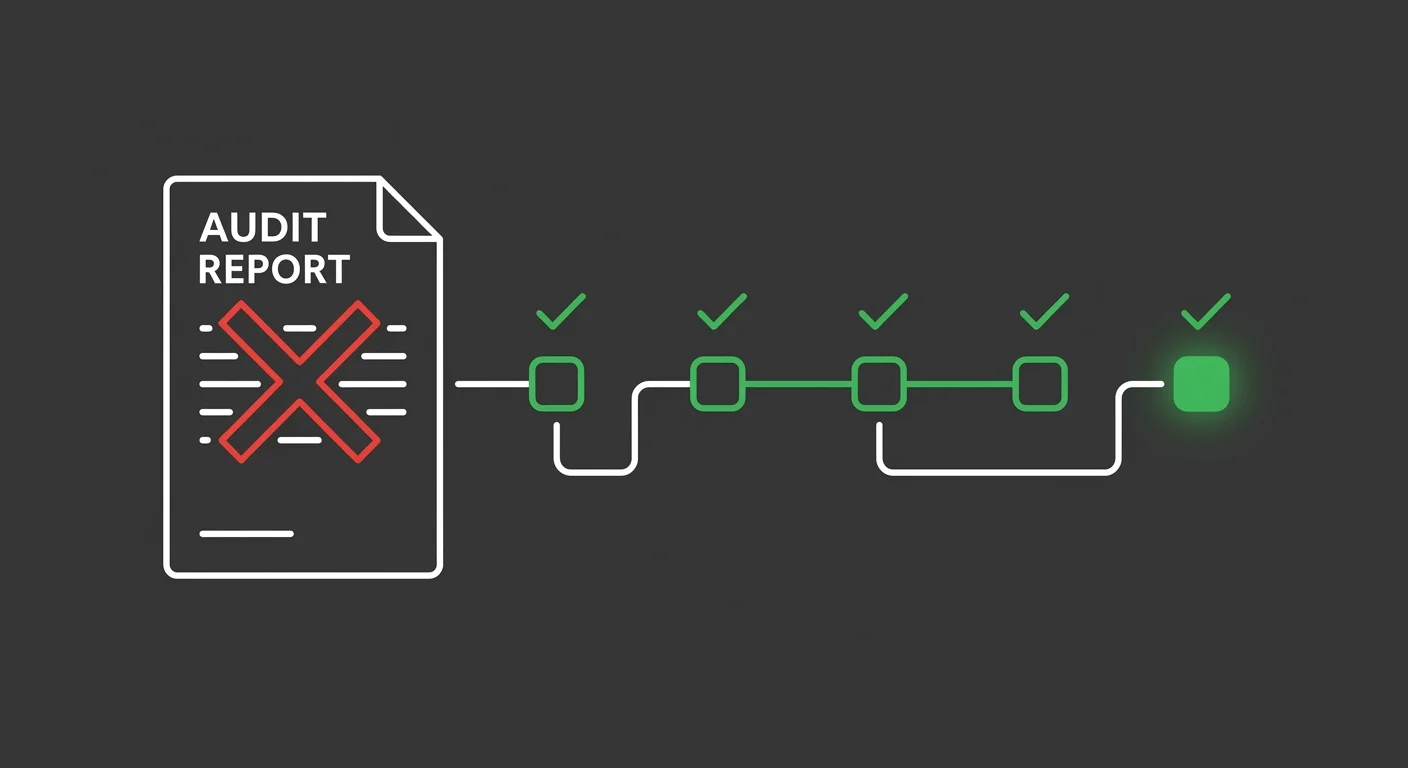
The report tells you what broke. It doesn’t change why it broke in the first place.
Most practices read the findings, correct the flagged claims, and go right back to the same billing workflow that produced the problem.
The documentation gaps close – temporarily. The modifier errors get addressed – once. Then the same denial patterns come back. The AR starts aging again. And the practice is exactly where it started, except now it has a report that described precisely why.
That cycle has a cause.
An audit without structural implementation is a diagnosis without treatment. Revenue leakage doesn’t stop because the report existed. It stops only when the conditions that created it are rebuilt from the ground up.
That is a fundamentally different problem than correcting flagged claims.
Why the ‘Read the Report and Fix It’ Approach Fails
Here’s what actually happens: a claim gets denied, the practice corrects it, and everyone moves on.
No one asks why the modifier was missing before submission. No one establishes who owns the catch next time. No one builds the structure to surface that pattern before it compounds into something that shows up as a cash flow problem three months later.
Billing errors aren’t isolated events. They’re systemic outputs. Treating them like isolated events is exactly why the same errors keep producing the same denials.
OIG audit findings put a number on it: up to 82% of Medicare chiropractic claims reviewed in a nationwide audit did not meet basic documentation requirements.
That’s not a typo. Nearly every claim in the sample failed.
And it wasn’t because chiropractors don’t know how to document. It was because the billing workflow had no mechanism to catch the gap before submission. The error wasn’t in the exam room. It was in the structure surrounding it.
The AR problem runs on the same track. Approximately 80% of chiropractic billing inquiries trace back to neglected accounts receivable and communication breakdowns with billing providers.
That’s not a documentation problem. That’s an accountability problem.
No one was watching the aging report. No one was communicating what sat unworked. Knowing that hidden revenue in aging AR exists doesn’t recover a dollar. Someone has to be structurally responsible for going after it – every week, not just after the next audit.
The fix-it approach optimizes for the event. The structural approach eliminates the conditions.
A practice that corrects this quarter’s denials without changing who owns the denial pattern is scheduled to have the same conversation next quarter. Same report. Same frustration. Same revenue sitting unrecovered.
Full-service chiropractic billing addresses the pattern – not just the claim. That’s a different kind of engagement than submitting a corrected claim and calling it done.
| Audit Action | What It Reveals | What It Does NOT Do | Risk If Stopped Here |
|---|---|---|---|
| Review flagged claim denials | Which claims were rejected and why | Fix the billing workflow that produced the denial | Same modifier or documentation error recurs in the next billing cycle |
| Identify documentation gaps | Where clinical notes failed to support medical necessity | Establish who is responsible for catching gaps before submission | Documentation improves temporarily, then degrades when oversight lapses |
| Surface aging AR balances | How much revenue is sitting unworked across claim age buckets | Recover that revenue or stop the aging pattern from repeating | Recoverable claims age past the point of return while the practice assumes they are being worked |
| Map denial patterns by payer or code | Which payers and codes are producing the highest rejection rates | Hold anyone accountable for resolving the pattern structurally | Pattern continues unchecked – future claims follow the same path to denial |
| Confirm modifier compliance issues | Where AT modifier usage and subluxation documentation are inconsistent | Build an ongoing review mechanism that catches modifier errors before submission | Compliance improves for the flagged period, then slips without a continuous feedback structure |
| Produce a findings report | A snapshot of billing performance at a single point in time | Create the accountability structure, communication cadence, or billing model change required to act on it | The report becomes a historical document – the conditions that produced the findings remain unchanged |
The Four Implementation Layers Every Chiropractic Practice Must Address
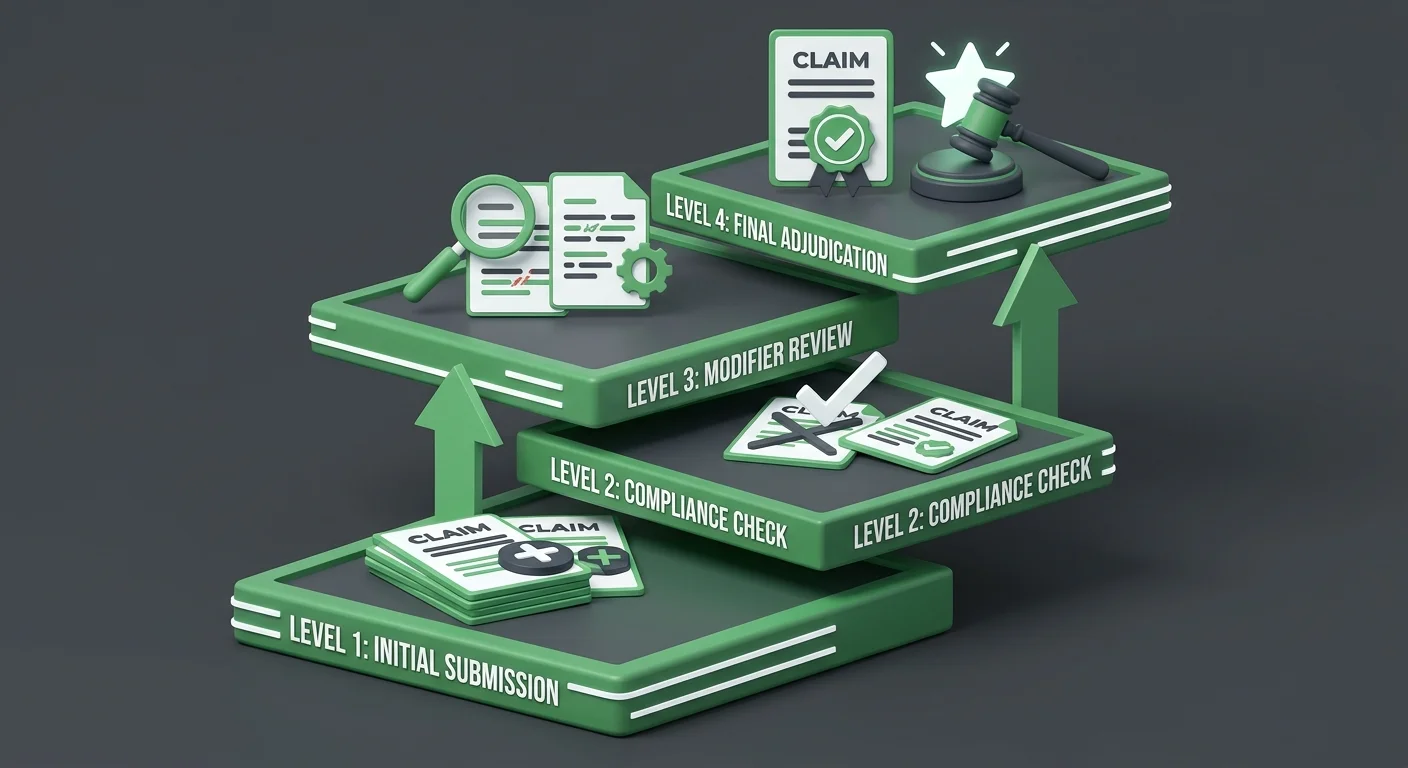
These four layers aren’t interchangeable. The order is the point.
Most practices collapse at Layer 2.
They fix the documentation. They address the modifier errors. Then they move on – leaving a stack of aging, unworked denials sitting in the AR with no one structurally responsible for recovering them.
The revenue the audit identified doesn’t come back. It ages past the point of return while the practice assumes the problem is solved.
Here’s the actual structure.
Documentation and Modifier Compliance comes first – because the audit surfaces it first. AR Recovery and Denial Pattern Resolution comes second – because the revenue is already aging and the clock is running. Billing Partner Accountability Structure comes third – because neither of the first two layers hold without defined ownership. Ongoing Feedback Loop and Audit Cadence comes fourth – because without it, the practice is back to a one-time diagnostic event, and the cycle starts again.
Documentation and Modifier Compliance: The Layer Most Audits Expose First
Documentation and Modifier Compliance is the layer audits expose first.
It’s also the layer most practices think they’ve fixed after they correct the flagged claims. They haven’t. Correcting claims is not the same as correcting the workflow that produced them.
Medicare coverage published analysis from CMS is unambiguous: the AT modifier must be appended to every active, corrective spinal manipulation service to qualify for reimbursement. Without it, maintenance care and active care look identical to the payer. And maintenance care is non-covered.
This regulatory reference draws the line even tighter. Medicare reimbursement for chiropractic services is limited strictly to manual manipulation of the spine to correct a documented subluxation – demonstrated by physical exam or x-ray.
These aren’t obscure edge cases. They’re the two most common documentation failure points a chiropractic audit surfaces. And both require clinical workflow changes – not just claim corrections. This regulatory reference
Correcting flagged AT modifier errors doesn’t retrain the workflow that produced them.
That’s the gap the fix-it approach misses every time. Understanding chiropractic EHR software limits matters here – EHR platforms process what they’re given. If the documentation going in doesn’t distinguish active treatment from maintenance care with the specificity Medicare requires, the software has no mechanism to catch it.
The error lives upstream of the claim. Documentation and Modifier Compliance has to reach back into the clinical documentation workflow – not just forward into the claim correction queue.
AR Recovery and Denial Pattern Resolution After an Audit
AR Recovery and Denial Pattern Resolution is where most post-audit implementation stalls.
It demands two things at once: recovering revenue that’s already aging, and mapping the denial patterns that will regenerate the same AR problem if left unaddressed.
Most practices do one. Neither one alone is enough.
The recovery side has a clock.
Denied and unworked claims don’t wait. Every week a claim sits without a filed appeal or a follow-up, the probability of recovery drops. Practices working through claims aging past 90 days know that payer windows close faster than most billing timelines account for.
The audit identified the revenue. This layer determines how much of it actually comes back.
Recovering a denied claim and eliminating the denial pattern are two different outcomes.
The pattern side is what makes this layer structural rather than transactional. Peer-reviewed documentation improvement research confirms that systematic clinical documentation improvement programs eliminate recurring denials and resolve structural revenue leakage by closing documentation and coding gaps at the source.
That’s the standard this layer is held to – not just recovering what the audit found, but building the denial-pattern visibility that stops the same revenue from disappearing again.
| Implementation Layer | What It Addresses | Common Audit Findings in This Layer | Consequence of Skipping |
|---|---|---|---|
| Documentation and Modifier Compliance | Clinical workflow gaps that produce incorrect or incomplete claim submissions – including AT modifier misapplication and subluxation documentation deficiencies | Missing or incorrect AT modifier on active treatment claims; subluxation not demonstrated by physical exam or x-ray; active and maintenance care indistinguishable at the payer level | Corrected claims re-enter the same broken workflow and produce the same denial patterns – the fix is transactional, not structural |
| AR Recovery and Denial Pattern Resolution | Aging, unworked denied claims and the recurring denial patterns that will regenerate the same AR problem if left unmapped | Claims sitting unworked past payer filing deadlines; denial patterns not categorized by root cause; no systematic appeal process in place | Recoverable revenue ages past the point of return; denial patterns recur next billing cycle with no structural change to prevent them |
| Billing Partner Accountability Structure | Defined ownership of claims, denial management, and performance reporting – including the communication cadence that keeps the practice informed | No defined responsibility for unworked claims; billing partner communication is reactive or absent; performance measured by submission volume rather than revenue recovered | Documentation and AR improvements happen in isolation with no one structurally responsible for enforcing or sustaining them – gains erode within months |
| Ongoing Feedback Loop and Audit Cadence | The continuous correction mechanism that converts a one-time audit event into a permanent revenue protection structure | No scheduled re-audit cadence; denial trends not tracked over time; clinical documentation drift not caught before it compounds into AR problems | The practice returns to a one-time diagnostic model – the same conditions that produced the original revenue leakage reassemble, and the cycle restarts |
Building the Accountability Structure That Keeps Findings From Repeating
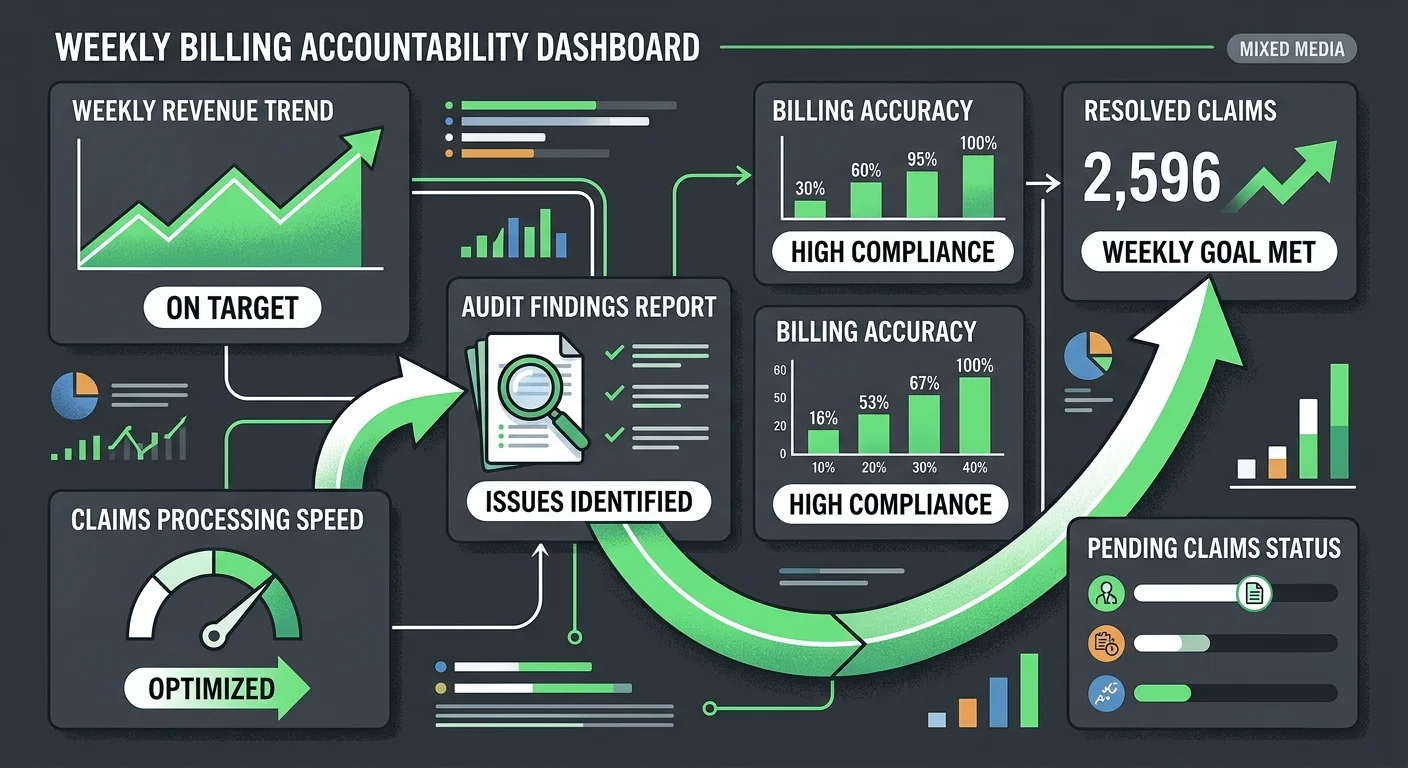
Layer 3 is where implementation either holds or falls apart.
Documentation fixes and AR recovery mean nothing if no one is structurally responsible for enforcing them after the audit closes. Without defined ownership, the same gaps that produced the original findings quietly reopen. And no one notices until the AR is aging again.
Most practices skip this layer entirely.
They correct the flagged claims, recover the aged AR, and decide the problem is solved. It isn’t. What they’ve done is create a temporary improvement inside the same accountability vacuum that caused the breakdown. The conditions haven’t changed. The claims have. The system hasn’t.
Accountability without structure is just intention.
And intention doesn’t catch a missing AT modifier at submission. It doesn’t follow up on a claim at 45 days. It doesn’t surface a denial pattern before it compounds into another aging AR problem. Structure does. That’s what this layer exists to create.
What a Billing Partner Accountability Structure Actually Requires
A genuine billing partner accountability structure defines three things explicitly: who owns each claim category, how performance is measured beyond clean-claim submission rates, and what the communication cadence looks like week to week.
Practices that have gone through bringing a billing partner into the post-audit workflow understand that these aren’t operational preferences. They’re requirements. Without them, the audit’s findings stay on paper – and the revenue leakage the audit identified stays in the aging AR.
Performance measurement is where most billing relationships get it wrong.
Submission volume and clean-claim rates tell a practice how many claims went out and how many cleared on first pass. They don’t tell the practice what happened to the complex claims that required a medical necessity argument or a multi-step appeal.
Measuring submission speed instead of revenue recovery is the core accountability failure. That’s why high-volume billing relationships consistently leave the most valuable claims unworked – and why practices watching strong submission metrics still end up with growing AR.
Weekly communication isn’t a bonus feature. It’s the mechanism that surfaces denial patterns before they compound, flags aging claims before recovery windows close, and keeps the practice informed without requiring the provider to chase down answers.
Silence from a billing partner isn’t professionalism. It’s a structure that hides problems until they become cash flow disruptions.
Layer 3 eliminates that silence by design – not as a customer service commitment, but as the operating condition that keeps every other layer honest.
The Feedback Loop That Turns a One-Time Audit Into Permanent Protection
Layer 4 is the layer that determines whether everything before it actually holds.
Continuous feedback loop audits reduce coding and billing discrepancy rates by correcting provider behavior at the source. That’s the mechanism – not fixing errors after they appear, but building the recurring review structure that stops them from forming. Without it, the practice is still running a one-time diagnostic event. The cycle restarts quietly, and no one calls it a breakdown until the AR is aging again.
Peer-reviewed clinical documentation improvement research confirms that systematic CDI programs eliminate recurring denials and resolve structural revenue leakage by closing documentation and coding gaps at the source.
Practices implementing this layer aren’t running another audit to find problems. They’re running a cadence that catches drift before it becomes a denial pattern – and catches a denial pattern before it becomes an aging AR problem. That’s also the structural condition that connects directly to the process for recovering denied revenue that the prior layers make possible.
An audit is a report. Not a prescription.
A feedback loop is a structural condition. And consistent feedback drives long-term provider behavioral alignment – which is what keeps the other three layers from quietly reverting.
The practices that permanently stop the revenue leakage cycle aren’t the ones that responded fastest to a report. They’re the ones that recognized the audit as the beginning of a structural shift. That distinction is the difference between clearing this quarter’s denials and never having the same conversation again next quarter.
| Accountability Element | Volume-First Billing Model | Embedded Specialty Partner Model | Revenue Impact |
|---|---|---|---|
| Claim ownership definition | Claims assigned by volume batch; no dedicated biller per practice; ownership unclear when denials surface | Each practice assigned a dedicated biller who owns every claim category from submission through resolution | Unowned claims age without follow-up; dedicated ownership stops recovery windows from closing unnoticed |
| Performance measurement standard | Success defined by clean-claim submission rate and monthly volume throughput | Performance measured by actual revenue recovered, including complex denials requiring appeals and medical necessity arguments | Volume metrics hide unworked high-value claims; recovery-based measurement surfaces what submission-based reporting buries |
| Denial pattern visibility | Denials reported in aggregate; no systematic pattern mapping; practice learns about trends after AR ages | Denial patterns tracked at the modifier and payer level; patterns flagged before they compound into aging AR problems | Late-stage pattern discovery means revenue has already aged; early visibility allows intervention before recovery windows close |
| Communication structure | Updates provided reactively when the practice follows up; silence treated as a sign that billing is running smoothly | Weekly proactive updates surface claim status, aging flags, and denial trends without requiring the provider to ask | Reactive silence hides emerging problems; structured weekly communication converts billing from a black box into a managed revenue function |
| Documentation feedback loop | Clinical documentation errors corrected claim-by-claim after denial; no upstream workflow correction | Documentation gaps identified at the pattern level and fed back into the clinical workflow to prevent recurrence at the source | Claim-level corrections repeat indefinitely; workflow-level feedback stops the error from forming in the first place |
| Audit cadence | Audit treated as a one-time diagnostic event; no recurring review structure once flagged claims are corrected | Recurring audit cadence built into the ongoing billing relationship; review cycles catch drift before it becomes a denial pattern | One-time audits produce temporary improvements; cadence-based review converts a diagnostic event into a permanent protection structure |
Who Is – and Isn’t – Ready to Implement Audit Findings Effectively
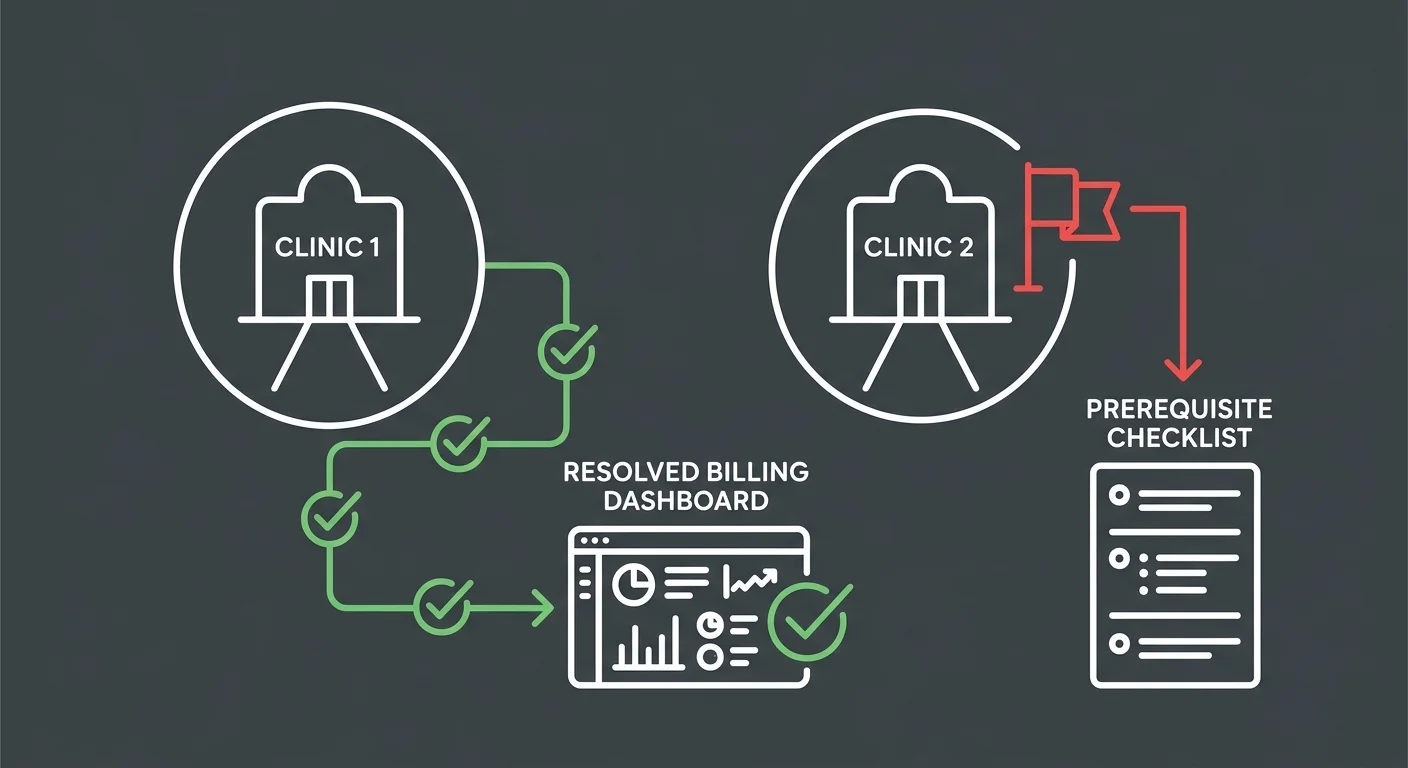
Not every practice is ready to act on what the audit found.
Saying that upfront protects both parties. A partnership that can’t produce structural change doesn’t serve anyone – and the audit findings won’t tell you that on their own.
An audit surfaces what’s broken. That’s its job. But converting those findings into permanent revenue protection requires something the audit itself can’t provide.
It requires the willingness to change the conditions that produced the breakdown – not just to correct the claims the breakdown generated.
Practices that treat the audit as the destination will cycle through the same revenue leakage again. The audit identified the problem. It didn’t build the structure that stops it from coming back.
Here’s what the data says. An OIG nationwide review found that up to 82% of Medicare chiropractic claims analyzed didn’t meet basic documentation requirements.
Those weren’t isolated mistakes. They were workflow patterns – produced consistently, claim after claim, by a billing structure with no mechanism to catch errors before submission.
Correcting the flagged claims without fixing the workflow is treating a symptom. The practices that get lasting results from implementation understand that before the work begins.
The Practice Profile That Gets Results From Audit Implementation
The practices that get lasting results from audit implementation come in with a specific posture.
They’re ready to change how billing works – not just what billing submits. They’ve already recognized that passive, EHR-reliant claim submission isn’t a billing strategy. It’s an exposure.
And they’re not looking for someone to run claims quietly in the background. They want a partner who surfaces problems weekly and holds the system accountable when something slips.
These practices also understand what billing accuracy is actually worth. Practices that recognize how documentation discipline shapes practice valuation and long-term financial standing treat coding integrity as a structural investment – not an administrative burden.
That mindset is what separates the practices that work through all four implementation layers from the ones that stop at Layer 1 and assume the work is done.
Readiness isn’t just organizational. It’s understanding what billing failure actually costs – not just this quarter, but compounded over time.
Approximately 80% of chiropractic clinic billing failures trace back to unworked aging AR and communication breakdowns with billing providers.
The practices positioned to reverse that pattern are the ones willing to engage. That means providing EHR access, turning documentation corrections around quickly, and staying available when a complex denial needs clinical clarification.
Readiness isn’t enthusiasm. It’s operational cooperation. And the absence of it is exactly how a second audit finds the same problems the first one already named.
Who Should Not Pursue Full Implementation Without Addressing This First
The practices that aren’t ready share a different profile.
Spotting it early prevents the most predictable outcome in billing: a second audit finding the exact same problems the first one already named.
The clearest signal is a practice looking for a one-time fix with no interest in building the accountability structure that holds the fix in place.
Entry-point services – practice audits, AR recovery – exist to show what’s broken and what it costs. They’re the start of a structural relationship, not a substitute for one.
A practice that wants the findings corrected without changing the workflow that produced them is solving for the symptom. The conditions that generated the original revenue leakage don’t disappear because the claims got corrected. They restart.
The second signal is resistance to transparency.
Layer 3 – Billing Partner Accountability Structure – requires real-time reporting, defined ownership, and weekly communication. Practices uncomfortable with visible billing performance data, or unwilling to cooperate with the documentation corrections Layer 1 demands, can’t support the feedback loop that Layer 4 depends on.
Working with DC-founded billing experts who understand both the clinical and administrative sides of chiropractic billing only delivers its full value when the practice shows up as a working partner. Not a passive recipient of a service. That distinction is the whole thing.
| Practice Readiness Signal | Ready for Full Implementation | Not Yet Ready – Address First |
|---|---|---|
| EHR access and documentation cooperation | Practice provides full EHR access and turns documentation corrections around promptly – the workflow required to support Layer 1 and Layer 2 | Practice restricts EHR access or delays documentation responses – Layer 1 corrections stall before they compound into lasting fixes |
| Posture toward billing accountability | Leadership actively wants defined ownership, measurable performance beyond clean-claim rates, and weekly status visibility – the structure Layer 3 requires | Practice is uncomfortable with real-time reporting or visible denial data – resistance to transparency prevents the feedback loop Layer 4 depends on |
| Relationship intent after the audit | Practice views the audit as the starting point of a structural change – ready to engage as a working partner, not a passive recipient of a service | Practice seeks a one-time correction with no intent to build the accountability structure that holds the fix in place – symptom addressed, cause untouched |
| Provider availability for complex claims | Provider is reachable when a high-friction denial requires clinical clarification – essential for medical necessity arguments and multi-step appeals | Provider is unavailable or unwilling to engage on claim-level clinical questions – complex denials go unworked and age past recovery windows |
| Willingness to change the workflow, not just the claims | Practice recognizes that the audit identified a workflow pattern – and is prepared to change how billing operates, not just which claims get corrected | Practice expects flagged claims to be corrected without modifying the documentation and submission workflow that produced them – the same conditions persist |
| Understanding of billing as a structural investment | Practice treats documentation discipline and billing data integrity as long-term financial infrastructure – not an administrative cost to minimize | Practice frames billing purely as a back-office expense – no connection between billing accuracy and practice financial health, making Layer 4 unsustainable |
Frequently Asked Questions
But the framework only answers the structural question. The audit surfaces something else – a set of concerns that don’t fit inside any implementation model.
These are the questions that decide whether implementation actually happens – or stalls before it starts.
How long does it typically take to transition our internal team to a new billing workflow after an audit?
It depends entirely on how much the current workflow has to change.
Practices with clean documentation habits and active EHR cooperation move faster. Practices where billing has been passive – claims going out, nothing tracked, denials sitting unworked – take longer. The workflow has to be rebuilt, not just reassigned.
There’s no shortcut on the documentation side. Layer 1 requires active provider participation. That’s the rate-limiting factor in every transition. It doesn’t accelerate without clinical buy-in – and clinical buy-in doesn’t come from sending a memo.
Why does our EHR software continue to miss modifier errors that lead to recurring claim denials?
Because the EHR is a submission tool. Not a billing system.
It sends the claim. It doesn’t review what came back. It won’t flag a missing AT modifier because the note failed to document active treatment progress. It won’t catch that subluxation wasn’t demonstrated by physical exam or x-ray before the claim went out.
EHR platforms process what’s entered – they don’t audit what should have been entered. That judgment takes human review. No software substitutes for it. And every practice that assumes otherwise finds out the hard way when the denials start stacking.
What is the operational cost of leaving unresolved billing errors in our 90-day aging accounts receivable?
Aging AR doesn’t hold its value. It loses it – every week it sits unworked.
Claims in the 90-day bucket are still recoverable if worked promptly. Let them age past that window and payer cooperation shrinks, appeal deadlines tighten, and recovery rates drop.
Unworked AR isn’t a deferred asset – it’s a depreciating one. The cost isn’t one missed claim. It’s the compounding effect of a pattern repeating monthly while the practice assumes someone is working it. That assumption is exactly what the audit just disproved.
How do we ensure clinical documentation compliance without slowing down patient volume?
Stop treating documentation compliance as a documentation problem. It’s a workflow design problem.
Clinicians slow down when compliance feels like an administrative burden dropped on top of patient care. The practices that sustain accuracy without sacrificing volume have integrated compliance into the clinical workflow – not bolted it on after the visit.
Consistent feedback loops correct provider behavior at the source. That’s the mechanism. Not quarterly surprise audits. Consistent, embedded feedback that makes accurate documentation the path of least resistance. When the loop is built correctly, compliance and patient volume stop competing – because they were never actually in conflict.
Why won’t a one-time clean-up audit permanently stop our clinic’s structural revenue leakage?
Because a one-time audit corrects flagged claims. It doesn’t change the workflow that generated them.
Systematic clinical documentation improvement programs eliminate recurring denials by closing documentation and coding gaps at the source – not by cleaning up the output of a broken process. A clean-up fixes what’s already broken. It can’t install the feedback structure that prevents the next cycle.
The conditions that produced the original revenue leakage are still present the day after the audit closes. Without an ongoing feedback loop and audit cadence, the drift that produced the first set of findings produces the next set. The only difference is the date on the report.
What is the AT modifier and why does getting it wrong cost more than a single denied claim?
The AT modifier tells Medicare that chiropractic services are active and corrective – not maintenance care. Without it, Medicare classifies the service as non-covered and denies the claim.
But the cost of getting it wrong goes beyond the single denial. A pattern of missing AT modifiers signals to Medicare reviewers that the practice isn’t differentiating active treatment from maintenance care at the documentation level. That pattern invites closer scrutiny – and closer scrutiny finds everything else the EHR didn’t catch.
One missed modifier is a billing error. A pattern of missed modifiers is a compliance exposure. The difference between those two outcomes is whether someone reviews modifier accuracy on every claim – or assumes the EHR handled it.
An Audit Shows You the Problem. Implementation Decides Whether It Stays Fixed.
Here’s where practices split.
Some read the findings, correct the flagged claims, and walk straight back into the workflow that produced them. The cycle restarts. The AR ages again. The same denial patterns show up under a different quarter’s numbers.
Others recognize what an audit actually is – a starting line, not a finish line. The audit cannot install an accountability structure. It cannot fix a documentation workflow. It cannot define who owns the denial pattern sitting at 45 days.
That work belongs to implementation. And implementation requires a structural commitment no audit can make on the practice’s behalf.
Each of the four layers exists because a one-time correction without ongoing structure produces a one-time result.
Documentation and Modifier Compliance closes the technical gaps the audit surfaced. AR Recovery and Denial Pattern Resolution recovers the aging revenue and maps the patterns that would regenerate the same problem. Billing Partner Accountability Structure defines who owns what – and makes performance visible instead of assumed. Ongoing Feedback Loop and Audit Cadence turns the whole framework from a temporary fix into a permanent condition.
None of those layers hold without the ones beneath them.
The practices that work through all four aren’t doing more work. They’re doing the work that actually lasts – because they stopped treating billing errors as isolated events and started treating them as systemic outputs with a structural source.
So here’s the actual shift.
Stop treating a billing audit as a resolution. Start treating it as evidence that the billing model needs to change.
Passive EHR-reliant claim submission isn’t a billing strategy – it’s an exposure. An embedded specialty partner who surfaces problems weekly, measures performance by revenue recovery instead of submission volume, and holds the system accountable through a full-service chiropractic billing relationship aligned under a performance-based model is what turns audit findings into a condition that doesn’t recur.
The audit showed the problem. Implementation – and only implementation – decides whether it stays fixed.
An audit is a report. Not a prescription. And the practices still treating it like a resolution are already scheduled to commission another one.
The audit told you what broke. It didn’t fix it.
If the same billing structure is still running – same EHR defaults, same modifier assumptions, same silence from whoever handles your claims – the findings don’t expire. The revenue leak does exactly what it did before. Just quieter, until the next report makes it loud again.
That conversation is happening now or later. Later always costs more.

© . All Rights Reserved | Web Design by iTech Valet