

In-House PI Billing vs. Expert Lien Management: Which Model Recovers More Revenue?
Expert lien management recovers more revenue than in-house personal injury billing because it treats PI liens as a specialized revenue discipline, not a standard billing function. In-house teams submit claims fast. Speed doesn’t determine settlement value. PI lien recovery requires legal fluency in medical necessity, causation, and apportionment – concepts that sit outside standard insurance billing training. Most in-house staff don’t have this expertise. That gap produces errors, underpayment, and abandoned claims.
The financial cost is measurable. Up to 80% of medical bills contain errors, and that rate climbs with PI case complexity. Reworking a single denied claim costs as much as $118. When those denials hit patient responsibility, the cost to collect becomes three to four times higher than collecting from payers. In-house teams – especially in small to mid-size practices – don’t have the bandwidth or legal knowledge to manage multi-step appeals or attorney coordination.
Expert lien management firms operate on a performance-based model. They get paid when you do. That structural alignment changes how claims are worked. Nearly two-thirds of denied claims are recoverable with proper follow-up, but recovering them requires dedicated expertise and time that in-house staff rarely have. Top-performing practices maintain denial rates of 4% or less – a benchmark most in-house PI billing operations never approach.
The difference isn’t about software or submission speed. It’s about who handles the claim after it’s submitted – and whether that person has the legal fluency and performance incentive to fight for every dollar.
Why Most Practices Underestimate PI Lien Complexity
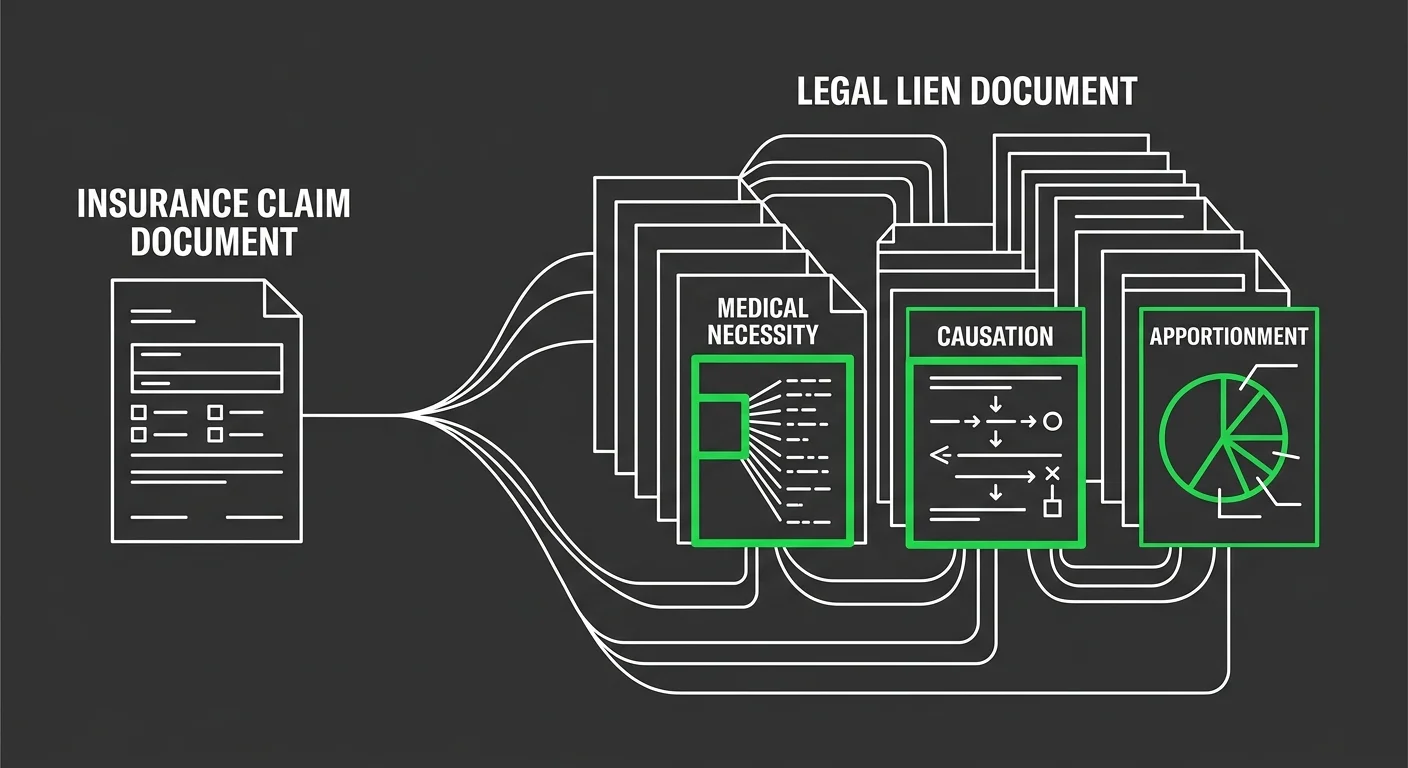
Most practices treat PI lien billing like insurance billing with a longer timeline.
That’s the first mistake.
Insurance billing operates inside a regulatory framework. Medical necessity is defined by payer policy.
PI lien billing operates inside a legal framework. Medical necessity, causation, and apportionment determine whether you get paid – and those determinations happen in settlement negotiations, not claim adjudication.
Your biller isn’t negotiating with a claims examiner. They’re coordinating with attorneys who are negotiating with opposing counsel.
The skill set is different. The documentation standard is different. The timeline is different.
And the error rate – already at up to 80% in standard medical billing – climbs when the complexity involves legal principles your billing staff has never been trained to handle.
What In-House Teams Miss
Your in-house team knows how to submit a clean claim. They know ICD-10, CPT, modifiers, payer rules.
PI liens require documenting causation in a way that survives legal scrutiny.
That means knowing when to code for acute care versus maintenance. It means understanding pre-existing condition defenses and how to isolate treatment specific to the accident.
The nuances of PI billing don’t show up in payer manuals. Your in-house team won’t learn them from a CPT update webinar.
These aren’t billing functions.
They’re revenue recovery disciplines disguised as billing functions.
And most practices staff them as if they were the former.
The Real Cost Structure
The immediate cost is rework.
The cost to rework a single denied claim is as high as $118. That’s just the labor and administrative expense – it doesn’t include the revenue lost while the claim sits in limbo.
The larger cost is structural.
Your in-house staff works on salary. They get paid whether the claim settles or not.
Performance-based lien management firms get paid when you do. That changes the incentive structure entirely. When a claim requires multiple appeals, attorney follow-up, or documentation correction, the salaried team has no economic reason to prioritize it over cleaner, faster claims.
So the high-friction, high-value claims – the ones that require legal framework for medical liens knowledge and persistent follow-up – get deprioritized.
Not because your team is lazy.
Because the cost structure doesn’t reward the work those claims require.
| Billing Type | Legal Knowledge Required | Documentation Standard | Error Rate Impact |
|---|---|---|---|
| Standard Insurance Billing | Payer policy interpretation and regulatory compliance – no legal causation analysis required | Medical necessity defined by coverage guidelines and clinical protocols | High baseline error rate that compounds with every additional complexity layer |
| Personal Injury Lien Billing (In-House) | Limited legal training – staff understand billing codes but not legal concepts like apportionment or causation burden | Medical necessity framed clinically, often missing the legal documentation required for settlement defense | Error rate climbs significantly when legal principles replace payer adjudication rules |
| Expert PI Lien Management | Deep fluency in medical necessity, causation, and apportionment as legal standards – trained to document for settlement negotiation, not claim adjudication | Documentation built to survive legal scrutiny and attorney review – structured for lien priority and settlement timing | Lower error rate on high-complexity claims because legal knowledge is embedded in the workflow, not retrofitted after denial |
Hidden Operational Costs of In-House PI Billing
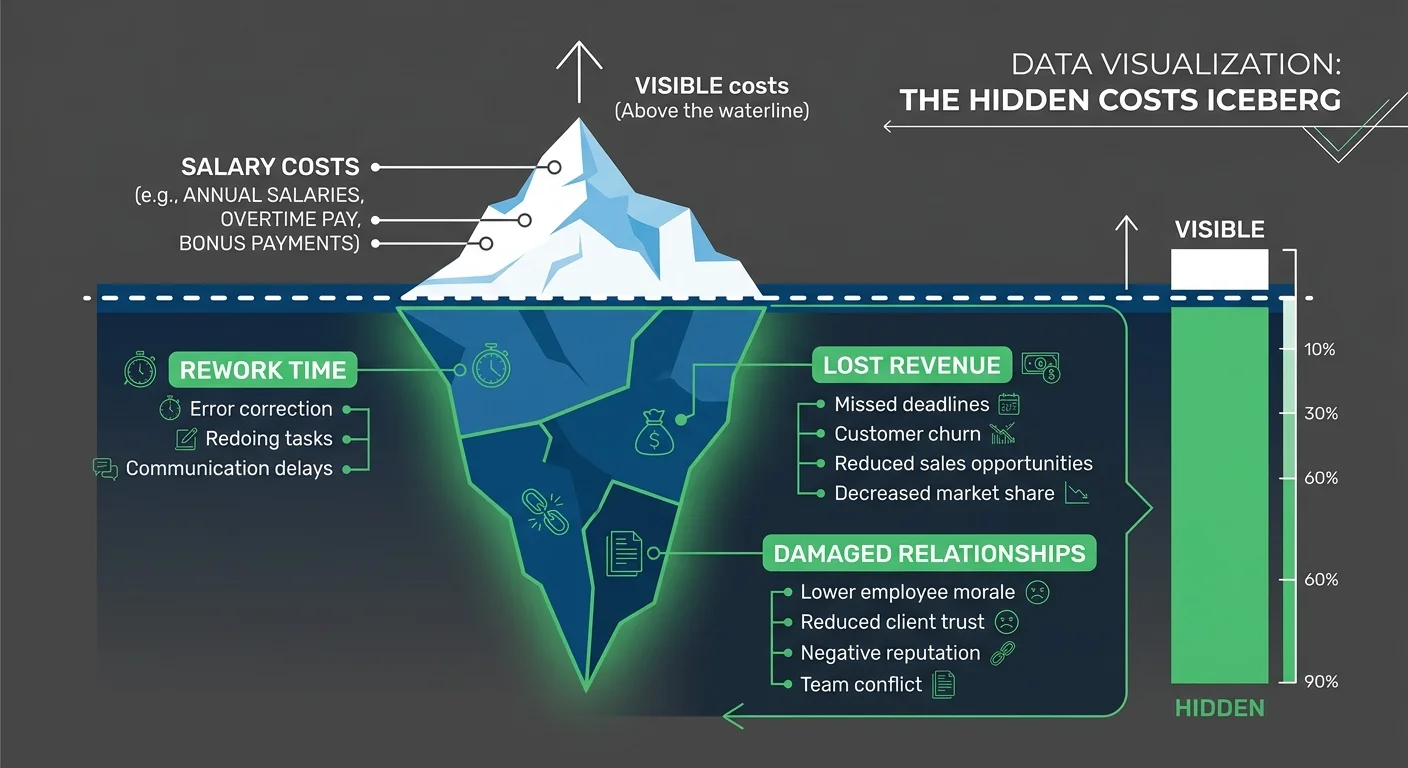
The hidden costs don’t show up on a payroll report.
They show up in the gap between what settles and what you actually recover.
In-house teams treat PI liens like insurance claims. Same workflow. Same tools. Same metrics.
But PI liens don’t adjudicate on the same timeline. They don’t follow payer rules. And they don’t resolve through standard denial workflows.
They’re a different category of work entirely.
So your biller submits the lien. Logs it as complete. Moves on.
Months pass. The case settles.
And you find out after the fact that the lien was paid at a fraction of its value – or left out of the settlement entirely because no one coordinated with the attorney’s office when negotiations closed.
That’s not a billing failure. That’s a structural mismatch between what PI lien recovery requires and how in-house teams are trained, incentivized, and measured.
Attorney Relationship Risk
Attorney relationships are the operational backbone of PI lien recovery.
And in-house teams – through no fault of their own – damage those relationships without realizing it.
Here’s how it happens.
The attorney’s office needs documentation updates, lien balance confirmations, or itemized billing breakdowns to move the case forward. Your in-house biller is juggling 200 other claims and doesn’t respond for a week.
The attorney’s paralegal escalates. Your front desk gets involved.
The attorney now associates your practice with administrative friction – not clinical outcomes.
That friction doesn’t just cost you on the current case.
It costs you on every future referral that attorney would have sent your way.
Maximize personal injury (PI) lien recovery requires proactive communication and lien coordination expertise that in-house teams don’t have the bandwidth or training to deliver. When you work with an expert lien management partner, the attorney gets a single point of contact who speaks their language, responds same-day, and manages lien resolution as a legal process – not a billing afterthought.
| Cost Category | Visible on P&L | Hidden Impact | Typical Annual Loss |
|---|---|---|---|
| Claim Rework | Yes (labor hours) | Each denial requires resubmission, documentation review, and appeal coordination – time that could have been spent on new claims | The cost to rework a single denied claim can be as high as $118 |
| Patient Collection After Denial | Partially (collection agency fees) | When a claim denial shifts to patient responsibility, collection costs escalate dramatically and often exceed the recovered amount | Administrative cost three to four times higher than collecting from payers |
| Abandoned Recoverable Claims | No (never reaches P&L) | In-house teams lack the bandwidth to appeal complex denials, leaving recoverable revenue uncollected | Nearly two-thirds of denied claims are recoverable but require dedicated follow-up |
How Expert Lien Management Recovers More
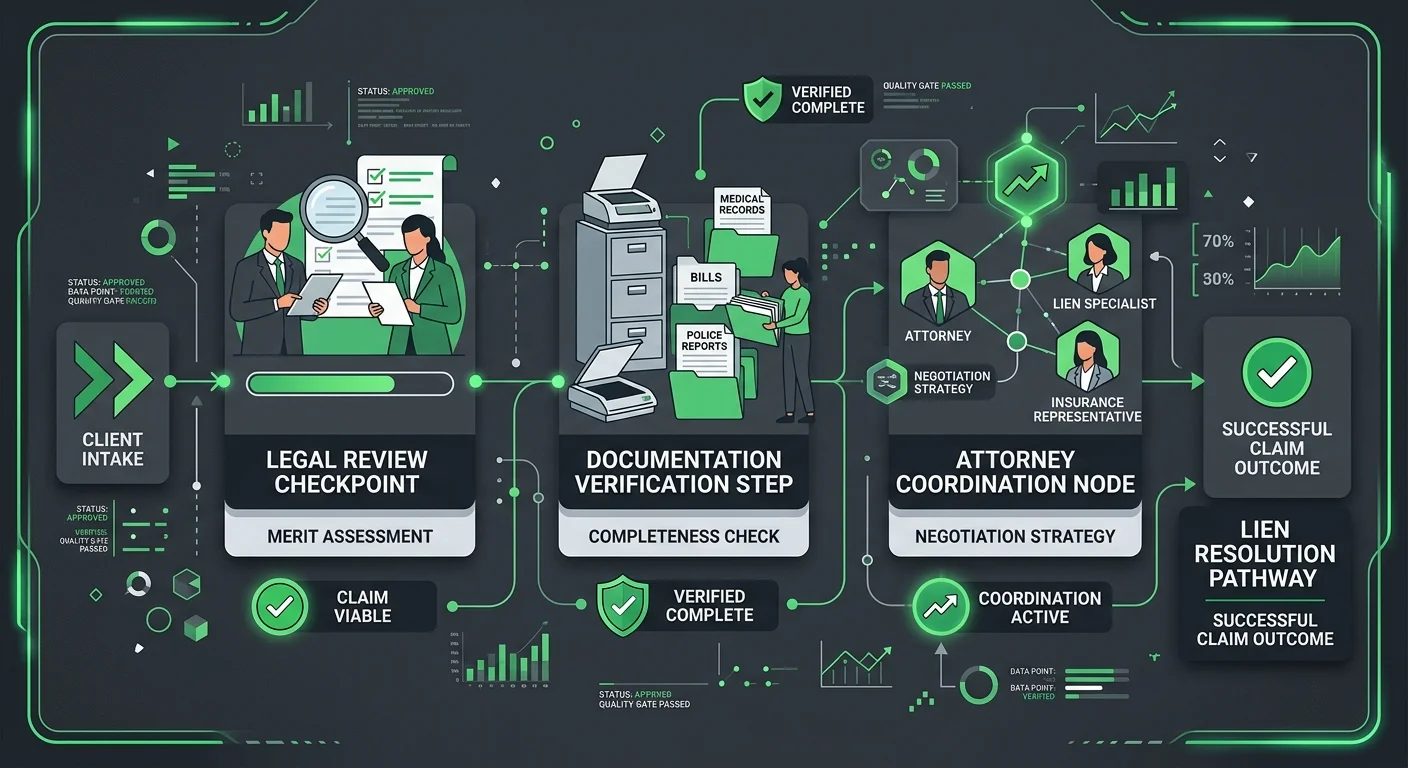
Expert lien management firms recover more revenue because they operate as a revenue discipline, not a billing function.
They don’t handle PI liens alongside insurance claims.
They handle PI liens exclusively.
In-house teams are generalists trained in insurance billing who occasionally handle PI liens.
Expert lien management firms are specialists who only handle PI liens.
That means they’ve built workflows, documentation standards, and attorney coordination systems around the legal principles like medical necessity, causation, and apportionment that determine whether you get paid. Not whether you submit a claim. Whether you recover the settlement.
Expert firms operate on a performance-based model. They only collect when you do.
That alignment changes everything. Which claims get prioritized. How aggressively denials get appealed. How proactively they communicate with attorneys.
Nearly two-thirds of denied claims are recoverable with proper follow-up, but recovery requires the bandwidth and expertise that in-house teams don’t have. So those claims die. Not because they weren’t winnable. Because no one had the economic incentive to fight for them.
Legal Expertise Built Into the Workflow
The biggest gap between in-house PI billing and expert lien management isn’t software.
It’s legal fluency.
Expert lien management firms don’t just submit claims. They document them in a way that survives legal scrutiny.
That means knowing how to establish causation in clinical narratives. How to structure itemized billing so apportionment disputes don’t tank the lien. How to coordinate with attorneys so lien priority is protected when the case settles.
None of that’s covered in standard billing training. But it’s baked into full-service insurance billing and revenue cycle management built for personal injury cases.
Here’s what that looks like.
When opposing counsel challenges medical necessity, expert lien management firms know how to pull the clinical documentation that proves the care was accident-related. Not pre-existing. Not unrelated. Not excessive.
When a settlement’s about to close and the attorney’s office needs an updated lien balance within 24 hours, expert firms respond same-day. That coordination is their core function. In-house teams treat those requests as interruptions.
Performance-Based Alignment
Performance-based billing isn’t just a pricing model.
It’s an incentive structure that changes which claims get worked and how aggressively they get pursued.
In-house staff work on salary. They get paid whether your PI lien settles at full value, partial value, or not at all.
Expert lien management firms don’t.
So when a claim gets denied, the expert firm has a direct financial reason to appeal it. And to keep appealing until it’s exhausted or recovered.
Top-performing practices maintain denial rates of 4% or less, but hitting that benchmark requires denial management and appeals expertise that most in-house teams don’t have the time or training to execute.
That alignment also changes communication patterns.
Expert lien management firms proactively update attorneys. They respond to paralegal requests within hours. They coordinate lien resolution timelines so your practice doesn’t get left out when settlements close.
In-house teams respond reactively. PI lien coordination isn’t their primary job, and they’re not measured or compensated based on how much you recover.
Documentation Precision
Documentation precision is where most in-house PI billing fails.
Not because the staff is careless.
Because they don’t know what legal standard the documentation needs to meet.
Expert lien management firms document every treatment note, every diagnosis, and every service in a way that anticipates apportionment disputes and causation challenges.
They know which clinical details strengthen the lien. Which ones create openings for opposing counsel to argue the care was unrelated to the accident.
That precision requires understanding the denial rate benchmarks that separate top-performing practices from everyone else. And it requires treating every PI case as a legal document, not just a billing claim.
| Recovery Factor | In-House Model | Expert Lien Management | Revenue Impact |
|---|---|---|---|
| Legal fluency | Generalist billing staff trained in insurance claims, not legal documentation standards for PI cases | Specialist firms document every service to withstand causation and apportionment challenges from opposing counsel | Fewer lien reductions from documentation disputes; stronger settlement positioning |
| Attorney coordination | Reactive communication when paralegal requests come in; treated as interruptions to primary billing workflow | Proactive same-day response to attorneys; lien balance updates and documentation delivered within hours | Protected referral relationships; practice included in settlements instead of left out when cases close |
| Denial follow-through | Denials appealed when time permits; high-friction claims deprioritized because staff paid regardless of recovery | Every denial appealed until exhausted or recovered; performance-based model creates direct financial incentive to pursue | Recoverable revenue captured instead of written off; higher net collections per case |
| Settlement timing coordination | Lien logged as complete after submission; no ongoing tracking of case settlement timelines or attorney negotiations | Active case monitoring and settlement coordination to ensure lien priority is protected when negotiations close | Practice receives full lien value at settlement instead of discovering partial payment or exclusion after the fact |
When Expert Management Makes Financial Sense
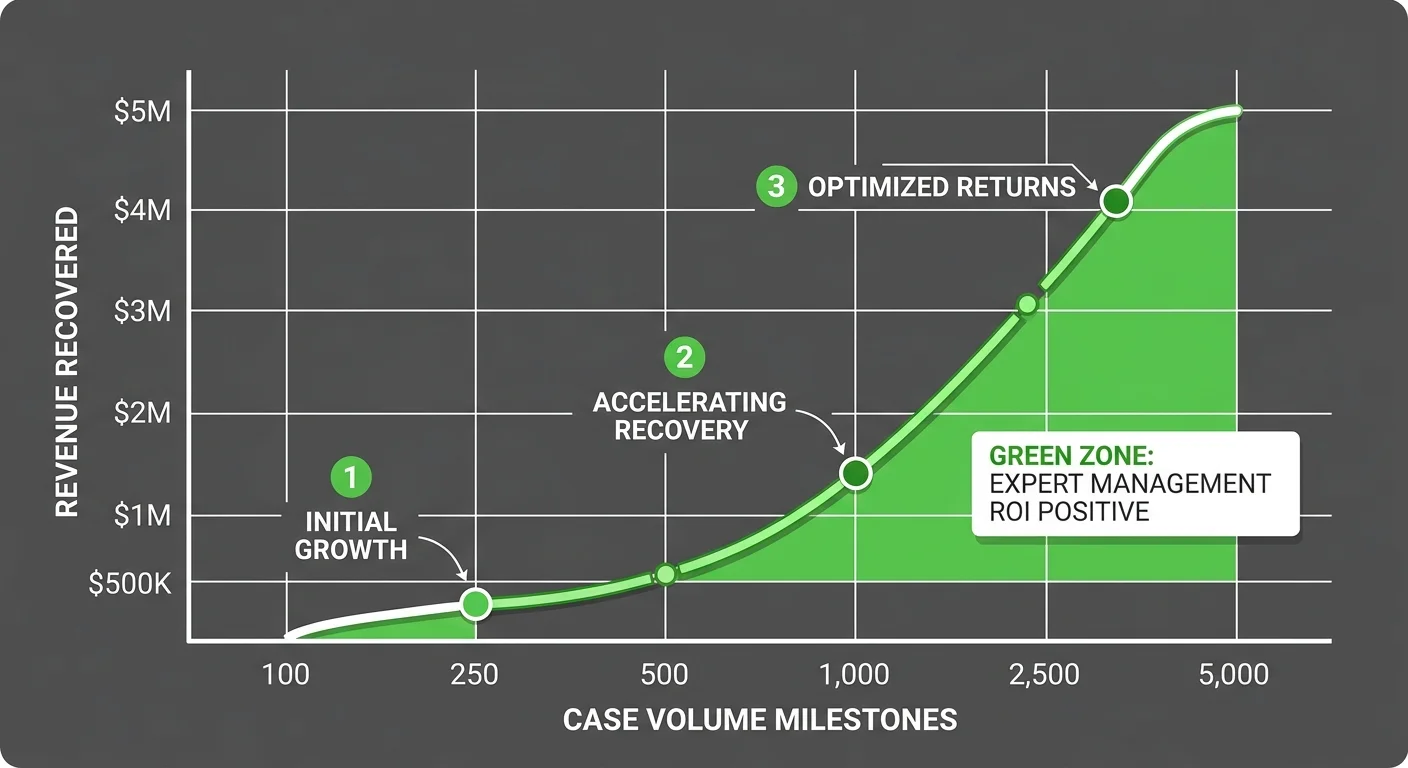
The question isn’t whether expert lien management works better.
It does.
The question is when the cost of keeping it in-house crosses the line from tolerable inefficiency to structural revenue loss.
Three signals tell you that in-house PI billing has stopped working.
PI case volume hits a threshold where your staff can’t keep up. Your denial rate climbs above industry benchmarks and stays there. And your referral pipeline depends on attorney relationships that in-house teams aren’t equipped to manage.
Any one of these is a yellow flag. All three together mean you’re leaving money on the table every month.
Volume Threshold
When your practice handles a handful of PI cases per month, in-house billing feels manageable.
The staff has time to follow up. The workload doesn’t overwhelm the queue. And the revenue lost to documentation gaps or missed coordination feels like the cost of doing business.
But once PI case volume scales – say, a dozen or more active liens at any given time – the cracks widen.
Your biller starts triaging PI cases behind cleaner insurance claims because those close faster and keep the metrics green. Attorney offices call for lien updates and your front desk doesn’t know who’s handling the case. Settlement timelines slip because no one coordinated lien resolution before negotiations closed.
That’s when in-house shifts from cost savings to bottleneck.
Expert lien management scales without adding overhead.
The firm’s infrastructure – dedicated staff, attorney coordination workflows, legal documentation standards – absorbs volume increases without creating internal friction. And because they only get paid when you do, scaling doesn’t dilute your ROI.
It compounds it.
Denial Rate as a Signal
Top-performing practices maintain a denial rate of 4% or less.
If your PI lien denial rate sits above that – or worse, if you don’t track it at all – that’s a structural signal your billing model isn’t equipped to handle the complexity PI cases require.
Here’s why denial rate matters.
Denied claims don’t just delay revenue – they multiply administrative costs. The administrative cost of collecting from patients after a claim denial is three to four times higher than collecting from payers. So every PI lien that gets denied, appealed, and written off doesn’t just cost you the settlement amount.
It costs you the rework time, the follow-up calls, and the opportunity cost of staff bandwidth spent chasing a claim that AR cleanup and recovery expertise could’ve prevented from denying in the first place.
And because in-house teams don’t specialize in legal lien frameworks, they miss the documentation details that prevent denials upstream.
Expert lien management firms document defensively from day one – which keeps denial rates low and recovery rates high without the rework cycle.
Attorney Referral Dependency
If a meaningful portion of your practice revenue comes from attorney referrals, in-house PI billing becomes a reputational liability.
Attorneys refer patients to practices that make their job easier – not harder. When your in-house team takes three days to respond to a lien balance request, or when settlement coordination falls through the cracks because no one coordinated with the paralegal, the attorney doesn’t blame your biller.
They associate your practice with administrative friction.
Expert lien management firms treat attorney relationships as a core operational function, not a courtesy.
They respond same-day. They update case status without being asked. And they speak the legal language attorneys expect – which protects your referral pipeline and positions your practice as the low-friction option attorneys want to work with.
That’s how chiropractic billing specialty expertise turns billing into a referral advantage instead of a referral risk.
| Practice Profile | Monthly PI Case Volume | Current Denial Rate | Annual Revenue at Risk | Break-Even Point |
|---|---|---|---|---|
| Small Practice (Solo or 2-Provider) | 3-5 active liens | Exceeds 4% | High rework costs per claim | First denied claim that requires appeal |
| Mid-Size Practice (3-5 Providers) | 8-12 active liens | Above benchmark threshold | Multiplied rework burden across volume | Third or fourth rework cycle |
| Multi-Location Practice (6+ Providers) | 15+ active liens | Consistently elevated denials | Compounding patient collection costs | When patient collection exceeds payer collection effort |
Frequently Asked Questions
You’ve seen the comparison. You’ve seen the inflection points.
Here’s what practices actually ask when they’re deciding whether to make the move.
These aren’t hypotheticals.
They’re the exact places where in-house PI billing stops working and starts costing you money you can’t see.
How do I maximize Personal Injury (PI) lien recovery without damaging attorney relationships?
Attorney relationships live or die on responsiveness.
The practices that recover the most treat attorney offices like internal partners. Same-day responses to lien balance requests. Case status updates before the paralegal has to call. Documentation that anticipates apportionment disputes so the attorney isn’t defending your billing choices during settlement.
Most in-house teams can’t sustain that.
They’re juggling insurance claims, patient billing, credentialing, and AR recovery. Attorney coordination isn’t a side task. It’s a full operational function that determines whether your referral pipeline grows or dries up.
What are the hidden operational costs of managing complex PI billing in-house?
The visible cost is salary and benefits.
The hidden costs are where the money disappears.
Rework time on denied claims is the first one. The cost to rework a single denied claim can be as high as $118. PI liens deny at higher rates than standard insurance claims because the documentation bar is higher. Every claim your team submits without understanding medical necessity, causation, and apportionment is a denial waiting to happen.
The second hidden cost is opportunity cost.
While your biller is chasing a PI lien denial through three rounds of appeals, they’re not working the cleaner claims that close faster. While they’re fielding attorney lien balance requests, they’re not managing your AR or credentialing queue.
PI liens eat staff bandwidth at a rate that’s invisible until you calculate what it’s costing you per case.
Why does generic billing software consistently fail to manage personal injury liens effectively?
Because software doesn’t understand legal context.
It understands claim submission. It doesn’t understand lien strategy.
PI liens require defensive documentation from the first visit. That means documenting causation clearly enough that opposing counsel can’t argue the treatment was unrelated to the accident. It means structuring diagnosis codes and treatment notes so they survive apportionment disputes. And it means coordinating lien resolution timelines with attorney settlement negotiations so your practice doesn’t get cut out when the case closes.
No billing software automates that.
Software submits the claim. It can’t anticipate the legal challenges your documentation will face six months later. Studies indicate that up to 80% of medical bills contain errors – and that rate climbs with complexity. Most of those errors happen because the software flagged nothing and the in-house team didn’t know what to look for.
How does a performance-based model improve PI lien recovery rates compared to an in-house salaried team?
Incentive alignment changes everything.
In-house teams get paid whether your lien settles at full value, partial value, or not at all. Performance-based firms only get paid when you do.
That structural difference shows up in three places. Appeal persistence – when a PI lien gets denied, the performance-based firm has a direct financial reason to keep appealing. In-house teams don’t. Documentation precision – performance-based firms document defensively from day one because their revenue depends on recovery rates, not submission volume. And attorney coordination – performance-based firms manage lien resolution timelines proactively because their payout is tied to whether your practice gets included in the settlement.
The cost to rework a single denied claim can be as high as $118.
Performance-based models prevent that rework cycle upstream by treating every PI case like the legal document it is – not like a standard insurance claim.
At what point does it become more cost-effective for a chiropractic practice to use an expert lien management service?
Three inflection points signal the crossover.
PI case volume scales past a dozen active liens at any given time. Your denial rate climbs above 4% and stays there. And your referral pipeline depends on attorney relationships that in-house teams can’t consistently manage.
Any one of those is a warning sign. All three together mean you’re losing recoverable revenue every month.
The cost-effectiveness question isn’t whether expert lien management is cheaper than salary. It’s whether your in-house team can deliver the documentation precision, legal fluency, and attorney coordination that PI liens require.
If they can’t, the gap between what they’re doing and what the work actually requires is where your settlement revenue disappears.
What specific documentation for PI liens do in-house teams most often miss?
They miss the legal details that protect the lien during settlement negotiations.
Medical necessity, causation, and apportionment – those are the three standards opposing counsel uses to challenge your lien. Most in-house teams don’t document with those challenges in mind.
Medical necessity means proving the treatment was appropriate for the injury. Causation means linking every service directly to the accident, not to pre-existing conditions. Apportionment means documenting which treatments addressed accident-related injuries versus unrelated care.
If your documentation doesn’t clearly establish all three, opposing counsel has an opening to argue your lien should be reduced or excluded.
Expert lien management firms document defensively from the first visit – which keeps your lien intact when settlement negotiations start and prevents the apportionment disputes that cut into your recovery.
The Bottom Line
The question isn’t whether expert lien management recovers more revenue.
The data on that is clear.
The question is whether your practice is losing enough right now to justify changing how you bill.
And the honest answer for most practices handling more than a handful of PI cases per month is yes. Not because in-house billing is broken. But because PI lien recovery is a specialized revenue discipline that requires legal fluency, documentation precision, and attorney coordination systems that in-house teams aren’t staffed or trained to deliver.
The gap between what your team can do and what the work actually requires is where your money goes.
PI lien billing is a revenue discipline disguised as a billing function.
Most practices treat it as the former while staffing it as the latter.
That’s the structural mismatch that costs them money on every case.
Expert lien management doesn’t eliminate complexity. It absorbs it. The legal knowledge, the attorney coordination, the defensive documentation standards, the performance-aligned incentive structure – all of that exists whether you handle it in-house or partner with a firm that specializes in it.
The difference is whether those systems are baked into your billing operation or bolted on as an afterthought.
If your PI case volume is climbing, your denial rate is above benchmarks, or your referral relationships depend on responsiveness your in-house team can’t deliver – the cost of waiting isn’t neutral.
It’s compounding.
Every month you delay is another month of settlement revenue left on the table. Another month of attorney relationships eroding. Another month of rework costs inflating your overhead.
The practices that recover the most from PI liens aren’t the ones with the best software or the hardest-working staff.
They’re the ones that treated it as a revenue discipline, not a billing function – and matched the complexity of the work to the expertise of the team handling it.
If you’re handling more than a few PI cases per month and you’re not sure how much settlement revenue you’re leaving on the table, a practice assessment shows you exactly where the gaps are. It identifies which liens are still workable, which documentation patterns are costing you during negotiations, and whether your team has the legal fluency PI recovery actually requires – because this is a revenue discipline, not a billing function.
© . All Rights Reserved | Web Design by iTech Valet