

Original Medicare vs. Medicare Advantage: A Guide to Billing & Billing Rules for Chiropractors
If you’ve ever sat in a room full of chiropractors or practice managers, you’ve probably heard this debate come up:
“Do I have to bill this Medicare Advantage plan?”
“Can I just charge my cash rate if I’m out-of-network?”
“What about the Medicare limiting charge?”
The intersection of Original Medicare Part B, private insurance contracts, and Medicare Advantage (MA) plans causes a lot of confusion.
This guide breaks down every scenario-from fully participating to completely out-of-network-so you can stay compliant, collect appropriate payment, and protect your practice.
3 Foundational Rules Every Chiropractor Must Know
Before diving into specific scenarios, you must understand three federal foundation rules:
1. Chiropractors Cannot “Opt Out” of Medicare
Medical doctors (MDs) and doctors of osteopathy (DOs) can legally “opt out” of Medicare and sign private cash contracts with Medicare patients. Chiropractors (DCs) cannot do this under federal law. You only have two choices: Participating (PAR) or Non-Participating (Non-PAR). Treating a Medicare beneficiary without enrolling in Medicare or attempting to privately contract for covered services is a compliance violation.
Source: CMS Medicare Benefit Policy Manual, Chapter 15, § 40.4 (Physicians and Practitioners Who May Not Opt Out)
2. The Mandatory Claim Submission Rule
If a Medicare beneficiary receives a service that Medicare covers (such as active spinal manipulation), you are legally required under federal law to submit a claim on their behalf. You cannot refuse to file a claim and simply collect cash.
Source: Social Security Act § 1848(g)(4) & CMS Medicare Claims Processing Manual, Chapter 1, § 70.8.8
3. Medicare Advantage (Part C) Is Federally Regulated Medicare
Medicare Advantage plans (administered by commercial carriers like Blue Cross Blue Shield, Humana, or UnitedHealthcare) are federally funded Medicare plans. Even when you treat a patient out-of-network under an Advantage plan, federal balance-billing and payment cap rules apply.
Source: Code of Federal Regulations, 42 CFR § 422.214 (Special Rules for Services Furnished by Noncontract Providers)
💡 The Commercial vs. Medicare Advantage Contracting Trap
Before reviewing the four billing scenarios, there is one crucial distinction every clinic billing department must understand:
Being “In-Network” with an insurance company’s Commercial plan does NOT mean you are “In-Network” with their Medicare Advantage plan.
Commercial insurance companies manage completely separate provider networks (panels) for their commercial lines of business versus their Medicare Advantage lines of business:
- Commercial Contract: Applies to under-65, employer-sponsored, and individual commercial plans.
- Medicare Advantage Rider/Contract: A separate, specific network agreement governing Medicare Advantage (Part C) beneficiaries.
Why Non-PAR Status Impacts Your Network Eligibility
Most major health insurance plans (including Blue Cross Blue Shield, Aetna, and UnitedHealthcare) require a provider to be actively enrolled as a Participating (PAR) provider in the Original Medicare Part B before they will allow you into their Medicare Advantage network.
If you choose to be Non-PAR with Original Medicare Part B, the insurer will frequently exclude you from their Medicare Advantage panel. As a result, you will be considered OUT-OF-NETWORK for their Medicare Advantage patients-even if you are fully in-network for their commercial patients!
Source Citation: CMS Managed Care Manual, Chapter 11 (Network Contracting Rules) & KMC University Compliance Directives
📌 Don’t Risk a Compliance Penalty at the Front Desk
Free Resource: The Bushido Billing Chiropractic Medicare vs. MA Cheat Sheet
Keep your front desk and billing team compliant. Download our printable 1-page quick-reference guide, including the complete Master Decision Matrix, the 3-Step HMO Cash Protocol, and federal regulatory citations.
👉 Download the 1-Page Cheat Sheet here (Takes less than 30 seconds)
Scenario Walkthrough: What Do You Do?

PAR with Original Medicare | In-Network with Medicare Advantage
- The Setup: You are a Participating (PAR) provider with Original Medicare AND you signed a specific provider contract for the insurer’s Medicare Advantage panel (e.g., BCBS MA).
- Do You Have to Bill? YES. You are contractually and legally required to bill the Medicare Advantage plan.
- How Pricing Works: Your signed network contract overrides everything else. You bill the Advantage plan and collect only the copayment, coinsurance, or deductible specified by the patient’s plan.
- Can You Charge Cash Rates? NO. Balance-billing or charging self-pay rates is strictly prohibited by your provider agreement.
Source Citation: CMS Managed Care Manual, Chapter 4 (Benefits and Beneficiary Protections) & KMC University Compliance Directives

PAR with Original Medicare | Out-of-Network with Medicare Advantage
Sub-Scenario A: The Plan HAS Out-of-Network Benefits (e.g., PPO or PFFS)
- Do You Have to Bill? YES. Because out-of-network coverage exists, a billable benefit is available under the patient’s plan.
- How Pricing Works: You submit the claim to the Advantage plan as an out-of-network provider. However, federal law protects the enrollee. Because you are PAR with Original Medicare, the total combined payment (from insurance and patient cost-sharing) cannot exceed the Original Medicare Allowed Fee.
- Can You Charge Cash Rates? NO. You cannot charge standard cash prices if they exceed the Original Medicare allowed rate.
Sub-Scenario B: The Plan HAS NO Out-of-Network Benefits (e.g., HMO)
- Do You Have to Bill? NO.
- How Pricing Works: Because the HMO plan provides zero coverage for out-of-network providers, no billable insurance benefit exists under their plan.
- Can You Charge Cash Rates? YES. You may treat the patient on a self-pay basis and charge your usual office cash rate.
- Required Protocol: Formally verify zero out-of-network benefits with the carrier, note the verification in the patient’s chart, and have the patient sign a Financial Responsibility Form / Good Faith Estimate acknowledging they are out-of-network and choosing self-pay before care is delivered.
Source: 42 CFR § 422.214; CMS Medicare Advantage Out-of-Network Payment Guide
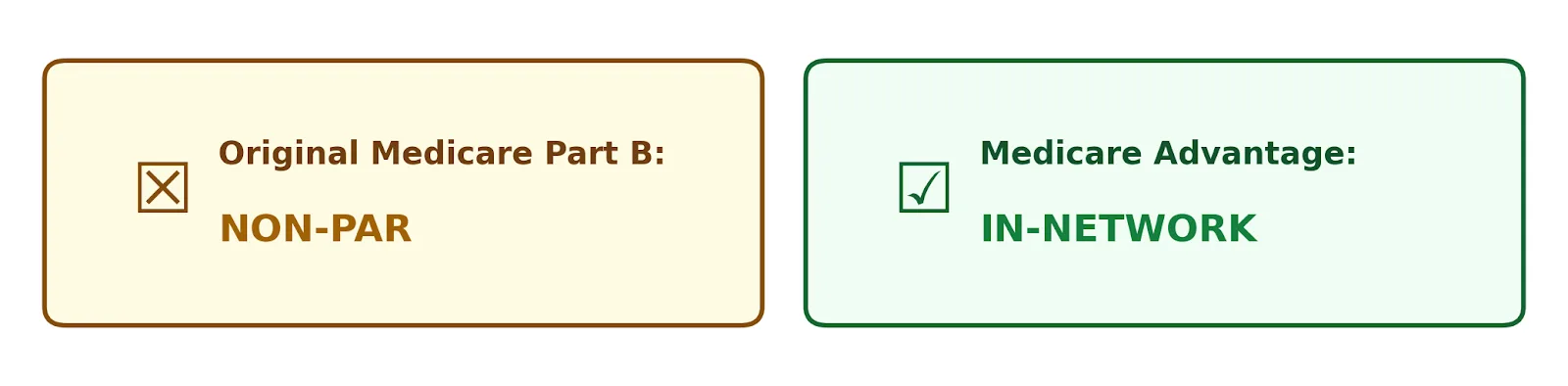
Non-PAR with Original Medicare | In-Network with Medicare Advantage
- The Setup: You chose Non-Participating (Non-PAR) status with Original Medicare Part B, but you signed an in-network provider contract with the commercial carrier’s Medicare Advantage plan (e.g., BCBS MA).
- Do You Have to Bill? YES.
- How Pricing Works: Your signed commercial contract with the Advantage plan overrides your Non-PAR Medicare status. You must bill the Advantage plan as an in-network provider and collect only the in-network copay or deductible.
- Can You Charge the Medicare Limiting Charge or Cash? NO. Your network agreement governs your fee structure. You cannot apply Medicare’s 115% limiting charge or self-pay cash prices.
Source: CMS Managed Care Manual, Chapter 11; KMC University Guidelines on MA Network Overrides
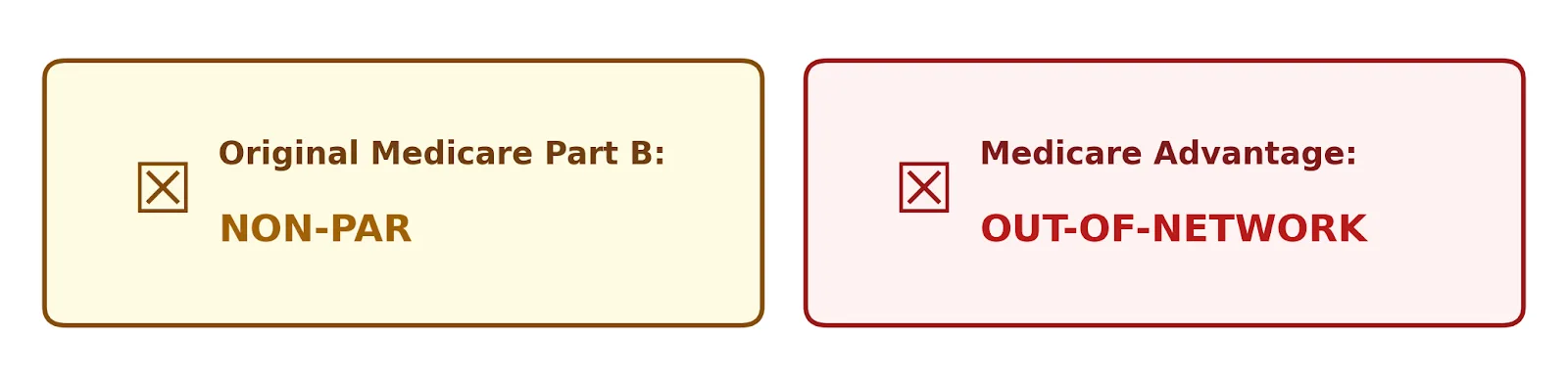
Non-PAR with Original Medicare | Out-of-Network with Medicare Advantage
Sub-Scenario 4A: The Plan HAS Out-of-Network Benefits (e.g., PPO or PFFS)
- Do You Have to Bill? YES.
- How Pricing Works: As a non-contracted provider treating an Advantage PPO patient, federal law caps what you can collect. You cannot collect more than the Medicare Limiting Charge (which is 115% of the Non-PAR Medicare allowed fee).
- Can You Charge Cash Rates? NO. You cannot charge standard office cash prices if they exceed the Medicare limiting charge. You collect up to the limiting charge from the patient (or bill unassigned), submit the claim to the Advantage plan, and the plan reimburses the patient based on their out-of-network benefit tier.
Sub-Scenario 4B: The Plan HAS NO Out-of-Network Benefits (e.g., HMO)
- Do You Have to Bill? NO.
- How Pricing Works: Because the HMO plan offers zero out-of-network coverage, no billable insurance benefit exists.
- Can You Charge Cash Rates? YES. You may charge your standard practice cash rates.
- Required Protocol: Verify $0 out-of-network coverage, document the call in the patient’s record, and obtain a signed Financial Responsibility agreement / Good Faith Estimate prior to rendering care.
Source: Social Security Act § 1848(g); 42 CFR § 422.214; CMS Medicare Claims Processing Manual, Ch. 1 § 70.8.8
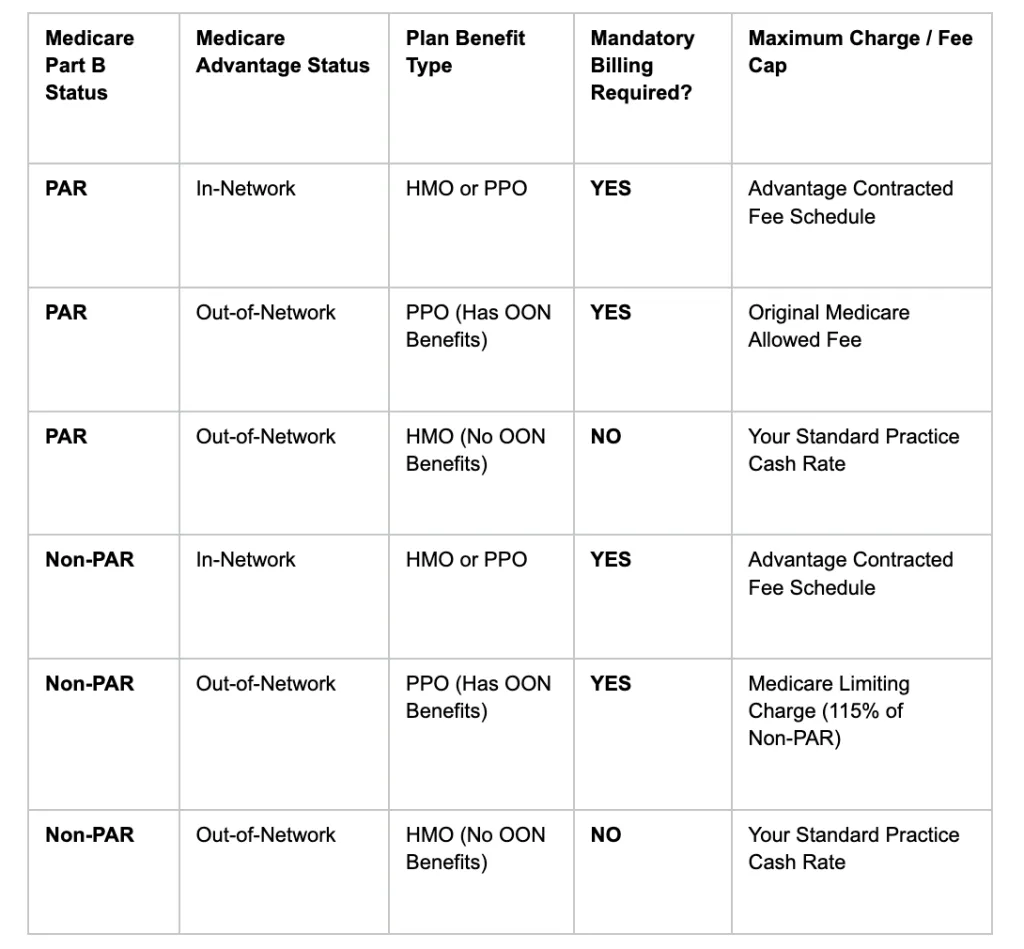
Quick Reference Billing Matrix
Important Note: Chiropractic vs. Physical Therapy (PT)
- Chiropractic Covered Scope: Original Medicare Part B only covers manual manipulation of the spine to correct a subluxation (CPT 98940-98942). Examinations, X-rays, modalities, and maintenance care are non-covered under Original Medicare Part B. However, many Medicare Advantage plans DO cover exams, X-rays, and therapy modalities. Always verify coverage benefits with the Advantage carrier.
- Physical Therapy (PT): Private practice physical therapists are also mandatory Medicare providers. Unlike chiropractic care, PT evaluations and therapeutic procedures are covered Part B benefits. PT practices follow these identical Medicare Advantage in-network vs. out-of-network billing rules.
Source: CMS Medicare Benefit Policy Manual, Chapter 15, § 30.5 (Chiropractic) & § 220 (Physical Therapy)
Want to Keep This Guide Handy at Your Practice?
Managing Medicare Advantage billing isn’t just about getting paid-it’s about protecting your practice from costly compliance audits and front-desk mistakes. Whether you need a quick-reference guide for your staff or personalized expert guidance on your contracts, we’ve got you covered.
Download the Quick Reference Sheet
Keep our printable 1-page Master Decision Matrix right at your front desk or billing station.
👉 Download the 1-Page Cheat Sheet
Have a Complex Medicare Scenario? Talk to an Expert!
Unsure how your current contracts interact with local Medicare Advantage carriers? Let’s talk through your practice’s specific setup.
📅 Schedule a Discovery Call
Source Directory & Citations
- Centers for Medicare & Medicaid Services (CMS):
- Social Security Act § 1802 (Opt-Out Provisions)
- Social Security Act § 1848(g)(4) (Mandatory Claim Submission)
- 42 CFR § 422.214 (Rules for Non-Contracted
- Providers Treating MA Enrollees)
- CMS Medicare Benefit Policy Manual, Chapter 15 (§ 30.5, § 40.4, § 220)
- CMS Medicare Claims Processing Manual, Chapter 1 (§ 70.8.8)
- CMS Medicare Managed Care Manual, Chapter 4 (Benefits and Beneficiary Protections)
- Healthcare Compliance & Legal Resources:
- KMC University (Kathy Mills Chang) – Chiropractic Medicare & Medicare Advantage Compliance Guidelines
- ChiroHealthUSA – Provider Status in Medicare Advantage Plans
- American Chiropractic Association (ACA) – Participating vs. Non-Participating Guidelines

© . All Rights Reserved | Web Design by iTech Valet