

Why Does Your Practice Valuation Depend on the Accuracy of Your Billing Data?
A chiropractic practice’s market valuation is determined by the structural accuracy of its billing data. That is not a theory. It is what happens in every due diligence room.
Buyers do not evaluate potential. They audit history – claim by claim, modifier by modifier, denial by denial.
They look at whether codes 98940, 98941, and 98942 were consistently billed with the active treatment (AT) modifier to demonstrate medical necessity. They look at whether denied claims were worked or written off. They look at whether aging accounts receivable represents collectible revenue or a pattern of abandoned billing.
Every gap they find becomes a discount applied to the asking price.
The exposure is real. Administrative billing error rates in private clinical settings frequently exceed 10%, which directly deflates a practice’s net collection rate – the core metric buyers use to assess actual revenue performance. Non-compliant billing processes expose practices to retroactive clawbacks under Section 5 of the FTC Act. HHS OIG audit findings consistently identify missing or misapplied AT modifiers as a primary driver of Medicare overpayments in chiropractic settings.
Modifier noncompliance, aged accounts receivable, elevated denial rates, and deflated net collection rates each function as independent valuation discount triggers. A practice with clean billing data commands a full multiple. A practice with unresolved billing deficiencies accepts the buyer’s number or loses the deal.
Revenue cycle management optimization eliminates the administrative leakages that create those discounts. But the strategic value is larger than the efficiency gain – a clean billing record is equity protection.
A practice sale is not where billing accuracy becomes important. It is where billing accuracy gets priced.
What Buyers Actually Audit When They Value a Chiropractic Practice
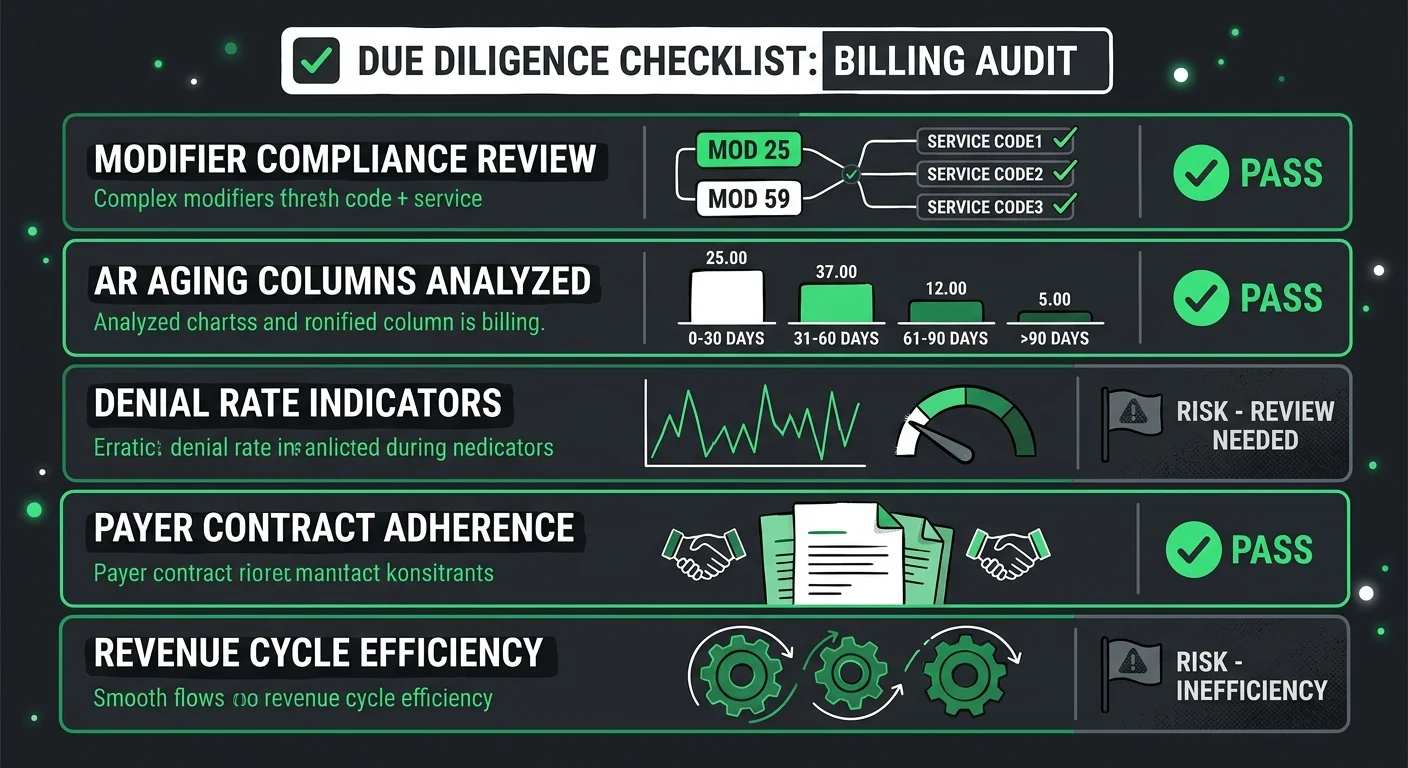
Most sellers walk into due diligence thinking it’s a sales conversation.
It isn’t. Sophisticated buyers show up with a forensic checklist – and it is narrower, harder, and more specific than most practice owners ever expect.
They’re not evaluating what your practice could become. They’re reconstructing what it actually earned – claim by claim, from the bottom of the billing record up.
That reconstruction focuses on four things: Modifier Noncompliance, Aged AR Exposure, Denial Rate Inflation, and Net Collection Rate Deflation.
Each one is measurable. Each one gets priced into the offer.
The Forensic Billing Review – What Due Diligence Actually Looks Like
A forensic billing review is not a scan of your profit-and-loss statement. Buyers and their advisors pull claim-level data. They examine payer-by-payer denial patterns. They cross-reference modifier usage against the underlying documentation.
That process surfaces problems a clean balance sheet will never show – and by the time they find those problems, the negotiating leverage has already shifted.
Modifier noncompliance is the first flag they look for. Published audit analysis from the HHS OIG identifies missing or misapplied AT modifiers as a primary driver of federal audit-based clawbacks in chiropractic billing.
Buyers know this history. They look for it specifically. And when they find it, they don’t treat it as a clerical error – they attach a dollar amount to it and subtract it from the offer.
Aged AR exposure is next. Buyers look at what percentage of outstanding receivables sits beyond 90 days – not because old AR is automatically gone, but because it answers a more damaging question: were denials being worked, or quietly abandoned?
A practice that wants to know what’s sitting in its AR before a sale should conduct a practice audit reveal hidden revenue well before the due diligence window opens. Buyers will find what’s there either way. The only variable is whether you found it first.
Why Generic Financial Statements Are Not Enough
General financial statements tell buyers what a practice earned.
They don’t tell buyers whether it earned everything it was entitled to earn. That gap is where the valuation discount lives.
Billing error rates in private clinical settings frequently exceed 10% – a figure NIH research traces directly to coding inaccuracies and documentation gaps that standard financial reporting never captures.
Net Collection Rate Deflation and Denial Rate Inflation both live inside that gap. Buyers find them. Sellers who leaned on financial statements alone have no counterargument when the discount arrives.
A practice with a documented history of clean chiropractic billing services walks into due diligence with evidence. Everyone else walks in with assumptions.
| Audit Category | What Buyers Examine | Why It Affects Valuation |
|---|---|---|
| Modifier Noncompliance | Consistency of AT modifier usage across chiropractic procedure codes; documentation support for active treatment versus maintenance care distinctions | Missing or misapplied modifiers signal federal audit exposure and retroactive clawback liability – buyers discount the purchase price to account for that inherited risk |
| Aged AR Exposure | Percentage of outstanding accounts receivable aged beyond 90 days; whether aging claims show evidence of active follow-up or systematic abandonment | Unworked aged AR reveals a pattern of revenue abandonment – buyers treat it as proof that the stated revenue figure overstates what the practice actually collects |
| Denial Rate Inflation | Payer-by-payer denial patterns; whether denied claims were appealed, corrected, and resubmitted or written off without resolution | Elevated denial rates indicate a billing operation that processes volume but does not recover complex claims – buyers recalculate sustainable revenue accordingly |
| Net Collection Rate Deflation | The ratio of revenue actually collected versus the total amount billed and legitimately owed; coding accuracy and documentation quality across the full claim history | A deflated net collection rate is the single most visible signal that administrative leakage is structural – buyers use it to reset the baseline revenue figure before applying a valuation multiple |
| Regulatory Compliance History | Evidence of billing process controls, payer audit responses, and documentation standards that demonstrate systemic accuracy rather than episodic correction | Practices without a documented compliance history give buyers no basis for confidence – the absence of evidence becomes evidence of risk, which converts directly into a lower offered multiple |
Why Volume-Based Billing Metrics Hide the Valuation Damage
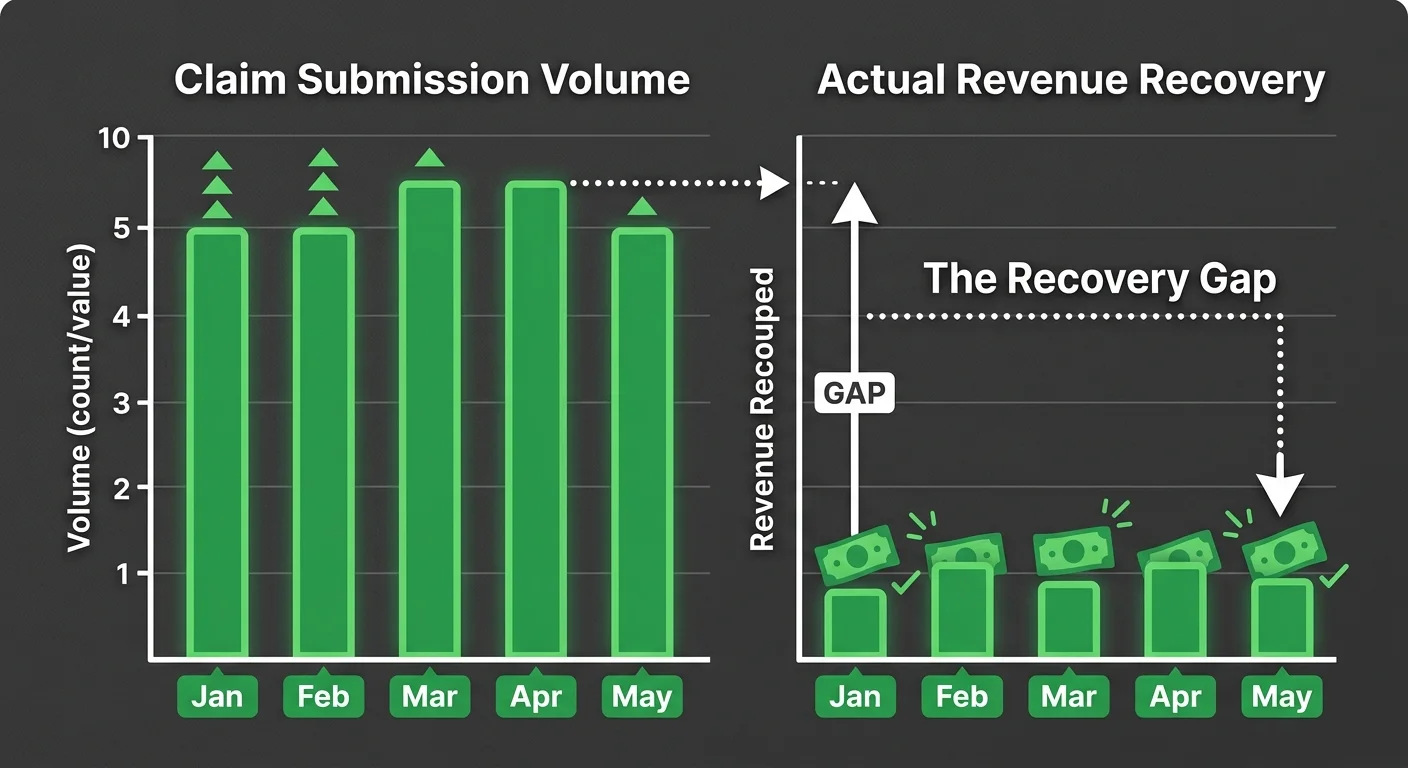
Most billing operations are graded on the wrong thing.
Submission speed. Claim volume. Clean claim rates. Those tell you how fast claims are leaving the building. They say nothing about how much revenue is actually coming back.
That gap is where practice equity disappears.
Denial management errors and unworked AR lead directly to unrecoverable revenue write-offs. Those write-offs compound quietly – month after month – while the submission dashboard shows green.
Volume-based metrics cannot see the claims that matter most in a valuation.
They count what was submitted. Buyers price what was actually collected. They find the gap every time.
Why Submission Speed Is the Wrong Performance Metric
Submission speed measures one thing: how fast claims exit the practice.
What it doesn’t measure is what happens when those claims return denied, underpaid, or flagged for documentation.
A volume-first operation is built for clean claims. Standard codes, predictable payers, no modifier complexity. Those move fast and pay without friction.
But chiropractic billing isn’t primarily made up of clean claims. That’s the problem the submission dashboard never shows you – and the one a buyer finds in the first hour of due diligence.
AT modifier requirements, personal injury lien workflows, and maintenance-versus-active-care documentation standards don’t fit a high-throughput system. They require human judgment at every step.
The EHR and billing software limitations most practices operate under make this unavoidable: software submits claims. It doesn’t argue medical necessity. Buyers understand this distinction. Sellers who haven’t cleaned it up pay for it at the table.
The Claims That Automation Cannot Work – and What Happens to Them
When a high-complexity claim comes back denied – one requiring a medical necessity argument, a documentation fix, or a multi-step appeal – the volume-first model has no real path to resolve it.
Working that claim costs more time than the model budgets for. So it gets set aside.
Then it ages. It hits the 90-plus-day column. Then a buyer prices it as unrecoverable.
NIH-indexed research connects RCM optimization to operational efficiency gains of 15% to 30% – because eliminating that abandonment pattern is exactly where the money is.
Billing error rates exceeding 10% aren’t random. They’re the predictable output of a system optimized for volume rather than recovery.
The claims automation can’t work aren’t edge cases. They’re the highest-value claims in the revenue cycle.
A buyer identifies them first. They’re the fastest path to a discount justification.
Denial Rate Inflation and Net Collection Rate Deflation both trace to the same root: a billing model that measured the wrong thing, for years, while the practice assumed everything was fine.
| Billing Metric | What Volume-Based Systems Report | What Buyers Actually See in Due Diligence |
|---|---|---|
| Clean Claim Rate | High percentage of claims accepted on first submission – signals operational efficiency | Reveals nothing about denied claims that were written off rather than worked – clean claim rate measures the easy claims, not the valuable ones |
| Claim Submission Volume | Total number of claims submitted per month – signals billing activity and throughput | A high submission count with unworked denials produces Denial Rate Inflation – buyers see the gap between what was submitted and what was collected |
| Submission Speed | Average days from service date to claim submission – signals operational responsiveness | Fast submission of an incorrectly coded claim still produces a denial – speed metrics are invisible to Modifier Noncompliance and its downstream valuation impact |
| Gross Collections | Total revenue received – signals overall practice revenue performance | Gross collections mask Net Collection Rate Deflation – buyers calculate what the practice was entitled to collect versus what it actually recovered |
| AR Balance (Total) | Aggregate outstanding accounts receivable – signals revenue in the pipeline | Buyers segment AR by aging bucket – balances beyond 90 days are flagged as Aged AR Exposure and discounted as probable write-offs regardless of the total balance reported |
| Denial Count | Raw number of denied claims over a reporting period – signals payer friction | Buyers examine denial rate by payer and code type – a pattern of unworked high-complexity denials signals a structural billing failure, not a payer problem |
The Billing Data Points That Directly Move Your Valuation Number
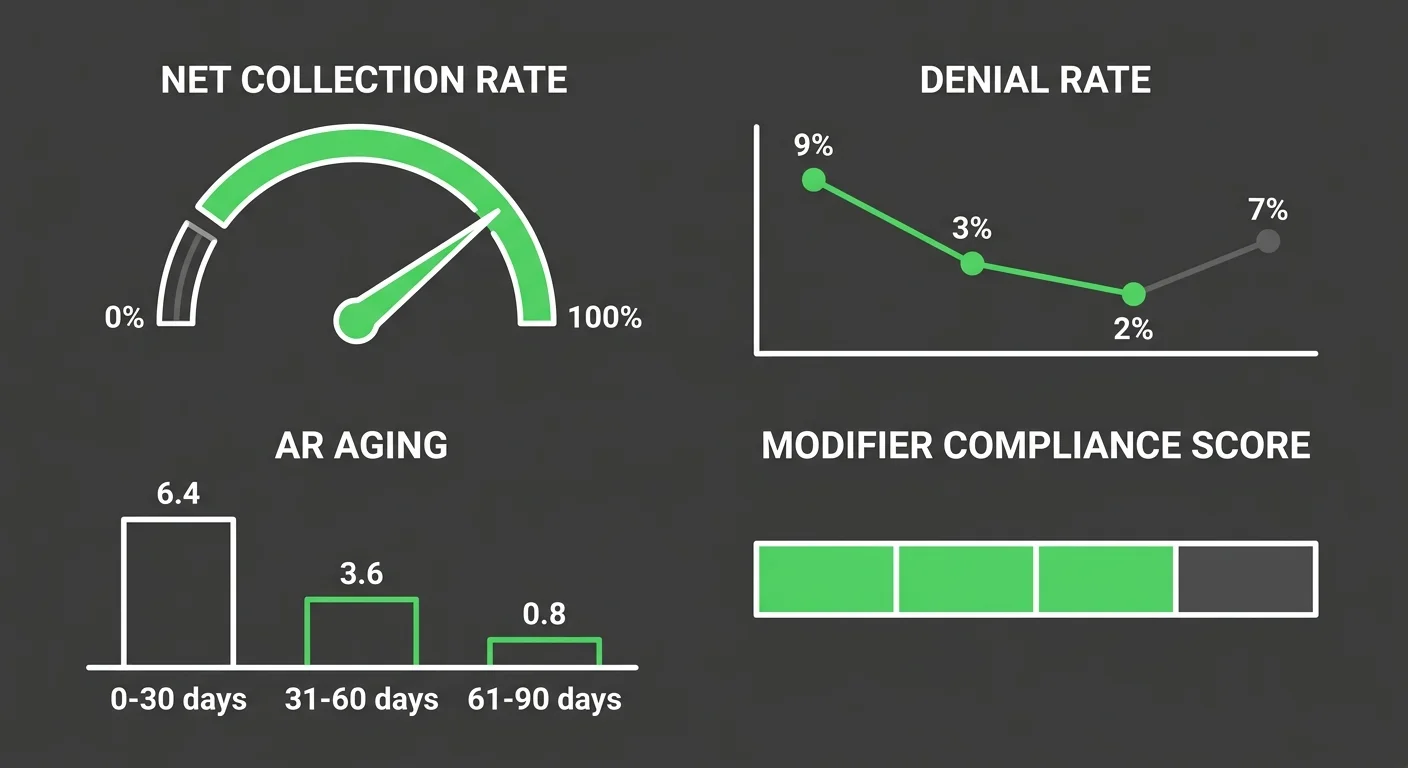
Here’s what buyers actually price.
Every discount applied to a practice’s asking price traces back to one of four billing data points. Each one is measurable. Each one is a lever – and buyers know exactly which direction to push it.
Buyers don’t walk into due diligence with a general impression. They arrive with a forensic checklist.
Four data points dominate that checklist every time.
Those four points are Modifier Noncompliance, Aged AR Exposure, Denial Rate Inflation, and Net Collection Rate Deflation.
Each one is quantifiable. Each one gets priced into the offer.
Net Collection Rate – The Number Buyers Weight Most
Net collection rate is the number buyers weight above everything else.
It cannot be gamed by submission volume. It measures what a practice actually collected against what it was contractually entitled to collect. Those are two different numbers – and the gap between them is what buyers are looking for.
Administrative billing error rates in private clinical settings frequently exceed 10%. That gap between entitled revenue and actual collections is exactly where Net Collection Rate Deflation lives.
A practice billing at full volume but carrying systemic documentation gaps will show a deflated net collection rate. Buyers don’t treat that as a fixable anomaly. They treat it as a permanent structural discount – and they price it accordingly.
When administrative leakages suppressing net collection rates get resolved, operational efficiency improvements reach 15% to 30%. That range isn’t a projection.
It’s the gap between a practice that bills what it earns and one that quietly abandons the claims no one wants to work. Buyers know how to find that gap. A practice audit reveal hidden revenue review surfaces it before they do.
Denial Rate Trends and What They Signal to Acquirers
Denial rate trends tell buyers something net collection rate alone can’t: whether a billing operation is actively managing its claims or just submitting them.
A rising denial rate isn’t a payer problem. It’s a documentation and workflow problem. Sophisticated acquirers know the difference – and they price the distinction.
Denial management errors and unworked accounts receivable lead directly to unrecoverable revenue write-offs. That history doesn’t stay hidden.
Practices preparing for buyer scrutiny need to understand what a regulatory billing audit guidelines review uncovers versus what a revenue-focused billing audit surfaces – because those two processes find entirely different problems. When buyers find Denial Rate Inflation in the claims data, the discount they apply isn’t just for past losses. It reflects their projection of future collections under the same conditions.
Who This Due Diligence Process Is Not Designed For
This process is built for practices that want to understand and control their valuation outcome.
It’s not designed for every seller.
If a practice wants a one-time report that produces a clean number – without any commitment to fixing what the report finds – this process won’t serve that goal.
Entry-point assessments exist to surface the problem clearly and show what it takes to resolve it long-term. They’re the start of a relationship. Not a substitute for one.
Practices that disengage from the billing process and expect a clean valuation outcome are operating on an assumption the due diligence room will correct.
Billing accuracy isn’t the result of reviewing it once before a sale. It’s the result of maintaining it consistently – so that when a buyer runs the forensic checklist, the billing history is already the answer.
| Billing Data Point | Healthy Benchmark | Risk Threshold | Valuation Impact |
|---|---|---|---|
| Modifier Noncompliance | AT modifier consistently applied and documented across all active treatment claims; no missing or misapplied modifier instances in the claims history | Recurring AT modifier errors, missing modifiers on Medicare claims, or documentation that cannot confirm active care status at the time of service | Buyers treat modifier errors as a federal compliance liability – not a clerical issue. The practice’s risk profile increases, and the offer price decreases to account for potential clawback exposure. |
| Aged AR Exposure | Minimal accounts receivable aging beyond 90 days; outstanding claims are actively worked and resolved within standard collection windows | A significant portion of AR sitting beyond 90 days with no documented follow-up or appeal activity – indicating denials were abandoned rather than managed | Buyers read aged AR as evidence of a passive billing operation. Each dollar beyond 90 days is discounted toward zero in the offer, regardless of whether it is technically still collectible. |
| Denial Rate Inflation | Denial rate trends stable or declining; denied claims are tracked, appealed, and resolved with documented outcomes | Rising or persistently elevated denial rates with no corresponding appeal activity – indicating claims are submitted but not recovered | A rising denial rate signals a workflow problem, not a payer problem. Buyers project future collections under the same conditions and reduce the offer to reflect what they expect to lose. |
| Net Collection Rate Deflation | Net collection rate reflects strong alignment between contractually entitled revenue and actual dollars collected; documentation supports the billed amounts | Net collection rate consistently below the expected threshold for the practice’s payer mix and visit volume – indicating systemic revenue leakage that financial statements do not capture | Net collection rate is the metric buyers weight most heavily because it cannot be inflated by submission volume. A deflated rate is priced as a permanent structural discount – not a temporary variance. |
How Modifier Errors and Aged AR Create Buyer Discount Triggers
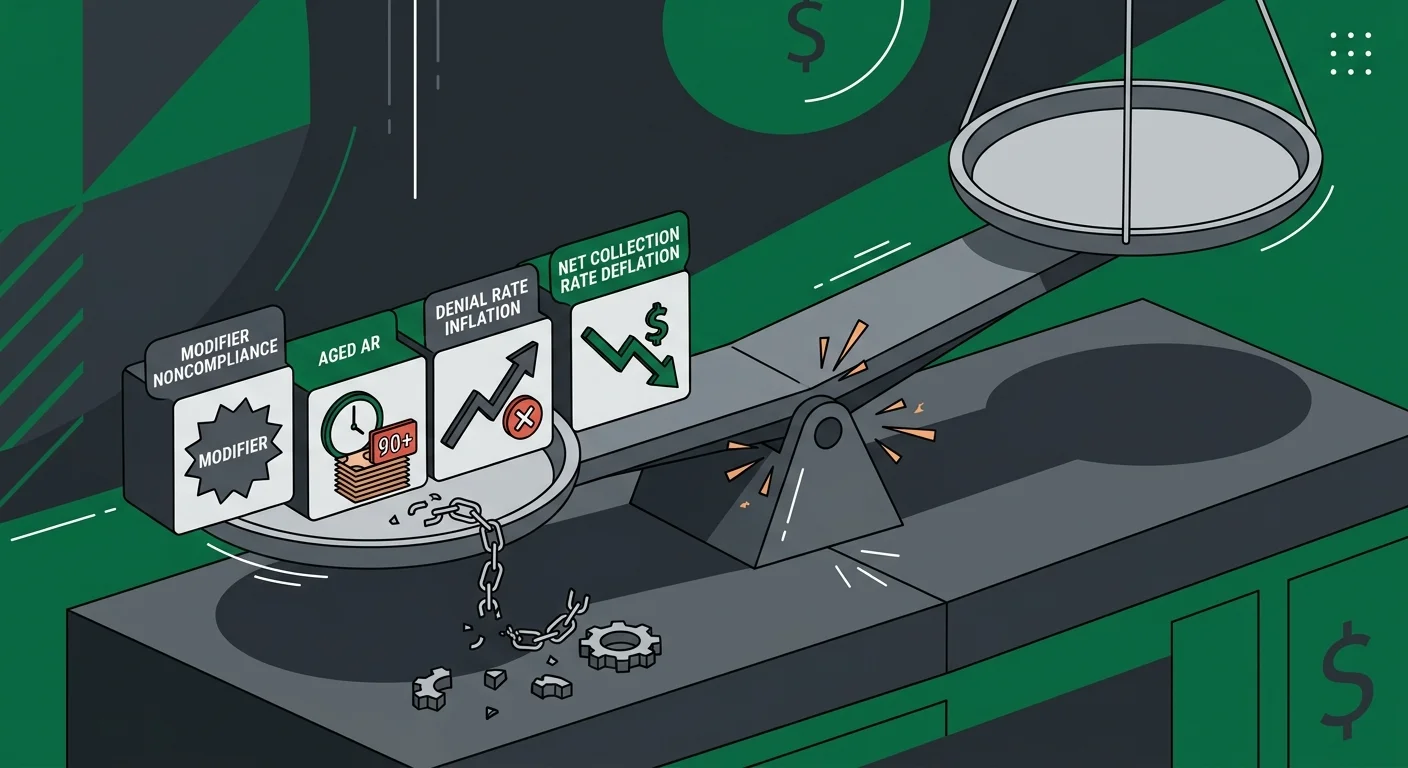
Knowing the four triggers is step one. Knowing exactly how each one registers inside a due diligence review is what actually changes your preparation.
Buyers don’t discount on instinct. They run specific tests against specific billing data. Modifier Noncompliance, Aged AR Exposure, Denial Rate Inflation, and Net Collection Rate Deflation map directly to those tests – one trigger per test, one discount per trigger.
Each trigger is a lever. And in the due diligence room, every lever moves in exactly one direction.
Discount Trigger 1 – Modifier Noncompliance and Federal Audit Exposure
Modifier Noncompliance is where chiropractic valuations take their first hit – and usually their biggest one. CMS regulations establish that codes 98940, 98941, and 98942 require the AT modifier to document active treatment and prove medical necessity. A practice that has been billing those codes without consistent AT modifier application hasn’t made a clerical error. It has built a federal compliance record – and buyers read compliance records differently than billing managers do.
HHS OIG audit findings consistently identify missing or misapplied AT modifiers as a primary driver of Medicare overpayments in chiropractic settings. Experienced buyers know this pattern by name. They isolate AT modifier compliance early in the review – not because it’s the easiest box to check, but because the exposure is retroactive. It doesn’t start at last quarter. It reaches back through the full billing history.
Non-compliant billing violates Section 5 of the FTC Act. That’s not a technicality – it’s an exposure a buyer prices into the offer. They’re not discounting for historical errors. They’re pricing in what it costs to inherit the liability. Practices that want to see their modifier exposure before a buyer does should start with their fee schedule reimbursement data – the modifier picture and the reimbursement picture are inseparable in any forensic billing review.
Discount Trigger 2 – Aged AR Exposure and Unrecoverable Write-Offs
Aged AR tells a buyer something the modifier data alone can’t. When receivables sit past 90 days, a buyer doesn’t read that as a cash flow timing issue. They read it as evidence of abandonment – denials that were filed, forgotten, and never resolved. That’s a very different story than a slow collections month.
That abandoned AR doesn’t disappear from the conversation. It gets repriced as a write-off. Buyers don’t apply a discount based on what the aged AR might theoretically recover. They apply it based on what they expect to collect running the billing operation they’re about to own. The billing history is the forecast. They treat it that way.
Discount Trigger 3 and 4 – Denial Rate Inflation and Net Collection Rate Deflation
Denial Rate Inflation and Net Collection Rate Deflation aren’t separate problems. They’re what Modifier Noncompliance and Aged AR Exposure look like after months of compounding.
A rising denial rate tells buyers the billing workflow is reactive. Claims go out, come back denied, and sit – with no structured resolution pathway in place. Every unworked denial that ages past 90 days becomes Aged AR. That AR accumulates into a net collection rate that no longer reflects what the practice was entitled to collect. Buyers follow that chain directly to the discount. Practices that want to see where their own chain breaks should understand that a regulatory billing audit and a revenue recovery audit surface different problems – and both matter before a buyer runs the same exercise.
The due diligence room prices all four triggers at once. Modifier Noncompliance establishes regulatory liability. Aged AR Exposure establishes operational neglect. Denial Rate Inflation establishes workflow failure. Net Collection Rate Deflation is the cumulative cost of all three. A practice with clean billing data across every trigger arrives with a defensible number. A practice that treated submission volume as a proxy for billing health arrives with a number buyers will correct – on their terms, not yours.
| Discount Trigger | Billing Root Cause | Buyer Response | Regulatory Authority |
|---|---|---|---|
| Modifier Noncompliance | Missing or misapplied AT modifier on codes 98940, 98941, and 98942 – active treatment not documented as medically necessary | Buyer isolates AT modifier compliance early; prices in retroactive federal clawback liability as a structural discount | CMS / HHS OIG |
| Modifier Noncompliance | Systemic AT modifier errors creating a federal compliance record across the billing history | Buyer treats missing modifier application as retroactive overpayment exposure – not a fixable billing gap | HHS OIG |
| Modifier Noncompliance | Non-compliant billing processes violating Section 5 of the FTC Act | Buyer prices in regulatory clawback risk and potential enforcement liability as a valuation restructuring event | FTC |
| Aged AR Exposure | Denials filed but not worked – accounts receivable abandoned past 90 days with no structured resolution pathway | Buyer reprices aged AR as expected write-offs based on inherited billing conditions, not theoretical recovery potential | HHS OIG |
Why Most Practices Cannot Self-Diagnose Their Billing Risk Before a Sale
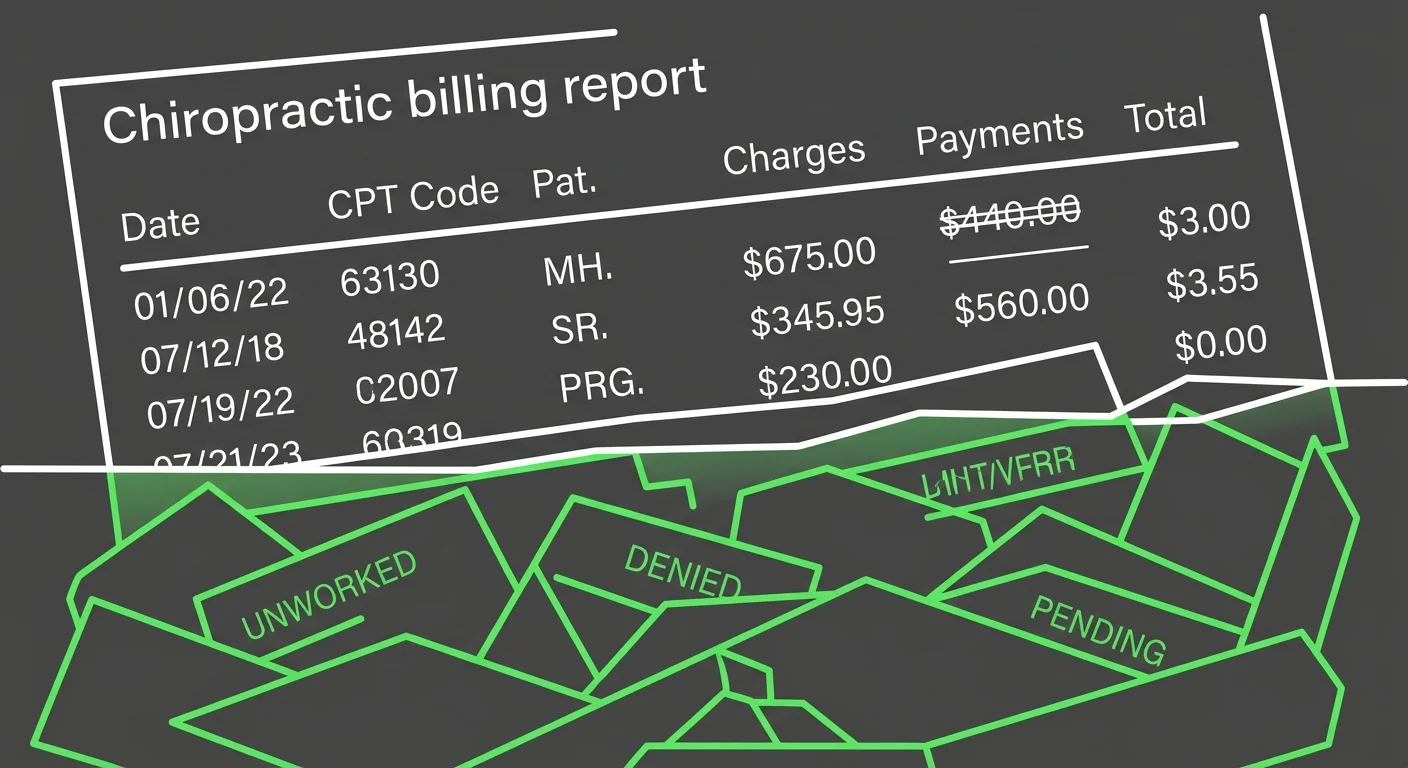
The dashboard looks clean. Claims are going out. Payments are coming in.
That picture is not wrong. It is just incomplete – and the part it omits is exactly what a buyer’s diligence team is trained to find.
Internal reports measure throughput. Submissions out. Payments in. Rejections flagged.
That’s one audit. A buyer’s diligence team runs a different one – and they’re specifically trained to find what yours never showed you.
The gap between what your internal reporting shows and what a buyer finds – that’s where practice equity disappears.
And if you discover that gap during the sale itself, you’re already losing. The buyer priced it in before the negotiation started.
The Structural Limits of EHR Reporting in a Due Diligence Context
EHR platforms are claim submission tools. That is the function they were built for. It is the function they perform well.
What they do not do – and were never designed to do – is audit the accuracy of what was submitted, or track the compliance exposure those submissions created downstream.
Here’s what that looks like in practice. Your EHR records that an AT modifier was applied. It doesn’t tell you how often it was missing. It doesn’t show whether the application was consistent with CMS documentation standards. And it absolutely does not calculate the cumulative exposure that inconsistency created across three years of billing history.
That analysis requires a human being to review the actual claims record. No software report produces it – because no software was built to.
Unworked denials are another version of the same problem. EHR reporting rarely surfaces them as a distinct category. They sit inside aging reports alongside legitimate open claims – indistinguishable from AR that’s still in process.
So the practice owner reads the report, sees a number, and believes they’re monitoring their billing health. They’re not. They’re measuring the wrong signal.
That’s exactly why weekly communication standards between a billing partner and a practice matter. Claim status visibility requires human interpretation. A dashboard can’t give you that.
What a Forensic Billing Review Surfaces That Internal Reports Miss
A forensic billing review doesn’t look at what you submitted. It looks at what you were entitled to collect.
Then it measures the distance between those two numbers. That distance is the valuation gap buyers calculate during due diligence. And it almost never shows up in any report a practice generates on its own.
Non-compliant billing patterns don’t just affect cash flow – they create regulatory exposure. Under Section 5 of the FTC Act, systemic billing inaccuracies can trigger retroactive clawbacks that restructure the valuation entirely. A forensic review surfaces the specific patterns your internal reporting has been obscuring.
Modifier application inconsistencies across payer types. Denial clusters tied to documentation gaps. Aged AR categorized as pending rather than abandoned. Net collection rate deflation that only becomes visible when entitled revenue is compared to actual collections.
Those are the four Discount Triggers – Modifier Noncompliance, Aged AR Exposure, Denial Rate Inflation, and Net Collection Rate Deflation. None of them announce themselves in a standard EHR billing summary. Resolving them is where operational efficiency improvements of 15% to 30% come from. Not as projections – as the measurable result of fixing what internal reporting never flagged.
| Diagnostic Method | What It Can Detect | What It Cannot Detect | Due Diligence Reliability |
|---|---|---|---|
| Internal EHR Billing Dashboard | Claim submission volume, payment timing, payer rejection flags | Modifier application consistency, unworked denial patterns, cumulative AT modifier exposure across billing history | Low – measures throughput, not accuracy; buyers discount evidence built on submission volume alone |
| Standard Aging AR Report | Outstanding balances by time bucket (30 / 60 / 90+ days), total open AR dollar volume | Whether aged claims were actively worked or passively abandoned, which denials are recoverable versus written off in practice | Partial – surfaces that aged AR exists but cannot distinguish operational neglect from legitimate in-process claims |
| Practice-Generated Denial Report | Initial payer rejection notices, denial reason codes on flagged claims | Resolution rate on denied claims, denial clusters tied to documentation gaps, denial patterns that repeat across payer types | Low – reports that denials occurred without confirming they were worked; buyers require resolution data, not just occurrence data |
| Forensic Billing Review (External) | Modifier application accuracy against CMS documentation standards, entitled revenue versus actual collections, denial cluster patterns, net collection rate deflation | Nothing material – designed specifically to surface what internal reporting cannot | High – produces the claim-level detail buyers use to calculate all four Discount Triggers: Modifier Noncompliance, Aged AR Exposure, Denial Rate Inflation, and Net Collection Rate Deflation |
Frequently Asked Questions
Billing-driven valuation discounts generate the same questions every time. They all orbit the same gap: what your internal reports show versus what a buyer’s forensic audit actually finds.
Here are the answers.
How do clean claim submission rates impact practice EBITDA during an acquisition?
Clean claim submission rates are not what buyers use to assess EBITDA. Buyers calculate EBITDA against entitled revenue – what the practice was eligible to collect – not against what moved through the system without being challenged.
A high submission rate paired with an unresolved denial backlog sends one message: the billing operation was optimizing for throughput, not for recovery. Buyers know the difference. That distinction reduces the defensible EBITDA number before a single valuation multiple is applied.
Unworked accounts receivable leads to unrecoverable write-offs. Those write-offs compress EBITDA on their own. The buyer’s multiple just makes the compression visible at closing.
Why do chiropractic modifier errors like the AT modifier trigger valuation write-downs?
The AT modifier is not a procedural detail. It is the documentation bridge between a billed service and Medicare’s coverage criteria.
CMS requires the AT modifier on codes 98940, 98941, and 98942 to establish that treatment is active and medically necessary – not maintenance care. When that modifier is missing or inconsistently applied, the claims record tells buyers something specific: Medicare reimbursements were collected without adequate documentation support.
That exposure is retroactive. HHS OIG audit findings identify missing or misapplied AT modifiers as a primary driver of federal clawbacks in chiropractic billing. A buyer acquiring that liability does not absorb it at face value. They price it as a discount – and they reach back through the full billing history to calculate exactly how much.
Can clinical software metrics replace a manual forensic billing audit before a practice sale?
No. Clinical software measures submission activity. A forensic billing audit measures accuracy. Those are entirely different questions.
An EHR records that a modifier was applied. It does not assess whether that application was consistent with CMS documentation standards across the full billing history. Software surfaces payer rejections – it does not isolate unworked denials sitting in aging reports alongside legitimate open claims.
Administrative billing error rates exceed 10% in private clinical settings. Standard software reporting was not built to surface that error rate as a distinct, auditable category. A buyer’s diligence team is not running software reports. They are running a structured claims-level review that internal tools were never designed to replicate.
How does aged accounts receivable over 90 days affect the enterprise value of a clinic?
Buyers do not read aged accounts receivable beyond 90 days as an administrative backlog. They read it as evidence of claim abandonment – denials filed and forgotten, never worked to resolution.
And they do not price it at its theoretical recovery value. They price it at what they expect to collect under the billing conditions they are about to inherit. That gap between theoretical and expected is what drives the offer discount.
Unworked AR leads directly to unrecoverable revenue write-offs. Those write-offs reduce enterprise value in direct proportion to the size and age of the exposure. Aged AR over 90 days is one of the clearest signals in a buyer’s diligence review – and they know exactly what it means before they make the first offer.
What is the typical valuation penalty for a chiropractic practice with high billing denial rates?
There is no fixed percentage. Buyers calculate the discount against the specific claims record in front of them – not against an industry benchmark.
But the mechanism is consistent. High denial rates deflate net collection rate. Net collection rate deflation compresses defensible EBITDA. Compressed EBITDA reduces the multiple a buyer is willing to apply. Each step follows directly from the one before it.
Billing error rates exceeding 10% in outpatient clinical settings translate into net collection rate deflation that buyers identify and reprice during diligence. A practice with persistent denial problems is not just losing revenue on uncollected claims. It is losing equity on every dollar of valuation those claims were supposed to support.
Billing Accuracy Is Practice Equity
A practice valuation isn’t built in the due diligence room.
It’s built in the billing decisions made every week, for years, before a buyer ever requests access to the records.
By the time a forensic audit begins, the outcome is already written in the claims history. Every AT modifier applied correctly. Every denial worked to resolution. Every aged AR dollar recovered instead of written off.
The sale surfaces that history. It doesn’t create it.
The four Discount Triggers – Modifier Noncompliance, Aged AR Exposure, Denial Rate Inflation, and Net Collection Rate Deflation – don’t show up at the end of a practice’s lifecycle. They develop quietly during normal operations, inside billing environments where submission volume gets tracked and accuracy gets assumed.
Practices that treat clean billing as an ongoing operational standard aren’t preparing for a sale. They’re protecting equity that belongs to them right now.
That’s why Bushido Billing exists. Because the practices that understand that distinction arrive at the table with a number they can defend.
The window to act is always earlier than sellers assume. A billing record that’s accurate today is a valuation asset tomorrow. One that isn’t becomes a discount the buyer prices in before the first offer lands.
Clean billing isn’t an administrative chore. It isn’t a pre-sale project. It’s the ongoing act of protecting practice equity long before a sale is ever on the table.
So ask yourself one question honestly: does your billing history, as it stands right now, tell the story your asking price requires?
A practice sale is not where billing accuracy becomes important. It is where billing accuracy gets priced.
Your billing history is already telling a story. The question is whether you know what it says before a buyer does.
A practice sale isn’t where billing accuracy starts to matter. It’s where billing accuracy gets priced – permanently, in the deal.
Book a Call to see where your billing data stands

© . All Rights Reserved | Web Design by iTech Valet