

How to Manage Provider Credentialing and Enrollment for a Rapidly Scaling Practice?
Provider credentialing and enrollment is the process of verifying a provider’s qualifications and securing payer approval to bill for clinical services. For a rapidly scaling chiropractic practice, it is also the process most likely to collapse cash flow when it is not treated as an active phase of the revenue cycle.
The payer panels are not ready when a new provider walks through the door.
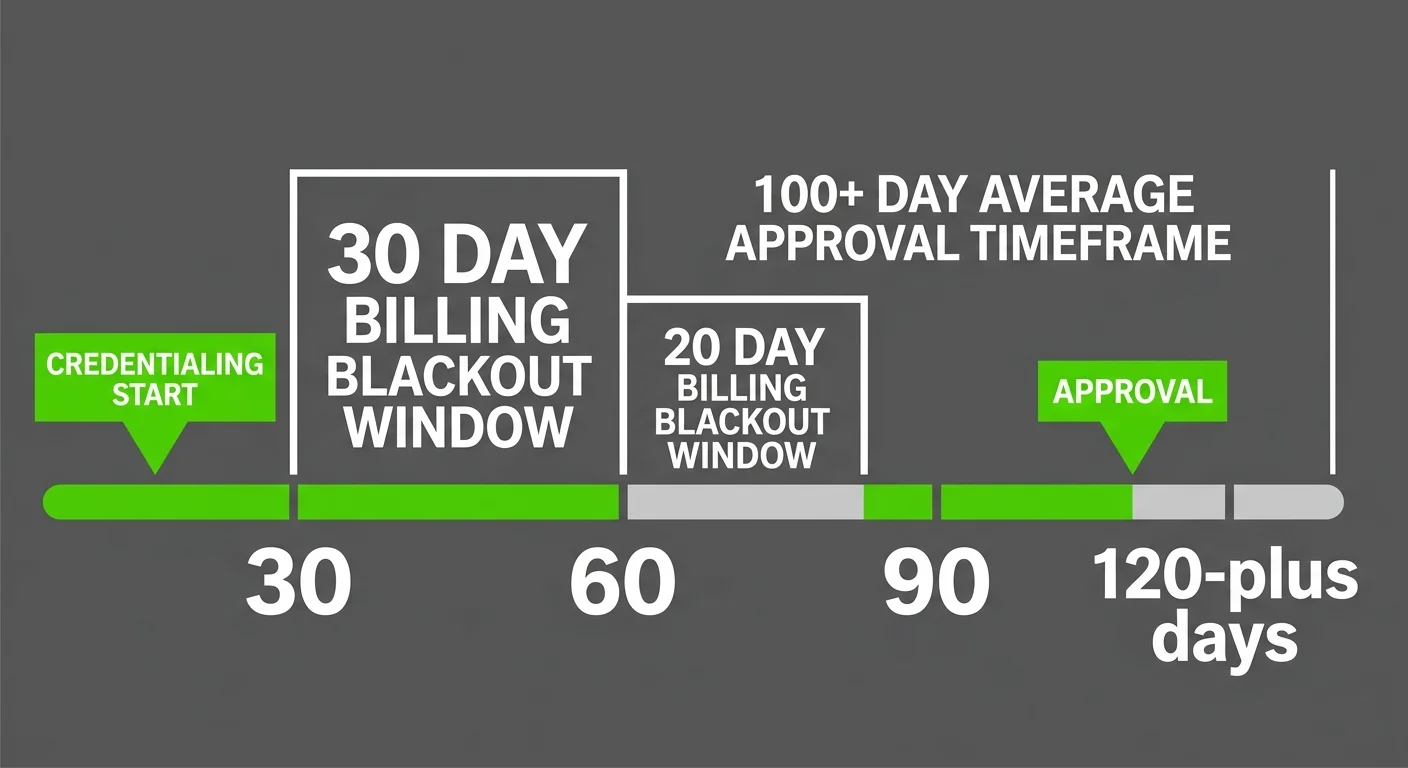
Each insurance carrier runs its own application, its own documentation review, its own timeline. That review typically spans 90 to 120 days or longer – during which the provider cannot bill at all, or can only bill under a supervising provider’s credentials depending on payer rules. Add multiple locations and multiple hires, and that delay multiplies with every expansion decision.
Federal enrollment compounds the exposure. Medicare participation requires enrollment through PECOS, and active providers must revalidate their enrollment details every five years. A missed revalidation or an incomplete documentation package does not create a paperwork problem – it interrupts billing eligibility entirely. HRSA guidelines require primary source verification of all licenses, registrations, and education credentials before a provider can participate in federal programs. These are structural gates that determine whether a claim ever reaches a payer.
For chiropractic groups, the complexity runs deeper. AT modifier compliance, maintenance versus active care documentation standards, and payer-specific rules mean credentialing errors do not just delay payment – they generate denials that compound into aging accounts receivable. Aging AR does not recover on its own.
Managing this process in-house, without specialty expertise, produces the same outcome: manual tracking, documentation gaps, and staff pulled away from billing execution. Scaling practices require a credentialing and enrollment process that runs parallel to hiring – not one that starts after a provider has already begun seeing patients.
Why Chiropractic Groups Lose Revenue During Provider Onboarding
Here’s the misdiagnosis most scaling practices make: they see cash flow drop after adding a new associate and call it a billing volume problem.
It isn’t.
It’s a timing failure – and it was locked in the moment credentialing didn’t run parallel to the hiring decision.
Practices that centralize billing workflows across multiple chiropractic clinics have already learned this the hard way.
Enrollment isn’t the paperwork that follows hiring. It’s the revenue cycle gate that determines when a new provider can generate collectible revenue.
Every day that gate stays closed, the practice absorbs a cost it cannot recover.
The Billing Blackout Window
Here’s what the blackout actually looks like. A new associate starts seeing patients on Day 1. Claims can’t go out under that provider’s credentials because the payer panels aren’t open.
So the clinic holds those claims – or bills under a supervising provider’s credentials, depending on payer rules.
Both create AR risk. Both compound every week the credentialing review drags on.
Payer credentialing processing spans 90 to 120 days on average, according to NIH research. That’s not the worst case. That’s the baseline.
For a practice that hired three associates across two locations in a single quarter, that delay doesn’t add. It multiplies.
The claims don’t disappear during that window. They age.
And aged AR in chiropractic billing compounds – into denials, retroactive eligibility disputes, write-offs that no amount of follow-up fully recovers.
The blackout window isn’t a delay. It’s a permanent revenue gap.
The Volume-First Credentialing Trap
There’s a second failure mode – and this one is entirely self-inflicted.
When credentialing gets treated as a speed-and-volume task instead of a revenue cycle phase, it gets handed off to whoever has bandwidth. That’s usually a front-desk staff member or office manager already stretched across scheduling, patient communication, and billing support.
That person is now your credentialing team.
The staff member chasing a CAQH attestation reminder isn’t working your AR. That’s not a minor inefficiency. It’s a direct, measurable trade-off most practices never bother to calculate.
Any group building for growth without expanding administrative headcount needs credentialing running parallel to hiring – not starting after the provider walks through the door.
The volume-first trap is exactly what it sounds like: move fast, check boxes, assume the payer sorts it out. That assumption is why so many enterprise chiropractic groups plateau at the moment they should be accelerating.
The payer panels aren’t ready. That’s not a payer problem. That’s a planning failure – and it started the day credentialing got treated as someone’s side task.
| Enrollment Phase | Typical Duration | Cash Flow Impact | Most Common Failure Point |
|---|---|---|---|
| Commercial payer panel review | 90 to 120 days or longer | Zero collectible revenue from new provider during review window; claims held or billed under supervising credentials, creating AR risk | Incomplete or inconsistent documentation package submitted at application – triggers payer requests for additional information, extending the timeline |
| Multi-location parallel enrollment | 90 to 120 days or longer per provider, per payer | Delays multiply across every associate added in the same hiring cycle; billing blackouts compound rather than overlap when onboarding runs sequentially | Treating enrollment as a post-hire task rather than a revenue cycle phase running parallel to hiring – each delayed start extends the aggregate cash flow gap |
| In-house credential tracking | Administrative waste spanning several weeks beyond necessary | Key clinic staff diverted from billing execution to redundant paperwork management – AR follow-up and denial resolution go unworked during the tracking period | Manual tracking of licensing credentials with no specialty-aligned workflow – staff without credentialing expertise misses payer-specific documentation requirements |
| Staff reallocation to credentialing tasks | Ongoing – no defined endpoint without a structured process | Billing execution capacity reduced; denied claims and aging AR accumulate while credentialing paperwork consumes staff bandwidth | No clear separation between credentialing responsibilities and active billing responsibilities – one staff member absorbs both, and billing loses every time |
What a Specialty-Led Credentialing Process Actually Looks Like
Most practices treat credentialing as something that happens after the hire. A box to check before Day 1. That assumption is the exact reason so many scaling chiropractic groups hit a revenue wall at the moment they should be accelerating.
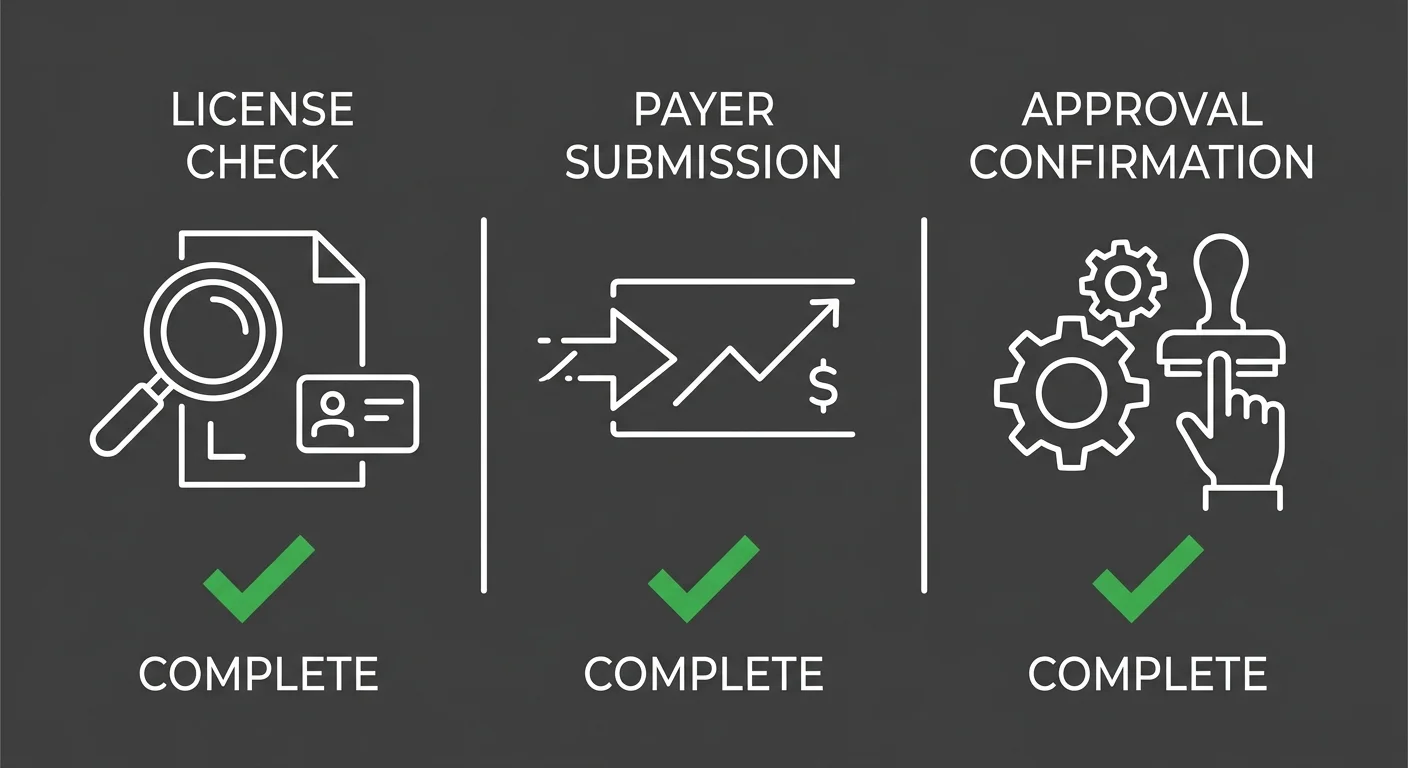
A specialty-led process runs differently from the start. Documentation assembly, primary source verification, payer application tracking, CAQH profile maintenance – every step runs as a live revenue cycle function. Not HR paperwork. Not administrative overhead. The launchpad that determines whether a new provider generates collectible revenue from Day 1 or bleeds the practice through a months-long billing blackout.
Primary Source Verification and Why Generalists Miss It
Here’s what HRSA federal quality guidelines make non-negotiable: every license, registration, and education credential must be verified at the primary source. That means contacting the issuing board, the institution, or the licensing authority directly. Not relying on a provider’s submitted copies. Not trusting an EHR’s intake form. Not assuming a CAQH profile is accurate because the provider filled it out themselves.
And this applies to every active chiropractic and allied health staff member – no exceptions. Generalists miss it because they’re working from a checklist built for general medical billing. Chiropractic-specific license categories, state board nuances, and DC designation verification require a different lens entirely. That’s a lens a generalist credentialing process doesn’t carry.
Here’s what happens when it’s done wrong. A payer flags a discrepancy during their own verification sweep. The credentialing application freezes. The entire timeline resets. That’s not a paperwork inconvenience – that’s another 30 to 60 days added to an already multi-month blackout window. And no one at the clinic knows it happened until the AR report surfaces it.
Why This Is Not a Task for EHR Software
EHR platforms are claim submission tools. They move documentation from the clinic to the clearinghouse – and they do that reasonably well. But the moment credentialing requires active follow-up with a payer’s provider relations department, a mid-application documentation correction, or a targeted appeal of an enrollment delay, the software has no pathway. It wasn’t built for that. It can’t do it.
Practices that are already working to centralize billing workflows across multiple chiropractic clinics run into this ceiling fast. The EHR tracks submission status. It doesn’t negotiate with a payer. It doesn’t catch a CAQH attestation that expired mid-application. It doesn’t know that a specific commercial carrier has a separate chiropractic credentialing unit with different documentation requirements than its general medical track.
That’s the gap a DC-founded embedded billing partner is built to close. Human expertise – with chiropractic specialty knowledge built in – tracks payer-specific requirements, manages primary source verification timelines, and follows up directly when an application stalls. Provider credentialing and enrollment done right isn’t faster software. It’s specialty-trained people who know exactly where the process breaks – and stay in it until it doesn’t.
| Credentialing Task | EHR Automation Handles | Specialty Human Review Required | Risk if Skipped |
|---|---|---|---|
| Initial provider documentation assembly | Collects submitted copies from provider intake forms | Requests and verifies primary source documents directly from issuing boards and institutions | Payer flags discrepancies during their own sweep, resetting the entire application timeline |
| Primary source verification of licenses and credentials | No – EHR accepts provider-submitted information at face value | Contacts licensing authorities, state boards, and educational institutions directly to confirm credential authenticity | Credentialing application frozen mid-process; billing eligibility delayed by additional weeks or months |
| CAQH profile creation and ongoing attestation | Sends automated reminders; cannot correct errors or manage expired attestations mid-application | Monitors attestation cycles, corrects profile discrepancies, and prevents expiration gaps that stall payer review | CAQH expiration during an active credentialing review triggers automatic rejection and a full restart |
| Payer-specific application routing and documentation requirements | Submits to clearinghouse using standard documentation set | Identifies carrier-specific credentialing units, chiropractic-track requirements, and supplemental documentation rules per payer | Application rejected or deprioritized due to missing payer-specific documentation; timeline resets |
| Active follow-up when an application stalls | No – EHR tracks submission status only; has no pathway for direct payer outreach | Contacts payer provider relations departments directly, identifies stall cause, and resolves documentation gaps in real time | Stalled applications age without detection; billing blackout extends silently until AR report surfaces the problem |
| Chiropractic-specific billing rule alignment during enrollment | No – EHR enrollment workflows are built for general medical billing parameters | Applies AT modifier rules, maintenance versus active care documentation standards, and DC designation verification at the credentialing stage | Credentialing approved under general medical parameters; first claims denied for chiropractic-specific rule violations |
| Medicare PECOS enrollment and revalidation tracking | Sends alerts for upcoming revalidation windows; cannot manage documentation submissions or resolve PECOS errors | Manages PECOS submissions, monitors revalidation cycles, and resolves system flags before they interrupt billing eligibility | Missed revalidation or incomplete PECOS documentation terminates Medicare billing eligibility without advance notice to the clinic |
PECOS, CAQH, and Commercial Panels: The Enrollment Sequence That Protects Cash Flow
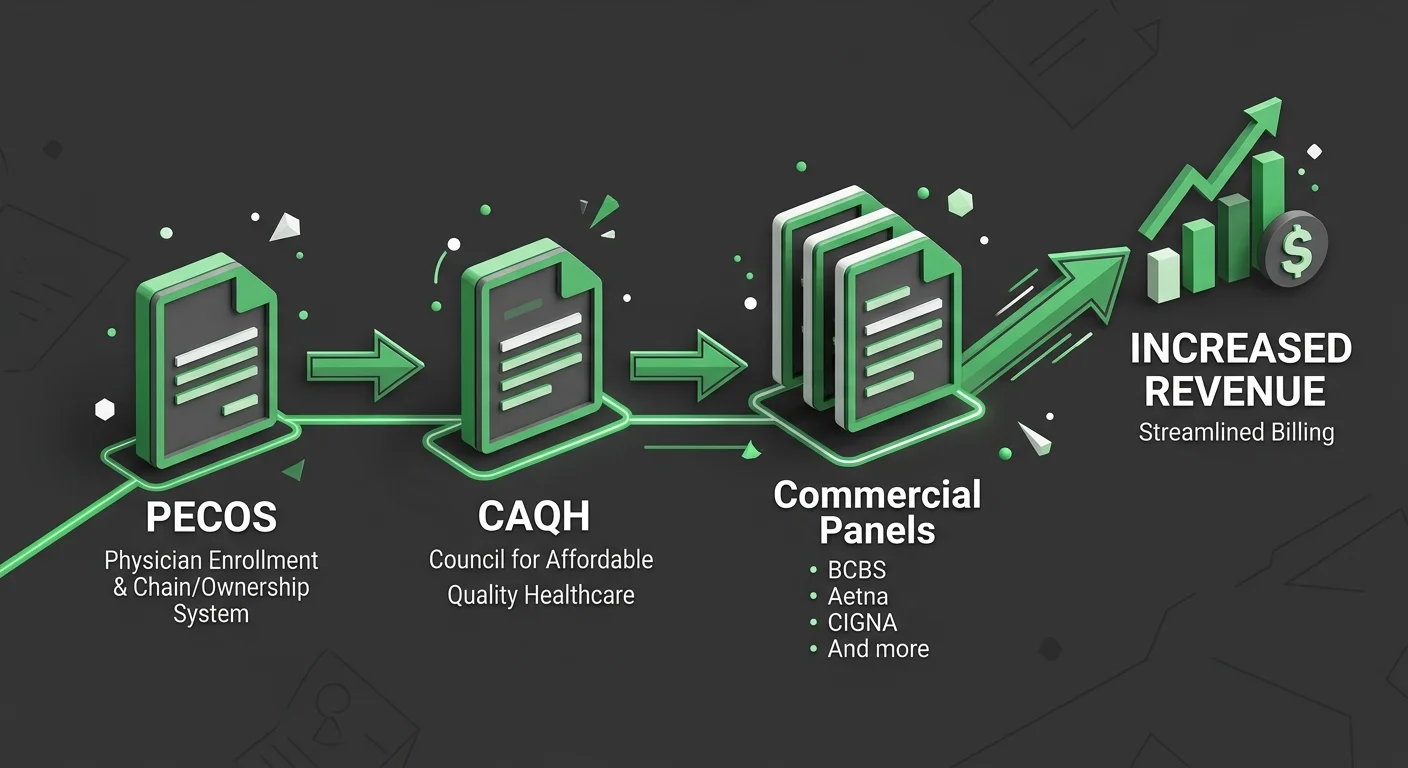
Three enrollment tracks. All running at the same time.
Medicare PECOS. CAQH profile maintenance. Commercial panel applications. Each has its own timeline, its own documentation requirements, and its own failure modes.
Run them in sequence – wait for one to clear before touching the next – and you build the exact billing blackouts you’re trying to avoid.
Getting that sequence wrong isn’t a paperwork headache. It’s a multi-month revenue gap that compounds every week it sits.
For a group adding multiple providers across multiple locations, those gaps don’t stack. They multiply.
Medicare PECOS Enrollment: Revalidation, Timing, and What Breaks
Medicare enrollment runs through PECOS – and it’s non-negotiable for any provider billing Part B. CMS mandates that active providers revalidate their enrollment details every five years to stay eligible for reimbursement, as confirmed by published enrollment guidance.
Miss a revalidation cycle. Submit incomplete documentation. Let a license lapse mid-application. Billing eligibility doesn’t slow down – it disappears.
The revalidation clock doesn’t pause when you’re busy hiring. It runs independently of your operational calendar.
A multi-location group adding three providers in a single quarter is managing three separate PECOS timelines – each with its own documentation set, each touching a federal system that has no interest in your growth plans.
Here’s what breaks most often: the practice assumes PECOS enrollment is done because the application went in.
Submission isn’t enrollment. CMS reviews documentation, cross-references licenses, and can return requests for additional information at any point. Every one of those requests resets the clock on that provider’s billing eligibility.
In most practices, nobody is watching closely enough to catch it before it costs weeks.
Commercial Panel Sequencing for Multi-Location Groups
Commercial panel credentialing is where the timeline gets expensive. Payer credentialing processing spans 90 to 120 days on average – and that’s not the worst case. That’s standard.
For a group adding providers across locations at the same time, that window doesn’t run once. It runs for each provider, with each payer, on a schedule entirely controlled by the carrier.
The sequencing decision matters more than most groups realize. If commercial applications don’t launch the moment a hire is confirmed – not after credentialing verification, not after the start date – the 90-to-120-day window starts late.
A provider who starts seeing patients in January might not be credentialed with a major commercial carrier until April or May at best. Every claim generated in that window is held, billed under a supervising provider with AR risk attached, or lost.
There’s no recovery path for that revenue. The window closes.
Managing this across multiple locations takes more than a tracking spreadsheet. Carrier-specific documentation requirements are real – a commercial carrier’s chiropractic credentialing unit frequently runs on different rules than its general medical track. Missing those distinctions doesn’t slow the process. It restarts it.
Practices that have worked to reduce onboarding friction for new associates already know this: commercial panel sequencing is a parallel workstream, not a downstream task. Starting it late isn’t an administrative oversight. It’s a structural revenue decision.
Who Should Not Be Running This Process In-House
If your credentialing process is owned by a front-desk coordinator, an office manager carrying six other responsibilities, or a general billing staffer without chiropractic specialty knowledge – the process isn’t being managed.
It’s being attempted.
That difference shows up in your AR aging report. Not your task list.
Groups consolidating into larger multi-location entities hit this at scale. The administrative systems that held together at one location don’t survive rapid provider expansion. The credentialing function is always the first to break.
If your practice is primarily cash-pay, if insurance billing isn’t a meaningful revenue driver, or if you’re looking for a process that requires zero provider cooperation on documentation – this isn’t the right fit. Full-service insurance billing at the enterprise level requires embedded specialty expertise and active provider participation. That’s the model.
Practices unwilling to operate that way will reproduce the same credentialing bottlenecks at every growth stage. The problem doesn’t shrink as you scale. It compounds.
| Enrollment System | Who It Governs | Key Deadline or Cycle | What Happens If It Lapses |
|---|---|---|---|
| Medicare PECOS | All providers billing Medicare Part B | Revalidation every 5 years | Billing eligibility suspended until revalidation is complete and approved |
| Commercial Panel Applications | Individual providers seeking in-network status with commercial carriers | Applications must launch at hire – not at start date | Provider bills out-of-network or holds claims for 90 to 120 days minimum |
| Multi-Location Panel Sequencing | Each provider at each location, per carrier | Parallel applications required – sequential filing multiplies the blackout window | Multi-month AR gaps that compound across providers and locations |
| Medicare PECOS (Scaling Groups) | Every new provider added during group expansion | Independent revalidation clock per provider – does not pause during growth | Billing eligibility lapses individually per provider if documentation is incomplete or license lapses |
Building the Credentialing Infrastructure for a Growing Chiropractic Group
Most groups think the hard part is hiring. It isn’t.
The hard part is building the administrative infrastructure that lets every new provider bill from Day 1 – and hold that capacity as the group keeps adding locations.
Manual credential tracking doesn’t just slow things down. It pulls billing staff off revenue-generating work to chase paperwork – and every week that drags out is a week claims aren’t moving.
At one location, a practice survives that friction. At three or five, it compounds into a structural backlog that no catch-up sprint ever fully clears.
The infrastructure has to exist before the growth arrives. Building it after the AR report shows the damage isn’t a strategy. That’s damage control – and it costs more than the original problem would have.
The Documentation Stack Every New Provider Requires
Every new chiropractic provider triggers the same documentation requirement: state DC license, NPI number, DEA registration where applicable, malpractice coverage confirmation, education transcripts, and any specialty certifications the provider holds.
That’s the floor. Every item on it has to be verified at the primary source.
Not collected. Verified.
HRSA-compliant credentialing standards require primary source verification. That means contacting the issuing board, the licensing authority, and the educational institution directly.
Not accepting provider-submitted copies. Not trusting a CAQH profile because the provider filled it out themselves.
Payers run their own verification sweeps. When their sweep finds what yours missed, the application freezes and the timeline resets. You don’t get a warning. You just stop hearing anything – and that silence is expensive.
How a group manages the choice between centralized and decentralized credentialing models isn’t a preference. It’s a structural decision with direct revenue consequences.
A fragmented documentation stack – each location tracking its own provider files independently – guarantees inconsistency. One location misses a license renewal. Another holds an outdated malpractice certificate. The application goes out with a gap, and the payer sends it back.
Get that wrong at two locations and you feel it. Get it wrong at five and you’ve built a credentialing backlog that compounds every quarter with no clean way out.
Tracking, Follow-Up, and the Communication Cadence That Prevents Silent Failures
Submitting a credentialing application isn’t the finish line.
It’s where the follow-up work starts – and most practices have no system built to run it.
Payers don’t notify clinics when an application stalls. They don’t flag a missing document, send a status update, or alert anyone that a provider relations review has been paused.
Silence from a payer isn’t progress. It’s the default.
And in a practice without a structured follow-up cadence, that silence can cost weeks before anyone realizes the clock stopped. By then, the damage is already in the AR aging report.
The follow-up cadence that prevents silent credentialing failures isn’t complicated. It’s just rare.
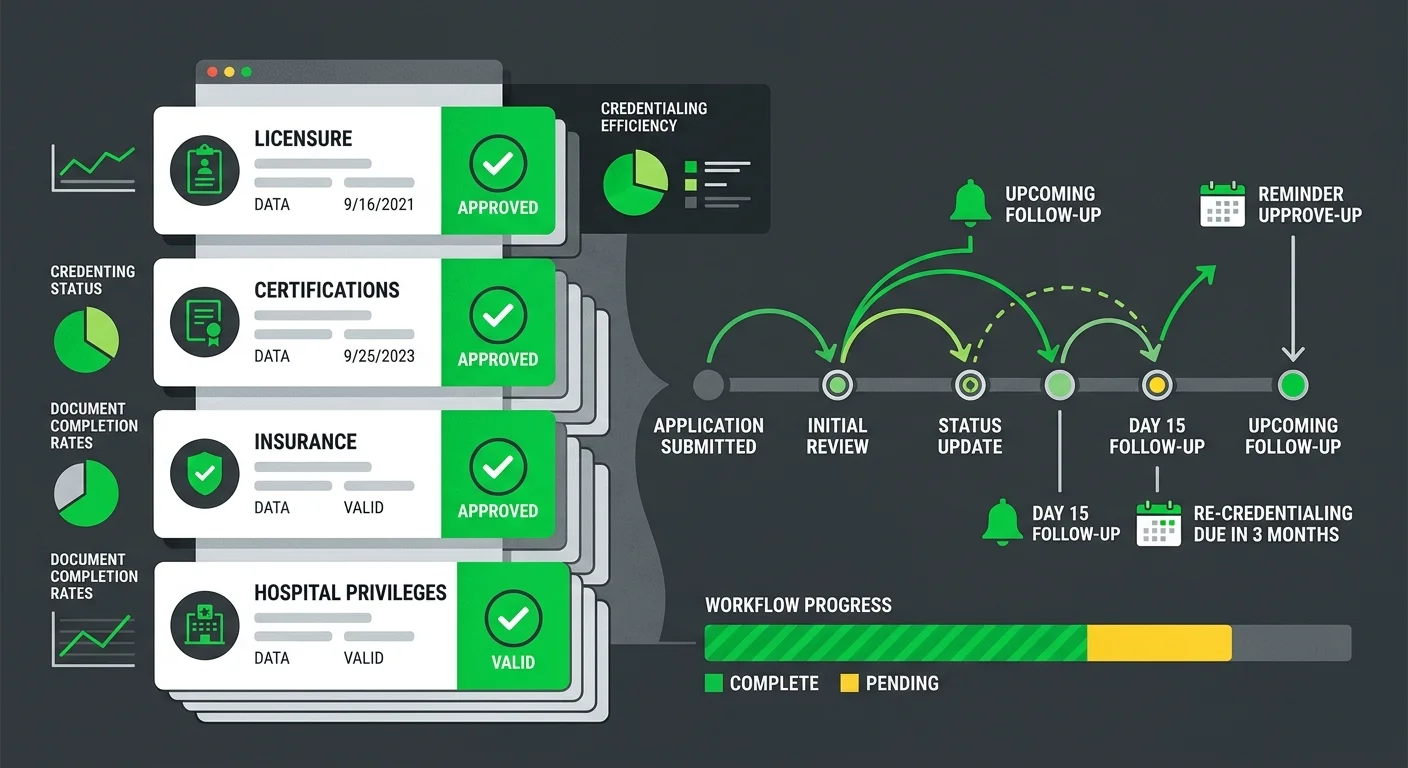
A designated contact for each active application. A scheduled follow-up interval with each payer’s provider relations unit. An internal status trigger that escalates the moment a timeline runs past its expected window.
That’s not overhead. That’s revenue protection. McKinsey’s analysis of accelerating medical group consolidation is direct on this point: the practices that scale without cash-flow collapse treat administrative infrastructure as a revenue function – not an afterthought. Credentialing follow-up is exactly where practices without that discipline break first.
| Document or Credential | Required For | Renewal Cycle | Who Tracks It |
|---|---|---|---|
| State DC License | All commercial payer credentialing, PECOS enrollment, CAQH profile | Varies by state – typically annual or biennial renewal | Designated credentialing coordinator; flagged in centralized tracking system |
| National Provider Identifier (NPI) | Every insurance billing submission across all payers and locations | No expiration – but address and taxonomy updates required when practice details change | Billing team; updated immediately when provider information changes |
| CAQH ProView Profile | Most commercial payer credentialing applications – primary data source for carrier review | Attestation required every 120 days to keep profile active | Provider with active oversight from credentialing coordinator; lapses stall all active applications |
| Malpractice Coverage Certificate | All payer credentialing applications and hospital privileging | Annual renewal tied to policy term – certificate must reflect current coverage dates | Practice administrator; outdated certificates trigger application rejections |
| DEA Registration (where applicable) | Payer credentialing and any prescriptive authority documentation requirements | Renewable every three years through the DEA registration portal | Credentialing coordinator; renewal gaps can freeze applications mid-review |
| Education Transcripts and Graduation Verification | Primary source verification during initial credentialing – required for every new provider | One-time requirement per provider; must be sourced directly from the issuing institution | Credentialing team; provider-submitted copies are not acceptable under primary source verification standards |
| Specialty Certifications (where held) | Payer credentialing profiles where specialty designation affects covered service scope | Varies by certifying body – typically renewed every two to three years | Provider with tracking by credentialing coordinator; expired certifications can limit billable service categories |
Frequently Asked Questions
These aren’t hypothetical questions. They’re the same credentialing problems that surface at the same growth stages – and cost the same revenue every time.
Here’s what you actually need to know.
How long does the provider credentialing process actually take when scaling to multiple locations?
Longer than your growth plan assumes. Payer credentialing processing spans 90 to 120 days on average. That’s not the worst case – that’s the baseline. And it runs separately for each provider with each payer. At one location, one hire, that’s manageable. Across three locations adding providers at the same time, those windows don’t align. They overlap and compound. The clock starts only when the application is submitted correctly and completely. A missing document resets it. An unanswered carrier request extends it. Plan for the full range. Build the buffer before the hire is confirmed – not after the associate walks in.
Why does relying on generic EHR software for credentialing and enrollment lead to lost revenue?
EHR software submits claims. It doesn’t credential providers. Those are different functions – and confusing them is exactly where the revenue loss starts. When a group relies on an EHR to manage enrollment, it’s trusting a submission tool to run a follow-up process it was never built for. Payer panels go pending. Applications stall without notification. Nobody inside the EHR is calling a provider relations unit to ask why an application has been sitting for 60 days. That silence becomes a billing blackout – and the dashboard shows nothing wrong.
What are the common points of failure when chiropractic groups handle CAQH updates in-house?
Can we delegate enrollment entirely to a new associate without disrupting active clinic billing?
Delegation relocates the risk. It doesn’t eliminate it. A new associate can gather their own documentation. They can’t manage the payer follow-up process on their own credentialing application – most carriers won’t allow it. More practically: a provider learning a new clinic’s clinical workflow isn’t positioned to track carrier-specific enrollment requirements, respond to provider relations requests, or escalate a stalled application before it costs weeks. Enrollment has to be owned by someone whose primary responsibility is exactly that. When it isn’t, it gets done between other things – and that’s when the blackout window quietly starts extending.
How do commercial insurance credentialing delays impact cash flow projections during an enterprise expansion?
They make the projections wrong. During a 90-to-120-day credentialing window – or longer – every claim generated by an uncredentialed provider either holds, bills under another provider’s NPI with AR risk attached, or doesn’t bill at all. For an enterprise expansion adding multiple providers across locations, those blackout windows don’t run sequentially. They overlap. Cash flow projections built on hire dates instead of credentialing completion dates will be off – sometimes significantly. The revenue those providers were supposed to generate won’t materialize on the timeline the model assumed. Build projections around enrollment completion. Not start dates.
What is the difference between credentialing and enrollment, and why does it matter for a scaling practice?
Credentialing is the verification process – confirming a provider’s licenses, education, and professional history meet a payer’s standards. Enrollment is what comes next: formally registering that credentialed provider with a specific payer so claims can be submitted and reimbursed under their NPI. Both are required. Neither replaces the other. For a scaling practice, the distinction matters because the timelines are sequential, not simultaneous. Credentialing has to complete before enrollment can begin. CMS Medicare enrollment then requires revalidation every five years to keep that status active. A group that conflates the two steps will routinely submit enrollment applications before credentialing is verified – triggering rejections that reset the clock entirely.
Credentialing Is a Revenue Decision, Not a Paperwork Problem
Credentialing isn’t the administrative step that happens after a hire is confirmed.
It’s the revenue cycle phase that determines whether that hire ever generates a single reimbursed claim.
Every day a provider sees patients without active payer enrollment, the practice absorbs the cost of its own growth. And it absorbs it permanently – no retroactive billing, no catch-up window, no recovery path.
That gap – between operational readiness and billing readiness – is where scaling practices bleed.
The rooms are ready. The patients are booked. The charts are open.
But the payer panels aren’t.
And when enrollment gets treated as paperwork that follows hiring instead of the launchpad of the revenue cycle, the gap doesn’t shrink as the group grows. It multiplies – one provider at a time, one location at a time, one aging AR report at a time.
Bushido Billing was built to close that gap before it opens – not after the damage shows up in the numbers.
Practices that treat credentialing as a revenue decision build the infrastructure before the growth arrives.
They run enrollment as a parallel workstream. They verify at the primary source. They follow up on every active application and align clinical documentation with payer rules before the first claim is ever submitted.
That’s what scaling without cash-flow collapse actually looks like.
The question isn’t whether your next hire can start seeing patients. The question is whether someone owns enrollment from day one – or whether you find out the answer the hard way.
The payer panels aren’t ready.
Adding providers while payer panels sit unfinished isn’t a paperwork backlog. It’s a cash-flow gap that compounds every week. Bushido Billing treats credentialing and enrollment as active revenue cycle work – not an administrative afterthought that starts once someone’s already on payroll.

© . All Rights Reserved | Web Design by iTech Valet