

How to Reduce Onboarding Friction for New Associates in a Multi-Location Group?
Onboarding friction in a multi-location chiropractic group is a revenue cycle problem – not an HR problem.
A new associate’s first patient visit and their first collectible claim are not the same event. The gap between them is where most multi-location practices lose revenue they never recover.
Credentialing cycles for clinical providers routinely run 90 to 120 days. Incomplete initial files push payer enrollment back an additional 14 to 30 days. Medicare enrollment through electronic PECOS submissions targets 45 days – paper applications can stretch to 80. A new associate who starts seeing patients before payer enrollment is complete generates clinical activity that cannot be billed, or gets billed incorrectly and denied.
For chiropractic practices, the alignment problem runs deeper. Medicare claims require the AT modifier to distinguish active therapeutic treatment from non-covered maintenance care. Without billing setup and documented training in place before that first claim goes out, the practice absorbs denial exposure it did not need to create.
Reducing this friction requires a sequenced approach – one that treats credentialing initiation, payer enrollment, billing system configuration, and compliance documentation as a coordinated launch, not a checklist completed after the associate arrives. Structured professional transition processes reduce early attrition risk by approximately 50% during active scaling. Structured programs improve initial productivity by over 70%.
Practices that scale multi-location groups without revenue disruption start the credentialing-first process before the associate signs – not after they show up.
Why Associate Onboarding Is an RCM Event, Not an HR Task
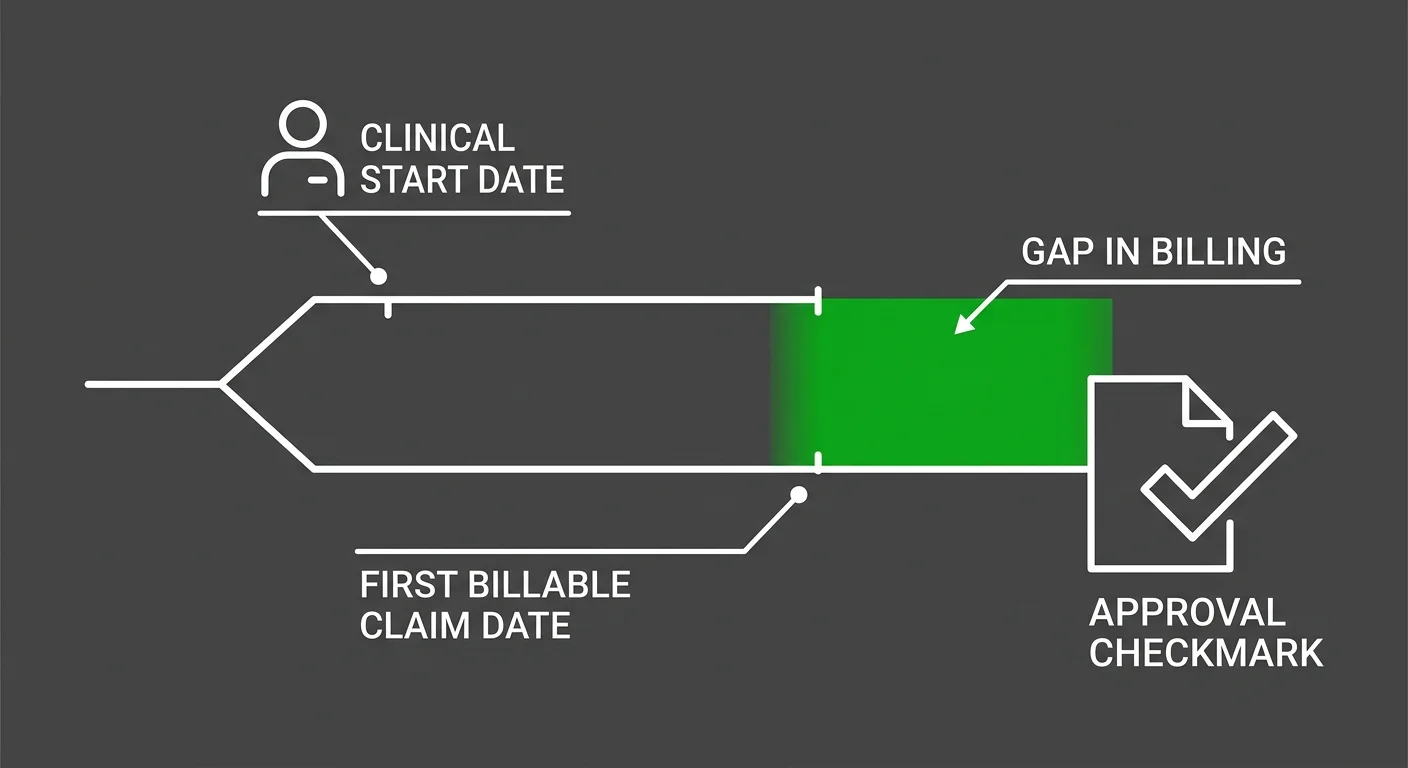
Most multi-location groups treat a new associate’s first week like an orientation exercise. Paperwork. EHR logins. Office tour. But the revenue clock doesn’t care about the checklist. It starts the moment that associate sees their first patient.
The billing infrastructure that makes that first visit collectible – payer enrollment, credentialing approval, billing system configuration – doesn’t move at clinical speed. Credentialing cycles routinely run 90 to 120 days. Incomplete initial files push payer enrollment back an additional 14 to 30 days on top of that. So when a new associate is ready to see patients on week one, the billing side of that equation isn’t even close.
That’s the problem. Every day between a new hire’s first clinical contact and their first collectible claim is a day of revenue exposure. In a multi-location group, that exposure doesn’t stay in one room. It multiplies.
The Gap Between First Patient and First Collectible Claim
The gap between first patient and first collectible claim isn’t a scheduling problem. It’s a structural one. Clinical capacity and billing compliance are two separate systems. And they almost never start at the same time.
A new associate sees their first patient on day one. Their credentialing file, meanwhile, is sitting in a payer queue – waiting on a missing document, still pending Medicare enrollment through PECOS. NIH research confirms that incomplete files routinely add 14 to 30 additional days to an already months-long process. Those aren’t claims deferred. They’re claims that were never properly set up to be submitted in the first place.
A new associate’s first patient visit and their first collectible claim are not the same event. Practices running a credentialing-first model plan for that gap and close it before the clinical clock starts. Everyone else discovers it as a denial wave three months after the associate joined – and by then, nobody remembers why the claims are failing.
Why Most Multi-Location Groups Miss This Until It’s Too Late
Here’s the pattern. Multi-location groups discover the credentialing gap when the AR report shows a cluster of zero-dollar claims tied to a new provider. By then, the window to bill retroactively is already closing. The group wasn’t negligent. They just never treated the associate’s start date as a billing event.
The same pressure that drives groups to hire associates fast is the pressure that compresses the credentialing timeline. Growth doesn’t wait. So the instinct is to move quickly, get the associate in front of patients, and sort out the paperwork later. Groups that figure out how to scale without ballooning administrative overhead learn this lesson early – because the billing gap that follows a rushed hire compounds quietly until it can’t be ignored.
Bushido Billing sees this pattern repeatedly in multi-location groups coming off a rapid hiring cycle. The high staff turnover risk to revenue cycle and the associate onboarding gap are versions of the same problem: clinical activity outpacing billing infrastructure. Standardized transition processes reduce early attrition risks by approximately 50% during active scaling – but only when the process starts before the associate’s first patient, not after.
| Onboarding Stage | HR Orientation View | RCM-First View | Revenue Impact |
|---|---|---|---|
| Credential-First Launch | Schedule orientation, collect HR paperwork, assign EHR login | Initiate credentialing file and payer enrollment applications before the associate’s start date | Claims are submission-ready the moment clinical activity begins – no retroactive billing gap |
| Billing Alignment | Walk associate through scheduling software and intake forms | Configure billing system for the associate’s NPI, assign modifier protocols, and verify payer-specific rules including Medicare AT modifier requirements | First submitted claims are correctly coded – denial exposure from setup errors is eliminated at the source |
| Active Compliance | Confirm HIPAA acknowledgment and handbook signature on file | Document billing training against OIG compliance standards, establish a payer-specific audit trail for the associate’s claim activity | Practice maintains a defensible compliance record – systemic billing errors tied to undocumented staff are a known audit trigger |
| Payer Enrollment Status Check | Not tracked – enrollment is assumed complete once paperwork is submitted | Actively monitor enrollment status across all relevant payers and flag incomplete files before the associate begins treating patients | Incomplete files are caught before they delay collections – not discovered weeks later in a denial cluster tied to a new provider |
| Multi-Location Coordination | Each location handles its own orientation independently, without a shared protocol | Credentialing, billing setup, and compliance documentation follow a standardized sequence across every location in the group | Scaling a new associate to additional locations does not restart a patchwork process – revenue exposure stays controlled as the group grows |
Why the Standard Checklist Approach Fails Multi-Location Groups
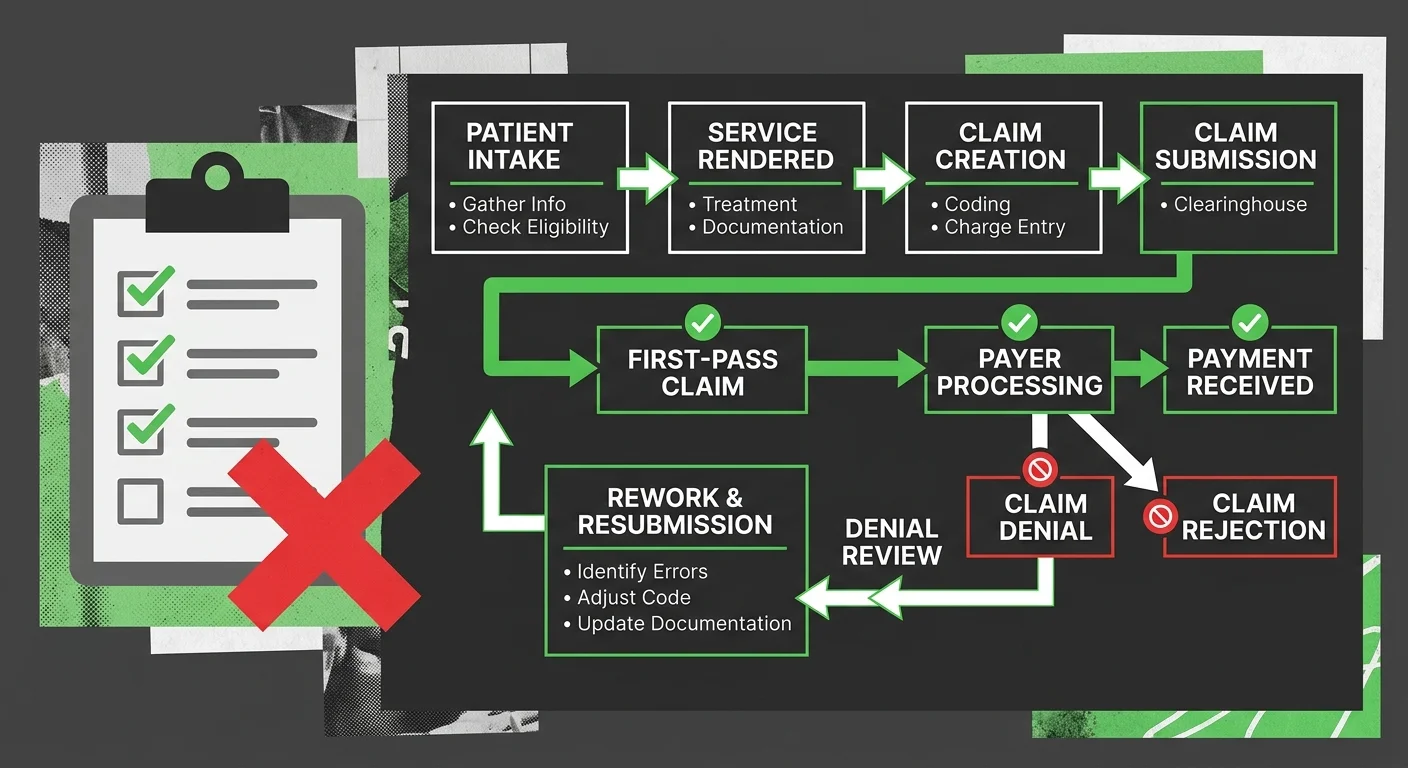
Most multi-location groups build their associate launch process around a checklist. EHR logins. HIPAA acknowledgment. Office tour. Maybe a shadow shift.
It looks complete. It isn’t even close.
The checklist treats a new associate’s arrival as an HR handoff. That’s the problem.
The items that actually determine whether claims get paid – payer credentialing, Medicare enrollment, billing system configuration, modifier instruction – aren’t on most orientation lists. They show up as afterthoughts. When they show up at all.
That sequencing error has a predictable outcome.
The associate starts seeing patients. Claims go out under incorrect configurations or missing credentials. Denials arrive weeks later. And by then, the billing problem has already become a collections problem.
The gap between the first patient visit and the first fully collectible claim was never acknowledged – let alone managed.
What EHR Platforms Actually Do – and Don’t Do
EHR platforms are claim submission tools. Not billing systems. That distinction matters for every practice managing chiropractic billing and revenue cycle management – and it matters most when a new associate walks in the door.
Here’s what an EHR does: it formats and routes a claim to the payer.
Here’s what it doesn’t do: verify the submitting provider is credentialed with that payer, confirm billing modifiers are configured correctly for that associate’s license type, or flag a Medicare claim missing the AT modifier that separates active therapeutic care from non-covered maintenance care.
That verification is a human function. The software assumes it’s already been done.
This is where the checklist model breaks under specialty pressure.
Chiropractic Medicare billing requires documented modifier discipline. The AT modifier must be applied accurately to active treatment claims. Maintenance care is strictly non-covered. Per published billing compliance guidance, regulatory standards require structured auditing protocols and documented billing instruction for clinical associates – specifically to prevent systemic errors.
An EHR cannot enforce that. A checklist cannot replace it.
The Volume-First Blind Spot That Kills New-Associate Revenue
Volume-first billing operations are built to process clean claims fast. They’re not built to catch credentialing gaps, modifier errors, or enrollment mismatches.
Those are exactly the problems that follow a new associate’s first weeks.
In a multi-location group scaling fast, the problem stacks.
Every new associate introduces another credentialing gap, another window of billing misalignment, another cluster of claims submitted before the billing infrastructure was ready to support them. High provider turnover doesn’t just slow revenue – it layers exposure with every cycle.
The volume-first model has no mechanism to pause and realign. It submits what arrives.
Incomplete files, missing credentials, misconfigured modifiers – all of it goes out, gets denied, and lands in an AR aging report that no one connects back to an associate who started three months ago.
The Credential-First Launch model exists precisely because the checklist approach was never designed for this problem.
| Capability | EHR Platform | Credentialing-First RCM Workflow |
|---|---|---|
| Provider credentialing verification | Assumes credentialing is complete before submission – no verification step built in | Initiates credentialing with all target payers before the associate’s first clinical date |
| Medicare modifier configuration | Formats and routes claims as submitted – does not flag missing or incorrect modifiers at the associate level | Configures AT modifier requirements and active-versus-maintenance care documentation standards for each provider before claims are submitted |
| Payer enrollment tracking | No built-in enrollment status monitoring – submits claims regardless of enrollment completion | Tracks enrollment status across all relevant payers and holds submission until the provider is billable with each payer |
| Billing compliance documentation | Does not generate or maintain documented billing instruction records for individual clinical associates | Produces structured billing training records and audit trails for each associate per regulatory compliance standards |
| Denial pattern attribution | Denial data is claim-level – not linked back to associate start dates or credentialing gaps | Cross-references denial clusters against associate launch timelines to identify and close structural billing gaps |
| Multi-location coordination | Operates at the claim level within a single location’s EHR instance – no cross-location credentialing oversight | Manages credentialing and billing alignment across all locations simultaneously when a new associate joins a group |
The Credentialing Bottleneck Every Multi-Location Group Hits
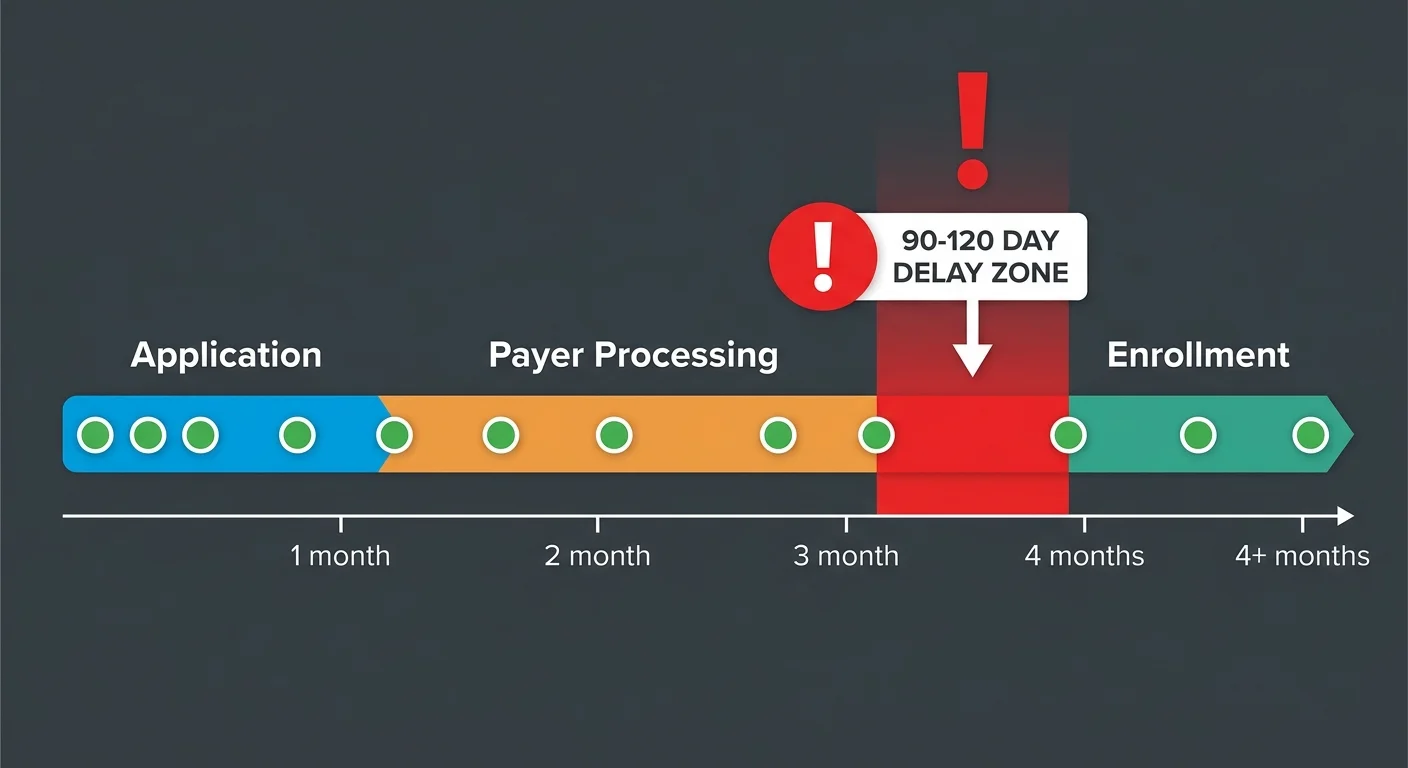
The credentialing bottleneck isn’t a paperwork problem. It’s the gap between when a new associate sees their first patient and when the practice collects its first dollar from that visit.
Standard credentialing cycles run 90 to 120 days. That window doesn’t compress because the practice is busy. Payers don’t care about your schedule.
For groups hiring quickly, this doesn’t just affect one associate. It stacks. Each new hire opens another 90-to-120-day exposure window – running simultaneously with every other hire. And when files are incomplete, that window stretches another 14 to 30 days per provider. Multiply that across a hiring cycle and the revenue gap isn’t a rounding error. It’s structural.
The 90-to-120-Day Window and What It Actually Costs
Here’s what the gap looks like in practice. An associate seeing 20 patients per week during the credentialing window is generating clinical activity – not collectible claims. Every visit submitted under a provider who isn’t enrolled with the payer is a claim that was set up to fail before anyone hit send.
Medicare makes it worse. Electronic PECOS submissions target a 45-day processing window. Paper submissions stretch to up to 80 days. If a practice doesn’t initiate Medicare enrollment before the associate’s first day – or better, before the offer letter is signed – those are days of pure, preventable revenue delay. Practices that understand how credentialing and enrollment interact during rapid scaling build the timeline backward from the start date. Everyone else builds it forward and absorbs the loss.
A new associate’s first patient visit and their first collectible claim are not the same event. The Credential-First Launch model exists to close that gap before it becomes an AR problem no one can trace back to its origin.
Providers Who Resist Transparency Make This Worse
There’s a specific pattern that makes the bottleneck worse. It’s not negligence – it’s resistance to the level of visibility that credentialing actually requires. Payers request documentation. Enrollment portals need timely responses. Incomplete files don’t just sit there. They add 14 to 30 days of delay on a predictable, compounding schedule. And that delay accrues whether anyone is paying attention or not.
Bushido Billing sees this consistently in multi-location groups coming off a fast hiring cycle. The associate drags on documentation. The practice assumes someone else is following up. Nobody is. Visibility into the credentialing timeline isn’t optional overhead. It’s the mechanism that determines whether clinical work converts to collected revenue. Providers who resist that transparency aren’t protecting their time. They’re extending the gap between first patient and first collectible claim – one unanswered request at a time.
| Credentialing Stage | Typical Timeline | Revenue at Risk | Common Delay Trigger |
|---|---|---|---|
| Payer credentialing (standard window) | 90-120 days | All claims submitted to that payer during the gap are unbillable or at denial risk | Incomplete initial file submitted to payer |
| Payer enrollment delay – incomplete file | Additional 14-30 days added to credentialing window | Extends the revenue gap beyond the standard credentialing cycle on every affected associate | Missing documentation triggers payer hold on enrollment application |
| Medicare enrollment – electronic PECOS submission | 45-day processing target | Medicare claims submitted before enrollment clears cannot be collected retroactively without re-billing | Enrollment not initiated at or before associate hire date |
| Medicare enrollment – paper submission | Up to 80 days | Doubles the Medicare revenue gap relative to electronic submission; compounds rapidly across multiple associates | Practice submits paper application instead of PECOS electronic filing |
Billing Compliance Requirements for New Associates
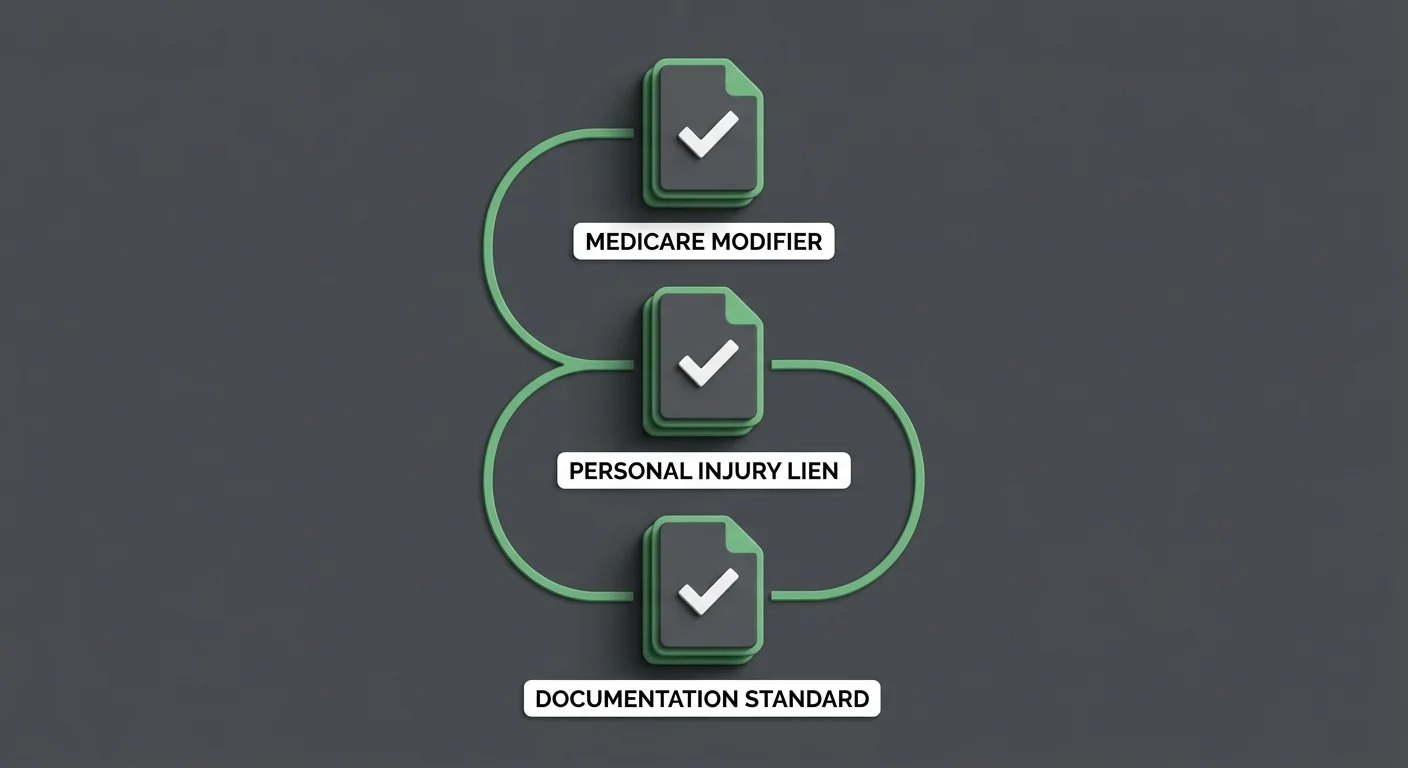
Getting credentialed and billing correctly are two different problems.
Most multi-location groups eventually solve the first one. They never fully solve the second.
Billing compliance for a new associate is not an orientation item. It is a live requirement with revenue consequences every time it breaks down.
The rules governing what a new associate can bill, how those claims must be documented, and which modifiers apply – these are not enforced by the EHR. The software does not know what the payer expects. That knowledge has to come from somewhere. And in most multi-location groups, it comes from nowhere at all.
Active compliance starts the moment the first credentialed claim goes out. Not after the first denial. Not after the first audit flag.
The Office of Inspector General requires structured auditing protocols and documented billing instruction for clinical associates – specifically to prevent systemic errors. That requirement exists because the errors are predictable. They follow patterns. And they are entirely preventable when the protocols are built before the first claim goes out, not assembled in response to the first denial wave.
Medicare Modifier Rules That New Associates Get Wrong
Medicare modifier errors are the most consistent billing mistakes new associates make. And the most expensive.
The AT modifier is not optional. It tells Medicare this claim is for active therapeutic intervention – not maintenance care. Medicare does not cover maintenance care. There is no appeal pathway for a visit documented as such.
Here is how it plays out. A new associate documents a visit with treatment language that reads as maintenance rather than active therapeutic necessity. The AT modifier gets omitted – or gets applied to a claim the documentation cannot support. The claim denies.
The associate did not know the standard. No one established it before day one. That is not a documentation problem. It is a process problem.
Active treatment claims require the AT modifier applied accurately and consistently. Maintenance care has no billing pathway – full stop.
For multi-location groups running practices across different EHR configurations and payer mixes, that consistency cannot depend on each location figuring it out independently. It has to be built into the associate’s billing instruction from the start. What a platform-agnostic billing partner manages across multiple systems is exactly this – the modifier discipline and configuration alignment that collapses when billing infrastructure does not follow the associate across locations.
Personal Injury Lien Billing and Why It Needs Its Own Protocol
Personal injury lien billing operates on entirely different rules than insurance billing.
New associates who have never worked inside a multi-location group with active PI caseloads often do not know that – until a lien claim is mishandled and the dispute surfaces.
Personal injury (PI) lien workflows require their own documentation standards, their own timeline management, and a working understanding of how lien rights interact with settlement processes.
This is not a generalist billing skill. It requires specialty-level protocol built specifically for chiropractic and allied health practices. And it needs to be part of a new associate’s billing instruction before they see their first PI patient – not introduced after the first dispute.
Documentation Standards That Protect New-Associate Claims
Documentation is the last enforcement layer. For new associates, it is consistently the weakest one.
A claim can carry the right modifier, route to the correct payer, and still deny – because the clinical notes do not substantiate the billing code.
For chiropractic specifically, clinical notes must reflect the active therapeutic necessity that justifies the billing code. That standard is not intuitive for associates trained in patient care rather than payer compliance.
The gap between how a provider naturally documents and what a payer auditor expects to see is real – and predictable. The EHR does not close it. The software routes the claim without reviewing whether the note actually supports the code.
This is the full scope of what a credentialing-first RCM model is designed to address.
Credentialing initiated before the hire date. Billing instruction in place before the first claim. Documentation standards set before the first visit. The How to Manage Provider Credentialing and Enrollment for a Rapidly Scaling Practice? framework treats each of these as a sequenced event – not a parallel checklist.
A new associate’s first patient visit and their first collectible claim are not the same event. Practices that understand this close the gap before it becomes an AR problem no one can trace back to its origin.
| Compliance Requirement | Why It Matters for New Associates | Risk if Missed | Governing Standard |
|---|---|---|---|
| AT Modifier Accuracy | New associates frequently document visits in ways that read as maintenance care rather than active therapeutic intervention – the distinction that determines Medicare coverage eligibility | Claim denial with no billing pathway to recover the visit; repeated errors trigger payer audits and systematic write-offs across the associate’s full Medicare caseload | Medicare chiropractic billing standards via the American Chiropractic Association and CMS modifier policy |
| Maintenance vs. Active Care Documentation | Associates trained in clinical care rather than payer compliance rarely know how their natural documentation style reads to a payer auditor – and the gap between clinical notes and audit-ready records is consistent and predictable | Claims denied at the documentation review stage even when the modifier was applied correctly; no recourse if notes do not substantiate the billed service | OIG compliance guidance requiring documented billing instruction for clinical staff to prevent systemic errors |
| Personal Injury Lien Protocol | PI lien billing operates under entirely different documentation standards, timeline requirements, and lien rights than standard insurance billing – and new associates with no multi-location PI exposure do not know this until a claim is already mishandled | Lien disputes, lost recovery rights, and compliance exposure on cases that can represent significant settlement-linked revenue for the practice | Chiropractic specialty billing standards for allied health PI lien workflows |
| Structured Billing Instruction Before First Claim | Regulatory standards require documented billing instruction for associates specifically to prevent the patterned, preventable errors that follow when training happens reactively after the first denial wave rather than proactively before the first claim | Systemic denial patterns that compound across an associate’s early caseload and land in AR aging reports with no clear origin traceable back to the onboarding gap | OIG compliance guidance on structured auditing protocols and documented clinical billing instruction |
| EHR Modifier Configuration Verification | EHR platforms do not enforce billing compliance – they submit what is entered. A misconfigured modifier template or a missing default for a specific payer routes claims incorrectly from the first submission forward | Denial patterns that appear as payer issues but originate in system configuration errors set during the associate’s first days on the platform | Active Compliance (Phase 3) protocols requiring billing infrastructure verification before the first credentialed claim is submitted |
| Ongoing Audit and Feedback Loop | Active Compliance does not end after the first month – new associates require structured review of early claim outcomes to catch documentation and modifier patterns before they become entrenched billing habits | Errors that started as isolated denials harden into systematic revenue leakage as the associate’s volume scales and the practice assumes the billing is running correctly | OIG compliance guidance on structured auditing protocols as a continuous requirement, not a one-time orientation item |
Frequently Asked Questions
The credentialing gap isn’t complicated. It’s predictable. The practices that get hurt by it made a series of small, late decisions – and never saw the revenue consequences coming until the AR report made it impossible to ignore.
These are the questions practice owners, office managers, and group administrators ask most – usually after a hiring cycle they thought they had under control.
How long does the provider credentialing process typically take for a new associate?
The standard window runs 90 to 120 days – and that assumes the initial file is complete. An incomplete file adds another 14 to 30 days on top of that.
Medicare enrollment through electronic PECOS targets 45 days. Paper submissions can stretch that to 80 days.
Practices that start the process before the hire is final are the ones that come closest to closing the gap. Everyone else absorbs it – usually three months after the associate’s first patient, when denied claims arrive and no one remembers why they were filed that way.
Can a new chiropractic associate treat patients before credentialing is fully approved?
Clinically, yes. An associate can treat patients before credentialing is approved.
Financially, the answer is different. Claims billed under a supervising provider carry their own compliance requirements – and they don’t always survive payer audit. The revenue risk is real. It just isn’t visible until the audit surfaces it.
The better move is to build the credentialing timeline so the associate’s billing-ready date and their clinical start date land as close together as possible. That only happens when the process starts before the hire is final. Not after the offer is signed. Before it.
Why do automated EHR platforms fail to prevent onboarding-related claim denials?
The EHR processes what it’s configured to process. That’s the full extent of its role in preventing denials.
It won’t flag a missing AT modifier on a Medicare claim where the documentation reads as maintenance instead of active therapeutic necessity. It won’t catch a PI lien claim filed without the correct documentation sequence. It won’t audit a new associate’s notes against payer expectations before the claim routes.
The EHR is a submission tool. The billing judgment that prevents denials is a human function – and it has to be built into the associate’s instruction before the first claim goes out, not reconstructed from the denial queue after.
What are the most common credentialing mistakes that delay billing for multi-location groups?
The most consistent mistake is starting credentialing after the associate’s start date is already locked – sometimes after the hire is signed.
The second is submitting incomplete initial files. That adds 14 to 30 days of avoidable delay to a window that already runs 90 to 120 days.
The third is treating Medicare PECOS enrollment as an afterthought – defaulting to paper submissions that stretch the process to 80 days, when electronic processing targets 45 days.
Each mistake compounds the one before it. Together, they turn a manageable credentialing gap into a multi-month revenue hole that no one connects back to a hiring decision made the previous quarter.
How does high associate turnover impact a multi-location chiropractic revenue cycle?
Every departure resets the credentialing clock. A replacement hire means another 90-to-120-day window, another round of payer enrollment, another period where clinical activity outpaces billing capacity.
For multi-location groups, this is not an occasional disruption. It is a structural revenue leak.
Practices with structured associate integration processes reduce early attrition risk by approximately 50%. That matters for one specific reason: the practices that build the billing infrastructure correctly from day one are also the ones that hold onto the associates who generate the revenue.
The turnover problem and the credentialing gap are the same problem. Solve the billing infrastructure, and you reduce the conditions that drive associates out. The two are not separate conversations.
What a Credentialing-First Onboarding Strategy Actually Looks Like
This isn’t a new checklist. It’s a different starting point.
Most multi-location groups set one date: the clinical start date. A credentialing-first model sets two – the clinical start date and the billing-ready date. Those aren’t the same day. Every practice that has already absorbed a credentialing gap knows exactly what it cost to treat them as one.
So what does executing it actually look like?
Credentialing starts before the hire is final. Medicare PECOS gets submitted electronically at the start of the process – not after the associate’s first week on the floor. Payer enrollment files go in complete from day one, so the 14-to-30-day incomplete-file delay never compounds the standard 90-to-120-day credentialing window.
Billing instruction goes in before the first claim goes out. AT modifier standards are set before the first Medicare patient walks through the door. PI lien protocol is established before the first lien case opens. Documentation standards get aligned with payer expectations on day one – not discovered in a denial wave three months into the associate’s tenure.
Billing alignment doesn’t start after credentialing closes. It runs in parallel from day one. That way, the associate’s first credentialed claim is also a clean one.
Bushido Billing was built on one position: this is an RCM problem. Not an HR problem. Not a paperwork problem. Not a software problem.
The practices that scale cleanly stopped treating a new associate’s arrival as an orientation event. They treat it as a revenue cycle event – one with a timeline that starts before the offer letter is signed.
Build the billing infrastructure before the associate starts. Or spend the next quarter recovering from the gap you chose not to close. Because a new associate’s first patient visit and their first collectible claim are not the same event.
That gap between a new associate’s first patient visit and their first collectible claim is already costing you. Book a Call to see exactly where your associate integration process breaks down – and what it’s costing you in recoverable revenue.

© . All Rights Reserved | Web Design by iTech Valet