

Regional Medicare Fee Allowances: A Comparison for Chiropractic Clinics
Medicare chiropractic reimbursement varies by locality through GPCI adjustments. See why regional fee differences demand specialty billing expertise.
Regional Medicare fee allowances for chiropractic clinics differ because of geography. The Medicare Physician Fee Schedule applies a Geographic Practice Cost Index to every payment. That index adjusts reimbursement for the cost of practicing in a specific locality. Medicare divides the country into distinct payment localities. Each locality carries its own adjusted rate for the same chiropractic CPT code. Spinal manipulation billed in one locality can reimburse at a different rate than the identical code billed in another. The difference holds even when the service and the documentation are exactly the same. The index applies separate adjustments for physician work, practice expense, and malpractice cost. Those three components shift independently from one region to the next. Medicare Administrative Contractors process claims on Medicare's behalf within defined regional jurisdictions. Each contractor publishes the finalized local fee schedules for the localities it covers. Chiropractic billing also carries its own modifier requirements. The Active Treatment modifier distinguishes active care from maintenance therapy. These modifier rules interact with the regional fee structure rather than operating apart from it. A clinic operating near a locality boundary must apply the correct locality-specific rate. That situation also requires the correct modifier combination to produce accurate reimbursement. Annual Physician Fee Schedule updates can adjust locality boundaries and payment amounts from one year to the next. Accurate chiropractic reimbursement therefore depends on matching three elements at the time of claim submission. Those elements are the service code, the applicable modifier, and the correct regional locality rate.
What Determines a Chiropractic Clinic's Medicare Fee Allowance by Region?

Medicare's chiropractic fee allowance is not one number. It is built from a national base rate, a locality adjustment, and a modifier rule, stacked together for every single claim.
And each of those pieces moves on its own schedule, so a clinic has to track all three at once, not just the code sitting on the claim. The complete guide to billing active treatment under Medicare covers the documentation side.
The Geographic Practice Cost Index Explained
So what's a GPCI? Short for Geographic Practice Cost Index, it's the mechanism Medicare uses to adjust payments for the cost of practicing in a specific area. It adjusts work, practice expense, and malpractice costs separately.
That index is why identical codes pay differently in different places. The adjustment is built into the fee schedule itself, not added afterward by a billing team.
How Localities Divide the Physician Fee Schedule
Localities are the boundaries GPCI math gets applied within, and CMS can change them. For CY 2024, CMS counts 29 Physician Fee Schedule localities in California and 109 nationwide.
Why One-National-Rate Assumptions About Medicare Chiropractic Pay Fall Apart
Here's where the one-national-rate idea breaks: it treats the Physician Fee Schedule as one number nationwide, and the locality system above says otherwise. That gap between what a clinic expects and how Medicare is actually built is exactly why regional fees stay a persistent, complex headache for most chiropractic clinics.
Why Treating Every Claim Like a National Average Fails
Any billing setup built around a single national rate per code cannot account for Geographic Practice Cost Index math by design. The reimbursement landscape is defined by more than just CPT codes; geographic adjustments create significant variability, which means a generalist process checking only the code misses the locality layer entirely.
Chiropractic claims ask for more than a code lookup: Active Treatment modifier rules and the active-care-versus-maintenance call both have to be tracked alongside how geographic adjustments shape chiropractic fee allowances. A system built for one national average just can't hold all of that at once, not consistently.
The Documentation Line Between Active Care and Maintenance
Maintenance therapy and active treatment sit on opposite sides of a reimbursement line. That line is drawn by documentation, not by the service performed. A locality-aware fee calculation means nothing if the modifier attached to the claim misrepresents which side of that line the care actually falls on.
What the Error and Improper Payment Data Actually Shows
Getting the rate right is only half the job. Medicare's own error data shows how often chiropractic claims miss its payment rules altogether.
| Reporting Period | Measure | Figure | What It Covers |
|---|---|---|---|
| 2024 reporting period | Improper payment rate for Medicare chiropractic services | 33.6% | Improper payment rate CMS reported for chiropractic services in the 2024 reporting period |
| 2024 reporting period | Projected improper payment amount | $178.3 million | Dollar figure Medicare projects was paid improperly for chiropractic services in that reporting period |
Reading the OIG Audit Findings on Chiropractic Overpayment
Start with an earlier audit of Medicare chiropractic payments, which found the problem was anything but marginal. The HHS Office of Inspector General estimated that $358.8 million, or about 82 percent, of the $438.1 million Medicare paid for chiropractic services was unallowable. That's a documentation problem at scale, and it's the kind of gap a careful billing process is built to close.
What the 2024 Improper Payment Rate Signals for Clinics
And the pattern hasn't closed with time. CMS notes that the improper payment rate for Medicare chiropractic services in the 2024 reporting period was 33.6%, with a projected improper payment amount of $178.3 million. A clinic planning its next move can check a breakdown of 2026 Medicare reimbursement changes to see where the fee structure is heading.
Why Generalist Billing Systems Miss the Regional Signal

One habit makes regional errors harder to catch: trusting the EHR to account for regional differences on its own. But an EHR submits a claim. It doesn't judge whether the locality rate, the modifier, and the documentation actually line up.
The Mechanism Behind Locality Misclassification in Claim Submission
Claim submission software applies the data it is given; it does not verify that the locality on file still matches the current Physician Fee Schedule year. Misclassification happens quietly, at the point of entry, long before a denial ever surfaces.
Catching that mismatch requires a person reviewing the claim against current locality rules, not a system executing a stored default. Appeals and AR recovery on a misclassified claim depend on that same judgment, which is why chiropractic revenue cycle management centers on reviewing claims rather than just transmitting them.
How the AT Modifier Collides With Regional Fee Variation
The Active Treatment modifier tells Medicare a service is active care, not maintenance therapy, and that one label can decide whether a claim pays at all. Stack a locality-specific rate on top of that call, and the room for error shrinks fast.
| Workflow Step | Generalist Default Approach | Locality-Aware Approach |
|---|---|---|
| Modifier assignment | Applies the Active Treatment modifier from a stored default or prior visit pattern, without checking the current locality year | Confirms the modifier against the provider's documentation and the locality's current fee schedule year before submission |
| Locality verification | Assumes last year's locality boundary still applies to the clinic's billing address | Re-verifies locality boundaries at the point of claim entry, since CMS can redraw them annually |
| Documentation review | Treats a visit note as sufficient support for active care | Cross-checks the chart for a treatment plan with measurable goals before the modifier goes on the claim |
| Denial response | Reworks and resubmits the claim without isolating whether the modifier or the locality rate caused the rejection | Separates modifier error from locality error first, then corrects the specific failure point |
| Boundary-adjacent billing | Applies one rate across all claims regardless of which locality the service was performed in | Tracks locality at the claim level for clinics billing from practice locations in more than one locality or Medicare Administrative Contractor jurisdiction |
Why the AT Modifier Changes the Payment Equation by Locality
A misapplied Active Treatment modifier does not fail the same way in every locality. The modifier determines whether the claim is payable; the locality rate determines what it pays if it is. Get the modifier wrong in a high-adjustment locality and the denial costs more than the same mistake somewhere else. Once billing runs on autopilot, nobody is positioned to catch that interaction before the claim goes out.
Documentation Steps That Support Active Treatment Claims
Supporting an Active Treatment claim means the documentation has to show a treatment plan with measurable goals, not just a visit note. That documentation has to come from the provider, in real time, not reconstructed after a denial. A billing process disconnected from the provider's own records cannot verify that the modifier matches the chart. Good billing runs on that cooperation, not around it.
How a Locality-Aware Billing Workflow Actually Gets Built
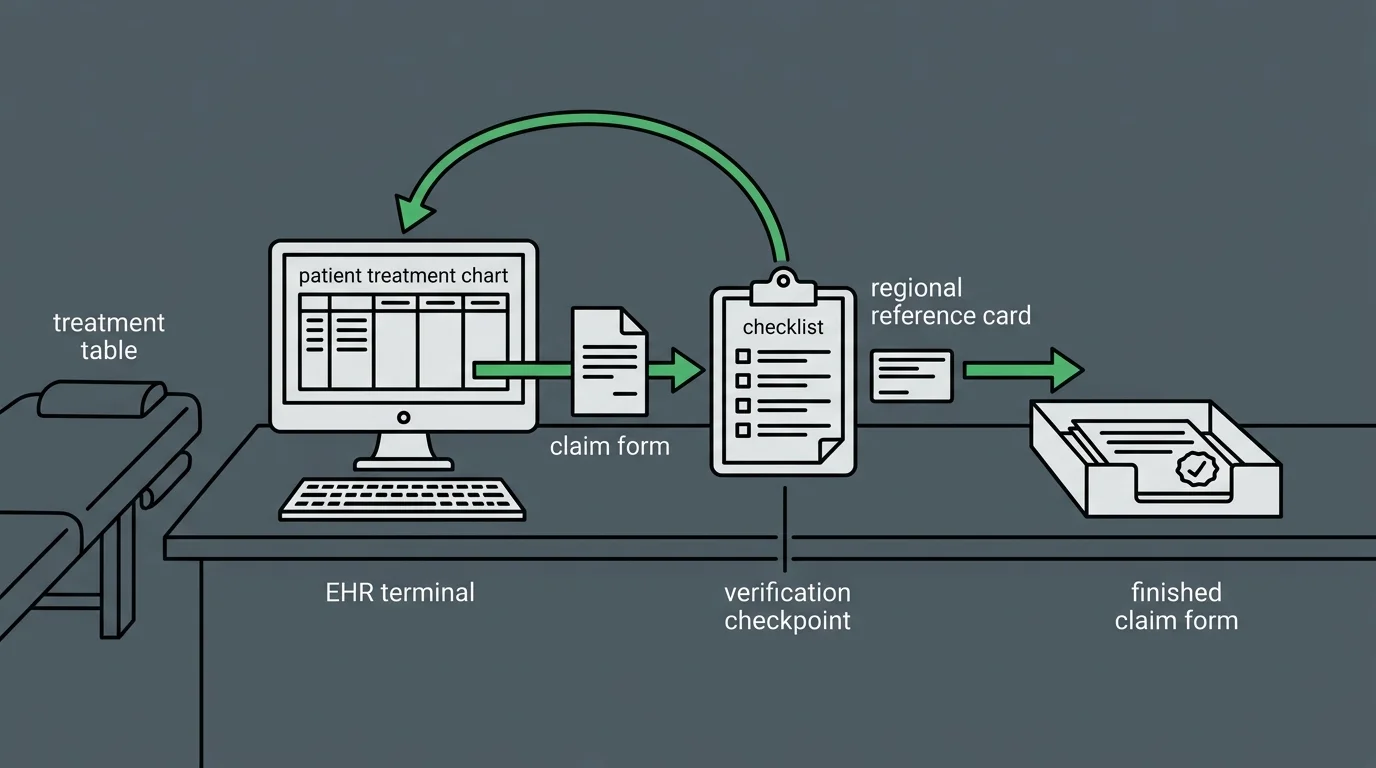
A locality-aware workflow treats every claim as a geography problem first and a coding problem second. The correct Geographic Practice Cost Index values, the correct locality, and the correct modifier have to be confirmed before the claim leaves the building. That confirmation step is the architecture generalist systems skip.
Why Most EHR Systems Can't Catch Locality Errors
An EHR stores a default locality and repeats it. It has no mechanism to flag a rate that shifted with the current Physician Fee Schedule year. That gap is exactly why many practices assume their software already handles regional adjustment, when the adjustment was never being checked at all.
What an Audit-Ready Locality Verification Step Looks Like
So what does a real verification step look like? It pulls the claim's locality, confirms it against the current fee schedule, and checks the Active Treatment modifier against the chart before submission, with nothing assumed from last year's defaults. That review is the map-reading skill, and it takes a trained person, not a stored setting.
Frequently Asked Questions
So the mechanics are on the table. These are the questions practices actually ask, answered quick and straight.
How often do regional Medicare fee allowances for chiropractic services change?
Locality boundaries and Geographic Practice Cost Index values can shift annually under the Physician Fee Schedule. A clinic cannot assume last year's locality map still applies.
What is a GPCI and how does it directly impact a chiropractic clinic's reimbursement?
GPCI is the adjustment math Medicare applies to a national base rate based on local practice costs. It applies separately to work, practice expense, and malpractice components, so a locality carries three stacked values rather than one.
Can EHR software reliably calculate the correct regional Medicare fee for every claim?
No. An EHR submits the claim data it is given; it does not verify that the stored locality still matches the current fee schedule year. That verification requires a person checking the claim, not a stored default.
Does the Active Treatment modifier have a different payment impact depending on the Medicare locality?
Yes. The modifier decides whether a claim pays at all, and the locality rate decides what it pays if it does. A misapplied modifier in a high-adjustment locality costs more than the identical error elsewhere.
What does the improper payment data reveal about how chiropractic claims get flagged?
It shows how often chiropractic claims miss Medicare's payment rules, not why each one did. The 2024 rate covered above is far too large to blame on a few stray typos.
How do Medicare Administrative Contractors handle regional fee schedule differences?
Medicare Administrative Contractors process claims for their own jurisdictions and publish the local fee schedules for the localities they cover. A clinic billing across contractor lines has to check each contractor's published amounts for its localities.
Where the Regional Math Actually Leaves a Chiropractic Clinic
So here's where the regional math lands: Medicare's chiropractic fee schedule was never one map. It's 109 payment localities that CMS can redraw, and each one carries its own Geographic Practice Cost Index math and its own modifier risk.
Reading that map correctly is not a software feature. It is a specialty skill, built on tracking locality shifts, verifying Active Treatment documentation, and catching what a default EHR setting was never designed to check.
A generalist process that checks only the code will keep missing that layer, year after year. To confirm a practice's own locality, modifier, and documentation alignment, schedule a conversation with Bushido Billing.