

Why Is High Staff Turnover the Biggest Threat to Your Practice’s Revenue Cycle?
Staff turnover is a revenue crisis in chiropractic practices. Not eventually. Immediately.
When a billing staff member leaves, they take something the practice cannot easily replace – accumulated, unwritten knowledge of how claims move through specific payers, how modifiers get applied, and which documentation patterns trigger denials. That knowledge doesn’t live in the EHR. It lives in a person.
Chiropractic billing carries requirements that most general medical billing workflows never encounter. Medicare reimbursement for chiropractic services requires manual application of the AT modifier to distinguish active care from non-covered maintenance. Omitting that modifier produces an automatic denial. Personal injury lien billing, workers’ compensation timelines, and payer-specific documentation standards add more complexity on top. These are not tasks software automates. They require informed human judgment, applied claim by claim.
The healthcare and social assistance sector recorded over 700,000 job separations in a single month, with a separation rate of 3.4% in late 2024. Chiropractic practices aren’t exempt. And because administrative and EHR-related tasks account for up to 30% of average healthcare staff workload, billing roles carry a disproportionate burnout risk. The staff most likely to leave are often the staff most responsible for keeping claims moving.
When that departure happens, the revenue cycle doesn’t pause while a replacement is hired and trained. Denials accumulate. Accounts receivable ages. Claims requiring medical necessity documentation go unworked. Chiropractic care already carries some of the highest improper payment rates in Medicare – insufficient documentation is the primary driver.
When the knowledge walks out, the revenue cycle bleeds. The only structural protection against that cycle is a billing relationship that doesn’t depend on any single employee’s continued presence – one built on specialty-level chiropractic expertise that survives internal staff changes entirely.
Why Staff Turnover Hits Chiropractic Billing Differently
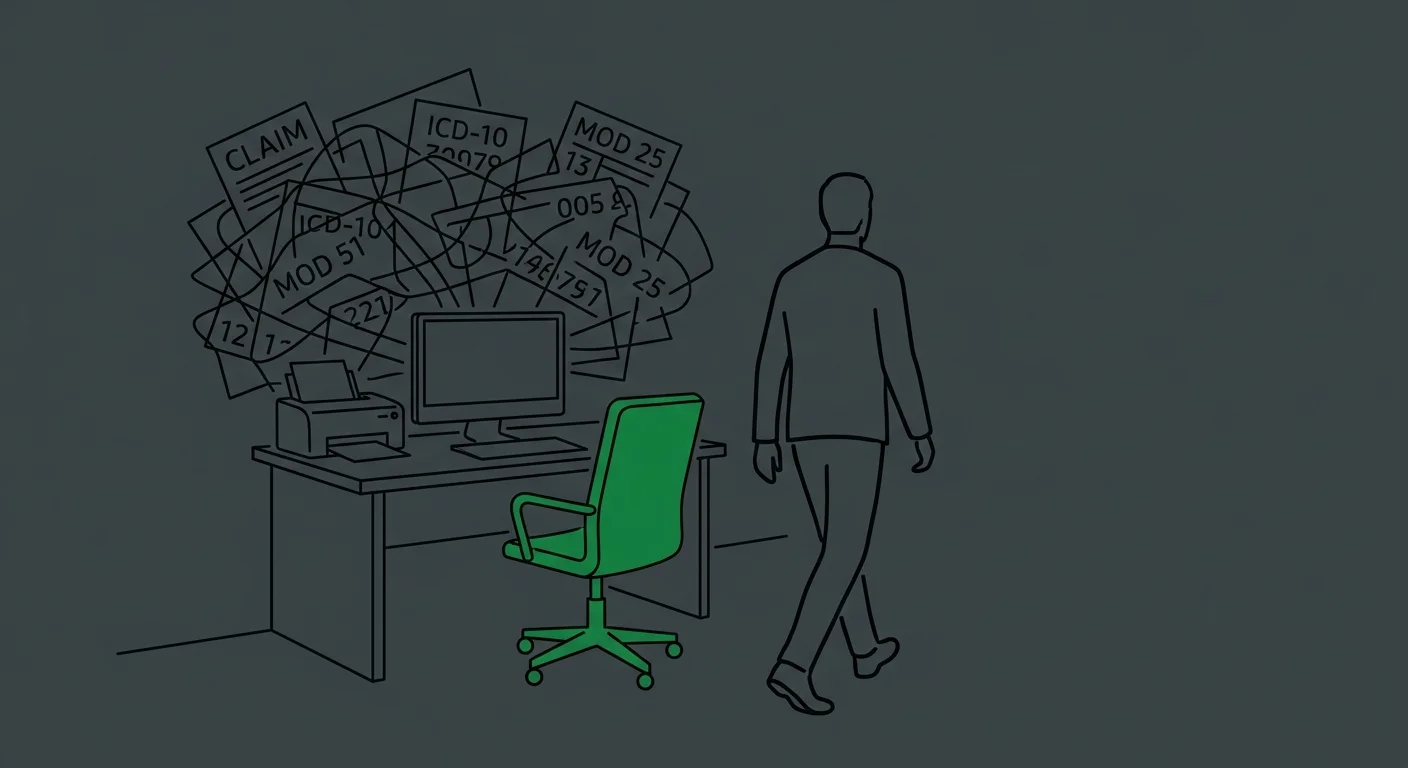
Most practices blame the software when claims go sideways. But the real fragility isn’t the platform. It’s the person.
Chiropractic billing doesn’t run on systems alone. It runs on the person who knows which payer requires a narrative attachment, which modifier combination pulls a claim into review, and which documentation pattern your last auditor flagged. That knowledge exists in one place. And it isn’t the EHR.
So what breaks first isn’t the software. It’s the judgment layer the software never had.
The Tribal Knowledge Problem in Specialty Billing
Every experienced biller carries knowledge that never makes it into a training document. Payer quirks. Documentation patterns that survived one audit. The exact modifier combination that stopped pulling claims into review. Bureau of Labor Statistics data puts a number on how often that knowledge walks out the door: healthcare and social assistance recorded over 700,000 job separations in a single month, with a separation rate of 3.4% in late 2024. That’s not a staffing footnote. That’s a cash flow event – once per departure, every time.
In chiropractic, the gap isn’t just inconvenient. It’s catastrophic. AT modifier logic, personal injury lien timelines, workers’ compensation documentation standards – none of this transfers to a generalist replacement. And NIH research shows that administrative and EHR-related tasks account for up to 30% of average healthcare staff workload. The people who carry the most billing knowledge are also the most exposed to burnout. So the exits aren’t random. The most experienced billers are the most likely to leave – and the hardest to replace.
Here’s the thing: tribal knowledge isn’t a character flaw in the people who hold it. It’s a structural flaw in how most practices build their billing operation. When one employee’s continued presence is the only thing standing between a functioning revenue cycle and a growing claims backlog, that’s an architectural problem. Not a staffing inconvenience.
Why Generic Replacement Hires Don’t Solve the Problem
The instinct is to replace them. Post the job, screen the stack, hire someone with a billing background, and start the cycle over. That’s a reasonable response to an HR problem. But this isn’t an HR problem. Practices that try to scale their administrative capacity without fixing the structural fragility underneath hit the same wall every time. The new hire doesn’t know what the last one knew. And no onboarding checklist closes that gap.
A general billing background doesn’t include AT modifier logic. It doesn’t include PI lien sequencing or the payer-specific documentation patterns that define revenue cycle management in chiropractic. Those aren’t skills you can shortcut through onboarding. So the new hire inherits the desk and the login credentials. They don’t inherit the judgment. And the claims that required judgment – the complex ones, the high-value ones – start failing quietly.
That’s why the revenue cycle bleeds. Not because the practice stopped caring – because it built a billing operation that couldn’t survive a personnel change. Denials don’t wait for a replacement hire to get up to speed. Accounts receivable ages on its own schedule, indifferent to whoever is now sitting at the billing desk.
| Billing Skill Type | Can a New Hire Learn It Quickly? | What Breaks If It’s Missing | Time to Restore Competency |
|---|---|---|---|
| AT Modifier Application | No – requires payer-specific pattern recognition built over time | Automatic denials on Medicare claims; maintenance care misclassification | Months of repetition across varied claim outcomes |
| Personal Injury Lien Sequencing | No – lien timelines and attorney coordination follow case-specific logic | Delayed or unrecoverable PI revenue; missed filing windows | Requires active PI caseload exposure to develop – cannot be simulated |
| Payer-Specific Documentation Standards | Partially – general patterns can be learned, but payer quirks cannot | Increased audit risk; claims returned for insufficient narrative | Varies by payer mix; high-volume payers accelerate learning, low-volume ones do not |
| Denial Pattern Recognition | No – requires historical claim data and outcome memory | Recurring denials from the same payers go undetected and unfixed | Built only through longitudinal exposure to a practice’s specific denial history |
| Workers’ Compensation Billing Protocols | No – state-specific rules and insurer variance require specialized familiarity | Claims submitted incorrectly; reimbursement delayed or forfeited entirely | Extended – each state’s fee schedule and documentation rules must be learned independently |
| AR Aging Prioritization | Partially – basic aging logic transfers, but claim-level prioritization does not | High-value recoverable claims deprioritized; older AR ages past the point of return | Requires familiarity with the practice’s payer mix and historical payment behavior |
Why Generic Billing Training and EHR Auto-Submit Can’t Fill the Gap
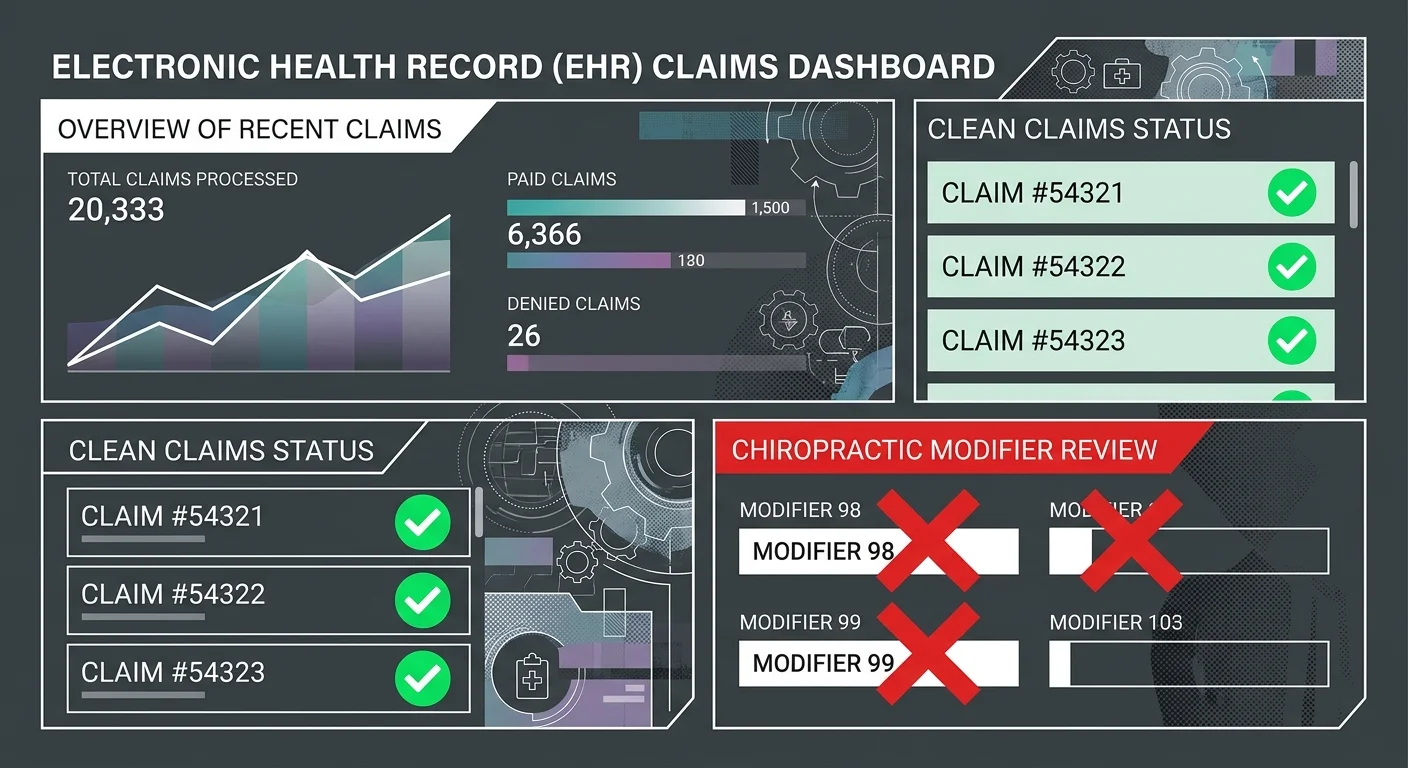
Two things happen the moment a biller walks out. The practice posts the job. And someone points at the EHR’s auto-submit feature and says the claims are covered.
Neither one covers the claims.
The EHR submits the claim. That part works.
But submission is step one. Getting paid is the entire rest of the process – and the EHR doesn’t touch any of it.
Here’s what no EHR vendor will say in the sales pitch: the software was never designed to handle chiropractic billing. It was designed to move data from a patient record to a clearinghouse.
The modifier logic, the denial response, the clinical judgment call – that was always a person’s job. The software just made it easier to submit.
What EHR Software Actually Does – and Doesn’t Do
EHR claims submission software does exactly what the name says. It maps diagnosis codes, pulls procedure codes, and routes the file to the payer. Manual data entry drops. Submission speed improves.
That is a real function. It solves a real problem. It just doesn’t solve the billing problem.
But the EHR cannot tell whether active care documentation is strong enough to survive a medical necessity review. It cannot choose the correct modifier when the clinical picture is ambiguous. It cannot flag a claim that is technically submittable but practically indefensible.
Those decisions require a person with specialty-level chiropractic billing knowledge. Not a system that routes files.
Specialty billing rules cannot be managed by software automation alone. That’s not a knock on the platform. It’s a description of what the platform was built to do – and how far short that falls from what a functioning chiropractic revenue cycle actually needs.
The AT Modifier Problem Automation Cannot Solve
The AT modifier is where auto-submit breaks down in the most expensive way possible. Per Centers for Medicare & Medicaid Services requirements, Medicare reimbursement for chiropractic services requires that the active treatment modifier be manually selected and documented on each eligible claim. Miss it, and the claim auto-denies as maintenance care – a non-covered service.
The EHR doesn’t make that call. A person does.
So when the person who knew exactly when to apply that modifier – and when to pull back – walks out, the judgment is gone. The software keeps submitting.
Denials start accumulating. The practice usually doesn’t see it until the AR report arrives with a story nobody wanted to read.
Reading the AT modifier rule isn’t the hard part. Every billing course covers it in the first week.
Applying it correctly – across every claim type, every payer, and every documentation scenario a chiropractic practice runs – that’s vertical knowledge. It doesn’t ship with an EHR license. And it doesn’t transfer through a generic billing background. It accumulates through months of specialty-specific work. When that person leaves, the accumulated judgment leaves too.
Why Most Practices Don’t Know Their EHR Is Failing Them
Chiropractic care carries some of the highest improper payment rates in Medicare. The U.S. Government Accountability Office has documented this directly – insufficient documentation is the primary driver of billing errors and audit exposure in this specialty.
But most practices don’t find this out through proactive review. They find it through a denial spike, a RAC audit inquiry, or an AR aging report that stopped making sense months ago.
That lag exists because the EHR confirms submission, not success. The claim left the system. The log says it went out. From the front desk, everything looks fine.
Then the remittance comes back wrong. The documentation error was there at submission – but nothing automated caught it before it reached the payer. By the time the denial lands, the original biller is already gone. And the institutional knowledge needed to write the appeal walked out with them.
| Billing Task | EHR Auto-Submit Capability | Human Specialist Required? | Risk If Automated Without Review |
|---|---|---|---|
| AT modifier selection | Cannot determine – routes claim as submitted | Yes – requires clinical documentation review | Automatic denial as non-covered maintenance care |
| Medical necessity documentation review | Cannot evaluate – maps codes, does not interpret clinical notes | Yes – requires specialty-level judgment | Claim submitted without sufficient support; denial or audit exposure follows |
| Personal injury lien sequencing | Not applicable – EHR has no PI lien workflow | Yes – requires knowledge of lien priority and payer coordination | Revenue from PI cases delayed, reduced, or lost entirely |
| Denial identification and response | Logs remittance data – does not initiate appeal | Yes – requires review of denial reason, documentation gap analysis, and payer-specific appeal language | Denials age past timely filing limits with no recovery action taken |
| Payer-specific documentation requirements | Standardized submission only – does not account for payer variance | Yes – requires institutional knowledge of individual payer expectations | Clean claims rejected for documentation format or missing attachments |
| Workers’ compensation billing timelines | No workers’ comp workflow – standard submission rules applied | Yes – requires knowledge of state-specific fee schedules and filing deadlines | Claims submitted incorrectly or outside filing windows; revenue forfeited |
What the Revenue Cycle Actually Looks Like During a Staff Transition
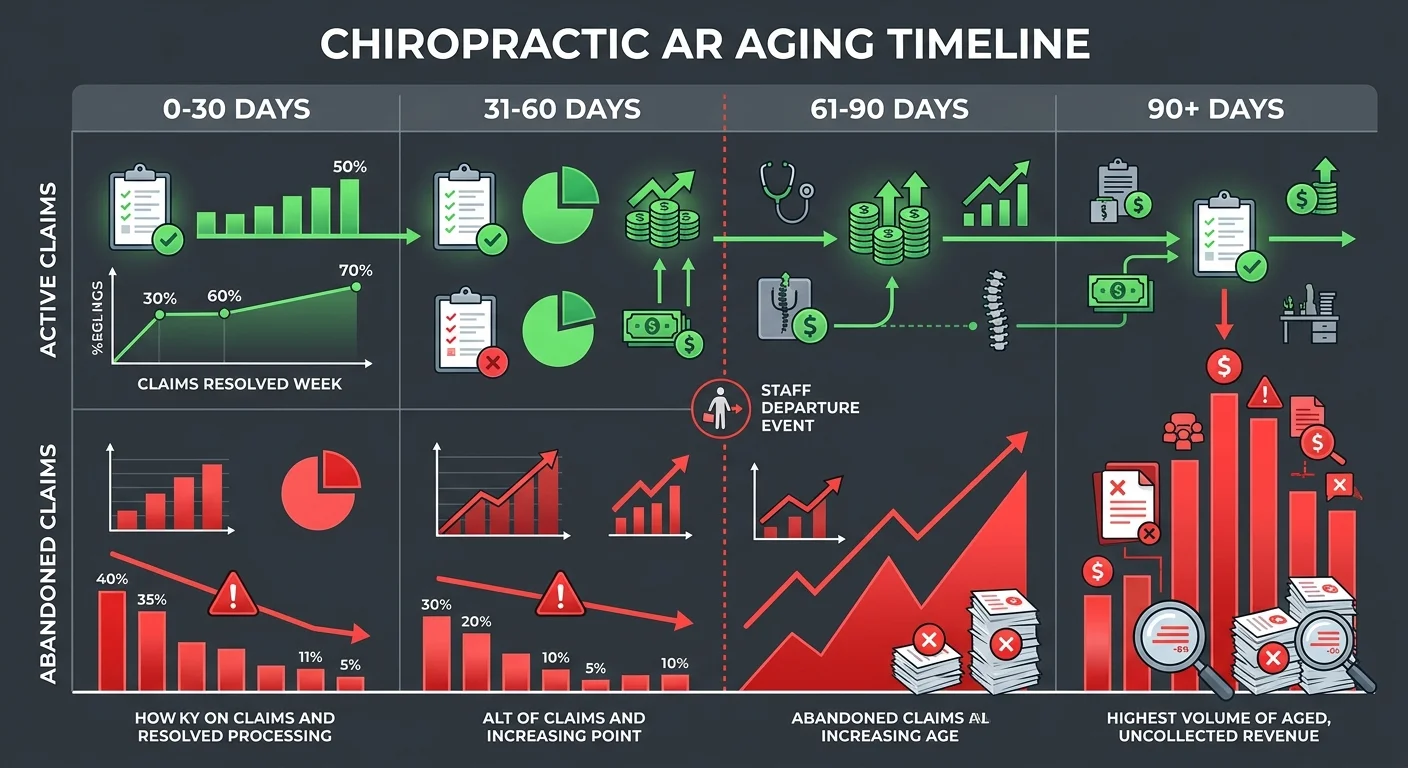
Practices call it a "gap." As if the revenue cycle pulls over to the shoulder and waits.
It doesn’t wait.
Here’s what actually happens – and it’s quieter than a crisis, which makes it more expensive. The EHR keeps submitting. Claims keep going out. The volume looks normal.
But the judgment layer is gone. The AT modifier gets applied inconsistently. Narrative attachments get skipped. Documentation that would have failed a medical necessity review goes out the door anyway – because nobody left knows what that costs when the remittance comes back.
The inefficiencies don’t announce themselves. There’s no alarm. No dashboard turns red. Cash flow predictability drops precisely during these transitions – not because claims stop going out, but because the wrong claims are going out.
They compound. Week over week. Until the remittance data tells a story that’s already weeks old by the time anyone reads it.
The Denial Surge That Follows Every Departure
Denials don’t wait for a replacement hire to get oriented.
They arrive on the payer’s schedule. Not the practice’s.
The first wave hits within thirty days. Claims submitted during the final weeks before the departure – and the first weeks of the gap – come back with denial codes nobody left is equipped to interpret, let alone appeal.
Chiropractic already carries some of the highest improper payment rates in Medicare. The U.S. Government Accountability Office has documented insufficient documentation as the primary driver of billing errors and audits. A staff transition doesn’t create that exposure. It removes the one person who was managing it.
The Bureau of Labor Statistics recorded a 3.4% separation rate in healthcare and social assistance in late 2024 – over 700,000 job separations in a single month. Each one of those departures left a billing operation with the same exposure: a denial wave arriving on the payer’s schedule, and nobody on the inside who knew how to fight it.
So the denial surge isn’t a spike that resolves on its own. It’s a backlog that grows every week the knowledge gap persists.
Practices working to reduce onboarding friction for new associates hit this wall consistently: the billing process feels intact until the denial data proves otherwise. By then, the window to appeal the oldest claims has already closed.
How AR Ages While No One Is Watching
AR doesn’t care what’s happening inside your practice. It ages on its own clock.
The Bureau of Labor Statistics recorded a 3.4% separation rate in healthcare and social assistance in late 2024 – over 700,000 job separations in a single month. Behind every one of those departures is an AR report that started aging the day the biller’s access was cut off. Nobody was watching it.
That’s the part that never shows up in the exit interview. The practice sees an open position. It doesn’t see the claims sitting at 60, 90, 120 days – moving further from collectible with every billing cycle that passes without a worked account.
The tribal knowledge that kept those accounts moving walked out with the biller. The AR report is just the delayed confirmation.
| Phase Post-Departure | Typical AR Behavior | Denial Pattern | Cash Flow Impact |
|---|---|---|---|
| Days 1-14 (Active Gap) | Claims continue submitting through the EHR; AR aging has not yet shifted; the revenue cycle appears intact from the outside | Denials begin accumulating but have not yet returned on remittance; documentation gaps are already embedded in submitted claims | Cash flow holds at near-normal levels; the damage is present but invisible in current reporting |
| Days 15-30 (First Wave) | First remittance files return with denial codes tied to modifier errors and documentation deficiencies; AR at 30 days starts to swell | AT modifier omissions and insufficient medical necessity narratives surface; denial codes arrive with no one qualified to interpret or respond to them | Collections begin softening; the practice notices slower deposits but may attribute the dip to payer processing delays rather than a billing breakdown |
| Days 31-60 (Compounding) | AR ages across the board; worked accounts decline sharply as the replacement hire or interim staff struggle to manage active claims and aging simultaneously | Denial volume increases; appeal windows on the earliest denials begin closing; payer timely filing limits start narrowing the recovery window | Cash flow disruption becomes measurable; the practice begins drawing on reserves or delaying vendor payments without a clear diagnosis of the cause |
| Days 61-90 (Structural Deterioration) | Accounts at 60 and 90 days begin moving toward uncollectible status; the tribal knowledge required to reconstruct documentation for appeals is no longer available | Denial patterns repeat across claim types because the root modifier and documentation errors were never corrected at the source; the same mistakes compound forward | Revenue shortfall becomes a cash flow crisis; the practice is now managing both the billing backlog and the operational costs of a practice running below collection capacity |
| 90+ Days (Chronic State) | AR report tells a story months in the making; many accounts have aged past the point where payer appeal or secondary billing is viable | Denial rate stabilizes at an elevated baseline if the replacement hire lacks chiropractic specialty knowledge; the practice normalizes a lower collection rate without identifying the cause | The revenue gap is now structural – not a temporary dip from a staff change, but a permanent reduction in what the practice collects per claim cycle |
How to Build a Revenue Cycle That Doesn’t Depend on Any One Person
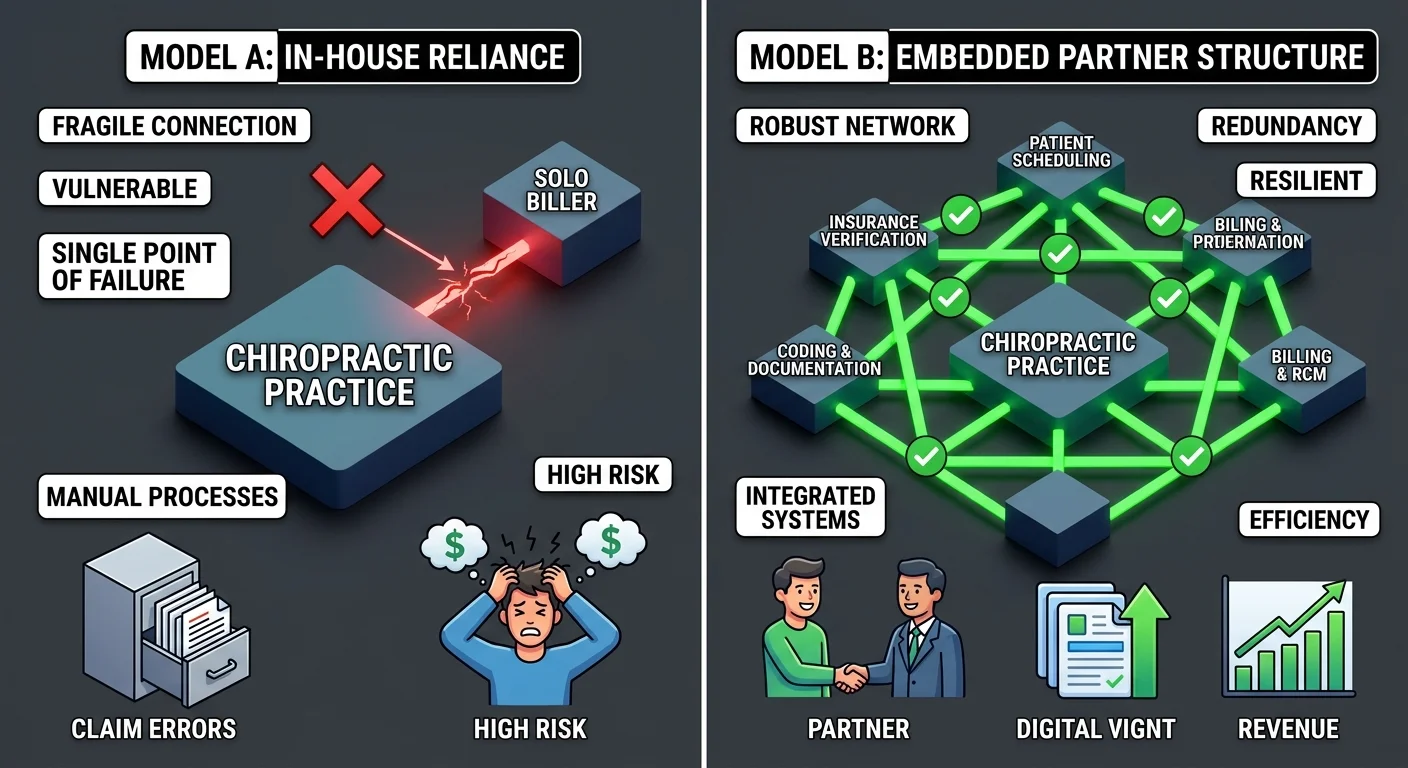
So the question isn’t how to find a replacement faster.
It’s how to build a billing operation that doesn’t collapse when someone leaves.
The administrative load that drives burnout – EHR navigation, modifier decisions, payer-specific documentation – represents up to 30% of the average healthcare staff workload. That load doesn’t disappear when a biller leaves. It transfers to a gap. And the gap doesn’t bill.
That means removing the person as the single point of failure. Not writing a better onboarding checklist.
Structural continuity is built into the operating model. Not into the personnel file.
What Billing Continuity Actually Requires
Billing continuity isn’t a binder in a desk drawer.
It’s an operating model where the billing function is embedded in the practice’s workflow – not stored in one person’s working memory.
Chiropractic billing rules require vertical knowledge of modifiers, personal injury liens, and workers’ compensation timelines that generalist billers don’t carry. That knowledge can’t be transferred in a two-week handoff.
It accumulates over time. Through repeated exposure to specific payer behavior, denial patterns, and documentation decisions that rarely get written down anywhere.
Billing continuity means the institutional knowledge belongs to the billing relationship – not to whoever is sitting at the desk this month. When it lives in the system, a personnel change is a personnel change. When it lives in a person, a personnel change is a revenue event.
Practices scaling their provider rosters run into this same wall. The compliance knowledge has to live in the system – the same way provider credentialing documentation has to live in a process, not in whoever handled the last enrollment.
Who This Approach Is Not For
This model isn’t for every practice. That’s worth saying plainly.
If the first question in evaluating a billing model is the rate – not the process, not the communication structure, not the specialty expertise – this isn’t the right conversation.
A billing model selected on price optimizes for cost. Not for recovery. Those two things are not the same.
And if the goal is a fully disengaged arrangement – no EHR access coordination, no documentation cooperation, no provider availability for appeals – the embedded billing partner model Bushido Billing operates on won’t produce results. Billing complexity doesn’t resolve through passivity.
Effective billing is a working relationship. Practices that disengage get disengaged results.
The Documentation Baseline Every Practice Needs Before a Transition
Before any transition – a departing biller, a new associate, a shift in billing model – there’s a baseline the practice needs. Not a manual. A documented operating picture: which payers are active, which claims are open, where the AR stands by age bucket, and which modifier decisions are being made on which claim types.
Without that baseline, a transition doesn’t start from zero. It starts from behind.
The practices most exposed to turnover damage are the ones that never captured what their biller actually knew. When the person walks out, what remains – in writing, in the system, in the AR report – is the only foundation the next phase has to build on. A thin foundation produces predictable results.
| Continuity Factor | In-House Billing Model | Embedded Billing Partner Model |
|---|---|---|
| Institutional Knowledge | Held by one individual – exits with the biller when they leave | Belongs to the billing relationship and partner organization – survives personnel changes |
| Modifier & Payer Expertise | Accumulated informally over time; rarely documented; lost at turnover | Maintained structurally by a specialist whose focus is chiropractic billing exclusively |
| Claims Continuity During Transitions | Submissions continue through EHR automation; judgment layer disappears | Billing decisions remain consistent regardless of internal staffing changes |
| AR Oversight | Dependent on the active biller’s capacity and institutional familiarity with open accounts | Dedicated oversight is a structural feature – accounts are worked regardless of who left last month |
| Denial Response Capability | Declines sharply during and after staff transitions; appeal window may close before anyone acts | Denial management does not pause – appeals and follow-up continue on the payer’s schedule, not the practice’s |
| Communication & Reporting | Internal; inconsistent; quality depends on individual initiative | Proactive weekly updates are built into the operating model – not contingent on a single staff member’s availability |
Frequently Asked Questions
Understanding the risk is one thing. Watching it show up in your AR, your modifier decisions, your documentation gaps – that’s a different conversation.
These are the questions that surface once the theoretical risk becomes an operational one. The answers are straight.
How long does a new in-house biller take to achieve accurate chiropractic modifier billing?
Longer than most practices plan for. The AT modifier must be manually selected and documented on every active chiropractic therapy claim. Miss it, and the claim gets denied as maintenance care – a non-covered service. That rule sounds clean. But the judgment of what qualifies as active care versus maintenance care isn’t sitting in a dropdown menu.
Most new in-house billers get functional on clean claims within a few weeks. Chiropractic-specific modifier logic, payer documentation habits, and the language of medical necessity take significantly longer to internalize.
And during that window, claims go out anyway. They just go out with less to back them up.
What is the hidden cost of EHR auto-billing errors when front desk staff manage claim submissions?
It’s not the denied claim. It’s the denied claim nobody catches before the appeal window closes.
EHR auto-billing submits what the system is configured to submit. It doesn’t evaluate whether the supporting documentation would survive a medical necessity review. It doesn’t catch a missing AT modifier. It doesn’t flag that the claim is about to age past reversal. Chiropractic care already carries some of the highest improper payment rates in Medicare – and according to the U.S. Government Accountability Office, insufficient documentation is the primary driver of those billing errors and audits.
When front desk staff manage submissions without vertical knowledge of AT modifier rules and documentation standards, the auto-billing function doesn’t fail loudly. It fails quietly. Denials age past the appeal window before anyone with real expertise looks at the remittance data.
That’s not an EHR problem. That’s a knowledge gap wearing an automation mask.
Why do generalist medical billing companies fail to recover aged AR for chiropractic clinics?
Because aged AR recovery in chiropractic isn’t a billing task. It’s a specialty task.
Recovering a 90-day chiropractic claim isn’t about resubmitting. It requires knowing why the claim was denied, whether the documentation supports an appeal, and which payer-specific argument has the best shot at reversal. That means understanding AT modifier decisions, personal injury lien workflows, and workers’ compensation timelines – the vertical knowledge generalist billers simply don’t carry.
Generalist billers can process clean claims. They can’t argue medical necessity for a chiropractic case they don’t have the specialty background to evaluate.
So the aged AR doesn’t recover. It ages out.
How does an embedded billing partner model prevent revenue drops during staff transitions?
The difference is where the institutional knowledge lives.
In an in-house model, modifier decisions, payer documentation habits, and AR management patterns live inside the biller. When that person leaves, those patterns leave with them. The Bureau of Labor Statistics recorded a healthcare and social assistance separation rate of 3.4% in late 2024 – over 700,000 job separations in a single month. Behind every departure in a billing role is an AR report that started aging the day that biller clocked out for the last time.
When billing is embedded in the practice’s workflow – with a dedicated biller whose expertise belongs to the relationship, not to their individual tenure – a personnel change doesn’t disrupt the revenue cycle. The payer knowledge stays. The modifier logic stays. The AR keeps moving.
The practice loses a staff member. It doesn’t lose a revenue cycle.
What documentation processes must a chiropractic practice protect when a billing staff member leaves?
The minimum viable baseline is an operating picture – not a procedure manual.
Before any billing staff transition, a practice needs documented clarity on four things: which payers are active and contracted, where the AR stands by age bucket, which claims are open and at what stage, and which modifier decisions are being applied to which claim types.
Without that baseline, whatever comes next – a replacement hire, a new billing arrangement, a period of gap coverage – starts from behind. The tribal knowledge that kept those accounts moving has to be captured in writing before it walks out the door.
Most practices discover this gap after the biller leaves. The ones that catch it before have something to hand off. The ones that don’t are starting from scratch with aging claims and no map.
Does high turnover affect chiropractic billing differently than other medical specialties?
Yes. And the reason is the specialty modifier layer.
Most medical billing runs on standard procedure codes and diagnosis-based documentation. Chiropractic billing adds a judgment-dependent modifier requirement – the AT modifier – that must be manually applied and supported by documentation of active medical necessity on every qualifying claim. That modifier cannot be automated. It requires a human decision.
Chiropractic care historically carries some of the highest improper payment rates in Medicare. Insufficient documentation is the primary driver of billing errors and audits. That’s not coincidence – it reflects the specialty-specific documentation burden that exists even when billing is running well.
When turnover removes the person making those modifier decisions, the exposure isn’t the same as losing a general coder. The gap is proportionally larger. And the claim consequences arrive faster.
Your Revenue Cycle Shouldn’t Live in Someone’s Head
The practices that get hurt worst aren’t the ones with obvious billing problems.
They’re the ones where billing worked. Long enough. Well enough. That no one ever questioned whether it was built to survive without one specific person running it.
A revenue cycle built around a person has an expiration date. That date is set the day the biller is hired – not the day they give notice.
But the structure can be built differently.
When institutional knowledge lives in the billing relationship – not in the individual holding the job – a personnel change is just a personnel change. The AT modifier decisions don’t evaporate. The payer-specific documentation patterns don’t walk out the door. The AR doesn’t start aging quietly while a job posting goes live.
The revenue cycle keeps running. Not because someone held it together. Because it was never dependent on any one person to begin with.
That’s what Bushido Billing is built to be. Not a replacement hire. Not a software workaround.
An embedded billing partner whose expertise belongs to the relationship – and whose performance is tied to exactly one outcome: the practice getting paid.
Staff turnover doesn’t disappear. But it stops being a revenue event. The knowledge stays. The AR keeps moving. The claims keep getting worked.
Your next biller will eventually leave. Every practice’s does. The only question is whether your revenue cycle is built to absorb it – or whether, when they walk out the door, you’re back to the same exposure you started with.
When the knowledge walks out, the revenue cycle bleeds.
If any of that hit close to home, it’s not a coincidence. It’s your revenue cycle showing you where the exposure lives. The question isn’t whether turnover has cost you – it’s how much you don’t know about yet. A Book a Call is where that changes.

© . All Rights Reserved | Web Design by iTech Valet