

How to Standardize Documentation Across Multiple Doctors to Ensure Consistent Billing?
Standardizing documentation across multiple doctors means one enforceable clinical protocol – every provider, every note, every time. Not a preference. A requirement.
Every doctor’s note is a link in the revenue chain. When those links differ from provider to provider, payers notice. Denials follow. Federal auditors follow those denials.
Medicare makes the stakes even higher. Chiropractic claims billed to Medicare require the AT modifier on every active treatment claim – distinguishing medically necessary care from maintenance care that Medicare won’t pay. When documentation doesn’t clearly support active treatment, or when two providers document the same condition two different ways, the AT modifier becomes indefensible. Claims fail. Revenue disappears.
Consistent clinical record keeping is the foundation of a billing record that survives commercial payer review, Medicare scrutiny, and federal audit examination. One provider documenting with specificity while another relies on vague or templated language doesn’t give a practice two documentation styles. It gives the practice a liability.
The American Chiropractic Association’s coding and compliance guidelines exist to close exactly this gap – protecting providers from downcoding and meeting the evidentiary standard payers require before releasing payment.
Documentation standardization is also a HIPAA-compliant workflow requirement. When patient records are shared with a billing partner for claims submission, payment coordination, or AR recovery, HIPAA explicitly permits those disclosures – but the records must be complete, consistent, and defensible.
Standardized EHR templates and structured clinical macros reduce variance between providers. But templates alone don’t hold. Without a peer-backed clinical accountability structure enforcing how those templates are used, documentation drift returns – and with it, the billing inconsistencies that cost multi-provider practices recoverable revenue.
Why Documentation Variance Across Doctors Costs You More Than Denials
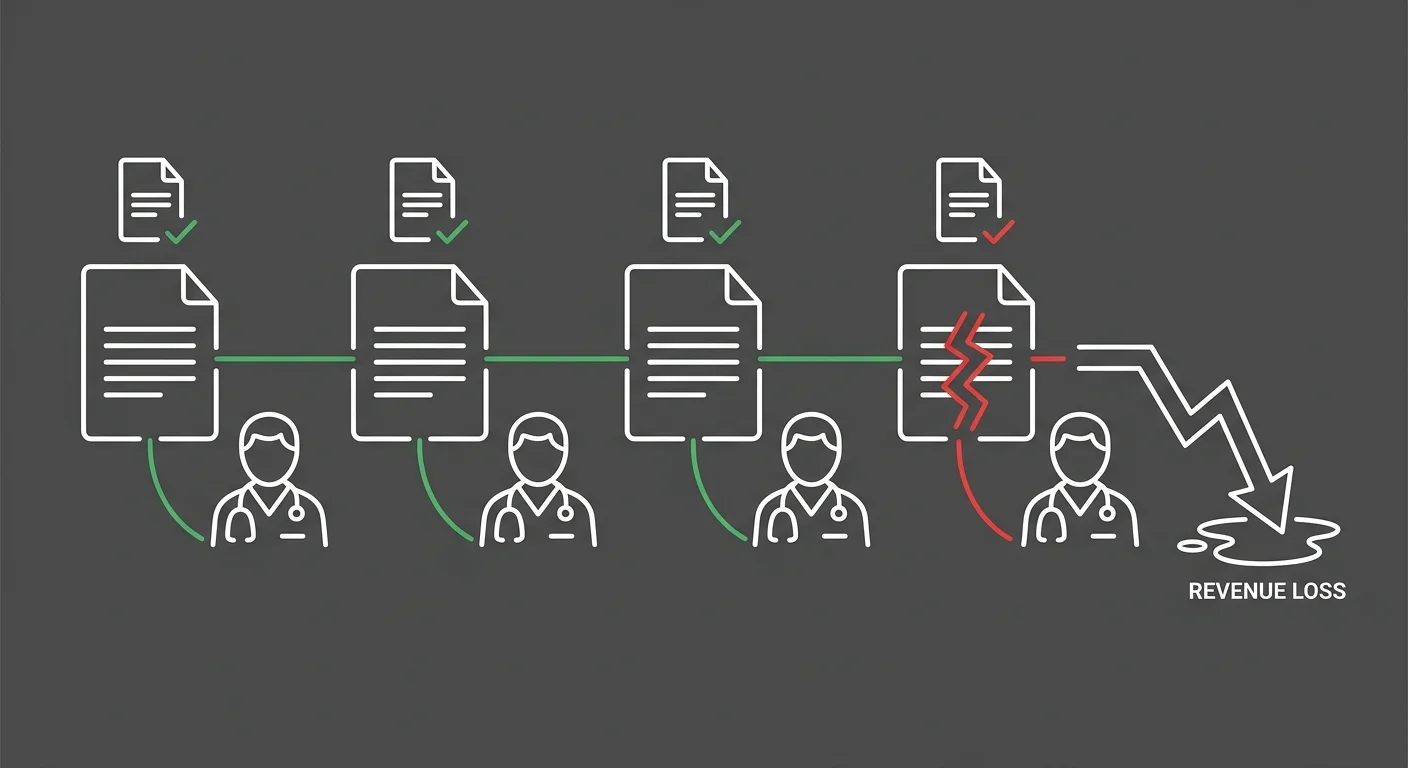
Documentation variance is not a clinical disagreement. It is a revenue leak – and in a multi-provider practice, it opens wider with every billing cycle.
When two providers document the same patient presentation differently, the billing record tells two different clinical stories. Payers don’t reconcile those stories in your favor. They deny the claim, flag the inconsistency, or both.
But denials are only what you see on the surface. The deeper cost is structural. Inconsistent documentation creates a compliance exposure pattern that follows the practice – across payer audits, across federal reviews, across every claim submitted while the variance exists. You don’t fix that by appealing individual denials. You fix it by closing the gap between how your providers document in the first place.
The Revenue Chain Every Multi-Provider Practice Is Building
Every treatment note a provider creates connects a patient encounter to a submitted claim to a paid reimbursement. That chain only holds if every link is built to the same standard. One provider building tight, defensible notes while another builds loose ones doesn’t give your practice two documentation styles. It gives your practice a structural fault.
Here’s the thing – a single weak link doesn’t just lose one claim. It draws scrutiny to the entire chain. Auditors and payers don’t investigate isolated notes. They investigate patterns. And when documentation quality varies by provider, the pattern is unmistakable.
Practices that scale a multi-location chiropractic practice hit this problem at a different magnitude. Adding providers without a unified documentation protocol doesn’t grow revenue. It multiplies the number of weak links in the chain. Consistent clinical record keeping is the foundation of every defensible billing audit and every reliable reimbursement. That cannot be left to individual provider preference.
Why Inconsistent Notes Attract Federal Audit Scrutiny
OIG doesn’t audit randomly. It follows improper billing rates and documentation gaps – and those are exactly the vulnerabilities that appear when providers in the same practice apply different documentation standards to the same types of claims. Federal scrutiny isn’t bad luck. It’s a predictable consequence of inconsistent clinical records.
A practice with three providers and three documentation styles isn’t running one billing operation. It’s running three – and each one carries its own audit exposure. The published analysis on clinical record quality confirms that documentation compliance and record quality benchmarks are the primary variables separating practices that survive scrutiny from those that don’t.
So the question is never whether inconsistent documentation will attract scrutiny. It will. The question is how much revenue disappears before the practice recognizes the pattern – and whether the revenue cycle management (RCM) infrastructure in place is built to catch it before federal auditors do.
| Documentation Variance Type | Billing Consequence | Audit Risk Level | Revenue Impact |
|---|---|---|---|
| Provider-to-provider narrative inconsistency – same condition, different clinical language across treatment notes | Payer flags divergent clinical stories; adjudicator denies the claim or requests additional documentation before payment | High – inconsistent narratives signal systemic documentation failure, drawing broader payer and auditor attention | Recurring denials on similar claim types; recoverable revenue stalls in appeals backlog rather than converting to payment |
| AT modifier unsupported by treatment note – provider documents care without clearly establishing active treatment necessity | Medicare claim fails on modifier validity; payment is withheld or recouped on post-payment review | Critical – AT modifier errors are a primary federal audit trigger for chiropractic practices billing Medicare | Direct revenue loss on every affected Medicare claim; repeated errors escalate to formal audit or repayment demand |
| Copy-paste or macro overuse – templated language applied without clinical specificity to individual patient encounters | Payer identifies cloned documentation patterns; denies claims for lack of individualized medical necessity support | High – cloned note patterns are a documented audit red flag across commercial and government payers | Claims denied in clusters rather than individually; volume of affected claims compounds recovery difficulty |
| Incomplete functional outcome documentation – provider records treatment performed but omits objective patient progress indicators | Commercial payer cannot validate medical necessity across a treatment episode; downcodes or denies continued care claims | Moderate to High – incomplete outcome tracking undermines the clinical rationale for ongoing treatment authorization | Reimbursement reduced per visit or denied for extended care phases; practice absorbs the revenue gap |
| Maintenance vs. active care misclassification – provider documents maintenance-level care under active treatment coding | Medicare and commercial payers reject claims where documentation does not support the billed level of medical necessity | Critical – misclassification between maintenance and active care is among the most scrutinized billing distinctions in chiropractic | Substantial revenue at risk across every misclassified claim; post-payment audits can trigger repayment demands across multiple billing periods |
| Unresolved provider variance without accountability structure – no clinical protocol enforcing documentation standards across the team | Individual provider documentation habits go unchecked; billing inconsistencies accumulate across every billing cycle | Escalating – audit exposure grows proportionally with the number of providers operating under different documentation standards | Revenue leakage compounds over time; the longer variance goes unaddressed, the larger the recoverable revenue gap becomes |
Why Generic EHR Templates Make Inconsistency Worse
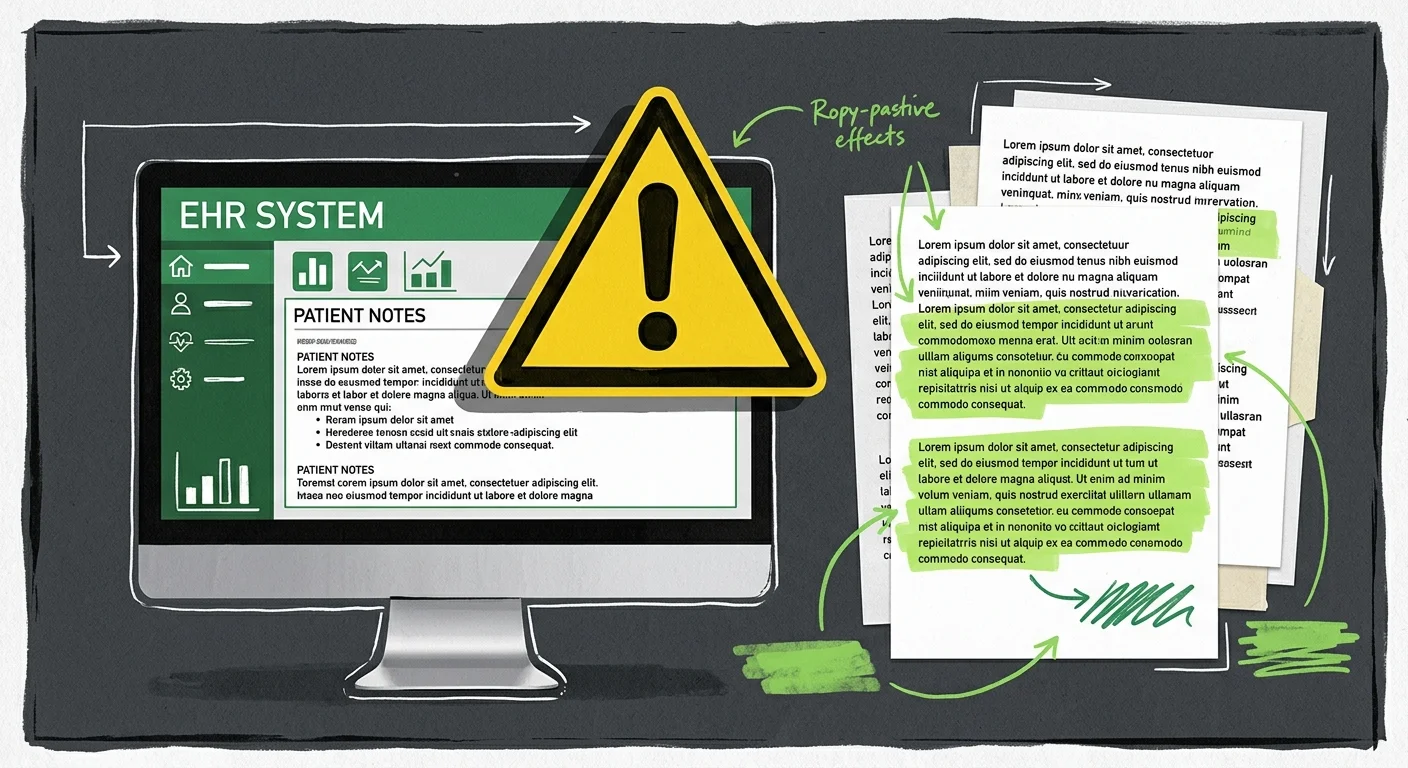
EHR platforms are not billing solutions. They’re documentation platforms. Treat them as the same thing, and your billing record starts breaking down before the first claim goes out.
The instinct makes sense. Standardize the software, and the documentation follows. But software standardization is structural. Clinical consistency is behavioral. Those are two different problems – and one tool cannot solve both.
Generic EHR templates are built for broad applicability. They’re not built for chiropractic-specific compliance – and that gap matters. The American Chiropractic Association’s coding and compliance guidelines exist to prevent downcoding and to satisfy the evidentiary standard commercial payers actually require. Those guidelines demand clinical specificity. A general-purpose template doesn’t capture it. So the note looks complete, and the claim still fails.
What EHR Software Actually Does – and Does Not Do
EHR software does one thing well: it submits claims. It routes the note through a structured format and pushes it toward the clearinghouse. That part works.
But the EHR doesn’t govern how the note gets written before that submission happens. It doesn’t evaluate whether your documented findings actually support the billed diagnosis. It doesn’t flag when a provider’s narrative is too vague to satisfy a payer’s medical necessity standard. And it doesn’t catch when one doctor’s note contradicts the clinical picture another doctor established for the same patient. Those are human problems. Software doesn’t fix them.
Here’s what that looks like in practice: the software appears to be working. Claims are submitting. The dashboard shows activity. But the notes are quietly accumulating variance that the practice won’t discover until denials start stacking. Even efforts to centralize billing workflows across multiple chiropractic clinics mean nothing if the clinical notes feeding those workflows are built on inconsistent foundations. Research on inter-clinician documentation alignment confirms that structured template usage reduces provider variance – but only when a governance layer enforces how those templates are actually applied.
The Copy-Paste Problem That Triggers Automatic Audit Flags
The copy-paste function inside an EHR is one of the most dangerous tools in a multi-provider practice. It looks like efficiency. It produces documentation that appears consistent. Payers and federal auditors have learned to spot it – and when they do, the scrutiny is immediate.
When a provider copies yesterday’s note to document today’s visit, the result is a reproduction – not a clinical record. Payers read it that way. The note doesn’t reflect the patient’s current status, functional progress, or treatment response. Those aren’t optional details. Commercial payer standards require them to justify continued care. A copied note signals the opposite of medical necessity: it signals that nothing changed, and the provider didn’t look.
So the chain breaks again. Not because the provider failed to treat the patient. Because the documentation does not tell the right story. A note that looks complete on the surface and says nothing defensible underneath is not a link in the revenue chain. It is a liability waiting to be pulled.
| EHR Capability | What It Handles | What It Cannot Replace | Billing Risk If Misused |
|---|---|---|---|
| Claim Submission Routing | Formats and transmits clinical notes through the clearinghouse to the payer | Clinical judgment about whether the documented findings actually support the billed diagnosis | Claims submit successfully while the underlying documentation fails medical necessity review – resulting in post-payment audits and recoupments |
| Structured Note Templates | Provides a consistent format for providers to record visit data | Enforcement of how providers populate that format – and whether the narrative reflects the patient’s actual clinical status | Providers produce notes that look uniform on the surface but contain the same vague or copy-forward language that triggers denial patterns |
| Macro and Auto-Fill Functions | Speeds up documentation by auto-populating recurring clinical language | Clinical specificity that distinguishes one patient’s functional progress from another’s – or one visit’s findings from the last | Payers and federal auditors flag copy-forward documentation as evidence of non-individualized care, exposing the practice to claim denial and audit scrutiny |
| Multi-Provider Record Management | Stores and organizes notes from multiple providers under a single patient record | Cross-provider consistency review – ensuring that two providers documenting the same condition tell a clinically coherent story | Contradictory notes across providers on the same patient create a compliance exposure pattern that payers and auditors investigate at the practice level, not the claim level |
| EHR Coding Suggestions | Recommends procedure codes based on documentation inputs and visit complexity indicators | Specialty-specific compliance knowledge – including chiropractic-specific modifier requirements and commercial payer evidentiary standards for continued care | Providers accept generic code suggestions that do not align with chiropractic coding guidelines, producing downcoding or unsupported billing that commercial payers reject |
| Dashboard Reporting and Activity Tracking | Displays claims volume, submission status, and surface-level workflow activity | Revenue recovery intelligence – identifying denial patterns, documentation gaps, and the specific provider-level variances driving revenue leakage | Practices interpret active dashboard metrics as a sign that billing is working – while documentation inconsistencies accumulate silently underneath |
The Core Components of a Chiropractic Documentation Standard
Software standardization is a starting point. That is all it is.
A real documentation standard governs what gets written, how it gets written, and whether it holds up when a payer or federal auditor tests it. Those are three different problems. One piece of software does not solve all three.
So what does a real standard require? Three things.
A governing protocol for active treatment documentation. A clear compliance posture for how clinical records move through billing workflows. And a clinical accountability structure that does not depend on individual provider habit.
Remove one of those components and the documentation system has a gap.
Payers and auditors find that gap before the practice does. Every time.
Medicare AT Modifier: The Documentation Element Practices Get Wrong Most Often
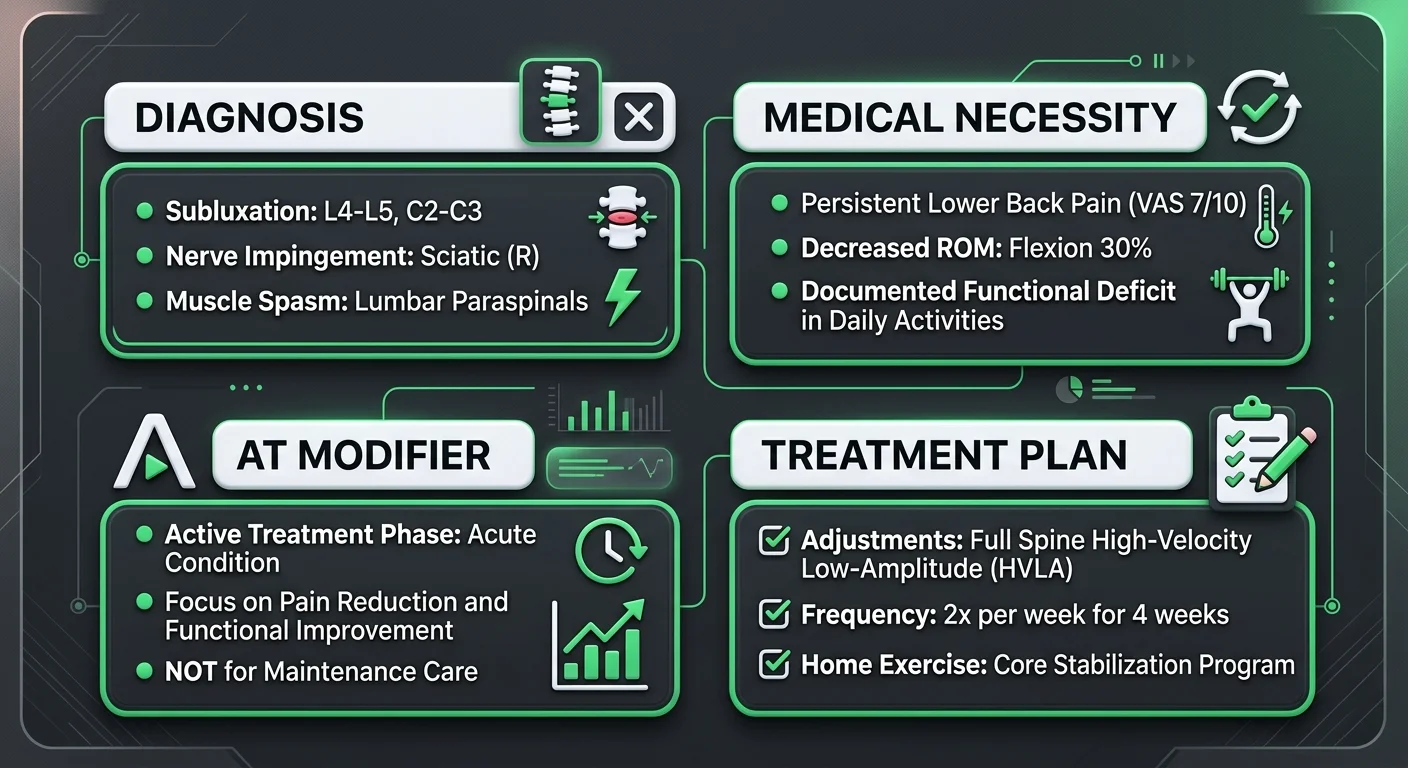
Medicare chiropractic billing requires the AT modifier on every active treatment claim. That modifier signals one specific thing: the care provided is medically necessary and active – not maintenance care, which Medicare does not cover.
That distinction is not administrative. It is clinical. And it has to be documented to exist.
The AT modifier is not just a billing code. It is a documentation commitment.
When that modifier goes on a claim, the treatment note must independently support the assertion that the patient is receiving active, medically necessary care. The claim and the note have to tell the same story. If the note does not deliver that support, the modifier becomes indefensible.
The payer does not call to ask for clarification. The claim fails.
In a multi-provider practice, this is where variance becomes catastrophic.
One provider documents objective findings, functional status changes, and a clear treatment response. Another documents the same type of visit in three lines. Medicare sees two different clinical stories on the same patient – and the weaker note does not just lose its own claim. It raises questions about every claim in that patient’s file.
That is not an isolated denial. That is an audit thread. And proactive communication between the billing operation and the clinical team is what catches these inconsistencies before they reach the payer – not after.
HIPAA Requirements for Clinical Records Used in Billing
When clinical records move to billing, claims submission, or payment coordination, HIPAA explicitly permits those disclosures without patient authorization. That permission is real.
But it is conditional. The records themselves must be complete, consistent, and defensible.
A disclosure made correctly on records built incorrectly is still a problem.
The published guidance on HIPAA payment disclosures is clear: the framework governing billing disclosures was built around the assumption that clinical records meet a baseline evidentiary standard.
A record that is vague, copied forward, or internally inconsistent does not meet that standard. The protection HIPAA extends to billing disclosures does not resolve the underlying documentation liability.
The disclosure process can be structurally airtight. If the records inside it are not, the exposure is the same.
The HIPAA compliance posture of a multi-provider practice is only as strong as the documentation quality underneath it.
A structurally compliant disclosure process built on inconsistent clinical notes is still a liability. The chain still has a weak link.
This Is Not for Practices That Want a Hands-Off Documentation Fix
Standardizing documentation across multiple providers is not a passive process. There is no switch to flip.
It requires active clinical governance – providers reviewing each other’s notes against a unified standard, billing intelligence feeding back into clinical documentation habits, and a practice-wide protocol that does not bend to individual provider preference.
That is not a software feature. That is a working discipline.
If the goal is a one-time template rollout with no ongoing accountability, this model is not the right fit.
Documentation standardization is a working discipline. Practices that want a genuinely defensible billing record – one that holds up under audit scrutiny and across every provider on the team – have to build it and maintain it as one.
That is the only version of the chain that does not break.
| Documentation Element | What It Must Demonstrate | Governing Authority | Common Failure Mode |
|---|---|---|---|
| Active Treatment Documentation | That the patient is receiving medically necessary, active care – not maintenance – with objective findings and functional status changes recorded at each visit | CMS Medicare Policy / AT Modifier Requirements | Vague or copied-forward notes that assert active care without documenting measurable clinical progress or treatment response |
| Medical Necessity Narrative | A clinician-authored explanation linking the patient’s presenting condition, examination findings, and treatment plan to a defensible billing diagnosis | Commercial Payer Medical Necessity Standards / ACA Coding Guidelines | Notes that document what was done without explaining why it was clinically necessary – leaving the payer to make assumptions that default to denial |
| Inter-Provider Consistency | That all providers on the same patient produce documentation that tells a coherent, non-contradictory clinical story across visits and treating clinicians | Internal Clinical Governance Protocol | Provider A documents objective findings and functional outcomes; Provider B documents the same visit type in three lines – creating conflicting clinical records on the same patient file |
| HIPAA-Compliant Record Structure | That clinical records shared with billing operations, clearinghouses, or payers meet the baseline evidentiary standard that authorizes payment-related disclosures | HHS HIPAA Privacy Rule – Payment Disclosure Provisions | Assuming HIPAA compliance is a process question rather than a documentation quality question – disclosing records that are internally inconsistent or incomplete |
| Functional Outcome Tracking | Measurable, visit-over-visit documentation of patient progress, including objective functional benchmarks that justify continued active care | Commercial Payer Audit Standards / ACA Billing Compliance Guidelines | Generic outcome language reused across visits without quantifiable progression – producing records that read as maintenance care even when active care is being delivered |
| Billing-to-Clinical Feedback Loop | An active channel through which denial patterns, payer-specific flags, and audit findings are returned to the clinical team to correct documentation habits at the source | Internal RCM Governance / Practice-Level Clinical Protocol | Treating billing and clinical documentation as separate silos – allowing systematic documentation errors to repeat across hundreds of claims before the pattern is identified |
How to Build a Clinical Documentation Audit Protocol for a Multi-Doctor Practice
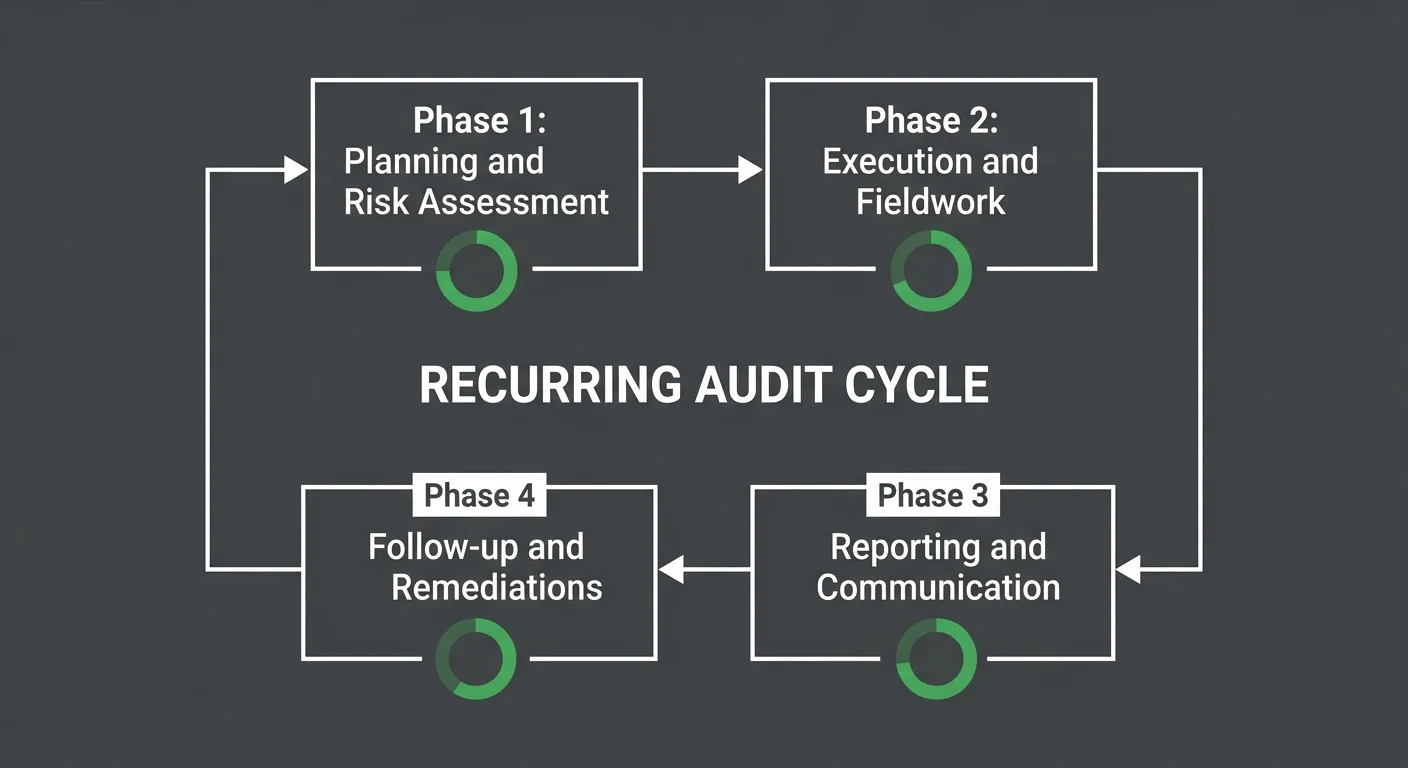
A documentation standard without a review mechanism is just a suggestion.
And in a multi-provider practice, suggestions don’t hold up when a federal auditor pulls a file and starts comparing notes across providers.
The audit protocol is what turns documentation rules from paper into practice.
It catches drift before drift becomes denial volume. It catches denial volume before denial volume becomes a cash flow problem the practice can’t reverse.
Here’s the thing – most multi-provider practices don’t have an audit protocol.
They have a documentation policy sitting in an onboarding folder. It got reviewed once during orientation. Nobody’s touched it since. That’s not a compliance posture. That’s a gap that widens every time a provider develops a documentation shortcut nobody’s catching.
The Audit Cadence That Keeps Documentation Drift From Becoming a Cash Flow Crisis
Documentation drift doesn’t announce itself. It builds one vague functional outcome notation at a time. One copied-forward objective finding. One AT modifier applied without the note to back it up.
By the time the pattern shows up in denial data, the revenue cycle damage is already months deep.
That’s why cadence matters more than depth.
A thorough audit once a year is worth less than a focused review every month. Monthly sampling – pulling a cross-section of notes from each provider and running them against the documentation standard – catches drift before it compounds.
Practices that want to scale a multi-location chiropractic practice without variance multiplying across every new location need that cadence in place before they add providers, not after.
The cadence has to be non-negotiable and calendar-driven – not triggered by a denial spike or a payer inquiry.
Reactive audits are forensic exercises. Proactive audits are revenue protection tools. The difference is whether the practice finds the problem or the payer does.
How to Run a Provider-Level Documentation Review Without Alienating Your Doctors
The word ‘audit’ creates resistance in clinical environments. Providers hear it as surveillance.
That framing defeats the purpose. A defensive provider is not a collaborative one – and the goal of a documentation review is clinical alignment, not disciplinary action.
So structure the review as a peer accountability process, not a top-down inspection.
When providers review each other’s notes against a shared standard – one they helped design – the dynamic shifts from evaluation to collaboration. The American Chiropractic Association’s coding and compliance guidelines give that standard an external reference point. That removes the perception that any single provider’s preferences are being imposed on the rest of the team.
Build this structure before the practice expands. Built in from the start, it scales. Bolted on afterward, it hits resistance every time.
Review findings have to feed back through specific, note-level correction – not global feedback.
‘Your functional outcome section needs to reflect measurable progress’ is actionable. ‘We need better documentation’ is not.
Every doctor’s note is a link in the revenue chain. You don’t strengthen a chain by telling someone to try harder. You identify the weak link, show exactly where it fails, and fix it. That’s what a provider-level documentation review actually does – and it’s the only version of clinical accountability that produces a billing record defensible enough to survive scrutiny.
| Audit Phase | Who Leads It | What Gets Reviewed | Frequency | Output |
|---|---|---|---|---|
| Protocol Design | Clinical lead or senior provider | Documentation standards, AT modifier requirements, active-vs-maintenance criteria, SOAP note structure | Once at launch – revisited when payer requirements change | Written documentation protocol distributed to all providers |
| Monthly Note Sampling | Billing-clinical liaison or practice administrator | Cross-section of treatment notes from each provider, checked against the documentation protocol and coding guidelines | Monthly | Provider-specific feedback report with note-level corrections |
| Peer Review Session | Rotating provider panel | Flagged notes from monthly sampling, functional outcome documentation, medical necessity language | Monthly or quarterly | Agreed corrections, protocol clarifications, updated shared language for common visit types |
| Denial Pattern Analysis | Billing operation in coordination with clinical lead | Denial codes tied to documentation deficiencies – medical necessity, modifier support, insufficient clinical findings | Quarterly | Root-cause documentation gap identified, protocol updated, provider-level correction issued |
| Full-Record Compliance Review | Clinical lead with billing input | Complete patient files for a sample of accounts – note consistency across visits, documentation of progress, modifier support across the file | Biannually | File-level assessment report, remediation plan for any provider showing systemic documentation drift |
| New Provider Onboarding Review | Clinical lead | First 30 to 60 days of treatment notes from any newly added provider, benchmarked against the practice standard | Within first two billing cycles after a new provider joins | Clearance confirmation or targeted correction plan before the provider’s volume scales |
Frequently Asked Questions
That’s the principle. Now here’s where it breaks in practice.
These are the questions that actually come up when practice owners try to put standardization into action.
Why does documentation disparity between doctors lead to billing denials?
Payers don’t reimburse claims. They reimburse clinical stories. When two providers document the same patient differently, the story breaks down. One note delivers measurable functional outcomes and a clear treatment rationale. The other delivers vague subjective complaints and no progress indicators. The payer reads two different clinical pictures – and denies the weaker one.
But it doesn’t stop there. Federal auditors treat documentation disparity as a pattern signal. Pull one file, find inconsistency between providers, and they pull more. One weak note doesn’t cost the practice one claim. It opens the entire billing relationship with that patient to review.
The American Chiropractic Association’s coding and compliance guidelines exist to prevent exactly this – a shared clinical reference that keeps notes aligned across the team. Without that alignment, the record doesn’t just have gaps. It has contradictions. And contradictions are what OIG auditors are built to find.
What specific documentation is required to support the Medicare AT modifier?
Medicare requires the AT modifier on every chiropractic claim billed as active treatment. That modifier signals one thing: the care is medically necessary and active – not maintenance care, which Medicare does not cover.
But the modifier alone does nothing. The note underneath it has to carry the weight.
That means the documentation must show three things: a specific, measurable functional deficit the patient is actively working to correct; objective findings that reflect change or the absence of plateau; and a clear clinical rationale for continued active care at that visit. A note that lists symptoms without demonstrating functional decline or measurable treatment response does not support the AT modifier – regardless of whether the modifier appears on the claim.
The claim and the note have to tell the same story. When they don’t, CMS doesn’t ask for clarification. The claim fails.
How often should clinical documentation audits be performed in a multi-provider practice?
Monthly. That’s the minimum for any multi-provider practice where documentation variance is directly driving billing output.
Quarterly or annual reviews catch problems after they’ve already compounded into denial patterns. By the time that data surfaces, the documentation issue behind it is months old – and so is the revenue it cost you. A monthly sampling pulls a cross-section of notes from each provider, runs them against the practice standard, and catches drift before it reaches the claim.
That’s the difference between a revenue protection tool and a forensic exercise.
The cadence has to be calendar-driven. Not triggered by a denial spike. Not scheduled when someone finds time. By the time denials prompt a review, the chain is already breaking. The audit exists to catch the weak links before the payer does.
Can a practice standardize clinical documentation without micromanaging its doctors?
Yes – but only if providers help build it from the start.
A documentation protocol handed down from administration without clinical input reads as surveillance. Providers resist it, route around it, or comply in form while abandoning it in practice. That’s not standardization. That’s the appearance of standardization with none of the revenue protection.
When providers co-design the standard – when they define what a defensible note looks like in their specialty, anchored to the American Chiropractic Association’s coding and compliance guidelines as an external reference – the protocol belongs to the clinical team. Peer review becomes accountability between colleagues, not evaluation by administration.
That distinction determines whether the standard holds under pressure. A rule imposed from outside bends. A standard the team built together doesn’t.
What are the HIPAA compliance considerations when standardizing patient records for third-party billing?
HIPAA explicitly permits disclosure of protected health information for billing, claims submission, and payment coordination – no patient authorization required. That permission is real. It’s also not the compliance risk.
The risk is the quality of the records being disclosed. HIPAA’s permission to share records for billing doesn’t resolve a documentation liability. It assumes the records meet a baseline evidentiary standard. A vague note, a copied-forward objective finding, a clinical record that contradicts itself across providers – none of that meets the standard.
Sharing it for billing purposes is a compliant disclosure act. It’s still a liability as a billing document.
So a structurally sound disclosure process built on inconsistent clinical notes is still a problem. HHS guidance makes clear that the regulatory framework governing billing disclosures was built around the assumption that the underlying records are defensible. Standardizing documentation across providers strengthens both sides of that equation at once.
How do standard EHR templates improve clinical billing consistency – and where do they fall short?
EHR templates solve a real problem. They create structural consistency – required fields, organized sections, captured data that a blank text field would leave to chance. A provider who can’t skip the functional outcome section because the template requires it is less likely to produce a vague note than one working without structure.
But templates don’t write clinical reasoning. They prompt for it.
A provider can complete every required field with generic, copied-forward language and produce a note that is structurally complete and clinically indefensible. The template doesn’t know the difference. The American Chiropractic Association’s coding and compliance guidelines demand the clinical specificity that determines whether a payer accepts a claim – and no general-purpose template was built to enforce that standard.
Software can’t audit intent. It can’t flag a functional outcome notation that says ‘patient improving’ without specifying from what baseline, toward what measurable goal, at what rate of progress.
That gap – between a completed template and a defensible note – is exactly where documentation drift lives. And it’s where human clinical review has to do what software cannot.
Documentation Is the Foundation – Not a Formality
Every revenue problem in a multi-provider chiropractic practice has a documentation problem underneath it.
The denial is visible. The audit flag is visible. The cash flow gap is visible. But the source – inconsistent treatment notes, unsupported AT modifiers, clinical stories that contradict each other across providers – that never gets fixed.
Practices stay busy fighting symptoms. The source keeps running.
One weak link doesn’t just lose its own claim. It invites scrutiny across the entire patient file – and in a multi-provider practice, across every provider on the team.
That’s not a billing problem. That’s a structural exposure. No software setting and no generalist billing firm resolves it on the practice’s behalf.
What resolves it is clinical governance: a unified documentation standard, a recurring peer review process, and a billing operation that feeds intelligence back into clinical habits instead of just processing claims and moving on. That’s the model Bushido Billing was built around. Revenue cycle management (RCM) for chiropractic practices means the documentation standard and the billing record run together – not parallel to each other and hoping for the best.
Documentation is not a compliance checkbox. It’s the foundation every other revenue decision in the practice sits on.
Credentialing, denial appeals, AR recovery, payer negotiations – all of it depends on whether the clinical record is defensible. Fix the foundation, and the rest of the revenue cycle has something solid to build on. Leave the weak links in place, and every investment in billing infrastructure is working against a chain that’s already breaking.
Every doctor’s note is a link in the revenue chain. The question is whether your practice is building those links to a standard – or leaving that to chance and calling it a documentation policy.
Every doctor’s note is a link in the revenue chain. If those links aren’t built to the same standard across every provider on your team, the chain is already breaking – and you may not see it until a denial pattern forces you to look. Book a call with Bushido Billing to find out exactly where.

© . All Rights Reserved | Web Design by iTech Valet