

What Chiropractors Get Wrong About Medicare Billing Rules Today
Medicare chiropractic billing hinges on active treatment versus maintenance care. See where documentation and AT modifier rules trip up practices.
Chiropractors most often get Medicare billing wrong by misapplying the line between active treatment and maintenance care, not by making simple clerical mistakes. Medicare Part B covers spinal manipulation only when it corrects a subluxation and only while that care is active treatment aimed at measurable functional improvement. Once a patient's condition plateaus and further visits serve to maintain that status rather than improve it, the same service becomes maintenance care, which Medicare does not pay for. The AT modifier tells Medicare a claim is for active treatment, and attaching it to a maintenance visit creates a mismatch between the claim and the record. That line has to be re-established at every visit through objective evidence of functional change, not assumed from the original diagnosis or an old treatment plan. Medicare's chiropractic coverage is also narrow: it covers only manual manipulation of the spine to correct a subluxation, and it doesn't pay for exams, X-rays or other services a chiropractor furnishes or orders. A subluxation can be shown by physical exam findings, and since January 1, 2000, an X-ray hasn't been required, though one may still be used. CMS reports that insufficient documentation, not incorrect coding, caused most improper payments for chiropractic services in 2024. Because the active-versus-maintenance call depends on clinical judgment applied at every visit, billing systems built for general medical specialties often miss the specific evidence Medicare looks for in chiropractic records.
Why Medicare Draws a Hard Line Between Active Treatment and Maintenance Care
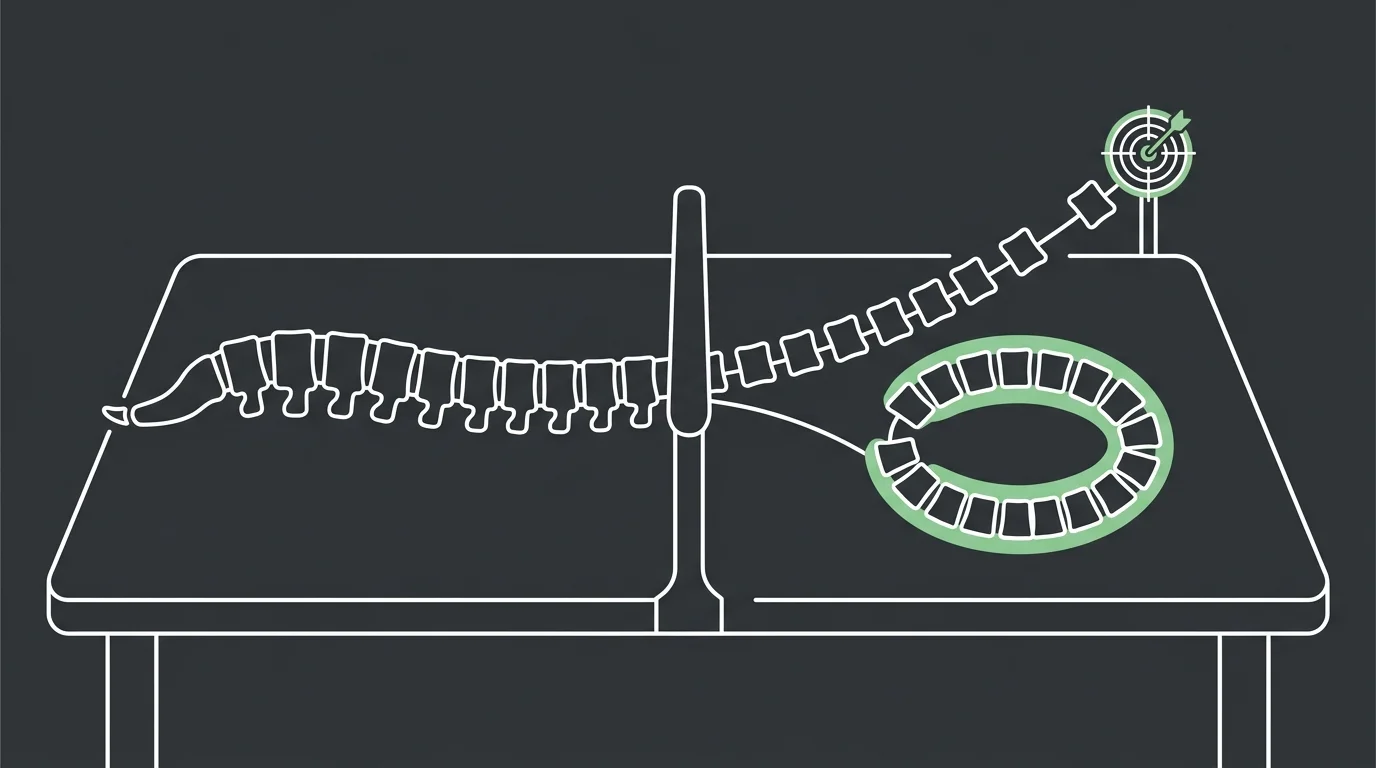
Everything in Medicare chiropractic billing comes back to one line: active treatment on one side, maintenance care on the other. Every other rule in this specialty sits downstream of it.
Medicare's rules for chiropractic billing are notoriously narrow and specific. That narrowness creates a landscape where simple procedural errors can turn into significant compliance issues, because the line between active treatment and maintenance care has to be redrawn at every visit rather than settled once. A practice working through active treatment billing requirements under Medicare will find that this redrawing, not the paperwork itself, is where generalist systems lose the thread.
What Counts as Active Treatment Under Medicare
Active treatment means the patient's condition is still moving. Medicare wants to see measurable gains from one visit to the next, not a care plan that just holds steady indefinitely.
Here's what trips practices up: it's easy to assume standard documentation already satisfies Medicare, without realizing the payer wants specific, objective evidence of functional improvement at every single visit, not just at the start of care.
Where Maintenance Care Gets Misclassified
Maintenance care gets misclassified the moment the notes start describing a patient's baseline instead of tracking change from it. The adjustment can be clinically sound and still fail the billing test. Medicare isn't scoring the adjustment; it's scoring the paperwork's evidence of progress.
Fee schedules can change from year to year. But even a practice weighing what the 2026 Medicare fee schedule means for chiropractic pay still has to draw that same active-versus-maintenance line at the visit level, no matter what the codes pay.
Why Generalist Billing Treats Chiropractic Claims Like Every Other Specialty
Here's where it breaks. Generalist billing systems handle a chiropractic claim like any other specialty claim: enter the code, submit the claim, wait for payment. That routine quietly assumes the notes already prove what Medicare needs proven.
Chiropractic Medicare billing does not work that way. The active-versus-maintenance line has to be redrawn at every visit, and a system built for general medical coding has no mechanism for redrawing it. A claims process that cannot evaluate functional change at the visit level cannot reliably separate active treatment from maintenance care, no matter how clean the codes look.
| Billing Approach | How the AT Modifier Is Applied | What Gets Missed |
|---|---|---|
| Generalist medical billing | Applied as a default once a diagnosis code is on file, then left unchanged for the life of the treatment plan | Whether the patient's condition is still changing visit over visit, since the modifier gets treated as permanent instead of conditional |
| Specialty-aware chiropractic billing | Re-evaluated at every visit against that visit's own documentation of functional change | Far less, because the modifier decision is remade each time rather than carried over from the prior claim |
| Claim-volume-driven billing | Applied based on what keeps the claim moving through the queue toward payment | The distinction between improvement and stabilization, since the goal is submission speed rather than evidentiary accuracy |
The Problem With Treating the AT Modifier as a Formality
So the AT modifier turns into a box to check instead of a statement to verify. Attaching it becomes habit, not a judgment call tied to what that visit's notes actually show.
That habit is a risk, because submission isn't billing. Getting paid is billing, and a claim only stays paid when the record backs it up. A practice weighing whether to stay enrolled at all can find a guide to leaving or keeping Medicare enrollment useful context, but the modifier problem exists regardless of that decision.
What the CERT and OIG Data Actually Shows About Chiropractic Claims

The scale of this problem is not anecdotal. Federal data puts numbers on how often chiropractic claims don't hold up under review.
That data also confirms this is not a coding problem. It is a documentation problem, and the gap between those two things is where generalist billing systems fail.
Reading the Improper Payment Numbers
According to CMS, insufficient documentation accounted for 95.5% of improper payments for chiropractic services in the 2024 reporting period, while incorrect coding accounted for only 0.7%. That means the record didn't prove what was billed, and the record is what Medicare reviews.
As CMS explains, the improper payment rate for chiropractic services in the 2024 reporting period was 33.6%, with a projected improper payment amount of $178.3 million. That's not a rounding error. It's what adds up across thousands of claims when the record doesn't back up what was billed.
How a Flawed Documentation Workflow Fails Under Audit Pressure
Problems with chiropractic claims aren't new. According to the HHS Office of Inspector General, Medicare inappropriately paid $178 million for chiropractic claims in 2006, which was 47 percent of claims meeting the study criteria. Building documentation around the active-versus-maintenance standard up front, instead of finding the gap under audit, is the job of good chiropractic billing support.
What Medicare Actually Pays for Beyond the Adjustment
The adjustment isn't the only thing that happens at a chiropractic visit. What Medicare covers around it is a separate rule from the active-versus-maintenance line.
Spinal Manipulation Versus the Services Around It
According to Medicare, Part B only covers adjustments of the spine by a chiropractor to correct a subluxation, when the chiropractor uses their hands or a device called an activator. The Medicare Benefit Policy Manual adds that all other services a chiropractor furnishes or orders aren't covered, and an X-ray used to show a subluxation can serve as documentation, but Medicare won't pay for it.
Why an EHR Can't Judge the Visit
EHRs submit claims, but they don't judge whether a visit's notes actually support what got billed. Denials, appeals, and AR recovery all hinge on that judgment, and it's a human call no claims system was built to make.
Building a Documentation Workflow That Holds Up to Scrutiny

A defensible workflow isn't one form filled out and filed. It's a string of checkpoints, and each one leaves evidence an auditor can verify without anyone at the practice having to explain it.
Subluxation Proof, Functional Evidence, and the ABN as Checkpoints
Proof of subluxation is the first checkpoint. Medicare hasn't required an X-ray to show a subluxation since January 1, 2000, and a physical exam can show it with at least two of the four PART findings (pain or tenderness, asymmetry, range of motion abnormality, tissue tone changes), one of which must be asymmetry or range of motion. If an X-ray is used, CMS says it must be taken within 12 months before or 3 months after the start of treatment.
That proof only earns its keep if the chart beside it logs functional change at every visit, because a subluxation finding on its own never proves active treatment. When a service falls outside Medicare's coverage, an Advance Beneficiary Notice is the checkpoint that records the patient's informed choice before the visit happens.
Frequently Asked Questions
Some mechanical questions keep coming back around this line. So here are the straight answers.
What is the difference between active treatment and maintenance care under Medicare rules?
Active treatment means the patient's condition is still changing, with documented functional gains expected visit over visit. Maintenance care means the condition has plateaued, even if adjustments continue.
When is it mandatory to use the AT modifier on a chiropractic Medicare claim?
The AT modifier goes on a claim for active or corrective treatment of an acute or chronic subluxation, and CMS says it must not be used when the visit was maintenance therapy. The modifier doesn't by itself prove the service was reasonable and necessary, so the visit's documentation has to back it up.
Can chiropractors bill Medicare for initial exams, E/M services, or X-rays?
No. Medicare covers only the spinal manipulation itself, so it won't pay a chiropractor for exams, E/M services or X-rays. An X-ray can still be used to document a subluxation.
What are the most common documentation mistakes that lead to chiropractic claim denials from Medicare?
It's rarely the coding. CMS traces most improper chiropractic payments to insufficient documentation, and notes that restate a patient's baseline instead of tracking change from it are one way a record falls short.
How does an Advance Beneficiary Notice work for chiropractic services Medicare does not cover?
An Advance Beneficiary Notice documents a patient's informed choice before a non-covered service happens, such as maintenance adjustments or ancillary care. It has to be issued ahead of the visit, not added afterward.
Where This Leaves a Practice Billing Medicare
That line between active treatment and maintenance care was never a formality. It's the one judgment call that decides whether a claim holds up or gets flagged, and it has to be made fresh at every single visit.
Generalist billing systems cannot draw that line because they were never built to evaluate functional change at the point of care. Specialty-level documentation can, and that gap is the real cost of treating chiropractic claims like any other specialty's paperwork.
So the documentation has to be built around that distinction now, instead of finding the gap only after a reviewer does, starting with an honest look at where a practice's own process stands. Book a call with Bushido Billing.