

What to Do After a Payer Upholds a Denial on Appeal
A payer kept its denial after your appeal? See the next Medicare levels: the OMHA hearing, the Part C review, and the Medicare Appeals Council.
The Office of Medicare Hearings and Appeals (OMHA) generally runs the third level of a five-level appeals process, and it works separately from the other agencies in the Medicare claims appeal process. If a party to an Administrative Law Judge (ALJ) hearing disagrees with the ALJ’s decision, that party may ask the Medicare Appeals Council (Departmental Appeals Board, or DAB) to review it, and there are no rules about how much money must be in dispute. If a Medicare Advantage (Part C) health plan makes an adverse reconsideration decision, meaning it keeps its first denial in whole or in part, the plan must automatically send the case file and its decision to the Part C Independent Review Entity (IRE) for review.
Where an Upheld Denial Sits in Medicare’s Appeal Ladder
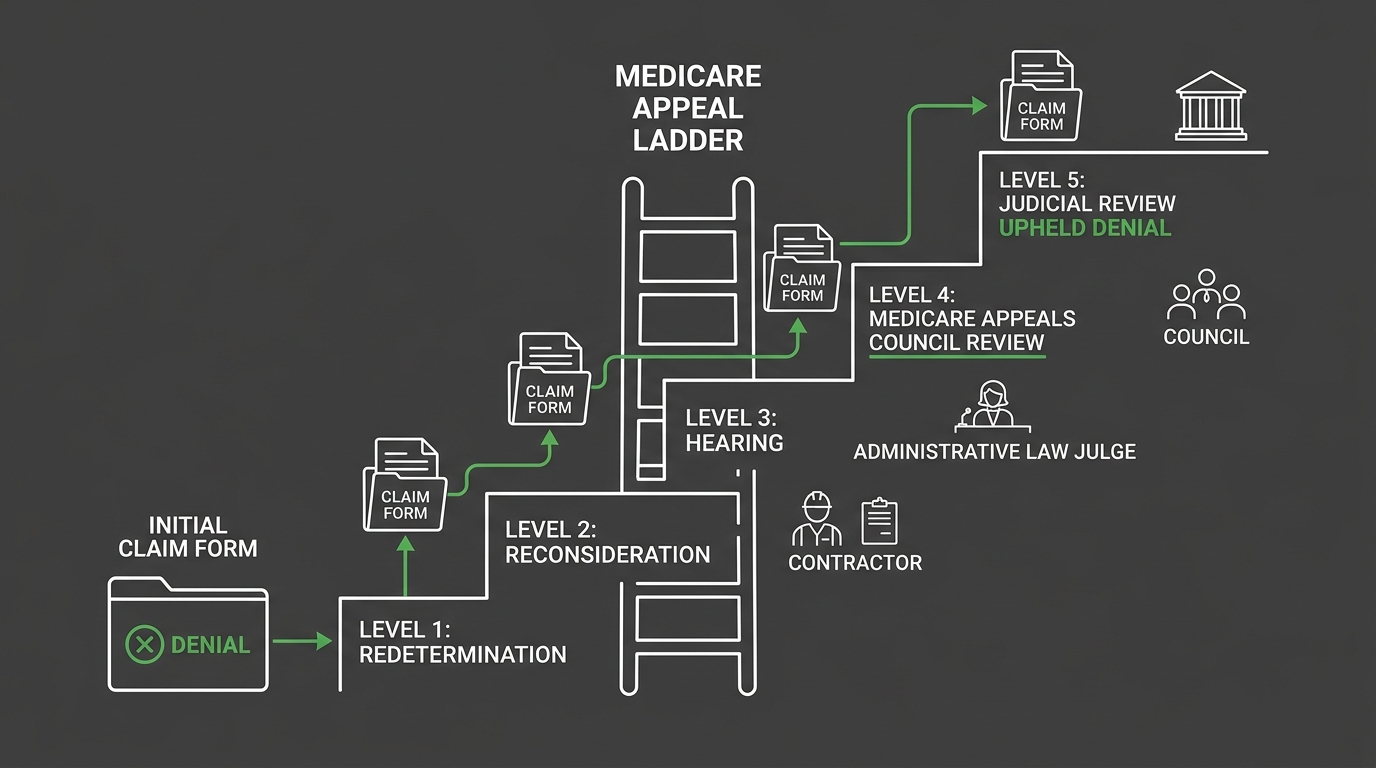
Medicare’s appeal process has five levels. The Office of Medicare Hearings and Appeals (OMHA) generally runs the third level, and it works separately from the other agencies in the Medicare claims appeal process. After an unfavorable reconsideration, your next stop is an OMHA hearing.
The U.S. Department of Health and Human Services says on its Office of Medicare Hearings and Appeals page that OMHA is responsible for the third level of the Medicare claims appeals process. For chiropractic denials and appeals more broadly, see Handling Denied Chiropractic Claims and Appeals: A Complete Guide.
Requesting an ALJ Hearing (Original Medicare)
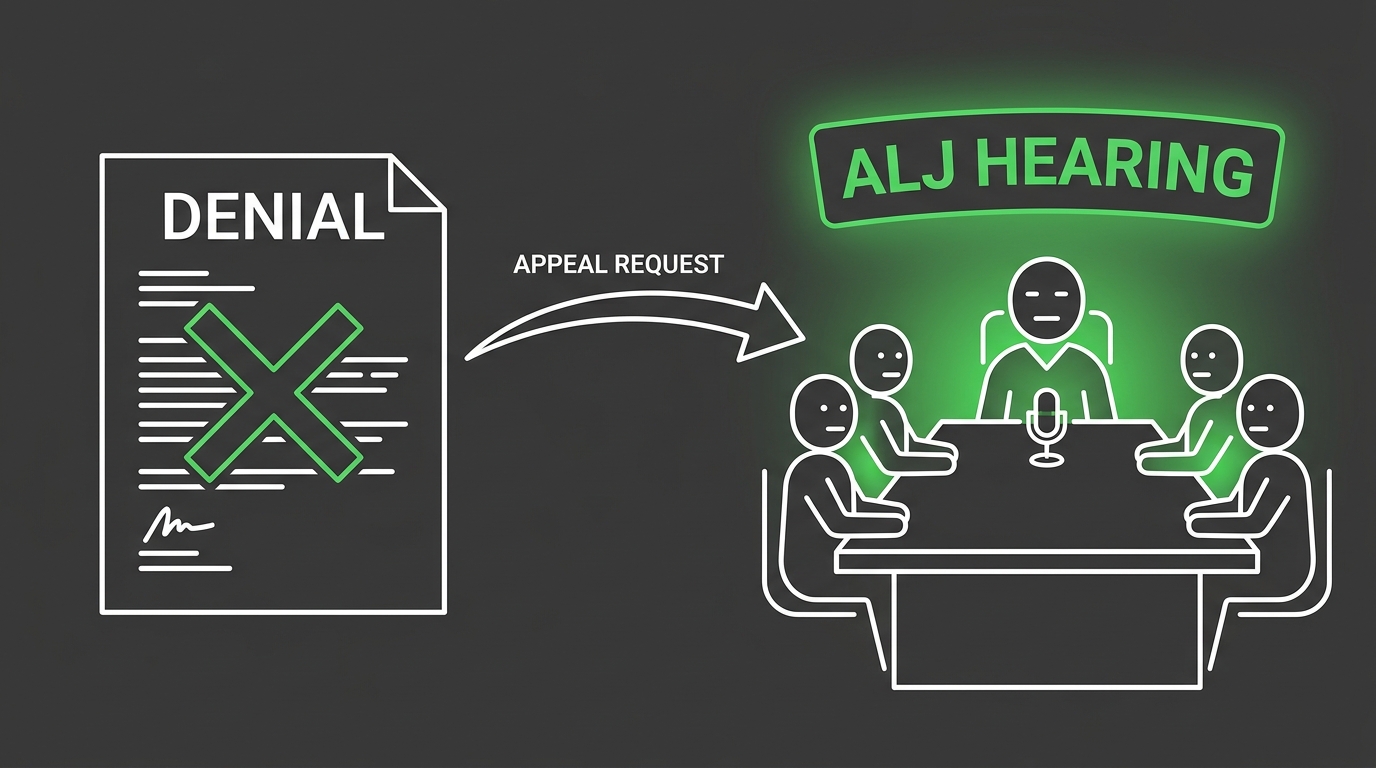
You can ask OMHA for a hearing if you disagree with a decision or dismissal from a Qualified Independent Contractor (QIC), or from one of the other decision-makers the rules list. You also have to meet the amount in controversy requirement. And you have to file within 60 days of getting the decision you’re appealing.
For appeals filed in calendar year 2026, the smallest amount in controversy for an Administrative Law Judge (ALJ) hearing, or for a review of a dismissal, is 200 dollars ($200). OMHA answers common questions on its page, FAQs – Requesting an ALJ Hearing.
The table below sums up the main requirements for a hearing request.
| Requirement | What it means |
|---|---|
| Filing deadline | Within 60 days of receiving the decision being appealed |
| Minimum amount in controversy | $200 for appeals filed in calendar year 2026 |
| Form | Form OMHA-100 is the best way to make sure the request has all required elements |
| How to file | Online for Part A or Part B appeals, or by mail |
| Copies to other parties | Send a copy to the other parties who received the reconsideration, whether filed online or by mail |
I’m happy to let software handle routine claims that have no errors. I wouldn’t hand a hearing request to a machine. I want a skilled person explaining why the care was medically necessary and writing an appeal that fits your case, so a person prepares the request and its evidence. I use tech where it helps, and I keep its role limited.
Filing the Hearing Request
The best way to make sure your request has all the required elements is to use Form OMHA-100, Request for Administrative Law Judge Hearing or Review of Dismissal.
Here’s what to know before you file:
- For appeals about Medicare Part A or Part B, you may file your appeal request online.
- Clearly list the reconsideration number (the Medicare appeal or case number) for the decision or dismissal you’re appealing on your request form for an Administrative Law Judge (ALJ) hearing.
- Whether you file online or by mail, you must also send a copy of the Request for Hearing to the other parties who received a copy of the reconsideration you’re appealing.
- If you’re appealing a reconsideration from a Qualified Independent Contractor (QIC), do NOT send a courtesy copy of your hearing request to the QIC that issued it.
- The OMHA e-Appeal Portal currently cannot accept appeal requests for certain kinds of appeals.
- Files are limited to 50 megabytes, and only certain file types may be uploaded.
Late Requests, New Evidence and Decisions Without a Hearing
If you miss the 60-day deadline to file your request for a hearing, you must explain in writing why your request is late. You must also ask the OMHA adjudicator to extend the deadline.
If a provider, supplier, or a beneficiary represented by a provider or supplier turns in evidence for the first time, it must come with a statement saying why the evidence was not given earlier to the QIC or a prior decision-maker. Without that statement, the evidence will not be considered. Do not send again medical records or other papers that you already sent earlier with the claim or at another level of appeal.
A case is decided without a hearing in only two situations:
- The decision favors the appellant on every issue, no other party is liable for the non-covered claims, and the Centers for Medicare & Medicaid Services (CMS) has not chosen to be a party to the hearing.
- All the parties who would be sent a notice of hearing gave up their right to appear before an Administrative Law Judge (ALJ) at a hearing.
When a Medicare Advantage Plan Upholds Its Denial
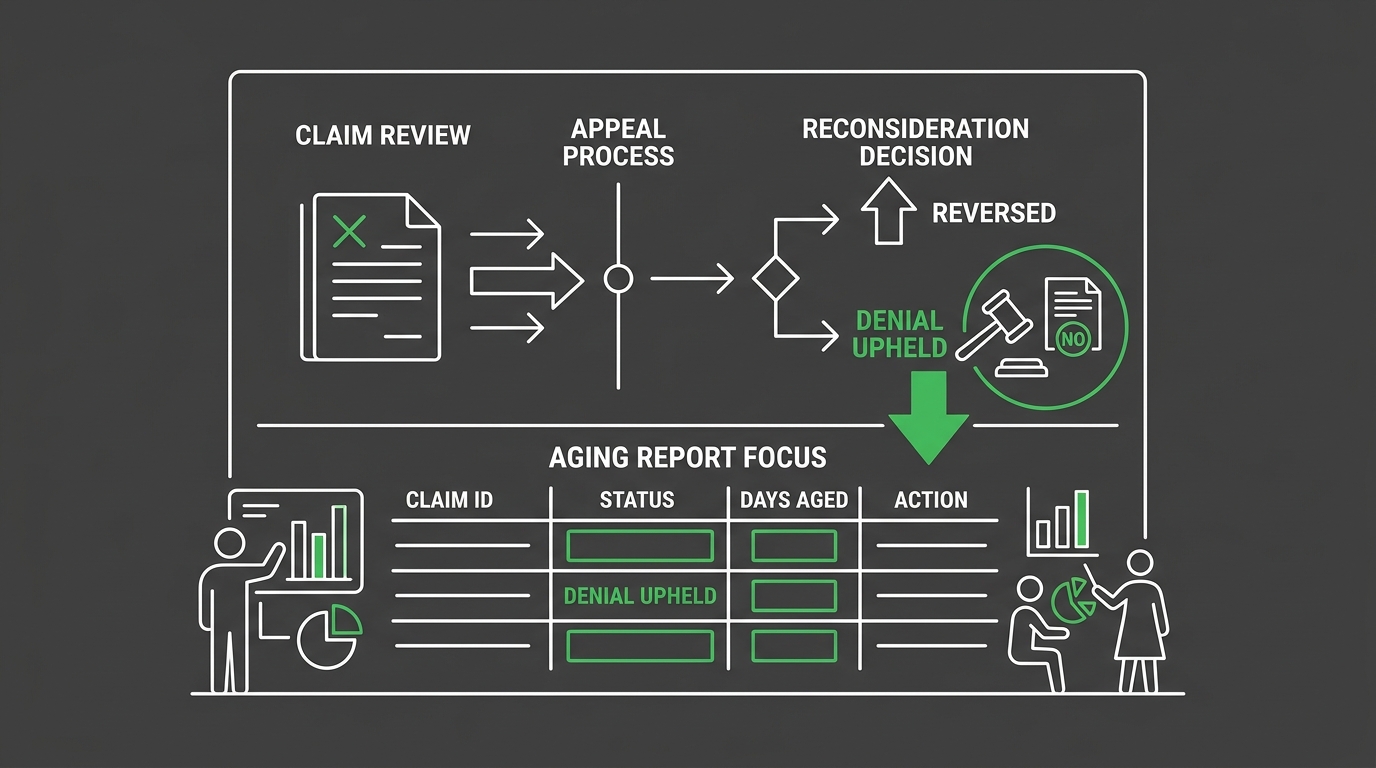
Sometimes your Medicare Advantage (Part C) plan makes an adverse reconsideration decision. That means it keeps its first denial, in whole or in part. When that happens, the plan must automatically send the case file and its decision to the Part C Independent Review Entity (IRE) for review.
The IRE changes in 2026. MAXIMUS Federal Services is the former Part C IRE, and it will keep working on reconsideration requests received through April 30, 2026. Starting May 1, 2026, C2C Innovative Solutions, Inc. is the Part C IRE.
For a plan dismissal, you have 65 calendar days from the date of the plan dismissal decision notice to file your request with the IRE.
If the IRE decision is unfavorable or partly favorable, the decision notice will have the information you need to ask for a hearing with an Administrative Law Judge in OMHA. CMS explains the review on its page, Reconsideration by Part C Independent Review Entity (IRE).
Asking the Medicare Appeals Council to Review an ALJ Decision
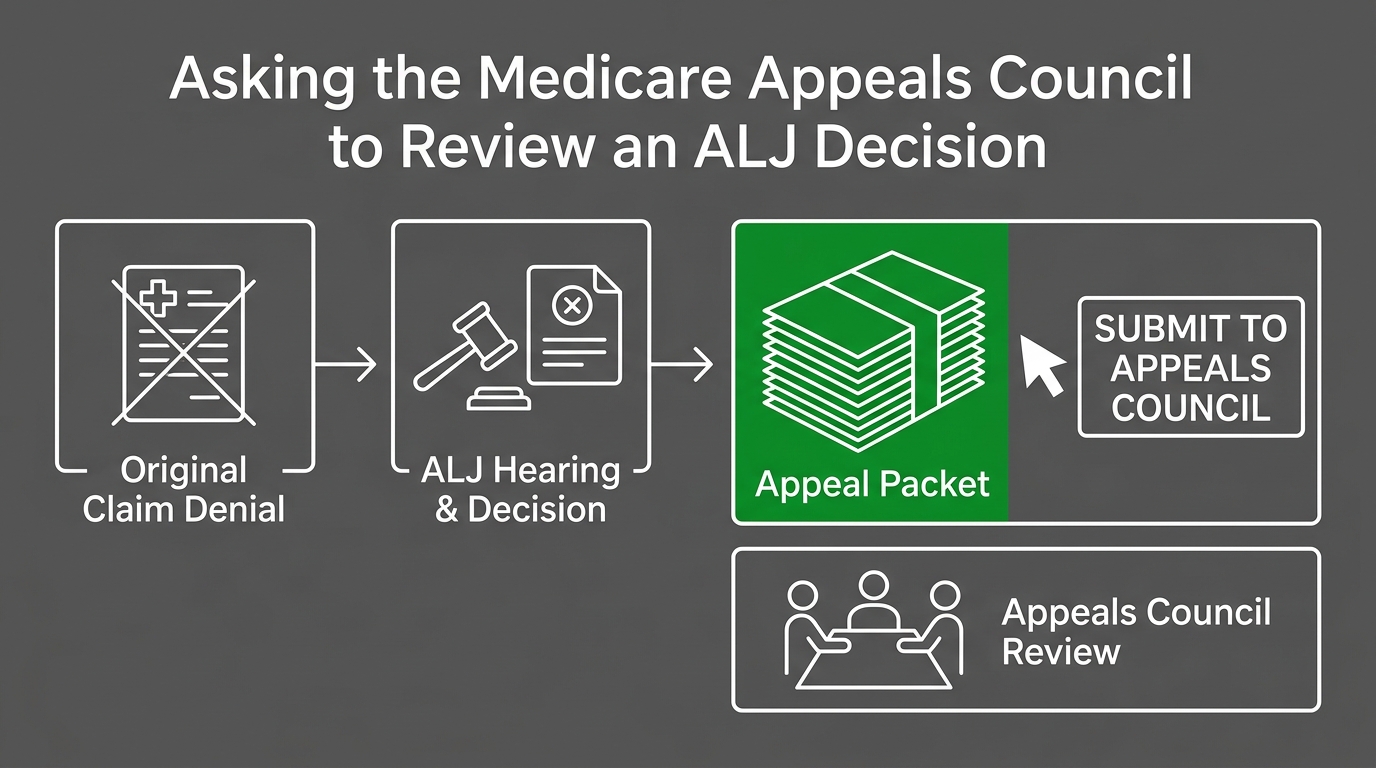
Say you’re a party to an ALJ hearing and you disagree with the ALJ’s decision. You can ask the Medicare Appeals Council (Departmental Appeals Board, or DAB) to review it, and there are no rules about how much money must be in dispute. Noridian Healthcare Solutions covers this on its page, Departmental Appeals Board (DAB) – JE Part B. It adds that your request must name the issues and findings you are disputing.
The Departmental Appeals Board sets the deadline in DAB-101 Request for Review of ALJ Medicare Decision/Dismissal. Your request must be received within 60 calendar days after you get the ALJ decision or dismissal, unless the time limit is extended for good cause.
The same document limits new evidence. The Medicare Appeals Council will not consider new evidence on issues the QIC has already considered, unless you show you have a good reason for sending it for the first time to the Council.
Want to see how we handle this work for you? Our Medical Billing Services page explains it.
Frequently Asked Questions
How is the amount in controversy calculated?
Take the subtotal balance and subtract any deductible or coinsurance that may be collected. What’s left is the amount in controversy.
Can smaller claims be combined to meet the hearing minimum?
Yes, under conditions. One condition is that your request for hearing lists all the claims you want combined. You also have to file it within 60 calendar days after you receive all the reconsiderations you’re appealing.
Do I have to attend the ALJ hearing in person?
No. You are not required to appear in person at the Administrative Law Judge hearing. You may take part remotely by telephone, or by video-teleconference at a video-teleconference site near you.
How do I send a request for Medicare Appeals Council review?
You can send it by U.S. Mail, by a common carrier such as FedEx, or by fax to (202) 565-0227.
Can the practice bill the patient if an appeal filed with transferred appeal rights fails?
No. When you appeal, you give up the right to bill the patient if your appeal fails.
Weighing Your Next Appeal Step
An upheld denial still leaves more levels. OMHA is responsible for the third level of the Medicare claims appeals process, and more levels follow it. Every level covered here comes with its own filing deadline. A specialty biller keeps track of those dates and weighs which path is worth the recovery.
We don’t count a claim as done when it goes out. We count it when the money lands in your practice’s account. So we weigh every further appeal by what it could recover, not by how much work it adds. Bushido Billing does chiropractic billing, full-service insurance billing, cleaning up unpaid claims, and fixing and appealing denied claims. Would you like to talk through your denied claim with us and pick the next step? Book a Call