

How Should Staff Respond to a ‘Not Medically Necessary’ Denial?
Got a 'not medically necessary' denial? Three steps staff can take, from getting the payer's reasoning in writing to filing a written appeal.
National Government Services (NGS Medicare) says Medicare does not pay for spinal manipulation that is done as maintenance care or that does not meet medical necessity. The Centers for Medicare & Medicaid Services says a denial notice must explain the reasons for the decision, including the denial code and its meaning, and the plan must describe any standard it used to deny the claim. When a denial is based on medical necessity, an experimental treatment, or a similar exclusion, the plan must either explain the scientific or clinical judgment behind it or say it will give you that explanation free of charge if you ask.
What a ‘Not Medically Necessary’ Denial Means
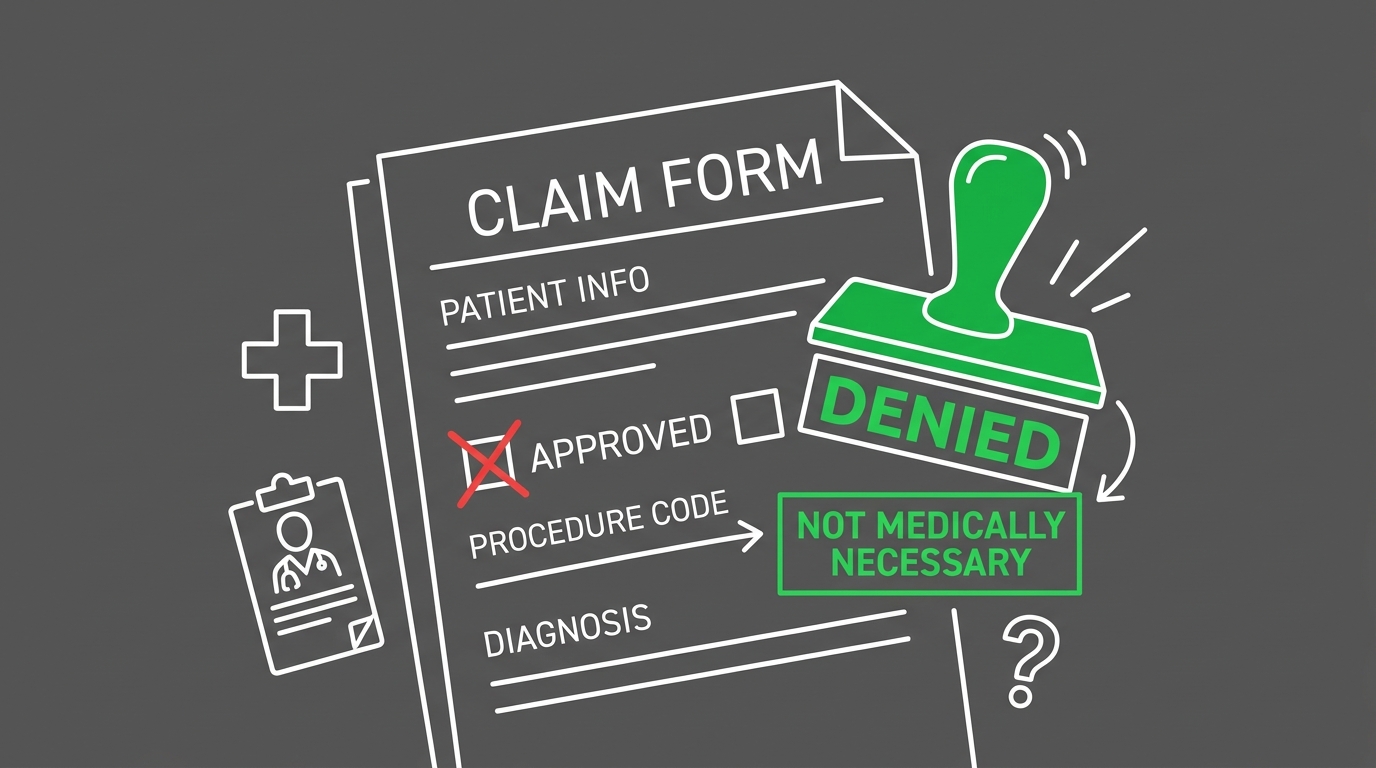
A “not medically necessary” denial is a formal decision. Under the federal health care law’s appeal rules, a denial is called an “adverse benefit determination.” The Centers for Medicare & Medicaid Services (CMS) says that includes “a failure to cover an item or service for which benefits are otherwise provided because it is determined to be experimental or investigational or not medically necessary or appropriate.” You can read that wording in its Coverage Appeals Job Aid.
Medicare has its own line on chiropractic care. National Government Services (NGS Medicare) states, “Medicare does not reimburse for spinal manipulation that is performed as maintenance care or does not meet for medical necessity.”
So your first job is to read the denial as a formal decision with reasons behind it. For the wider denial and appeal process, see Handling Denied Chiropractic Claims and Appeals: A Complete Guide.
Why Medicare Treats Some Chiropractic Care as Maintenance

Under Medicare, chiropractic maintenance therapy is not considered medically reasonable or necessary, according to CMS. That means Medicare does not pay for it. CMS defines maintenance therapy as a treatment plan that seeks to prevent disease, promote health, and prolong and enhance quality of life. It also covers therapy done to maintain or prevent deterioration of a chronic condition.
There’s also a point where active care stops counting as active. Once a patient’s clinical status has stayed stable for a given condition, with no more objective clinical improvement expected, CMS considers further manipulative treatment maintenance therapy. It is not covered.
You can find the chiropractic guidance NGS Medicare publishes for providers at Chiropractic Services – NGSMEDICARE.
I won’t hand maintenance-versus-active-care documentation to a generalist biller. I want someone with chiropractic specialty knowledge showing, in the record, that your care is still active.
The Modifiers Behind These Denials: AT and GA
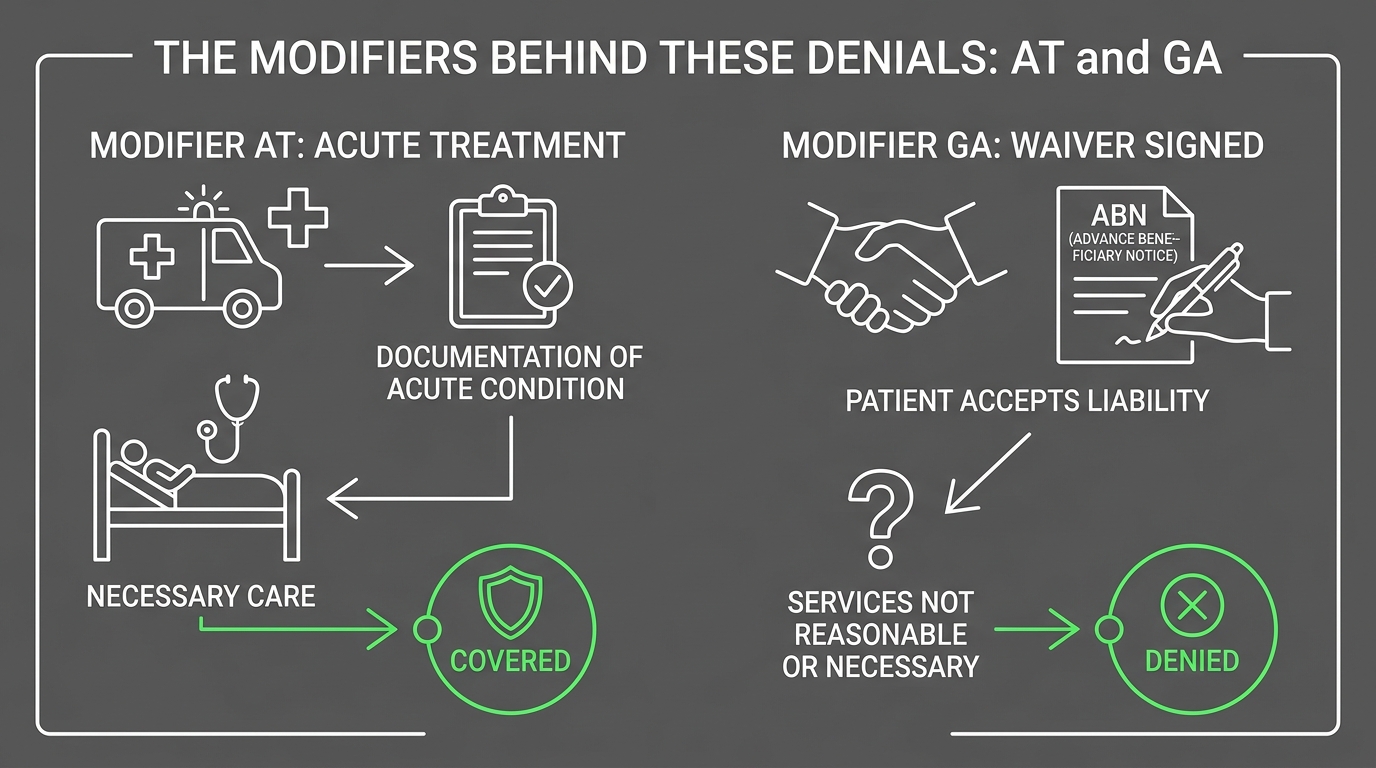
Start with what each modifier means. NGS Medicare says the AT modifier is “used to indicate that the covered services billed are for active corrective treatment and the provider’s documentation supports medical necessity and Medicare coverage guidelines.” The GA modifier is “used to report when a mandatory ABN was issued to a beneficiary for a covered service that is not likely to be covered by Medicare due to medical necessity.” An ABN is an Advance Beneficiary Notice, the mandatory notice given to a Medicare patient.
Leaving the modifier off has its own result. Here is the NGS Medicare wording on Current Procedural Terminology (CPT) codes: “If CPT codes 98940–98942 are billed without a modifier the claim will be denied by the system as not medically necessary.”
One more rule to keep in front of you. Noridian Healthcare Solutions (JE Part B) says, “Providers should not report the AT modifier and GA modifier together on the same claim.”
This table puts those facts side by side.
| Situation | What it tells Medicare |
|---|---|
| AT modifier | The covered services billed are for active corrective treatment, and the provider’s documentation supports medical necessity and Medicare coverage guidelines |
| GA modifier | A mandatory ABN was issued to a beneficiary for a covered service not likely to be covered by Medicare due to medical necessity |
| 98940-98942 billed with no modifier | The claim will be denied by the system as not medically necessary |
| AT and GA on the same claim | Providers should not report them together on the same claim |
For the Centers for Medicare & Medicaid Services’ own guidance, see the CMS Manual System transmittal R23BP – Chiropractic active treatment and maintenance therapy and Billing and Coding: Chiropractic Services (A56273).
I keep chiropractic modifier rules with specialists. I don’t hand AT and GA decisions to a biller who covers every specialty and treats chiropractic as one more line item.
Step 1: Get the Payer’s Clinical Reasoning in Writing

Start with the denial notice itself. The Centers for Medicare & Medicaid Services says a notice must “explain the reason(s) for the decision, including denial code and its meaning, and describe any standard the plan used to deny the claim.”
Medical necessity has an added rule. If a denial rests on medical necessity, an experimental treatment or a similar exclusion, the plan must either explain the scientific or clinical judgment behind it, or say it will give you that explanation free of charge if you ask.
So check two things. Does the notice list the denial code and what it means? Does it give the clinical reasoning, or say the plan will provide it free of charge on request? If it says the latter, ask for it. These rules are in the Coverage Appeals Job Aid.
Step 2: Pull the Notes That Show Care Is Still Corrective
Now go to the patient’s record. CMS says, “When further clinical improvement cannot reasonably be expected from continuous ongoing care, and the chiropractic treatment becomes supportive rather than corrective in nature, the treatment is then considered maintenance therapy.”
So pull the notes that show improvement is still expected. If your record reads as supportive, the care reads as maintenance. CMS also says that once the patient’s condition has stayed stable, with no more objective clinical improvement expected, more manipulative treatment is considered maintenance therapy and is not covered.
We let automation handle routine, error-free claims. The notes that argue medical necessity go to a skilled person, because we want judgment, not software, making that case for you.
Step 3: File the Written Appeal and Log Every Call
The consumer, or a person the consumer has named in writing to act for them (an authorized representative), may file an appeal. Make sure that written designation is in place before anyone files on a patient’s behalf.
Keep a log of every call. The Centers for Medicare & Medicaid Services says to keep notes from phone conversations about the appeal with the plan, issuer, or doctor. Include the date, time, the person’s name and title, and key details discussed. Its Internal Claims and Appeals and the External Review Process Overview explains the process.
Think of your electronic health record (EHR) system as the tool that gets claims out the door, not as your billing operation. Have a person write the appeal and work the denial and the unpaid account, rather than leaving them to any tool.
If the Plan Upholds the Denial
A “no” from the plan is not always the last word. In an external review, an independent reviewer, not the insurance company, makes the final decision about whether to pay the claim. By law, the plan or insurer must accept the decision of the independent review organization (IRO).
For the next moves, read What to Do After a Payer Upholds a Denial on Appeal. To see how we do the work, visit our Medical Billing Services page.
Frequently Asked Questions
Who should staff ask about a Medicare billing or coding question?
Your staff should ask your Medicare Administrative Contractor (MAC). The Centers for Medicare & Medicaid Services tells providers with a billing or coding question to contact their MAC.
Can a clinic have every Medicare patient sign an ABN?
No, a clinic usually can’t. NGS Medicare says routine or blanket ABNs are usually not permitted. An ABN should go to a Medicare beneficiary only when the provider has reason to expect Medicare will deny payment for some or all of the services. So decide patient by patient, and don’t make it a standard form for everyone.
Which modifier goes on the claim when an ABN was given?
Put the GA modifier on the claim, or in rare instances the GZ modifier. The Centers for Medicare & Medicaid Services says chiropractors who give a Medicare patient this notice, or get one from them, must follow Pub. 100-04, Medicare Claims Processing Manual, Chapter 23, section 20.9.1.1, and put one of those modifiers on the claim.
Who pays if Medicare denies for medical necessity and no ABN was given?
Not the patient. NGS Medicare says Medicare patients are not responsible for payment if they weren’t told before the services that Medicare would not cover them because of medical necessity. So check whether a notice was given before you bill the patient.
Get Help With Medicare Denials
To recap: get the payer’s reasoning in writing, pull the notes that show care is still corrective, and file a written appeal with every call logged. Bushido Billing offers Medicare and documentation support for your practice when you’re doing this work.
We don’t treat a chiropractor co-founder’s background as marketing. Shared professional standing is what earns your trust, and that’s why Dr. Karen Hannah, DC, co-founder of Bushido Billing, stands behind how we work. DC means Doctor of Chiropractic.
Would you like to talk through a denial with our team? Book a Call