

How to Triage a Chiropractic AR Aging Report
Learn how to triage a chiropractic AR aging report: set it up, check filing deadlines and slow payers, sort by payer type, and work denials promptly.
MGMA says to run your A/R (money owed to you) reports monthly at minimum. Separate insurance and patient balances due, and use service date instead of billing date, to find billing schedule issues. Wisdom says an insurance aging report focuses on unpaid insurance claims by payer and by age. It helps you check for claims close to timely filing deadlines and spot payers that are consistently slow. MGMA also says to run regular A/R reports and work denials immediately. If claims are denied again and again for the same reason, look at the denials closer. You may need to review your payer contracts.
Setting Up the Aging Report So It Can Be Triaged
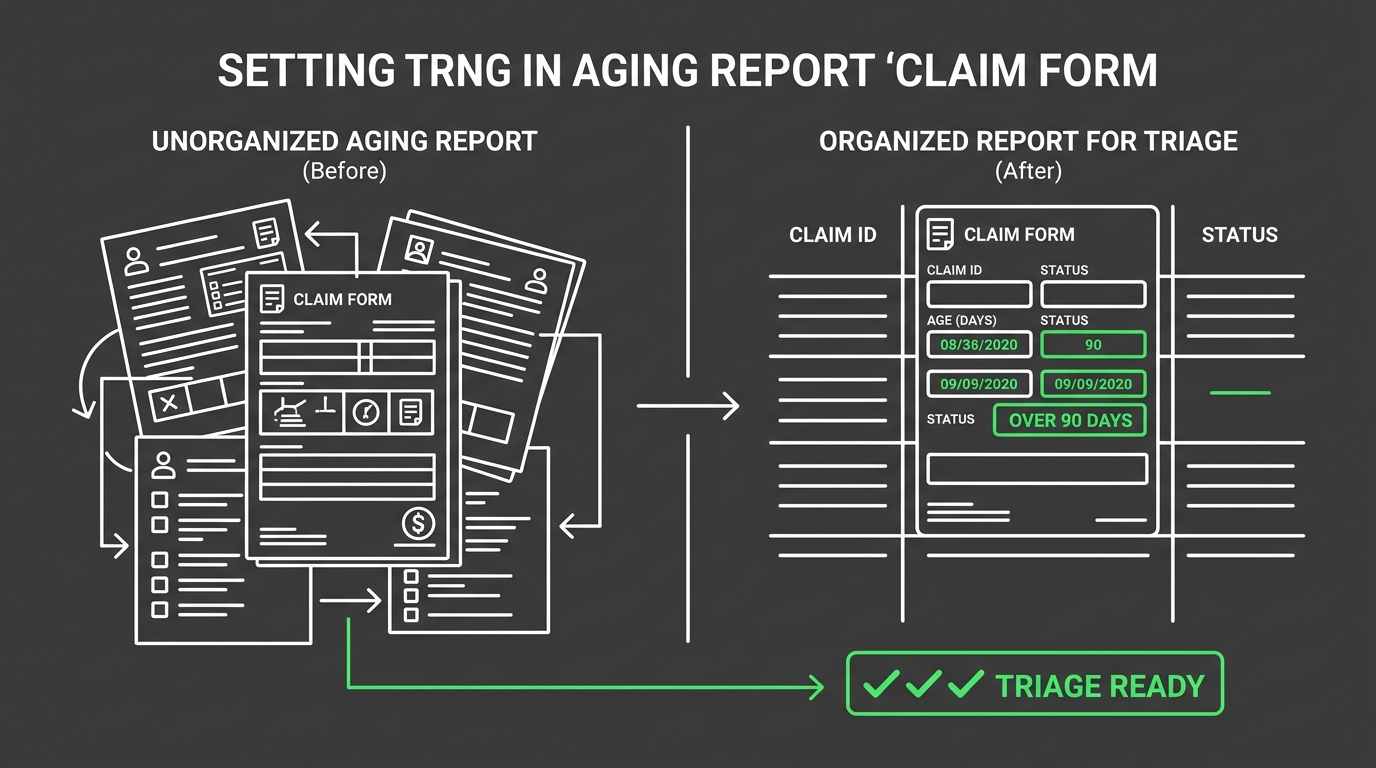
Start with the report itself. The Medical Group Management Association (MGMA) says to run your accounts receivable (A/R) reports, which show the money owed to you, at least once a month. Split your insurance balances from your patient balances. Then age each balance by the date of service, not the date you billed. MGMA says this helps you find billing schedule issues.
Next, read the report in buckets. MGMA says money owed to you is placed in “aging buckets.” There are five:
- 0 to 30 days
- 31 to 60 days
- 61 to 90 days
- 91 to 120 days
- 121+ days
Each bucket shows how long a balance has been owed to you.
Reading the Report for Filing Deadlines and Slow Payers
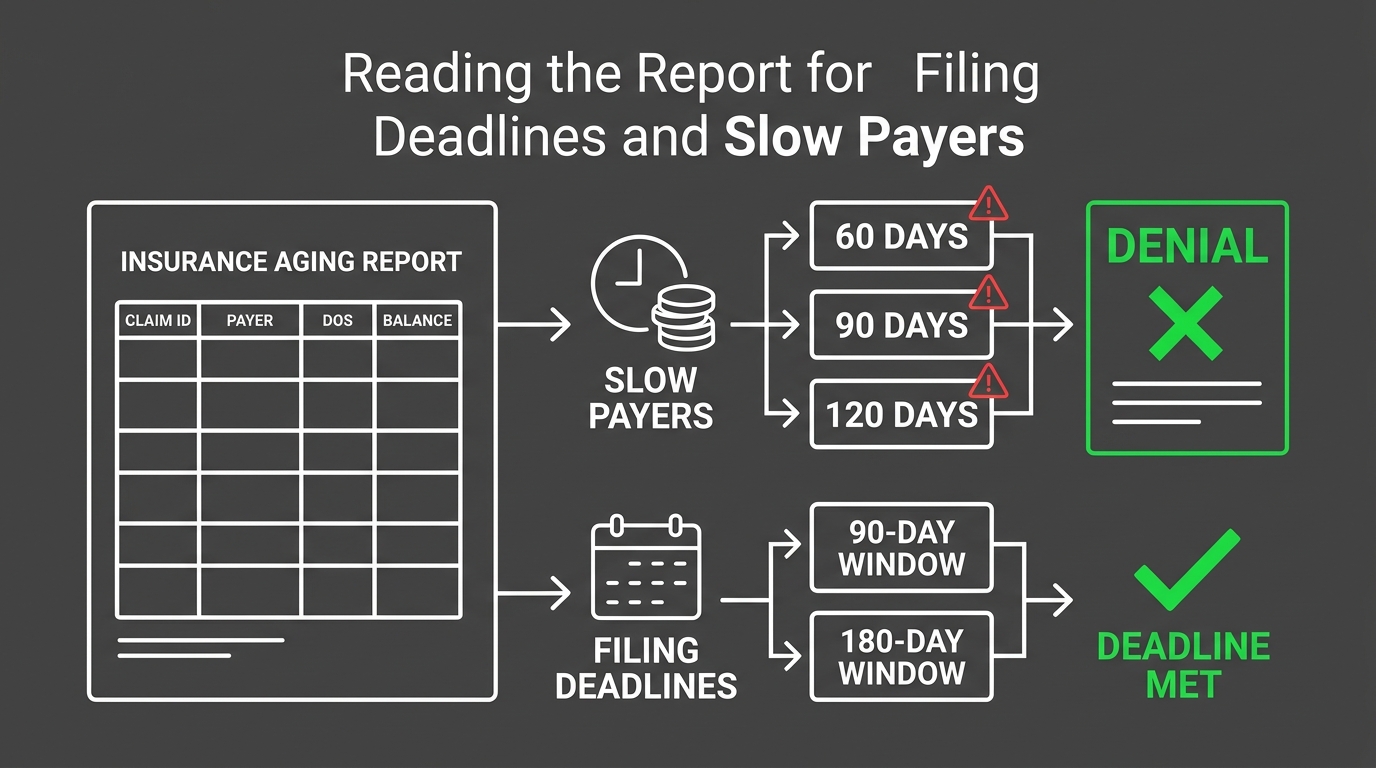
For this job, use the insurance aging report. Wisdom says it looks at unpaid insurance claims by payer and by age, and it helps you do two things. You check for claims close to their timely filing deadlines, and you spot payers that are consistently slow.
Slow payers show up faster when you compare them to your own average. The American Academy of Family Physicians (AAFP) says some insurance carriers take longer to pay claims than your overall average days in A/R, which is how long money stays owed to you. Here is their example. Say your practice’s average days in A/R is 49.94, but Medicaid claims average 75 days. AAFP says that should be addressed.
So give each payer its own line. The ones sitting above your practice’s average are the ones to address.
Sorting Claims by Payer Type
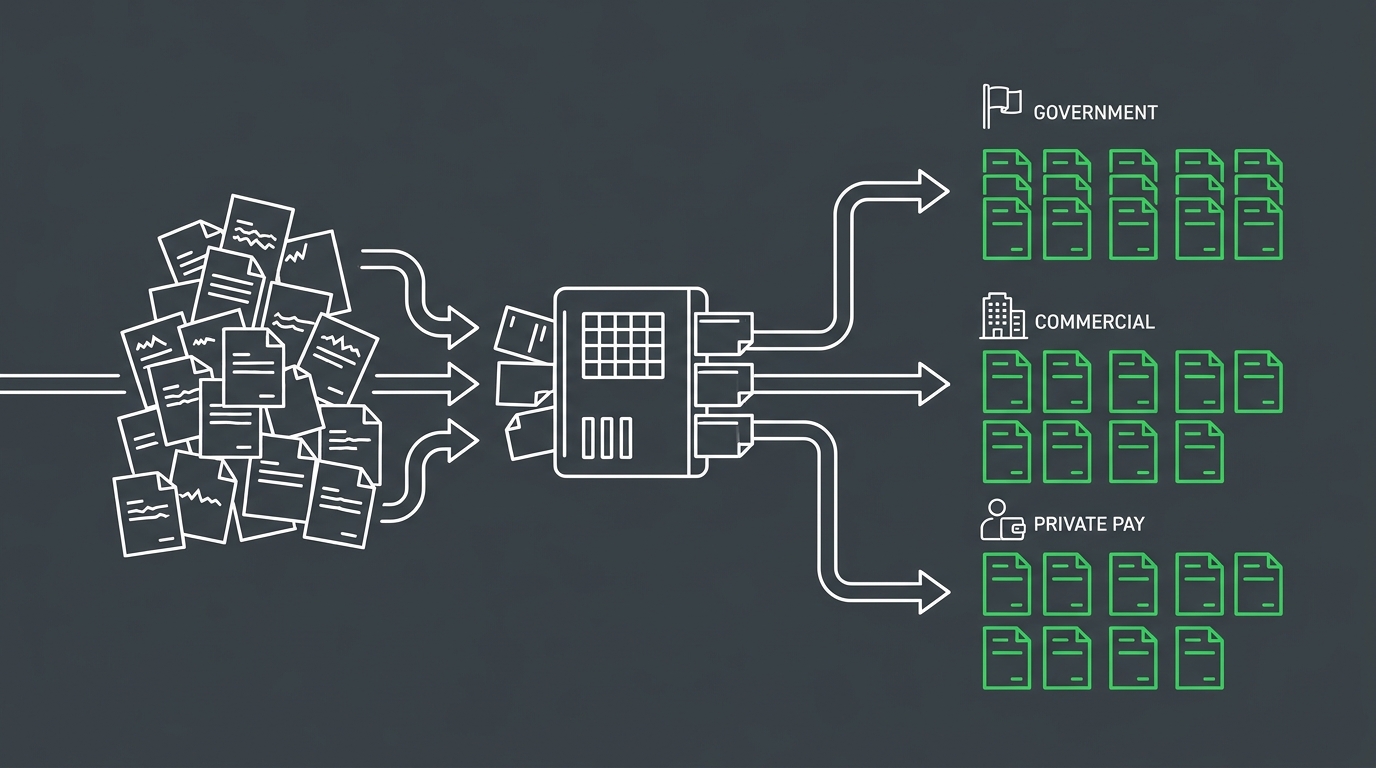
Before you work an unpaid claim, note which kind of payer holds it. CareCostEstimate says state prompt-pay rules don’t reach self-funded employer plans, also called Employee Retirement Income Security Act (ERISA) plans. Those plans cover about 63 percent (63%) of workers who have coverage through an employer. The rules also never reach Medicare or Medicare Advantage. You can read more on the source page, Prompt-pay laws by state: deadlines, interest, and the statute to cite.
The table below shows how the payer type changes what you do with an unpaid claim.
| Claim situation | What it means for triage |
|---|---|
| Medicare claim fully adjudicated with nonpayment | It is a claim denial: a non-payment determination based on Medicare rules and regulations |
| Claim pended by the payer for records | Not a clean claim; the prompt-pay clock usually stops |
| State-regulated plan paying clean claims late | The state insurance department acts on a pattern of late payment on clean claims |
| Self-funded ERISA employer plan | State prompt-pay rules don’t apply; the remedy is the plan’s own appeal process and, ultimately, ERISA §502 |
Medicare: A Denial Is a Final Payment Decision
The Centers for Medicare & Medicaid Services (CMS) describes a Medicare claim denial in plain terms. It’s a claim that has been fully adjudicated, meaning fully decided. The decision is not to pay, based on Medicare rules and regulations.
State-Regulated Plans: Clean Claims and Prompt-Pay Rules
State prompt-pay rules depend on a clean claim. CareCostEstimate says a claim the payer pends for records, meaning it holds the claim to ask for records, is not clean. When that happens, the clock usually stops.
CareCostEstimate also says the state insurance department enforces prompt-pay laws. What the department acts on is a pattern of late payment on clean claims. So it helps you to know which of your claims were clean and which were held for records.
Self-Funded Employer Plans: The Plan’s Own Appeal Process
For self-funded plans, CareCostEstimate says none of the state prompt-pay rules apply. What you can do is use the plan’s own appeal process and, in the end, section 502 of ERISA, the federal employer-plan law.
Separating Clerical Fixes From Claims That Need an Appeal
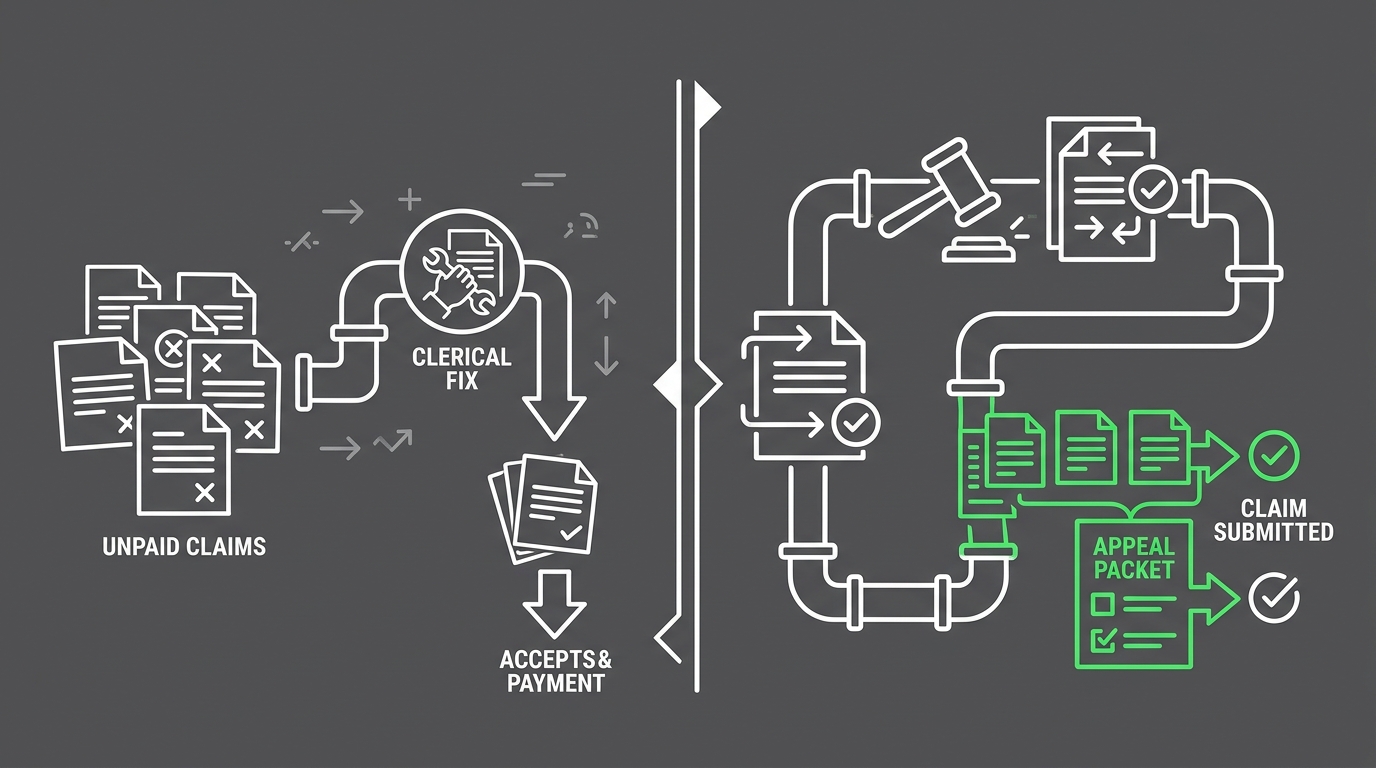
Some unpaid claims need a small fix. Others need a full appeal. Your first job is telling them apart.
CMS defines clerical errors, including minor errors or omissions, as human or mechanical errors by the party or the contractor. Examples include math or computation mistakes and swapped (transposed) procedure or diagnosis codes. CMS adds that clerical or minor errors are limited to errors in form and content. Omissions do not include failing to bill for certain items or services. CMS also says mistakes made by a third-party payer do not count as clerical errors.
Telephone reopenings are limited too. CMS says they’re limited to resolving minor issues and correcting errors, as section 10.4 defines them. CMS also says that asking for a reopening does not pause the time limit for asking for an appeal. You can read all of it in Medicare Claims Processing Manual Chapter 34 – Reopening and Revision of Claim Determinations.
The table below sorts common situations into clerical errors and everything else.
| Situation | Clerical error? |
|---|---|
| Math mistake or transposed procedure or diagnosis code | Yes |
| Failing to bill for an item or service | No; omissions do not include failure to bill for certain items or services |
| Error made by a third-party payer | No |
| Fix requested by telephone reopening | Telephone reopenings are limited to resolving minor issues and correcting errors as defined in §10.4 |
I’m happy to let software handle routine claims that have no errors, and I give tech a real but limited role. I don’t hand it judgment calls. When a claim needs an explanation of why care was medically necessary, or an appeal written for that one denial, I put a skilled person on it. Simple fixes move fast, and a claim that needs a tailored appeal gets a person.
Once you know what an aged claim needs, the next question is what to do with it. That’s covered in Rework or Write Off: Deciding an Aged Claim’s Next Step.
Claims Denied After an Unanswered Records Request
Sometimes Medicare sends you an additional documentation request (ADR), and nobody answers it. The Centers for Medicare & Medicaid Services (CMS) says that if no response comes in within the set time, the medical review department will likely deny the service. The reason given is that it wasn’t reasonable and necessary, because of a lack of documentation.
An appeal after that can be treated as a reopening when certain conditions are met. CMS lists several, and two of them run on different clocks. One is about when the records arrive: the requested documentation is received after the 45 day period, with or without a request for redetermination or reopening. Another, numbered 4 in the CMS text, is about when you file: within 120 days of the date of receipt of the initial determination (the first decision). The full list is in Medicare Claims Processing Manual Chapter 34 – Reopening and Revision of Claim Determinations.
Wondering whether an old claim like this can still be collected? That’s the subject of Is an Old Chiropractic Claim Actually Uncollectible, or Just Unworked?
Chiropractic Claims Denied Even With the AT Modifier
The AT modifier is a billing code add-on, and having it on your claim doesn’t settle things. CMS says the modifier may not in all instances indicate that the service is reasonable and necessary. As always, Medicare Administrative Contractors (MACs) may deny the claim if a medical review finds that the medical record doesn’t support active/corrective treatment (active or corrective care).
So your record has to back up the claim. The full modifier rule is explained in Resolving Aged Chiropractic Insurance Balances: A Complete Guide.
We don’t hand chiropractic billing to just any billing firm. We want specialty knowledge of Medicare’s AT modifier requirements, personal injury lien workflows and documenting maintenance care versus active care, and we don’t count on a generalist to supply it dependably. When we look at an AT denial, we check the notes for active/corrective treatment first.
Working Denials Promptly: Resubmit, Appeal or Review the Contract
MGMA says to run regular A/R (money owed to you) reports and work denials immediately. If your claims keep getting denied for the same reason, those denials need a closer look.
Pick the right move for each denial:
- Resubmit. First Coast Service Options (Medicare) describes a remark message on a remittance advice (the payment explanation). It says your claim contains incomplete or invalid information, and no appeal rights are afforded because the claim is unprocessable. In that case, fix the claim and send it again as a new claim.
- Appeal. If your Medicare redetermination request leaves out the required information, it will be dismissed. First Coast says that’s because it did not contain all the necessary elements. So file a complete request. The steps are in Tutorial: Completing the Medicare redetermination and clerical error reopening request form. For the rules on appeals, see Medicare Claims Processing Manual, Chapter 29 (Appeals).
- Review the contract. When one denial reason keeps coming back, MGMA says you may need to review your payer contracts.
We don’t treat the electronic health record (EHR) as the billing department. We let it submit claims, and we put a person using judgment on denials, appeals and aged balances. You can see how the work is done on our Medical Billing Services page. For more on old balances, see Resolving Aged Chiropractic Insurance Balances: A Complete Guide.
Frequently Asked Questions
When is a Medicare determination notice considered received?
Medicare presumes you received it five days from the date on it, unless there is evidence to the contrary. CMS says this applies to a determination, decision or notice. So write down the date on the notice and count from there.
Are Medicare appeal deadlines counted in calendar days or business days?
Calendar days, unless otherwise specified. CMS says that throughout Chapter 29, day or days means calendar days. So count every day, weekends included, when you set your appeal dates.
Who handles Medicare’s second level of appeal?
A Qualified Independent Contractor (QIC) handles it. CMS says a QIC is an entity that contracts with the Secretary in accordance with the Act. It does level 2 appeals, which are called reconsiderations, and expedited (fast) reconsiderations.
How can a practice prove a claim was clean when the payer received it?
Keep the clearinghouse’s acceptance report with the time stamp on it. That’s your proof the claim was clean on the day it was received. CareCostEstimate names these reports as the 999 and 277CA.
Where to Go From Here
Here’s the triage order. Run your aging report at least monthly. Split insurance from patient balances, age by service date and read it in the five aging buckets. Check for claims near filing deadlines and payers running slower than your average. Then sort each claim by payer type and decide whether it needs a clerical fix, a resubmission or an appeal.
We judge billing by what lands in your account. A sent claim isn’t the finish line for us, and we count the job done only when the money arrives. We’d take collections over activity or claims sent any day. We also put a chiropractic specialist on your report, not a biller spread across every specialty, because we expect middling, inconsistent results from the generalist.
Bushido Billing works as an embedded billing partner, one that works closely inside your practice. We treat denial management, appeals and accounts receivable recovery as the core of the work, not as optional add-ons. We also offer Medicare and documentation support. Our work includes full-service insurance billing, cleaning up unpaid insurance claims, and fixing and appealing denied claims for chiropractic practices. Would you like to book a call about working your aging report together? Book a Call