

What Happens After a Chiropractic Account Is Sent to Collections?
See what happens after a chiropractic account goes to collections: HIPAA agreements, validation notices, call limits, credit reporting, and appeals.
If a practice uses an outside collection agency for unpaid medical bills, it must sign a HIPAA business associate agreement (a written HIPAA contract) with the agency before any protected health information (PHI) is shared. The debt collector must give the patient a validation notice, either in its first contact or within 5 calendar days after it. The patient gets 30 calendar days, called the “validation period,” to dispute the debt or ask about the original creditor. Under their voluntary reporting policies, the three nationwide credit bureaus (Equifax, Experian and TransUnion) hold back medical debt from credit reports if it is less than one year past due.
Why Medical Balances Reach Collections Late
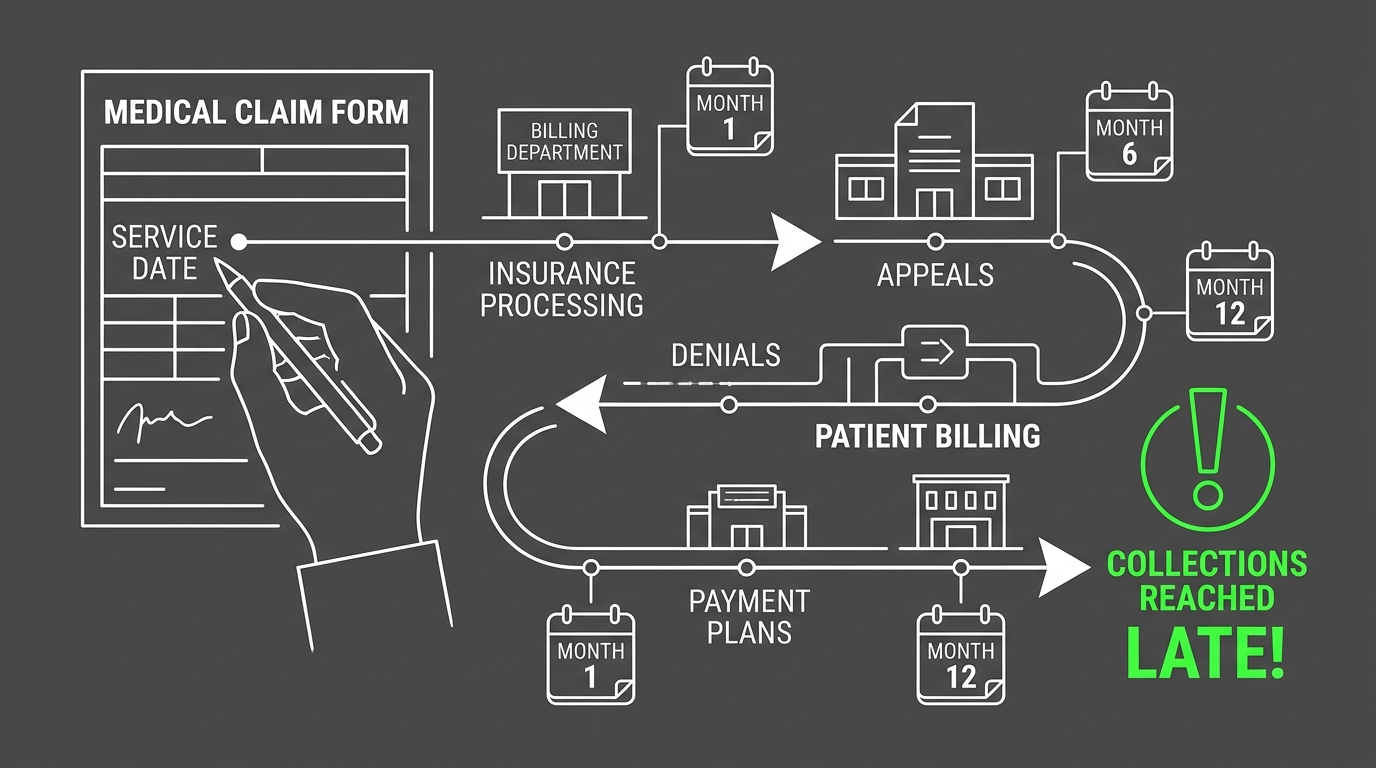
The Consumer Financial Protection Bureau (CFPB) says medical bills get collected long after the services were provided. For some people, collections came years later, and sometimes more than a decade (10 years) later.
The CFPB also described what people run into when they try to pay medical bills. They may get multiple bills from different providers. They may also see confusing procedure codes, opaque pricing, and uncertain insurance coverage.
Before you write an old balance off as lost, Is an Old Chiropractic Claim Actually Uncollectible, or Just Unworked? looks at whether it was ever actually worked. The CFPB rule on collector conduct, § 1006.14 Harassing, oppressive, or abuse conduct, comes up again in the contact limits below.
Handing Over the Account: A Business Associate Agreement and Only the Necessary Information
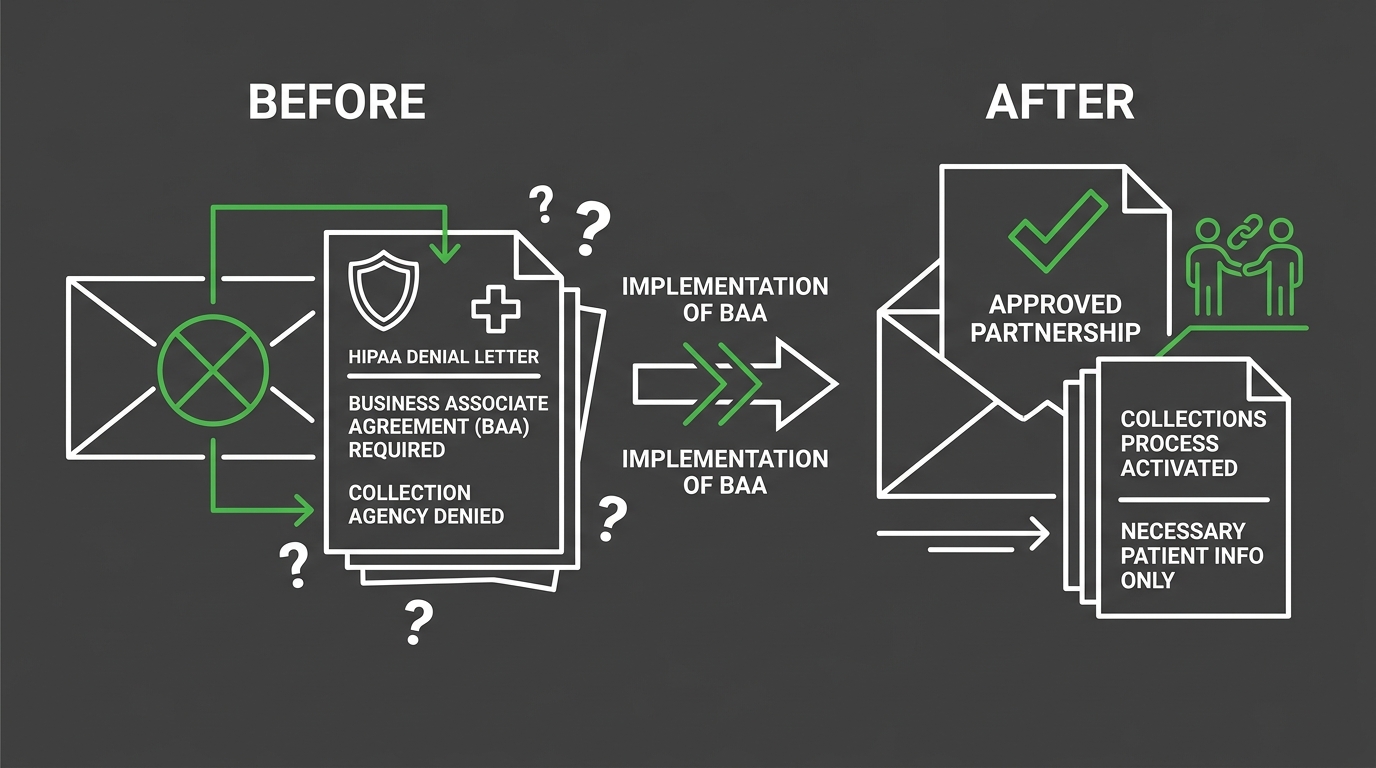
The Health Insurance Portability and Accountability Act (HIPAA) doesn’t stop your practice from using a collection agency. The U.S. Department of Health and Human Services (HHS) says the Privacy Rule lets covered entities keep using debt collection agencies, and it counts debt collection as a payment activity. The rule’s definition of “payment” names billing, claims management, collection activities, and related data processing.
There are two guardrails. First, you bring the agency in through a business associate arrangement, so it does this work on your practice’s behalf. HHS explains this on its page Does the HIPAA Privacy Rule prevent health plans and providers from using debt collection agencies? Second, other parts of the Privacy Rule, such as the business associate and minimum necessary requirements, govern what you share with the agency.
HIPAA Journal spells out the order of steps. If you use an external collection agency to recover unpaid medical bills, you must enter into a HIPAA business associate agreement (a written HIPAA contract) with it before any protected health information (PHI) is shared. HIPAA Journal covers this in Is It a HIPAA Violation to Send to Collections?
The Agency’s First Step: A Validation Notice and a 30-Day Dispute Window
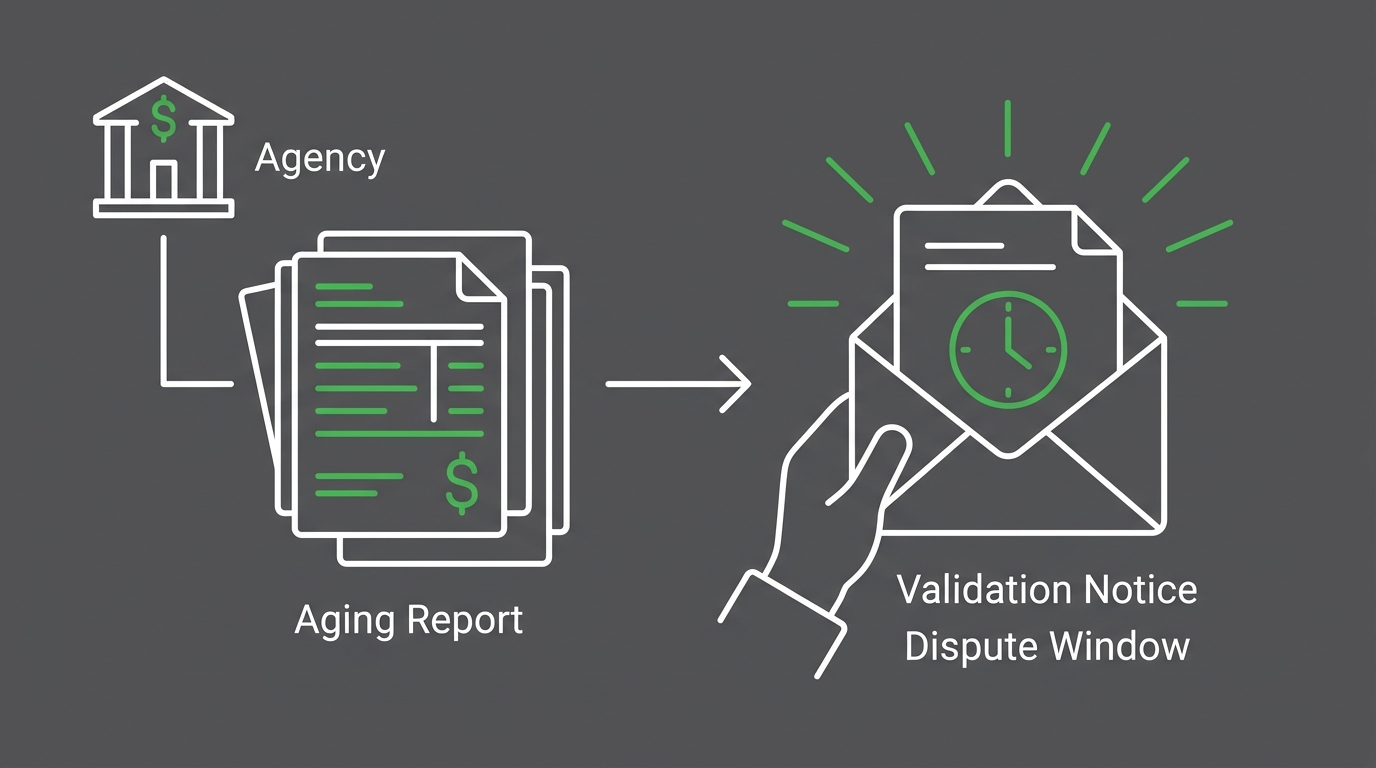
Once the agency has your account, its first step is a validation notice. After that, the patient has a set time to respond. The Federal Trade Commission explains the patient’s rights in Debt Collection FAQs. The CFPB’s § 1006.14 Harassing, oppressive, or abuse conduct also sets limits on how an agency behaves.
This table lines up the steps in the order they happen.
| Step | Rule |
|---|---|
| Agency sends the validation notice | In its first communication or within 5 calendar days after |
| Patient is assumed to have received it | 5 business days after it is provided electronically or in writing |
| Patient may dispute or ask for original-creditor information | Within a 30-calendar-day validation period |
| Patient disputes in writing within that period | Agency must stop collecting the debt (or the disputed part) until it provides the information needed to verify the debt or the original-creditor information |
Who the Federal Debt Collection Rules Cover
The Federal Trade Commission says people have important rights under the federal debt collection law, the Fair Debt Collection Practices Act (FDCPA), for credit card debt, car loans, medical bills, student loans, mortgages, and other household debts. Business debts are not covered.
Venable LLP notes that the CFPB’s final debt collection rule rests mainly on the Bureau’s power to make rules carrying out the FDCPA. So it covers debt collectors as the FDCPA defines that term. The rule took effect on November 30, 2021.
What the Notice Says and When It Arrives
A debt collector has two ways to give the validation notice. It can include the notice in its first contact with the patient, or it can send it within 5 calendar days after that first contact.
The notice has to include several items. Among them are the name of the creditor the debt is now owed to, the current amount of the debt, and the amount of the debt on the itemization date.
Once the collector provides the notice, electronically or in writing, the patient is assumed to have received it 5 business days later. The two counts measure different things: the 5 calendar days are the deadline for providing the notice, and the 5 business days mark when the patient is assumed to have received it.
The Patient’s 30-Day Dispute Window
The patient gets 30 calendar days to dispute the debt or ask for information about the original creditor. The rule calls this the “validation period.”
During that time, the collector must not engage in collection activities or communications that overshadow, are inconsistent with, or would interfere with the patient’s right to dispute the debt or ask for that information.
Say the patient disputes the debt, or asks for original-creditor information, in writing within the validation period. The collector must then stop collecting the debt, or the disputed part of it. It stays stopped until the collector provides the information needed to verify the debt or provides the original-creditor information.
Limits on How the Agency Contacts the Patient
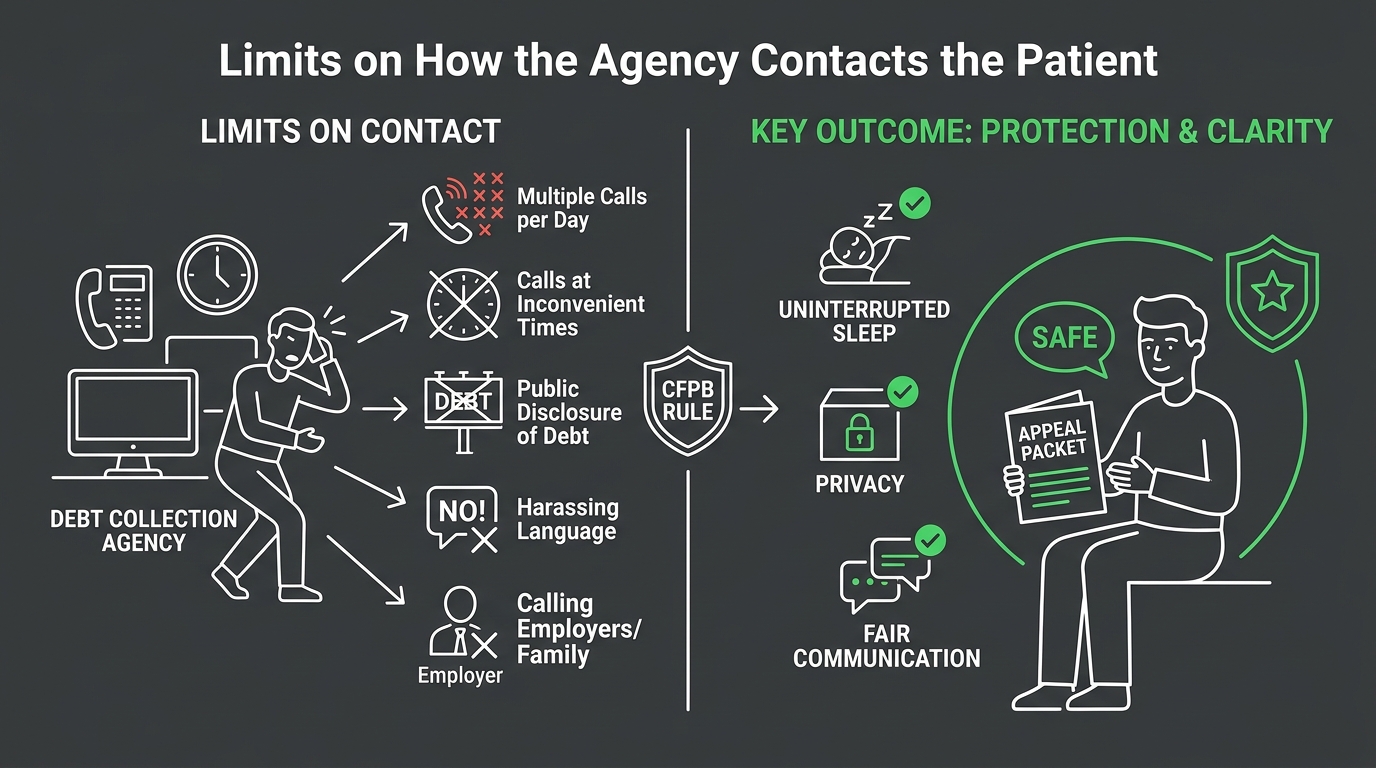
Under the CFPB’s rule, a debt collector must not engage in any conduct whose natural consequence is to harass, oppress, or abuse any person in connection with collecting a debt. That includes, but is not limited to, the conduct described in paragraphs (b) through (h) of the section.
Calls have a limit. A collector is presumed to follow it if it calls a person about one debt no more than seven times in seven days in a row. It also must not call that person within seven days in a row after a phone conversation with them about that debt.
The rule spells out what counts as a call. “Placing a telephone call” includes conveying a ringless voicemail. It doesn’t include sending an electronic message, such as a text message or an email, that may be received on a mobile phone.
Harassment isn’t tied to one kind of contact. The CFPB says harassing, oppressive, or abusive conduct can occur regardless of the communication media the collector uses. That includes in-person interactions, telephone calls, audio recordings, paper documents, mail, email, text messages, social media, or other electronic media, even if § 1006.14(b) through (h) doesn’t specifically address it.
Lawsuits have a limit too. The final rule bars collectors from bringing, or threatening to bring, legal action against a consumer to collect a time-barred debt, which is a debt too old to be collected by a lawsuit. If they do, they’re strictly liable, meaning they’re responsible even if they didn’t mean to. Venable LLP explains this in Debt Collection Consumer Disclosure Rule.
When a Medical Debt Can Appear on a Credit Report
The agency has to tell your patient first. The final rule bars a collector from furnishing collection information about a debt to a credit bureau without first notifying the consumer about the debt. Reporting without that notice is known as “passive collection.” If the collector waits 14 days in a row after sending the mail or electronic message, it has a safe harbor, which means it’s treated as meeting this requirement.
The credit bureaus have their own policies too. The National Consumer Law Center (NCLC) says Equifax, Experian and TransUnion, the three nationwide credit bureaus, do three things:
- They hold back medical debt that is less than one year past due.
- They remove paid medical debt, so there is no sign it was ever in default.
- They never report medical debts under $500, even if unpaid and in collections. This change took effect in spring 2023.
NCLC covers these policies in The Latest on Keeping Medical Debt Out of Credit Reports.
The table below shows each rule and what it means.
| Rule | What it means |
|---|---|
| Agency must notify the patient first | No collection information goes to a credit bureau without first notifying the patient |
| Notice by mail or electronic message | Waiting 14 consecutive days after sending it is a safe harbor |
| Debt less than one year delinquent | Not included in credit reports |
| Debt paid off | Removed, with no sign it was ever in default |
| Debt under $500 | Never reported, even if unpaid and in collection |
If the Patient Is Appealing an Insurance Denial
KFF says that while patients appeal, no federal rule stops providers from trying to collect the unpaid bill.
Once a plan denies a claim, federal law says it must give the patient at least 180 days to file an internal appeal. For post-service claims, which are claims for care already received, the plan has to finish that internal appeal no later than 60 days after it’s filed.
If the patient wins the appeal, the plan must process the claim again, this time following No Surprises Act rules. The out-of-network provider must then refund the patient any amount collected above the in-network cost sharing amount that applies. KFF explains more in What resources are available for privately insured patients who get surprise balance bills?
If you have balances still waiting on payers, see Resolving Aged Chiropractic Insurance Balances: A Complete Guide.
Collecting Patient Balances Sooner and Personal Injury Balances Differently
The National Library of Medicine notes that an important part of the patient experience is giving clear expectations about the payment process and the patient’s financial responsibility (what the patient owes). That can help patients engage in those processes. Physicians Practice says the chance a patient will pay drops significantly once the patient leaves the office.
We don’t count a claim as done when it goes out the door. We judge billing by the money that actually lands in your practice’s account, not by claims sent or tasks logged, and we score the work by what’s still collected after the handoff.
We handle personal injury (PI) liens as a payer type and offer personal injury claims billing. You can see how the work is done on the Medical Billing Services page.
I don’t buy the idea that any billing firm can do chiropractic, so I treat personal injury lien workflows as specialty work and keep them with people who know them, not generalists.
Frequently Asked Questions
Can the collection agency look for a patient who has moved?
Yes. The U.S. Department of Health and Human Services (HHS) says getting information about where a person is located is a routine activity that helps collect amounts owed and manage accounts receivable. Under the Health Insurance Portability and Accountability Act (HIPAA), that makes it a payment activity.
Does HIPAA conflict with the federal debt collection law?
Not as far as HHS knows. The Department says it is not aware of any conflict between the Privacy Rule and the Fair Debt Collection Practices Act.
Can a self-pay patient dispute a bill that’s higher than their good faith estimate?
Yes, in some cases. For services given in 2022, a patient can dispute a bill if the final charges are at least $400 more than the good faith estimate. The patient has to file the dispute within 120 days of the date on the bill.
Who is responsible for the unpaid portion of a claim on a remittance?
The group code tells you. Group codes say who is responsible for paying the unpaid part of a claim balance. For example, CO (Contractual Obligation) puts it on the provider, and PR (Patient Responsibility) puts it on the patient.
Does Bushido Billing handle patient invoicing?
Yes, but only for full billing clients. You can see what we offer on the Medical Billing Services page.
Working the Account Together After the Handoff
A handoff to collections follows clear rules. You sign a business associate agreement and share only the minimum necessary. The agency sends a validation notice and keeps within limits on contact. Money can still be recovered before and after that handoff, and your practice stays part of it.
When you bring in a billing partner, we don’t hand the work off and forget it. We ask for electronic health record (EHR) access, help from your practice on documentation, and providers we can reach, because we don’t expect good results from a practice that checks out.
We hold that a confident, ethical billing partner does not need to frighten a prospect into signing a contract. Bushido Billing does insurance billing and revenue cycle management for chiropractic and allied health practices, including personal injury claims billing. Would you like to talk through your unpaid accounts with us? Book a Call.