

How Does Bushido Billing's Weekly Update Model Prevent Revenue Leakage?
Bushido Billing's Weekly Update model prevents chiropractic revenue leakage by replacing silent, automated claims processing with a dedicated human biller who reviews claims, modifier accuracy, and accounts receivable status every week — surfacing problems before they compound into permanent write-offs.
Chiropractic billing fails quietly. Medicare claims for active spinal manipulation therapy require the AT modifier on CPT codes 98940, 98941, or 98942 to distinguish covered active care from non-covered maintenance care. When that modifier is missing, misapplied, or unsupported by documentation, the claim denies. Documentation error rates on Medicare chiropractic claims have exceeded 50% in federal audits — concentrated exactly in the modifier and medical necessity requirements that automated clearinghouse models are not built to catch.
The damage compounds fast. As accounts receivable ages, the probability of full recovery drops. Claims that could have been corrected and resubmitted within days sit unworked while the practice assumes someone is handling it. Administrative backlogs and processing delays extend the loss further. Practices discover the gap only after months of degraded collections — and by then, significant revenue is already gone.
The Weekly Update model is built to stop that cycle. A dedicated specialty biller reviews claim-level activity, flags modifier errors, identifies unworked denials, and communicates findings directly to the practice — every week, without being asked. Structured human-led oversight correlates with substantially lower denial rates compared to unmonitored automated systems.
That means the practice knows what was submitted, what was denied, what is being appealed, and what is aging in AR — not because a crisis forced the conversation, but because the reporting cadence makes that information standard. Proactive communication is not a premium feature. It is the mechanism that makes revenue leakage visible before it becomes unrecoverable.
Last Updated: July 22, 2026
- • Why Silence From a Billing Company Is a Revenue Problem, Not a Professionalism Signal
- • How the Volume-First Billing Model Quietly Abandons High-Value Claims
- • Why Most Chiropractic Billing Errors Go Undetected Without Weekly Oversight
- • What Happens to AR When No One Reviews It Weekly
- • What the Weekly Update Model Actually Does, Step by Step
-
• Frequently Asked Questions
- • How does a weekly billing update catch revenue leaks before they become permanent write-offs?
- • Why can't automated medical billing software replace the weekly human oversight model?
- • What specific chiropractic billing errors are caught during a weekly claim-level audit?
- • How does a lack of proactive communication from a billing company cover up growing AR?
- • What are the immediate operational steps of Bushido Billing's weekly reporting model?
- • Is weekly reporting standard across all chiropractic billing companies?
- • Reading the Gauge: Why Weekly Visibility Is the Standard, Not the Exception
Why Silence From a Billing Company Is a Revenue Problem, Not a Professionalism Signal
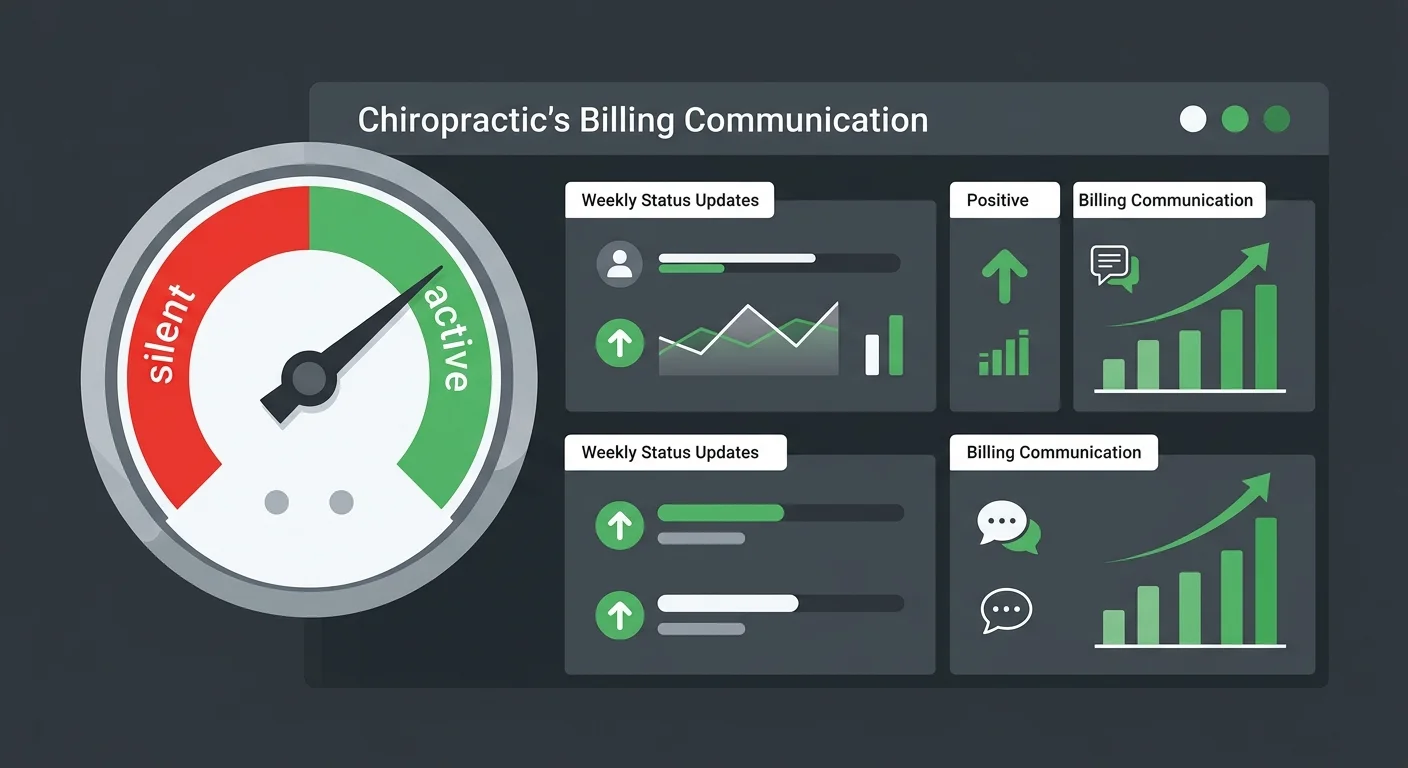
Silence from a billing company isn't professionalism. It's a design feature — one that keeps the practice blind while unworked denials age past the point of return.
The default billing relationship is a silent one. Claims go out. The practice waits. And when nothing comes back, it's easy to read that as good news.
It isn't. It means the pressure gauge has no visible dial. The leaks are already happening inside the pipes — and nobody's watching them.
And it's not anecdotal. GAO research into claims processing backlogs confirms what most practice owners only discover after the fact: administrative overhead compounds over time, and payment lags don't stay contained — they grow.
Silence from the billing side doesn't hold the problem steady. It gives the problem room to expand.
What Billing Silence Actually Costs a Chiropractic Practice
Every week a denial sits unworked, it ages closer to unrecoverable.
That's not a billing inconvenience. That's direct revenue loss with a countdown attached.
The cost of silence isn't abstract. When a practice has no visibility into claim-level activity, modifier errors stack across multiple visits before anyone catches them.
By the time the pattern is visible, the AR is already stratified — recent claims tangled with aged accounts that have little realistic chance of full recovery. That's exactly why a dedicated chiropractic billing specialist outperforms a generalist pool: a specialist is watching for the problem before the pattern has time to set.
Here's what most billing companies don't tell you: transparency isn't just a courtesy. The FTC enforces explicit disclosure standards on healthcare billing operations — meaning the practice has an actual right to know what's happening with its claims.
But rights without enforcement are useless. If your billing company isn't surfacing claim-level activity on a regular schedule, you have no way to distinguish a functioning revenue cycle from one that's quietly failing.
The Communication Standard That Changes the Math
So what does the right standard look like? Simple: the practice knows the status of its claims every week — without having to chase anyone down to find out.
Not a login portal the front desk forgets to check. Not a quarterly summary that arrives after the damage is done. A direct, human update — what was submitted, what was denied, what is actively being worked, and what is aging.
The weekly update model is built around that standard. It replaces default silence with a recurring report that functions as the pressure gauge — giving the practice a reliable read on what's happening inside the revenue cycle.
Not after a crisis forces the conversation. Every week, by design.
| Communication Pattern | What It Signals | Revenue Impact | Recovery Window |
|---|---|---|---|
| No proactive updates — practice must ask for status | Billing company is not monitoring claim activity between submissions | Unworked denials age undetected; modifier errors repeat across multiple visits before discovery | Narrows with every passing week; aged AR recovers at a fraction of its original value |
| Quarterly or monthly summary reports only | Revenue cycle is managed by volume, not by outcome — reporting is retrospective, not corrective | Problems surface after the damage is done; AR stratification is already set by the time the practice sees it | Limited — pattern corrections come too late to prevent the next wave of the same denial |
| Automated portal access with no direct communication | The practice is expected to self-interpret raw data with no specialist context | Modifier errors and documentation gaps go unaddressed because the practice lacks the expertise to identify them | Dependent entirely on the practice catching and escalating its own claim failures — most don't |
| Weekly direct update from a dedicated specialty biller | Claim-level activity is actively monitored and the practice is told what is happening without asking | Denial patterns are flagged before they compound; unworked AR is identified and escalated within the same billing cycle | Maximum — problems are caught while claims are still within the correctable and resubmittable window |
| Silence after a denial with no follow-up communication | The denial has been logged but not worked — it is sitting in a queue with no timeline or ownership | Each week of inaction ages the claim closer to write-off; the practice has no basis for knowing the difference between 'being worked' and 'being ignored' | Closes rapidly — without a structured escalation trigger, recovery becomes unlikely within the standard filing window |
How the Volume-First Billing Model Quietly Abandons High-Value Claims
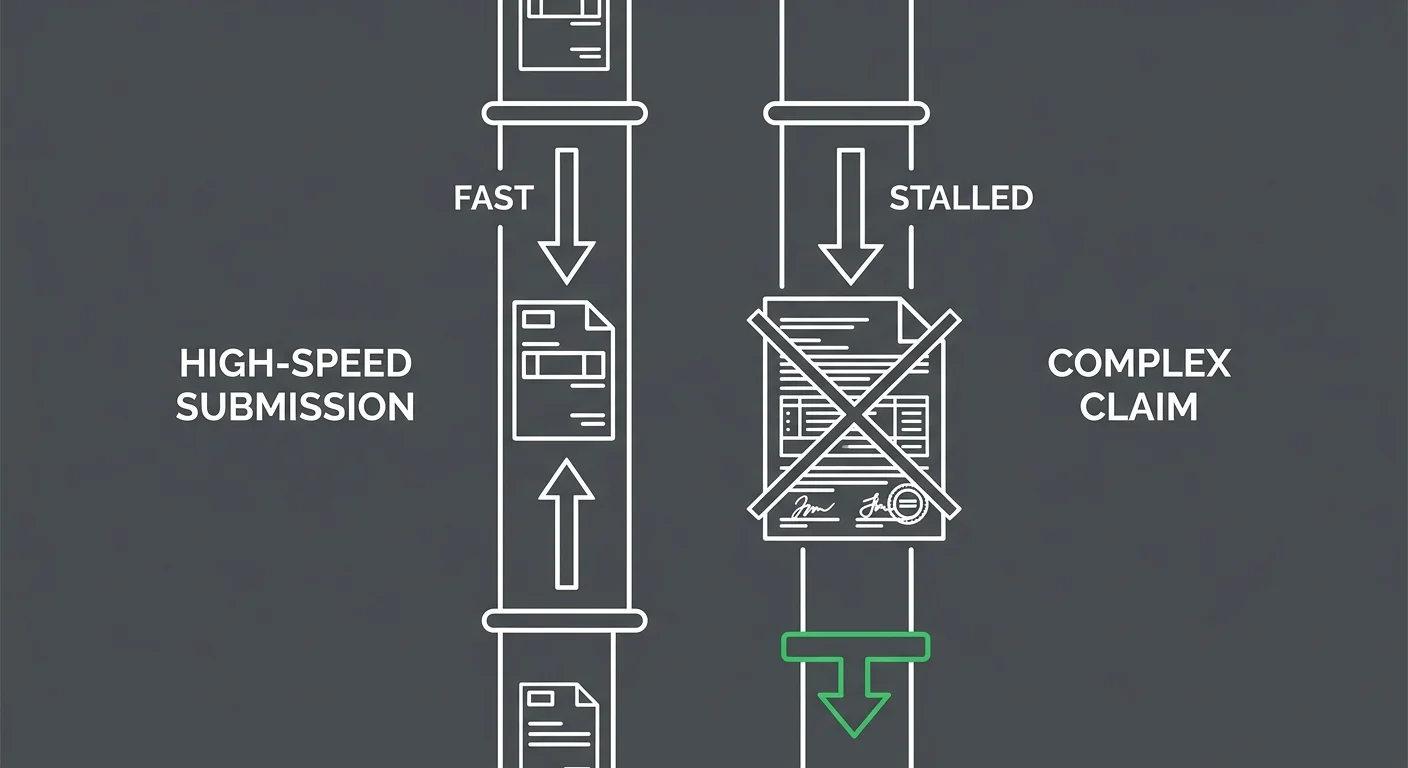
Silence is the symptom. The volume-first model is the disease.
Practices that keep cycling through billing companies are solving for the wrong variable. They're switching partners when they should be switching models.
Most billing companies are built to move claims fast. Throughput is the metric. Speed is the scoreboard. That works fine — right up until a claim requires actual work to get paid.
The moment a claim needs a medical necessity argument, a modifier correction, or a multi-step appeal — the economics collapse. Working that claim costs more than the model allows.
So it gets skipped. Then it ages. Then it disappears. And nobody tells the practice it's gone.
Why Most Billing Companies Get Paid to Submit, Not to Recover
Here's what most billing contracts actually reward: submission. Not recovery. The claim goes out, the billing company gets credit, and whether the money actually comes back is your problem — not theirs.
That structure creates a direct conflict of interest every time a hard claim lands. Documentation review, modifier correction, resubmission — that work takes time. Time the volume model never budgeted for.
So the billing company eats the cost the first few times. Then it stops eating it. Hard claims stop getting worked — and the practice never sees the decision being made.
OIG audit data shows documentation error rates on Medicare chiropractic claims exceed 50% — concentrated in modifier and medical necessity requirements. The hardest claims to document correctly.
Those aren't edge cases. Those are the most valuable claims in the practice's AR. And the volume model is built to walk away from them.
The Claims That Volume Models Deprioritize — and Why They're the Most Valuable
The claims getting skipped aren't the easy ones. They're the high-complexity accounts — missing modifiers, thin documentation, payers demanding clinical justification before they'll pay a dime. Published audit documentation shows error rates on these exact claim types surpass 50%, concentrated precisely in modifier and medical necessity requirements. That's not a fringe problem. That's where chiropractic practices lose the most unrecovered revenue — and it's where the volume model has the least incentive to show up. Published audit documentation
That's the trap. The claims most worth recovering are the ones the volume model has the least reason to touch.
They sit. They age. The revenue leaks — and the practice has no gauge telling it what's happening.
Why This Model Fails Chiropractic Practices Specifically
Chiropractic billing isn't general medical billing. The AT modifier rules, the active-versus-maintenance care distinction, personal injury (PI) lien workflows — these are specialty requirements. Generalist billers don't consistently execute them. Most don't even know where they break.
When a generalist biller hits an AT modifier denial, the path of least resistance is to move on. A specialty biller knows the documentation standard, knows the appeal pathway, and knows that claim is recoverable.
That's not a difference in effort. It's a difference in expertise. That's why the embedded billing partner model exists — to put specialty knowledge inside the revenue cycle where it actually changes the result.
The volume model isn't failing chiropractic practices by accident. It was never built for this complexity.
That's the pressure gauge reading no one is showing them.
| Claim Type | Volume Model Response | Revenue Recovery Risk | What a Specialty Biller Does Instead |
|---|---|---|---|
| AT modifier denial — active care vs. maintenance dispute | Flagged and deprioritized — modifier correction requires documentation review that exceeds the model's cost allowance | High — claim ages unworked while the window for resubmission narrows | Reviews visit notes against active care documentation standards, corrects modifier, and resubmits with clinical justification attached |
| Medical necessity denial — insufficient clinical justification | Moved to backlog — building a necessity argument requires specialist knowledge the volume model does not staff for | High — without a structured appeal, the denial becomes a write-off by default | Constructs a claim-specific necessity argument using visit documentation, resubmits within the payer's appeal window |
| Multi-step payer appeal — requires two or more resubmission rounds | Abandoned after first denial — the time cost of a second appeal round exceeds what the volume model can absorb | Critical — multi-step claims that stall past the first round rarely recover without active human follow-through | Tracks each appeal stage, logs payer response timelines, and escalates to the next step before the window closes |
| Coding error on high-visit-frequency claim — incorrect CPT or modifier across multiple dates of service | Partially corrected or ignored — retroactive coding corrections across multiple dates require audit work the throughput model cannot justify | High — pattern errors that span multiple visits compound the revenue loss before anyone identifies the root cause | Conducts a claim-level audit across affected dates, corrects coding retroactively, and flags the documentation gap to prevent recurrence |
| Personal injury lien claim — delayed settlement cycle with third-party liability | Deprioritized — lien billing operates outside standard insurance workflows and requires specialty-specific tracking the generalist model lacks | Elevated — lien claims that go untracked lose position in the settlement priority order and may not be collected at all | Manages the lien lifecycle separately, tracks settlement timelines, and protects the practice's collection position through resolution |
Why Most Chiropractic Billing Errors Go Undetected Without Weekly Oversight
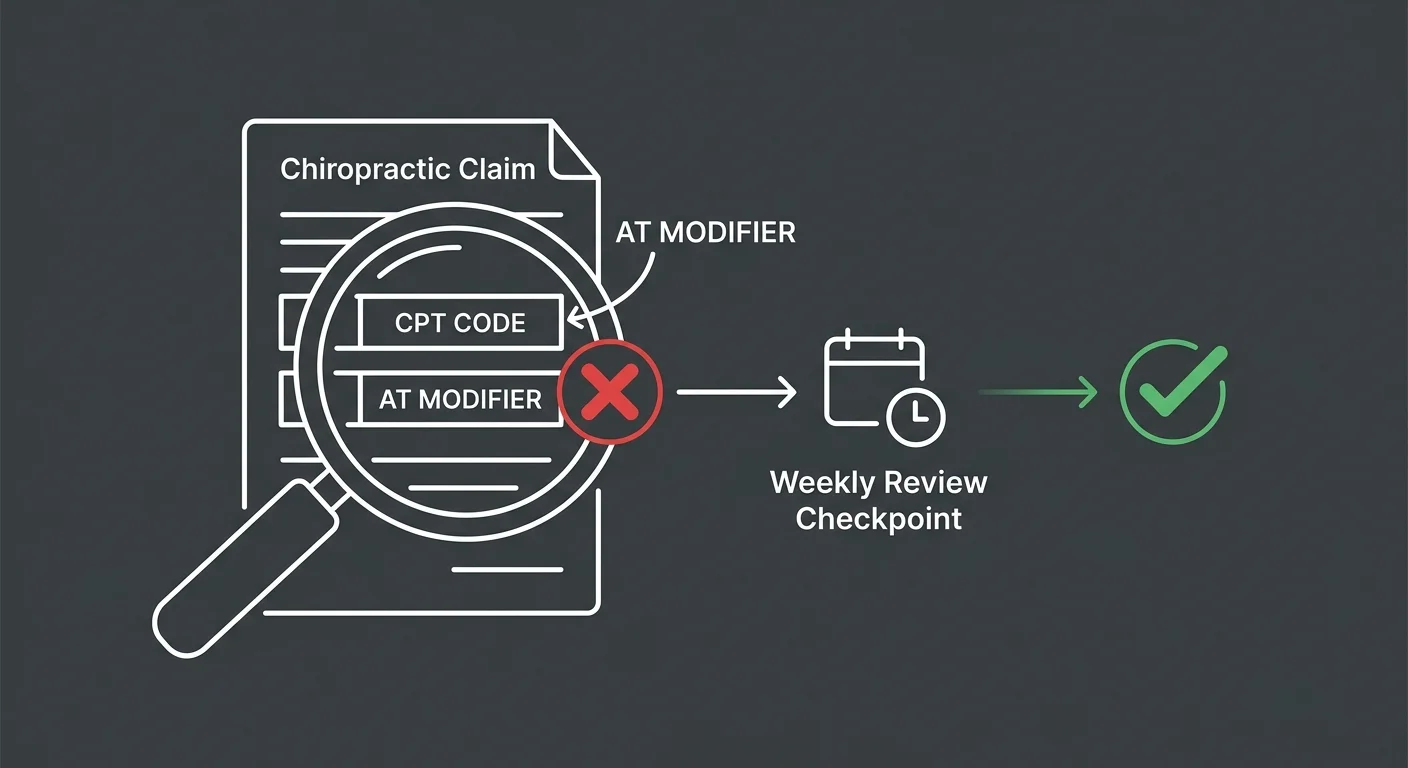
Billing errors don't announce themselves.
They compound. Claim after claim, week after week — while the practice reads the silence as confirmation that everything is fine.
Without a recurring human review, there's no readable dial.
The leaks are already happening. Pressure is dropping. And the practice won't see it until the cash flow number tells a story that's already months old.
AT Modifier Errors: The Most Expensive Mistake No One Notices
The AT modifier is not a technicality. It's the single line between a covered Medicare claim and a non-covered one.
When it's missing — or when the documentation doesn't back it up — the claim denies. Automatically. No appeal, no second look, no warning. Per published billing guidelines, active spinal manipulation therapy must append the AT modifier to CPT codes 98940, 98941, or 98942 to distinguish covered active care from maintenance care Medicare won't reimburse.
That distinction has to be right on every claim. Not most. Every one.
Prior reviews identified chiropractic documentation error rates exceeding 50% on Medicare claims — and those errors cluster precisely around modifier requirements and medical necessity verification.
That's not a marginal compliance gap. That's more than half of claims carrying a defect a payer can use to deny payment.
And in a silent billing model, nobody is telling the practice it's happening.
Here's what makes AT modifier errors so destructive inside an automated model: the claim goes out, the denial comes back, and then nothing happens.
No weekly review means the denial sits in a queue. The same error runs again on next week's submissions. And the week after that.
By the time anyone notices the pattern, AR has already stratified across multiple claim generations. The damage isn't from one bad claim. It's from one undetected error repeated until the revenue gap is too wide to ignore.
Documentation Gaps That Trigger Systematic Denials
Modifier errors are the most visible version of a bigger problem.
Documentation gaps — thin clinical notes, missing progress records, weak medical necessity support — trigger systematic denials that look random until someone maps them against the underlying records.
They're not random. They're a pattern nobody is tracking.
That's where cadence matters. When a practice runs weekly billing audits to optimize clinic cash flow, documentation gaps stop looking like isolated incidents.
A denial that appears random on Monday looks like a systemic documentation protocol failure by Friday — but only if someone is reviewing claim-level data every week.
Wait for a quarterly summary and the pattern has already cost the practice three months of recoverable revenue.
Why Patterns Stay Hidden Without a Weekly Human Review
Patterns don't hide because they're subtle. They hide because no one is looking at the right frequency.
An automated clearinghouse processes what it can process and flags what it can't. What it cannot do is recognize that the same modifier error appeared on seventeen claims across three providers over four weeks.
That recognition requires a human. Specifically, a dedicated chiropractic billing specialist who knows what a denial pattern looks like in this specialty — and who checks for it on a defined cadence, not after a crisis makes it impossible to ignore.
Bushido Billing's weekly review model is built on that cadence.
The dedicated biller isn't waiting for a crisis to surface before investigating. The review is proactive, recurring, and claim-level. That's what keeps modifier errors from compounding, documentation gaps from multiplying, and unworked denials from quietly aging into permanent write-offs.
The pressure gauge stays readable. The practice stays informed. Revenue doesn't disappear in the silence between reports.
| Billing Error Type | CPT Codes Affected | Denial Trigger | Detection Without Weekly Review |
|---|---|---|---|
| Missing AT Modifier | 98940, 98941, 98942 | Claim denied as maintenance care — non-covered under Medicare | Denial sits in queue; same error repeats across subsequent submissions undetected |
| Insufficient Medical Necessity Documentation | 98940, 98941, 98942 | Payer rejects claim for lack of clinical justification supporting active treatment | Pattern appears as isolated denials rather than a systemic documentation failure |
| Active vs. Maintenance Care Miscoding | 98940, 98941, 98942 | Claim flagged for billing non-covered maintenance visits as active spinal manipulation | Error compounds across multiple claim generations before any reporting surface shows it |
| Modifier Applied to Wrong CPT Code | Codes outside 98940–98942 range | Claim rejected outright — modifier is only valid on the three designated codes | Automated clearinghouse flags the rejection but no human maps it to a coding pattern |
| Missing Progress Documentation | Any chiropractic CPT | Payer audits and retroactively denies for insufficient clinical record support | Absent weekly claim-level review, gaps accumulate until a payer audit forces the reckoning |
What Happens to AR When No One Reviews It Weekly
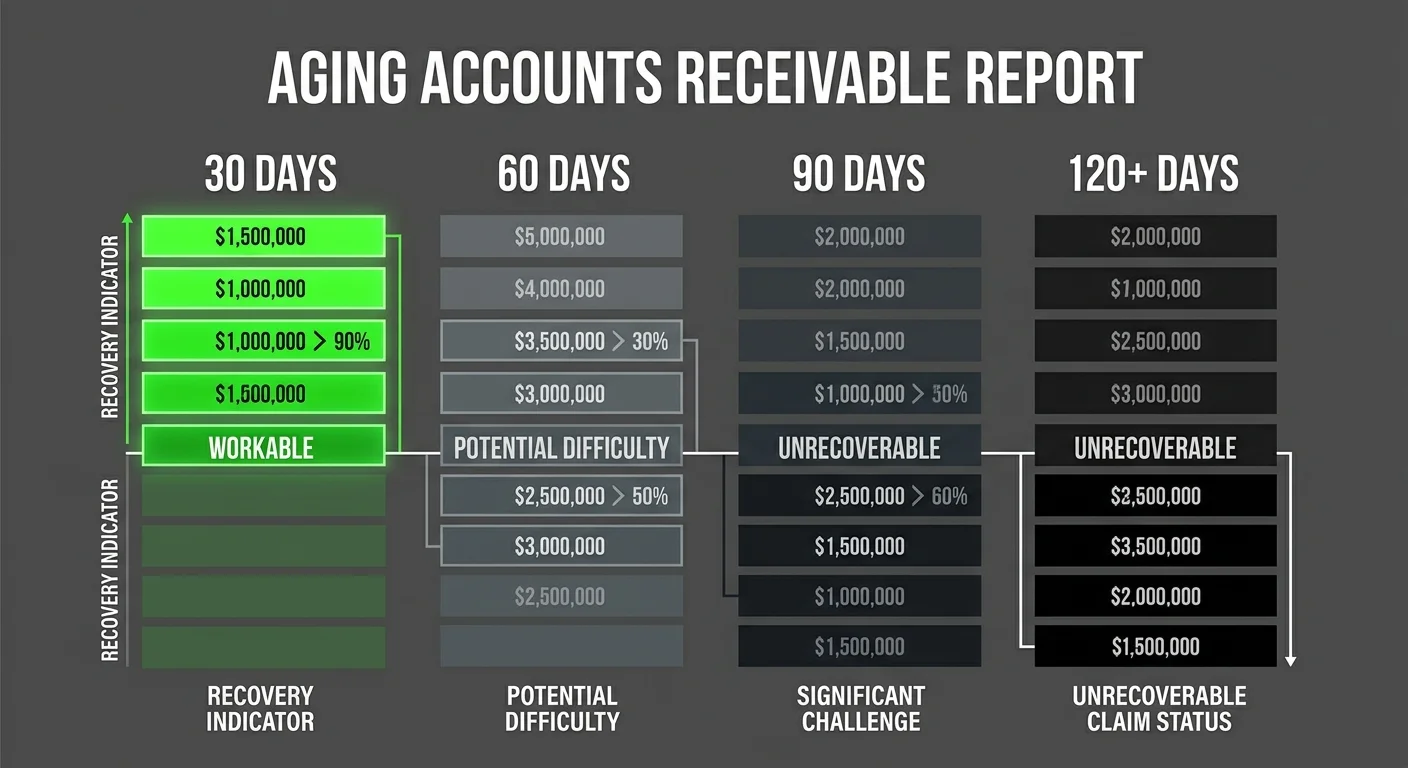
Unworked AR doesn't hold its value. It ages — and the older it gets, the less of it is recoverable.
Every week without a human review is a week the pressure builds inside the revenue cycle.
And nobody's watching the gauge.
The practice isn't losing revenue in a single visible event.
It's losing it incrementally — one denied claim sitting unworked, then another, then a pattern that's been repeating for six weeks before anyone looks at the AR report and realizes the numbers don't add up.
Administrative friction and delayed reviews compound that damage systematically. What starts as a workable denial becomes an aged claim, then a write-off.
Not because recovery was impossible. Because no one intervened at the right point in the cycle.
How Unworked AR Ages Past the Point of Recovery
AR has a shelf life. Payers enforce timely filing windows. Appeals have deadlines.
The longer a denied claim sits unworked, the narrower the recovery pathway becomes. Until the window closes entirely and the revenue is gone.
What makes this so damaging is the compounding effect. A denied claim from week one that goes unworked feeds into week two's queue alongside new denials.
By week four, the practice is carrying four generations of unresolved claims. And the oldest ones are approaching the point where recovery is no longer possible.
The practice that spots a deteriorating billing relationship — silence, no claim-level reporting, no proactive denial communication — catches this before the AR stratifies. The one that assumes no news is good news doesn't find out until the aging report surfaces. And by then, it's telling a story that's already months old.
A significant portion of that AR? Already unrecoverable.
Who Gets Blamed When the AR Report Finally Surfaces
Here's what happens when the AR report finally surfaces: the billing company points to submission volume. The practice points to the aging buckets.
Neither of those conversations fixes the claims that have already crossed the recovery threshold.
Blame doesn't recover revenue. Neither does a post-mortem on a billing relationship that quietly failed for months before anyone called it.
The only structure that prevents that conversation is a weekly billing audits cadence — claim-level activity reviewed on a defined schedule, denials flagged before they age, and the practice always knowing its AR status. Without being asked.
| AR Aging Bucket | Typical Recovery Rate | Primary Cause of Decline | Intervention Window |
|---|---|---|---|
| 0–30 Days | Highest recovery potential | Initial denial or payer processing delay | Immediate — claim is fully workable and within all timely filing windows |
| 31–60 Days | Declining — appeals window narrows | Unworked denial sitting without human review | Urgent — appeal must be initiated before payer deadlines close |
| 61–90 Days | Significantly reduced | Administrative friction and compounding review backlogs | Critical — administrative overhead accumulates and payer responsiveness drops |
| 91–120 Days | Severely limited | Delayed dispute resolution past primary appeal thresholds | Near-closed — secondary appeal or write-off decision required immediately |
| 120+ Days | Largely unrecoverable | Claim aged past timely filing and appeal windows with no intervention | Closed — revenue lost; no recovery pathway remains without extraordinary measures |
What the Weekly Update Model Actually Does, Step by Step
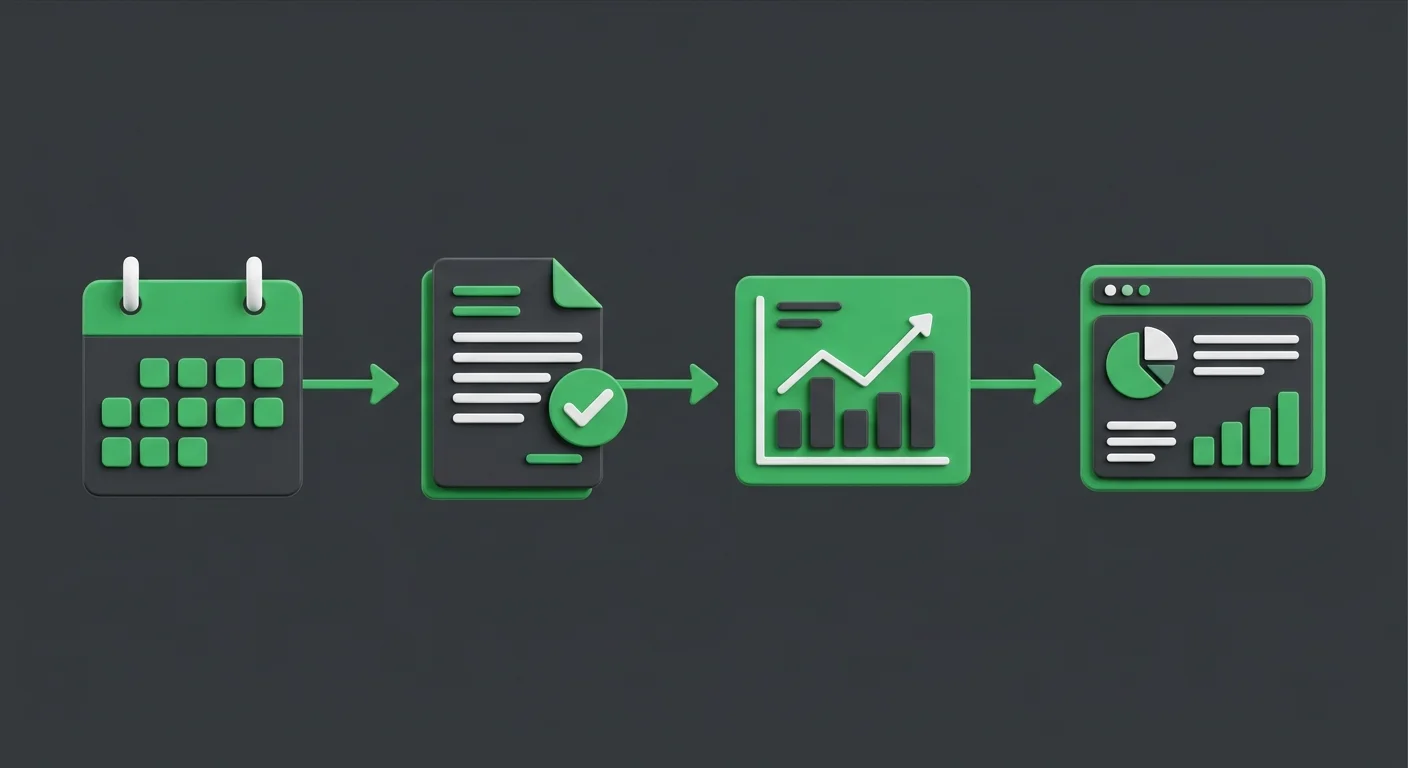
So what does the fix actually look like — not in theory, but step by step, in the real billing workflow?
Bushido Billing's Weekly Update model isn't a reporting feature. It's a structured oversight cadence built into the billing relationship itself — a recurring, claim-level review that surfaces what's broken before it compounds into a write-off.
Every step maps to a failure mode the silent, automated clearinghouse approach cannot catch. That's not an accident. The model was built around the exact points in the chiropractic revenue cycle where human judgment is the only tool that works.
Claim-Level Review: What Gets Checked and When
The review starts at the claim level. Not the summary. Not the aging bucket. A dedicated biller reviews individual claims every week — what was submitted, what came back, what denied, and why.
That includes checking AT modifier status on every Medicare spinal manipulation claim. CMS requires the AT modifier on CPT codes 98940, 98941, and 98942 to confirm active treatment — not maintenance care. A missing modifier is an automatic denial. A weekly review catches that error in the current week's submissions. Before it becomes next week's unworked queue.
The review also checks documentation alignment. Do the clinical notes support the codes billed? Is medical necessity adequately established? Does the payer's denial logic point to something fixable?
A generalist logs a denial. A specialty biller reads the pattern behind it. That distinction is the difference between writing off revenue and recovering it.
How Denial Patterns Get Tracked and Reported
One denial is a data point. Three with the same rejection reason are a pattern. Five pointing to the same documentation gap across two providers are a systemic problem that won't fix itself. NIH research on medical billing oversight confirms it: human-led review pipelines produce substantially lower persistent denial rates than unmonitored automated portals. The pattern is the problem. And you can't see the pattern if nobody's looking at it every week.
An automated clearinghouse processes claims and flags exceptions. That's it. It cannot recognize that the same error appeared across three claim generations and trace it back to a documentation gap in the clinical workflow.
That connection requires a human. One who's looking at the data every week — not waiting for a quarterly summary to reveal what should have been caught in week two.
What the Practice Receives Each Week — and Why It Matters
- Which claims cleared payment and which are still outstanding
- Every denial that came back — with the specific reason attached
- What action is being taken on each open denial
- Current AR broken down by age bucket
- Whether the revenue cycle is trending in the right direction
That's the gauge reading. A practice that gets this every week knows whether the revenue cycle is healthy or quietly failing. A practice that gets silence has no gauge at all — just assumptions.
Most practices that end up with stratified AR and unrecoverable write-offs didn't know there was a problem. They read silence as confirmation.
Weekly reporting replaces that assumption with data. And data, on a defined cadence, is the only thing that keeps pressure from building until something bursts.
| Weekly Update Component | What It Reviews | Revenue Protection Function | Who Acts on It |
|---|---|---|---|
| Claim-Level Submission Review | Every claim submitted that week — codes billed, modifiers applied, documentation alignment with payer requirements | Catches modifier errors and documentation gaps in the current cycle before they enter the denial queue | Dedicated specialty biller — reviews individually, not by exception flag |
| AT Modifier Verification | Medicare spinal manipulation claims on CPT codes 98940, 98941, and 98942 — confirms active treatment modifier is present and adequately supported | Prevents automatic denials caused by missing or unsupported AT modifier before claims age into unworkable status | Dedicated specialty biller — chiropractic-specific knowledge required to read modifier compliance correctly |
| Denial Pattern Tracking | Recurring rejection reasons across multiple claims and dates — identifies when a single denial is actually a systemic documentation or coding failure | Surfaces root causes before they replicate across additional claim generations, stopping compounding damage at the source | Dedicated specialty biller — pattern recognition requires human judgment across claim generations, not automated exception flagging |
| AR Age Bucket Review | Outstanding claims organized by how long they have been unresolved — flags claims approaching payer timely filing and appeal deadlines | Keeps recovery windows open by ensuring no claim ages past the point where intervention is still possible | Dedicated specialty biller — prioritizes action on claims closest to the recovery threshold |
| Weekly Status Report to Practice | Full accounting of claims cleared, claims denied, denial reasons, actions taken, and current AR status by age bucket | Eliminates the assumption problem — the practice knows the exact state of its revenue cycle every week without having to ask | Practice owner or office manager — receives the update directly; no silence, no lag between event and awareness |
Frequently Asked Questions
Knowing how a system works is one thing. Trusting it enough to change your billing relationship is something else entirely.
Most practitioners who find their way here have already been burned. They've heard the promises before. So instead of soft reassurances, here are real answers to the questions that actually come up.
No hedging. No qualifications. Just the answers.
How does a weekly billing update catch revenue leaks before they become permanent write-offs?
Revenue leaks don't announce themselves. They accumulate — one unworked denial, then another — until the pattern is weeks old and the recovery window is already closing.
Payers enforce timely filing windows. Appeals have hard deadlines. A denial caught the same week it's generated is workable. One discovered three months later often isn't.
That's the math the weekly review changes. Instead of compounding quietly, the problem gets caught while it's still a manageable queue — before the pressure builds past the point where recovery is possible.
Why can't automated medical billing software replace the weekly human oversight model?
Automated software processes claims. That's the full extent of what it does well.
When a claim comes back denied, the software logs the exception. It doesn't read the denial reason. It doesn't connect that rejection to a documentation gap in the clinical notes. It doesn't recognize that the same error has appeared on five claims across three weeks.
That pattern recognition requires a human — specifically, one who understands chiropractic billing: AT modifier rules, medical necessity documentation standards, the difference between what a payer says and what actually caused the denial. Structured human-led oversight correlates with substantially lower persistent denial rates compared to unmonitored automated portals.
Software has no mechanism for judgment. It never will.
What specific chiropractic billing errors are caught during a weekly claim-level audit?
Three error categories show up most consistently in a weekly claim-level audit.
First: AT modifier defects on Medicare spinal manipulation claims. A missing or inadequately supported modifier on CPT codes 98940, 98941, or 98942 is an automatic denial — and documentation error rates on these claims have historically exceeded 50% according to OIG reviews when medical necessity isn't properly verified. That's not a rare edge case. That's a persistent, predictable failure point that a weekly audit is built to catch.
Second: documentation misalignment — clinical notes that don't adequately support the codes billed, or that fail to establish active treatment rather than maintenance care.
Third: payer-specific denial patterns — repeated rejections from the same payer pointing to a fixable root cause in how claims are being submitted.
None of these show up in submission volume metrics. They're only visible at the claim level, reviewed by someone who knows what they're looking for.
How does a lack of proactive communication from a billing company cover up growing AR?
Silence from a billing company is not neutral. It's a structure that hides problems until they're large enough to be undeniable.
Without proactive claim-level reporting, AR aging happens invisibly. Denied claims sit unworked. Administrative friction compounds the backlog. And the practice has no mechanism to distinguish between 'billing is running smoothly' and 'billing is quietly failing.'
By the time the silence breaks — usually when someone pulls the aging report and sees what's sitting in the 90-day and 120-day buckets — the oldest claims have often already crossed the recovery threshold.
The communication gap didn't cause a single bad week. It caused months of undetected revenue loss.
What are the immediate operational steps of Bushido Billing's weekly reporting model?
Each weekly cycle follows a defined sequence — not a summary email, not a monthly call.
Bushido Billing's dedicated biller reviews individual claims from the prior week: what was submitted, what cleared, what denied, and what the denial reason was. Modifier status is confirmed on every active treatment claim. Documentation alignment is checked against the payer's denial logic. Denial patterns are tracked across claim generations — not logged as isolated exceptions and forgotten.
At the close of the review, the practice gets a clear accounting: which claims cleared, which are in dispute, what action is being taken on each denial, and where the AR stands by age bucket.
That's the gauge reading. It arrives every week, on a defined schedule, without the practice having to ask for it.
Is weekly reporting standard across all chiropractic billing companies?
No. Weekly reporting is not the industry standard. It's the exception.
Most billing companies operate on silent automation models where communication happens reactively — the practice asks, or the aging report forces the conversation. That structure exists because proactive communication costs time, and volume-first models don't build that time into their operating cost.
The result: delayed reviews and administrative friction accumulate without the practice knowing. Revenue impact compounds quietly over weeks and months. And the practice finds out when it's already too late to recover the oldest claims.
Weekly reporting is Bushido Billing's structural commitment. Not a feature tier. Not an optional upgrade. The baseline of how the billing relationship works — because anything less isn't a billing relationship. It's a liability.
Reading the Gauge: Why Weekly Visibility Is the Standard, Not the Exception
The gauge was there the whole time.
But nobody was reading it.
Most practices don't end up with stratified AR and six-figure write-offs because of one catastrophic event. They get there week by week — reading silence from their billing company as confirmation that everything was fine. It wasn't. The pressure was building. The dial was dark.
Weekly visibility isn't a premium add-on. For a specialty this documentation-intensive and modifier-sensitive, it's the floor.
Practices that accept silence as professionalism are accepting a structure that hides problems until the damage is already priced into their AR aging report. That's not a billing relationship. That's a liability with a monthly invoice attached.
Bushido Billing's Weekly Update model exists because that tradeoff is unacceptable. A dedicated specialty biller reviewing claims on a defined weekly cadence is the gauge — the mechanism that keeps denial patterns visible, unworked AR from compounding, and the revenue cycle readable before something breaks. That's not a differentiator. That's the job.
So here's the honest question: can your practice tell you right now what's in its denial queue? How long those claims have been sitting? What's actively being worked versus what's quietly aging out?
If the answer is no, the gauge is silent.
And a silent gauge doesn't mean the pressure is fine. It means no one is watching. The only way to protect your revenue — the only way to actually run a practice and not just hope the billing is working — is to know what's in your pipes.
You don't know what you don't know — and that's exactly how silent billing relationships stay intact. If you want to see what's actually happening inside your claims, your AR, and your denial patterns, a call with Bushido Billing is where that starts.

© 2026 Bushido Billing. All Rights Reserved | Web Design by iTech Valet