

Why Is a Dedicated Biller More Effective Than a General Billing Pool for Chiropractic Clinics?
A dedicated chiropractic biller outperforms a general billing pool. Full stop.
General pools are built for volume. They move clean claims fast and set aside anything that slows the line. Chiropractic billing slows the line – constantly. Modifier requirements, documentation standards, payer-specific rules that shift by claim type: these aren’t edge cases in chiropractic billing. They’re the daily reality.
The conveyor belt ejects what it can’t process fast. That’s not a flaw in the model. That’s the model.
The structural gap is accountability. A dedicated biller knows your payers, your providers, and your documentation patterns. When a denial hits, that biller already has context – they know why it happened and what an appeal requires. A general pool assigns whoever is available. That person starts from zero every time.
The stakes are highest on Medicare claims. The AT modifier – designating Active Treatment – must appear on every covered Medicare chiropractic claim, and the clinical chart must support subluxation via physical exam or X-ray. Missing or incorrect modifier usage doesn’t generate a request for more information. It generates an automatic denial. A dedicated biller tracks these requirements as part of daily practice. A general pool’s automated scrubbing engine treats specialized modifiers as generic inputs.
Documentation integrity compounds the problem. An HHS Office of Inspector General audit found that approximately 82% of reviewed chiropractic claims failed to meet federal documentation criteria – not because the care wasn’t delivered, but because the billing operation lacked specialty-specific oversight.
Aging AR doesn’t recover on its own. It requires someone tracking what was filed, what came back, and what still needs to be worked – and communicating that status to the practice consistently. In a dedicated model, that accountability is structural. In a general pool, it’s incidental at best.
How a General Billing Pool Actually Works – and Where It Breaks

Here’s what most billing companies never explain: how a general pool actually works. That silence is intentional.
Picture a conveyor belt. It’s built for speed – not accuracy, not recovery, not specialty nuance. Claims go on, clean ones move through, and anything too complex to clear in one pass gets pushed to the side. Not because anyone decided to abandon it. Because the belt doesn’t stop.
That’s not a failure of individual effort. It’s the architecture. General billing pools are designed around throughput – claims submitted, speed of submission, rejection rate on clean claims. None of those metrics measure how much your practice actually collects. And that gap is exactly where chiropractic practices lose the revenue they never see again.
The Volume-First Model: What It Optimizes For
The volume-first model works – for the claims it’s built to handle. Clean codes, standard payer rules, no modifier complexity. Those move fast and get paid.
But chiropractic billing isn’t clean. Standardized claim engines read specialized modifiers as generic inputs – and they miss the clinical context those modifiers carry. An AT modifier error doesn’t get flagged, reviewed, and fixed. It gets submitted wrong, denied fast, and dropped into your aging AR report. Where it sits. Until someone works it – or it ages past the point of return.
The federal record makes this concrete. An HHS Office of Inspector General audit found that approximately 82% of reviewed chiropractic claims failed to meet federal documentation criteria – with an estimated $358 million in Medicare overpayments tied directly to improper documentation. That’s not a compliance story. That’s what happens when a volume-first model handles specialty claims without the human oversight those claims require.
Why Silence Is a Feature, Not a Bug, in Pool Billing
No news feels like good news. It isn’t.
Silence is built into the pool model. When a biller is working hundreds of accounts across dozens of specialties, communicating with any one practice is overhead the model never budgeted for. Practices that understand the weekly communication benefits of a dedicated billing relationship figure this out fast: silence from your billing operation isn’t professionalism. It’s a system designed to hide problems until they become cash flow crises.
So when a complex chiropractic denial sits unworked for 60 days, nobody calls. When an AT modifier error creates a pattern of automatic rejections, nobody flags it. The embedded billing partner model is built on the opposite premise – a practice deserves to know what’s happening with its revenue every week, without having to ask. That accountability doesn’t exist in a pool. It can’t. The pool was never designed around it.
| Billing Model Feature | General Billing Pool | Dedicated Chiropractic Biller |
|---|---|---|
| Claim handling approach | Automated scrubbing engine processes claims in bulk; flags clean submissions and routes complex claims to a general queue | Single biller reviews every claim manually with full knowledge of the practice’s payers, providers, and documentation history |
| Specialty knowledge applied | Generalist coverage across multiple specialties; chiropractic-specific modifier rules and documentation standards treated as generic inputs | Chiropractic billing expertise applied on every claim – AT modifier requirements, personal injury lien workflows, and payer-specific rules tracked as daily practice |
| Denial follow-up | Complex denials deprioritized or set aside when manual review exceeds the model’s throughput threshold; aging AR accumulates without active intervention | Denials reviewed in context, appealed with supporting documentation, and tracked through resolution by the same biller who filed the original claim |
| Performance measurement | Volume metrics: claims submitted, submission speed, clean-claim pass rate – none of which measure how much the practice actually collects | Revenue recovery metrics: collections rate, AR aging movement, denial resolution rate – aligned to what the practice actually receives |
| Communication structure | No built-in practice communication cadence; status updates provided reactively, if at all | Structured weekly updates delivered consistently – practice knows what was filed, what came back, and what is being worked, without asking |
| Accountability model | Distributed across a rotating pool of generalists; no single point of accountability when a claim pattern fails | Single dedicated biller is accountable for the full revenue cycle – continuity, context, and follow-through are built into the model |
Why Volume-First Billing Fails Chiropractic Claims Specifically
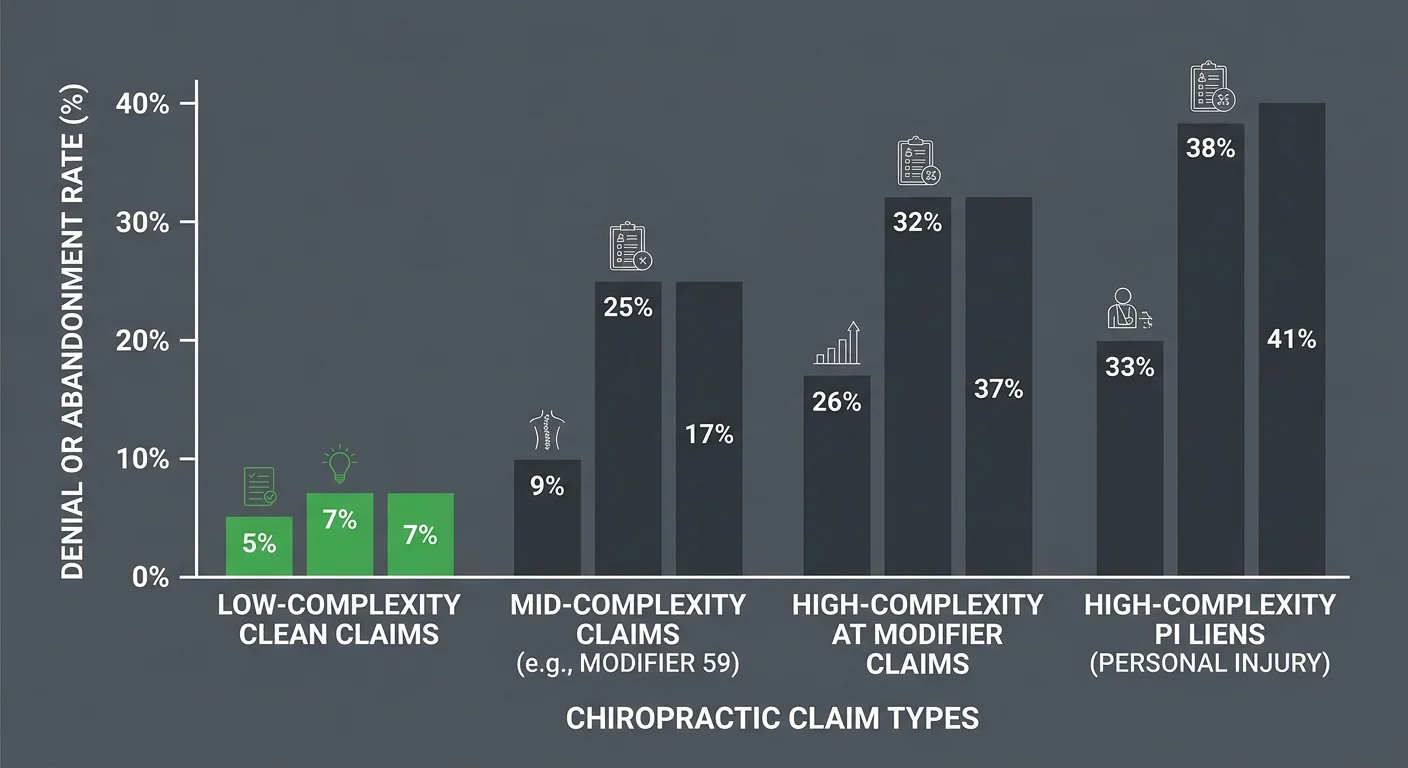
Here’s what the volume-first model is actually built to do: move claims, not recover revenue.
A general billing pool runs like a sorting facility. Speed is the metric. Volume is the goal. The moment a claim requires a human to stop, read a chart, and make a judgment call – the system has no gear for that.
That design works fine for specialties built around predictable codes and standard payer rules.
Chiropractic is not that specialty. The gap between what the pool handles well and what chiropractic claims actually require – that gap is where practice revenue disappears.
So why does chiropractic take the worst of it – more than almost any other specialty?
The Claims a Pool Deprioritizes – and Why That Costs Practices the Most
The pool doesn’t deprioritize complex claims out of negligence. It deprioritizes them by design.
A billing operation built around throughput – submissions per day, clean claim rate, speed of first pass – has no financial incentive to stop and work a claim that requires a multi-step appeal, a documentation correction, or a medical necessity argument. Those claims cost more time than the model budgets per account.
So they get set aside. That’s not a bug. That’s the architecture.
And those are precisely the claims chiropractic practices generate most.
The AT modifier. Subluxation documentation requirements. Personal injury lien workflows. Maintenance-versus-active-care distinctions. Every one of these demands specialty-level judgment that a generalist operation cannot consistently apply at volume.
The American Chiropractic Association is direct about it: improper coding and lack of modifier specificity heighten audit profiles for chiropractic physicians. A pool that processes modifiers as generic inputs has no mechanism to catch those errors before they become denials.
So the claim gets submitted. Denied. Filed in the aging AR report.
Nobody appeals it. Nobody tracks the pattern. Practices without a dedicated chiropractic biller rarely find out until the AR is months deep – and recoverable revenue has started crossing into write-off territory.
Documentation Standards Generalists Miss in Chiropractic Billing
Documentation is the fastest way to lose a chiropractic claim.
It’s also the most consistent gap in general billing operations. Not one payer’s quirk. A pattern across the entire specialty category.
An OIG audit found that approximately 82% of reviewed chiropractic claims failed to meet federal documentation criteria – with estimated overpayments of approximately $358 million tied directly to improper documentation.
The size of that number is jarring. But the cause is what matters.
These weren’t fraudulent claims. They were claims billed without the specialty-specific oversight that chiropractic documentation requires. The volume model ejects what it can’t process fast – and documentation-heavy chiropractic claims are exactly what it can’t process fast.
A generalist biller doesn’t know what a chiropractic chart needs to look like to survive a Medicare audit.
They’re not tracking whether clinical notes support subluxation findings. They’re not flagging when a provider’s documentation pattern is building a systemic denial risk.
That knowledge is specialty-specific. It doesn’t exist in a pool that serves dozens of unrelated practice types – and it can’t be developed there.
This Is Not the Right Fit for Every Practice
Here’s the honest version: this model isn’t the right fit for every practice.
If insurance billing is a small fraction of your revenue – or if you run primarily cash-pay – the argument for specialty-level oversight doesn’t hold. A cash-pay practice doesn’t need what this is built to deliver.
But if your practice manages Medicare, commercial payers, and personal injury liens – where modifier accuracy, documentation integrity, and denial follow-through determine whether you get paid – a general pool isn’t a cost-effective choice.
It’s a revenue leak. And it compounds quietly, month after month, until the AR report makes the problem impossible to ignore.
| Claim Type | General Pool Handling | Consequence for the Practice | Dedicated Biller Handling |
|---|---|---|---|
| AT Modifier (Active Treatment) | Processed as a generic modifier input; no specialty review before submission | Modifier errors trigger automatic denials; claims age into unworked AR without appeal | Biller reviews documentation against AT modifier requirements before submission; catches errors at the source |
| Subluxation Documentation | Chart completeness not verified; claim submitted on whatever documentation exists | Claim denied for insufficient clinical support; pattern repeats across multiple visits before anyone flags it | Biller monitors documentation patterns and alerts the provider before a systemic denial risk develops |
| Complex Denial Appeal | Multi-step appeals deprioritized; high effort relative to throughput model’s financial incentive | Denied claims sit unworked until they age past the point of recovery and cross into write-off territory | Biller works the denial, builds the appeal, and tracks it through resolution – this is a standard step, not an exception |
| Personal Injury Lien Billing | Lien workflows fall outside standard payer rules; generalist operations lack the process to manage them consistently | PI claims stall, get abandoned, or are submitted incorrectly – revenue from high-value cases goes unrecovered | Biller applies lien-specific workflows from intake through settlement, maintaining status visibility throughout |
| Maintenance vs. Active Care Distinction | Distinction not applied at the claim level; maintenance visits billed without coverage verification | Claims submitted for non-covered services trigger denials and elevate audit exposure for the practice | Biller flags coverage status at the visit level before claims go out, preventing avoidable denials |
| ICD-10-CM Coding Specificity | Generic diagnostic codes applied without chiropractic-specific review; modifier specificity not prioritized | Improper coding heightens the practice’s audit profile and increases commercial clearinghouse rejection rates | Biller applies chiropractic-specific coding standards on every claim, reducing audit exposure and rejection frequency |
What the AT Modifier Reveals About Billing Specialization
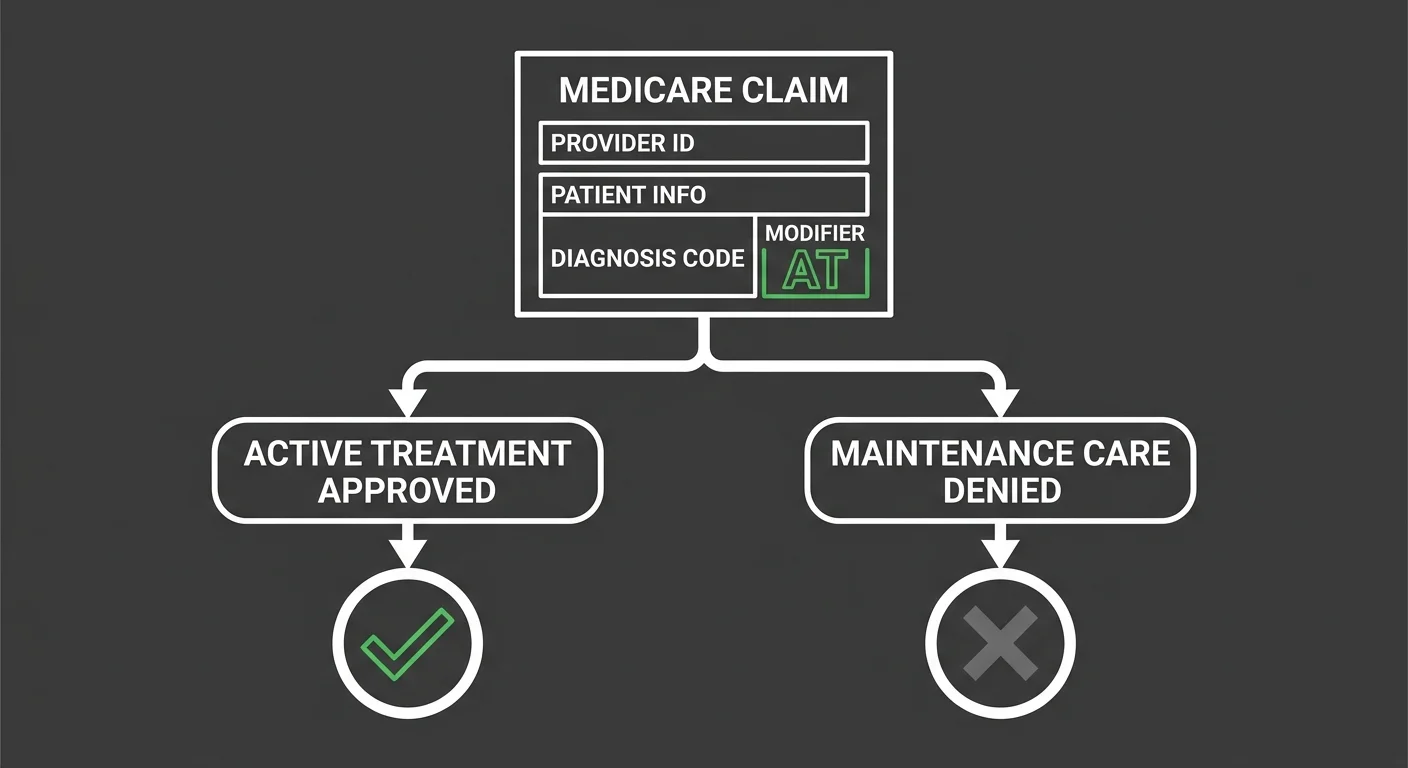
No modifier in chiropractic billing draws the line more sharply than the AT modifier. Not a technicality. A threshold. Get it wrong once and you lose a reimbursement. Get it wrong consistently and you’ve built a denial pattern – one that compounds silently while the practice assumes the billing is running fine.
Here’s the thing: AT modifier errors aren’t a carelessness problem. They’re an architecture problem. A general billing pool processes modifiers as data fields – populated or not populated. That’s the check. A dedicated chiropractic biller understands what the modifier represents clinically, and what the chart has to contain to back it up. Those are not the same job.
That’s the whole argument in two sentences. The pool ejects what it can’t process fast. The dedicated biller is the one who goes back for what got dropped.
What CMS Requires – and Why Generic Scrubbers Miss It
Published coding guidelines are unambiguous: the AT modifier designates Active Treatment, and clinical charts must support subluxation of the spine via physical exam or X-ray. That’s not a documentation suggestion. That’s the condition for reimbursement. Miss it, and the claim doesn’t generate a request for more information. It generates a denial.
Here’s where the general pool breaks down. A standardized claim engine checks whether the modifier field is populated. It does not check whether the clinical record actually supports the modifier. Those are two different checks – and only one of them protects the practice from a denial. The scrubber doesn’t know the difference. It was never built to.
So the claim goes out. It comes back denied. And in a general billing pool, silence is built into the operating model – the practice finds out about the pattern weeks later, or not at all. A weekly billing update from a dedicated biller catches this after the first occurrence. Not the fifteenth.
Medicare Enrollment Revalidation: The Billing Risk Nobody Tracks
There’s a second risk almost nobody talks about – and it has nothing to do with documentation. Federal enrollment guidelines are explicit: failure to respond to revalidation notices triggers the immediate deactivation of Medicare billing privileges. When that happens, every claim submitted under those credentials is rejected until revalidation is resolved. The AT modifier becomes irrelevant if the billing privileges are gone.
A general billing pool doesn’t track revalidation timelines. That’s not its job. A dedicated biller – embedded in the practice, managing its specific accounts – knows when those deadlines are coming. That’s the difference between a routine administrative task and a billing crisis that shuts down Medicare revenue mid-cycle.
The Pattern Behind Chiropractic Claim Failures
AT modifier errors don’t happen randomly. They follow a pattern – and that pattern almost always traces back to one of three things: the chart doesn’t document subluxation findings adequately, the modifier was applied to a visit that doesn’t meet active treatment criteria, or the biller processed the modifier without reviewing the clinical record at all. One of those is a documentation gap. The other two are a training gap. None of them fix themselves.
And because general billing operations default to automated scrubbing, none of those root causes get caught before submission. They get caught on the denial. By then, the claim is aging. The appeal window is open but narrowing. The practice has zero visibility into any of it – unless someone is actively tracking the pattern and reporting back. In a general pool, that someone doesn’t exist.
That’s what a dedicated chiropractic biller is built to do. Not just submit claims – work the ones that come back, identify why they came back, and eliminate the conditions that created the denial in the first place. The AT modifier is where that expertise shows up most clearly. It’s also where its absence costs the most.
| Requirement | CMS Standard | Common Pool Error | Impact on Claim |
|---|---|---|---|
| Active Treatment designation | AT modifier must be present on every Medicare chiropractic claim for active, medically necessary care – not maintenance visits | Modifier field populated without verifying whether the visit qualifies as active treatment under Medicare criteria | Claim denied on medical necessity grounds; appeal requires clinical re-review that a general pool rarely initiates |
| Subluxation documentation | Clinical chart must support subluxation of the spine via physical exam or X-ray findings at the time of service | Modifier applied but chart reviewed only for code completeness – subluxation findings not verified against clinical record | Claim fails Medicare’s coverage condition; documentation gap creates a repeating denial pattern across multiple dates of service |
| Active vs. maintenance care distinction | Treatment documented as maintenance care is explicitly non-covered under Medicare; AT modifier cannot be applied to those visits | Modifier submitted uniformly across visit types without distinguishing active treatment from maintenance in the clinical notes | Systematic overpayment risk and elevated audit profile for the practice; payer clawbacks compound over time |
| Modifier review against clinical record | Biller must confirm the chart substantiates the modifier before submission – not after a denial is received | Automated scrubber confirms modifier field is populated; no pre-submission cross-check against clinical documentation | Errors reach the payer uncorrected; appeal window opens on denial rather than being avoided at submission |
| Provider credential revalidation | Medicare billing privileges require timely response to revalidation notices to remain active | Revalidation deadlines not tracked by a generalist pool – treated as a provider administrative responsibility outside billing scope | Missed revalidation triggers immediate deactivation of Medicare billing credentials; all claims submitted under those credentials are rejected until resolved |
| Denial pattern identification | Recurring AT modifier denials signal a systemic documentation or coding issue that must be corrected at the source | Individual denials worked in isolation or abandoned; no root-cause analysis performed across the claim history | Same error repeats across multiple claims; revenue loss compounds without any structural correction to prevent recurrence |
What a Dedicated Chiropractic Biller Actually Does Differently

The failure modes are documented. Now the harder question: what does a dedicated biller actually do that a pool can’t – and where does it show up in your collections?
It’s not a single capability. It’s what each model is measuring.
A general billing pool measures success by submission speed and clean claim rate. A dedicated chiropractic biller measures success by what the practice actually collects – including the denials that came back and required someone to go get the money.
Those aren’t the same metric. And they don’t produce the same results.
That distinction rewrites the entire incentive structure.
When one person is accountable to one practice – not cycling through hundreds of accounts – every denial has a name on it. Every aging claim belongs to someone. That’s what changes what actually gets worked.
In a pool, no individual claim belongs to anyone. That’s exactly where revenue disappears.
AR Recovery: What Gets Worked vs. What Gets Written Off
AR recovery is where the gap stops being theoretical.
A general billing pool has no structural mechanism to prioritize aging claims over new submissions. New claims move fast. They generate clean metrics. They keep the volume model running.
Aged claims require manual review, appeal drafting, and payer follow-up. None of that fits a throughput-first operation – so it doesn’t happen.
So the AR report grows. Not because the claims are unrecoverable – many of them are entirely workable – but because no one is assigned to work them.
That’s the core distinction between human-driven denial resolution and automated status updates: automation flags that a claim is aging. A dedicated biller pursues it, drafts the appeal, and tracks the denial pattern driving it.
One is a report. The other is work.
The OIG estimated approximately $358 million in chiropractic Medicare overpayments – not fraud, but documentation that didn’t meet federal criteria.
A dedicated biller who knows what those charts need to look like before submission doesn’t generate that exposure.
A pool that treats documentation as a field to populate does.
Weekly Communication as a Structural Feature, Not a Service Upgrade
Silence from your billing operation isn’t professionalism. It’s a sign that communication isn’t in the operating model – and a model that doesn’t budget for it can’t surface problems before they compound into cash flow crises.
Weekly communication isn’t a premium add-on. It’s the mechanism by which a problem gets caught at the first occurrence instead of the fifteenth.
A dedicated biller embedded in one practice’s accounts knows what changed this week – which payer shifted its documentation requirements, which claim came back with an unfamiliar denial code, which provider’s coding pattern is starting to create a systemic problem. That knowledge is a byproduct of focus.
The weekly communication benefits of a dedicated model aren’t something a pool can add as a feature. They’re a consequence of a structure the pool was never built around.
Personal Injury Lien Billing and High-Friction Claims
Personal injury lien billing is the highest-friction category in chiropractic revenue cycle management. The payer isn’t a commercial insurer running a standardized clearinghouse workflow. It’s an attorney, a liability carrier, or a third-party administrator operating on a litigation timeline – not a claims calendar.
A general billing pool has no established protocol for that.
A dedicated biller who works chiropractic accounts does. That’s the difference between a claim that gets worked and one that gets abandoned.
Personal injury lien billing isn’t a different claim type. It’s a different billing relationship.
It requires persistent follow-up, documentation tying treatment necessity to accident causation, and coordination with legal timelines that shift mid-case. The documentation intensity is the same as Medicare – with the added complexity of a counterparty who isn’t a payer at all.
Automation has no pathway through that. Someone has to work it.
This is the end of the conveyor belt.
The claims too complex to clear in one automated pass – the AT modifier disputes, the aging Medicare denials, the personal injury liens waiting on case resolution – these are the ones that get ejected from a volume-first system.
Bushido Billing is structurally built to be the person standing there to catch them. That’s not a service quality claim. It’s a description of how the model works – and why practices that need this level of billing expertise can’t get it from a pool that was never designed to deliver it.
| Billing Task | General Pool Approach | Dedicated Biller Approach | Why It Matters for Revenue |
|---|---|---|---|
| AT Modifier Review | Checks whether the modifier field is populated; does not verify the clinical record supports active treatment criteria | Reviews the chart before submission to confirm subluxation findings are documented and the visit qualifies as active treatment | Claims submitted without chart support get denied; catching the gap before submission protects the revenue and the audit profile |
| Denial Pattern Identification | Flags individual denials as they occur; no structural analysis of recurring root causes across claims | Tracks denial reasons across the practice’s full claim history to identify and eliminate systemic coding or documentation patterns | One corrected pattern prevents dozens of future denials – a single denial addressed in isolation prevents none of them |
| Aging AR Follow-Up | Prioritizes new submissions to maintain volume metrics; aging claims receive no dedicated pursuit | Assigns ownership to every aging claim, drafts appeals, and escalates payer follow-up before the appeal window closes | Aged claims are often fully recoverable – they go uncollected not because they are lost, but because no one is assigned to work them |
| Medicare Revalidation Tracking | Does not monitor individual provider revalidation timelines; treats it as the practice’s administrative responsibility | Tracks revalidation deadlines for every provider in the practice and flags upcoming requirements before deactivation becomes a risk | A missed revalidation notice triggers immediate suspension of Medicare billing privileges – catching it early is the difference between a routine task and a revenue crisis |
| Personal Injury Lien Billing | No established protocol for non-insurer counterparties; lien claims either stall or are deprioritized within a standard clearinghouse workflow | Manages litigation-tied timelines, coordinates documentation of accident causation, and maintains persistent follow-up with attorneys and liability carriers | Personal injury liens are high-value claims that require a fundamentally different billing relationship – a pool built for clean commercial claims cannot sustain that process |
| Communication and Reporting | Provides periodic or on-request reporting; silence between billing cycles is treated as normal operating practice | Delivers weekly updates on claim status, payer changes, and emerging denial patterns specific to the practice’s accounts | Problems caught at the first occurrence cost the practice one denied claim; problems caught at the fifteenth cost the practice fifteen – plus compounding AR aging |
| ICD-10 and Coding Specificity | Applies standard code sets without specialty-level review; modifier specificity and diagnosis precision are not validated against chiropractic payer requirements | Applies chiropractic-specific ICD-10-CM coding with modifier precision required by commercial and federal payers, reducing clearinghouse rejections and audit exposure | Improper coding and lack of modifier specificity heighten audit profiles and trigger automatic clearinghouse rejections before a claim ever reaches adjudication |
Frequently Asked Questions
The evidence is clear. But practices don’t stall on evidence. They stall on the specific questions nobody’s given them a straight answer to yet.
Here are the ones that come up most. Straight answers only.
What is the difference between a dedicated biller and a general billing pool?
A general billing pool assigns claims to whoever is available. A dedicated chiropractic biller is assigned to one practice – and stays there.
That’s not a staffing preference. It’s a structural accountability difference.
In a pool, no individual owns an aging claim. In a dedicated model, every claim – from submission through resolution – belongs to one person. That’s what makes follow-through possible.
Why do chiropractic claims get denied more frequently when handled by a general billing pool?
Chiropractic claims need specialty-level documentation review. A generalist workflow isn’t built for that – and it shows in the numbers.
Take the AT modifier. A biller who doesn’t understand what subluxation documentation must contain will let modifier errors sail through automated scrubbing. The claim clears the clearinghouse. Then it comes back denied after it’s already touched the payer.
The OIG found that approximately 82% of reviewed chiropractic Medicare claims failed to meet federal documentation criteria. That’s not bad luck. That’s what happens when billing operations treat clinical records as fields to populate instead of documents to actually read.
How does a dedicated chiropractic biller handle complex denials like the AT modifier?
The dedicated biller reads the chart before the claim goes out – not after it comes back denied. That’s the whole difference.
On an AT modifier claim, the biller confirms the clinical record documents subluxation via physical exam or X-ray, and that the visit clears active treatment criteria. If something’s off, it gets caught at the source. The payer never sees the problem.
And when a denial does come back? There’s no ramp-up. The biller already knows the account, spots the pattern immediately, drafts the appeal, and corrects the root cause before the next round goes out. That’s what ownership of an account actually looks like.
Will switching to a dedicated biller improve my clinic’s accounts receivable aging?
Yes. But the mechanism is what matters.
Aging AR grows because no one is structurally assigned to work it. In a volume-first operation, new submissions take priority. Aged claims wait – not because they’re unrecoverable, but because the model has no gear for them.
A dedicated biller has no such triage conflict. The practice’s AR is the only AR. Workable aging claims get pursued. The ones that aren’t recoverable get documented and closed – so the report reflects reality, not accumulation.
What are the specific communication advantages of having a single dedicated biller?
A dedicated biller knows what changed this week. A pool reports what processed.
That’s the practical gap. When one biller owns one practice’s accounts, they notice when a payer shifts its documentation requirements. They flag the denial code that appeared for the first time. They catch when a provider’s coding pattern is creating systemic risk – before it compounds into a write-off.
And there’s a timeline risk most practices don’t think about: failure to respond to Medicare revalidation notices triggers the immediate deactivation of Medicare billing privileges. A dedicated biller tracks those deadlines as part of the job. A pool doesn’t know they exist until the billing stops.
The Claim That Gets Caught
The conveyor belt doesn’t stop for hard claims. It moves to the next one.
For clean submissions – standard codes, routine visits, payers that don’t push back – a general pool works fine. That’s exactly what it was designed for. But chiropractic revenue doesn’t live in that lane.
It lives in the claim that needs someone to stop, pull the chart, read what the documentation actually says, and go back to the payer with a real argument. A pool doesn’t have that person. So the claim goes out the back – and nobody notices until the AR report gets ugly.
Here’s the verdict. Everything before it was evidence.
The AT modifier doesn’t fail because the practice billed wrong. It fails because the person processing the claim doesn’t know what the clinical record needs to say – and didn’t stop to find out. The aging AR doesn’t grow because the claims are unrecoverable. It grows because nobody is assigned to work them.
And the silence? That’s not professionalism. That’s a model that never budgeted for communication in the first place. A billing operation that doesn’t talk to you cannot surface a problem before it compounds.
Bushido Billing is built around something different: one dedicated biller, one practice, full visibility into the AR, and a weekly accountability structure that means problems get named before they become crises.
The question was never whether a dedicated biller outperforms a general pool. That case is closed.
The real question is whether the practice is ready to stop using a model that was never built for chiropractic complexity. Practices that make that shift stop losing revenue on the same denials every month. They stop finding out about problems after those problems have already done damage. They stop guessing whether the billing is working – because someone tells them, every single week.
The conveyor belt ejects what it can’t process fast. You know what’s being ejected. The only thing left to decide is who’s standing at the end of the line.
You already know something’s off. The AR is older than it should be. The denials aren’t getting worked. And nobody’s calling to explain why.
That’s not a billing problem. That’s a structure problem – and it won’t fix itself.
Bushido Billing works with chiropractic practices that are done guessing and ready to see exactly where their revenue cycle stands. Book a Call to find out what yours is actually doing.

© . All Rights Reserved | Web Design by iTech Valet