

How to Use Weekly Billing Audits to Optimize Your Clinic's Cash Flow?
A weekly billing audit is a structured, recurring review of a chiropractic practice's claims activity, denial patterns, accounts receivable aging, and documentation compliance — conducted every seven days to catch and correct revenue leaks before they compound into unrecoverable losses.
Chiropractic billing carries one of the highest error risk profiles in Medicare. The Government Accountability Office identified chiropractic services as having some of the highest billing error rates across all Medicare clinical categories. HHS Office of Inspector General audits found that over 80% of sampled chiropractic claims failed to meet federal documentation requirements — resulting in revenue that never came back. These aren't random failures. They're structural patterns that repeat every billing cycle when no one is watching closely enough.
A weekly audit targets four specific problem areas: new denial activity, accounts receivable aging, modifier and documentation accuracy, and payer behavior patterns. Each requires human review — not automated reporting — because the errors that drive the highest revenue loss require judgment to catch. The AT modifier must be applied correctly on Medicare claims to establish active, medically necessary care. Maintenance care coded as active therapy is one of the most common and costly billing errors in chiropractic. No software flags that distinction consistently.
The core function of a weekly audit isn't compliance defense. It's cash flow protection. When denial patterns surface within days instead of weeks, appeals get filed while the clinical record is still fresh and the payer's deadline is still open. When AR aging is reviewed weekly, claims approaching critical age thresholds get worked before they're gone.
Monthly reporting tells you what you already lost. A weekly audit is the mechanism that stops the loss while there's still time to act.
Last Updated: July 22, 2026
- • Why Monthly Billing Reports Are Already Too Late
- • What the Data Says About Chiropractic Billing Error Rates
- • What a Weekly Billing Audit Actually Covers
- • How to Build a Weekly Billing Audit Into Your Practice Workflow
-
• Frequently Asked Questions
- • How does a weekly billing audit prevent chiropractic denials?
- • What key metrics should we track during a weekly billing review?
- • Can our existing EHR software automate chiropractic billing audits?
- • Why is a standard monthly billing report too slow to protect clinic cash flow?
- • What immediate steps should a clinic take if an audit reveals a high denial rate?
- • How long does a weekly billing audit take to complete?
- • Stop Waiting for the Month-End Report to Tell You What You Already Lost
Why Monthly Billing Reports Are Already Too Late
Monthly billing reports feel like accountability. They're not.
They're a summary of damage that already happened. A financial post-mortem delivered long after the window to act has closed.
Think about what a 30-day gap actually means. A claim denied on day two of the billing cycle doesn't surface until the end of the month.
By then, the payer's appeal window has shrunk. The clinical notes that would support a strong rebuttal are harder to reconstruct. The provider who treated that patient may not remember the encounter.
The revenue that was recoverable on day three is a different problem on day thirty-one.
Chiropractic billing doesn't forgive that lag. FactClaim_03 shows chiropractic services carry some of the highest billing error rates across all Medicare clinical categories.
That means the volume of denials hitting a practice's pipeline every week is rarely small. It's consistent. It's predictable. And it's recoverable — but only if someone's watching while there's still time to act.
Waiting a month to see that volume isn't a reporting strategy. It's a choice to absorb losses that didn't have to happen.
Why the Monthly Report Fails at the Source
Here's the problem with a monthly report: it's built backward.
It tells you what submitted, what paid, and what denied — after every outcome is already locked. The errors that caused those outcomes? Gone. Unaddressed. Queued to repeat in the next billing cycle.
Documentation gaps drive a significant share of initial claim denials. Missing provider signatures. Unsupported modifiers. Notes that don't establish medical necessity.
None of that is random. It's a pattern. And it repeats every single cycle because nobody caught it before the next batch went out.
A monthly report confirms the pattern existed. It does nothing to interrupt it.
This is the structural failure that practices working with a dedicated biller rather than a rotating billing pool understand immediately — someone has to be watching closely enough, and frequently enough, to catch the pattern before it compounds.
Monthly reporting assumes the billing system is working. It checks in occasionally to confirm.
A weekly audit assumes nothing. It verifies everything while there's still time to course-correct.
| Reporting Cadence | Earliest Error Detection | Typical AR Impact at Discovery | Recovery Likelihood |
|---|---|---|---|
| Weekly Audit | Within days of claim submission or denial | Claims are still within active appeal windows; clinical notes are fresh and provider recall is intact | High — errors are caught while the correction cycle is short and revenue is still fully in reach |
| Bi-Weekly Review | Two to four weeks after submission | Some payer deadlines have narrowed; documentation reconstruction becomes harder as time passes | Moderate — workable claims still recoverable, but the window is shrinking and effort increases |
| Monthly Reporting | Thirty or more days after the error occurred | Payer appeal windows are significantly reduced; claim age has compounded the recovery difficulty | Low — a meaningful share of denied revenue has aged past the point where appeals are practical |
| Quarterly Summary | Sixty to ninety or more days after submission | Large portions of AR have crossed critical aging thresholds; patterns have repeated across multiple billing cycles | Very low — recoverable revenue is now a fraction of what it was when the errors first occurred |
What the Data Says About Chiropractic Billing Error Rates
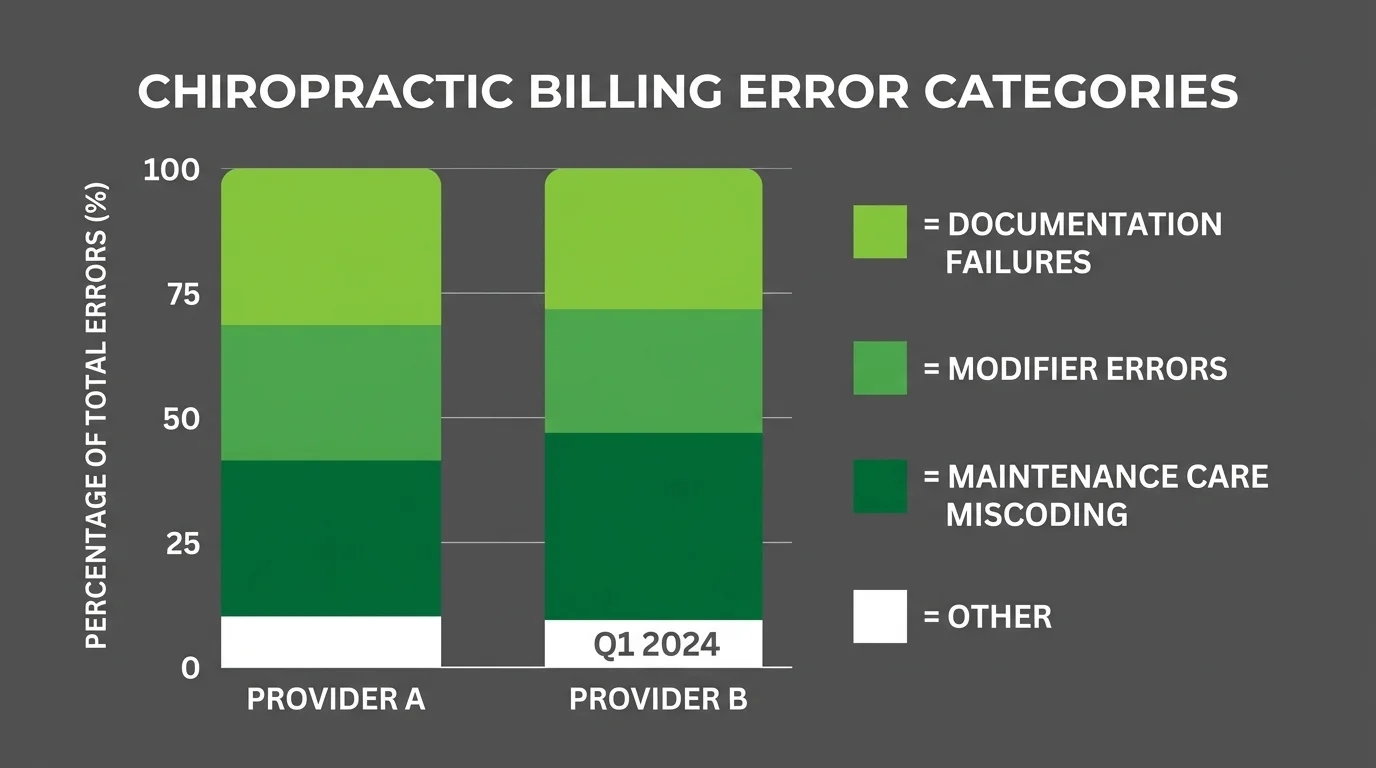
The data isn't ambiguous. Published audit findings show that over 80% of sampled chiropractic claims failed to meet federal documentation requirements.
That's not a rounding error. That's a structural failure baked into how most practices run billing.
Run that number through your actual claim volume. Eight out of every ten claims your clinic submits may carry documentation gaps large enough to trigger a denial, a delay, or an audit flag.
The revenue doesn't disappear because the care wasn't real. It disappears because the paperwork didn't hold. That's a recoverable problem — but only if someone catches it before it ages.
That's exactly why preventing revenue leakage demands more than one billing fix. The leak isn't running through one hole. It's spreading across modifier errors, documentation gaps, and maintenance care miscoding — all at once, every billing cycle.
A monthly report doesn't catch that in time. By the time it lands, the damage is already aged.
The AT Modifier and Maintenance Care Misclassification Problem
Here's where Medicare chiropractic billing breaks down most consistently. Federal coding guidance requires the AT modifier on every claim for acute spinal manipulation — it's the line that separates active, medically necessary care from maintenance therapy.
Without it, Medicare won't pay. Applied incorrectly, the claim becomes an audit flag.
There's no gray area.
Maintenance care is explicitly excluded from Medicare chiropractic benefits. That's not a gray area — it's a hard exclusion.
And yet OIG investigations found systemic billing errors where maintenance care was coded as active therapy — generating millions in estimated Medicare overpayments. The pattern hit hardest in long-term spinal maintenance cases, where the documentation drift is gradual enough that no one flags it until an auditor does.
This isn't a one-time coding mistake. It's what happens when no one's watching the claims closely enough or frequently enough to catch the shift.
A provider treats a patient through an extended care episode. The documentation moves — gradually, subtly — from active to maintenance. The AT modifier stays on. The claim goes out. Then the same thing happens the following week.
By the time an audit surfaces it, that pattern has been running for months. The overpayment is already stacked.
Reviewing chiropractic AR aging and revenue reports every seven days is what stops that drift before it becomes a pattern. When modifier and documentation decisions get reviewed weekly, misclassification gets caught before it triggers a payer audit — before it ages into revenue that's gone for good.
The data shows the problem. The weekly cadence is what actually fixes it.
| Error Category | Regulatory Source | Primary Finding | Audit Risk Level |
|---|---|---|---|
| Documentation Deficiencies | HHS Office of Inspector General | Over 80% of sampled chiropractic claims failed to meet federal documentation requirements — resulting in estimated millions of dollars in unrecoverable clinical revenue | Critical |
| AT Modifier Misapplication | Centers for Medicare & Medicaid Services | AT modifier usage is mandatory for acute spinal manipulation reimbursement — omission or incorrect application triggers denial or audit flag | High |
| Maintenance Care Miscoded as Active Therapy | HHS Office of Inspector General | Systemic billing errors where maintenance care was improperly coded as active therapy — evaluated against millions of dollars in estimated Medicare overpayments | Critical |
What a Weekly Billing Audit Actually Covers
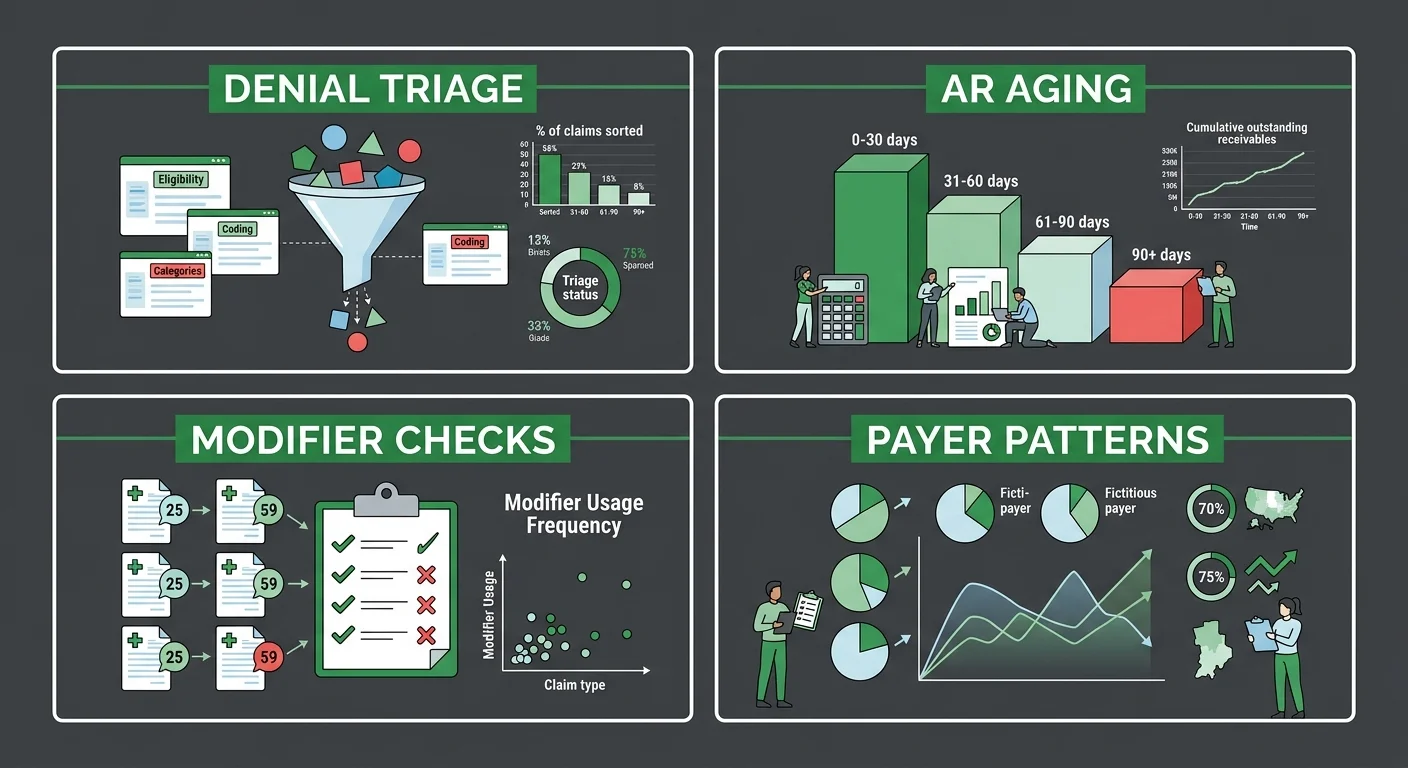
Billing errors in chiropractic don't cluster in one place. They spread across modifier applications, documentation quality, aging claim thresholds, and payer behavior — all at the same time, every billing cycle. So a functioning audit isn't a single check. It's four distinct review zones, each one targeting a different leak point in the revenue pipeline.
Inadequate documentation drives a substantial share of initial claim denials, and modifier errors compound that exposure on top of it. An audit that doesn't cover both — separately, deliberately — is leaving the highest-risk categories unreviewed. That's not an audit. That's a guess with a schedule.
Structure forces review. Review forces correction. And correction before claims age past the point of return is the only version of billing that actually protects cash flow. Here's what that review actually looks like.
The Four Audit Zones Every Chiropractic Practice Must Review Weekly
Denial Triage is the first zone. Every new denial that entered the practice's pipeline in the past seven days gets reviewed — reason code, payer, procedure code, and the documentation that accompanied it. The goal isn't to log the denial. It's to determine whether it's correctable now, while the appeal window is still open and the clinical record is still intact. Denials that sit unworked for two weeks become significantly harder to reverse. The window doesn't stay open out of courtesy.
AR Aging Review is the second zone. Every claim sitting in a 30-, 60-, 90-, or 120-day bucket gets looked at — not summarized, looked at. Claims don't age gracefully. Every week a claim sits unworked, recovery probability drops. The only way to intercept before the damage is done is to know exactly where each claim stands before it crosses into unrecoverable territory.
Modifier and Documentation Spot-Check is the third zone. It's a targeted review of claims queued for submission or recently submitted — checking AT modifier application, provider signature presence, and whether the clinical note actually supports the diagnosis coded. This is the zone where the errors CMS flags most often get caught before they go out the door.
Payer Pattern Tracking is the fourth zone. It logs which payers are denying which codes, and how often. The goal is to stop treating payer behavior as a surprise and start treating it as a strategy.
These four zones aren't arbitrary categories. Each one targets a failure type the OIG and GAO have identified as a primary driver of chiropractic revenue loss. Run all four weekly and the practice has an early-warning system. Skip any one of them and that zone becomes the drain that floods the floor.
Who Runs the Audit — and What Happens When Nobody Does
The most important question a practice can ask about its billing isn't 'are we submitting claims?' It's 'who's reviewing them — and how often?' Submission is mechanical. Review is judgment. And judgment is exactly what's missing when a practice assumes billing is running fine because no one's reported a problem.
When no one owns the weekly review, the four audit zones don't disappear — they just go unworked. Denials age. AR climbs past the 90-day threshold. Modifier errors repeat cycle after cycle because nobody caught the pattern the first time. The slow drain that preventing chiropractic revenue leakage is designed to stop keeps running, quietly, until the damage shows up in a cash flow crisis that took months to build.
Audit cycles only reduce compliance risk when someone is accountable for running every zone, every week, and escalating what they find. Without that accountability structure, the audit is a concept — not a control. And concepts don't recover denied claims.
| Audit Zone | What It Reviews | Key Red Flags | Frequency |
|---|---|---|---|
| Denial Triage | Every denial received in the past seven days — reason code, payer, procedure code, and accompanying documentation | Correctable denials approaching appeal window expiration; repeat reason codes from the same payer; denials tied to documentation gaps rather than clinical disputes | Weekly |
| AR Aging Review | All open claims sorted by aging bucket — reviewing what is sitting unworked at 30, 60, 90, and 120-plus days | Claims crossing into the 90-day threshold without follow-up; aging balances concentrated with a single payer; claims that have never received a response | Weekly |
| Modifier and Documentation Spot-Check | Claims queued for submission or recently submitted — AT modifier application, provider signature presence, and clinical note alignment with the diagnosis coded | AT modifier applied to maintenance-level visits; missing or incomplete provider signatures; clinical notes that do not support the coded diagnosis | Weekly |
| Payer Pattern Tracking | Denial and payment data sorted by payer — tracking which payers are denying which codes, at what rate, and whether the pattern is worsening | A single payer responsible for a disproportionate share of denials; new denial reasons appearing for previously accepted codes; payment delays inconsistent with contract terms | Weekly |
How to Build a Weekly Billing Audit Into Your Practice Workflow
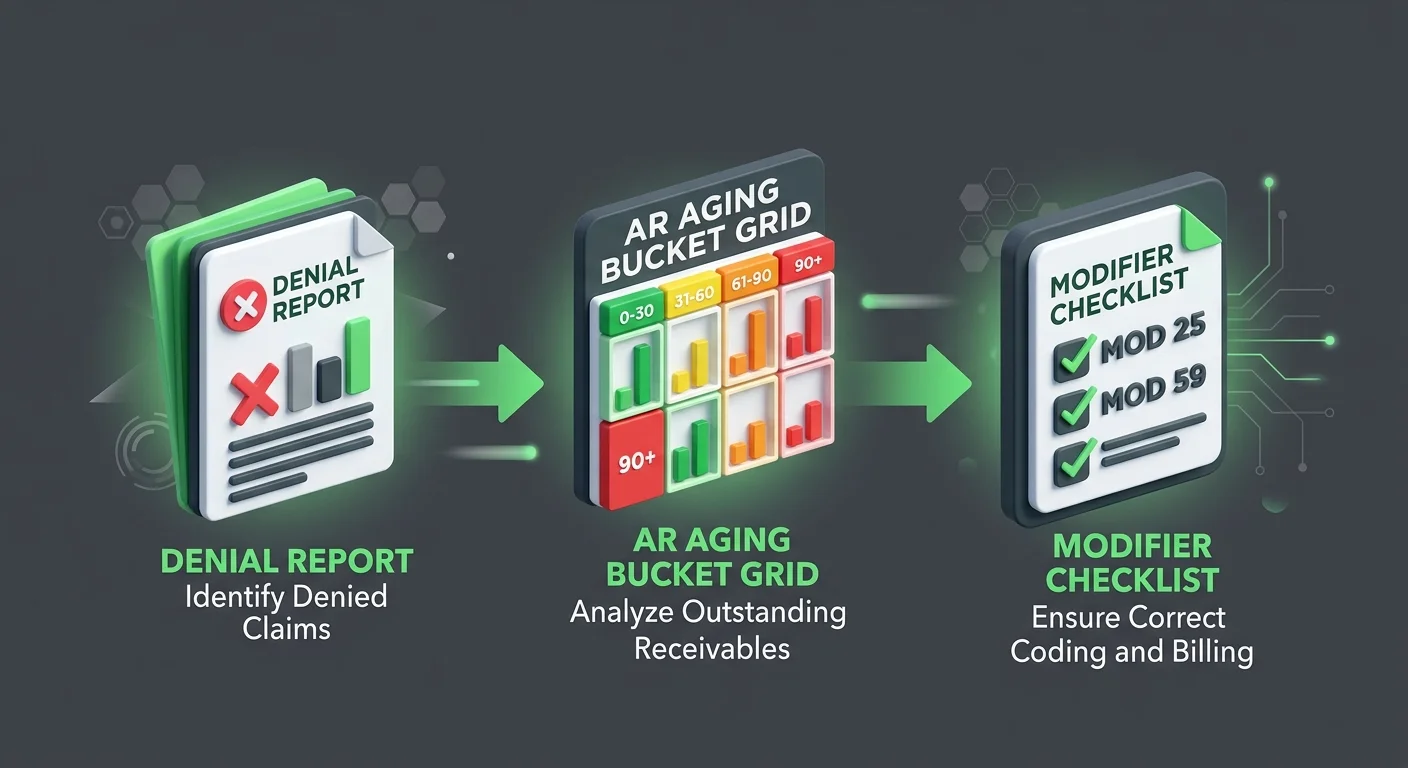
Knowing what to audit is the easy part.
The practices that protect their cash flow aren't the ones with the best intentions. They're the ones that made the weekly audit non-negotiable before the week got busy.
Here's the trap: most practices treat the audit as something to schedule when there's bandwidth.
There's never bandwidth. The clinic fills it. The week fills it. The audit gets pushed.
It needs a fixed calendar slot — a recurring block that runs regardless of what's happening in the clinic. Not when something feels off. Every week.
What follows is the operating sequence for turning the four audit zones into a weekly habit.
Not a concept. A practical order of operations — the steps that move a practice from "we should audit" to "we just did." If you want to understand why real-time access to your billing data is the foundation this sequence runs on, that context matters before you run step one.
Step 1 — Pull and Triage the Prior Week's Denial Report
Pull every denial that entered the pipeline in the prior seven days. Don't sort by dollar amount first — sort by reason code.
The reason code is the diagnosis. It tells you whether you're looking at a documentation failure, a modifier error, an eligibility issue, or a coding mismatch. That distinction determines what gets fixed and what gets flagged for pattern review.
For each denial, ask three questions: Is the appeal window still open? Is the clinical record intact enough to support a corrected claim? Is this reason code showing up more than once this week?
That third question is the one most practices skip.
It's also the one that catches a pattern before it becomes a crisis.
Chiropractic services carry some of the highest billing error rates in Medicare clinical categories. The Government Accountability Office specifically recommended systematic pre-payment and post-payment review as the structural response to that exposure.
Denial Triage is where that review starts — at the individual claim level, inside the appeal window, while correction is still on the table.
Step 2 — Review AR Aging Buckets and Flag Stalled Claims
Open the AR aging report and look at the columns — not the totals.
The total AR balance is a lagging number. It tells you where you've been. What matters is what's sitting in the 60-day, 90-day, and 120-day buckets — because those are the claims actively aging toward unrecoverable.
Flag every claim that crossed a threshold since last week's review. A claim that moved from 60 days to 90 days didn't just age — it lost recovery probability.
AR Aging Review isn't a passive read. It's an intervention: find the stalled claim, determine why it's stalled, and put an action on it before it crosses the next line.
The full-service chiropractic billing model is built around exactly this kind of weekly intervention.
Practices that protect cash flow aren't the ones with the lowest denial rates. They're the ones that move on stalled claims before the payer's window closes. That's a timing advantage — and it only exists if someone is reviewing the AR every seven days.
Step 3 — Spot-Check Modifier and Documentation Accuracy
Before the next batch of claims submits, pull a sample from the queue. Review each one for three things: AT modifier presence and accuracy, provider signature completeness, and whether the clinical note actually supports the diagnosis being coded.
This is Modifier and Documentation Spot-Check — and it's the zone where the most preventable revenue loss lives.
The AT modifier isn't a technicality. It's the mechanism that separates active, medically necessary care from maintenance therapy — and Medicare pays for one of those, not both.
Analysis of Midwest billing compliance patterns found systemic errors where maintenance care was improperly coded as active therapy, generating millions of dollars in estimated Medicare overpayments. That pattern doesn't start with one bad claim. It builds week over week when nobody checks the modifier before submission.
The spot-check doesn't need to cover every claim in the queue. It needs to cover enough to detect a pattern — and it needs to run every week, not once a quarter when something already went wrong.
Maintenance care is explicitly excluded from Medicare chiropractic benefits. When the proactive weekly update model includes a modifier review at the submission stage, that line stays enforced — and the practice stays on the right side of it before an auditor ever gets involved.
| Audit Step | Action Item | Tool or Report Used | Time Estimate | Owner |
|---|---|---|---|---|
| Denial Triage | Pull all denials from the prior seven days; sort by reason code; flag recurring codes; assign each denial a correctable or non-correctable status and an action owner before the appeal window closes | Denial report from practice management system or billing platform | Under one hour | Dedicated biller or billing lead |
| AR Aging Review | Open the aging report and review the 60-, 90-, and 120-day buckets column by column; flag every claim that crossed a threshold since last week; assign a follow-up action to each stalled claim before it ages further | AR aging report — weekly snapshot | Under one hour | Dedicated biller or billing lead |
| Modifier and Documentation Spot-Check | Pull a representative sample from the upcoming submission queue; verify AT modifier presence and accuracy on every Medicare claim; confirm provider signature completeness and that the clinical note supports the coded diagnosis | Claim queue within EHR or billing system; clinical documentation | Thirty to forty-five minutes | Dedicated biller in coordination with treating provider |
| Payer Pattern Tracking | Log which payers denied which codes this week; compare against prior weeks to identify recurring denial patterns by payer; update the payer pattern log and flag any payer whose denial frequency increased week-over-week | Running payer denial log — maintained week over week | Fifteen to thirty minutes | Dedicated biller or billing lead |
| Weekly Escalation Review | Summarize findings across all four audit zones; escalate any denial pattern, aging threshold breach, or modifier error that requires provider input or payer-level follow-up; confirm every action item has an owner and a deadline | Weekly summary report or internal communication channel | Fifteen minutes | Billing lead — provider notified as needed |
Frequently Asked Questions
The framework tells you what to audit and how to run it. But the first week a practice actually holds the cadence, a different set of questions surfaces — the skeptical ones, the practical ones, the ones no framework section answers.
Here are the questions that come up most. Straight answers only — because the stakes don't leave room for anything else.
How does a weekly billing audit prevent chiropractic denials?
It catches the conditions that produce denials before they lock in. Denial Triage surfaces reason code patterns while the appeal window is still open — when a correction actually changes the outcome. Modifier and Documentation Spot-Check reviews AT modifier accuracy and note alignment before the next submission batch leaves the practice.
The OIG found that over 80% of sampled chiropractic claims failed to meet federal documentation requirements. That's not a fringe problem. That's the majority of preventable denials tracing directly to documentation failures — the kind a pre-submission review catches before they become a number on a loss report.
The weekly cadence doesn't eliminate every denial. It eliminates the preventable ones. And it shortens the response window on the ones that weren't.
What key metrics should we track during a weekly billing review?
Four numbers, tracked weekly without exception: denial volume by reason code, AR balance by aging bucket (30, 60, 90, 120-plus days), claim submission accuracy rate, and open appeal count with days remaining in each window.
The reason code breakdown tells you what's failing and why. The aging buckets show which claims are actively losing recovery probability — not as a historical record, but as a live intervention list. The submission accuracy rate, reviewed through Modifier and Documentation Spot-Check, tells you whether errors are entering the pipeline before anyone can stop them. The open appeal count tells you whether the practice is actually working its denials or just logging them.
The GAO flagged chiropractic services as carrying some of the highest billing error rates in Medicare clinical categories — and recommended systematic review as the structural fix. These four metrics are that structure, built into a weekly cadence instead of a post-mortem report.
Can our existing EHR software automate chiropractic billing audits?
No. And that misunderstanding costs practices real money.
An EHR submits claims. It doesn't review them. It doesn't flag whether the AT modifier was applied correctly, whether the clinical note supports the coded diagnosis, or whether a specific payer is building a denial pattern on a specific code. Those are judgment calls — and no EHR automates judgment.
Faster submission doesn't fix inadequate documentation. A human reviewer running Modifier and Documentation Spot-Check before the queue goes out does.
The EHR is the pipeline. The weekly audit is the quality control that keeps it from leaking.
Why is a standard monthly billing report too slow to protect clinic cash flow?
Because by the time a monthly report lands, most of the damage in it is already unrecoverable.
A claim that denied in week one sits in the 30-day aging bucket by month-end. Some payers' appeal windows run shorter than 30 days. A monthly report doesn't surface that claim in time to act — it surfaces it in time to document the loss.
AR Aging Review and Denial Triage only work when the review interval is shorter than the intervention window. A monthly cadence guarantees that a meaningful share of workable denials age past recovery before anyone looks at them.
That's not a reporting gap. It's a structural revenue leak — and it runs on autopilot until someone changes the cadence.
What immediate steps should a clinic take if an audit reveals a high denial rate?
Three steps, in order.
First, sort every denial by reason code and identify which codes appear more than once. A single denial is an event. A repeated reason code is a pattern — the same error entering the pipeline week after week.
Second, check every open denial for appeal window status. Pull the ones with time left and queue them for immediate action. The ones past the window get documented and analyzed for root cause — because if the error is preventable, it needs to stop repeating.
Third, trace the pattern back to its source. Denials clustering around AT modifier errors mean Modifier and Documentation Spot-Check needs to tighten before the next submission batch. Denials clustering around documentation failures mean the clinical note workflow is the problem — not the biller.
An audit that produces a specific corrective action protects revenue. An audit that produces a list of what went wrong is just a more detailed version of the monthly report.
How long does a weekly billing audit take to complete?
With a dedicated billing reviewer running all four zones — Denial Triage, AR Aging Review, Modifier and Documentation Spot-Check, and Payer Pattern Tracking — a thorough weekly audit runs between 60 and 90 minutes.
That assumes the reviewer has direct EHR access, a live AR aging report, and a denial log organized by reason code. Practices without those tools in place spend extra time on setup and retrieval — time the audit shouldn't be absorbing.
The 60-to-90-minute window isn't a ceiling. A practice with high claim volume or a backlog of aged AR will need more time in the early weeks. But that investment compresses as the process matures and the four zones stop surfacing the same errors on repeat. The audit gets faster as the practice gets cleaner.
Stop Waiting for the Month-End Report to Tell You What You Already Lost
The month-end report doesn't tell you what went wrong.
It tells you what already happened — weeks ago, in claims that aged past the appeal window while the practice assumed the biller had it covered.
That assumption is where the revenue disappears. Not in one visible failure. In a slow drain the summary captures only after the damage is permanent.
The four audit zones — Denial Triage, AR Aging Review, Modifier and Documentation Spot-Check, and Payer Pattern Tracking — don't stop existing when you skip a week.
They just go unworked.
Denials stack. AR climbs past the 90-day threshold. Modifier errors repeat because nobody caught the pattern the first time. That's not a billing problem you can solve with a better report. It's a structure problem. And the only thing that fixes a structure problem is a structure — one that runs every week, regardless of how busy the clinic gets.
Bushido Billing's weekly audit model isn't a reporting upgrade. It's a control system — the hand that checks the drain before the floor floods.
Practices that protect their cash flow don't wait for a crisis to confirm something's wrong.
Monthly reporting tells you what you already lost. The only question is whether your practice finds out this week — or in thirty days, when the window to act has already closed.
Your monthly report isn't a billing system. It's a record of what already slipped through. If you don't know whether your claims are getting caught before they age past recovery — that's not a minor gap. That's where practices lose the most revenue they'll never see again. Book a Call with Bushido Billing. Find out exactly where your pipeline stands — before next month's report tells you.

© 2026 Bushido Billing. All Rights Reserved | Web Design by iTech Valet