

Professional Billing Audit vs. Software Reporting: Which One Finds the Real Money?
Software reporting and a professional billing audit are not two versions of the same tool. They answer different questions — and only one of them tells you where the money went.
Software reporting tells you how fast claims are leaving the practice. A professional billing audit tells you how many actually arrived.
Revenue cycle management covers the full arc from patient registration to final balance resolution. Most practice software monitors only the front half of that arc. Claims go out. The dashboard turns green. The practice assumes revenue is following.
It often isn't.
Modifier errors are the single largest driver of chiropractic billing denials. These aren't random mistakes. They follow patterns — and those patterns are invisible inside a standard software report. The report confirms transmission. It cannot tell you whether the AT modifier was applied correctly, whether the documentation supports the level of care billed, or whether a denial has already aged past the point of recovery.
An OIG regional audit found that 82% of reviewed chiropractic services failed to meet Medicare documentation and clinical necessity standards. That number doesn't reflect a software glitch. It reflects the gap between claims being sent and claims being defensible. Software cannot close that gap.
Human review can.
The CMS Physician Fee Schedule calculates reimbursement using geographic cost indices and precise modifier inputs. Small coding inaccuracies don't produce small revenue losses. They suppress per-visit collection yields across every affected claim — compounding quietly while the dashboard stays green.
A professional billing audit examines what the software never sees: denial patterns, modifier accuracy, documentation integrity, and recoverable revenue aging in accounts receivable. It doesn't confirm that claims were sent. It determines whether the practice is actually getting paid for the work its providers performed.
Last Updated: August 17, 2026
- • What Software Reporting Actually Measures — and Where It Stops
- • What a Professional Billing Audit Actually Reviews
- • Reading the Results: What Each Tool Tells You — and What to Do With It
- • Who Should Be Using Which Tool (and When Both Miss the Point)
-
• Frequently Asked Questions
- • What is the average timeline and staff commitment required to complete a professional billing audit?
- • Why does standard EHR and billing software fail to catch chiropractic modifier errors like missing AT or GP codes?
- • What are the most common failure points in automated EHR reports that create hidden revenue leakage?
- • If billing software is significantly cheaper, why does relying on it alone cost the practice more long term?
- • How do billing audit findings get integrated into the clinical team's daily documentation workflow?
- • Can a billing audit recover revenue from claims that were already denied and closed?
- • The Real Question Isn't the Tool — It's What You're Willing to Know
What Software Reporting Actually Measures — and Where It Stops

Software reporting has one job. It confirms that claims were submitted, the clearinghouse accepted them, and a response came back. That's the design. That's also the ceiling.
Revenue cycle management runs from patient registration all the way to final balance resolution. Most practice software turns green the moment a claim ships out the door. Everything after that — denials worked, modifiers corrected, aging AR recovered — sits completely outside the dashboard's reach.
Here's the thing: the software isn't broken. It's doing exactly what it was built to do. The problem is that most practices read submission confirmation as evidence of revenue collection. Those are not the same event.
The Dashboard Tells You Claims Left — Not That They Paid
A submitted claim and a paid claim look identical on a standard report. Both show activity. Both move the column. Neither one tells you whether money actually arrived.
That gap is where chiropractic practices bleed revenue. Not through dramatic billing failures. Through the quiet accumulation of unworked denials aging inside a report the software generates but no one is trained to act on. What a practice audit does is surface what's hiding in that AR before it ages past the point of recovery.
The dashboard confirms transmission. It cannot evaluate clinical necessity. It cannot tell you whether the AT modifier was applied correctly, whether documentation supports the level of care billed, or whether a payer's denial is still inside the appeal window. Those questions require a human reviewing the actual claim file — not a status column.
Why the Claims Software Clears Are the Easy Ones
Here's the honest truth about automation: software clears clean claims. Straightforward diagnosis, standard coding, no modifier complexity — those process without friction. The system handles them fine. That's not a criticism. That's just the full scope of what it was built to do.
But the moment a claim requires modifier precision — AT modifier application, documentation that separates active care from maintenance, or a payer-specific rule the clearinghouse doesn't flag — automated systems have no pathway to resolution. NIH research on EHR documentation shows that automated template replication across dates of service creates severe compliance risk. The template sends the claim. The audit determines whether the claim was ever defensible.
So the claims software clears fastest are the ones that needed the least work. The ones left behind — complex denials, modifier disputes, documentation gaps — carry the highest recovery value. The full picture of billing software limitations makes this concrete: submission speed and revenue recovery are measuring two completely different things.
| Reporting Function | What Software Tracks | What It Cannot Track | Revenue Impact |
|---|---|---|---|
| Claim Submission Tracking | Whether a claim was transmitted to the clearinghouse and accepted for processing | Whether the claim was paid, partially paid, or denied after adjudication | Submission confirmation is not revenue. A green status means the claim left — not that money arrived. |
| Denial Notification | That a denial was received and logged in the system | Why the denial occurred, whether it follows a pattern, and whether it is still within the appeal window | Unworked denials age silently. The report shows they exist — not that anyone is working them. |
| Modifier Application | That a modifier code was included in the claim submission | Whether the modifier was applied correctly, matches the clinical documentation, and satisfies payer-specific rules | An incorrect AT modifier on a Medicare claim suppresses reimbursement across every affected visit — not just one. |
| AR Aging Report Generation | How long claims have been outstanding, organized by time bucket | Which claims are still recoverable, which have lapsed, and what billing decision created the aging in the first place | An AR aging report shows the damage. It does not diagnose the cause or identify what is still workable. |
| Documentation Status | That a progress note or encounter record is attached to the claim | Whether the documentation supports the level of care billed, distinguishes active care from maintenance, or would survive a payer audit | A claim sent with a replicated template passes submission. It fails the moment a payer requests the underlying record. |
| Payer Response Logging | That an explanation of benefits or remittance advice was received and recorded | Whether the payer's adjudication logic was applied correctly or whether the payment falls short of the contracted rate | Accepting the payer's number as final — without verifying it against the contracted fee schedule — leaves recoverable revenue on the table permanently. |
What a Professional Billing Audit Actually Reviews

A professional billing audit doesn't start with the dashboard. It starts with the actual claim file — the documentation, the modifier logic, the payer response, and how many days sat between denial and follow-up. That's a different starting point entirely.
Here's what a human-led audit actually reviews: whether clinical documentation supports the care billed, whether modifiers were applied correctly on every date of service, whether denials were worked or left to age, and whether fee schedule inputs are accurate enough to capture full per-visit reimbursement. Software generates none of that analysis. It confirms a transaction happened. That's it.
Software tells you how fast claims are leaving. A billing audit tells you how many actually came back — and names, claim by claim, what stopped the rest.
The Chiropractic Modifiers Software Misses Most Often
Modifier errors are the single largest driver of chiropractic billing denials — confirmed by NIH peer-reviewed analysis of medical documentation standards. But this isn't a general coding problem. It's a chiropractic-specific problem rooted in the active care versus maintenance distinction, and in the precise modifier application the CMS Physician Fee Schedule demands.
The AT modifier — the active treatment designation required on every Medicare chiropractic claim — is where most practices bleed. When it's missing, the claim goes out clean. The clearinghouse accepts it. The status column turns green. Then the denial comes back. And without a human reviewing the actual file, it just sits there aging.
The software never flagged it. It was never designed to. A professional billing audit catches AT modifier omissions, GP modifier misapplications, and documentation that doesn't distinguish active care from maintenance — the exact failure points a fee schedule research audit is built to surface and correct before they compound across months of claims.
Why Most Practices Don't Know Their Denial Patterns
Denial patterns don't announce themselves. They stack up quietly inside an aging AR report that most practices generate and almost no one interprets. The software produces the report. It can't tell you what's driving the number — or whether those claims are still inside the appeal window.
82% of reviewed chiropractic services failed to meet Medicare documentation and clinical necessity standards — confirmed by this published analysis of federal compliance reviews. That's not a billing software failure. That's a documentation and modifier accuracy failure that software was never built to catch.
And here's the thing: practices that don't know their denial patterns aren't ignoring the problem. They're trusting the wrong instrument to diagnose it. A dashboard showing submission volume doesn't show denial root causes. Only a structured human review of the claim history — the kind a comprehensive practice audit delivers — tells you whether the practice is losing the same revenue on the same modifier error, month after month, while the dashboard stays green.
| Audit Review Area | What Gets Examined | Common Finding | Typical Revenue Effect |
|---|---|---|---|
| Modifier Accuracy | Whether AT, GP, and other chiropractic-specific modifiers were applied correctly across every date of service | Modifier omissions or misapplications present on a high proportion of Medicare claims — often consistent across multiple months | Claims denied or underpaid at the payer level, with recovery window closing the longer the error goes undetected |
| Clinical Documentation Integrity | Whether the clinical notes support the level of care billed and distinguish active care from maintenance care | Documentation that does not meet medical necessity standards, including templated notes replicated across dates of service | Claims that cannot be defended on appeal, resulting in permanent revenue loss even when the care itself was appropriate |
| Denial Pattern Analysis | Whether denials are isolated events or recurring patterns tied to a specific payer, code, or modifier error | The same denial reason repeating across months — undetected because software reports show volume, not root cause | Compounding revenue leakage from the same correctable error applied repeatedly before anyone identifies the source |
| Accounts Receivable Aging | Whether outstanding claims are being actively worked or sitting unaddressed past the point of productive follow-up | A significant portion of AR aged beyond the typical appeal window — with no documented follow-up activity on file | Revenue that was recoverable at 30 days becomes unrecoverable at 120 days; delays convert workable claims into write-offs |
| Fee Schedule Accuracy | Whether the practice's fee schedule inputs align with current CMS conversion factors and geographic cost indices | Fee schedule entries that have not been updated to reflect current payer contracts or annual CMS adjustments | Per-visit reimbursement suppressed across every affected claim — a quiet, cumulative yield reduction invisible on the dashboard |
| Appeal Timeline Compliance | Whether denied claims are being appealed within each payer's required filing window | Denials left unworked until the appeal deadline has passed, removing any path to recovery regardless of claim merit | Revenue permanently forfeited — not because the claim was wrong, but because no one acted within the required timeframe |
Reading the Results: What Each Tool Tells You — and What to Do With It
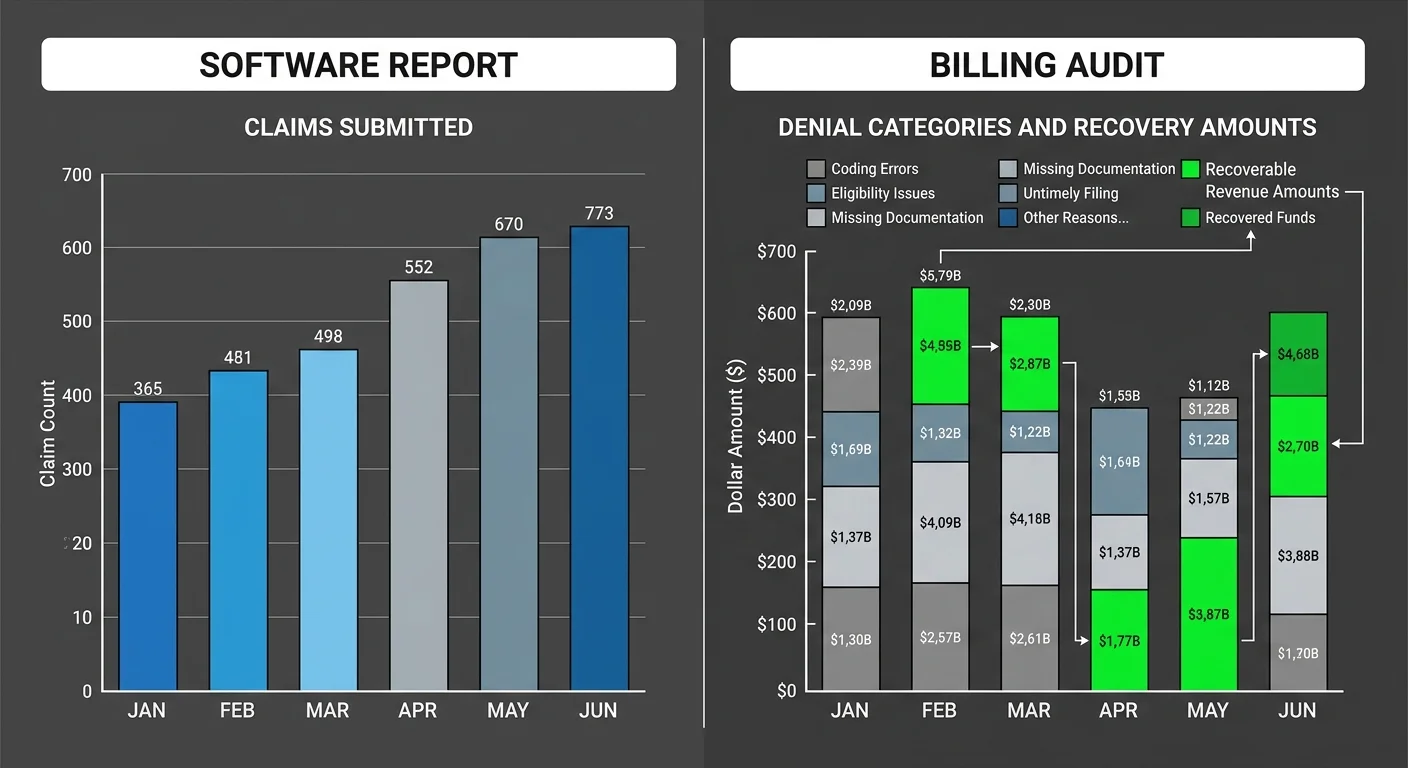
So both tools have been mapped. Both failure modes are on the table. Now the only question that matters: what does each output actually let you do?
Software reporting enables confirmation. A professional billing audit enables action — specific, claim-level, recoverable action.
Confirmation and action aren't the same thing. A green dashboard tells you claims left the building. It doesn't tell you how many arrived. It doesn't tell you what stopped the ones that didn't.
Speed is measurable. Arrival is a different question entirely. And only one of these two instruments was built to answer it.
How to Read a Software Report Without Misreading Your Revenue
A software report has three readable outputs: submission status, clearinghouse acceptance, and payer response codes. Read those correctly and you know whether a claim was received.
That's the instrument's honest ceiling. Most practices treat it as the floor.
Here's the thing: misreading a software report isn't a failure of attention. It's a failure of expectation.
The report was never designed to surface denial root causes, modifier accuracy failures, or documentation gaps. Expecting it to is like reading a shipping confirmation and concluding the package was useful. NIH data on administrative waste in healthcare billing confirms that up to $265 billion in losses trace to exactly this kind of systemic gap — complex claims processed as if submission equals resolution.
The corrective read is straightforward. Treat the software report as a transmission log — not a revenue report.
Use it to confirm claims were sent. Use everything else — denial codes, aging columns, unworked response queues — as signals that a human review is required. The report tells you something happened. It can't tell you whether that something produced revenue.
How Audit Findings Translate Into Recoverable Revenue
Audit findings only translate into recoverable revenue when they're specific enough to act on.
A finding that says "denials are elevated" isn't actionable. A finding that says "AT modifier omissions on dates 3, 7, and 11 triggered payer rejections still within the appeal window" is. That level of specificity is the entire difference.
That specificity is what separates a professional billing audit from a dashboard export. The CMS Physician Fee Schedule calculates reimbursement against geographic cost indices and precise modifier inputs — which means every coding inaccuracy suppresses per-visit collection yields mathematically, across every affected claim.
An audit maps those inaccuracies to specific claim lines. A software report never sees them. A fee schedule research audit is built to quantify exactly where those inputs break down at the per-visit level.
But the most important audit finding isn't a number. It's a pattern.
Recoverable revenue doesn't scatter randomly across a practice's AR. It concentrates around a small set of recurring modifier failures, payer-specific documentation rules, and denial types the software flagged as "responded" and moved past.
Once a billing audit identifies those patterns, the recovery path is clear. You stop guessing at the symptom. You start fixing the cause.
| Output Type | Software Report | Professional Billing Audit | Actionability |
|---|---|---|---|
| Submission Status | Confirms whether a claim was transmitted to the clearinghouse | Verifies whether the transmitted claim was correctly coded and defensible at the documentation level | Low — confirms a transaction occurred, not whether it produced revenue |
| Denial Visibility | Displays payer response codes and denial flags in the status column | Identifies the root cause of each denial — modifier error, documentation gap, or payer-specific rule failure | High — root cause identification enables targeted appeals and pattern correction |
| Modifier Accuracy | No pathway to flag AT modifier omissions or GP modifier misapplications — clearinghouse acceptance does not equal coding correctness | Examines every date of service for correct modifier application against active care versus maintenance documentation standards | High — correcting modifier errors recovers suppressed per-visit reimbursement across affected claim lines |
| AR Aging Analysis | Generates an aging report showing claim age by bucket; does not interpret what is driving the aging or which claims remain workable | Evaluates each aging claim for appeal eligibility, denial cause, and recovery likelihood — distinguishing recoverable revenue from written-off loss | High — separates recoverable claims from irretrievable ones so recovery effort is concentrated where it produces results |
| Fee Schedule Accuracy | Does not audit whether fee schedule inputs reflect current geographic cost indices or accurate conversion factor data | Reviews fee schedule configuration against CMS Physician Fee Schedule requirements to identify per-visit collection gaps caused by inaccurate modifier inputs | High — correcting fee schedule inputs increases reimbursement yield on every future claim, not just historical ones |
| Pattern Detection | Surfaces submission volume and payer response data; cannot identify whether the same modifier failure is repeating across months of claims | Maps denial types, modifier errors, and documentation failures to identify recurring patterns that are suppressing revenue systematically | High — pattern identification stops recurring revenue loss at the source rather than managing its symptoms claim by claim |
Who Should Be Using Which Tool (and When Both Miss the Point)
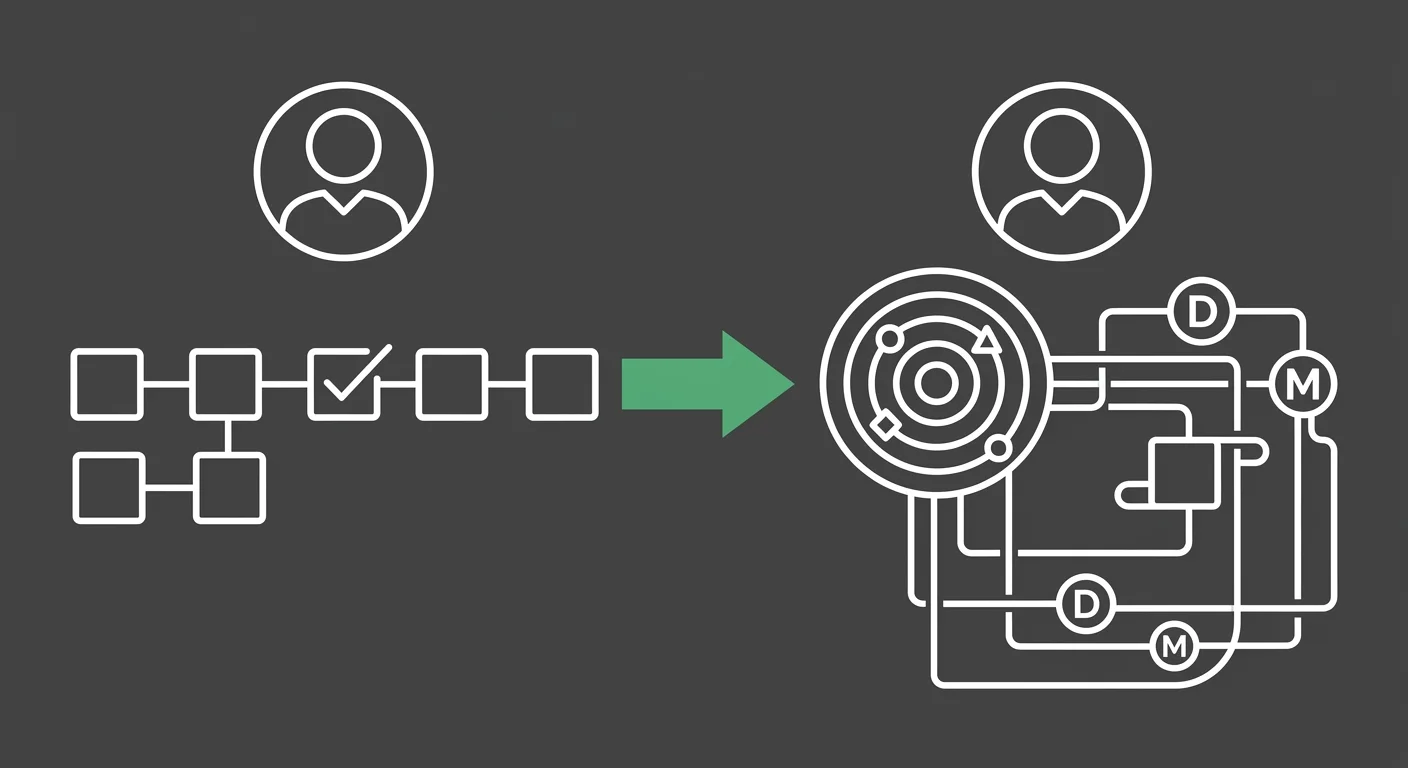
Here's the actual question: not which tool is better — but what happens when a practice treats either one as the whole answer.
Software reporting belongs in every practice. It's the transmission log — and every practice needs a transmission log. Submission tracking, clearinghouse acceptance, payer response codes: these are operational necessities. The error isn't using the software. The error is expecting the software to answer questions it was never built to ask.
A professional billing audit belongs in any practice where the software report looks clean and the cash flow doesn't match. That gap is the signal. Submissions are high. Collections are flat. The speedometer is working fine — it's the destination that's unanswered. That's not a dashboard problem. That's a human review problem.
Practices That Rely on Software Alone: What That Actually Signals
Software-only reliance signals one thing clearly: the practice is measuring activity, not outcomes.
Automated EHR templates create a specific, documented risk: identical progress notes replicated across different dates of service. The software never surfaces it. Every templated note clears the clearinghouse. Every templated note looks identical in the status column. But the audit asks a different question — were any of them defensible when a payer looked twice? The 82% of reviewed chiropractic services that failed federal documentation standards weren't filed by practices cutting corners. They were filed by practices that trusted the template and the submission confirmation, and never had a human check the gap between what was sent and what was supportable.
Modifier errors are the single largest driver of chiropractic billing denials. And that pattern concentrates in practices where no one is auditing modifier logic across dates of service — where the AT modifier gets applied inconsistently, where active care and maintenance distinctions blur in the documentation, where the software keeps reporting successful submissions. The dashboard stays green. The denial rate climbs. Both facts coexist because the instrument reading green was never designed to detect the problem. Practices that act on what an audit uncovers break that pattern. The ones that don't keep losing the same revenue on the same modifier error, month after month.
This Is Not for Every Practice — And That's by Design
A professional billing audit is not for every practice. That boundary matters.
If the first question is what does it cost, this is not the right conversation. Price is a procurement frame. A billing audit is a diagnostic instrument. Those two frames don't fit together — and the mismatch tells you exactly what the buyer is trying to evaluate. The value of an audit isn't the fee. It's what the audit finds, and whether the practice is ready to act on those findings. A practice looking for a one-time report with no intent to change anything downstream will get a document. Not recovered revenue. Working with an embedded billing partner means the findings connect to an ongoing recovery process — not a folder that gets filed and forgotten.
And if the expectation is zero engagement — no documentation cooperation, no EHR access, no provider availability to clarify denial specifics — neither tool produces results worth measuring. Software reports what it can see. A billing audit reviews what it can access. A practice that withholds access to its actual claim files gets a surface reading on both ends. That's not a billing problem. That's a partnership problem — and no instrument fixes it.
| Practice Situation | Primary Tool Needed | Audit Urgency | Expected Revenue Gap |
|---|---|---|---|
| Submissions are high, collections are flat — the dashboard looks clean but cash flow doesn't match | Professional billing audit | High — the gap between submission activity and revenue arrival is the primary signal | Significant — unworked denials and modifier failures are actively suppressing collections while the software reports success |
| New practice establishing baseline billing operations with no prior claim history to review | Software reporting | Low — no historical denial patterns exist yet to audit; operational transmission tracking is the correct starting point | Minimal at this stage — revenue gaps develop over time as modifier inconsistencies and documentation habits compound |
| Practice using EHR templates across all dates of service with no human review of documentation variance | Professional billing audit | High — templated note replication creates systematic documentation exposure that software never surfaces | Elevated — payer scrutiny of identical progress notes can trigger retroactive denial of previously accepted claims |
| Stable collections, low denial volume, active human review of aging AR already in place | Software reporting | Low — the transmission log is functioning as intended; no diagnostic gap requiring human audit intervention | Low — existing review processes are already catching what software cannot |
| Practice with growing AR aging beyond 90 days and no clear picture of which claims are still within the appeal window | Professional billing audit | Critical — claims age past recoverability while the software continues reporting them as responded | High — recoverable revenue is actively expiring; every week without a structured review narrows the recovery window |
| Practice relying on software alone after switching billing systems or onboarding a new payer mix | Both — software reporting for transmission continuity, professional billing audit to validate modifier logic under new payer rules | Moderate to high — system transitions introduce undocumented modifier mapping failures that automation doesn't flag | Variable — depends on how long the transition gap has been running without a human review of payer-specific denial patterns |
Frequently Asked Questions
The questions below aren't philosophical. They're operational. What does running a billing audit actually require? What does software miss, and why? What does recovery look like when you find it?
The software was never the problem. The expectation was. Here's what the gap actually looks like.
What is the average timeline and staff commitment required to complete a professional billing audit?
Lighter than most practices expect. The practice doesn't run the audit — it enables one.
What that looks like: EHR access permissions, AR report exports, and provider availability to clarify specific denial responses when the auditor flags them. A few coordinated hours across the review period. Not a dedicated internal resource. Not a workflow disruption.
The time-intensive work is on the auditor's side. Reviewing claim history, mapping denial patterns, evaluating modifier logic across dates of service — that's not happening inside your daily operations. Your job is access. Everything after that is theirs.
Why does standard EHR and billing software fail to catch chiropractic modifier errors like missing AT or GP codes?
Because software was built to process claims. Not read notes.
The AT modifier requires someone to confirm that the documentation behind it actually supports active, medically necessary treatment — not maintenance care. Software reads the modifier code. It doesn't evaluate whether the note holds up. So when a modifier is missing or misapplied, one of two things happens: the claim hits the clearinghouse, clears it, and gets denied on payer review. Or it gets rejected downstream after submission. Either way, the software logs it as handled.
Modifier errors are the single largest driver of chiropractic billing denials — and both outcomes look identical in the status column. That's not a bug. That's what the column was designed to show. It's also why the dashboard stays green while denials pile up.
What are the most common failure points in automated EHR reports that create hidden revenue leakage?
The report isn't showing you what's wrong. It's showing you what was sent.
Automated EHR reports surface submission status, clearinghouse acceptance, and payer response codes. That's it. They don't flag documentation quality, modifier consistency across dates of service, or the gap between what was submitted and what the clinical record actually supports.
Research confirms that identical progress note replication across different dates of service creates serious billing compliance exposure — and automated reports never detect it. A templated note clears the clearinghouse the same way a properly individualized note does. The dashboard stays clean. The risk compounds invisibly. By the time a payer audits the file, the correction window is often already gone.
If billing software is significantly cheaper, why does relying on it alone cost the practice more long term?
Software costs less because it does less. That's a scope description, not an insult.
The real issue isn't the subscription fee. It's what stays unrecovered while the practice depends on it exclusively. An OIG regional audit found that 82% of reviewed chiropractic services failed federal documentation and clinical necessity standards. Those weren't claims the software flagged. Those were claims it processed and moved past — submissions that looked complete right up until a human reviewed what was actually behind them.
The cost of software-only reliance isn't the monthly invoice. It's the revenue that aged out of the appeal window while the dashboard reported everything as handled. Healthcare administrative waste from this kind of systemic gap has been projected at up to $265 billion. That figure is what happens when submission confirmation substitutes for revenue verification — at scale, across the entire industry.
How do billing audit findings get integrated into the clinical team's daily documentation workflow?
Only if it changes something downstream. A report that gets filed and forgotten isn't a recovery instrument. It's paperwork with a cover page.
The integration step is behavioral. The audit identifies the modifier patterns, documentation gaps, and denial types that produced the most recoverable loss. Those findings go back to the clinical team as specific, repeatable corrections — not generic compliance reminders. Active versus maintenance care documentation. AT modifier application on Medicare claims. Progress note individualization across dates of service.
Each finding becomes a targeted protocol correction. Practices that actually recover revenue treat those findings as operational inputs — not retrospective analysis. That one distinction determines whether the audit changes the number or just describes it.
Can a billing audit recover revenue from claims that were already denied and closed?
A denied claim isn't automatically a closed case. Many denials carry appeal rights with defined windows — and if those windows are still open, a properly constructed appeal with corrected documentation can reopen the claim.
The audit's first job is triage. Which claims are still workable, and which have genuinely aged past the point of return. That distinction matters because not every denial is the same problem. A missing modifier is a different recovery path than a coverage termination. Treating them identically is how practices write off money they didn't have to.
A billing audit maps both. It tells you which portion of the closed AR is recoverable — and which is historical. That's the difference between an audit as a revenue instrument and an audit as a compliance exercise. One changes the number. The other just documents it.
The Real Question Isn't the Tool — It's What You're Willing to Know
The speedometer never lied. That's the point.
Software reporting does exactly what it was built to do. It confirms claims left the building. The instrument isn't broken.
The error is reading a transmission log as a revenue report. The error is deciding the work is done when the submission clears.
So the real question was never software versus audit. It was always: what does the practice actually want to know?
Submission volume is one answer. Revenue recovery is a different answer entirely. A professional billing audit exists to close the gap between claims sent and revenue that actually arrived — to name the modifier failures, documentation patterns, and unworked denial queues the dashboard was never designed to surface.
Bushido Billing is built around that second question. Not confirmation. Arrival.
Software tells you how fast claims are leaving. A billing audit tells you how many actually arrived.
Practices that know their denial patterns make better decisions faster. Practices that don't keep losing the same revenue on the same problem — month after month — while the dashboard stays green.
That's not a software failure. That's a knowledge gap.
And the only instrument built to close it is a human-led review of what the software moved past. So the question isn't which tool is better. The question is whether your practice is ready to find out what it's been missing.
Your software confirmed the claims went out. It didn't tell you how many came back — or how much of what didn't is still recoverable. That gap is where real money lives. If you want to know what it looks like in your practice, Book a Call.

© 2026 Bushido Billing. All Rights Reserved | Web Design by iTech Valet