

What is the Step-by-Step Process for Recovering Denied Revenue Older Than 90 Days?
Recovering denied chiropractic revenue older than 90 days is not a resubmission problem. It is a documentation problem — and documentation problems require human judgment to fix.
When a chiropractic claim ages past 90 days, the denial is rarely a clerical slip. Federal oversight agencies consistently identify documentation deficiencies and modifier placement errors as the primary drivers of chiropractic claim failures. Medicare claims require the Active Treatment (AT) modifier to establish that care is medically necessary and active — not maintenance. When that modifier is missing, misapplied, or unsupported by the clinical notes in the file, the claim fails. And when it ages without correction, timely-filing windows close.
Healthcare claim processing requires exact alignment between clinical documentation and the alphanumeric diagnostic codes defined in official classification directories. A mismatch between what the provider documented and what the claim submitted is not something an automated system can interpret. A trained billing specialist has to read it, diagnose it, and correct it.
A machine can resubmit the claim. It cannot fix what made the claim fail.
The recovery process follows five phases: Forensic Triage, Root Cause Classification, Human-Led Appeal Construction, Payer Follow-Through, and Structural Gap Remediation. Each phase depends on the one before it. None of them can be automated.
Forensic Triage identifies which claims are still within workable recovery windows and which have aged past the point of return. Root Cause Classification determines exactly why each claim was denied — not just the denial code, but the underlying documentation or modifier error that produced it. Human-Led Appeal Construction builds the correction argument using the clinical record. Payer Follow-Through tracks the appeal through adjudication with active escalation when the payer goes silent. Structural Gap Remediation closes the workflow errors that allowed these claims to age in the first place.
This process requires a billing partner whose payment depends on actually collecting the revenue — not just on submitting claims. When the incentives are aligned, the work gets done.
Last Updated: August 17, 2026
- • Why Denied Claims Age Past 90 Days in the First Place
- • The Forensic AR Audit: How to Identify What Is Still Recoverable
- • Building the Human-Led Appeal: Clinical Documentation, AT Modifier Compliance, and Payer Follow-Through
- • Post-Recovery: Closing the Structural Gaps That Created the Backlog
-
• Frequently Asked Questions
- • Why do insurance claims older than 90 days get denied for timely filing?
- • What role does the AT modifier play in chiropractic denials older than 90 days?
- • Can software platforms automatically recover complex chiropractic denials?
- • How does a performance-aligned billing partner audit aging accounts receivable?
- • What is the next step if an insurance payer ignores a 90-day appeal?
- • The Only Path Through Aging AR Is a Human One
Why Denied Claims Age Past 90 Days in the First Place
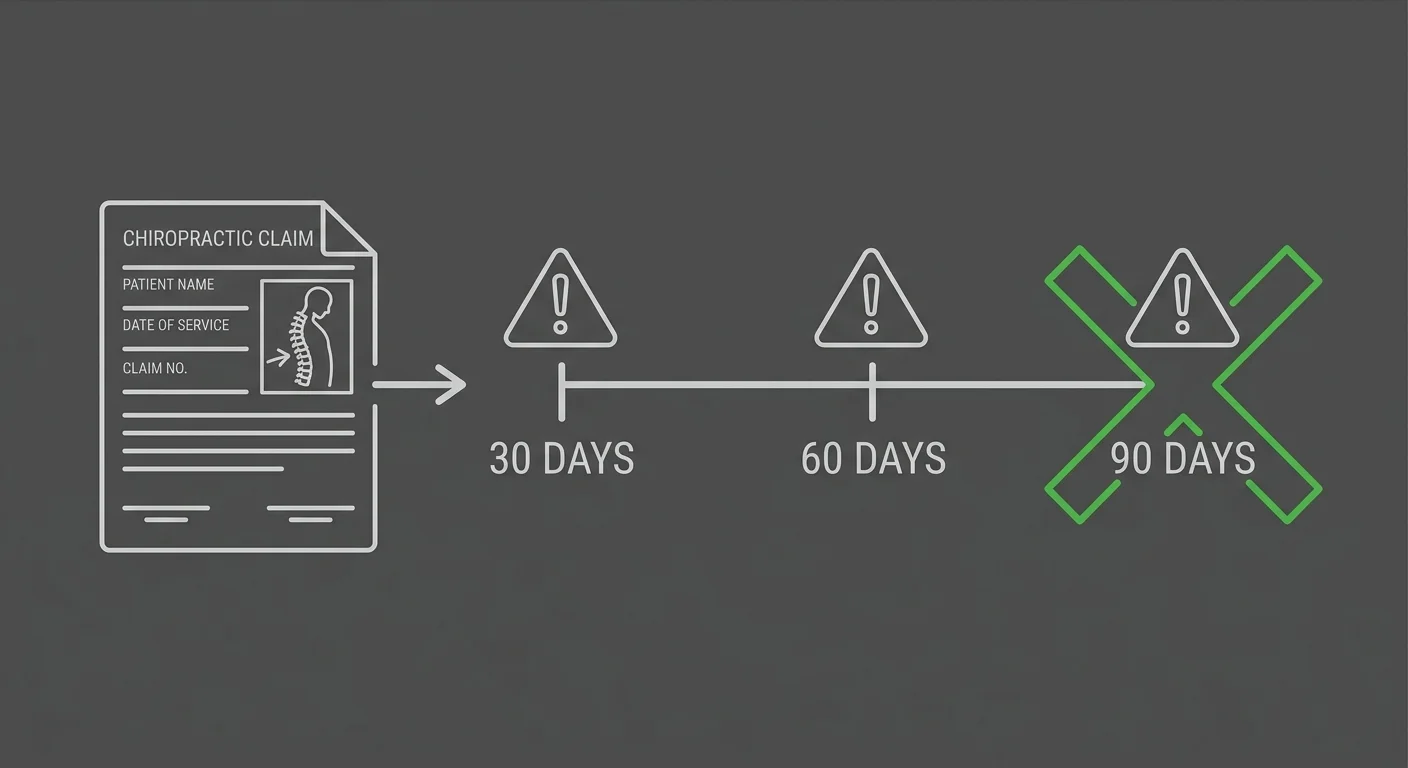
Denied chiropractic claims don't age because nobody noticed. They age because the system designed to catch them didn't — and by the time a human looked, the recovery window was already closing.
Chiropractic carries a heavier documentation load than most specialties. The OIG consistently flags documentation deficiencies and modifier placement errors as the primary drivers of chiropractic audit failures. That's not an isolated billing quirk. It's evidence that chiropractic-specific requirements make errors easy to commit — and exponentially harder to reverse once those claims start aging.
Get the root cause wrong, and resubmission just repeats the original mistake. Any recovery process that skips the audit is recycling failure, not fixing it.
The Documentation Gaps That Start the Clock
Most aging AR starts with a documentation gap that existed before the claim ever went out. Research shows that up to 10% or more of specialty medical claims are rejected initially because of coding discrepancies. In chiropractic, that number compounds fast — because the specialty demands clinical specificity that general billing workflows aren't built to enforce.
Medicare claims require the AT modifier to establish that care is active and medically necessary — not maintenance. Miss it, the claim fails. Include it without clinical notes that actually support the medical necessity argument, and the claim still fails — just later in the review cycle. Both errors produce the same denial code. They require completely different fixes.
So the documentation gap isn't always a missing field. More often it's a mismatch between what the provider documented and what the claim submitted — and that gap widens every week the claim sits unworked. Practices that conduct a revenue leakage assessment of their current AR routinely find the same documentation patterns driving denials across dozens of claims, not just the handful they originally flagged. A forensic look at hidden revenue in aging AR almost always surfaces those patterns before a second round of denials hits.
Why Automated Resubmission Makes Aging AR Worse
Automated resubmission feels like action. It isn't.
When a billing platform flags a denied claim and resubmits it without a human reviewing the underlying documentation error, the result is almost always an immediate rejection — not a review. Payers recognize automated resubmissions on aged claims. And when a timely-filing violation already exists, the automated resubmission doesn't reset the clock. It puts a second timestamp on a claim that was already broken.
The published chiropractic billing guidance on AT modifier requirements is explicit: documentation must affirmatively support the medical necessity of active care — not simply accompany the claim. An automated system can attach a modifier. It cannot read a clinical note and determine whether that modifier holds up under scrutiny.
That's the problem with automation-forward billing on aged claims. Claims that survived past 90 days are, almost by definition, the ones that needed human judgment at the point of denial. Running them through the same automated pipeline again doesn't fix anything. It confirms the original failure — and it sets up the next one.
| Denial Root Cause | Why It Ages Past 90 Days | Recovery Complexity |
|---|---|---|
| Missing or misapplied AT modifier | Denial code reads as a technical error — automated platforms resubmit without reviewing whether the underlying clinical notes support medical necessity. Each resubmission without correction consumes days inside the filing window. | High — requires a human to read the clinical record, assess whether the documentation supports active care, and rebuild the modifier argument before resubmission. |
| Clinical documentation does not match the submitted diagnosis code | The mismatch isn't flagged internally until the payer rejects the claim. By the time a human reviews it, the denial has already aged through one or more follow-up cycles. | High — correction requires reconciling provider notes against the submitted code, identifying where the disconnect occurred, and resubmitting with amended documentation. |
| Maintenance vs. active care ambiguity | Payers deny the claim without specifying which visit dates are at issue. Practices treat it as a single denial and resubmit in bulk — without separating active-care visits from maintenance visits that were never covered. | High — each date of service must be individually evaluated against the clinical record to determine whether a defensible medical necessity argument exists. |
| Timely-filing window not tracked per payer | Different payers enforce different filing deadlines. Without payer-specific tracking, claims that could still be recovered are abandoned alongside those that cannot — and no one audits the difference. | Moderate — the recovery path depends entirely on whether the filing window remains open. Claims outside the window require a separate exception appeal with documented proof of timely original submission. |
| No follow-up protocol after initial denial | The claim enters an unworked queue. Staff assume the billing platform is managing it. The platform logs the denial and waits for an instruction that never comes. Weeks become months. | Moderate to high — the longer the claim sits without active follow-up, the more the payer's internal record of the denial solidifies. Reversing it requires both a corrected claim and documented escalation history. |
| Denial pattern not identified across the AR | Individual denials are worked in isolation. The same documentation error driving fifty claims is treated as fifty separate problems — each one addressed reactively instead of corrected at the source. | High — pattern-level recovery requires a full AR audit before any individual claim is touched. Without it, corrected claims are resubmitted while the root error continues producing new denials. |
The Forensic AR Audit: How to Identify What Is Still Recoverable
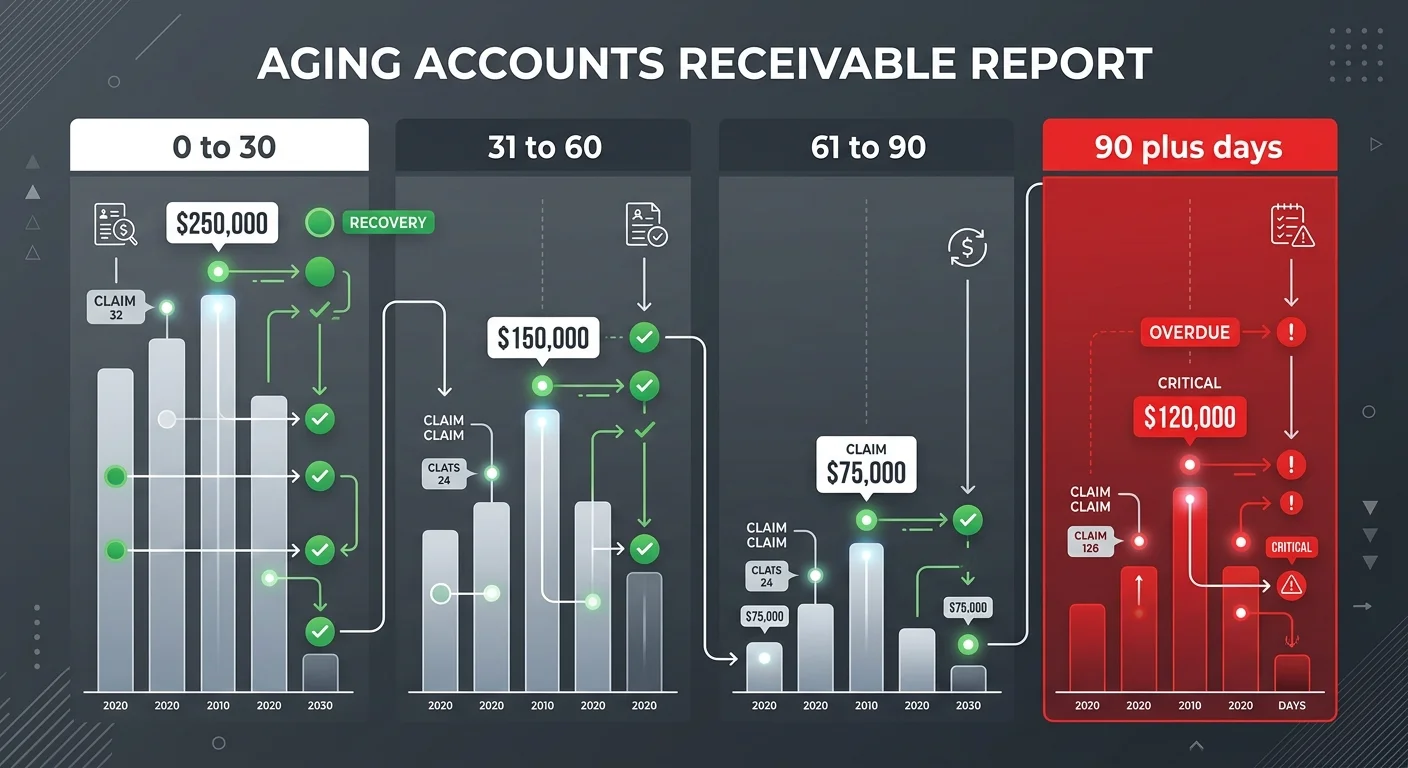
Automation had its shot. It flagged the claims. It resubmitted them. It failed.
So now a human sits down with the aging report and asks a different question — not what the denial code says, but what actually broke, and whether anyone can still fix it. That's a forensic AR audit.
Here's the first hard truth: not every claim that aged past 90 days is recoverable. Some have crossed timely-filing thresholds with no appeal pathway remaining. Others carry documentation gaps too fundamental to argue past a payer.
A forensic audit draws that line before anyone spends time building an appeal. Working an unrecoverable claim isn't billing strategy. It's wasted effort that costs the practice twice — once in lost revenue, once in lost labor.
Practices that want to understand the full scope of their aging AR start with a denied claims revenue assessment that maps every claim before a single appeal gets written.
That sequencing isn't optional. It's the foundation of everything that follows.
Phase 1 — Forensic Triage: Sorting the AR by Recoverability
Forensic Triage is not about working claims. It is about deciding which claims are worth working.
Every claim in the aging AR gets sorted against three criteria: whether the payer's timely-filing window is still open, whether the denial is technically reversible given the documentation on file, and whether the revenue justifies the labor required to pursue it.
Those are judgment calls. They require someone who understands chiropractic-specific payer behavior — not a billing platform that flags every overdue account the same way.
The CDC's diagnostic coding guidelines require exact alignment between clinical documentation and the alphanumeric sequences in official classification directories. In Forensic Triage, that alignment gets checked at the individual claim level — not in aggregate.
A claim with a documentation-to-code mismatch and an open timely-filing window is a recovery candidate. The same mismatch on a claim outside that window isn't. The triage step draws that line. Everything after it depends on drawing it correctly.
Phase 2 — Root Cause Classification: What Actually Caused Each Denial
Once recoverable claims are isolated, Root Cause Classification begins.
And here, the denial code stops being the answer. It becomes the starting point.
Federal oversight agencies — including the OIG — consistently flag documentation deficiencies and modifier placement errors as the primary drivers of chiropractic billing failures. But two claims can carry the exact same denial code for entirely different reasons.
One claim has a missing AT modifier. Another has the AT modifier present — but the clinical notes don't support it. The denial code looks identical. The correction is completely different.
That distinction doesn't show up in the code. It shows up when someone reads the clinical record behind the denial.
Root Cause Classification also surfaces something Forensic Triage can't: pattern data.
When the same documentation error is driving denials across multiple claims, that's not a coincidence. That's a workflow gap — and it's been quietly aging revenue for months. Identifying it here is what makes Structural Gap Remediation possible later. The five phases are sequential because they're cumulative. Each one builds the evidence the next one requires.
Who This Recovery Process Is Not For
This recovery process isn't for every practice. And saying so clearly isn't a disclaimer — it's the point.
Root Cause Classification requires access to the clinical record. Human-Led Appeal Construction requires provider availability when the file has gaps that need clarification.
A practice that won't engage at that level isn't a candidate for this process. If you're looking for a fully hands-off arrangement with zero engagement, this isn't the right fit — and pretending otherwise wastes everyone's time.
The same applies to practices looking for a one-time intervention with no interest in fixing the workflow errors that created the aging AR in the first place. Recovering the backlog without closing those gaps means the same claims will age again in six months.
That's why the full-service insurance billing relationship exists. Recovery and prevention aren't separate problems. They're two phases of the same one — and treating them as separate is how practices end up doing this twice.
| AR Age Bucket | Typical Recoverability | Primary Recovery Action Required | Human Judgment Required? |
|---|---|---|---|
| 0–30 Days | High — most payers' timely-filing windows are fully open | Standard denial review and corrected claim resubmission with documentation verification | Yes — modifier accuracy and clinical note alignment must be confirmed before resubmission |
| 31–60 Days | Moderate to High — window is open but documentation gaps are already hardening | Root cause classification to identify whether the denial is a coding error, modifier issue, or clinical documentation mismatch | Yes — distinguishing between correctable errors and unfixable gaps requires clinical billing expertise |
| 61–90 Days | Moderate — recovery is still viable but requires immediate triage to confirm the filing window has not closed with specific payers | Forensic Triage to confirm payer-specific timely-filing status, then Root Cause Classification before any appeal is constructed | Yes — payer-by-payer filing rules vary; a general resubmission without triage risks burning the remaining window |
| 91–120 Days | Low to Moderate — recovery depends on whether a valid appeal basis exists and the payer's exception policies | Human-Led Appeal Construction with a defensible medical necessity argument and documented exception grounds | Yes — appeals at this stage require a clinical narrative that automation cannot generate |
| 121–180 Days | Low — most standard timely-filing windows have closed; recovery depends on payer-specific exception pathways or documented extenuating circumstances | Detailed review of payer contracts and exception eligibility before committing appeal labor to claims that may not have a viable pathway | Yes — determining whether an exception argument is worth constructing requires specialty-level payer knowledge |
| 180+ Days | Very Low — the majority of claims at this stage are past recovery; triage focuses on identifying rare exceptions rather than bulk appeals | Final audit to separate any remaining exception candidates from unrecoverable claims; transition focus to Structural Gap Remediation to prevent recurrence | Yes — this stage is about protecting future revenue, not chasing past denials that cannot be reversed |
Building the Human-Led Appeal: Clinical Documentation, AT Modifier Compliance, and Payer Follow-Through
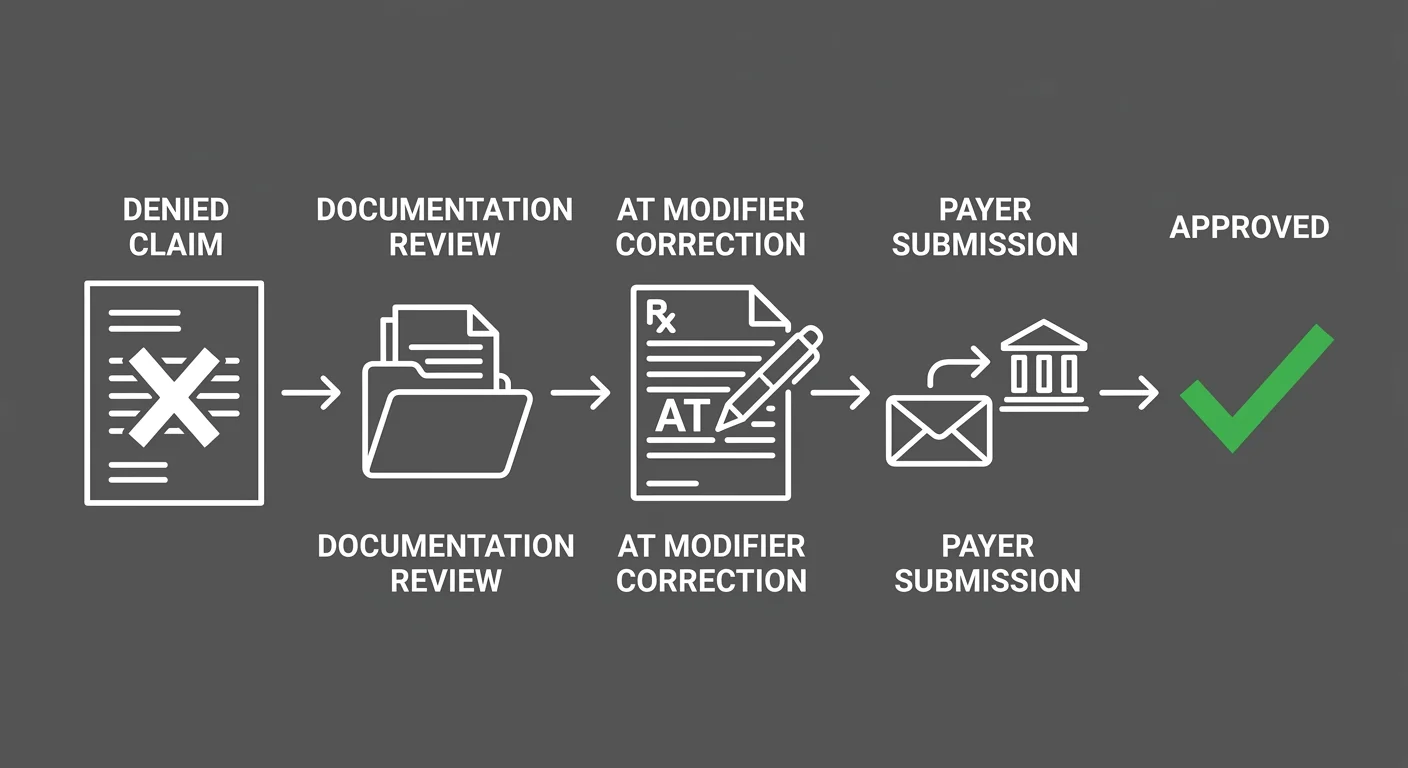
Triage tells you which claims are worth pursuing. Root Cause Classification tells you why they failed. Now comes the part that actually separates recoverable revenue from written-off losses — building an argument that makes the payer reverse a decision they've already committed to.
Here's the thing: an appeal is only as strong as the clinical documentation behind it. A claim that aged past 90 days didn't survive that long because the paperwork was clean. It survived because no one had assembled the specific clinical argument the payer needs to reverse their original decision.
That assembly is human work. And the bar is higher on an aged claim than on a clean first submission — because the payer already said no. Once.
Phase 3 — Human-Led Appeal Construction: What the Claim Must Contain
Phase 3 — Human-Led Appeal Construction starts with one thing in writing: the specific, documented reason the denial was issued. Not a guess. Not a category. The exact reason — pulled from the EOB or payer correspondence — cross-referenced against the clinical record. If that gap isn't identified before the appeal letter is drafted, the appeal is noise. There is no shortcut past that step.
For Medicare claims, the AT modifier sits at the center of most reversible denials. CMS guidance on chiropractic services is unambiguous: the modifier must appear on the claim to confirm the manipulation was medically necessary and active — not maintenance care. But placing the modifier correctly isn't the appeal. The appeal is proving, through the clinical notes, that the modifier was accurate at the time of service. That means pulling the provider's documentation and reading it against the payer's medical necessity criteria line by line. A machine can resubmit the claim with the modifier attached. It cannot fix the documentation gap that caused the denial in the first place.
The appeal letter does three things — and it has to do all three correctly, or it doesn't move the payer. It identifies the specific denial reason. It cites the clinical documentation that contradicts that reason. And it references the coverage criteria the payer is required to weigh. Each of those elements has to be located, verified, and sequenced by a human who understands what that payer needs to see. None of it runs on autopilot. None of it should.
Before handing over a single clinical file, ask one question: is your billing partner operating as a HIPAA business associate? Any billing platform that accesses patient records during appeal construction carries that classification — and the U.S. Code technical safeguards governing data handling apply regardless of whether the appeal goes out by fax or through an integrated portal. The FTC has made clear that third-party entities handling health data are accountable for technical safeguards, not just the providers who hired them. Get that answer before the file transfer happens. And the practices that also apply audit findings to prevent recurring gaps are the ones that stop rebuilding the same AR backlog six months from now.
Phase 4 — Payer Follow-Through: What Happens After the Appeal Is Filed
Filing the appeal doesn't end the work. It starts Phase 4. Most practices treat submission as the finish line. That's the exact moment the real pressure begins.
Payers don't process aged claim appeals on any schedule you can plan around. Some request additional documentation after the initial submission. Others issue a secondary denial without explanation. A few simply hold the claim in review and go quiet. Each scenario demands a different response — and none of those responses happen automatically. EHR platform compatibility between your system and your billing partner determines how fast you can answer when a payer comes back mid-review. A lag there isn't a minor inconvenience. It turns a recoverable appeal into a secondary denial.
Phase 4 — Payer Follow-Through runs until one of two things happens: the claim is paid or the appeal pathway is formally exhausted. That means tracking every open appeal, logging every payer response, and hitting documentation deadlines inside the payer's required window. National transaction standards require structured administrative code formats to govern these exchanges — but the format is the floor, not the work. The real judgment call is knowing when to push, when to escalate, and when a claim has genuinely reached the end of its options. Closing a claim correctly rather than letting it sit in indefinite limbo is not a software decision. That's a billing specialist's call.
| Appeal Component | What It Must Demonstrate | Common Error on Resubmission | Source Standard |
|---|---|---|---|
| AT Modifier Accuracy | That the chiropractic manipulation was active and medically necessary at the time of service — not maintenance care | Modifier is present on the resubmission but unsupported by the clinical notes in the file — payer denies again on the same grounds | CMS chiropractic billing guidelines governing Medicare AT modifier placement and medical necessity documentation |
| Clinical Note Alignment | That the provider's documented findings directly support the diagnosis codes and treatment rendered on the claim date | Clinical notes are resubmitted without revision — original documentation gaps that triggered the denial remain unaddressed | ICD-10-CM diagnostic classification standards requiring exact alignment between clinical documentation and assigned code sequences |
| Medical Necessity Argument | That the payer's own coverage criteria, applied to the clinical record, require reversal of the original denial decision | Appeal letter restates the claim details without citing the payer's specific coverage criteria — no argument is made against the denial reason | Payer-specific coverage policies and CMS medical necessity definitions for chiropractic services |
| Documentation Request Response | That any additional records requested by the payer mid-review are complete, compliant, and submitted within the required window | Documentation request goes untracked — practice misses the payer's response deadline and the appeal closes as abandoned | HIPAA administrative simplification standards governing structured electronic health data exchanges between providers and payers |
| Business Associate Data Handling | That all clinical records accessed and transmitted during appeal construction meet technical safeguard requirements for authorized third-party entities | Billing partner shares or transmits patient records without confirming compliant data handling obligations — exposes the practice to unauthorized disclosure risk | HHS and FTC technical safeguard requirements for business associates handling protected health information |
| Denial Reason Citation | That the specific denial code and its underlying rationale are identified and addressed point-by-point in the appeal — not referenced generically | Appeal letter acknowledges the denial without dismantling the payer's stated reason — leaves the original objection standing | Payer explanation of benefits documentation and standardized remittance advice code definitions |
Post-Recovery: Closing the Structural Gaps That Created the Backlog
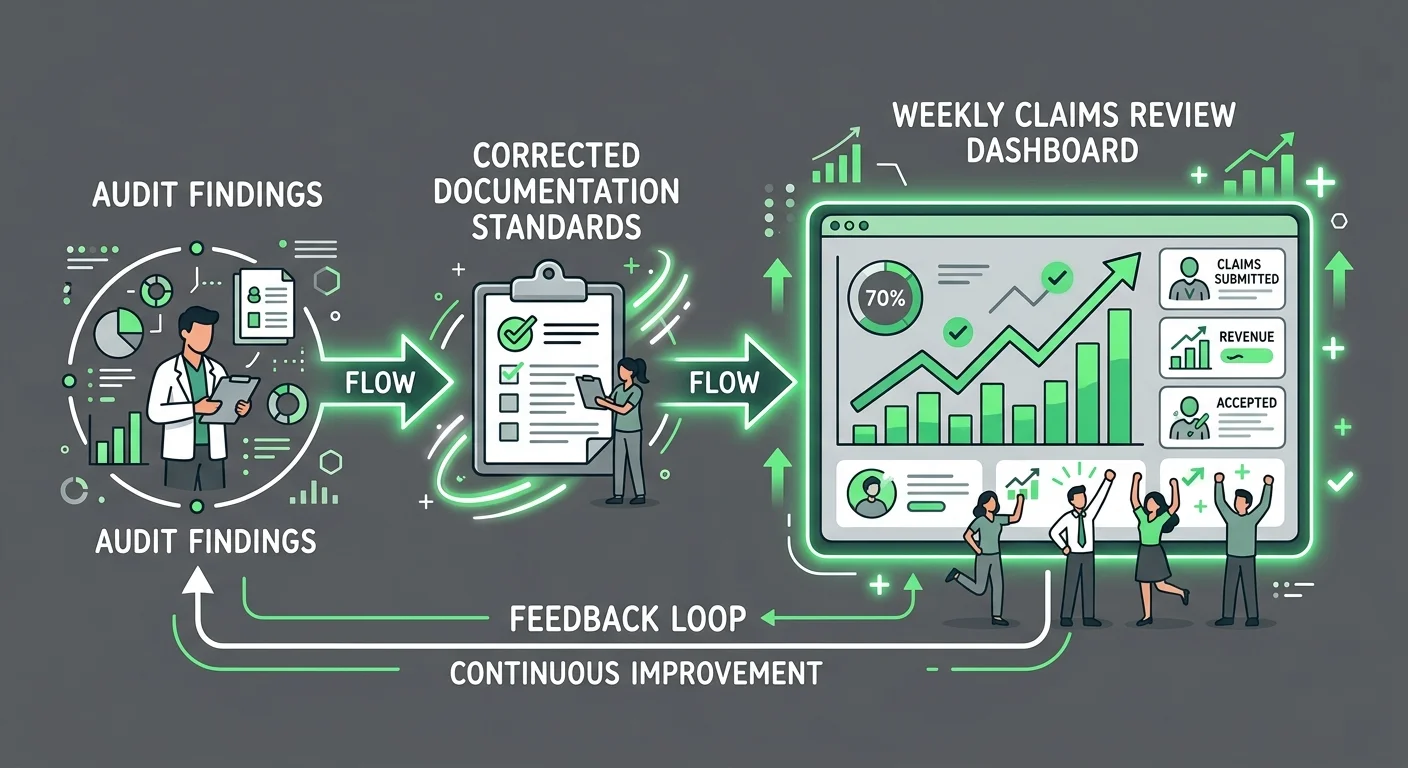
Recovery is not the finish line. It is the midpoint.
The back half of this work is understanding why the AR aged — and shutting down the documentation and workflow gaps that let it happen.
The OIG has identified documentation deficiencies and modifier placement errors as the primary drivers of chiropractic billing failures — consistently, across practices of every size. These aren't one-time mistakes.
They're baked into how a practice documents, codes, and submits. Fix the denied claims without fixing the pattern, and the same claims age again in six months. Same problem, new batch.
That's the line between Phase 4 and Phase 5.
The AR gets cleared. Then the system that built it gets fixed.
Phase 5 — Structural Gap Remediation: What Changes After the AR Is Cleared
Phase 5 starts with the pattern record Root Cause Classification built during the recovery process. Every documentation error that drove a denial, every modifier omission, every ICD-10 mismatch — it's all logged. That's not just a denial list. It's a map of where the workflow broke.
Phase 5 takes that map and traces each error back to the exact point in the clinical and billing process where it originated. Not the claim level. The system level.
The practices that get the most out of Phase 5 are the ones willing to look at what the data actually shows. The documentation errors costing clinics recoverable claims don't show up as random one-offs — they run in patterns.
The AT modifier applied inconsistently across providers. Clinical notes that clear the documentation bar on some visits but not others. ICD-10 sequences that drift from official classification requirements when documentation gets rushed.
Phase 5 finds where each pattern starts — and names exactly what has to change at that point in the workflow.
Here's where HIPAA administrative simplification rules stop being a compliance box and start being a structural design standard. The rules govern how clinical data flows through the billing system. When that flow is fragmented — when documentation and submission operate as two separate silos — the gaps produce denials even when the treatment is fully justified.
The claim can be correct. The handoff between documentation and submission can still break it.
Phase 5 closes those gaps at the system level. Not the claim level.
How a Performance-Aligned Billing Partnership Prevents the Next Backlog
A performance-aligned billing partnership changes the incentive underneath everything that follows Phase 5.
When a billing partner gets paid on collections — not on submissions — preventing the next AR backlog isn't a service feature. It's a business requirement. Their revenue depends on yours.
That alignment is what makes the weekly communication standard worth anything. Knowing which claims are pending, which triggered documentation requests, and which are closing in on payer deadlines — every week — is how a practice catches a developing problem before it becomes a 90-day backlog.
The proactive communication dashboard exists because visibility isn't optional in a functioning billing relationship. Silence is how the last backlog grew.
Bushido Billing is built on the premise that a billing partner who communicates proactively is the only kind worth keeping.
Practices that want to know what a DC-founded billing partner actually looks like will find that the distinction matters most when claims aren't clean. Specialty-level clinical knowledge, performance-aligned payment, and weekly reporting as a structural feature — those aren't differentiators on easy claims.
They're what makes recovery possible on the hard ones.
The whole point of Phase 5 is to make Phases 1 through 4 unnecessary for the same claim types the next time around. That's what recovery is actually for.
| Structural Gap | How It Generated the Backlog | Remediation Action | Who Must Own It |
|---|---|---|---|
| AT modifier applied inconsistently across providers | Claims failed Medicare medical necessity review because modifier placement varied by provider rather than by clinical standard, creating a pattern of denials that aged without detection | Establish a practice-wide documentation protocol that ties AT modifier use to specific clinical criteria — not provider habit — and audit a sample of claims monthly against that standard | Billing partner in coordination with the treating provider; cannot be automated or delegated to front-office staff |
| Clinical notes that meet documentation standards inconsistently across visit types | Payers denied claims where notes failed to establish medical necessity for that specific visit, even when the treatment itself was appropriate — aging the claim before anyone noticed the gap | Map documentation requirements by visit type and payer, then create note templates that prompt providers to address each criterion before the claim is submitted | Treating provider owns documentation quality; billing partner owns the requirement map and the feedback loop when notes fall short |
| ICD-10 sequences that drift from official classification requirements under time pressure | Coding errors introduced when documentation is rushed produced mismatches between the diagnosis and the treatment billed, triggering denials that required clinical review to reverse | Implement a pre-submission coding review step for claim types historically associated with drift — particularly when visit volume spikes and documentation speed increases | Billing partner owns the pre-submission review; practice administrator owns the workflow conditions that create time pressure |
| Fragmented data exchange between clinical documentation and billing submission | Gaps between what the provider documented and what reached the billing system created denials that were technically preventable — the treatment was justified but the data transfer broke the claim | Audit the handoff points between clinical documentation and billing submission to identify where data is lost, delayed, or reformatted incorrectly before it reaches the payer | Billing partner identifies the gap points; practice leadership decides which integration changes are operationally feasible |
| No active tracking of open claims approaching payer filing deadlines | Claims that were workable aged past the timely filing window without anyone monitoring their status, converting a recoverable denial into an unrecoverable write-off | Establish a real-time AR monitoring process with weekly reporting on claims approaching deadline thresholds — so payer follow-through happens before the window closes, not after | Billing partner owns the monitoring and reporting cadence; practice leadership owns the decision to act on escalation signals |
| Silent billing relationship with no structured communication standard | Without weekly visibility into claim status, developing AR problems went undetected until they became backlogs — by which point recovery required a full forensic process rather than a simple correction | Require weekly status reporting from the billing partner as a structural feature of the engagement — not a request made after problems surface | Practice leadership owns the standard they hold a billing partner to; billing partner owns the execution of that standard every week without being asked |
Frequently Asked Questions
The five phases tell you how the process works. They don't answer the questions practitioners actually ask when they're staring at an aging AR report and trying to figure out what's still salvageable.
So here are the questions that actually matter — what to do when payers go silent, why software fails the cases you care most about, and how the audit process starts.
Why do insurance claims older than 90 days get denied for timely filing?
Timely filing limits are contractual deadlines — each payer sets them, and once that window closes, late submission becomes its own denial reason. It has nothing to do with whether the service was clinically appropriate. The payer doesn't care. The deadline passed.
But that's not automatically the end of the claim. Most payers have a secondary window for appeals supported by proof of timely submission. That window is shorter. And it requires documentation — a remittance advice trail, a clearinghouse acknowledgment, a prior submission confirmation — that shows the claim was filed on time and either rejected or never properly adjudicated.
Here's what most practices miss: a timely filing denial is a documentation retrieval problem, not a resubmission problem. The appeal has to prove the timeline. That's exactly why automated resubmissions fail these cases. The payer already knows the claim is late. What they need is evidence of what happened before it got there.
What role does the AT modifier play in chiropractic denials older than 90 days?
The AT modifier tells Medicare that a chiropractic service is active and medically necessary — not maintenance care, which Medicare doesn't cover. When it's missing or misapplied, the claim reads as maintenance therapy by default. Medicare denies it.
For aged claims, the problem compounds. By the time a 90-day denial surfaces in AR review, the clinical notes that would justify the modifier may not have been documented with the specificity Medicare requires. Recovering that claim means going back to the original visit records and making the argument — in writing, with the clinical detail the payer demands — that the treatment was active and medically necessary on the date of service.
The OIG has flagged modifier placement as one of the primary drivers of chiropractic billing failures. It's not a paperwork technicality. It's the clinical argument the entire claim rests on. And you can't reconstruct it from a clearinghouse report or an EHR submission log. Someone has to understand both what the modifier means and what the documentation has to say to defend it.
Can software platforms automatically recover complex chiropractic denials?
No. And it's worth being direct about why.
Software handles clean claims efficiently. That's what it's built for. A claim with complete documentation, correct coding, and no modifier issues moves through automated workflows without friction. But the claims sitting in a 90-day AR backlog aren't clean. They're there because something in the documentation, the coding, or the modifier application created a problem the system couldn't resolve on its own.
Automated resubmission takes a denied claim and sends it back through the same pathway that rejected it. When the root cause is a documentation deficiency or a modifier error, the resubmission carries the same deficiency. The payer issues the same denial. The claim ages another cycle.
The OIG's findings on chiropractic billing failures point to documentation deficiencies as the primary driver — not submission volume. Recovering complex denials requires someone to read the clinical record, identify what actually drove the denial, and build a response that addresses that specific cause. A machine can resubmit the claim. It cannot fix what made the claim fail.
How does a performance-aligned billing partner audit aging accounts receivable?
It starts with Forensic Triage — pulling the full AR aging report and segmenting every denied claim by age, payer, and denial reason code. Not a summary review. A claim-by-claim analysis that separates what's still recoverable from what has aged past the point of return.
From there, Root Cause Classification maps each denial to its actual driver — documentation deficiency, modifier error, coding mismatch, or a payer-specific policy issue. That classification determines the appeal strategy for each claim. A billing partner aligned on collections has a direct financial reason to get this right. A misclassified root cause produces an appeal that doesn't recover the revenue — and that costs the billing partner too.
The full audit runs through all five phases, from initial triage through Structural Gap Remediation. Third-party billing partners operating in this capacity are classified as business associates under applicable technical safeguard standards, which governs how clinical records are accessed and handled. Confirm that standard is met before sharing any patient file with an external billing partner.
What is the next step if an insurance payer ignores a 90-day appeal?
Payer non-response is a specific scenario. It requires a documented follow-up sequence — not a single resubmission and a wait.
The next step is a formal escalation through the payer's appeals or provider relations channel, with a written record of every prior submission and every communication attempt. Most payers have a defined escalation pathway for appeals that exceed the standard review window. That pathway exists for exactly this situation.
If escalation produces no resolution, the next option depends on the payer type. For Medicare, there's a multi-level appeals process that extends through Administrative Law Judge review and beyond. For commercial payers, state insurance department complaints are a documented lever — particularly when a payer's non-response is consistent across multiple claims.
None of this happens automatically. Phase 4 — Payer Follow-Through exists because filing the appeal is not the finish line. Someone has to track the response window, log every communication, and execute the next step when the payer goes quiet. A billing partner who treats submission as the end of the job will let recoverable claims expire while a payer runs out the clock. That's not a billing failure. It's a structural accountability failure.
The Only Path Through Aging AR Is a Human One
Every phase in this process required a human. Forensic Triage, Root Cause Classification, Human-Led Appeal Construction, Payer Follow-Through, Structural Gap Remediation — every single one demanded that someone read a clinical record, interpret a payer's logic, and decide what to do next.
No software made those calls.
The automation had already run its course before the claim hit 90 days. What came after was human work — or it was nothing.
But recovery is only half the question. The other half is whether the billing structure underneath your practice is built to prevent the next backlog — or just to keep filing and moving on.
Here's the distinction that actually matters: a billing partner paid on collections has a structural reason to care whether revenue comes back. A billing partner paid on submissions does not. That is what determines whether Structural Gap Remediation ever gets completed — or whether the same AR problem surfaces six months later wearing a different claim number and the same underlying cause.
Aging AR is not a software problem. It is a clinical documentation problem, a payer communication problem, and a workflow accountability problem — stacked on top of each other.
The practices that recover and stay recovered treated it as a forensic audit, not a batch resubmission. Every phase required someone who could read what the denial actually meant and build an argument the payer had to address.
A machine can resubmit the claim. It cannot fix what made the claim fail. And if your billing partner's incentives run on submissions rather than collections, that judgment call never gets made. The revenue disappears again — same cause, different claim number.
Aging AR doesn't wait. And every week it sits unworked, the recovery window shrinks — not because the money is gone, but because no one is doing the work to get it back. A resubmission tool can fire off the claim again. It cannot read the file, identify the AT modifier error, and build the appeal that actually reverses the denial. That's the work. And that's where a conversation with Bushido Billing starts.

© 2026 Bushido Billing. All Rights Reserved | Web Design by iTech Valet