

How to Onboard a Billing Partner After a Successful Revenue Recovery Audit?
Transitioning to a billing partner after a revenue recovery audit is not a handoff. It is a structured alignment process that determines whether the patterns the audit uncovered actually change — or repeat under a new name.
The audit identified where claims failed, which denials went unworked, and how much revenue left the practice unrecovered. Research confirms that approximately 30% of medical claims are denied, and up to 60% of those denials are never resubmitted by standard billing operations. The audit surfaces that gap. The billing partner's job is to close it — and keep it closed.
Successful transition begins with administrative and legal compliance. Federal regulations require executed Business Associate Agreements to secure HIPAA compliance for all patient billing data before any claims records transfer to a new partner.
From there, the process shifts to a structured review of existing accounts receivable, payer enrollment status, and documentation workflows — particularly around active treatment coding. Prior HHS OIG audits found that up to 82% of reviewed chiropractic Medicare claims did not meet documentation requirements. That figure is the baseline the new partner must systematically correct.
The billing partner then takes responsibility for active claims management against measurable performance standards. A clean claim rate above 95% is the recognized benchmark for a functioning revenue cycle partnership. Reaching it requires a partner who understands chiropractic-specific coding — including the AT modifier that must accompany codes 98940, 98941, and 98942 to confirm active treatment on Medicare claims.
A generalist applying generic billing logic to a specialty workflow does not reach that benchmark. A chiropractic-specific partner with performance-aligned incentives, dedicated personnel, and a structured weekly communication cadence does.
Last Updated: August 17, 2026
- • Why the Audit Outcome Shapes Every Onboarding Decision
- • What the Transfer of AR and Documentation Actually Requires
- • The First 90 Days: What Good Onboarding Actually Looks Like
- • Who This Transition Is and Is Not Designed For
-
• Frequently Asked Questions
- • What is the first step in onboarding a chiropractic billing partner after an audit?
- • How do you transfer outstanding accounts receivable to a new billing company?
- • How does a performance-based billing partner align with a clinic's cash flow goals?
- • Why should a chiropractic practice avoid generalist medical billers after a revenue recovery audit?
- • What key metrics should a practice track during the first 90 days of billing partner onboarding?
- • The Bottom Line on Billing Partner Onboarding After an Audit
Why the Audit Outcome Shapes Every Onboarding Decision
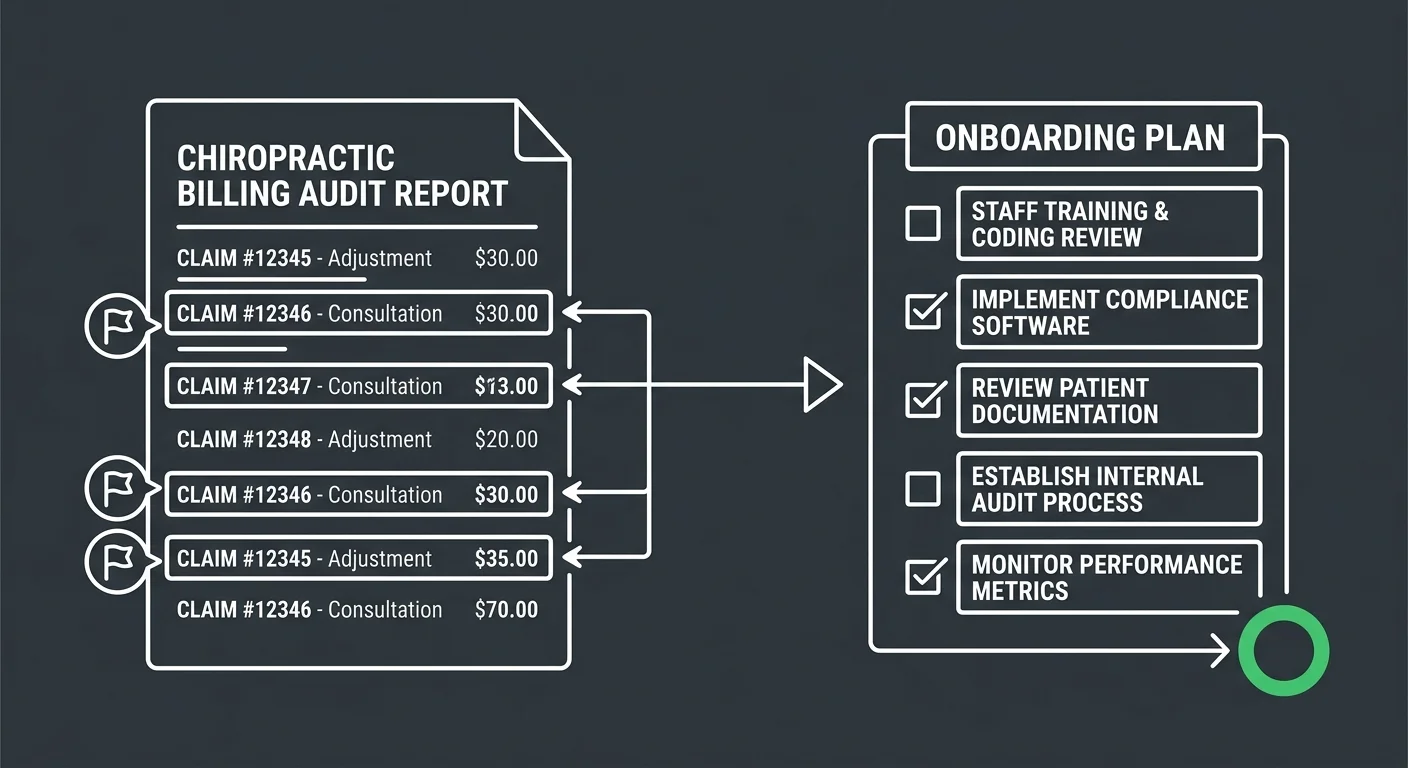
The audit outcome isn't background reading. It's the operational blueprint for what happens next — what to fix first, which denials to chase, where documentation broke down, and what the incoming billing partner must do differently from day one.
Here's the thing: most practices treat the audit as the finish line. The problems got named. The numbers got surfaced. The review is done. But the hidden revenue in your current AR only stays recovered if the next partner is built to protect it. The audit is the map. The billing partner is the guide. Without the right guide, the map just shows you the same road back to the same problems.
That means the audit findings have to function as a technical handoff document — not a summary to file away. Every coding gap, every unworked denial, every pattern the audit surfaced becomes a specific requirement the incoming billing partner must be equipped to handle before they touch a single claim.
Why Volume-First Billing Fails After an Audit
Volume-first billing works when claims are clean. The moment complexity enters the picture, it breaks down. And chiropractic billing is almost never simple.
The problem is structural. A volume-first model is built for throughput — get claims out fast, process the easy ones, move on. High-friction denials cost more time than the model ever budgets for. So they get deprioritized. Then they age. Then they're gone. CMS coding requirements make this worse for chiropractic specifically: codes 98940, 98941, and 98942 require the AT modifier to confirm active treatment on Medicare claims — a distinction that generic billing logic routinely misses.
The audit already showed exactly what that cost your practice. NIH data on claim denial patterns confirms it isn't an outlier problem — a substantial share of denied claims across outpatient specialties are never resubmitted at all, because the volume model doesn't budget for the work. The audit put a number on the damage. The next billing partner has to be built differently to stop it from compounding.
So the audit doesn't just tell you what went wrong. It tells you what the next billing partner must be. It exposes specific failure modes — which payers denied most aggressively, which documentation gaps drove those denials, whether the prior operation was even structured to catch the patterns. To implement audit findings correctly, the incoming partner needs chiropractic-specific expertise, the willingness to work complex denials by hand, and a performance structure that rewards recovery over submission volume. Hand those findings to a generalist and you get a generalist result.
| Audit Finding Category | What It Reveals About Your Billing Operation | How It Shapes Billing Partner Selection |
|---|---|---|
| High denial rate from a specific payer | The prior billing operation lacked payer-specific knowledge or failed to track denial patterns by source — problems accumulated invisibly | The incoming partner must demonstrate familiarity with that payer's documentation requirements and have a defined process for tracking and appealing denials by payer |
| Active treatment documentation gaps | Claims were submitted without the modifier specificity required to confirm medical necessity — a systemic coding failure, not a one-time error | The incoming partner must have chiropractic-specific coding expertise and a review process that catches modifier errors before submission, not after denial |
| Large volume of aging, unworked AR | The prior billing operation prioritized submission volume over denial follow-up — high-friction claims were left to age past recovery | The incoming partner must be structured to work complex denials manually and recover aging AR, not simply process new claims and move on |
| Communication breakdown between billing and practice | The practice had no visibility into claim status, denial trends, or AR aging — problems compounded in silence until they became cash flow crises | The incoming partner must provide a structured communication cadence — not as an add-on, but as a non-negotiable operational feature from day one |
| Maintenance vs. active care coding confusion | Claims for non-covered maintenance care were submitted without proper distinction from active treatment — creating both denial exposure and compliance risk | The incoming partner must understand the clinical distinction between maintenance and active care and apply it consistently across all claim types |
| Misaligned billing incentives | The prior billing model was compensated on claim volume, not revenue recovery — creating a structural conflict between what the biller optimized for and what the practice actually needed | The incoming partner's fee structure must align with actual collections, not submission throughput — performance-based compensation removes the incentive to deprioritize difficult claims |
What the Transfer of AR and Documentation Actually Requires
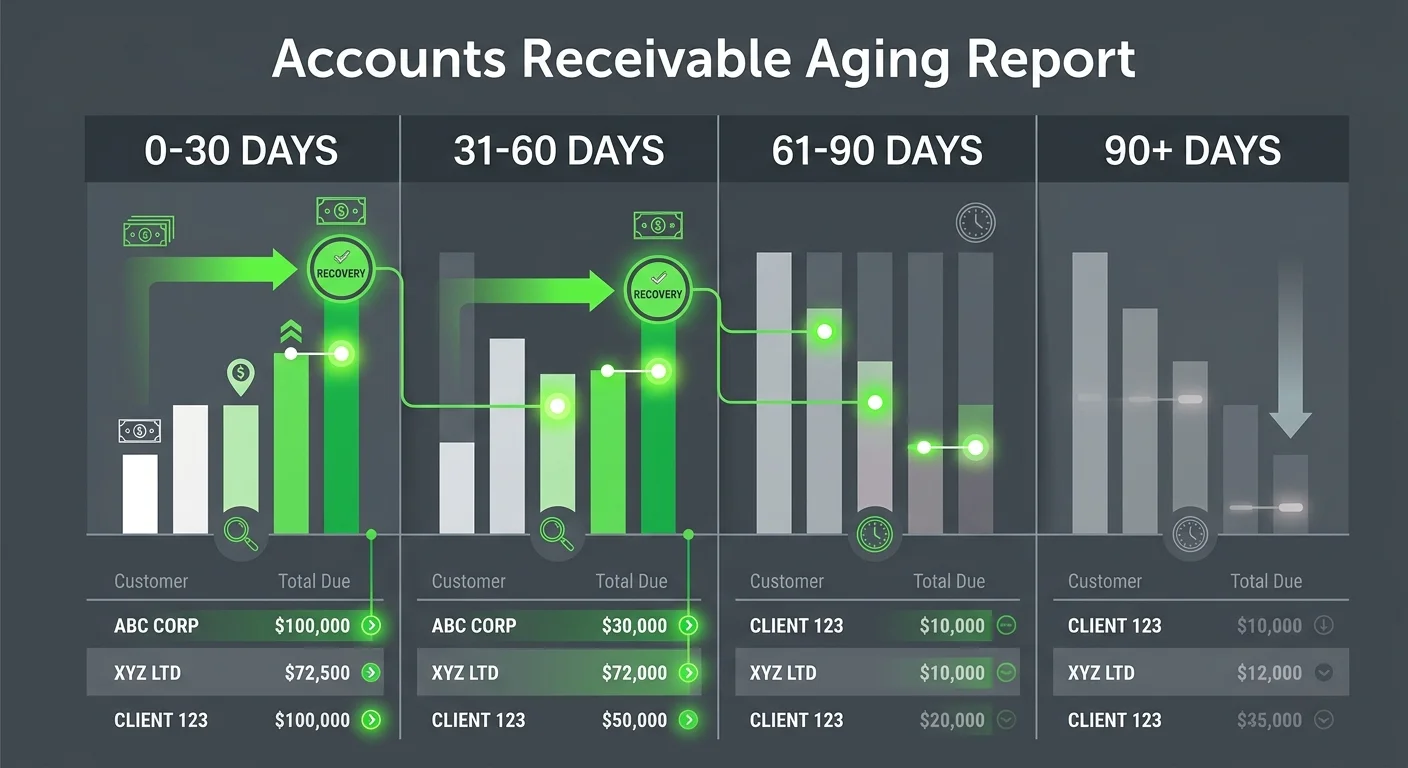
AR transfer is where most transitions quietly fail.
Not because anyone meant for it to go wrong. Because no one treated it like a structured process.
The audit identified which claims were denied, which aged without follow-up, and which payers drove the most damage. That information has to travel with the work.
A billing partner who inherits an AR bucket without the history behind it is flying blind. And blind billing produces the same denials the audit just finished documenting.
NIH research on claim denial outcomes puts a number on the problem: roughly 30% of medical claims are denied, and up to 60% of those denials are never worked or resubmitted. The audit just showed you exactly how much of that pattern lived inside your practice.
The AR transfer is the moment to make sure it stops there. But that only happens if the incoming partner receives the full picture — not just the balance, but the history behind every aged claim in that bucket.
AR Transfer Requirements by Claim Age and Status
Not all outstanding claims are the same problem.
A 25-day-old clean claim with a simple payer error is nothing like a 110-day-old denial sitting on a documentation gap with a missed appeals window. Treating them the same way is how practices lose revenue that was still recoverable.
Before work begins, the incoming billing partner needs a segmented view of the AR — organized by claim age, payer, denial reason, and whether the claim is still recoverable.
Claims under 90 days with workable denial codes are active priorities. Claims past 120 days need an immediate call on whether the appeals window is still open. Anything older requires a professional AR cleanup to determine what's worth pursuing and what has aged past the point of return.
That segmentation isn't overhead. It's the difference between a billing partner who starts with a strategy and one who starts with a pile.
The audit already did the diagnostic work. The AR transfer has to preserve those findings — status by status, payer by payer — so the incoming partner inherits a plan, not just a spreadsheet.
Documentation and EHR Access Alignment
AR transfer gets most of the attention.
But documentation access is where the work actually breaks down.
A billing partner can't work a complex denial — or build a credible appeal — without access to the clinical notes, SOAP documentation, and prior authorization records that support the claim. That access has to be established inside the EHR before any billing activity starts.
And it has to be legal. Business Associate Agreements are required under HIPAA to govern patient billing data handled by any third party. That paperwork isn't a formality — it's the legal foundation for everything that follows. Get it done before anything else moves.
Documentation alignment isn't administrative busywork. It determines whether the billing partner can actually do the job.
A partner without full EHR access — or one stuck with read-only permissions that block clinical record pulls for appeals — is structurally prevented from recovering the high-friction claims the audit flagged as the biggest revenue losses. The audit is the map. Without documentation access, the partner can't move.
| AR Aging Bucket | Typical Recoverability Status | Recommended Handling at Transfer |
|---|---|---|
| 0–30 days | High — most claims still within primary payer timely filing window | Prioritize immediately; verify clean claim submission, correct any payer errors, and resubmit without delay |
| 31–60 days | Moderate to high — denial reasons are typically still workable with documentation support | Triage by payer and denial code; documentation-backed appeals are viable; assign to active work queue on day one |
| 61–90 days | Moderate — window is narrowing; success depends on denial reason and payer policy | Assess each claim individually; coding gaps and modifier errors can still be corrected; complex denials require immediate escalation |
| 91–120 days | Low to moderate — appeals pathways may still be open but require urgent action | Conduct recoverability assessment before committing resources; claims with clear documentation and valid denial reasons take priority over speculative appeals |
| 121–180 days | Low — most payer appeals windows have closed; secondary options are limited | Flag for formal AR cleanup assessment; do not assume writeoff without confirming timely filing limits and secondary payer options by plan |
| 180+ days | Minimal — most standard appeals and timely filing remedies are exhausted | Evaluate on a claim-by-claim basis only; assess whether secondary billing, patient responsibility conversion, or dispute resolution pathways remain open before closing |
The First 90 Days: What Good Onboarding Actually Looks Like
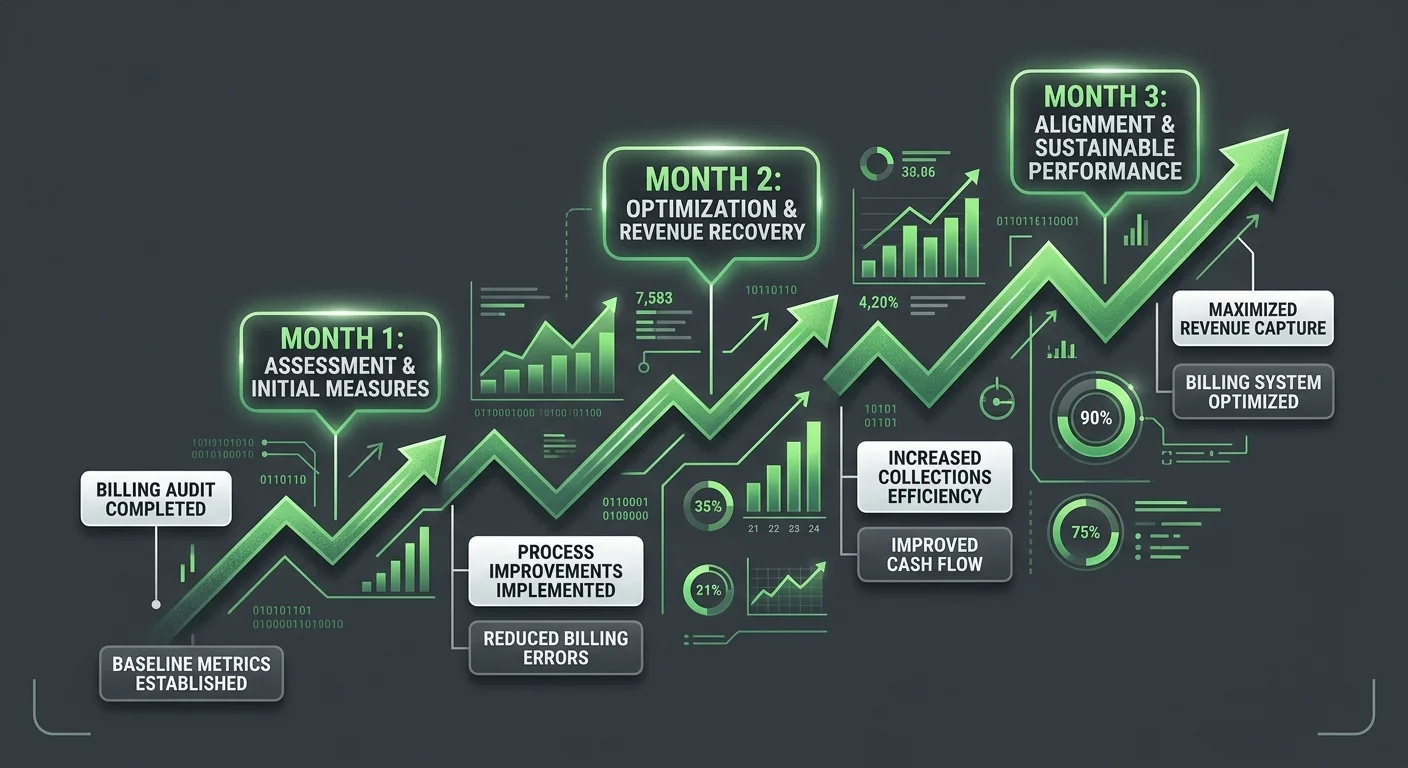
The AR is categorized. The transfer is done. Now comes the part that actually tells you whether any of it mattered.
The first 90 days are where the audit's findings either get resolved — or quietly restart under a different name.
This period is not a grace period. It's the most diagnostic stretch of the entire partnership.
Clean claim rates show up early. Denial patterns show up early. Communication cadence shows up early. NIH administrative burden findings confirm that inefficient revenue cycle operations drive substantial unnecessary waste — which means every week of unclear performance is a week of compounding cost. The first 90 days should produce visible evidence that the pattern is breaking. Not a promise that it will.
So define the targets before the partner touches a single claim.
A clean claim rate above 95% is the recognized benchmark for a functioning revenue cycle partnership. Getting there requires chiropractic-specific expertise — and the actual willingness to work complex denials manually. Not just push clean claims through and wait for payment.
Metrics to Track in the First 90 Days
Volume-first operations look busy. That's the problem.
Tracking the right metrics from day one is the only way to tell the difference between a billing partner who is working and one who is submitting.
Track clean claim rate, denial rate by payer, average days in AR, and resubmission rate on worked denials.
A clean claim rate above 95% means claims are being built correctly before submission — not patched after rejection. Denial rate by payer tells you whether the patterns the audit surfaced are shrinking or holding steady. Days in AR tells you whether cash is actually moving. Resubmission rate tells you whether the complex denials are being actively worked — or left to age past the point of recovery.
Here's the thing: if the audit did its job, none of these metrics should be a surprise. The audit already flagged which ones were broken.
The first 90 days aren't about giving the new partner time to settle in. They're about confirming — with data — that the same failures aren't quietly restarting.
Communication Standards That Signal a Working Partnership
Metrics confirm performance. But communication is what catches problems before the metrics can.
Silence from a billing partner isn't professionalism. It's a structure that hides problems until they've already become cash flow emergencies.
A functioning partnership produces weekly updates on claim status, denial trends, and AR movement. Not monthly summaries. Not quarterly reviews. Weekly. That cadence is what keeps the practice informed — not surprised.
But this runs both directions. The billing partner needs timely documentation access, fast turnaround on clinical record requests, and provider availability when a denial requires clarification.
A practice that disengages after onboarding gets disengaged results. The audit identified the revenue that's recoverable. Whether it actually gets recovered depends on whether both sides stay in the work.
| Performance Metric | What It Measures | Target Benchmark | Red Flag Threshold |
|---|---|---|---|
| Clean Claim Rate | Claims submitted correctly on first pass — no corrections needed after rejection | Above 95% | Below 90% by day 60 — signals systemic preparation failures |
| Administrative Cost per Claim | Efficiency of the billing operation relative to revenue recovered — bloated admin overhead signals volume-first processing | Declining as workflows stabilize post-transition | Stagnant or rising overhead with no corresponding increase in collections |
Who This Transition Is and Is Not Designed For

But none of it matters if the practice isn't ready to do the work.
The audit is the map. The billing partner is the guide. But the guide cannot do the job if the practice won't hand over the map — documentation on time, EHR access open, provider available when a denial needs clarification.
This is a working relationship. Not a handoff.
This process is built for a specific kind of practice. Others will waste it.
Fit determines outcome. And a misaligned fit doesn't just slow recovery — it repeats the failure the audit just finished documenting.
Practices Ready to Do This Right
Ready practices treat the audit findings as a mandate — not a report to file.
They know which payers caused the most damage. They know which documentation gaps drove denials. And they give the billing partner real access: to the EHR, to clinical records, to provider availability when an appeal needs clarification.
They don't need to be sold on the complexity. The audit already showed them, in dollar terms, what happened when they pretended it wasn't there.
These practices also know that revenue recovery doesn't start at AR transfer.
Some have already run a fee schedule review to confirm they're capturing full reimbursement at the per-visit level before a single backlog claim gets touched. That preparation matters. It means the incoming partner isn't simultaneously fixing submission errors and renegotiating what gets billed.
One problem at a time. Ready practices already operate that way.
And these practices understand the communication standard. Not because someone told them to expect it — but because silence from the last billing relationship is exactly what cost them.
Weekly updates aren't a luxury request. They're the baseline for a functioning partnership. The audit already proved, in dollar terms, what happens when that standard isn't met.
Practices This Process Will Not Work For
Some practices shouldn't run this process yet.
Not because the need isn't real. Because they aren't set up to support the work. And identifying that early prevents a second billing failure from landing right on top of the first.
If the first question in any billing conversation is about rate, the fit isn't there.
Full-service chiropractic billing doesn't compete on price. It competes on recovery. A practice whose primary evaluation criteria is the billing fee will select for the same volume-first model the audit just finished documenting as a failure.
That's not a coincidence. That's the mechanism.
And if the expectation is a billing partner that runs silently in the background — no documentation access, no provider availability, no engagement with the denial workflow — this process will not deliver.
The audit exposed specific, complex failure patterns. Up to 60% of denied claims are never resubmitted or worked by standard billing operations. A practice unwilling to support the manual, detail-level work required to reverse those numbers will produce a new billing relationship with the same results as the last one.
The audit is the map. A practice that won't engage with the guide ends up exactly where it started.
| Practice Characteristic | Fit Signal | Why It Matters for Billing Outcomes |
|---|---|---|
| Treats audit findings as a mandate, not a suggestion | Strong fit | The audit's diagnostic value is only preserved if the practice acts on what it found. Practices that internalize findings drive faster denial resolution and fewer repeat patterns. |
| Willing to provide full EHR access and clinical records for appeals | Strong fit | Complex denials require underlying clinical documentation to build a credible appeal. Without real access, the billing partner cannot work the highest-value claims the audit identified. |
| Expects and values weekly communication on claim status and AR movement | Strong fit | Proactive communication surfaces problems before they compound. Practices that hold the billing partner to a weekly update standard avoid the silence that drove the original revenue loss. |
| Understands this is a working partnership, not a silent service | Strong fit | Provider availability for denial clarifications and timely documentation turnaround are structural requirements. Practices that engage produce materially better recovery outcomes. |
| Leads every billing evaluation with rate as the primary question | Poor fit | Rate-first selection criteria consistently produce volume-first billing relationships — the same model the audit just documented as a failure. Recovery depends on process, not price. |
| Expects billing to run without documentation cooperation or provider involvement | Poor fit | High-friction denials — the ones responsible for the largest revenue losses — cannot be worked without clinical access and provider engagement. A practice that withholds both gets surface-level billing, not recovery. |
| Wants a one-time fix with no ongoing relationship after the audit | Poor fit | AR recovery is the starting point, not the finish line. The patterns the audit exposed require sustained attention. A transactional engagement leaves the root causes unaddressed and the cycle intact. |
| Bills primarily cash-pay with minimal insurance complexity | Poor fit | The value of a chiropractic-specific billing partner is concentrated in insurance denial management, modifier compliance, and payer-specific appeal workflows. Practices without significant insurance volume don't have the friction this model is built to resolve. |
Frequently Asked Questions
The audit surfaces the problem. The transition is where it either gets fixed — or quietly restarts under a different billing company's name.
Practice owners navigating this handoff tend to have the same questions. Here are straight answers.
These aren't hypothetical questions. They come from owners who already did the audit — and now have to make the transition work.
What is the first step in onboarding a chiropractic billing partner after an audit?
Documentation alignment — not claim transfer. That's what comes first.
Before anything moves, you need a signed Business Associate Agreement, confirmed EHR access credentials, and proof that your billing partner can actually pull clinical records when a denial needs support. Those aren't formalities. Without them, the recovery work the audit identified is dead on arrival.
The audit found where revenue was leaking. Documentation access is what lets the billing partner seal it.
How do you transfer outstanding accounts receivable to a new billing company?
AR transfer starts with categorization. Not movement.
Every open claim gets sorted by age, payer, denial reason, and realistic recovery probability before anything changes hands. Claims under 90 days with clear denial codes get prioritized for immediate rework. Claims past 180 days get evaluated one by one — some are still recoverable, most aren't.
What transfers is a categorized, prioritized body of work. Not an aging report dumped into a new inbox. A billing partner who accepts an AR transfer without running that categorization step isn't managing a recovery. They're inheriting a backlog — and you've seen where that leads.
How does a performance-based billing partner align with a clinic's cash flow goals?
A performance-based model ties the billing partner's revenue directly to what the practice collects. That's not a pricing model. That's a structural incentive to work the hard claims — the ones a volume-first biller deprioritizes because they cost more to fight than the submission fee covers.
Up to 60% of denied claims are never resubmitted by standard billing operations. That's the volume-first model in action. Claims get submitted, denials come back, and the denial sits unworked because there's no financial incentive to push it through.
When the billing partner gets paid when you get paid, abandoning hard claims stops making sense. That alignment is the point.
Why should a chiropractic practice avoid generalist medical billers after a revenue recovery audit?
Chiropractic billing has coding rules that generalists don't consistently apply — and the audit already documented what happens when they don't.
Providers must append the AT modifier to codes 98940, 98941, and 98942 to confirm active treatment. Miss it, apply it incorrectly, or fail to support it with the right documentation, and the denial that follows has specific appeal requirements. A generalist biller sees a denied claim. A chiropractic specialist sees whether it's a maintenance care denial or an active treatment documentation gap — and that distinction determines whether the claim gets recovered or permanently written off.
The audit identified which coding errors were driving your revenue loss. A generalist biller will reproduce them. The knowledge required to catch them isn't in their toolkit.
What key metrics should a practice track during the first 90 days of billing partner onboarding?
Watch four numbers in the first 90 days: clean claim rate, denial rate by payer, average days in AR, and resubmission rate on worked denials.
A clean claim rate above 95% is the recognized benchmark for a functioning billing partnership. Anything below that in the first quarter signals a submission problem that compounds fast. Denial rate by payer tells you whether the patterns the audit flagged are shrinking — or repeating. Days in AR tells you whether cash is actually moving.
But resubmission rate is the one that matters most. It's the only metric that tells you whether complex denials are being actively worked — or quietly abandoned the way your last billing relationship abandoned them. If that number is low, the name on the billing company changed. Nothing else did.
The Bottom Line on Billing Partner Onboarding After an Audit
The audit told you what broke.
Now there are two questions. Is your practice ready to run the process that actually fixes it? And is the billing partner you're considering built to execute that process — or just built to process claims?
Here's the distinction that matters: a volume-first billing partner will take the audit findings, nod, and drift straight back to the same denials, the same unworked AR, the same revenue aging out of reach. The AR categorization, the documentation alignment, the 90-day performance tracking, the weekly communication cadence — none of it holds if the billing partner running it is built for throughput instead of recovery.
A chiropractic specialist with aligned incentives, real EHR access, and a mandate to work complex denials manually produces different numbers. That same stack of audit findings handed to a generalist volume biller produces the same denials with cleaner paperwork. That distinction is the entire point.
So the decision isn't whether to act on the audit. It's whether to act on it correctly.
Bushido Billing exists for practices that are done watching the same revenue cycle failure repeat under a different billing company's name. The transition to the right billing partner — executed properly — should be the last time that conversation happens.
The audit is the map. The billing partner is the guide.
The audit told you exactly what broke. Now the question is whether the partner you're considering is actually built to fix it — or whether you're about to repeat the same expensive mistake with a different company. Bushido Billing works with chiropractic practices that are ready to act on what the audit found. Not practices that are still shopping. Not practices that want a one-time patch. If you're ready for a partner whose incentives are tied to your recovery, the next step is a conversation.

© 2026 Bushido Billing. All Rights Reserved | Web Design by iTech Valet