

What Are the Benefits of Weekly Communication with Your Billing Team?
Weekly communication with a billing team gives chiropractic practice owners real-time visibility into claim status, denial patterns, and accounts receivable movement. Without a structured update cadence, billing problems compound silently. Claims age past timely filing limits. Denials go unworked. Cash flow disruptions arrive without warning.
Silence has never been safety.
The benefits of a weekly update are both operational and financial. On the operational side, regular communication creates a feedback loop between the practice and the billing team. Clinical documentation errors surface before they trigger audit risk. Denial patterns get identified before they become systemic. On the financial side, consistent communication prevents the revenue leakage that accumulates when billing problems go undetected. Administrative friction and billing misalignment contribute to losses of up to 15 percent of total potential clinic collections.
A weekly update is not a status meeting. It is a performance accountability structure. It confirms which claims are in process, which denials are being worked, and which aging accounts receivable items require escalation. Structured communication cadences between billing teams and their clients reduce overall operational error rates by up to 25 percent. That reduction is not incidental — it is the direct result of problems being caught and corrected before they compound.
Federal compliance frameworks reinforce this standard. Third-party billing companies operate under regulatory requirements that mandate clear transparency and periodic, active reporting. A billing relationship that runs without regular reporting is not just an operational gap. It is a compliance exposure.
For chiropractic practice owners, administrative tasks and billing communications already consume a significant share of clinical working hours. A structured weekly update with a dedicated billing team does not add to that burden. It redirects it — replacing reactive crisis management with a predictable, proactive review cycle that keeps revenue moving and problems visible before they become permanent losses.
Last Updated: July 22, 2026
- • What Silence Actually Costs a Chiropractic Practice
- • Why Most Billing Relationships Default to Silence
- • What a Weekly Billing Update Should Actually Cover
- • How Weekly Communication Protects Revenue at the Claim Level
-
• Frequently Asked Questions
- • How does a weekly update prevent chiropractic claims from aging past timely filing limits?
- • What specific metrics should my billing team report during weekly updates?
- • Can we replace our weekly sync with a messaging portal or ticket system?
- • How do weekly billing syncs help identify clinical documentation errors before audit risks arise?
- • What should I do if my current billing company refuses to provide a weekly update?
- • How much time does a weekly billing update actually take for the practice owner?
- • The Battery Check Your Billing Relationship Needs
What Silence Actually Costs a Chiropractic Practice

Silence from a billing company feels like control.
It isn't.
Silence is the condition that lets revenue problems compound undetected — claims aging past timely filing limits, denials sitting unworked, AR moving further past recovery with every week that passes.
Think of a smoke detector with dead batteries.
No alarm doesn't mean the house is safe. It means the warning system stopped working — and nobody noticed until it was too late.
For chiropractic practices, this isn't a metaphor. Administrative friction and billing misalignment drive revenue losses of up to 15 percent of total potential clinic collections, according to McKinsey research on healthcare administrative waste.
When a billing relationship goes quiet, that leakage doesn't slow down. It accelerates.
The Revenue That Disappears Without a Sound
High-complexity claims don't die loudly.
A denial on a personal injury lien. A Medicare claim rejected for AT modifier documentation. A payer-specific coding error triggering systematic underpayment.
None of these announce themselves. They disappear into an aging AR report that no one is reading aloud to the practice owner.
NIH research shows that administrative and billing-related tasks already consume up to 16.6 percent of a clinical professional's working hours.
That's time the practice owner spends on administration instead of patients — and still not catching what the billing company isn't surfacing.
The burden is double. The visibility is zero.
The revenue that disappears in a silent billing relationship doesn't leave all at once.
It erodes. A denied claim here. An appeal that never got filed. A timely filing deadline crossed without anyone noticing. By the time the practice owner sees the cash flow gap, months of recoverable revenue are already gone.
Silence was never safety. It was just a delay.
Why the Volume-First Billing Model Is Built to Go Quiet
The volume-first billing model is built for throughput. Not recovery.
The incentive is to submit as many claims as possible, as fast as possible. Clean claims get paid. Complex ones get deprioritized — because working a multi-step appeal costs more time than the model budgets for.
And that structure goes quiet by design.
Communication costs time. Time is a cost the volume model doesn't absorb. So practices get automated statements and no follow-up — not because the billing company is performing, but because explaining problems is operationally inconvenient.
This is exactly why billing companies stop communicating after the contract is signed.
The contract guarantees the relationship. Communication would have to justify the performance. When those two things are decoupled, silence becomes the default.
And the practice is left assuming everything is fine.
A practice paired with a dedicated biller rather than a shared billing pool changes this dynamic at the foundation.
One person. Accountable for every claim, every week. Not a queue that processes what it can and buries the rest.
When one person owns the outcome, silence stops being an option.
| Silence Duration | Billing Impact | AR Risk Level | Revenue Recovery Likelihood |
|---|---|---|---|
| 1–2 weeks | Denials sit unworked; no appeal initiated | Low — claims still within timely filing window | High — most claims recoverable with prompt action |
| 3–4 weeks | Aging AR begins accumulating; payer follow-up missed | Moderate — timely filing window closing on some claims | Moderate — selective recovery possible with immediate escalation |
| 5–8 weeks | High-complexity claims deprioritized; documentation errors go uncorrected | Elevated — multiple claims approaching or past filing limits | Low — significant portion of AR no longer workable |
| 3+ months | Systematic underpayments go undetected; appeal deadlines forfeited | Critical — AR aging well past payer recovery thresholds | Minimal — most aged claims are unrecoverable without formal dispute |
| Ongoing / indefinite | Silent billing decay becomes the operational baseline; cash flow disruptions normalized | Severe — practice revenue permanently eroded | Near zero — revenue lost to compounding inaction, not a single event |
Why Most Billing Relationships Default to Silence
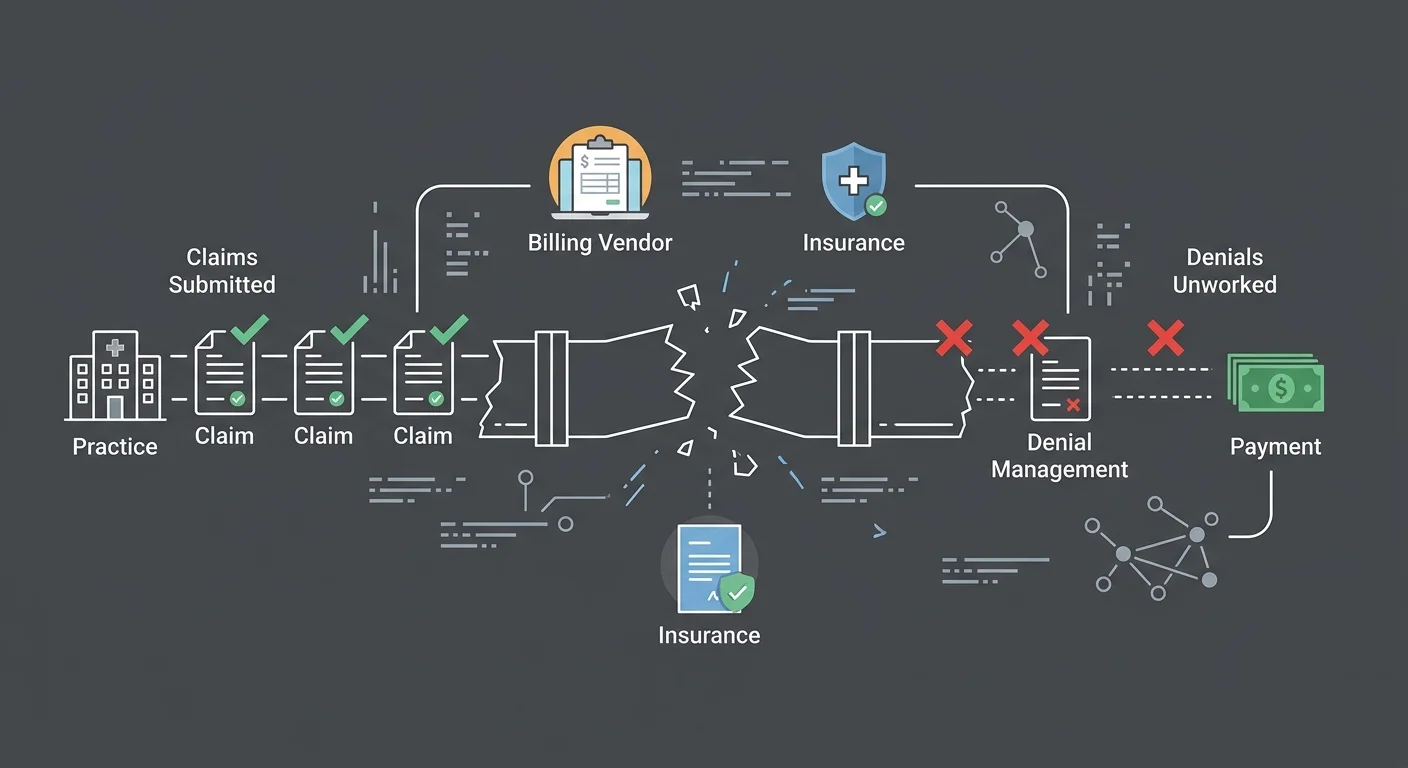
Silence from a billing company isn't professionalism. It's a design feature — one that hides problems until the practice owner finds them in a cash flow crisis.
The volume-first billing model is built for throughput, not recovery. Clean claims get processed fast. Complex denials, multi-step appeals, payer-specific coding errors — these cost more time than the model budgets for.
So they get set aside. And nobody calls to say so.
Claims age. Denials go unworked. Cash flow gaps widen. And the practice keeps assuming everything is fine — because no one has said otherwise.
The Structural Incentive to Stay Quiet
Here's the thing about silence: there's an economic incentive behind it. Communication costs time. Time is a cost the volume model doesn't absorb.
So billing companies minimize it — not because they're performing well, but because explaining problems requires accountability the model was never designed to deliver.
That's not a bug. That's the model doing exactly what it was designed to do. Volume-first billing is optimized for submission speed. Not revenue recovery. When those two things pull in opposite directions, silence is the logical result — not an accident.
An embedded billing partner runs on different logic entirely. When one person owns every claim for one practice, communication isn't optional overhead — it's how the relationship proves it's working. Silence stops being a default. Accountability requires something to replace it. That something is a weekly answer.
What Federal Compliance Standards Actually Require
Here's what most practice owners don't realize: silence from a billing company isn't just a performance problem. It's a compliance exposure. The FTC's healthcare billing compliance guidance makes clear that third-party billing companies are required to operate with active transparency — not reactive, when-asked-for reporting.
CMS Medicare performance standards set strict, time-sensitive boundaries for submitting clean claim corrections. Miss those windows and the revenue doesn't just get delayed — it gets forfeited. A billing company running silent isn't protecting your practice. It's leaving recoverable money at risk of becoming permanently unrecoverable.
Gartner's vendor management research identifies structured weekly meetings as a core best practice for maintaining alignment in collaborative service relationships. That standard exists because the alternative — infrequent, reactive check-ins — is exactly where errors compound and go uncorrected. For chiropractic practices, those uncorrected errors have a direct revenue cost. The published timelines for claim corrections leave no room for a billing relationship that surfaces problems late.
| Billing Model Type | Communication Cadence | Claim Complexity Handled | Transparency Level |
|---|---|---|---|
| Volume-First Billing Pool | Automated statements only — no structured cadence | Clean claims processed; complex denials deprioritized or abandoned | Low — problems surface only when the practice escalates |
| Generalist Billing Company | Periodic check-ins driven by practice inquiry, not a proactive schedule | Standard claims handled; specialty-specific rules inconsistently applied | Inconsistent — reporting depends on staff availability and client pressure |
| Silent Relationship (Any Model) | No regular cadence — reactive communication only after a crisis emerges | Claim complexity irrelevant — nothing is being actively surfaced or escalated | None — the practice has no visibility until cash flow disruption forces a conversation |
| Embedded Billing Partner with Weekly Update | Structured weekly update — fixed cadence, not triggered by problems | Full-complexity claims worked, including denials, appeals, and payer-specific issues | Full — claim status, denial patterns, and aging AR reviewed on a predictable schedule |
| Dedicated Biller with Accountability Structure | Weekly communication built into the engagement model — not an optional add-on | One biller owns every claim; complex cases escalated before they age past recovery | High — one accountable person surfaces problems before they become permanent losses |
What a Weekly Billing Update Should Actually Cover
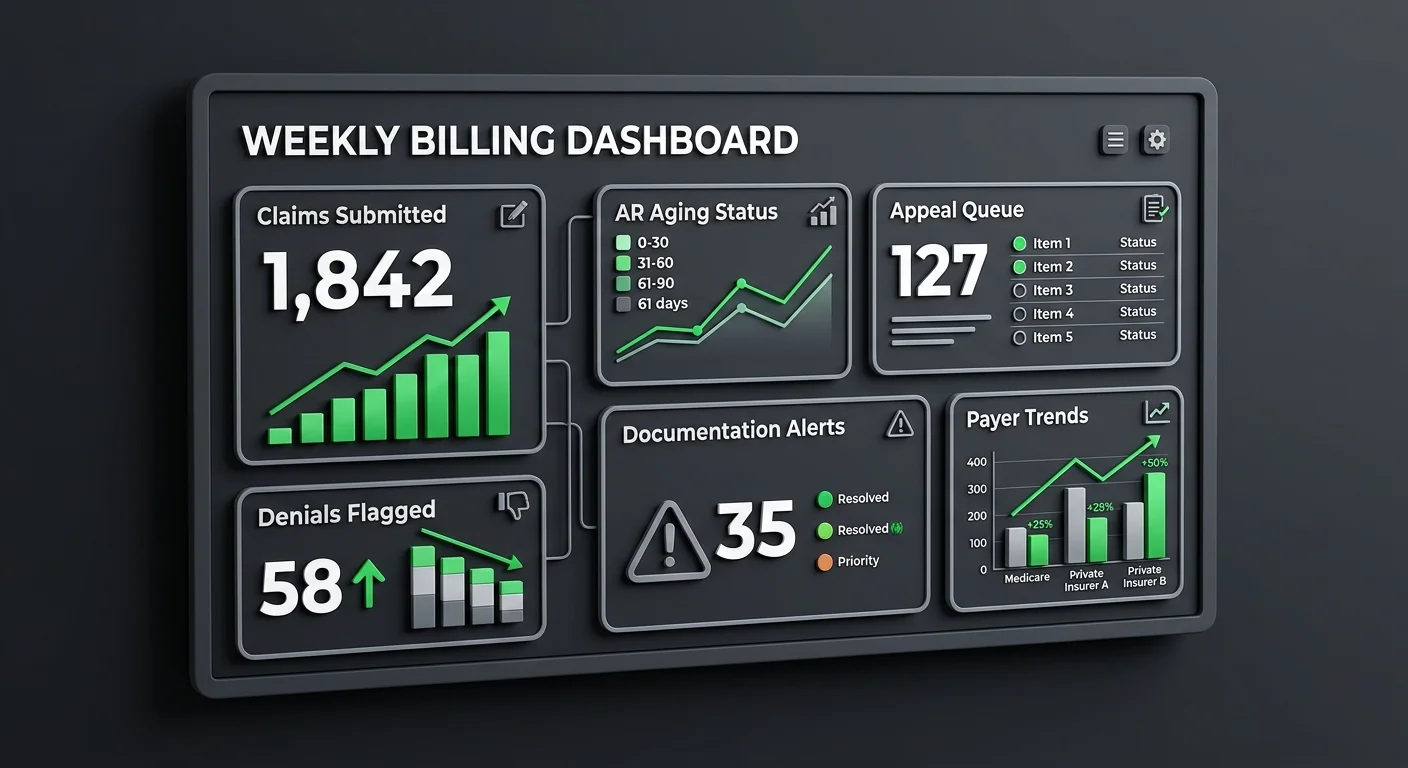
Knowing why the silence exists doesn't fix anything. The question that actually moves money is more specific: what should a weekly update cover, and how do you know if you're getting a real one?
Most practice owners have never seen a functional billing update. So they have no baseline for what's missing. That's not an accident. Billing companies stay unaccountable not through deception — but through the absence of a defined standard. When no one names what a weekly update should contain, the billing company gets to decide. And that decision is almost always silence.
A weekly update isn't a courtesy call. It's a structured performance review — specific metrics, explained by a human, with action items attached. When a practice knows what belongs in that review, they can hold their billing team accountable for delivering it. That's when the weekly update cadence stops being a favor and starts being the mechanism that catches revenue problems before they become permanent losses.
The Six Metrics Every Weekly Update Must Include
Structured weekly communication cadences reduce operational error rates by up to 25 percent. But that number doesn't happen because someone scheduled a meeting. It happens because specific metrics get reviewed, surfaced, and acted on every week — instead of discovered months later during a cash flow crisis.
Published analysis on error rate reduction in collaborative partnerships confirms that the cadence itself drives the outcome — not access to a portal. A billing dashboard no one is reading aloud to the practice owner is just a more expensive version of silence. The data has to be reviewed on a fixed cycle, by a human who is accountable for explaining what it shows and what happens next.
- Claims submitted that week — volume and clean-claim rate
- Denials received — reason codes, payer patterns, and appeal status
- Payments posted — matched against expected reimbursement by payer
- AR aging movement — which claims advanced, which stalled, which crossed 90 days
- Appeals in progress — open items, deadlines, and next action owner
- Documentation flags — clinical errors caught before submission
Documentation and Clinical Errors Caught Before They Become Denials
Documentation errors are the billing problem most practices never see coming. By the time a denial lands, the claim is already weeks old and the correction window is closing. A weekly review that includes documentation catches those errors at the source — before the claim goes out, before the denial gets issued, before the revenue is already at risk.
Practices that have lived through a billing company going quiet almost always discover the same thing afterward: documentation errors were compounding the entire time. Not flagged. Not corrected. Just silently driving a denial rate no one explained. Catching a clinical documentation issue in week one is a five-minute fix. Catching it after six months of systematic underpayment is a recovery project — and some of that revenue is already gone.
When a billing team reviews clinical records weekly and surfaces coding gaps in real time, the practice's error rate drops structurally — not because someone is chasing fires, but because the review catches them first. That's the smoke detector working correctly. The weekly check isn't scanning for emergencies. It's confirming, every week, that the system is working — so that when something does go wrong, it gets caught in days, not quarters.
| Update Component | What It Tracks | Why It Matters for Revenue Recovery |
|---|---|---|
| New Claims Status | Claims submitted during the period, payer receipt confirmation, and any immediate rejections flagged at submission | Catches front-end errors before they age — a rejected claim identified in week one is correctable; one discovered at 90 days is a recovery project |
| Denial Root Cause Review | Every denial received, categorized by reason code, payer, and claim type — with a clear explanation of what drove each one | Denial patterns are revenue patterns; a billing team that can name the cause can fix it systematically rather than claim by claim |
| Aging AR by Payer Bucket | Outstanding balances segmented by payer and age, with escalation flags on claims approaching timely filing boundaries | Timely filing limits are hard deadlines — revenue that crosses them becomes permanently unrecoverable, regardless of how valid the claim was |
| Appeals in Progress | Active appeals with their current status, the argument being made, and the expected resolution window | An appeal without a status update is an appeal that may have stalled — visibility here is what separates a working appeal from an abandoned one |
| Payments Posted vs. Expected | Payments received during the period compared against expected reimbursement rates by payer and procedure | Systematic underpayment rarely announces itself — this comparison is the mechanism that surfaces chronic shortfalls before they compound across quarters |
| Documentation and Coding Flags | Clinical documentation gaps or coding errors identified during the period that require practice-side correction before resubmission | Documentation errors caught at the source prevent denial cycles from repeating — the same error left unflagged drives the same denial indefinitely |
How Weekly Communication Protects Revenue at the Claim Level
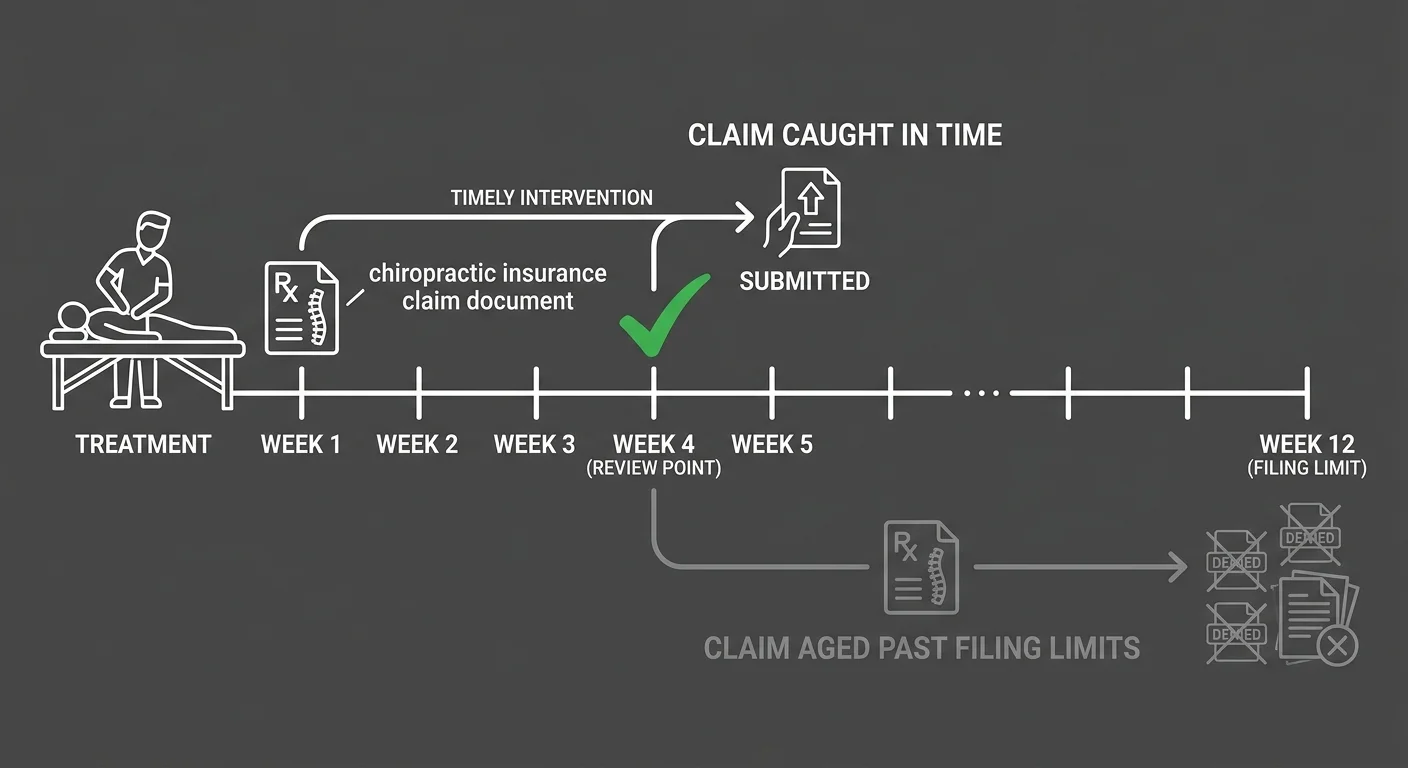
Knowing what a weekly update should contain is one thing. Knowing what it actually protects — at the claim level, in real time — is what moves money.
Every week without direct contact is a week where a claim can cross a line it cannot uncross. Structured weekly communication cadences reduce operational error rates by up to 25 percent — but the number understates the real protection.
A claim approaching a timely filing deadline is visible in a weekly review. In silence, it's invisible until it's gone.
When a billing team is in consistent contact with the practice, claim-level problems get caught before they expire.
That's not a courtesy. That's the model working.
Timely Filing Windows and Why Weekly Contact Is the Safeguard
Timely filing limits are among the most punishing realities in chiropractic billing — and the least discussed. Medicare performance metrics outline strict, time-sensitive boundaries for submitting clean claim corrections to avoid outright forfeiture.
Miss the window, and the revenue is gone. Not delayed. Not appealable. Gone.
A billing team that communicates weekly knows exactly where every claim sits in its filing window. A billing team operating in silence doesn't — and neither does the practice.
The difference isn't technical. One model demands accountability to the clock. The other doesn't — and claims pay for that absence.
The practices most at risk are the ones where a billing relationship is quietly failing and no one sees it until claims have aged past recovery. Recognizing what a deteriorating billing relationship looks like while there's still time to act is the whole game.
A weekly update makes that recognition possible. Silence makes it impossible.
Who Is Not the Right Fit for This Model
This model isn't the right fit for every practice. That's worth saying plainly.
If a practice wants billing that runs entirely behind the scenes — no engagement required, no documentation cooperation, no provider availability for appeal clarifications — a structured weekly update is going to feel like friction.
That friction isn't a flaw. It's the mechanism. Effective billing is a working partnership, and the practice side has to show up for it.
Third-party billing companies operate under federal compliance structures — the FTC is explicit on this — that require clear transparency and periodic, active reporting. That standard can't be met when one side of the relationship is checked out.
If the goal is zero involvement, this model won't deliver it. If the goal is recoverable revenue and a billing team that can prove what it's doing every week, the weekly update is where that proof lives.
| Claim Scenario | Weekly Contact Present | Weekly Contact Absent | Revenue Outcome |
|---|---|---|---|
| Denial received on a complex chiropractic claim | Flagged in weekly review with root cause identified and appeal initiated within days | Sits unworked in the billing queue — denial reason never surfaced to the practice | Claim either recovered through timely appeal or lost permanently to inaction |
| Timely filing deadline approaching on an unpaid claim | Billing team escalates the claim during weekly review and submits correction before the window closes | No escalation occurs — deadline passes undetected in a silent queue | Revenue is forfeited entirely — not delayed, not appealable, gone |
| Clinical documentation error flagged by payer | Error surfaced in weekly update, practice corrects within days, resubmission filed | Error sits unreported — practice continues submitting the same flawed documentation | Systematic underpayment compounds across multiple claims before anyone notices |
| Payer reimbursement posts below expected rate | Discrepancy identified in weekly payment reconciliation and investigated immediately | Underpayment goes undetected — no one is reconciling expected versus actual | Practice loses the difference across every affected claim with no recovery path |
| AR aging past 90 days on a high-value insurance claim | Aging flagged in weekly AR review with escalation action assigned | Claim ages silently past the point of workability with no intervention | Recoverable revenue becomes unrecoverable — practice assumes the claim is being worked |
| Coding issue identified by payer on an active care claim | Caught in weekly documentation review before additional claims go out with the same error | Practice continues submitting with the same coding gap through multiple billing cycles | Denial rate rises structurally — root cause never identified until a crisis forces review |
Frequently Asked Questions
But knowing the structure matters is different from knowing what to do when the structure isn't there. These questions are for the practice owner who's already in that situation.
Six questions. Direct answers. If any of them don't match how a current billing relationship is actually running — that gap is worth acting on.
How does a weekly update prevent chiropractic claims from aging past timely filing limits?
It makes the window visible. That's the whole answer.
Claims don't expire loudly. They expire quietly — while no one is required to look. Medicare performance standards set strict, time-sensitive boundaries for submitting clean claim corrections. Miss that window and the revenue is gone. Not delayed. Gone.
A billing team in weekly contact knows exactly where every claim sits in its filing window. A billing team running silent doesn't. And neither does the practice owner — until the write-off shows up.
What specific metrics should my billing team report during weekly updates?
Six things belong in every update — and a billing team that can't deliver all six is not running a real update.
* New claims submitted and their current status * Denials received with root cause identified — not just the denial code * Aging AR by payer bucket, with escalation flags on anything approaching a filing deadline * Appeals in progress with expected resolution timelines * Payments posted against expected reimbursement, with any discrepancy explained * Documentation or coding issues that require a correction from the practice before resubmission
Structured weekly communication cadences reduce operational error rates by up to 25 percent. That reduction comes directly from this kind of specific, accountable reporting. Not from dashboard access. Not from a portal that shows activity without explaining it.
Can we replace our weekly sync with a messaging portal or ticket system?
No. A messaging portal records activity. It doesn't create accountability.
A ticket system shows what was submitted. It doesn't show what was denied, why it was denied, or what's being done about it before the filing window closes. There's no mechanism in a portal that requires a human to explain what they found and what they're doing next.
Gartner's vendor management research identifies structured weekly meetings as a core best practice for maintaining alignment and quality assurance in collaborative service relationships. A portal doesn't replicate that. It replaces a structured review with the appearance of one — and that substitution shows up in aging AR, not in the inbox.
How do weekly billing syncs help identify clinical documentation errors before audit risks arise?
By the time a documentation error shows up as a denial, the claim is already weeks old and the correction window is narrowing. That's the problem weekly review solves — catching the error before the claim leaves the practice, before the denial arrives, before the revenue is already at risk.
The FTC's compliance framework for third-party billing companies requires clear transparency and periodic, active reporting. Weekly documentation review is how that standard gets met in practice — not just on paper.
A documentation issue caught in week one is a five-minute fix. The same issue caught after six months of systematic underpayment is a recovery project — and some of that revenue is already gone.
What should I do if my current billing company refuses to provide a weekly update?
Treat the refusal as information.
A billing company unwilling to provide a structured weekly update is a billing company that can't account for its work on a weekly basis. That's not a policy preference. It's a signal about what is — and is not — being done with the practice's claims.
Request a full aging AR report and a denial breakdown for the last 90 days. What comes back will clarify whether the relationship is worth continuing. A billing company that resists accountability on a weekly basis has already answered the question the practice owner is really asking.
How much time does a weekly billing update actually take for the practice owner?
For the practice owner, it is one focused conversation — typically under 30 minutes. The billing team does the preparation. The practice's role is to review what is surfaced, answer any documentation questions, and make decisions on flagged claims.
That is not overhead. That is the practice owner exercising the level of control over revenue that silence removes entirely.
The practices that treat this as too much involvement are usually the same ones who discover — months later, in an aging AR report — exactly what that silence was costing them.
The Battery Check Your Billing Relationship Needs
The smoke detector wasn't alarming — not because the house was fine, but because the batteries were dead.
That's the only question a weekly update actually answers: which one is true right now?
Silence has never been safety.
Practices that demand a weekly update from their billing team catch problems early. They protect timely filing windows. They surface documentation errors before those errors compound into permanent revenue loss.
Practices that accept silence accept the conditions where every one of those failures stays invisible — until it is irreversible.
Bushido Billing is built on one conviction: a billing partner who cannot account for their work every week is not a partner. They are a liability the practice is paying for.
Practices that treat weekly communication as optional will keep discovering that truth the hard way — in aging AR reports, in expired timely filing windows, in denial patterns nobody flagged until they became a cash flow crisis.
The weekly update is not overhead. It is the battery check.
And a billing relationship that cannot pass it every single week has already started failing — whether the practice knows it yet or not.
That weekly conversation either exists or it doesn't. And if it doesn't, the practice is already paying for it — in aged claims, unworked denials, and revenue that won't come back. Silence has never been safety. Book a Call to see exactly what's happening with the practice's claims — and what it's worth to find out.

© 2026 Bushido Billing. All Rights Reserved | Web Design by iTech Valet