

What Should You Expect from Your First 90 Days with a New Billing Partner?
The first 90 days with a new billing partner either build a functioning revenue cycle or quietly repeat the problem you just left.
That outcome is determined before day 30. Here is what drives it.
The first 90 days are not a passive transition. They are an active alignment phase – one that requires clinical-biller coordination, dedicated personnel, and consistent communication from the very first claim. The first 90 days don’t fail on day one. They fail in the silence between day one and day ninety.
Days 1-30 are about clinical-biller alignment. The billing partner maps existing workflows, identifies documentation gaps, and locks in the modifier standards your claims require. HCPCS codes 98940, 98941, and 98942 require the AT modifier to indicate active, corrective treatment rather than maintenance care. Practices that skip this step don’t discover the problem immediately. They discover it in denials and aging receivables.
Days 31-60 are about reporting and accountability. By this point, the billing partner should be delivering structured reporting on claim status, denial patterns, and revenue trends. Administrative and clerical errors account for more than half of first-pass clinical claim denials in specialized outpatient services. A billing partner who cannot name those patterns by day 60 is not managing a revenue cycle. They are processing claims and hoping.
Days 61-90 are where the partnership gets tested. Historical federal audits have identified up to 82% of reviewed chiropractic claims as technically unallowable due to insufficient documentation of active care. By day 90, a high-performing billing partner should have surfaced those risks, corrected documentation workflows, and begun systematic recovery on neglected accounts receivable.
Billing and insurance-related complexity consumes up to 14.5% of total clinical revenue for non-surgical physician specialties. The practices that recover that revenue share one structural trait: a billing partner who communicates proactively, assigns dedicated personnel, and builds accountability into the model from day one – not as an upgrade, but as the operating standard.
Why the First 90 Days Are a Diagnostic Window, Not a Setup Phase
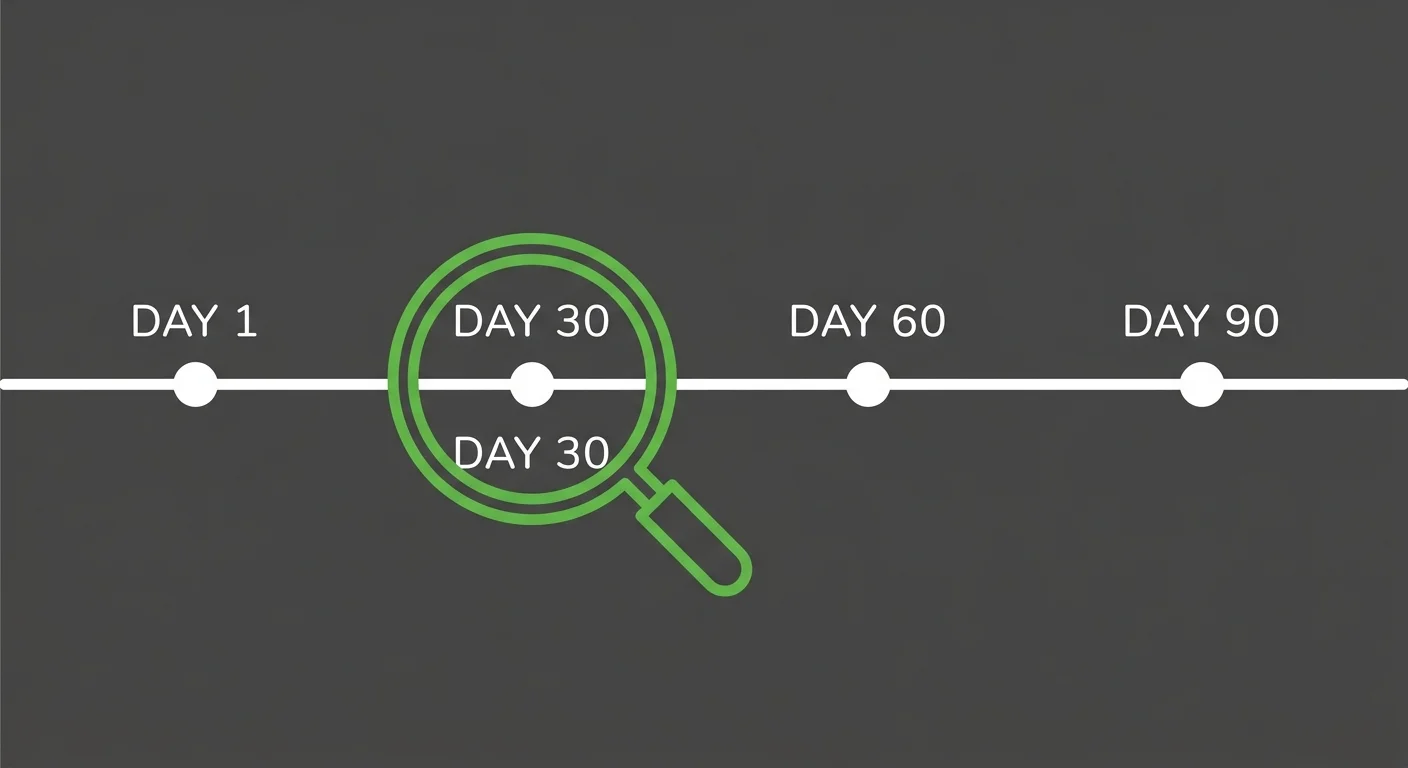
Most practices assume the first 90 days with a new billing partner are administrative setup. Software syncs. Credentials transfer. Things sort themselves out.
That assumption is where revenue goes to die.
The first 90 days are a diagnostic window. Every claim submitted, every denial returned, every silence from the billing side – all of it is data.
A billing partner that isn’t reading that data in real time and telling you what it means isn’t transitioning your practice. They’re processing volume. And processing volume is not the same thing as protecting revenue.
Here’s what’s actually at stake. Billing and insurance-related complexity consumes up to 14.5% of total clinical revenue for non-surgical physician specialties.
That revenue doesn’t disappear on day one. It erodes quietly – in the gap between what gets submitted and what actually comes back. The practices that protect it have a partner who treats day one as the start of active diagnosis, not passive integration.
Why Most Billing Transitions Miss the Problems That Matter
Volume-first billing relationships are structurally designed to miss the problems that matter.
Clean claims get processed. Complex ones – the claims with modifier nuance, documentation gaps, or credentialing mismatches – get deprioritized. Working them costs more than a throughput model budgets for.
So they sit. They age. They die in AR.
And in most cases, nobody tells the practice they’re gone.
Administrative and clerical errors – coding mistakes, modifier mismatches, credentialing gaps – account for more than half of first-pass claim denials in specialized outpatient services.
These aren’t mysterious failures. They’re preventable. A chiropractic billing specialist catches them on review. A generalist passes them through because the volume model doesn’t build in that review step. The claims die not because they were unfixable, but because nobody was watching for them.
That’s exactly why the distinction between a dedicated biller model vs general billing pools matters most during a transition. A dedicated specialist builds context across a single practice’s claims. A shared queue buries your denials inside an unrelated mix of specialties where nobody owns the pattern.
Silence from the billing side during the first 90 days isn’t a sign things are running smoothly. It’s a structure that hides problems until they compound into a cash flow crisis.
The Structural Features a Real Transition Requires
So what does a real transition actually require?
Not software access. Not a credentialing packet. A structural commitment – dedicated personnel, embedded communication, and active modifier review from the very first claim.
That means a dedicated biller assigned to your practice – not a shared queue that routes claims to whoever is available. It means weekly updates that surface denial patterns and AR movement in real time, not a monthly summary that arrives after the damage is already priced in.
And it means a billing partner whose full-service billing and revenue cycle management model is built around recovery outcomes, not submission speed.
Think of it like a clinical intake. The first appointment surfaces the presenting complaint.
But the first 90 days of consistent follow-up determine whether the underlying problem actually gets resolved – or whether it gets managed just well enough to stay invisible until it can’t be ignored anymore.
| Transition Element | Volume-First / Automated Approach | Embedded Specialist Approach | Revenue Impact |
|---|---|---|---|
| Biller Assignment | Claims routed to a shared queue – whoever is available works the file | Dedicated biller assigned to the practice from day one – full context, no handoffs | Dedicated context catches modifier and credentialing patterns that shared queues miss entirely |
| Communication Cadence | Monthly summary reports, or no structured reporting at all | Weekly updates surfacing denial patterns, AR movement, and coding flags in real time | Problems identified in week two instead of month four – recoverable rather than compounded |
| Days 1-30: Clinical-Biller Alignment | Software credentials transferred; practice assumed to be ready to bill | Active workflow mapping, documentation gap identification, and modifier standard review | Prevents the first wave of preventable denials before they age into AR |
| Days 31-60: Reporting and Accountability | Claim volume tracked; denial reasons not analyzed or communicated to the practice | Structured denial pattern reporting delivered – root causes identified and corrected | Practice understands what is failing and why, rather than discovering it in a cash flow drop |
| Days 61-90: Modifier Accuracy and AR Recovery | Aging AR left unworked; complex claims deprioritized in favor of clean-claim throughput | Systematic AR recovery initiated; documentation workflows corrected for modifier compliance | Recoverable revenue worked before it ages past the point of return |
| Accountability Model | Fee structure independent of collection outcomes – billed regardless of what is recovered | Performance-based model – revenue recovery drives the billing partner’s incentive structure | Structural alignment between what the billing partner earns and what the practice actually collects |
| Silence Signal | No news treated as good news – problems surface only when cash flow drops | Silence treated as a red flag – proactive communication is built into the operating model | Issues caught and communicated before they compound into a crisis the practice cannot reverse |
Days 1-30: Establishing the Clinical-Biller Alignment

Days 1-30 are not administrative setup. They’re diagnostic intake.
A billing partner either builds the clinical context needed to bill correctly during this window – or starts processing claims blindly and finds out what your documentation actually looks like through denials.
Here’s what most practices don’t realize going in: the first 30 days tell you more about a billing relationship than the next six months will.
Every workflow mapped, every modifier reviewed, every credentialing gap surfaced – or not – in this window determines whether the partnership produces revenue or just produces submissions.
So the right question isn’t whether the billing partner is getting set up. It’s what they’re actively building during this window – and whether your practice can see it in real time.
What Biller Access and EHR Integration Actually Require
EHR access isn’t a formality. It’s the foundation.
A billing partner working from summaries and exports – instead of reading clinical documentation directly in the system where it lives – creates exactly the kind of diagnostic sequencing errors that published research analysis identifies as a primary driver of automated claims rejections.
That gap doesn’t show up on day one. It shows up in your AR at day 45.
But EHR integration requires something from your practice, too.
Provider availability for clarifications. Timely documentation turnaround. A willingness to engage when the billing partner surfaces a discrepancy.
Practices that expect zero engagement during this phase are structurally guaranteeing lower recovery. Not because the billing partner isn’t capable – but because clean claims require two parties working toward the same outcome.
That’s exactly what generalist billing relationships miss.
They accept whatever comes through the EHR feed and process it. A specialist builds a working relationship with the documentation workflow – so the claims going out actually reflect the care being delivered.
The AT Modifier Audit: Why It Happens in Week One
The AT modifier audit happens in week one because it has to.
HCPCS codes 98940, 98941, and 98942 require the AT modifier to indicate active, corrective treatment rather than maintenance care – and according to this published analysis, applying correct modifiers is mandatory for reimbursement of spinal manipulation.
A billing partner who discovers this problem at day 45 isn’t protecting your practice. They’re just late.
Historical federal audits have identified up to 82% of reviewed chiropractic claims as technically unallowable due to insufficient documentation of active care.
That number isn’t a billing anomaly. It’s what happens when modifier standards aren’t audited before the first claim goes out – and when no one tracks the pattern as it develops.
A week-one AT modifier audit isn’t punitive. It’s structural.
The billing partner is mapping where documentation supports active care, where it doesn’t, and what needs to change before those claims hit a payer’s automated review.
Catching this in week one costs time. Missing it costs revenue – and in some cases, costs the practice its Medicare participation.
And that’s exactly why the benefits of weekly update meetings matter from the start – not at day 60 when the denial trend becomes undeniable.
Modifier accuracy isn’t a one-time fix. It requires consistent review as your documentation evolves.
This Partnership Is Not for Every Practice
This partnership isn’t for every practice.
If the goal is a billing arrangement that runs without clinical engagement – no EHR cooperation, no documentation feedback, no provider availability for appeals – that’s not what Days 1-30 produce.
Bushido Billing operates as an embedded partner, not a processing vendor. That means the practice participates.
Documentation gaps get surfaced and addressed – not quietly bypassed because surfacing them takes time.
Practices that resist that model don’t get worse billing service. They get a different kind – one that processes what it receives and lets the rest age in AR.
The right fit is a practice that wants to know what’s happening with its revenue. One that treats billing as a clinical function – not a background task someone else handles invisibly.
That practice will get everything the first 90 days are designed to deliver. The wrong fit already knows who they are.
| Setup Task | Who Owns It | Target Completion | What Happens If It’s Skipped |
|---|---|---|---|
| EHR access and system integration | Billing partner initiates; practice provides credentials and access permissions | Week 1 | Billing partner works from exported summaries rather than live documentation – diagnostic sequencing errors go undetected and claims reflect summaries, not actual care delivered |
| AT modifier audit across active claim types | Billing partner leads; practice provides documentation for active care visits | Week 1 | Modifier errors compound silently across every submitted claim – by the time the pattern surfaces, weeks of revenue are already at risk with payers |
| Credentialing and enrollment verification | Billing partner leads; practice provides current provider enrollment documents | Week 1-2 | Claims submit under unverified or mismatched provider credentials – denials arrive at day 30 or later with no clear correction path established |
| Payer mix review and fee schedule alignment | Billing partner leads; practice confirms active payer contracts | Week 2 | Claims price against outdated or incorrect fee schedules – underpayments go undetected and the practice accepts less than contracted rates without knowing it |
| Documentation workflow mapping | Joint – billing partner and practice provider | Week 2-3 | Billing partner processes whatever arrives through the EHR feed without clinical context – preventable coding gaps pass through uncorrected on every submission |
| First-pass denial review and pattern identification | Billing partner owns; reports findings to practice | Week 3-4 | Early denial patterns go unreported – the practice assumes clean submissions while the same correctable errors repeat across every claim cycle |
| Weekly update cadence established | Billing partner initiates; practice confirms availability | Week 1 (initiated immediately) | Silence becomes the default structure – problems accumulate without visibility and the practice learns about revenue leakage after it has already compounded |
Days 31-60: Reporting Becomes the Accountability Mechanism
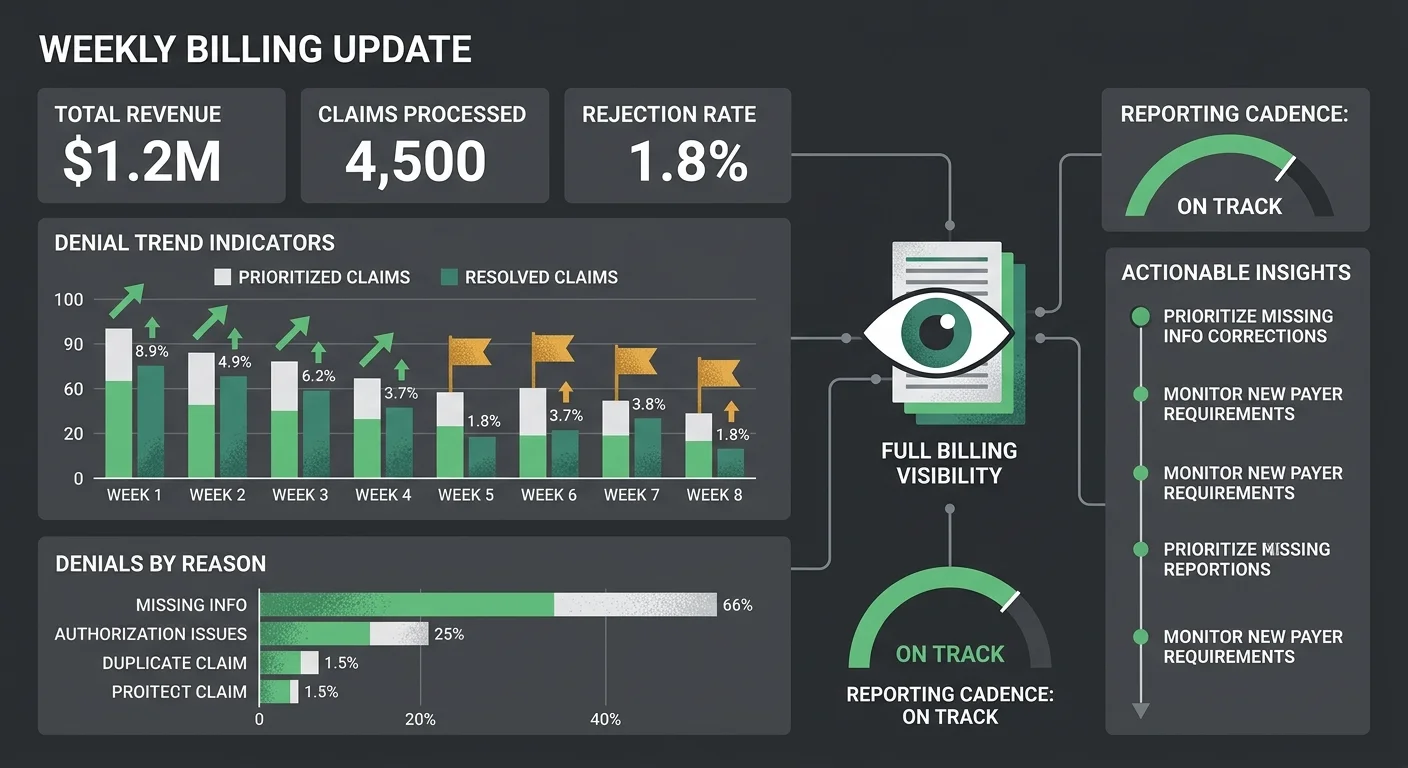
Month one builds the foundation. Month two finds out if it holds.
And the only instrument that answers that question is reporting.
Most practices assume month two feels quiet because things are working. That’s the wrong read.
Clean claims processing and revenue recovery are not the same thing. Denial patterns – modifier mismatches, credentialing gaps, documentation inconsistencies – have been stacking since day one. They don’t disappear. They wait.
The question isn’t whether the patterns exist. The question is whether anyone is reading them – or whether the billing partner is just clearing the queue and calling it progress.
Reporting at day 31 isn’t a courtesy. It’s the accountability mechanism – and the difference between a billing partner and a billing vendor.
If your billing company can’t show you exactly what got denied, why it got denied, and what pattern is driving it, they’re not managing your revenue cycle. They’re managing your impression of it.
That distinction matters legally, not just operationally. FDIC compliance guidance makes this explicit: Section 5 of the FTC Act prohibits billing vendors from fabricating collection metrics, hiding transaction fees, or misrepresenting historical appeal success. Visibility isn’t a feature you negotiate for. It’s a requirement.
What a Weekly Update Should Actually Tell You
A weekly update that confirms claims were submitted isn’t a weekly update. It’s a receipt.
Real weekly communication and active reporting answers three questions: what moved, what didn’t, and why. Every week. Without the practice having to ask.
What moved means collections – specific claims paid, amounts received, payer response timelines. Not a summary. The line items.
What didn’t move means the denial queue – which claims came back, what triggered the denial, what the next step is and who owns it.
And why means pattern recognition. Are the same denial codes appearing across multiple claims? Is a specific payer rejecting a modifier that’s applied correctly everywhere else? That third piece is what separates a reporting partner from a receipt-printer.
Most billing relationships skip the third piece entirely. And it’s the most expensive gap to ignore.
Administrative and clerical errors account for more than half of first-pass clinical claim denials in specialized outpatient services. Those aren’t mystery failures. They’re predictable – which means they’re preventable, if someone is tracking the trigger.
A weekly update that surfaces what’s driving those errors gives the practice something to act on: a documentation fix, a workflow adjustment, a credentialing correction that stops the same denial from showing up next week. That’s the difference between a billing call and a billing diagnosis.
Think about how it works in the clinic. The first appointment surfaces the presenting complaint. But the consistent follow-up is what determines whether the underlying problem actually resolves – or whether it gets managed just well enough to keep the patient coming back.
Weekly reporting in month two is that follow-up. It’s where the billing relationship either addresses the pattern or quietly lets it compound into a cash flow problem the practice has no leverage left to fix.
Reading Denial Patterns Before They Become Cash Flow Problems
Denial patterns don’t arrive with an announcement. They accumulate.
One rejected modifier. One documentation flag. One aging claim nobody followed up on. By the time a practice notices the gap at day 90 or day 120, weeks of recoverable revenue have already aged past the point of return.
The first 90 days don’t fail on day one. They fail in the silence between day one and day ninety – the window where patterns form and nobody says a word.
So the work in days 31-60 isn’t reactive. It’s diagnostic.
A dedicated biller reviewing the denial queue in real time isn’t just clearing rejected claims. They’re building a map – where the documentation workflow is producing predictable, preventable errors, and what it’s going to cost if those errors repeat.
That map only exists if the communication structure supports it. Understanding the benefits of weekly update meetings isn’t theoretical – it’s the reason the pattern becomes visible before it becomes a cash flow problem.
Silence from a billing partner during this window isn’t professionalism. It’s a structure that hides the pattern until it’s too late to do anything about it.
Practices that protect their revenue in the first 90 days demand visibility at day 31. They don’t wait for the summary at day 60. By then, the damage is already priced in.
| Reporting Metric | What It Measures | Why It Matters in Days 31-60 | Red Flag Signal |
|---|---|---|---|
| Denial Rate by Claim Type | Which procedure codes and modifier combinations are generating rejections | Establishes whether early modifier corrections from Days 1-30 are holding – or whether new patterns are emerging | Denial rate stays flat or rises week over week with no explanation from the billing partner |
| Denial Pattern Identification | Whether the same denial code is appearing across multiple claims, payers, or providers | A single denial is a data point; a recurring denial is a workflow problem – this metric separates the two | Weekly updates list individual denied claims but never identify a pattern connecting them |
| Appeals Status and Timeline | Which denied claims have been appealed, when, and what the current payer response status is | Appeals that sit unworked age past timely filing limits – tracking status in real time prevents recoverable revenue from expiring | Appeals are mentioned in summary totals but no individual claim status or next-action is provided |
| AR Aging Snapshot | How claims are distributed across aging buckets – current, 30, 60, and 90-plus days outstanding | The 31-60 window is the earliest point a practice can see whether AR is being actively worked or quietly accumulating | AR report is provided as a static total rather than a breakdown by age and payer |
| Payer-Specific Rejection Flags | Whether a specific payer is rejecting modifier applications or documentation formats accepted by all other payers | Payer-specific behavior requires a targeted correction – not a global documentation change – and can only be identified when data is segmented by payer | All payer activity is reported in aggregate, making it impossible to isolate payer-driven rejection patterns |
| Documentation Correction Requests | How many times the billing partner has surfaced a documentation gap and what the practice’s response time has been | Tracks whether the clinical-biller feedback loop established in Days 1-30 is functioning – or breaking down in practice | No documentation correction requests have been issued, suggesting gaps are being bypassed rather than addressed |
| Weekly Communication Consistency | Whether the billing partner is delivering structured updates on a set cadence – not just responding to practice inquiries | Proactive reporting is a structural feature of an embedded billing relationship; reactive-only communication signals a volume-first model | Updates arrive only when the practice asks – or include only submission confirmations with no denial or AR context |
Days 61-90: Modifier Accuracy and AR Recovery Take Center Stage
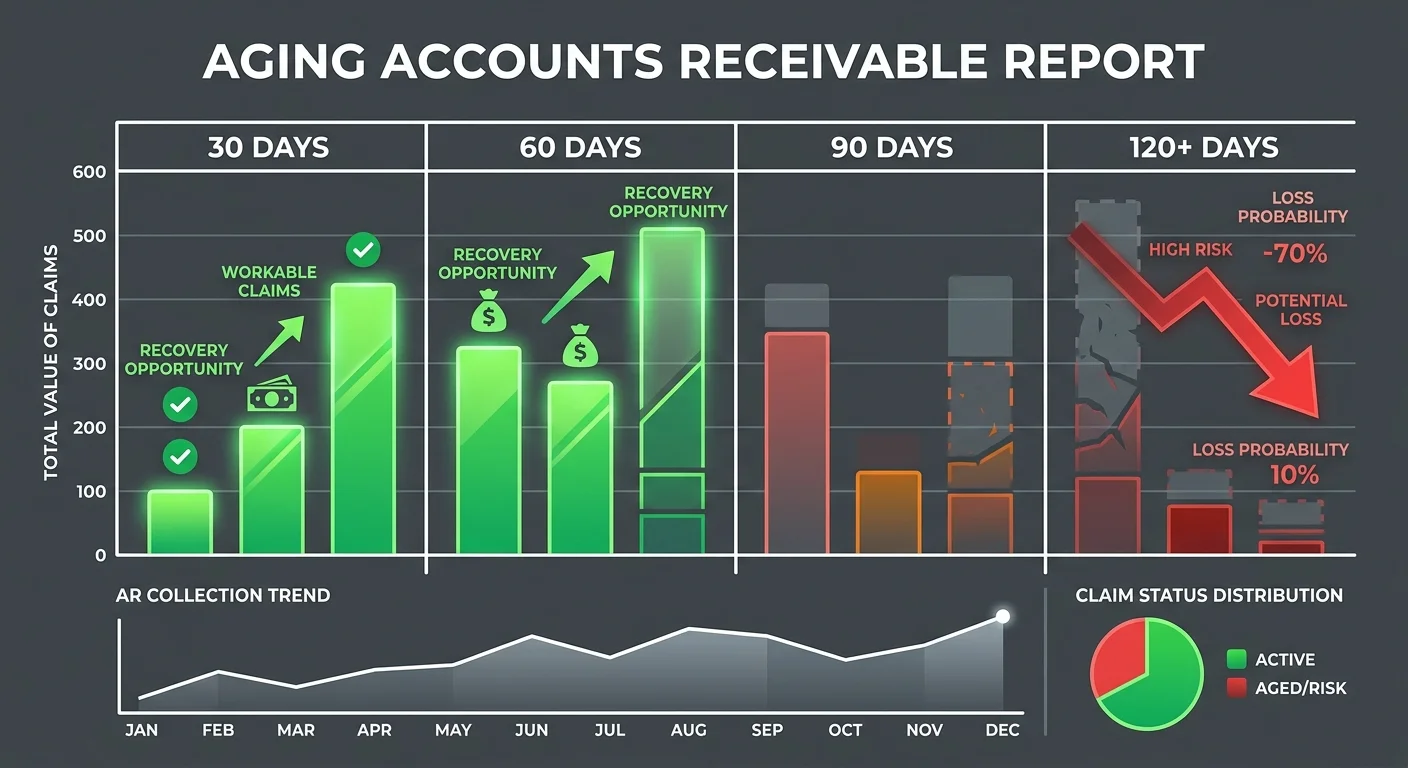
By day 61, the diagnosis is done. The patterns are mapped. The gaps are named. So the only question left is whether anything actually gets fixed – or whether the billing partner keeps naming the same problems on a weekly call while the revenue ages past recovery.
This is where the real difference shows. A generalist processes what it receives. A specialty-aligned partner goes back – into the aging AR, into the denied claims, into the modifier mismatches – and works the cases that actually move revenue. That distinction isn’t philosophical. It’s measurable.
Billing and insurance-related complexity consumes up to 14.5% of total clinical revenue for non-surgical physician specialties. That number is the ceiling the wrong billing relationship never escapes. The right one spends month three systematically reclaiming it.
How High-Complexity Claims Get Worked – or Abandoned
High-complexity claims don’t fail loudly. They age quietly. A denial for a missing modifier sits in the AR report for 30, 60, 90 days – and a billing partner who doesn’t work it actively just lets the window close. Most practices don’t notice until the claim is gone.
HCPCS codes 98940, 98941, and 98942 require the AT modifier to indicate active, corrective treatment rather than maintenance care. When those modifiers aren’t applied correctly – or when the documentation doesn’t support active care – the claim comes back denied.
That denial isn’t the surprise. What’s surprising is how many billing relationships treat it as a dead end. A chiropractic specialist reads it as a starting point: a documentation correction to make, a medical necessity argument to build, a pattern to stop before it repeats.
Federal audits have identified up to 82% of reviewed chiropractic claims as technically unallowable due to insufficient documentation of active care. That’s not an outlier. That’s what happens when no one is making a medical necessity argument on the practice’s behalf.
And here’s the part that should concern you: the billing partner who reaches day 90 without surfacing this pattern didn’t miss it by accident. The volume model doesn’t build in the review step that catches it. So the claims process, the denials accumulate, and the revenue ages out – quietly, without a single conversation about it.
Practices that have looked closely at why communication breaks down after signing recognize this immediately: the complex claims that require real appeal work are exactly the ones a volume-first operation deprioritizes. Working them costs more than the throughput model budgets for.
So they get abandoned. Not explicitly. Just slowly – by omission. The practice never gets a call saying the claim was written off. It just stops appearing in the update.
What Your Existing AR Should Look Like by Day 90
By day 90, the AR report should tell a coherent story. Not a perfect one – but a coherent one. Claims from the first 30 days should be largely resolved. Denials from month two should show active follow-up status.
And the pattern data from weeks of reporting should be driving documentation corrections that stop the same denial codes from appearing in month four. That’s not an ambitious target. That’s the minimum output of a billing relationship that was actually working.
Improper diagnostic sequencing and missing primary/secondary code linkages are the primary drivers of automated claim rejections. A clean AR at day 90 means those errors were caught early, corrected systematically, and aren’t generating new rejections at the same rate they were in week one. That’s the measurable output of the first 90 days with a new billing partner done right.
The AR report at day 90 isn’t just a financial document. It’s a record of whether your billing partner stayed engaged – or stayed quiet. Those are not the same thing. And by day 90, you’ll know exactly which one you hired.
| Claim Type | Complexity Level | Typical Abandonment Risk | What Correct Handling Requires |
|---|---|---|---|
| AT Modifier Claim (Spinal Manipulation) | High | High – requires active care documentation review and modifier verification on every claim | Dedicated review of SOAP notes, confirmation of active treatment status, and correct modifier application before submission |
| Maintenance Care Denial | High | Very High – often abandoned because the appeal requires a medical necessity argument, not a simple resubmission | Clinical documentation audit, narrative justification for active care classification, and structured payer-specific appeal |
| Diagnostic Code Sequencing Error | Medium | Moderate – frequently left in aging AR when no one tracks primary/secondary code linkage across claim batches | Pattern-level review of denial codes, corrected diagnostic sequencing, and coordinated documentation fix with the provider |
| Credentialing or Enrollment Mismatch | Medium | High – claims sit unpaid while credentialing discrepancies go unresolved; volume-first operations rarely flag these proactively | Cross-referencing payer enrollment records, identifying the mismatch, and initiating corrective enrollment updates before the filing window closes |
| Clean Claim with Minor Technical Error | Low | Low – most billing operations catch and correct these on first pass | Standard claim scrubbing, error correction, and resubmission within normal processing timelines |
| Aging AR Claim (60-90+ Days) | High | Very High – the longer a claim sits, the fewer payers will accept a corrected submission; most operations stop working these | Active AR recovery outreach, payer follow-up calls, documentation reconstruction where possible, and escalated appeals before filing deadlines expire |
Frequently Asked Questions
The roadmap tells you what should happen. But practices that have been burned before aren’t asking about the roadmap. They’re asking what goes wrong, what this transition actually costs them, and what accountability looks like when it’s not just a line in a proposal.
Ask these before day one. Here’s what the right answers look like.
What specific milestones should a chiropractic clinic hit in the first 30 days of a new billing partnership?
Three things should be done by day 30. EHR access established and verified. The dedicated biller has reviewed the practice’s existing denial patterns. A baseline reporting structure is live and producing data.
Those aren’t stretch goals. They’re the minimum floor.
If week three arrives and the billing partner hasn’t surfaced a single observation about the practice’s existing AR, that’s not a slow start. That’s the structure of the relationship revealing itself early – and it’s telling you exactly what the next 60 days will look like.
Administrative and clerical errors account for more than half of first-pass clinical claim denials in specialized outpatient services. A billing partner who doesn’t identify those patterns in the first 30 days isn’t protecting the practice. They’re inheriting the same problems the previous arrangement left behind – and calling it a transition.
Will our clinic experience cash flow disruption or clinical downtime during the first 90 days?
A well-structured transition doesn’t create cash flow disruption. It surfaces the disruption that was already there.
Most practices entering a new billing relationship find their existing AR has more aged, unworked claims than they realized. That’s not something the transition caused. It’s a pre-existing condition the previous arrangement never resolved – and a billing partner who frames those claims as the transition’s fault isn’t being honest about where the problem started.
What day one through day thirty should deliver is continuity. Claims go out on time. Active follow-up on outstanding denials. A clear picture of what the AR actually contains. The billing relationship changes. The revenue cycle doesn’t pause.
How does a billing partner handle our existing accounts receivable during the transition?
Existing AR is the first thing the transition reveals. A specialty-aligned billing partner doesn’t set it aside and start fresh. They review the aging buckets, identify what’s still workable, and prioritize claims before appeal windows close.
But working existing AR is triage, not rescue. Claims that have aged past payer deadlines aren’t recoverable – regardless of how much effort goes into them. A billing partner who tells a practice otherwise isn’t being optimistic. The FTC is explicit: fabricating collection metrics or misrepresenting historical appeal success is prohibited conduct.
What a practice should expect is an honest accounting. What’s in the AR. What’s still recoverable. A clear plan for the claims that still have legs – and no promises about the ones that don’t.
What level of reporting and transparency should we expect by day 60?
By day 60, reporting should be delivering more than submission counts. The practice should know its current denial rate by category, which payers are generating the highest rejection volume, and what specific documentation or modifier issues are driving those patterns.
That’s not an advanced request. That’s the baseline output of a billing partner who is actually embedded in the practice’s revenue cycle.
Silence at day 60 isn’t neutral. It’s a structure that keeps the practice from knowing what’s wrong until the cash flow gap has already priced it in. Proactive reporting by day 60 isn’t a premium feature. It’s the standard a functioning billing partnership meets – and the absence of it tells you exactly what kind of relationship you’re in.
Why does a weekly update cadence matter more than a monthly billing report during the 90-day period?
A monthly report tells a practice what happened. A weekly update tells the practice what’s happening – and gives it time to act before the window closes.
Denial patterns don’t announce themselves. They accumulate. A modifier error that generates a denial in week two can be corrected before it replicates across 30 more claims – if someone surfaces it in week three. A monthly report delivers that information six weeks too late.
Administrative and clerical errors account for more than half of first-pass clinical claim denials in specialized outpatient services. The weekly cadence isn’t about frequency for its own sake. It’s about the gap between a problem appearing and the practice knowing it exists. That gap is what determines whether the same denial files again next week – or stops.
What happens if the AT modifier is applied incorrectly on Medicare claims during the transition?
HCPCS codes 98940, 98941, and 98942 require the AT modifier to indicate active, corrective treatment rather than maintenance care. When that modifier is missing or incorrectly applied, the claim comes back denied. Medicare has no obligation to pay it regardless of the clinical work performed.
Historical federal audits have identified up to 82% of reviewed chiropractic claims as technically unallowable due to insufficient documentation of active care. That’s not a documentation technicality. That’s what happens when modifier accuracy isn’t actively managed – and when no one is building the medical necessity argument the claim requires.
The right billing partner catches AT modifier errors before the claim goes out. During the transition period specifically, that means a dedicated biller with chiropractic modifier expertise reviewing claims in real time – not a generalist processing volume and flagging problems after the payer has already acted.
What the First 90 Days Are Really Telling You
The first 90 days aren’t a trial period. They’re a verdict.
The clinical intake framing holds: the first appointment reveals the presenting complaint. But it’s the consistent follow-up that determines whether the underlying problem gets resolved – or just managed well enough to stay invisible until it can’t be ignored.
By day 90, you’re not waiting to see how things shake out. You already know. The AR report is the record. And the only real question is whether it shows a billing partner who was embedded in your revenue – or one who was simply adjacent to it.
Days 1-30 either produced clinical-biller alignment or they didn’t. There’s no partial credit. Days 31-60 either surfaced the denial patterns driving your cash flow gaps or buried them behind submission receipts. Days 61-90 either closed the loop on preventable errors – or left the same claims aging past the point of return.
That’s the full picture. And it’s binary. A billing partner is either working your revenue or processing your claims. Those aren’t the same thing, and 90 days is more than enough time to tell the difference.
The first 90 days don’t fail on day one – they fail in the silence between day one and day ninety.
Here’s the standard worth holding: a billing partner who communicates proactively, works complex denials instead of walking away from them, and delivers a coherent AR report at day 90 isn’t exceeding expectations. They’re meeting them.
Bushido Billing is built around exactly that standard. Performance-based accountability from the first claim. A dedicated biller who knows chiropractic modifier rules – not a generalist processing volume and hoping the complex ones sort themselves out. Weekly updates that tell you what moved, what didn’t, and why – not just confirmation that claims went out.
The only question is whether you’re demanding that – or letting silence answer for itself.
The first 90 days don’t fail on day one. They fail in the silence between day one and day ninety – the weeks where no one calls, no one reports, and the problems compound quietly until they show up as a cash flow gap.
If that pattern sounds familiar, you already know what’s broken.
Bushido Billing works with chiropractic practices that are done waiting for summaries that arrive too late to fix anything. Book a call to see what your first 90 days could actually look like.

© . All Rights Reserved | Web Design by iTech Valet