

How to Build a Defensible Appeal File Before You Submit It
Learn what goes in a Medicare appeal file for a chiropractic claim: the cover letter, records, signatures and form details to check before you submit.
National Government Services (NGS Medicare) says the person who appeals must provide the information and documents for provider submitted appeals, and decisions at these levels are based only on what is submitted with the case. NGS also says that leaving out any of the right documents may lead to an unfavorable decision. Find-A-Code lists what you may want to include: the patient’s medical history, papers showing how severe the problem is or that it started suddenly, x-ray reports, test results, the patient’s treatment plan, consultation reports, referral requests and reports, or copies of messages between the provider and the patient.
Why the File Decides Most Medicare Appeals
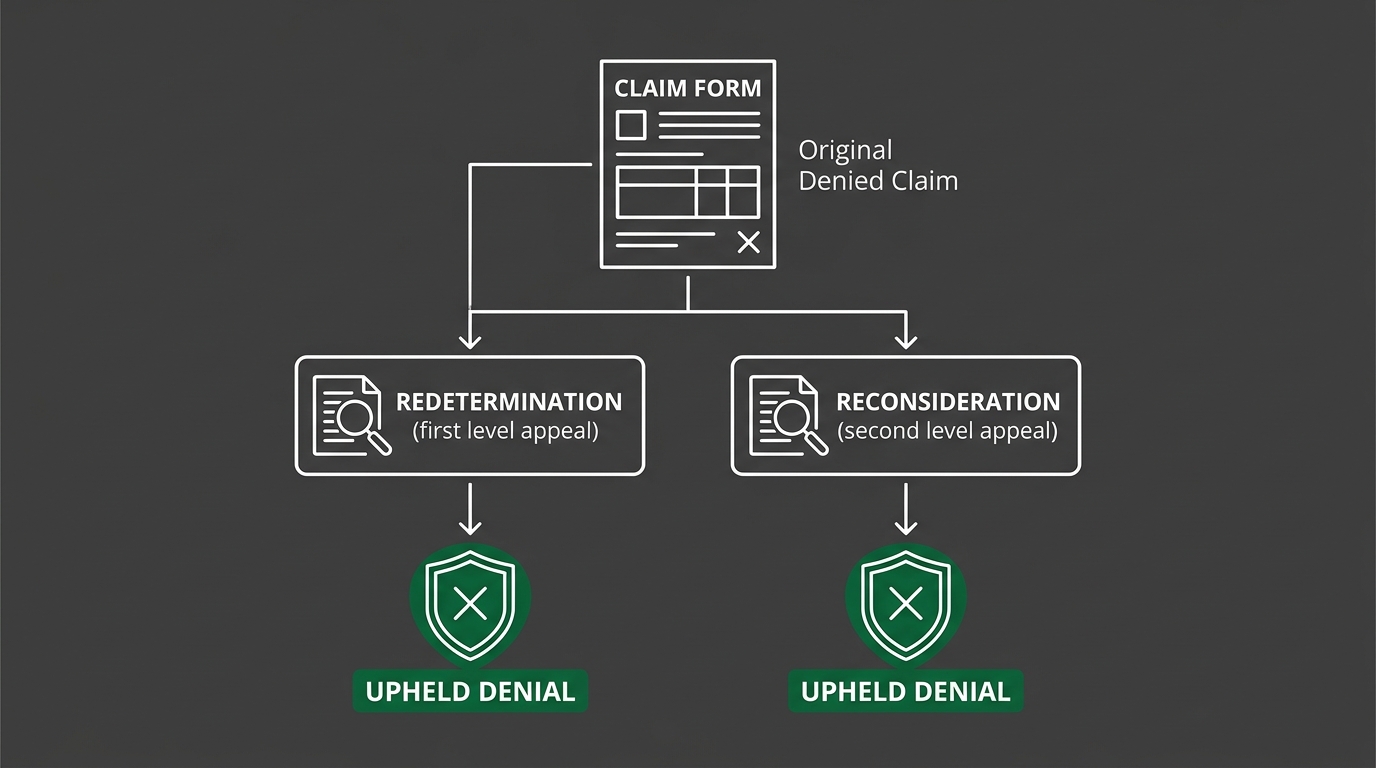
National Government Services (NGS Medicare) says original claim denials are often upheld at the redetermination or reconsideration level. The reason is a lack of documentation supporting the medical necessity of the services given.
If you’re the one appealing, you’re the one who has to provide the information and documents. Decisions at these levels are based only on what you submit with the case. Leave out any of the right documents and you may get an unfavorable decision.
The Centers for Medicare & Medicaid Services (CMS) reports that insufficient documentation accounted for 95.5% of improper payments for chiropractic services in the 2024 reporting period. That’s about 96 in 100. No documentation (2.4%), incorrect coding (0.7%), medical necessity (0.6%) and other errors (0.9%) also caused improper payments.
I treat electronic health record (EHR) software as the thing that gets claims out the door. It isn’t a full billing operation. When a claim is denied, someone has to read the record, build the appeal and chase the money still owed. I don’t trust any tool to do that well on its own, so I put a person with judgment on every appeal file.
You can read the full picture of denials in Handling Denied Chiropractic Claims and Appeals: A Complete Guide. The NGS rules quoted above come from the Medicare Part B 101 Manual – Appeals/Reopenings.
Before You Gather: Wait for the Remittance Notice and Check the Policy
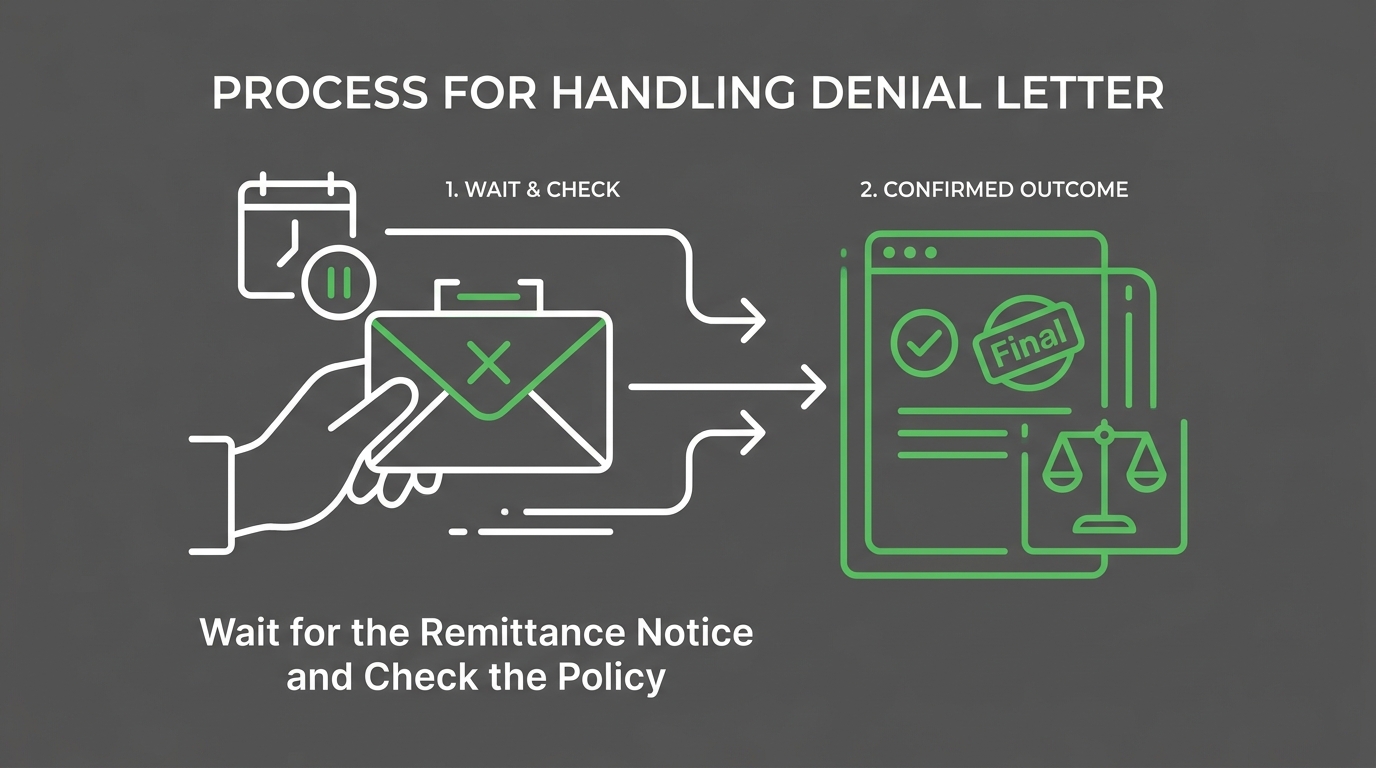
Do two things before you pull a single page.
First, wait for the decision. NGS Medicare says providers should wait to file a redetermination until they get the Medicare remittance notice. That is the payment notice that gives the claim decision.
Second, read the rules. Before you ask for a redetermination or reconsideration, NGS says to read the Medicare Part B publications and provider bulletins, plus all the medical policy and documentation guidelines that apply to each service you appeal.
What Belongs in the Appeal File

Find-A-Code says to start with a cover letter that explains why you’re asking for the redetermination. Next, add proof of the earlier payment or denial. That can be a copy of the claim form (1500), a copy of the remittance notice, or a copy of the explanation-of-benefits statement (EOMB).
Then add the clinical records. Find-A-Code says you may want to include the patient’s medical history, papers showing how severe the problem is or that it started suddenly, x-ray reports, test results, the patient’s treatment plan, consultation reports, referral requests and reports, or copies of messages between the provider and the patient.
Find-A-Code also says that if you use handwritten notes, your own shorthand or abbreviations, it is fine to write them out in a readable form before you send them for review. You cannot add information. You can only turn what is there into a more readable form.
Here’s my rule for the clinical records. I let software handle routine claims that have no errors. I don’t let it decide which records show why care was medically necessary. I pick those pages with a trained eye, and I put a skilled person on every tailored appeal after a denial.
The table below shows what goes in your packet and why each item is there. Find-A-Code keeps its list on its Medicare Appeals Process Forms page. CMS offers the Form CMS-20027 Medicare Redetermination Request Form.
| Item | Why it’s included |
|---|---|
| Cover letter | Explains why the redetermination is requested |
| Claim form (1500), remittance notice, or EOMB | Evidence of the prior payment or denial |
| History, x-ray reports, test results, treatment plan, referral reports | Records you may want to enclose |
| Transcribed handwritten notes | Made more readable, with no information added |
The Denial Notice and Claim Evidence
First Coast Service Options (FCSO) gives a few plain tips on the claim evidence.
- You can get the internal claim number (ICN) from your remittance advice. The ICN is the claim’s own tracking number. The remittance advice is the notice that explains how a claim was paid.
- You may also attach a copy of the remittance advice (RA) or the electronic remittance advice (ERA), with the services in question circled.
- Include a copy of the Explanation of Benefits from the primary insurance company with your redetermination request.
Subluxation and Multi-Region Documentation
CMS has a Medicare Documentation Job Aid for Chiropractic Doctors. It’s an educational tool, numbered MLN1232664, March 2022, page 2 of 3. It says your documentation must show at least 2 of these 4 elements, known as P.A.R.T.:
- Pain
- Asymmetry or misalignment
- Range of motion abnormality
- Tissue tone changes
At least 1 of those 2 must be asymmetry or misalignment, or range of motion abnormality. The job aid also says to include dated documentation of the first evaluation, a primary diagnosis of subluxation with the level of subluxation, and any documentation that supports medical necessity.
CMS also makes a point about regions. The claim form only lists the diagnoses for two regions you treated. If you bill treatment for more than two regions, though, your clinical record must explain why you treated the other regions.
Signatures and Authentication
Check each signature in the file. Palmetto GBA and Noridian Healthcare Solutions both explain the rules. Read the Palmetto page, Medicare Medical Records: Signature Requirements, Acceptable and Unacceptable Practices, and the Noridian page, Medical Documentation Signature Requirements.
What counts as a signature
- Palmetto GBA says Medicare requires the author to sign off on the services provided or ordered. The signature on each entry must be easy to read and should include the practitioner’s first and last name.
- Find-A-Code says the only acceptable signatures are a written signature on a paper copy or fax, and an electronic, digital or digitized signature on secure web portals approved by CMS. Don’t use “Signature on File” or a stamp signature.
- Signature stamps alone aren’t accepted by Medicare as a valid signature, and Palmetto warns they may lead Medicare to deny payment.
- Reports that are dictated, or typed up from dictation, need a valid signature that finalizes and approves them. Without one, Palmetto says they’re not acceptable for payment purposes.
When a signature can’t be read
- Palmetto says a signature log lists the typed or printed name of the author next to their initials or a signature that cannot be read.
- An attestation is a signed statement. Palmetto says someone other than the author of the entry may not sign it. Even two people in the same group should not sign for each other.
- Palmetto says the attestation or signature log must reach its office within 20 calendar days of the call, or of the date the post office gets the written request.
- Noridian says that if your facility has no signature log now, it will accept all submitted signature logs, whatever date they were made.
- Noridian also says a first response to an Additional Documentation Request (ADR) that includes a log or attestation for unreadable signatures will speed up claim processing.
Late entries and scribes
- Don’t add late signatures to the record, apart from the short delay that happens during transcription. Palmetto says to use the signature authentication process instead, which means a signature log or an attestation.
- In records you send to Medicare reviewers, Noridian says to clearly show the date and the author of any amendment, correction or delayed entry.
- When a scribe writes up the visit, the scribe’s signature isn’t required, but Palmetto says the billing provider must sign. Noridian says the treating physician or non-physician practitioner (NPP) must sign and date those entries.
I don’t run a billing partnership as a handoff. I ask you for access to your EHR, cooperation on documentation, and providers who stay reachable and turn signatures around quickly. I’ll tell you plainly up front that a checked-out practice gets poor results.
Filling Out the Redetermination Form Correctly
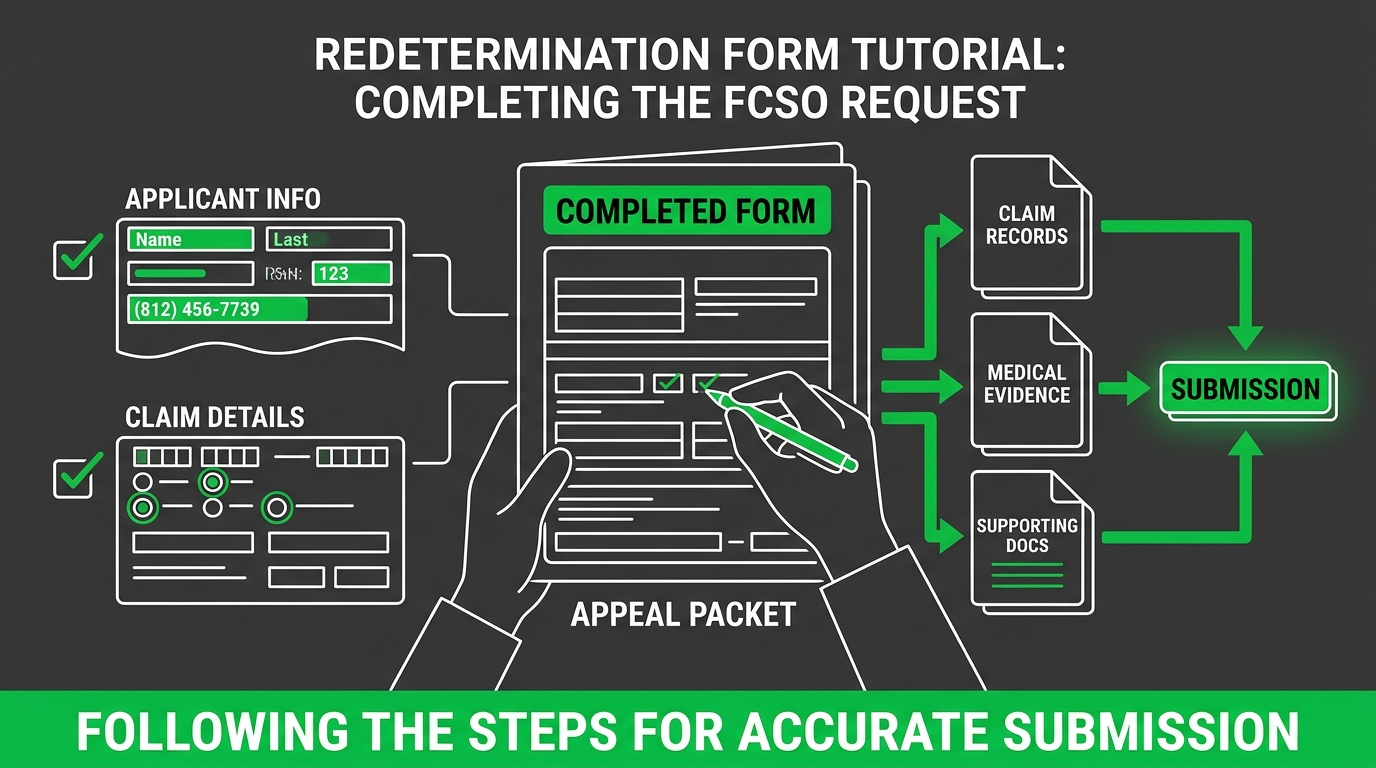
The Tutorial: Completing the Medicare Part B Redetermination Request Form from First Coast Service Options (FCSO) walks you through the form.
Check how your own contractor wants requests grouped:
- With FCSO, send one redetermination form for each claim you’re questioning.
- With National Government Services (NGS Medicare), you don’t need a separate request for each service or procedure code on the claim. All requests for one patient, using that patient’s Medicare number, can go on one request.
FCSO has more for you:
- If you leave out the required information, your request will be dismissed because it did not have all the necessary parts.
- On the First Coast Medicare Part B form, chiropractic services have their own choice. If you’re questioning chiropractic services, select (fill in) that choice.
- Check that the patient’s name and Medicare number match, and that the number is right. Wrong information could get your request dismissed.
- Give the specific reason you’re asking for a redetermination or a clerical error reopening. Also explain why you believe the service or services should be handled differently than in the first claim decision.
- If a Medicare remittance notice shows message MA-130, no appeal or reopening rights are available for that claim.
Get All the Evidence In Before the Decision
The Centers for Medicare & Medicaid Services (CMS) wants your evidence attached to the form. Or you can attach a statement that explains what you plan to send and when. You can send more evidence later, but all of it must be received before the redetermination is issued.
Find-A-Code says reconsideration by the Qualified Independent Contractor (QIC) is the last level at which you can send in new evidence. It also says more documents sent in at that step could increase the time the QIC has to decide.
To see the steps in order, read What Are the Formal Steps to Appeal a Spinal Adjustment Denial? For timing, read How Long Do Payers Have to Respond to a Written Appeal?
Final Checks Before It Goes Out
Do a last pass, then keep your proof.
NGS Medicare says all medical information given to the Part B MAC (Medicare Administrative Contractor) must be documented in the patient’s file. It must be available should an audit be required.
Find-A-Code adds one habit: keep a checked copy of the checklist with the Redetermination Request Form in the patient record, so it’s easy to find.
When a Reopening Fits Better Than an Appeal
When a minor error is involved, you can ask Medicare to reopen the claim so the error can be corrected, instead of going through the appeal process. That’s how NGS Medicare puts it.
FCSO explains that CMS defines clerical errors, including minor errors or omissions, as human or mechanical errors on the part of the party or the contractor. Think swapped codes, wrong data entry, or a wrong modifier or date of service.
A few things to know:
- If the diagnosis on the paid claim needs to be corrected, or another diagnosis needs to be added, NGS says to write a note in the medical record about the issue and the diagnosis so it can be part of the record.
- A reopening can’t be granted to add items or services that were not billed the first time. That’s from FCSO.
- Failing to respond to an Additional Documentation Request (ADR) within 45 days has resulted in a denial, according to Find-A-Code. It also says the reopening must be requested within 120 days from the initial determination to be considered. The 45 days is the window to respond to an ADR. The 120 days is the window to request a reopening.
- If you don’t have the right information ready when you call the telephone reopening line, you may get an unfavorable decision, NGS warns.
You can see how we do this work on our Medical Billing Services page.
Frequently Asked Questions
What happens to an incomplete redetermination request?
It gets dismissed. National Government Services (NGS Medicare) says incomplete requests are dismissed, with an explanation of the missing information. Check every part of your request before you send it.
Who can act for a Medicare patient in an appeal?
A person, supplier or physician who submits a properly completed appointment of representative form. NGS Medicare requires that to act as the patient’s representative. Complete it before you act for the patient.
Can a non-participating physician appeal on a patient’s behalf?
Yes, but only if the patient has validly transferred the patient’s appeal rights to you. Find-A-Code says this applies to a doctor who is not a participating doctor and does not accept assignment. Get that transfer in place before you appeal.
Should staff ask the patient what reason they were given for the denial?
Yes. Find-A-Code’s advice is to contact the patient and ask what reasons they were given for the denial. Have your staff make that call.
Build the File Before You Send It
Build your file before it goes out. If you leave out any of the right documents from your appeal, you may get an unfavorable decision, according to NGS Medicare. CMS reports that insufficient documentation accounted for 95.5% (about 96 in 100) of improper payments for chiropractic services during the 2024 reporting period.
Bushido Billing can work inside any electronic health record (EHR) system, so your practice keeps control of its own systems.
The rest of those improper payments came from no documentation (2.4%), incorrect coding (0.7%), medical necessity (0.6%), and other errors (0.9%).
Want help with your file before it goes out? Book a Call