

Why is Real-Time Access to Your Billing Data Essential for Practice Growth?
Real-time billing data access is how a practice owner confirms that claims are being worked – not just submitted. Without it, there is no way to know whether your highest-value claims are being pursued, appealed, or quietly abandoned.
Chiropractic billing carries regulatory complexity that most general billing workflows are not built to handle. CMS requires the Active Treatment (AT) modifier on every Medicare claim for medically necessary spinal manipulation. When documentation does not align with that standard, CMS executes automated denials. Federal audit data shows that approximately 82% of chiropractic claims reviewed did not meet Medicare documentation requirements. That is not a documentation problem. That is a visibility problem.
Peer-reviewed research indicates that up to 80% of healthcare bills contain errors. In a silent billing relationship – no regular reporting on claim status, denial patterns, or AR aging – those errors do not surface until the revenue is already gone. The practice assumes claims are being processed. The biller assumes the practice is satisfied. Neither assumption produces collected revenue.
HHS and HIPAA’s Right of Access framework require healthcare institutions to maintain secure, accessible records of patient data and adjacent billing information. Structural data invisibility is not just a business risk. It is a compliance exposure.
Real-time access solves one specific problem: it closes the lag between when a claim fails and when the practice finds out. Practices with visibility into claim status, denial reasons, and AR aging by payer can identify patterns before they become cash flow crises. Claims do not disappear. They decay in silence. And the only structural defense against that is knowing what is happening before it is too late to act.
What Real-Time Billing Data Actually Means for a Chiropractic Practice
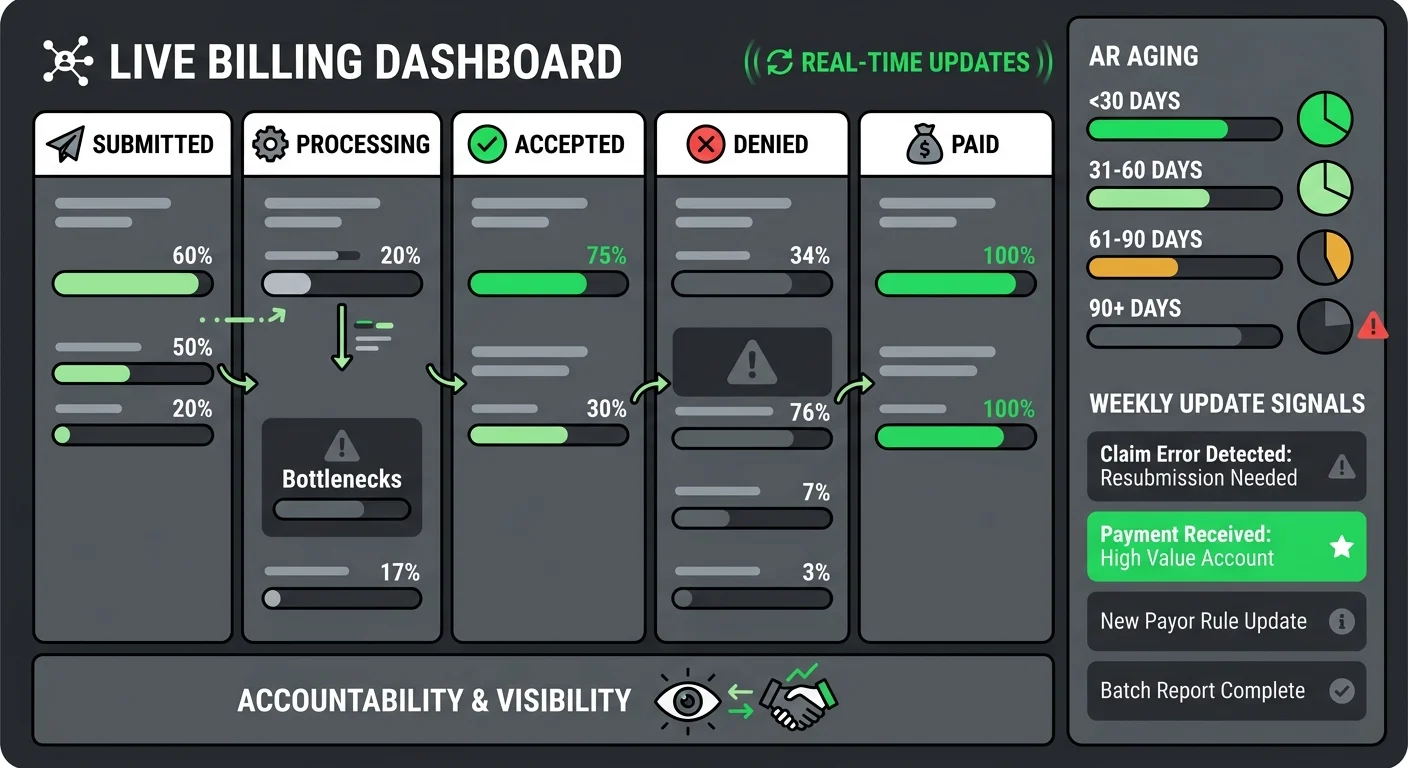
Real-time billing data isn’t a dashboard feature.
It’s an accountability structure. One that tells you – right now, today – whether the claims your practice submitted are being actively worked or quietly sitting in a queue no one is touching.
Most practice owners have billing data. That’s not the problem.
What they don’t have is access to that data when it’s current, readable, and actionable. A report that arrives once a month – or not at all – isn’t visibility. It’s a summary of decisions already made without you.
Chiropractic revenue cycle management isn’t just claims in and money out. It’s every stage between submission and collection – and if you can’t see those stages in motion, you don’t know what you’re losing until it’s already gone.
That’s the difference between a billing partner who protects your practice and one who processes paperwork and calls it a service.
The Difference Between a Report and Real Visibility
A report is historical. It tells you what happened.
Real visibility tells you what’s happening right now – and it gives you the ability to act before a problem becomes a permanent loss.
CMS enforces billing codes with automated precision. The AT modifier for medically necessary spinal manipulation must appear correctly on every eligible Medicare claim. When the documentation doesn’t match, published CMS guidelines are clear: automated denials execute without exception.
Real visibility means knowing when that denial hit. Not 90 days later, when the claim has aged past the point of recovery.
How claims get assigned matters more than most practices realize. When you’re routed through a shared billing pool, no single person knows your claim history well enough to spot a pattern.
Denial patterns don’t announce themselves. They compound – quietly, over months – until they’ve already hit your cash flow. A monthly report can’t replicate that claim-level familiarity. It can only confirm the damage already happened.
The Volume-First Model Isn’t Designed to Catch What It Misses
The volume-first billing model isn’t built to catch what it misses.
It’s built to maximize throughput – submit as many claims as possible, as fast as possible, and move on.
High-complexity claims cost more to work than the volume model budgets for. AT modifier disputes, personal injury lien billing, maintenance versus active care documentation challenges – these don’t get worked.
They age.
Real-time tracking in a chiropractic revenue cycle keeps accounts receivable from crossing into unworkable territory. Days sales outstanding drops when someone can see a problem before it ages past the intervention point.
But that only works when the data is visible early enough to act on. Visibility isn’t a reporting convenience. It’s the intervention window – and once it closes, it doesn’t reopen.
The black box isn’t a byproduct of a bad billing company.
It’s a structural feature of the volume-first model. Silence is what allows high-friction claims to die without anyone being accountable for the loss.
| Billing Data Point | What It Reveals | What Silence Hides | Why It Matters to Chiropractic |
|---|---|---|---|
| Claim status by payer | Whether a submitted claim is pending, in review, denied, or paid – and at what stage it stalled | Claims sitting in a denied or pending state for weeks without follow-up, aging past the point where an appeal is viable | Chiropractic payers vary widely in processing timelines and denial triggers – claim-level status visibility is the only way to catch a stall before it becomes a write-off |
| Denial reason codes | The specific reason a claim was rejected – modifier missing, documentation mismatch, eligibility issue, or coordination of benefits dispute | Denial patterns that repeat across dozens of claims without anyone identifying the root cause, producing the same revenue leak month after month | AT modifier denials, maintenance versus active care disputes, and PI lien rejections each require a different correction – without the code, the fix is a guess |
| AR aging by payer | How long outstanding balances have been sitting, segmented by payer, so workable claims can be prioritized before they expire | Receivables that appear on a monthly summary as ‘outstanding’ without any signal that they crossed into unworkable territory weeks earlier | Chiropractic claims have strict timely filing windows – a balance that looks recoverable on a summary report may already be past the appeal deadline |
| First-pass resolution rate | The percentage of claims paid on the initial submission without requiring a correction or appeal – a direct measure of billing accuracy upstream | A high volume of resubmissions and corrections that never appear in summary reporting, masking a fundamental accuracy problem in the billing workflow | A low first-pass rate in chiropractic billing signals systemic documentation or coding issues – problems that compound quietly when no one is tracking them |
| Follow-up activity log | A record of every action taken on a claim after initial submission – calls made, appeals filed, documentation requested, corrections submitted | The absence of any follow-up on complex claims, which looks identical to active follow-up when neither is reported to the practice | High-complexity chiropractic claims require persistent, documented follow-up – without a log, there is no way to distinguish active pursuit from quiet abandonment |
| Payment posting accuracy | Whether payer remittances are being posted correctly, underpayments are being flagged, and contractual adjustments are being applied at the right amounts | Systematic underpayments that go unchallenged because no one is reconciling remittance data against contracted rates in real time | Chiropractic payers frequently apply blanket downcoding or visit-limit reductions – underpayments that go uncontested become permanent revenue losses |
Why Black-Box Billing Gets Away With It
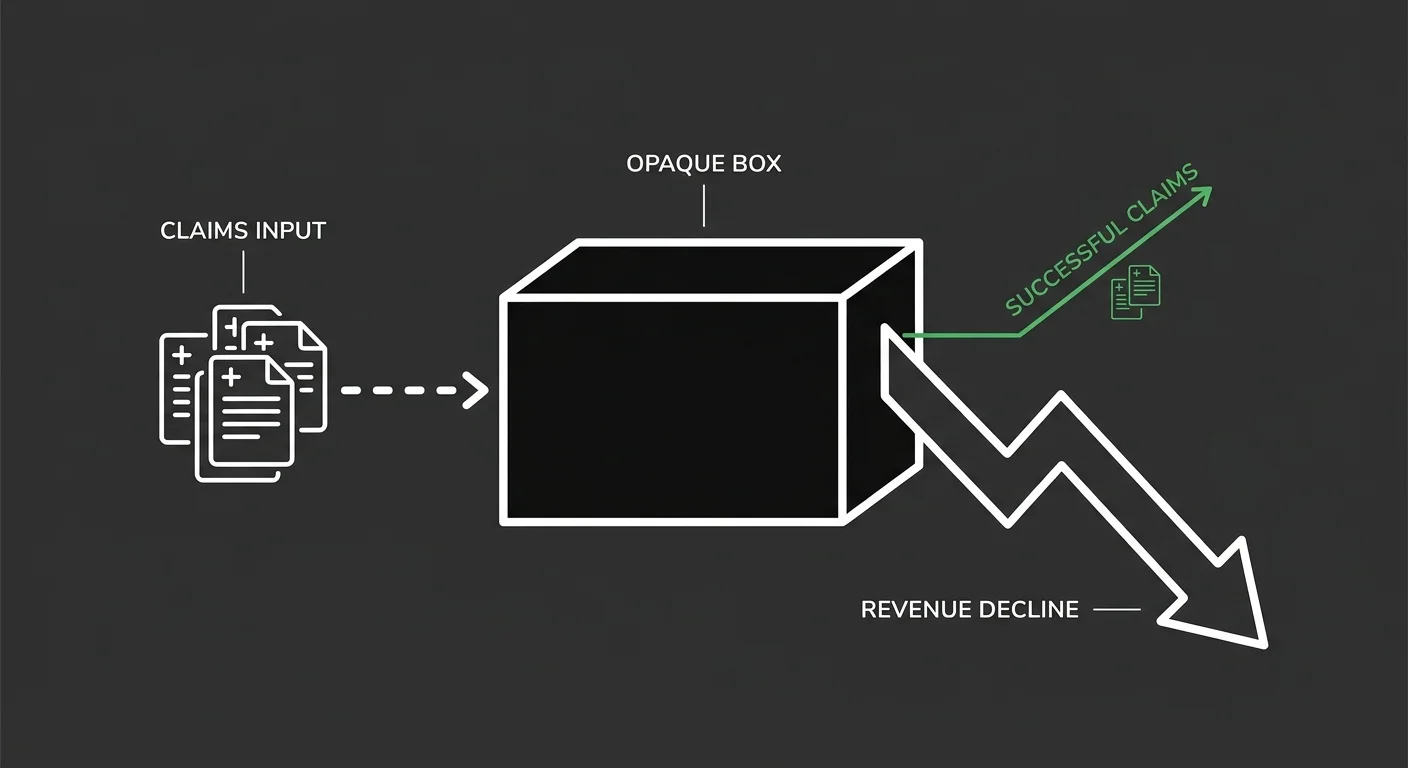
Black-box billing survives because silence looks like competence – until it doesn’t.
When a practice never sees its claim-level data, there’s nothing to question.
No denial report means no pattern. No pattern means no accountability. The billing company works what it can, moves on, and your practice never finds out what got left behind.
This isn’t an accident. It’s how the volume-first model is designed to work. Silence is what allows high-complexity claims to age past recovery without anyone being accountable for the loss.
What Happens to High-Complexity Chiropractic Claims in the Dark
AT modifier disputes, personal injury lien billing, maintenance versus active care documentation – these are the claims most likely to get denied.
They’re also the claims most likely to be abandoned.
Here’s the math. Under a volume-first model, working a complex appeal costs more time than the model budgets per claim.
So the claim sits. Then it ages. Then the recovery window closes – and nobody sends you a notification that it happened.
This isn’t a theory. HHS OIG findings show that approximately 82% of chiropractic claims reviewed did not meet Medicare documentation requirements.
That’s not primarily a documentation failure. That’s what happens when no one in the billing relationship is watching the data closely enough to catch problems before they compound.
And it’s not unique to chiropractic – peer-reviewed research puts billing errors in up to 80% of healthcare bills.
In a silent billing relationship, those errors don’t surface. Your practice assumes the biller is working it. The biller assumes the claim is fine. Neither assumption produces collected revenue. Practices that build regular communication with their billing team into their operations create the one structural mechanism that catches errors while they’re still correctable.
Who Gets Hurt Most – and Why They Don’t Know It Yet
The practices most exposed to black-box billing aren’t the smallest ones. They’re the ones generating enough volume that no single denied claim feels like a crisis – so the pattern never gets noticed.
A practice billing $800,000 a year doesn’t feel one abandoned AT modifier claim.
It feels twenty of them – six months later – when AR aging shows a block of Medicare claims that never converted. By then, most of those claims are unworkable.
That’s the mechanism. Not one catastrophic failure – a slow, invisible erosion of the exact claims that required the most expertise to recover.
Practices that don’t know this is happening aren’t being careless. They just have no data telling them otherwise.
| Claim Type | Complexity Level | What a Volume Model Does With It | Revenue Risk if Abandoned |
|---|---|---|---|
| Standard clean claim (simple diagnosis, no modifier issues) | Low | Submitted immediately, tracked to payment – this is what the model is optimized for | Minimal – clean claims convert reliably under any billing model |
| AT modifier claim (Medicare, medically necessary spinal manipulation) | High | Submitted without modifier verification; denied automatically; denial sits unworked as claim ages | Severe – recovery window closes as claim ages past payer timelines |
| Personal injury lien billing | Very High | Deprioritized or declined – lien tracking requires case-level follow-up that volume throughput cannot absorb | Severe – lien claims that go unworked are rarely recoverable once the case resolves |
| Maintenance vs. active care documentation dispute | High | Claim submitted without documentation review; denied for medical necessity; appeal not initiated | High – payer recovers payment or denies future claims without a filed appeal |
| Multi-step denial requiring documentation correction | Very High | First denial pass goes unresponded; claim ages into secondary denial or write-off | Severe – each unanswered denial cycle reduces the recoverable amount and narrows the appeal window |
| Payer-specific coding variation (modifier stacking, bundling rules) | Medium-High | Claim submitted using generic coding logic; denied on payer-specific grounds; pattern goes unreported | Moderate to High – repeated denials across a payer go unidentified without claim-level reporting |
The Compliance Risk No One Mentions
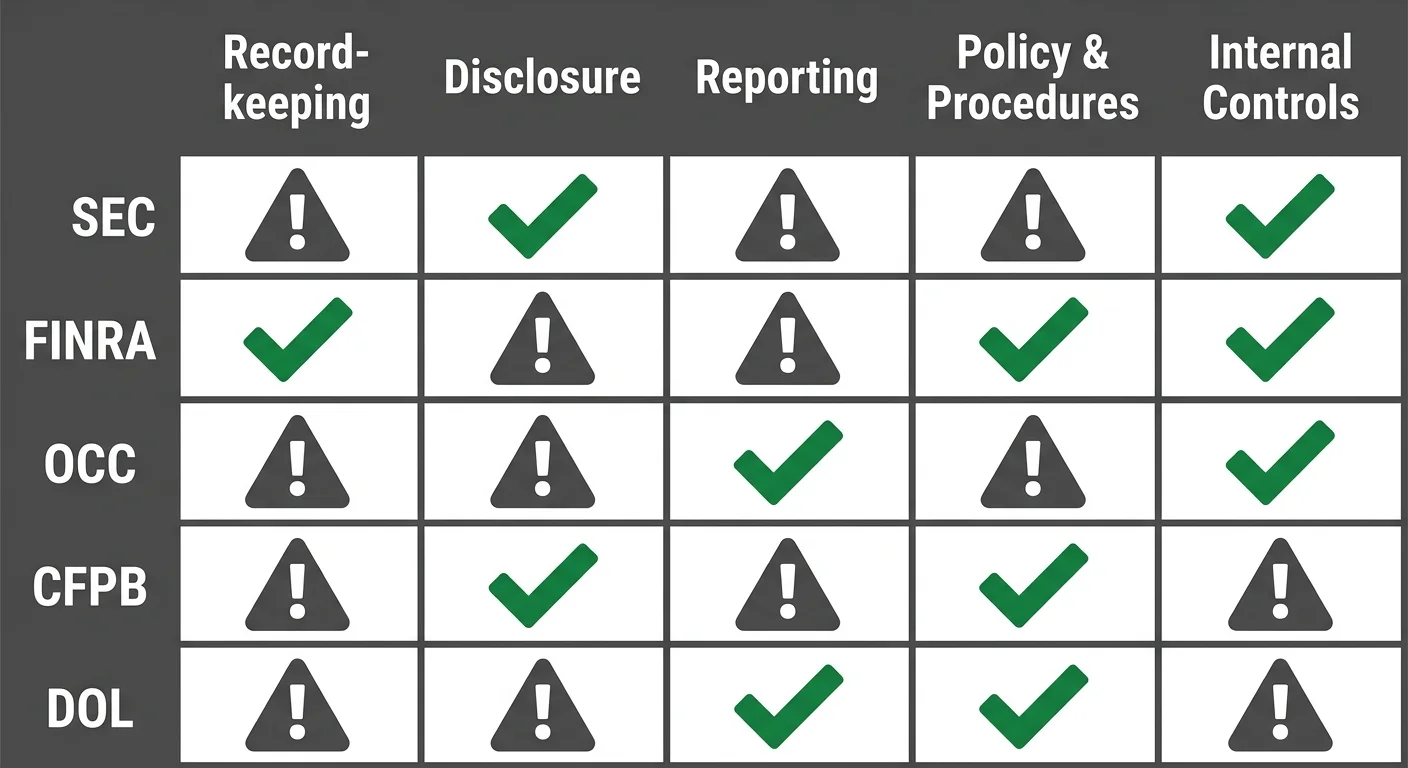
Revenue loss is the cost everyone talks about.
The compliance exposure is the one that compounds long after the billing relationship ends – and almost no one warns you it’s there.
Most practice owners think about visibility as a revenue problem. It’s also a compliance problem.
When you have no real-time window into claim status, denial patterns, or documentation flags, you can’t verify whether your billing operation is meeting federal standards. That’s not a minor gap. That’s operating blind in a regulated environment.
Federal documentation standards for chiropractic billing are specific, enforced, and unforgiving.
If you can’t see your claim-level data, you don’t know when those standards are being missed. And in most cases, the first notification comes from an auditor – not your billing company.
Federal Documentation Standards Are Not Suggestions
HHS OIG audits found that approximately 82% of chiropractic claims reviewed did not meet Medicare documentation requirements.
That figure is not a profile of bad practices. It is what happens systemically when billing environments are designed around throughput. Speed and documentation accuracy do not coexist in the volume-first model – and the data shows which one loses.
CMS enforces the AT modifier requirement with automated precision. A claim that fails the documentation pattern gets denied automatically – no human review, no warning, no grace period.
A practice with real-time access sees that denial the same day. A practice without it finds out when the claim has aged past the point of recovery.
That’s not a slow process. It’s a closed window.
Federal documentation standards aren’t guidelines. They’re the floor.
Billing environments that don’t surface documentation failures in real time aren’t just losing revenue. They’re accumulating regulatory exposure – one claim cycle at a time, with nobody watching.
When Invisibility Becomes a Liability
Here’s the part that almost never comes up in billing conversations: HIPAA’s Right of Access framework applies to your billing relationship too. Published access guidance establishes that healthcare institutions must maintain secure, accessible records – and the billing data tied to those records is part of that obligation.
Structural invisibility – a billing setup where you can’t access your own claim data on demand – isn’t just a bad business arrangement. It’s a potential compliance violation.
The legal standard doesn’t distinguish between intentional restriction and structural neglect. If the data isn’t accessible, the exposure is real either way.
The FTC enforces penalties against healthcare vendor systems that restrict secure data access or run non-compliant data handling. That enforcement scope reaches billing vendors directly.
But here’s what most practice owners don’t realize: delegating billing to a black-box operation doesn’t transfer your regulatory responsibility. It shares it – with a vendor whose data practices you can’t see or verify.
That’s a different kind of risk than a denied claim. A denied claim ages. A compliance exposure compounds.
Most practice owners have never been told to think about billing visibility as a compliance issue. It’s framed as a convenience feature. It’s not.
Learning to regain control of your billing without doing the billing work yourself starts with one recognition: visibility and delegation aren’t opposites. Visibility is what makes delegation defensible.
A practice that can see its billing data at any moment isn’t micromanaging its billing partner. It’s protecting itself. Your claims don’t disappear – they decay in silence. And silence, it turns out, is both a revenue problem and a legal one.
| Regulatory Body | Standard or Requirement | Chiropractic Billing Implication | Risk When Billing Is Invisible |
|---|---|---|---|
| HHS OIG | Medicare documentation standards for chiropractic claims | Every claim must meet federal documentation requirements to qualify for Medicare reimbursement – missing or insufficient documentation triggers denial and potential audit exposure | Practice cannot identify documentation failures in real time, allowing non-compliant claims to accumulate across billing cycles undetected |
| CMS | AT modifier requirement for medically necessary spinal manipulation | The AT modifier must appear correctly on every eligible Medicare claim for active chiropractic care – incorrect or absent modifier triggers automated denial without human review | Practice discovers denials weeks or months after the fact, when claims have aged past the point where recovery is viable |
| HHS / HIPAA | Right of Access – seamless, secure access to patient records and adjacent billing data | Billing data tied to patient records falls within the access framework – a practice must be able to retrieve its own claim-level data on demand | A black-box billing arrangement where the practice cannot access its own data on demand is a potential compliance violation, not merely a business inconvenience |
| FTC | Non-compliant data handling and restricted access to health data profiles | Billing vendors that restrict secure access to practice data or operate non-compliant tracking systems are subject to federal enforcement action | A practice that cannot see its vendor’s data practices has not eliminated its regulatory responsibility – it has shared it with a vendor it cannot verify |
What Real-Time Visibility Actually Looks Like in Practice
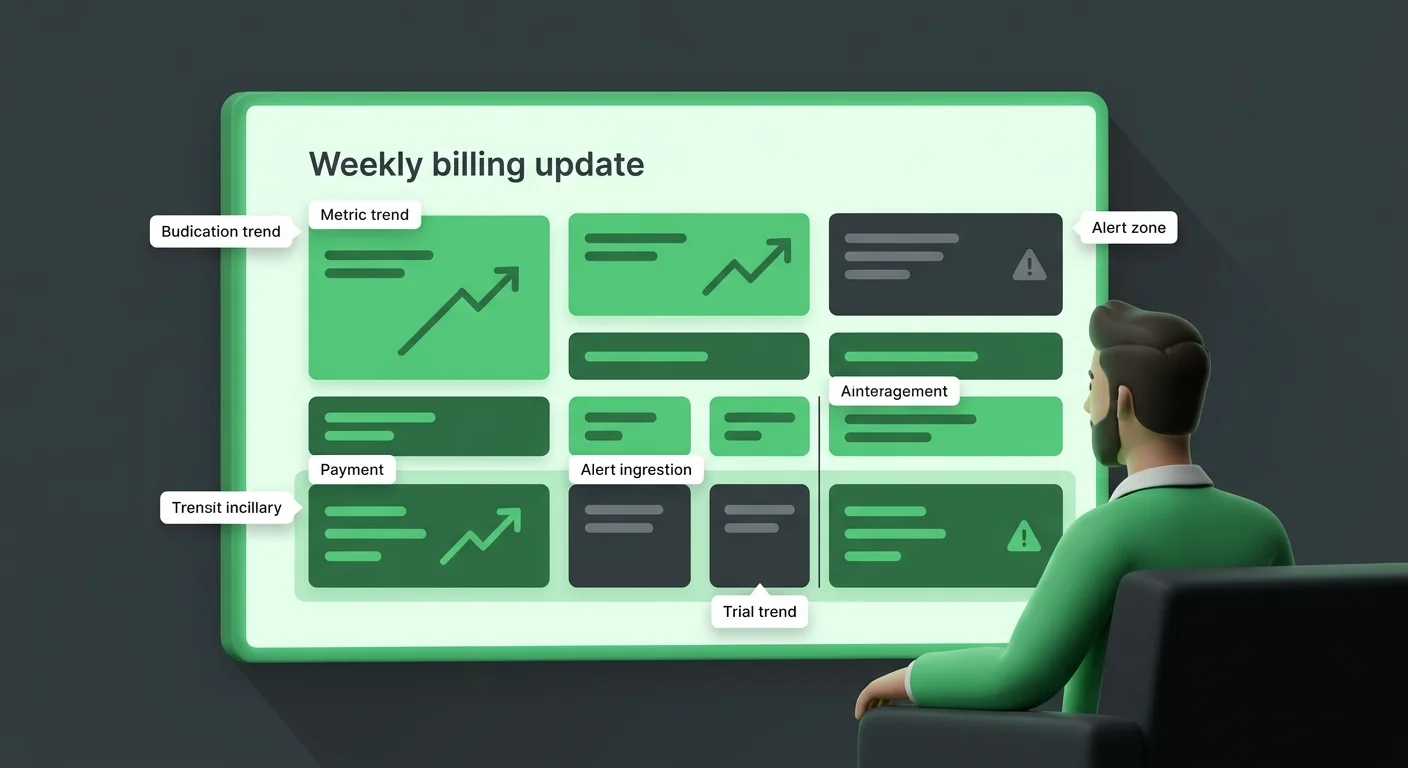
Real-time visibility isn’t a reporting perk. It’s what makes delegation defensible – because you can see, at any moment, whether the work is actually getting done.
The difference between a transparent billing relationship and a black-box one isn’t trust. It’s structure. A billing partner with nothing to hide builds the data access in from the start – not as a courtesy, but as the operating model.
Peer-reviewed research puts the error rate on healthcare bills at up to 80%. In a black-box billing relationship, those errors don’t surface until the claim has already aged past the point of recovery. You never see the problem. You just stop seeing the money. Real-time access is what breaks that cycle.
Key Metrics a Chiropractic Practice Owner Should See Every Week
What you need to see every week isn’t a summary report. It’s the data that tells you whether your highest-value claims are being worked – or sitting ignored in a queue somewhere.
Research on real-time data integration in clinical revenue cycle management shows it consistently reduces days sales outstanding and keeps AR from crossing into unworkable territory – below standard 40-day baselines when the system is functioning. But that only happens when the right metrics are visible early enough to act on. Not after a quarterly review. Not after the damage is already done.
Here’s what actually matters: AR aging by payer, open denial count broken down by claim type, and documentation flags on Medicare claims – especially anything touching AT modifier compliance. Those three data points tell you whether your billing partner is working your hardest claims or quietly moving past them. And knowing what to expect in your first 90 days with a new billing partner shapes how fast a practice can establish that accountability baseline from day one.
This Is Not an Invitation to Do the Billing Yourself
Seeing the data is not the same as doing the billing. That distinction matters. It’s the one most practices miss when they hesitate to ask for access.
A practice that reviews its AR aging report every week isn’t taking billing back in-house. It’s doing what any owner should do with a critical revenue function: confirming the work is actually happening. Every business owner does this with payroll, with rent, with overhead. Billing should be no different. That’s not micromanagement. That’s just owning the outcome.
The goal of weekly communication with your billing team isn’t to give you more to manage. It’s to make the delegation permanent. Visibility is what gives you the confidence to stay out of the details – because you already know someone’s watching them. You don’t need to know how to appeal a denial. You need to know that someone is, and that they’re not going to quietly stop.
| Metric | What It Measures | Healthy Benchmark | Red Flag Signal |
|---|---|---|---|
| AR Aging by Payer | How long claims have been outstanding, broken down by insurance payer | Majority of claims resolving within 40 days | Large blocks of claims aging past 60-90 days with no status change |
| Days Sales Outstanding (DSO) | Average number of days between claim submission and payment receipt | Below the 40-day baseline | DSO trending above 40 days and climbing across consecutive billing cycles |
| Open Denial Count by Claim Type | Number of unresolved denials segmented by claim category (e.g., AT modifier, maintenance vs. active care) | Denials being worked within the current billing cycle | Growing backlog of open denials with no documented appeal activity |
| Claim Error Rate | Percentage of submitted claims that contain documentation or coding errors | Errors identified and corrected before claim ages | Error patterns repeating across billing cycles with no documented correction |
Frequently Asked Questions About Billing Transparency and Practice Growth
Knowing something is wrong is easy. Knowing what to do next is where most practice owners get stuck.
The questions below are what they ask right before they decide to demand something different.
These aren’t hypothetical. They’re the questions that sit between recognizing a black-box billing relationship and replacing it with one that has actual accountability built in.
How does real-time billing access prevent unworked AR from compounding?
Unworked AR doesn’t announce itself. It ages quietly – and the longer it sits, the less of it is recoverable.
Peer-reviewed research indicates that up to 80% of healthcare bills contain errors. In a silent billing relationship, those errors don’t surface until the claims have already crossed into unworkable territory. The practice assumes the biller is handling it. The biller moves on. Neither assumption produces collected revenue.
Real-time access breaks that cycle. When you can see AR aging by payer in real time, a pattern of unworked denials becomes visible within days – not after a quarterly review when the window to act has already closed.
Can’t I just rely on my EHR software reports instead of a live billing dashboard?
An EHR report tells you what was submitted. A live billing dashboard tells you what happened after submission. That second part is what determines whether your practice gets paid.
EHR platforms are claim submission tools. Denial status, AR aging, documentation flags, open appeal counts – none of that is submission-side data. It lives on the billing side. And if the billing side isn’t giving you real-time access, the EHR report is showing you half the picture.
The half that’s missing is exactly where your revenue is either being recovered or quietly abandoned.
Will managing my own billing data require me to do the actual billing work myself?
No. Reviewing your billing data is not the same as doing your billing.
A practice owner who checks their AR aging report every week is not taking over the billing function. They’re confirming the billing function is being executed – which is exactly what any business owner should do with a critical revenue operation.
Visibility is the accountability mechanism. It’s what allows a practice to stay fully delegated with confidence – because when something isn’t being worked, the data surfaces it before it becomes a loss.
What metrics should a chiropractic practice owner review weekly to evaluate billing performance?
Three metrics matter most: AR aging by payer, open denial count by claim type, and documentation flags on Medicare claims – particularly anything tied to AT modifier compliance.
AR aging by payer tells you whether claims are being followed up or sitting. Open denial count by claim type tells you whether your highest-complexity claims are being worked or quietly moved past. AT modifier flags tell you whether your Medicare documentation is meeting the standard CMS enforces with automated precision.
Those three data points tell you more about your billing partner’s actual performance than any monthly summary report ever will.
If claims are getting paid and cash is coming in, why does real-time access even matter?
Clean claims getting paid is not the same as all claims getting paid.
HHS OIG audits found that approximately 82% of chiropractic claims reviewed did not meet Medicare documentation requirements. That figure doesn’t describe practices where nothing was being collected. It describes what happens systemically when high-complexity claims are deprioritized in favor of throughput – while simpler claims keep clearing and revenue keeps arriving.
The money in your account confirms your easiest claims are being processed. It tells you nothing about your hardest ones. Real-time access is the only way to know the difference.
The Only Billing Relationship Worth Having
The only billing relationship worth having is one where you can see what’s happening.
Not because you plan to do the work yourself. Because visibility is what makes delegation safe in the first place.
A billing partner with nothing to hide builds the access in from the start. Not as a courtesy. As the operating model.
The black box is not a feature. It’s a protection mechanism – for the billing company, not for you.
When you can’t see your claim-level data, you can’t verify whether your highest-value claims are being worked or quietly abandoned. That’s not a trust problem. That’s a structural problem. And structure doesn’t fix itself.
Bushido Billing was built on the premise that a chiropractic practice owner deserves to know what is happening with their revenue at every stage of the cycle. Weekly updates, visible AR data, and proactive communication aren’t upgrades. They’re the baseline.
Visibility is not the opposite of delegation. It’s what makes delegation permanent.
A practice owner who can see their billing data doesn’t need to manage their biller. They confirm the work is happening and stay focused on patients. That’s the only arrangement worth entering.
Your claims don’t disappear – they decay in silence. And if the billing relationship you have right now can’t survive a simple request to see your own data, that’s the only answer you need.
Your claims don’t disappear – they decay in silence. If that’s what’s happening right now, the problem isn’t your claims volume. It’s the structure that keeps you from seeing what’s actually being worked and what’s being abandoned.
Bushido Billing builds that visibility in from the start. Book a Call to see what your billing data actually looks like.

© . All Rights Reserved | Web Design by iTech Valet