

How to Conduct a Revenue Leakage Assessment of Your Denied Insurance Claims?
Revenue leakage in denied chiropractic claims doesn’t announce itself. It hides inside a clean submission rate while the claims that actually needed to be worked – the complex ones – age past their appeal windows and disappear.
A revenue leakage assessment is a structured, four-step review process: Pull and Stratify Your Denial Report by Category, Identify High-Complexity Denial Clusters, Quantify Recoverable Revenue by Denial Type, and Assess Your Billing Partner’s Appeal Capacity. It starts after submission. That distinction matters.
The denial report is the first instrument. Claims are sorted by denial category – medical necessity, modifier errors, documentation deficiencies, coding specificity failures – to surface which types occur most frequently and which carry the highest dollar value per occurrence. Clinical documentation deficiencies and missing objective measures are the primary structural driver of chiropractic claim denials. Modifier mismatch is a separate problem: billing modifier errors and improper unbundling trigger insurer denials that require manual claim scrubbing to correct.
Once categories are mapped, the assessment isolates high-complexity denial clusters. These are the claims that require medical necessity arguments, multi-level appeals, or documentation corrections to recover. Medicare’s AT modifier is the clearest example of complexity in practice. Medicare mandates the AT modifier to identify active, corrective chiropractic adjustments and explicitly excludes maintenance therapy from covered benefits. A claim that misapplies or omits the AT modifier does not get adjusted – it gets denied. Recovering it requires a structured appeal, not a resubmission.
Quantifying recoverable revenue means identifying how much of the denied balance is still within its appeal window. Medicare Fee-for-Service appeals follow a strict five-level review system. Level 1 Redetermination requires filing within 120 days of the initial determination. Revenue that ages past that deadline is gone.
The final step is the one most practices skip: evaluating whether the billing operation has the capacity to work those appeals. A clean submission rate is not a revenue guarantee – it is a hiding place. This assessment measures what comes back.
What Revenue Leakage Actually Means in a Chiropractic Billing Cycle
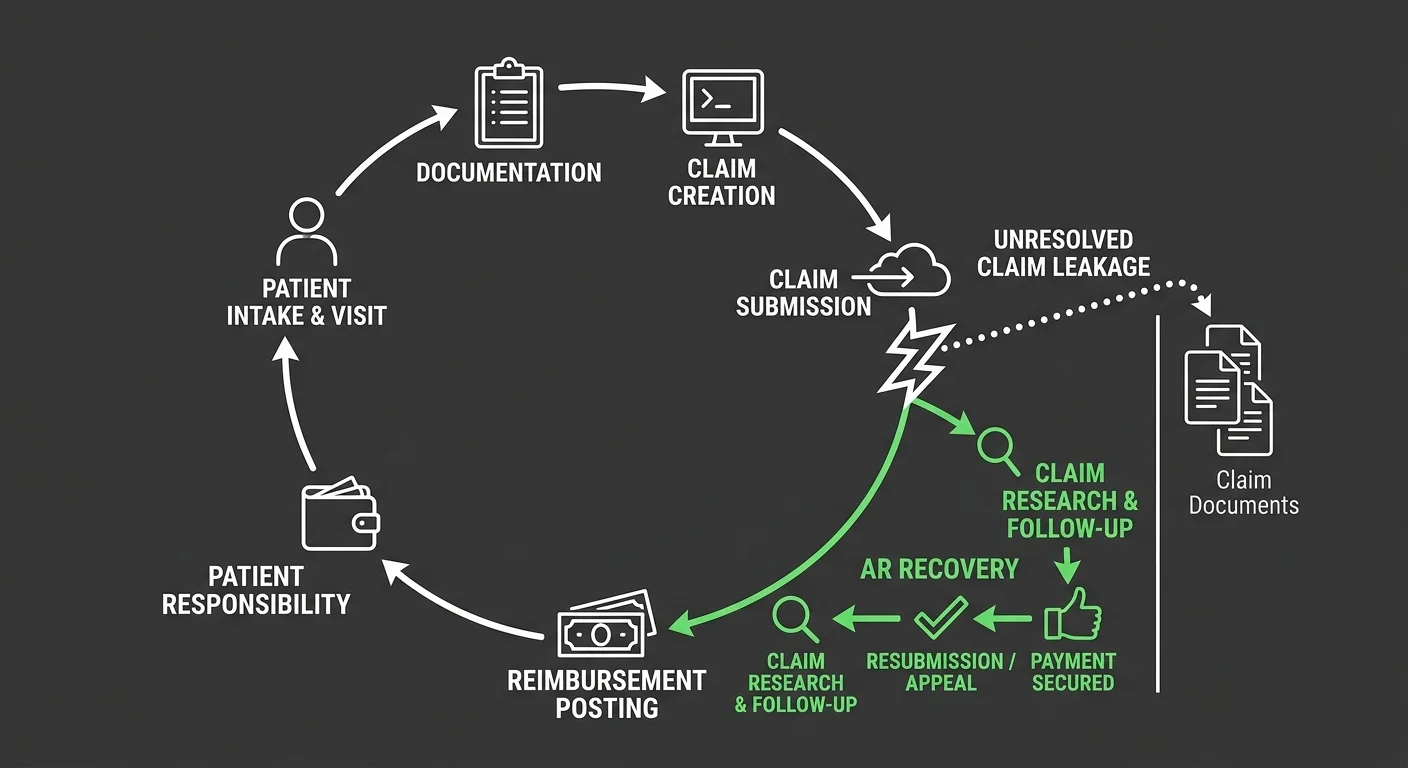
Revenue leakage is not a billing error. It is a structural outcome – the predictable result of measuring the wrong thing for long enough that the losses stop feeling like losses and start feeling like normal.
Here’s the thing: most practices track claim submission rate as a proxy for billing health. But that number only tells you what went out. It says nothing about what came back.
A claim leaves the practice clean. It comes back denied. It sits in an aging report, unworked. No billing dashboard flags that as a failure. It logs as a submission. The submission was perfect. The revenue is gone.
Administrative expenses make up roughly 25% of all US healthcare spending, according to McKinsey. And the waste doesn’t pile up at intake. It compounds at the denial and appeal stage.
That’s precisely where most automated billing platforms stop working. So that’s exactly where chiropractic revenue leaks. Not at the front door. At the back.
Why Most Practices Measure the Wrong Thing
Billing companies lead with clean claim rate because it is easy to defend. High submission speed, low clearinghouse rejection rate – those numbers look like performance. They are not performance. They are throughput.
Throughput measures how fast claims leave the practice. Recovery measures how much money comes back. Those are different instruments entirely.
Conflating them is how practices spend years assuming their billing is working while AR quietly ages past the point of return. A practice audit that maps what is actually in the AR – by denial type, age, and dollar value – is the only way to see the gap between those two numbers.
Documentation deficiencies and missing objective measures are the leading structural driver of chiropractic claim denials. That pattern doesn’t show up in a submission report. It shows up in a denial report – and only if someone is actually reading it.
The Claims That Never Come Back
Some denied claims get worked. Most do not.
The ones that require a medical necessity argument, a multi-step appeal, or a documentation correction are the most expensive to recover – which makes them the first claims a volume-based billing operation quietly deprioritizes. They sit. They age. The appeal window closes.
But the practice never sees that decision get made. There’s no report that says a claim was abandoned. It just stops moving.
And without proactive communication, the practice assumes the claim is being worked – right up until the filing deadline passes and the revenue is gone for good. That’s what leakage looks like from the inside: not a sudden loss, but a slow, silent drain that only becomes visible when someone runs the right assessment.
| Leakage Category | Where It Appears in AR | Why It Goes Undetected | Estimated Recovery Window |
|---|---|---|---|
| Medical Necessity Denials | Aging AR at 60-90 days, often miscategorized as ‘pending’ rather than denied | Submission dashboards record the claim as sent; the denial return is logged but never escalated for appeal | Workable if identified early; window closes progressively as payer-specific timelines expire |
| AT Modifier Errors (Medicare) | Flat denials with no resubmission pathway visible in standard clearinghouse reporting | Automated systems flag the rejection but cannot construct a medical necessity argument; the claim stalls without human escalation | Requires structured appeal filed within the payer’s redetermination window; unworked claims age out entirely |
| Documentation Deficiencies | Clustered in denials tied to specific providers or visit types; rarely separated from general denial volume in aggregate reports | Root cause is invisible without reading individual denial remittances; volume-based billing operations do not audit at that level | Recoverable only if documentation can be corrected and resubmitted before the appeal deadline; after that, permanently lost |
| Coding Specificity Failures (ICD-10) | Mixed into denial batches alongside modifier errors, making the coding root cause difficult to isolate without manual review | Clearinghouse scrubbing catches formatting errors, not clinical specificity failures; those pass through and deny at the payer level | Short recovery window; payers require corrected claims promptly and do not extend timelines for coding-based denials |
| Abandoned High-Complexity Claims | Present as static line items in AR aging reports – no movement, no status update, no escalation flag | No report labels a claim ‘abandoned’; silence from the billing operation is indistinguishable from active work without direct inquiry | Unrecoverable once the appeal window closes; the loss only becomes visible when the practice runs a structured denial assessment |
| Personal Injury Lien Claims | Segregated from insurance AR in some systems, creating blind spots in standard aging report reviews | Lien billing follows a different resolution timeline than insurance claims; practices tracking only insurance AR miss the gap entirely | Dependent on case resolution; requires active monitoring rather than a fixed filing window |
Why Clean Claim Rates Hide the Real Revenue Problem
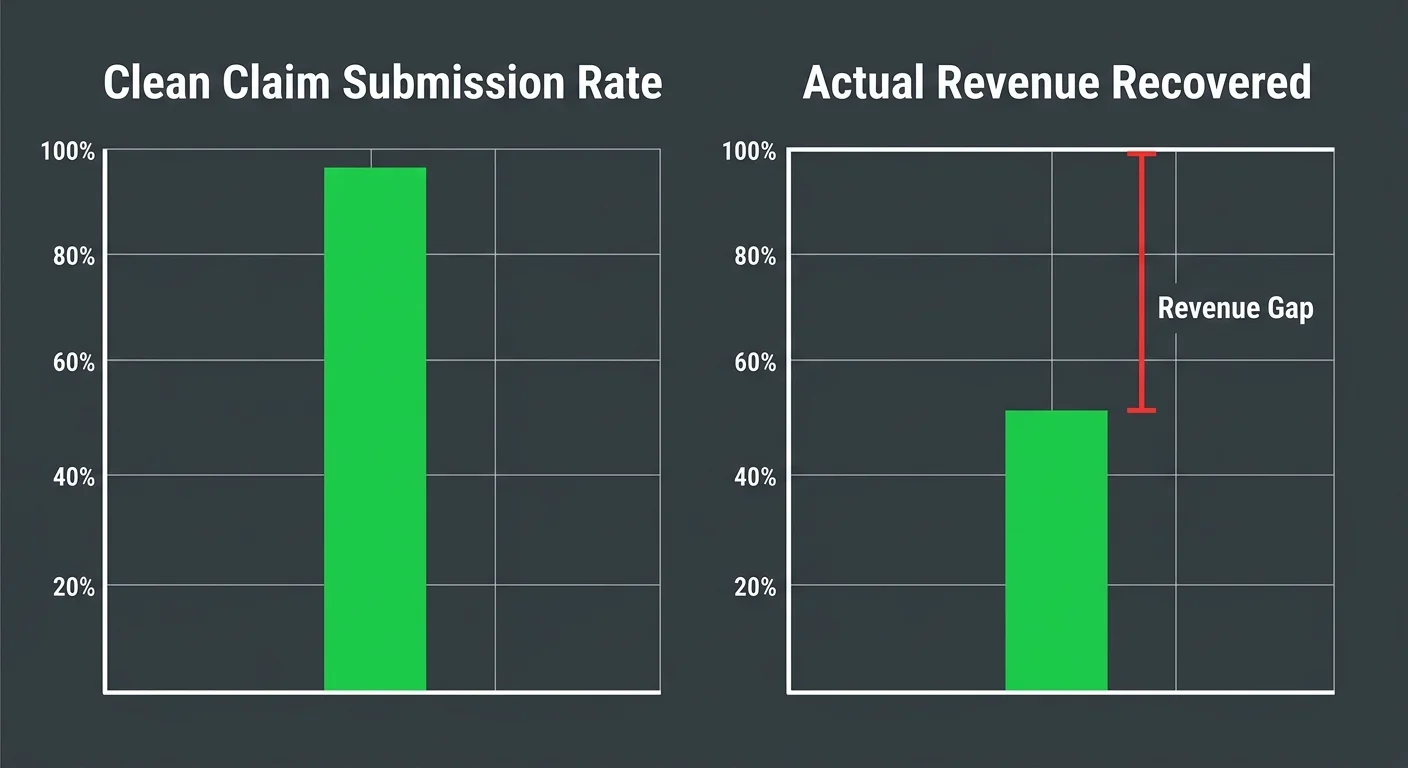
Clean claim rate is the number billing companies lead with because it is easy to defend.
High submission speed, low clearinghouse rejection rate – those numbers look like performance. They are not performance. They are throughput.
Most billing companies are built to optimize the first number. They stay silent on the second.
That silence is the problem. The gap between what gets submitted and what actually gets paid is invisible to the practice – until it shows up as a cash flow shortfall that has been compounding for months. By then, some of it is already unrecoverable.
That gap is where chiropractic revenue disappears.
Not at intake. Not at submission. At the denial stage – when a claim comes back rejected and the decision about whether to appeal it gets made quietly, inside a billing operation the practice never sees.
Why Volume-First Billing Models Deprioritize Complex Chiropractic Denials
Here’s the thing about volume-first billing: it works exactly as designed for clean claims. Straightforward diagnosis, standard code, no modifier issues – those claims move fast, process cleanly, and get paid.
The model is efficient because it does not slow down for complexity. That is also exactly what makes it dangerous.
But the moment a claim requires a medical necessity argument, a documentation correction, or a modifier dispute – the volume model has no pathway for it.
Working that claim costs more time than the model allocates per claim. So it gets deprioritized. Then it ages. Then the appeal window closes and the revenue is gone.
Modifier mismatch is one of the clearest examples. Research published on PubMed confirms that billing modifier errors and improper unbundling are primary drivers of insurer denials – and recovering them requires manual claim scrubbing, not resubmission.
That scrubbing takes human judgment. It takes time. Volume models do not budget for either – so those claims don’t get scrubbed. They get skipped.
So the revenue disappears. And no report surfaces the decision that lost it.
The claim stops moving. The practice assumes it is being worked – right up until the filing deadline passes. McKinsey puts administrative expenses at roughly 25% of all US healthcare spending. That inefficiency compounds hardest at exactly the stage volume models abandon: the denial and appeal layer.
That is not a billing error. That is a structural outcome.
The High-Complexity Denial Categories That Drain Chiropractic Cash Flow
Not all denials cost the same.
The ones that hit hardest are the ones that require specialty-level knowledge to fight: AT modifier disputes, medical necessity rejections on active care, personal injury lien complications. These are not coding oversights a clearinghouse catches. They are high-friction, high-value recovery problems – and generalist billing operations consistently leave them unworked.
And these are the denial categories that carry the most recoverable revenue.
A clearinghouse rejection on a misformatted claim is easy to fix. A denial asserting that active chiropractic adjustments lacked sufficient medical necessity documentation is not. That denial requires a clinical argument, supporting records, and a structured multi-level appeal. Automated platforms are not built to do that work. Volume-first billers are not incentivized to do it either.
The result is predictable. High-complexity denials pile up in aging reports. Appeal deadlines pass unnoticed. The practice’s real revenue picture – what is still recoverable versus what has already aged out – stays completely invisible.
That is exactly what a revenue leakage assessment is built to expose. Specifically, tracking the process for recovering denied revenue by denial type and age is what turns an aging report from a static document into an action list. Before the remaining window closes.
| Billing Performance Metric | What It Measures | What It Misses | Who Benefits From Using It |
|---|---|---|---|
| Clean Claim Submission Rate | How fast claims leave the practice with no clearinghouse rejection | Whether denied claims are appealed, worked, or abandoned after submission | Volume-first billing companies – high throughput looks like high performance |
| First-Pass Acceptance Rate | The percentage of claims accepted by the clearinghouse on initial submission | Payer-level denials that occur after clearinghouse acceptance – the stage where complex denials accumulate | Automated billing platforms – clearinghouse acceptance is easy to report and easy to defend |
| Claim Volume Processed | Total number of claims submitted within a billing period | The dollar value and recoverability of denied claims sitting unworked in the AR | Generalist billing operations – volume metrics obscure the quality of recovery work |
| AR Aging Report | How long outstanding balances have been sitting unpaid, grouped by time bucket | Which balances are still within appeal window versus permanently unrecoverable – the report shows age, not workability | Neither the practice nor the biller without a denial-type overlay – raw aging data hides recovery potential |
| Denial Rate | The percentage of submitted claims that receive a payer denial | The breakdown of denial categories – whether denials stem from documentation gaps, modifier errors, medical necessity rejections, or unbundling issues that require different recovery strategies | Billing companies reporting aggregate denial rate – a single percentage conceals the complexity and recoverability of what is inside it |
| Revenue Recovery Rate by Denial Type | What percentage of each denial category is successfully appealed and paid – stratified by complexity and payer | Nothing – this is the metric that surfaces where chiropractic revenue actually disappears | The practice and its billing partner – this number is rarely reported because it requires human tracking, not automated dashboards |
How to Conduct the Revenue Leakage Assessment: A Step-by-Step Framework
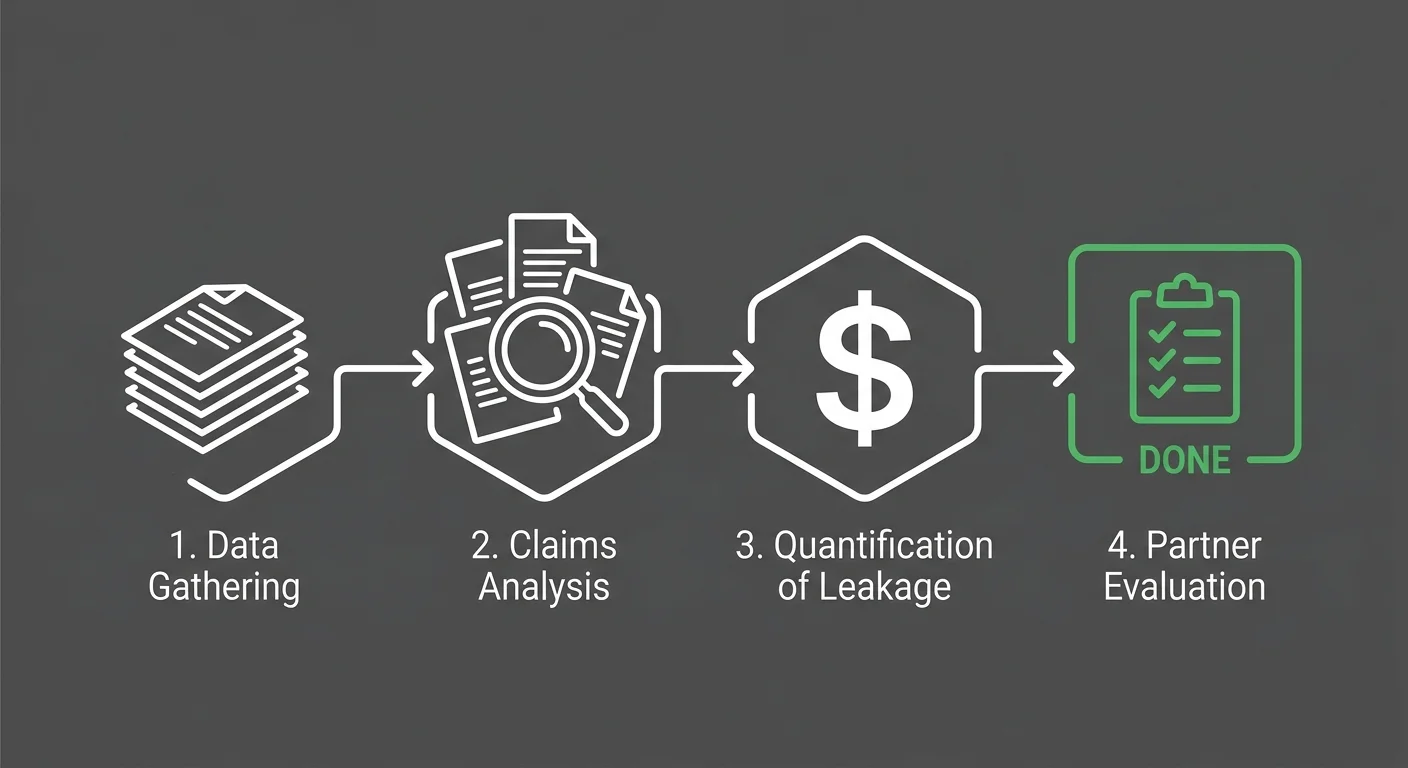
Knowing revenue is leaking is not the same as knowing where it’s going. The assessment only earns its place when it produces three things: exactly where the leakage is happening, how much of it is still recoverable, and whether anyone in the billing operation is actually equipped to get it back.
That takes four steps – each one building on the last. And none of it shows up in a standard submission report.
Step 1 – Pull and Stratify Your Denial Report by Category
Pull the raw denial report from your billing system or clearinghouse. But don’t treat it as a flat list – that’s where most practices stop, and stopping there tells you almost nothing. The first real move is stratification: sorting denials by category so the report reveals patterns instead of isolated incidents.
The categories that matter: denial reason code, payer, service date, and dollar value. An unstratified denial report tells you claims were denied. A stratified one tells you why – and whether the same reason is showing up across multiple claims, multiple payers, or multiple date ranges. That’s not a list. That’s a diagnosis.
Modifier mismatch and improper unbundling are the two categories most likely to cluster. And when they cluster, that’s not bad luck – that’s a systemic coding problem. Recovering those claims requires manual claim scrubbing, not a simple resubmission. If those errors keep showing up in the stratified report, something upstream is broken.
Step 2 – Identify High-Complexity Denial Clusters
Stratification shows you the pattern. Step 2 finds the worst of it – the denial clusters with the highest recovery cost. These aren’t claims a corrected resubmission fixes. These are the ones that require a structured appeal.
The clearest marker is a medical necessity dispute. The payer isn’t just rejecting the claim on a technicality – they’re asserting the documentation doesn’t support the services billed. Resolving that requires a clinical argument, supporting records, and in Medicare cases, working through a published appeals framework that covers up to five levels of review. The AT modifier denial is the sharpest example of this. CMS chiropractic coverage rules mandate the AT modifier to identify active, corrective adjustments and explicitly exclude maintenance therapy from covered benefits. Miss it or misapply it, and no resubmission will touch the denial.
These are exactly the claims volume-first billing operations quietly stop working. The time required to appeal them doesn’t fit the model – so they don’t. Step 2 is how the assessment separates recoverable revenue from revenue that’s already being silently abandoned.
Step 3 – Quantify Recoverable Revenue by Denial Type
Step 3 runs the numbers. For each denial category, the assessment calculates the total dollar value of denied claims – then checks that figure against the appeal filing deadline to determine what’s still workable.
Medicare Level 1 Redetermination requires filing within 120 days of the initial determination. Past that window, the revenue is gone – no appeal pathway exists. So quantifying recoverable revenue by denial type is also a deadline audit: how much is still reachable, how much is borderline, and how much has already closed. That’s the number the assessment is built to surface. For claims still inside the window, knowing the process for recovering denied revenue – which documentation is needed, which denial types are realistically workable – determines where to focus appeal effort first.
Step 4 – Assess Your Billing Partner’s Appeal Capacity
Step 4 is the one most practices skip. It’s also the most important. Knowing what’s recoverable means nothing if the billing operation doesn’t have the capacity – or the expertise – to work the appeals.
Step 4 asks three direct questions. Does your billing operation track appeal outcomes by denial type? Is there a dedicated person actively working denied claims – or does the denial queue sit unattended until someone flags it? And has your billing partner shown you, in writing, that complex chiropractic denials – AT modifier disputes, medical necessity rejections – are being appealed, not filed and forgotten?
A full-service billing partner built for chiropractic and allied health should answer all three questions immediately – with documentation. Vague answers aren’t a minor concern. No appeal tracking at all means the assessment has found the source of the leak. Not in the claims themselves, but in the operation that was supposed to recover them. Bushido Billing structures every client engagement around this exact accountability standard: what went out, what came back denied, what was appealed, and what was recovered. That’s the conclusion a comprehensive practice audit is built to reach.
| Assessment Step | Data Source Required | What You Are Looking For | Red Flag Signal |
|---|---|---|---|
| Step 1 – Pull and Stratify Your Denial Report by Category | Clearinghouse export or billing system denial log, sorted by denial reason code, payer, service date, and dollar value | Repeating denial reason codes across multiple claims or payers – patterns that signal a systemic billing problem rather than an isolated error | Denial report is a flat, unsorted list with no category breakdown – no stratification means no diagnosis |
| Step 2 – Identify High-Complexity Denial Clusters | Stratified denial report from Step 1, plus payer Explanation of Benefits (EOB) or Remittance Advice (RA) documents | Medical necessity disputes, modifier-related rejections, and documentation deficiency denials – claim types that require a structured appeal rather than a corrected resubmission | No distinction between simple rejections and complex denials – all denied claims are treated as resubmission tasks, meaning high-value appeals are never initiated |
| Step 3 – Quantify Recoverable Revenue by Denial Type | Denial aging data cross-referenced against payer appeal filing deadlines by denial category | Total dollar value of denied claims still within the appeal filing window – segmented by denial type to prioritize where appeal effort is most valuable | No aging cross-reference exists – the practice has no visibility into how much denied revenue has already aged past the appeal deadline and is permanently lost |
| Step 4 – Assess Your Billing Partner’s Appeal Capacity | Written appeal tracking records, denial resolution logs, and direct documentation of appeal outcomes by denial type from the billing operation | Evidence that high-complexity denials – including modifier disputes and medical necessity rejections – are actively being worked and appealed, not deprioritized | No appeal tracking documentation exists, or answers to capacity questions are vague – the billing operation cannot demonstrate that denied claims are being worked at all |
What a Completed Revenue Leakage Assessment Reveals About Your Billing Partner
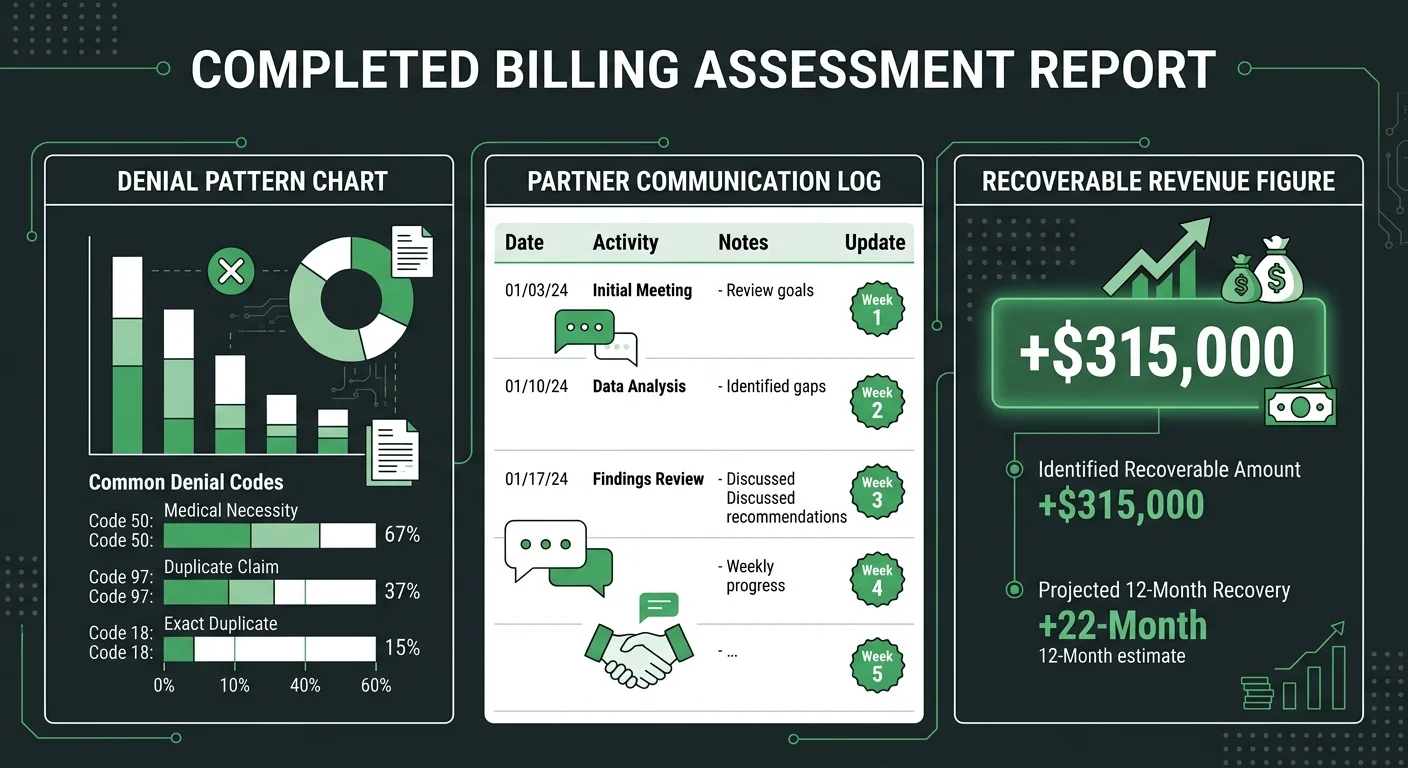
Four steps. One number.
But here’s the thing – the number isn’t the point. The point is what it tells you about the billing operation that was supposed to prevent it from happening in the first place.
A finished assessment doesn’t just show you how much revenue walked out the door. It shows you whether the billing partner has a functioning appeal process – a dedicated person reviewing denied claims by category, a documented track record of working high-complexity denials through to resolution.
Those three things either exist or they don’t. The assessment makes the answer visible. And most practices don’t like what they see.
And when practices run this process for the first time, the finding is almost never a coding problem. It’s a communication and capacity problem.
Claims go out. Denials come back. The appeal layer is understaffed, untargeted, or absent entirely. Clinical documentation gaps and missing objective measures drive those denials – but that’s only half the failure. The other half is a billing operation that never surfaces the pattern, never connects it to how per-visit reimbursement rates drift below contracted levels over time, and never tells the practice that both problems are compounding at once.
Who This Assessment Is Not For
This assessment is built for practices under real insurance pressure. Not every practice qualifies – and that’s worth saying plainly.
If your practice runs primarily cash-pay, carries minimal insurance volume, or wants a one-time cleanup with no intention of changing the underlying billing relationship – this process won’t produce value for you.
The assessment diagnoses a billing system under real payer pressure. Without that pressure, there’s nothing to diagnose. The exercise only works if the problem it’s built to surface actually exists.
So is a practice that wants a report without a response.
The assessment surfaces recoverable revenue and structural failures – but recovery requires action. ICD-10 clinical specificity rules and standardized diagnostic coding standards, as outlined in published coding guidelines, exist because claim accuracy isn’t self-correcting. Neither is a broken billing relationship.
If you’re not prepared to act on what this reveals – whether that means demanding accountability from your current operation or replacing it – the exercise produces information. It doesn’t produce change.
What the Numbers Signal About Your Next Move
The numbers the assessment produces sort into three categories.
Revenue still recoverable within active appeal windows. Revenue that’s borderline and needs immediate action. And revenue that has aged past the point of return.
Each category carries a different instruction. And the third one is the most important.
Aged-out revenue isn’t just a cash flow loss. It’s evidence of a systemic failure – one that happened quietly, repeatedly, and without a single notification to the practice.
The Medicare Level 1 Redetermination window closes 120 days from the initial determination. Every claim that aged past that deadline without a filed appeal represents a decision the billing operation made on the practice’s behalf.
A decision the practice was never told about.
But the forward-looking signal matters just as much.
The recoverable revenue figure – stratified by denial type, payer, and filing deadline – defines exactly where appeal effort should be concentrated first. A billing partner that can receive that output and deploy structured appeal capacity against the highest-value, most time-sensitive denial clusters is what full-service billing actually means.
A billing partner that can’t is a submission service. The assessment tells a practice – clearly, without inference – which one it currently has. And what the process for recovering denied revenue looks like with the right operation behind it.
| Assessment Finding | What It Signals About Your Billing Relationship | Recommended Next Step |
|---|---|---|
| No appeal tracking by denial type or payer | The billing operation is processing claims, not managing revenue – denials are logged but not worked systematically | Require written documentation of appeal outcomes by denial category before the next billing cycle |
| High-complexity denials (medical necessity disputes, modifier errors) clustered across multiple date ranges | The same structural failure is repeating without correction – the billing operation is not identifying or escalating denial patterns | Conduct a root-cause review of the top denial category and verify whether any structured appeals were filed |
| Significant denied revenue aged past active appeal windows | The billing operation allowed recoverable revenue to close without action – a decision made on the practice’s behalf without disclosure | Quantify the total closed revenue, establish a deadline audit protocol, and verify current denial queue age going forward |
| No dedicated person assigned to reviewing denied claims | Denial management is unassigned overhead, not a structured function – complex appeals are deprioritized or abandoned entirely | Confirm whether a named biller is accountable for the denial queue, with documented review cadence and escalation criteria |
| Practice has not received proactive denial reporting or trend communication | Silence is a structural feature of the billing relationship, not an oversight – problems are accumulating without the practice’s knowledge | Establish a minimum weekly update standard and verify whether the billing operation can produce denial trend data on demand |
| Recoverable revenue is stratified and appeal windows are still open | The billing relationship is repairable if the billing operation has the capacity and specialty expertise to work high-complexity appeals immediately | Deploy structured appeal effort against the highest-value, most time-sensitive denial clusters first – starting with medical necessity disputes and modifier-related rejections |
Frequently Asked Questions About Revenue Leakage Assessments
The assessment produces numbers. The numbers produce questions.
Practitioners who see their denial data stratified and quantified for the first time do not need more information. They need answers to the questions that have been sitting underneath their billing reports for months.
These are the ones that come up every time.
How often should a chiropractic practice conduct a revenue leakage assessment?
Every time the billing relationship changes. Every time payer contracts are renegotiated.
Beyond those triggers, the assessment should run on a defined cadence – not as an annual formality, but whenever denial volume trends upward over a rolling quarter or AR aging starts shifting toward the 90-plus-day column.
A billing operation that is functioning correctly surfaces those signals without being asked. One that does not is itself a reason to run the assessment immediately.
What are the most common coding errors that lead to chiropractic claim denials?
Two categories drive most of the denial volume in chiropractic practices: documentation deficiencies and modifier errors.
Documentation deficiencies mean the clinical record doesn’t support the medical necessity of the service billed. Missing objective measures, incomplete functional assessments, inadequate progress notes – any of these gives a payer grounds to deny. The second category is modifier mismatch and improper unbundling: codes submitted don’t correctly represent what was performed, or they conflict with payer-specific bundling rules. ICD-10 clinical specificity failures fall into this second bucket – and they’re more common than most practices realize.
Both are correctable. But only if someone is tracking which error type is driving which denial – and feeding that data back to the provider. A billing operation that isn’t doing that isn’t managing your denials. It’s watching them.
How does the Medicare AT modifier impact reimbursement for active chiropractic care?
The AT modifier tells Medicare that the service being billed is active, corrective, and medically necessary. Without it, Medicare reads the visit as maintenance therapy – which it does not cover. Full stop.
That is not a technicality. It is the line between a paid claim and a denied one.
Medicare excludes chiropractic maintenance therapy from covered benefits under any circumstance. A claim submitted without the AT modifier fails on first review. So does a claim submitted with the AT modifier on a visit whose documentation does not meet active care standards – because the modifier makes a promise the record has to keep. A billing operation that isn’t tracking AT modifier compliance by provider and by visit type isn’t managing Medicare reimbursement. It’s submitting claims and hoping the documentation holds.
What is the difference between a clearinghouse rejection and a payer denial?
A clearinghouse rejection happens before the claim ever reaches the payer. It failed a format or eligibility check and was never adjudicated. The payer never saw it.
A payer denial happens after adjudication – the claim was received, reviewed, and rejected on clinical or coverage grounds.
The corrective action is completely different. Clearinghouse rejections need a corrected resubmission. Payer denials need a formal appeal with supporting documentation. Practices that lump these two categories together in their denial reporting cannot accurately assess how much revenue is still recoverable – or where appeal capacity should go first. Mixing them is not a minor reporting issue. It is how recoverable revenue quietly ages out of reach.
Can an EHR-integrated billing tool replace a dedicated medical biller for denial management?
No. And the distinction matters more than most practices realize.
An EHR handles claim submission. It sends the claim and records the transaction. What happens after the claim comes back – that is billing. Reviewing the explanation of benefits, identifying the denial reason, determining whether an appeal is warranted, assembling supporting documentation, filing within the payer’s deadline – no EHR automates that sequence. Not one.
Manual claim scrubbing is what actually lowers first-pass denial rates. The appeal work that follows a denial requires human judgment every time. The EHR is the submission mechanism. The biller is the recovery mechanism. Treating one as a substitute for the other is exactly how appeal capacity disappears – quietly, claim by claim, until the AR report reflects it.
How do I know if my current denial rate is a billing problem or a documentation problem?
Start with where the denial reason codes are pointing.
If the majority cite medical necessity, missing documentation, or inadequate clinical records – the primary driver is documentation. The fix starts at the clinical level, with the provider’s charting. If the majority cite modifier errors, bundling conflicts, or incorrect procedure codes – the primary driver is billing execution.
Most assessments reveal both. A documentation gap the billing operation never surfaced. A coding pattern that was never corrected because no one was tracking it. ICD-10 clinical specificity requirements for chiropractic are not ambiguous – standardized coding guidelines exist to define exactly what the record must support. When denials cluster around specificity failures, the question is not whether the standard exists. It is whether anyone in the billing relationship is actually applying it. If the answer is no, that is the assessment finding that matters most.
What the Assessment Is Really Telling You
The assessment doesn’t end with a number. It ends with a verdict.
Every step – stratifying denials by category, isolating high-complexity clusters, quantifying recoverable revenue, stress-testing appeal capacity – is built around one question. Not "how much was lost?" but "why was it allowed to stay lost?"
That’s the difference between a report and a diagnosis.
And what the four steps consistently expose isn’t a coding crisis. It isn’t a payer problem.
It’s a structural accountability gap.
Claims go out. Denials come back. Somewhere between that denial and the appeal filing deadline, the billing operation either acts – or it doesn’t. In volume-first models, it doesn’t. The claim sits. The clock runs. The window closes.
The assessment makes that invisible process visible. It converts silence into a documented record: what was worked, what was abandoned, what closed permanently without a single appeal attempt. That record is what a practice deserves to see. And what most practices have never been shown.
So here’s what the assessment is really telling a practice: the gap between what was submitted and what was recovered isn’t bad luck. It’s a design feature of a billing model that was never built to close it.
A billing partner built for chiropractic and allied health – one that tracks appeal outcomes by denial type, assigns a dedicated person to high-complexity claims, and communicates findings without being asked – isn’t a premium upgrade. It’s the baseline standard. Anything short of that isn’t full-service billing. It’s a submission service with a billing company’s name on it.
Bushido Billing exists because that distinction has a measurable cost – and most practices are paying it without knowing it. A clean submission rate is not a revenue guarantee – it is a hiding place.
Your denial data already has the answer. A clean submission rate isn’t a revenue guarantee – it’s a place to hide problems until they compound past the point of recovery. If working through this process surfaced questions your current billing relationship hasn’t answered, that’s the conversation. Book a Call

© . All Rights Reserved | Web Design by iTech Valet