

Transparency vs. Opacity: How to Spot the Signs of a Failing Billing Relationship?
A failing chiropractic billing relationship has one consistent signature: silence. Claims go out. Time passes. The practice receives no meaningful update on what was paid, what was denied, or what is sitting unworked in the accounts receivable queue.
That silence is not an accident. It is a structural feature of billing models that prioritize claim submission volume over actual revenue recovery.
A silent billing dashboard is not a clean AR report. It is a window with the blinds pulled down.
The warning signs fall into two categories: communication patterns and financial outcomes. On the communication side, the indicators are infrequent or absent reporting, no proactive notification when denials spike, and no dedicated point of contact who understands the practice’s payer mix and claim history. On the financial side: aging AR that never resolves, denial rates that climb without explanation, and cash flow gaps the practice cannot trace to any specific billing failure.
Chiropractic billing carries compliance obligations that make this worse. Medicare requires the Active Treatment modifier on every claim for corrective care, and maintenance therapy is explicitly excluded from reimbursement. When a billing partner is not actively monitoring documentation requirements and communicating gaps back to the provider, those claims fail quietly – and the practice does not find out until the AR has already aged past recovery.
Administrative errors are the primary driver of initial insurance claim denials. Denial rates range from five to fifteen percent across healthcare practices, and up to eighty-six percent of those denials are attributable to preventable mistakes. A billing partner operating without consistent reporting cannot identify, track, or correct those error patterns. The denials repeat. The AR grows.
A healthy billing relationship looks different. It includes a dedicated biller who knows the practice, weekly updates that surface denial patterns before they become cash flow problems, and full AR visibility on demand. Transparency is not a premium feature. It is the baseline standard that determines whether a billing relationship is actually working – or simply appearing to work while revenue quietly disappears.
What Billing Transparency Actually Means – And Why Most Relationships Don’t Have It
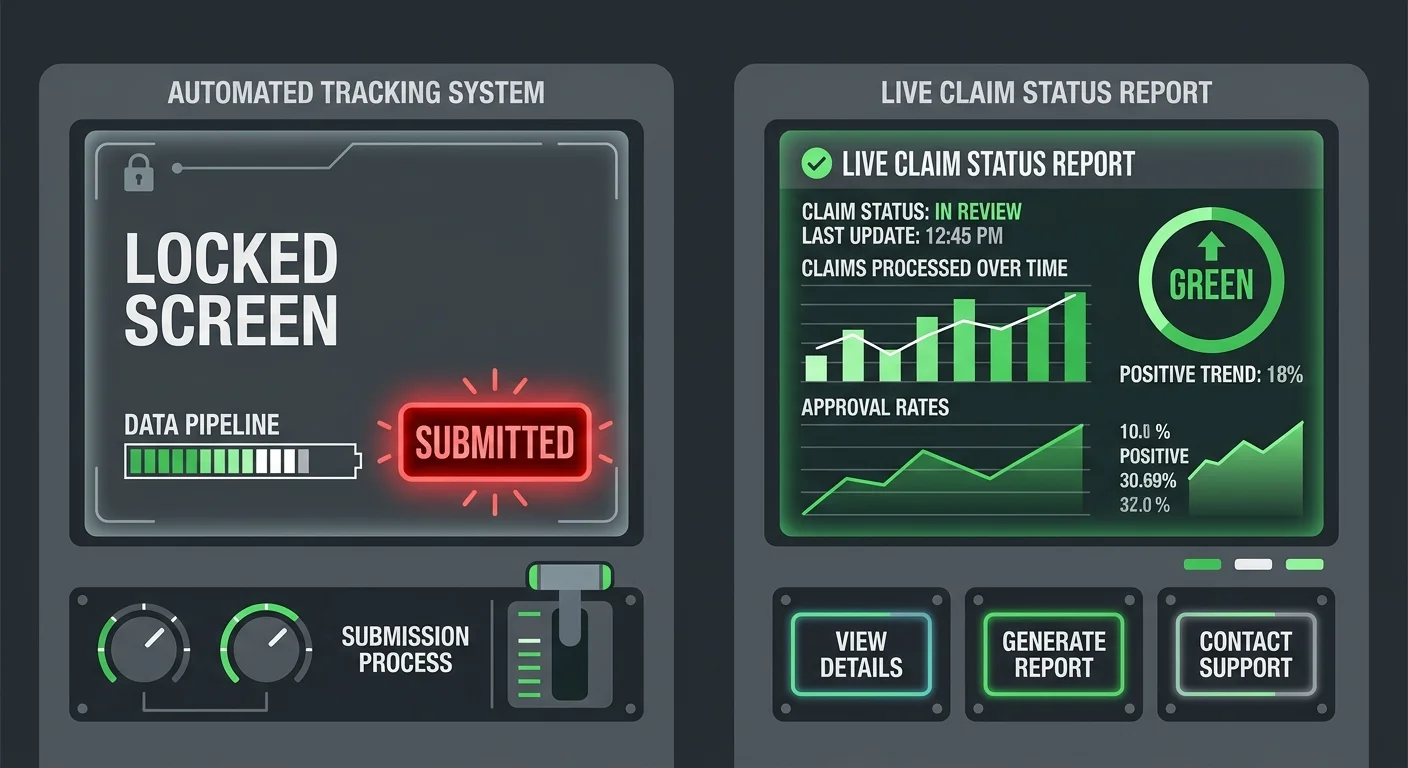
Transparency in a billing relationship isn’t a feature you unlock at a higher price tier.
It’s a structural condition. Either the relationship was built for it, or it wasn’t. And your AR report will tell you which one you have – usually long before anyone bothers to mention it.
Here’s what it actually looks like: a dedicated biller who knows your payer mix, a weekly update that names what was paid, what was denied, and what’s actively being worked.
AR visibility you don’t have to ask for. That’s the baseline.
Anything short of that isn’t a billing partnership. It’s a billing assumption.
The billing industry redefined transparency. Quietly, and entirely to its own benefit.
Now it means: you can log in and see a number. A portal. A submission count. A dashboard that refreshes without any human involvement and requires none going forward.
That is not the same as a partner calling you to explain why three of your Medicare claims came back denied this week – and what’s actively being done about it. A portal tells you claims went out. A partner tells you what came back, what’s stuck, and what it’s going to cost you if it doesn’t move.
The Difference Between a Dashboard and Actual Visibility
A silent dashboard is not a clean AR report. It’s a window with the blinds pulled down.
The number on the screen tells you how many claims went out. It says nothing about what came back denied, what aged past ninety days, or what the biller quietly stopped working because the claim was too complex to resolve under their model.
Real visibility means someone reads the data and tells you what it means.
That’s the separation between a dedicated biller assigned to your practice and a rotating pool processing claims in bulk. One model produces interpretation. The other produces throughput. And interpretation is the only thing that catches a problem before it ages into a write-off.
Throughput doesn’t catch anything. It just keeps moving.
NIH research links administrative opacity directly to mounting aged accounts receivable and clinic financial distress. Hidden billing errors don’t stay small. They compound.
A billing partner who doesn’t surface errors proactively isn’t protecting the practice. They’re controlling when the practice finds out how much revenue it’s already lost. Those are not the same thing.
Why the Volume-First Model Was Never Built for Transparency
The volume-first billing model was engineered around one metric: how fast claims go out.
Not how much comes back. Not what gets denied. Not what gets worked. Speed of submission. That’s it.
Denial follow-up, documentation review, weekly communication with the practice – none of that was ever in the model. It was never designed to do those things.
That model works fine for clean, simple claims. Straightforward coding, standard payer, no modifier complexity – those get processed, paid, and the submission count looks great.
But the moment a claim needs a medical necessity argument or a documentation correction, the volume model has no efficient pathway.
So the claim sits. Then it ages. Then it quietly dies – and nobody tells the practice.
This is why denial rates across healthcare practices run from five to fifteen percent. And why up to eighty-six percent of those denials trace back to preventable administrative mistakes.
The volume-first model doesn’t eliminate those errors. It processes past them. The claim fails, the submission count stays impressive, and the practice absorbs a loss it doesn’t even know it’s taking yet.
That’s not a billing problem. That’s a structural silence problem.
Effective chiropractic revenue cycle management requires a partner built to catch denial patterns and report them before they become structural cash flow problems.
The volume-first model isn’t that partner. It was optimized to submit – and submission is where its responsibility ends. Everything after that – the follow-up, the appeals work, the denial tracking, the weekly conversation about what’s actually happening in the AR – is exactly what that model was designed to skip.
That’s not an oversight. That’s the model.
| Visibility Marker | Automated Dashboard Model | Human-Led Billing Partner |
|---|---|---|
| Claim status updates | Portal shows submission count – no context on what was paid, denied, or aged | Dedicated biller reports what was paid, what was denied, and what is actively being worked |
| Denial pattern tracking | Denials are processed individually with no cross-claim pattern analysis or proactive notification | Denial patterns are identified, named, and reported back to the practice before they compound into AR problems |
| AR visibility | Aggregate aging report available on request – no explanation of what is recoverable versus what has already been abandoned | Full AR breakdown delivered on a regular cadence, with clear distinction between workable claims and aged-out losses |
| Documentation gap alerts | No mechanism to flag missing or insufficient documentation before a claim is submitted or denied | Biller reviews documentation requirements proactively and communicates gaps to the provider before claims fail |
| Point of contact | Rotating support queue – no single biller familiar with the practice’s payer mix or claim history | Single dedicated biller assigned to the practice – knows the payer mix, the patterns, and the history |
| Communication cadence | Updates triggered by the practice asking – silence is the default state between billing cycles | Weekly updates delivered without prompting – the practice knows what is happening before it has to ask |
| Complex claim handling | High-complexity claims requiring medical necessity arguments or multi-step follow-up are deprioritized under volume pressure | Human expertise applied to high-friction claims – the ones that require judgment, not just submission speed |
Why Silence Is a Structural Feature, Not a Billing Company Personality
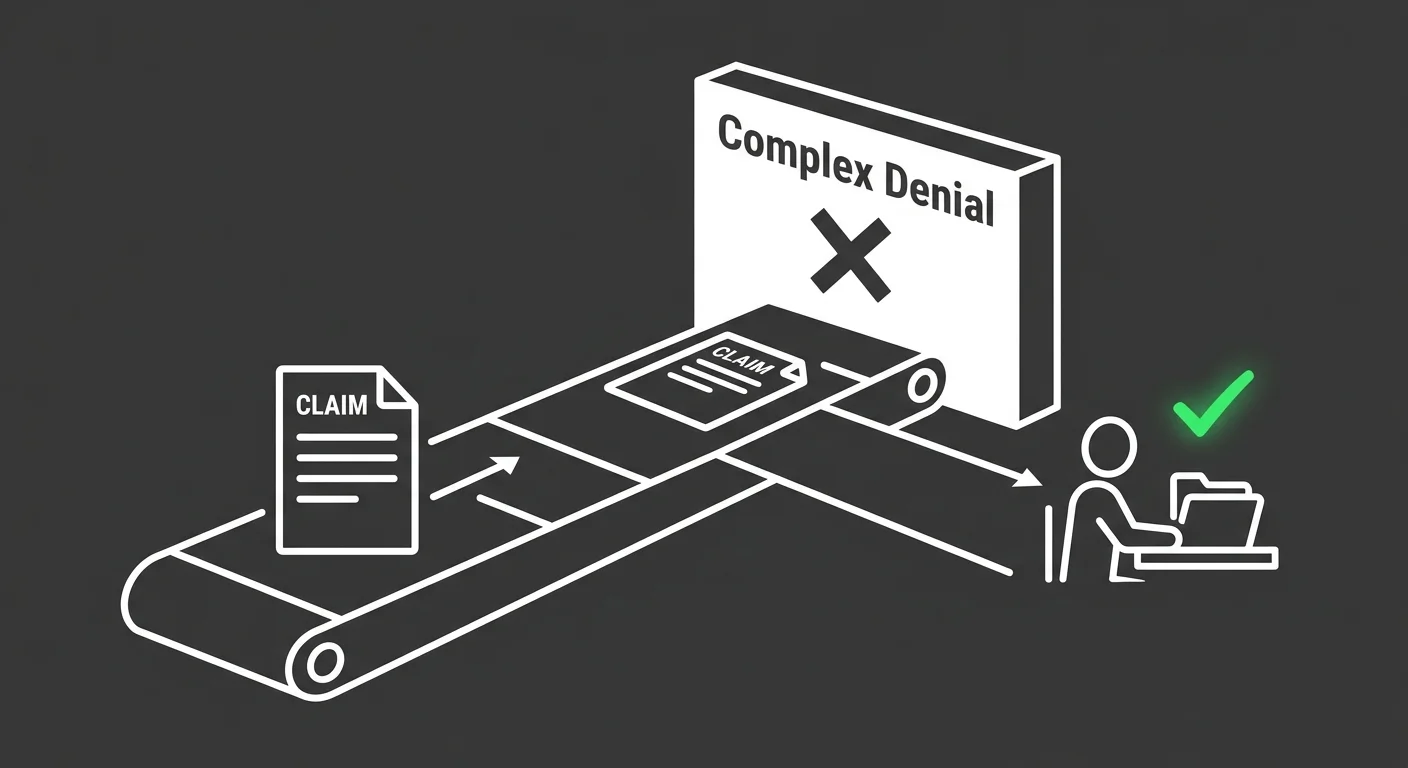
Silence from a billing company isn’t a personality flaw.
It’s not a distracted biller. It’s not a rough quarter. It’s the predictable output of a model that was never designed to communicate – because communication costs time, and time is the one thing a volume-first operation won’t spend.
When a billing company stops sending updates, stops flagging denials, and stops returning calls – that’s not a relationship going cold.
That’s the model doing exactly what it was built to do. Claim submission is the product. Everything after submission – follow-up, denial tracking, the actual conversation with the provider – is overhead. And overhead is what a volume-first model was built to eliminate.
The real answer to why billing companies stop communicating after the contract is signed is an economic one. Silence is cheaper than transparency. In a high-volume operation, cheaper always wins.
And it keeps winning – right up until the practice’s AR finally tells the story no one bothered to share.
How Volume-First Billing Deprioritizes Communication
The volume-first model has one performance metric: how many claims go out the door.
Not how many came back paid. Not how many denials got worked. Submission speed. That single number shapes every decision downstream – including whether any biller spends time actually talking to the practices they serve.
Real communication requires investigation. Someone has to read the denial reason, understand that specific payer’s rule, identify the documentation gap, and then explain it to the provider in plain language.
That’s not a five-minute task. In a volume-first shop, it doesn’t happen – because the next batch is already queued and the clock is already running.
So the complex claim just sits.
The one that needed a medical necessity argument, a documentation correction, a follow-up call to the payer – that claim ages in silence while the submission count looks clean. The practice never hears about it. The model never built a way to tell them.
The Compliance Obligations Your Billing Partner Is Already Accountable For
Here’s what most practices don’t know: their billing company isn’t operating outside the law on this.
Under federal statute, billing companies are classified as Business Associates. That means HIPAA’s transparency and data-handling obligations apply directly to them – not as a suggestion, but as a structural requirement. The published HIPAA framework binds the billing partner whether they communicate like it or not. Silence doesn’t exempt them. It just means the practice has no visibility into whether those obligations are being met.
The FTC’s enforcement framework extends that accountability further. Health data handling violations must be disclosed within 60 days of discovery. Civil monetary penalties scale up to fifty thousand dollars per violation.
A billing partner operating in silence isn’t just a communication problem. It’s a compliance exposure the practice absorbs quietly – on behalf of a company that stopped returning calls.
Sixty percent of people surveyed by Pew Research Center express discomfort with AI managing critical health records without human oversight. Providers feel the same friction – and they’re right to.
Transparency about who is working your claims, what they found, and what they did about it is the baseline for institutional trust. A billing partner who can’t answer those three questions isn’t meeting that baseline. And that gap doesn’t just cost revenue. It costs confidence in the whole relationship.
Who This Billing Model Is Not Designed For
This model isn’t built for everyone. That’s worth saying plainly.
If the first question is ‘what’s your rate?’ – with no follow-up on communication cadence, specialty expertise, or what happens when a claim gets denied – this isn’t the right conversation.
Rate tells a practice what a billing company costs. It says nothing about how much revenue actually comes back. Those are different questions. Only one of them determines whether the billing relationship is working.
And if a practice wants a fully disengaged arrangement – no EHR access cooperation, no documentation turnaround, no availability for denial clarifications – the embedded billing partnership model that Bushido Billing operates on won’t deliver results.
Effective billing is a working partnership. Practices that disengage get disengaged outcomes. That’s not a warning. It’s just how the model works.
| Billing Model Feature | Volume-First / Automation-Forward | Embedded Human Billing Partner |
|---|---|---|
| Primary performance metric | Claim submission speed – how many claims go out the door | Revenue recovery – how much actually comes back paid |
| Communication structure | Silent by design – communication is overhead the model doesn’t budget for | Weekly updates are structural, not optional – the practice knows what’s happening without asking |
| Denial handling pathway | Complex denials deprioritized – no efficient route for medical necessity arguments or documentation corrections | Dedicated biller investigates denial reason, identifies the documentation gap, and reports findings to the provider |
| Biller assignment model | Rotating claim pool – no single biller owns the practice’s AR or knows its payer mix | Dedicated biller assigned to the practice – builds pattern recognition specific to that clinic’s payers and coding history |
| AR visibility | Portal shows submission counts – the practice sees a number, not an interpretation | Human-read reporting surfaces what was paid, what was denied, and what is actively being worked |
| Response to aging claims | Claims quietly age past recovery – no alert, no escalation, no provider notification | Aging claims trigger active follow-up and direct provider communication before they reach unrecoverable status |
| Accountability standard | Silence passes as stability – problems surface only when the AR report can no longer hide them | Proactive disclosure is the operating standard – problems are named early, before they become cash flow crises |
The Warning Signs: How Billing Opacity Shows Up in Your Practice
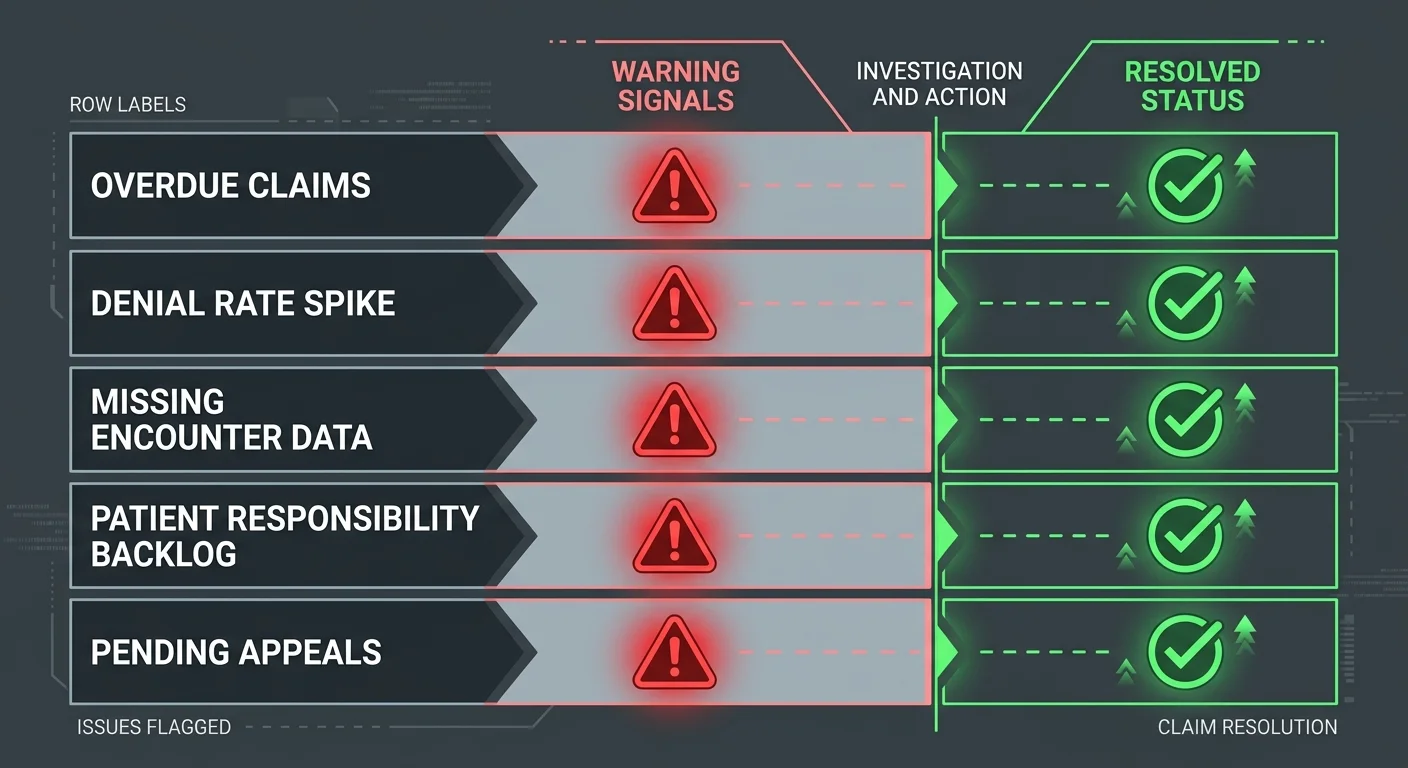
Most practices don’t know the billing relationship is broken until the AR report is already a crisis.
By then, the damage isn’t recent. It’s been compounding for months – claim by claim, quietly – while the practice assumed silence meant everything was fine.
Here’s the thing: the warning signs don’t announce themselves. They show up as patterns.
In how the billing company communicates – or stops communicating. In what the reports show and what they conspicuously leave out. In which claims keep dying without any explanation attached.
Reading those patterns early is the difference between catching a broken relationship in time and inheriting a six-figure AR problem.
Hidden billing errors don’t surface in a single bad month. They produce aged claims that can’t be recovered. They degrade a practice’s financial stability slowly enough that nobody notices until the number is too large to ignore.
That process happens behind a quiet dashboard. The practice waits for news. The news never comes.
Communication Patterns That Signal a Broken Relationship
The clearest early signal isn’t in the AR report. It’s in who’s picking up the phone.
When a billing company stops initiating contact – stops sending structured updates, only responds when the practice chases them down – the relationship has already shifted. The practice is now managing the billing company. That’s backwards, and it’s a problem that compounds every week it goes uncorrected.
A weekly update cadence isn’t a premium feature. It’s the baseline expectation for any billing partner doing its job.
When updates go monthly, then sporadic, then nonexistent, the practice isn’t just losing communication. It’s losing visibility into exactly the claims that need the most active follow-up – the complex ones, the denied ones, the ones nobody’s working. That’s where the revenue disappears. And without structured updates, the practice has no way to know it’s happening.
- Calls that go unreturned for more than a business day
- Update emails that report submission counts but never name a denied claim by payer or reason
- Responses to direct questions that are vague about what action was actually taken
- No proactive outreach when denial volume spikes – the practice finds out last
Reporting Gaps That Reveal an Unworked AR
An AR report that only shows totals is hiding something.
Not always intentionally – but structurally. A report built around total claims submitted, total billed, and gross collections tells a practice what went out. It doesn’t show what came back denied. It doesn’t show what aged past ninety days. It doesn’t show where the money quietly stopped moving.
- No breakdown of claims by aging bucket (30 / 60 / 90 / 120+ days)
- No denial reason summary – what payers are rejecting and why
- No list of claims sitting in active follow-up
- No distinction between paid, pending, and closed-without-payment
That’s the gap that separates resolving claim denials with human expertise from a portal refreshing a submission count. One outputs a number. The other outputs an explanation – and an action.
Initial denial rates run five to fifteen percent across healthcare practices. Up to eighty-six percent of those denials stem from preventable administrative mistakes.
A billing partner who isn’t surfacing those patterns in the AR report isn’t catching them. The practice’s revenue ages past the point of return while the portal shows a clean submission count.
Denial Patterns That Point to Abandoned Claims
Denied claims don’t always show up as denied.
In a volume-first operation, they show up as nothing. No follow-up. No appeal filed. No notation in the report. The claim stops moving – and because nobody names it, the practice never knows to ask.
Published guidance on AT modifier requirements confirms that the Active Treatment modifier must be present for Medicare chiropractic coverage, and that maintenance therapy is explicitly excluded from reimbursement.
A billing partner who doesn’t catch missing or incorrect Active Treatment modifiers before submission isn’t just generating denials. They’re generating denials that are hard to overturn – because the documentation gap lives in the original clinical record, not in a field someone corrects and resubmits.
By the time the practice finds out, the window to fix it is often already closed.
If the same denial reason keeps appearing – wrong modifier, insufficient documentation, medical necessity not established – and the billing partner hasn’t flagged the pattern or proposed a fix, that’s not bad luck.
That’s an abandoned workflow. The pattern existed. Someone decided not to work it.
And the practice’s cash flow absorbed the cost of that decision in silence.
| Warning Sign | What It Looks Like in Practice | What It Actually Signals | Urgency Level |
|---|---|---|---|
| Communication goes silent after onboarding | The billing partner stops initiating contact. Updates only arrive when the practice reaches out to ask. Calls go unreturned for more than a business day. | The relationship has inverted – the practice is now managing the billing company. Silence is the model, not a temporary lapse. | High – address immediately |
| Reports show submission counts but never name denied claims | Monthly or sporadic emails list total claims submitted and gross billed amounts. No denied claim is identified by payer, reason code, or aging bucket. | The billing partner is reporting the metrics that look good and omitting the ones that reveal unworked denials. The AR is aging behind a clean-looking number. | High – structural opacity |
| No aging breakdown in the AR report | The AR report shows total outstanding balances but no breakdown by 30-, 60-, 90-, or 120-day buckets. Paid, pending, and closed-without-payment claims are not distinguished. | Revenue that has aged past the point of recovery is hidden inside a single total. The practice cannot act on what it cannot see. | Critical – revenue exposure active |
| Denied claims disappear without follow-up | A claim comes back denied. No appeal is filed, no notation appears in the report, and no one mentions it. The claim stops moving and the practice is never told. | In a volume-first operation, complex denials cost more to work than they’re worth. Abandonment is the default path – and silence is how it stays hidden. | Critical – revenue is lost, not delayed |
| The same denial reason repeats across multiple claims | Wrong modifier, insufficient documentation, or medical necessity not established keeps appearing on claims from the same payer or claim type. No pattern has been flagged and no fix has been proposed. | The billing partner identified the pattern and chose not to work it. Repeated denials on the same issue are not bad luck – they’re an abandoned workflow. | Critical – systemic revenue loss |
| Vague answers to direct questions about claim status | When the practice asks what happened to a specific claim, the response describes what the system shows rather than what action was actually taken – ‘it’s in process’ or ‘we’re following up’ with no specifics. | No one is actively working the claim. The billing partner is reading a portal status, not managing the account. The practice is absorbing the cost of inaction. | Medium-High – escalate if repeated |
| No distinction between claims in active follow-up vs. closed without payment | The AR report doesn’t separate claims that are being actively pursued from claims that have been quietly closed without a payment or a documented reason for closure. | Revenue that has already been abandoned is being counted the same way as revenue that’s still recoverable. The practice has no way to know how much is already gone. | High – requires immediate report audit |
What Happens to Your AR When Billing Goes Dark
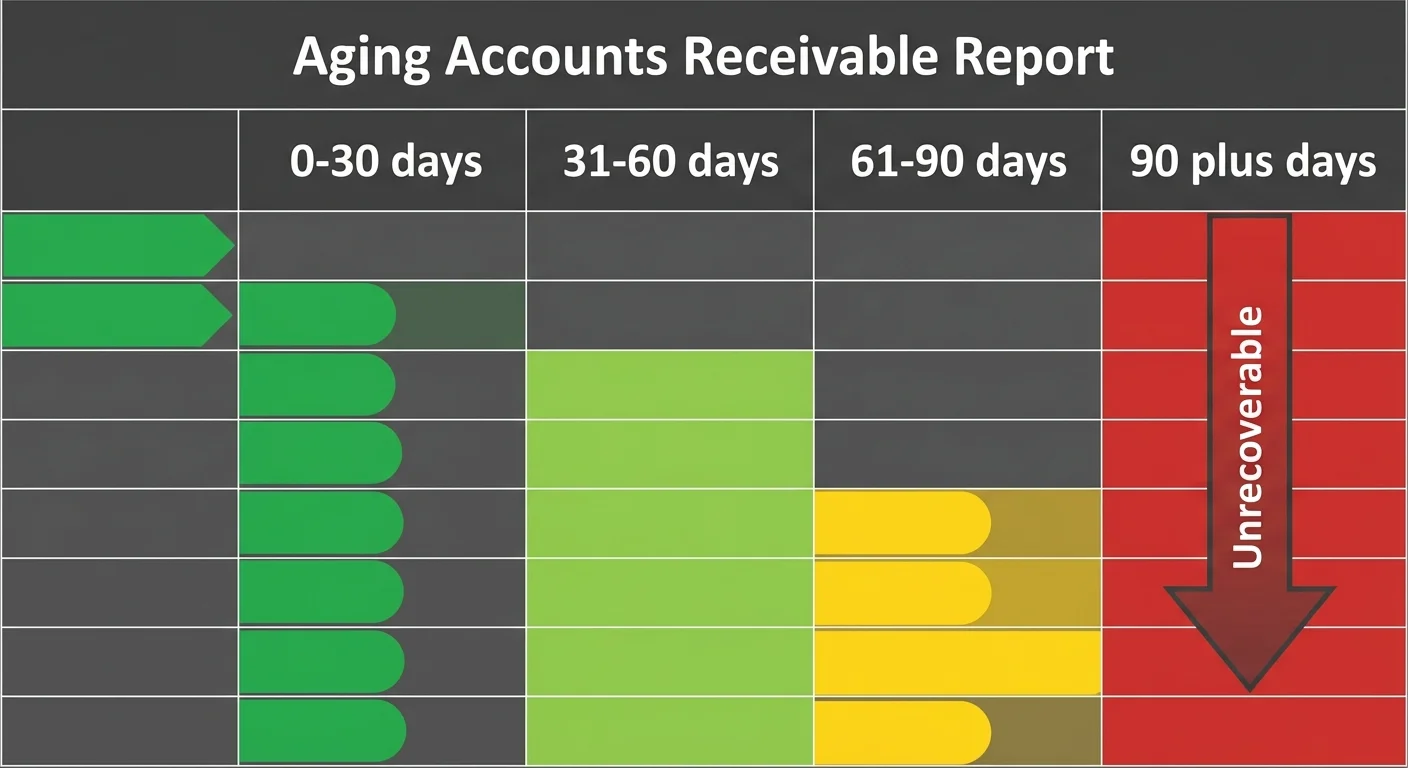
Spotting the warning signs is problem one. Understanding what they’re costing you while you ignore them – that’s the one that actually ends practices.
When a billing partner goes quiet, the AR doesn’t wait. It keeps aging. A claim that needed a follow-up call at 30 days is genuinely hard to recover at 90. At 120, most of those claims are gone.
That progression isn’t loud. It’s invisible. A silent dashboard doesn’t look like a crisis. It looks like nothing. And ‘nothing’ is exactly what a volume-first operation is built to show you while complex claims die in the 120-day bucket.
How Silence Compounds Into Unrecoverable Aged Claims
Hidden billing errors don’t create one bad month. They produce unrecoverable aged claims. That’s not a worst-case scenario. It’s the direct consequence of building a billing relationship around submission speed instead of revenue recovery.
The damage doesn’t trigger an alert. It shows up months later as a cash flow gap the practice can’t immediately explain. Because nobody named the claims that quietly closed without payment. They just disappeared.
Initial denial rates run between five to fifteen percent across healthcare practices. Up to eighty-six percent of those denials trace back to preventable administrative mistakes. When nobody is surfacing those patterns in a structured weekly update, the mistakes don’t stop. They repeat. What started as a workable denial becomes a write-off – not because it was unbeatable, but because nobody worked it.
The Medicare AT Modifier Gap: A Case Study in What Goes Unworked
The Medicare Active Treatment modifier is the clearest version of what goes unworked when a billing partner stops talking. CMS is not ambiguous: the AT modifier must be present for Medicare chiropractic coverage. Maintenance therapy is excluded. No exceptions. No appeals on that basis.
A missed or incorrect AT modifier before submission creates a denial that’s genuinely hard to reverse. The problem lives in the original clinical record. Fixing it means going back to the provider, correcting the note, and refiling. Most volume-first operations never start that conversation – because starting it costs time their model was never built to spend.
So the denied Medicare claim sits. It ages into the 90-day bucket, then the 120-day bucket. The provider never hears it was denied. Nobody works the appeal. The same modifier error appears across five claims from the same provider – and nobody maps it back to the clinical workflow, because nobody’s reading the denial reasons. Practices that want to understand what a functioning partner catches in the first weeks of a new engagement will find the AT modifier pattern is almost always the first thing surfaced and corrected.
What a Functioning Weekly Update Cadence Prevents
A functioning weekly update cadence doesn’t just close the communication gap. It stops the downstream damage before it compounds. When a billing partner reports weekly on denied claims by payer and reason, aging buckets by category, and claims in active follow-up, the practice can course-correct. Not after the cash flow gap appears – before.
The weekly update forces accountability. A billing partner who has to explain every week which claims were denied and what action was taken works differently than one hiding behind a silent portal. The reporting structure changes the behavior. That’s not a side effect. That’s the point.
Billing companies are classified as Business Associates under federal law. HIPAA’s transparency obligations apply directly to how they handle practice data. Civil monetary penalties for non-compliant data handling can reach fifty thousand dollars per violation. So a billing partner who can’t produce a structured weekly account of claim activity isn’t just underdelivering on communication. They’re already operating below the legal standard they’re bound by. That’s not a premium feature. That’s the floor.
| AR Age Bucket | Typical Recovery Rate | Primary Driver of Loss | Billing Partner Action Required |
|---|---|---|---|
| 0-30 days | High – claims are workable with prompt follow-up | Preventable administrative mistakes – wrong modifier, missing documentation | Identify denial reason by payer, initiate correction or appeal within the billing cycle |
| 31-60 days | Moderate – recovery requires active outreach and documentation review | Unworked denials compounding without structured follow-up | Denial pattern summary produced, payer contacted, documentation gap flagged to provider |
| 61-90 days | Declining – payer timely filing windows begin closing | Hidden billing errors left unaddressed past the correctable window | Escalated appeal filed; provider notified of claims at risk of timely filing expiration |
| 91-120 days | Low – many payers close claims; AT modifier errors especially difficult to reverse | Missing or incorrect Active Treatment modifier on Medicare claims not caught before submission | Review original clinical record for AT modifier documentation; refile with corrected note if window remains open |
| 120+ days | Minimal to none – claims frequently unrecoverable at this stage | Opacity in administrative processes and poor communication from the billing vendor | Write-off assessment; root cause audit of denial patterns to prevent recurrence |
Frequently Asked Questions
The patterns are real. The damage is documented. But the questions that follow aren’t abstract – they’re practical, and they come from practices already inside a failing relationship trying to figure out what to do next.
Here are the most direct questions practices ask once they recognize the problem. The answers don’t hedge – because the situation doesn’t have room for it.
Why do chiropractic billing companies stop communicating after the contract is signed?
It’s structural. Not personal.
Volume-first billing operations are built around one metric: how fast claims go out the door. Communication costs time. Time isn’t budgeted in a model that measures performance by submission speed.
Once the contract is signed and the workflow is running, there’s no financial incentive to tell the practice what’s going wrong. Silence is cheaper than accountability. The practice reads the quiet as stability. The billing company reads it as efficiency. The AR ages in the gap between those two interpretations – and neither side corrects the other.
That’s not a relationship breakdown. That’s the model working exactly as designed.
What are the clearest warning signs that a billing relationship has already broken down?
The clearest sign is a billing report that shows submission counts and nothing else. No aging buckets. No denial reasons. No list of claims currently in active follow-up.
When a report can’t tell the practice what’s pending versus paid versus closed-without-payment, it isn’t a clean AR picture. It’s a missing one.
The second sign is response lag. When the practice has to initiate every conversation – chase down a specific claim, ask about a denial that’s weeks old – the relationship has already reversed. A functioning billing partner surfaces problems before the practice asks.
If the practice is always the one picking up the phone, the relationship is already broken. It just hasn’t been named yet.
How does billing opacity directly affect a chiropractic clinic’s accounts receivable?
Directly. And faster than most practices expect.
A claim that needed follow-up at 30 days is significantly harder to recover at 90. At 120, many payers won’t accept an appeal at all. The window closes quietly – and nothing in a silent dashboard tells the practice it’s closing.
Initial denial rates run between five to fifteen percent across healthcare practices. Up to eighty-six percent of those denials come from preventable administrative mistakes. When those mistakes go unnamed, they don’t stop – they repeat. What started as a workable denial becomes a write-off. The practice absorbs the cost. The billing partner never mentions it.
That’s not an edge case. That’s what opacity costs, compounded monthly.
Can automated billing status updates replace human-led claim follow-up and denial resolution?
No. Not even close.
An automated status update tells a practice a claim was submitted. It doesn’t tell the practice the claim came back denied. It doesn’t name the denial reason. It doesn’t confirm whether an appeal was filed – or whether the same denial reason has appeared across a dozen other claims from the same payer this month.
Sixty percent of surveyed individuals express discomfort with AI managing critical administrative health records without human monitoring. Providers feel the same friction – and for good reason.
Denial resolution requires someone to read the explanation of benefits, match it to the clinical documentation, identify the specific deficiency, and build a response. Automation has no pathway for that. It outputs a status. It doesn’t work the claim.
How often should a chiropractic billing partner provide reports and status updates?
Weekly. Structured, specific, and proactive.
Not a portal login. Not a monthly summary. A weekly update that names denied claims by payer and reason, shows aging buckets by category, and lists which claims are in active follow-up right now.
Billing companies are classified as Business Associates under federal law. The FTC’s Health Breach Notification Rule confirms that vendors handling patient and billing records outside direct insurance pathways carry explicit transparency obligations – and civil monetary penalties for non-compliant data handling can scale up to fifty thousand dollars per violation.
A billing partner who can’t produce a structured weekly account of claim activity isn’t just underdelivering on communication. They’re operating below the accountability standard they’re already legally bound to meet.
Weekly reporting isn’t a premium feature. It’s the baseline of a billing relationship that’s actually working.
The Billing Relationship You Actually Deserve
Here’s what it actually looks like.
A dedicated biller who knows the payer mix. Who catches AT modifier errors before the claim goes out – not after the denial lands. Who files the appeal without being asked, because that’s what working a claim means.
A weekly update that names specific claims, specific denial reasons, and specific next steps. Not a submission count. Not a portal refresh. A real conversation.
A partner who surfaces problems before they become cash flow crises. That’s the standard. Not a premium. The standard.
The alternative isn’t a billing partnership.
It’s a silent dashboard. A portal that surfaces submission counts and nothing else. A billing company that only picks up when the practice chases it down – that’s a volume-first operation using communication silence to obscure what it isn’t working.
That silence isn’t professional restraint. It’s a structure built to hide the gap between what was submitted and what was actually recovered.
There’s a difference. It costs practices real money. And most practices don’t find out until the AR has already told the story.
Bushido Billing was built around one standard: full visibility into what’s moving, what’s stalled, and what’s at risk of aging past the point of return. Not as a negotiated add-on. Not as a tier upgrade. As the baseline of what a functioning billing relationship requires.
Weekly updates that name denied claims by payer and reason. An assigned biller who owns the AR – not a rotating pool processing volume. Proactive communication that surfaces problems before they compound into a cash flow crisis.
That’s the open window. And if a practice can’t see clearly into its own billing operation right now, the question isn’t whether the relationship is struggling. The question is how long the damage has been piling up – because a silent billing dashboard is not a clean AR report – it’s a window with the blinds pulled down.
If that silent dashboard sounds familiar – submissions logged, outcomes invisible, and you’re still the one picking up the phone – that’s not a rough patch. That’s the model working exactly as designed. A billing partner who hides behind a portal login isn’t protecting your time. They’re protecting their own. Book a Call to find out what’s actually sitting behind yours.

© . All Rights Reserved | Web Design by iTech Valet