

What to Do Right After Re-Credentialing Is Approved
After re-credentialing approval, practices must push the new effective date to every system and check directories and CAQH before submitting claims.
After re-credentialing is approved, the immediate priority is updating every connected system before new claims are submitted. Approval from a payer is a status change, not a completed task. The provider's effective date, revised credentialing file, and any updated fee schedule or contract terms must be pushed into the practice management system, the electronic health record, and the clearinghouse enrollment profile without delay. Many payers also expect a current CAQH re-attestation after a credentialing update, since they pull credentialing data from CAQH ProView. Medicaid managed care plans are required by CMS rules to update their online provider directories within thirty days of receiving updated provider information, but that window doesn't mean claims will process correctly during the gap. Internal systems should be updated immediately rather than waiting for a payer's directory refresh. The billing team handling claim submission needs to know the exact effective date of the new credentialing status so claims are not submitted under outdated provider information. A lapse between approval and system updates is where claims start denying for reasons that have nothing to do with the clinical service provided. The work that follows approval determines whether that approval translates into paid claims or into a backlog of rejected ones.
What Actually Happens the Moment Re-Credentialing Gets Approved
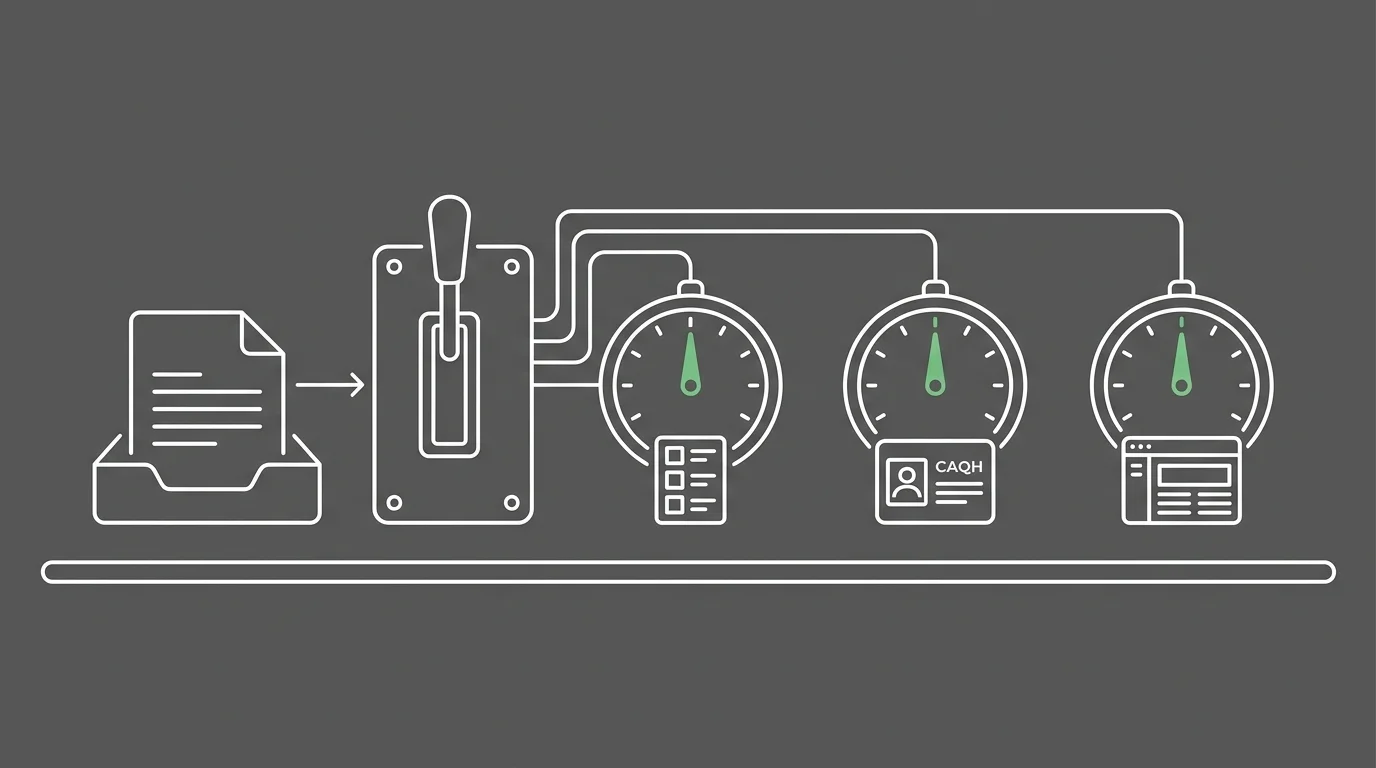
Re-credentialing is the cycle where payers check that a provider still meets their standards for staying in network. Approval is the payer saying that check is done, and their side of the cycle closes right there.
But approval is widely treated as the end of a long administrative process, when it's actually the start of a critical update sequence. The baton just changed hands between the credentialing file and the billing system. For a structured walkthrough of that handoff across the rest of the panel year, the year-round guide to commercial credentialing upkeep covers the maintenance cycle this moment opens.
Where the Approval Letter Gets Treated as the Finish Line
Here's how it usually goes: the approval letter lands and gets treated like a trophy. Someone prints it, files it, and moves on to the next task on the list.
And honestly, that instinct makes sense. It's also the exact moment the revenue cycle starts breaking, quietly, before anyone notices.
Why the Filed-Away Approval Letter Creates Silent Denials
But a filed letter only proves the paperwork is done. It doesn't prove the billing system matches reality. The stretch right after approval is when a quiet gap between a practice and its billing service turns into a real revenue problem.
So a billing partner who flags a credentialing mismatch isn't creating a problem; silence is what hides one until it becomes a cash flow crisis. Skipping the immediate push of updates across every connected system is an unforced error, and an easy one to make. Checking the lead time needed before re-credentialing deadlines before the next cycle starts is how that error gets prevented instead of repeated.
What the Data Says About Payer Directories and Claim Timing
Directory accuracy is not a given even when the rules are clear. The HHS Office of Inspector General notes that, per CMS rules, Medicaid managed care plans must update their online provider directories within 30 days of receiving updated provider information. A 30-day window means a directory can lag behind an approval for weeks.
Pending windows like that one are easier to plan for with a stage-by-stage re-credentialing timeline in hand.
Why a Mismatch Still Needs a Person to Catch It

Even after approval, the payer's directory, the CAQH profile, and the practice's own systems are separate records, and they don't all update on the same day. A mismatch between any of them can surface later as a denial that looks unrelated to credentialing.
No EHR is going to catch that mismatch, because an EHR submits claims and never asks why one came back wrong. Denial review, appeals, and AR cleanup and revenue recovery take a person reading the remittance against the actual credentialing file. That human judgment is what turns a records mismatch into a paid claim instead of a write-off.
The System Architecture That Keeps Credentialing Data and Billing Data in Sync
Credentialing data and billing data describe the same fact, so the moment they drift apart, claims start failing for reasons that have nothing to do with the care delivered. The fix is structural: treat the credentialing file as the single source of truth. The practice management system, the clearinghouse profile and the fee schedule all pull from that one file instead of getting updated separately.
| System Layer | What It Stores | Who Must Update It |
|---|---|---|
| Credentialing File | Effective date, payer-specific contract terms, revised fee schedule, provider demographic details | The practice's credentialing contact, immediately upon approval notice |
| CAQH ProView Profile | Attestation date, practice location, and provider identifiers that payers pull for credentialing | The provider or designated staff member, re-attested on the schedule CAQH sets and after every credentialing update |
| Practice Management System | Claim submission defaults, provider effective dates, payer enrollment status | The billing team, before the next claim batch goes out |
| Clearinghouse Enrollment Profile | Payer connection status, provider identifiers used to route claims electronically | The billing partner coordinating with the clearinghouse on the practice's behalf |
| Electronic Health Record | Clinical documentation linked to the rendering provider, not claims adjudication logic | Clinical and administrative staff, kept consistent with the credentialing file but never treated as the source of truth |
Where CAQH Re-Attestation Fits Inside That Architecture
CAQH re-attestation sits inside this architecture as a feed, not a side task. Many payers pull credentialing data from CAQH ProView, so a stale profile keeps outdated data in front of every payer that checks it.
Here's the catch: updating the practice management system and re-attesting CAQH are two separate jobs, and the architecture only holds when both get done.
Where Internal Systems Fall Out of Step With the New Credentialing File
Internal systems don't fall out of step loudly. The credentialing file changes on one date, while the practice management system keeps the old effective date until someone corrects it by hand, and nobody sees that lag until a claim denies.
Each time a re-credentialing cycle closes, it resets every downstream field that depends on it.
An architecture that treats the closed cycle as a trigger for a system-wide push catches that reset immediately. One that treats it as paperwork lets the reset happen nowhere but the file cabinet.
The Sequence an Operator Runs in the First Thirty Days After Approval

Everything above comes down to one sequence, run in order, inside the first thirty days. Skip a step, and the gap it was meant to close stays wide open.
It starts with notification, moves through a directory and enrollment check, and ends with proof on the claims side that the new status is actually in use. Every one of those steps matters. None of them runs itself.
| Step | System Touched | Why It Comes in This Order |
|---|---|---|
| Notify the billing partner of the new effective date | Billing team and practice management system | Nothing downstream can be trusted until the system of record knows the credentialing cycle closed |
| Update the practice management system and electronic health record | Practice management system and EHR | Claims generated from these systems carry whatever status is stored here, correct or not |
| Re-attest with CAQH where the payer requires it | CAQH ProView | The CAQH profile has to match the new credentialing file before the payer directory is compared against it |
| Compare the payer directory listing against the approval letter | Payer-facing provider directory | Catches a lag between what the payer shows publicly and what the payer has actually approved internally |
| Confirm the clearinghouse enrollment profile reflects the new status | Clearinghouse enrollment profile | Claims can clear the practice's own systems correctly and still reject at the clearinghouse if this step is skipped |
| Run a test claim or hold submission until confirmation arrives | Claims submission queue | Verifies the new status is actually in use before volume goes out under it, rather than finding out from a batch of denials |
Notifying the Billing Partner Before Any Claim Goes Out
The billing partner needs the new effective date before a single claim goes out under it. That notice is not a courtesy update — it is the input the billing system needs to stop submitting against the old credentialing file.
A billing operation that only reacts once a claim denies is already a step behind. The embedded version of this work means the billing partner has standing access to the credentialing file, the EHR, and the provider's availability for a quick confirmation call. A disengaged practice working with a disengaged biller gets exactly that outcome on both sides — the update sits unflagged until a denial forces the conversation.
Confirming the Directory and Enrollment Record Match the New Approval
Next comes a direct comparison between what the payer directory shows and what the approval letter says. The two should match; confirming that they do catches the lag before a claim tests it.
Frequently Asked Questions
The same few questions surface every panel cycle. These are the ones that trip practices up right after approval lands.
How soon after re-credentialing approval can I expect claims to process correctly?
Claims should process correctly once every connected system shows the new effective date. Until that's confirmed, hold submission or send a test claim first, because claims sent before the update finishes can still deny on old information.
What happens if I forget to update my CAQH profile after getting re-credentialed?
Payers that pull from CAQH can hold up the file even when everything else is current.
Who is responsible for updating payer directories with my new credentialing information?
The payer owns the directory update, inside its own regulatory window. But nobody polices the gap while that update sits pending. So the practice and its billing partner have to check the listing against the approval letter.
Can a lapse in re-credentialing lead to having to repay money to insurance companies?
Yes. A payer that finds claims paid under a lapsed or mismatched credentialing status can recoup that money after the fact, treating the paid claim as an overpayment.
What is the difference between re-credentialing and Medicare revalidation?
Re-credentialing is the cyclical check a commercial payer runs to confirm continued network eligibility. Medicare revalidation is the periodic revalidation of Medicare enrollment information, on CMS's own schedule.
The Handoff That Decides Whether Approval Pays Off
A relay baton dropped at the handoff never finishes the race on momentum alone. Approval is that handoff, not the tape at the end.
Treat the approval letter as a signal to move, not a result to file. The practice that pushes the update across every connected system in the same week protects revenue that a filed letter alone cannot.
A billing partner who calls out a mismatch the day it appears is doing the job correctly. Silence is the actual risk. If the handoff after approval isn't running cleanly on a practice's panel, book a call with Bushido Billing to talk it through.