

Why Do Chiropractic Collections Keep Dropping Despite Steady Patient Volume?
Chiropractic collections keep dropping despite steady visits because generalist billing fails to prove medical necessity. See what actually breaks
Chiropractic collections drop despite steady patient volume because claims get denied or underpaid for failing to prove medical necessity, not because fewer patients walk through the door. A full schedule reflects clinical demand. A shrinking bank account reflects a documentation and coding gap between what a visit accomplished and what the payer was shown on paper. Medical necessity is a specific, provable standard, not a general impression that a patient is getting better. Payers require documentation that ties each visit to an active treatment plan, a measurable functional deficit, and a clear expectation of improvement within a defined timeframe. When history, examination findings, and treatment notes fail to connect in that chain, claims get denied, downcoded, or paid at a reduced rate even when the care itself was appropriate. That gap widens as payers tighten scrutiny on chiropractic-specific coding, modifier use, and visit frequency measured against documented progress. General medical billing knowledge does not carry over to chiropractic claims, because the standard for proving necessity in spinal manipulation therapy differs from the standard applied to most other outpatient specialties. A practice can see the same number of patients month over month while collections decline steadily, because each unpaid or reduced claim represents care that was delivered but never fully reimbursed. The result is a widening distance between two separate financial pictures inside the same practice: a schedule that looks healthy and a revenue cycle that does not. Closing that gap requires documentation and coding built around the clinical logic payers demand, not generic administrative processing applied uniformly across specialties.
The Full Schedule, Shrinking Bank Account Problem
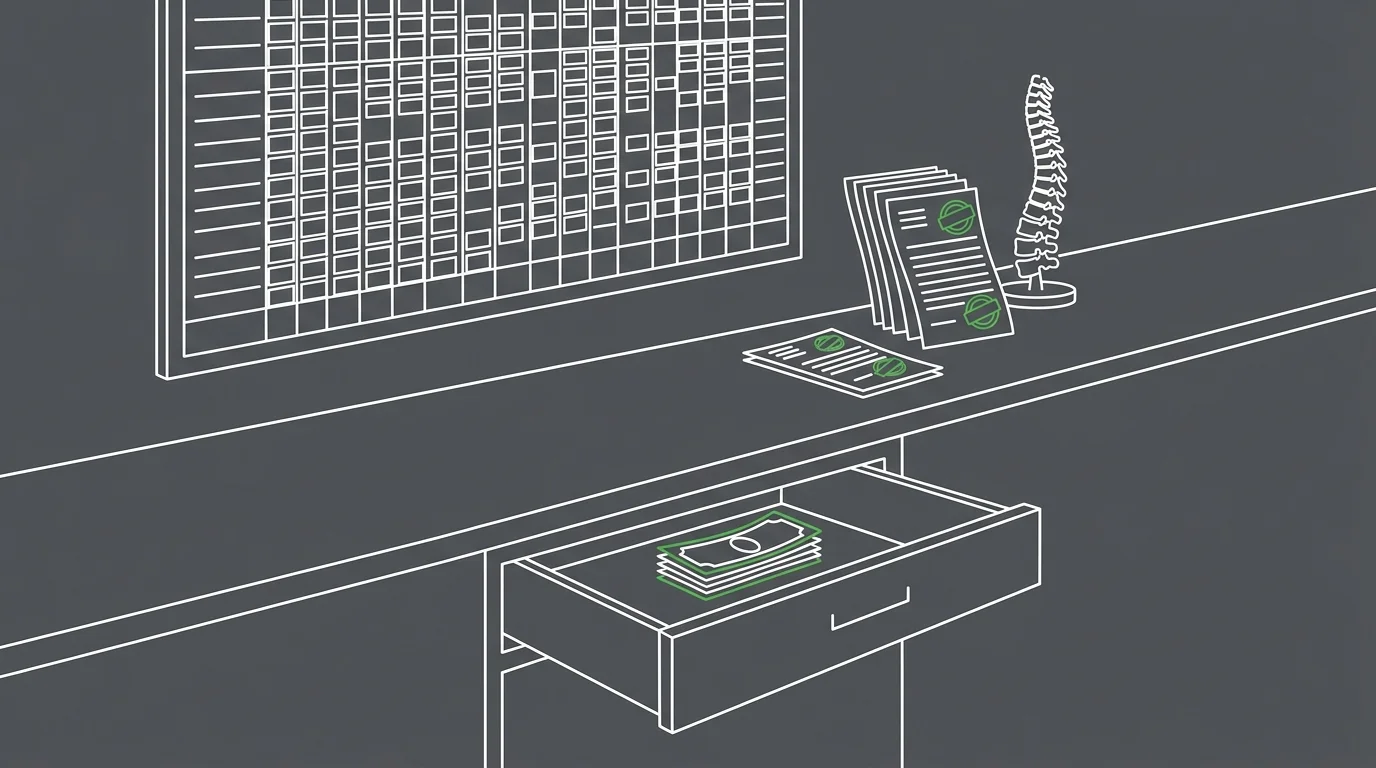
Two ledgers exist inside the same practice, and only one of them ever shows up on the schedule. The appointment book says the practice is thriving. The bank account tells a different story, and that gap is not a mystery — it is a paper trail that never closed the loop on medical necessity.
Generalist billing treats every specialty the same, and chiropractic care won't cooperate with that. Look closely at how generalist agencies mishandle chiropractic-specific documentation and you'll see why claim logic that clears for other outpatient care collapses the moment chiropractic scrutiny hits it.
Why Volume Metrics Hide the Real Collections Story
A full schedule proves demand. It says nothing about whether the paperwork behind each visit ever proved medical necessity to the payer who has to sign off on it.
Patient volume is the metric every practice watches first. It is also the one that hides the real problem best, because the schedule ledger and the documentation ledger never talk to each other.
| Metric | What It Measures | Why It Misleads Alone |
|---|---|---|
| Patient Volume | How many patients are scheduled and seen in a given period | Counts visits without checking whether each visit's documentation ever proved medical necessity to the payer |
| Billed Amount | What the practice submitted for reimbursement across all claims | Reflects intended revenue, not what a payer actually approved once coding and documentation were reviewed |
| Collected Amount | What the payer actually reimbursed after review | Exposes the true gap, but only when compared directly against billed and volume figures side by side |
| Denial and Downcode Rate | How often claims are rejected or paid at a reduced level | Stays invisible on a schedule report, even though it is the clearest signal that documentation is failing |
| Days in Accounts Receivable | How long unpaid or unresolved claims sit before resolution | Grows quietly while patient count looks stable, masking a slowing revenue cycle behind a full calendar |
What the Billed-Versus-Collected Gap Actually Measures
Here's what the billed-versus-collected gap measures that volume can't touch: how much delivered care actually turned into paid revenue. Every denied, downcoded, or reduced claim stretches that gap wider while the appointment book stays packed.
Generalist billing treats this gap as noise instead of signal. Chiropractic revenue cycle management is not a simple administrative task; it is a complex clinical and financial discipline with its own unique set of rules, and a gap that keeps widening is that discipline failing in real time.
Where Regional Reimbursement Trends Add to the Gap
Regional reimbursement trends compound the same problem. As published research data reports, allowable costs per chiropractic procedure declined between 2017 and 2022 as part of an overall spending decrease of 8.82% in Minnesota commercial insurance claims. That kind of shift means the same documentation that once cleared a claim can now fall short of what a payer expects.
A practice watching only its patient count will never catch that standard shifting underneath it. Closing the billed-versus-collected gap starts with understanding How to Prove Medical Necessity for Chiropractic Care at the level payers now demand.
What Counts as Proof: The Documentation Standard Payers Actually Apply
Volume never proves a thing. The documentation attached to each visit is the only thing that carries medical necessity.
Payers apply a standard, not a feeling. And that standard starts on day one — with the initial visit record, where every claim built on a weak foundation inherits that same weakness. Look at Chiropractic Billing Services Compared and you'll see how differently agencies treat that foundation.
The Elements CMS Requires in an Initial Visit Record
CMS sets the bar for what an initial visit record must contain, and it is specific. CMS reports requires initial visit documentation for chiropractic services to include a history consisting of chief complaint, family history if relevant, and past medical history including general health, prior illness, injuries, hospitalizations, medications, and surgical history. That requirement is not a suggestion for chiropractic-specific claims.
A history missing surgical background or prior injury detail is not a small omission. It is the exact gap a payer flags first, and generalist credentialing rarely trains for that level of specificity.
Why Generalist Billing Treats Chiropractic Claims Like Any Other Medical Claim

Generalist billing runs one claim logic across every specialty it touches. Chiropractic claims don't survive it, because the standard for proving necessity here isn't the standard applied to most outpatient care.
| Reimbursement Benchmark | Figure | What It Signals |
|---|---|---|
| Average reimbursement-to-billing ratio | 62% | A typical solo U.S. chiropractic practice collects only 62% of what it bills, meaning more than a third of delivered care goes unpaid. |
| Payer scrutiny trend | Increasingly stringent | As insurance payers increase their scrutiny, documentation and coding standards required to get paid have become significantly more stringent, raising the bar generalist billing rarely meets. |
The Mechanism: How a Denial Becomes Permanent Lost Revenue
A denial is not the end of the story. It is the start of a second job nobody staffed for.
A typical solo U.S. chiropractic practice collects at a reimbursement rate of 62% against what it bills in 2025. That gap is not random variance. This published analysis reports the average reimbursement-to-billing ratio for U.S. chiropractic practices is 62% — a finding from an industry survey. Each unreworked denial inside that gap is revenue the schedule already earned and the ledger never received.
Coding Errors That Convert a Clean Visit Into a Denied Claim
Numbers like that trace back to a specific flawed practice: coding a visit for speed instead of specificity. As insurance payers increase their scrutiny, the documentation and coding standards required to get paid have become significantly more stringent. A modifier dropped or a code mismatched against the exam note converts a clean visit into a denied claim before a payer ever weighs the care itself. Billing Services breaks down where that conversion happens most often.
The Chiropractic-Specific Documentation Architecture That Prevents Denials
Here's the good news buried in a denial: it's diagnosable. That makes it preventable too. Prevention starts with a documentation architecture built around what payers actually require, not what generalist workflows assume they do.
Building the Visit Record: What Belongs in Chart Notes From Day One
The chart note is the first witness a payer reads. Chief complaint, relevant family history, and past medical history all need to be on the page before treatment ever begins. Skip one, and the record already argues against itself.
Coding and Modifier Discipline: Matching the Code to the Clinical Story
A code is a claim about what happened in the room. Match the modifier and the code to the exam note exactly, and the claim tells one clean story. Let them drift apart, and the payer reads inconsistency where care actually happened.
Working a Claim After It's Been Filed: The Follow-Up Sequence That Recovers Revenue

A denial does not resolve itself. It sits in a queue, unworked, unless someone treats it as a claim with a clock attached rather than a closed file.
| Step | Action | Deadline Window |
|---|---|---|
| Read the Denial Reason | Identify the exact code or documentation gap the payer cited before touching the claim again. | Immediate, before any resubmission |
| Correct the Record | Fix the modifier, code, or missing documentation element that triggered the denial. | Within the payer's stated appeal window |
| Resubmit or Appeal | File a corrected claim or formal appeal with the documentation gap closed. | Before the appeal window expires |
| Track to Resolution | Follow the claim through payer response instead of letting it sit unworked in a queue. | Ongoing until the claim is paid or exhausted |
Reworking a Denial: The Sequence and the Deadline Clock
The sequence starts with the denial reason, not a resubmission. Every payer sets an appeal window, and missing it converts a fixable claim into a permanent loss. That deadline is why the schedule can stay full while the ledger keeps bleeding — the two ledgers split further apart every time a denial ages past its window unworked.
Frequently Asked Questions
The mechanics behind the two-ledger problem raise specific, mechanical questions. Here are the direct answers.
What is the most common reason chiropractic claims are denied?
Documentation that never proves medical necessity is the most common cause. A chart note with no clear functional deficit, no active treatment plan, and no expected improvement timeline hands a payer grounds to deny before the care itself is ever weighed.
How does failing to prove medical necessity affect collections?
Unproven necessity turns delivered care into unpaid care. The visit happened and the schedule counted it, but the ledger never sees payment because the paper trail never closed the loop.
Why do collections drop even when patient volume stays steady?
Volume only counts how many patients walked in. It says nothing about whether each visit's documentation met the payer's standard for necessity, so a full schedule and a shrinking bank account can sit side by side indefinitely.
What coding mistakes most often lower chiropractic reimbursements?
Mismatched modifiers and codes that don't match the exam note are the most frequent culprits. A code is a claim about what happened in the room, and any drift between the code and the note reads as inconsistency to the payer.
How much revenue is typically lost to unworked claim denials?
An unworked denial sits in a queue past its appeal window and turns into a permanent loss, not a delayed payment. Every missed deadline stretches the gap between what was billed and what was collected wider.
What does CMS require in an initial chiropractic visit record?
CMS requires a history covering the chief complaint, relevant family history, and past medical history, including general health, prior illness, injuries, hospitalizations, medications, and surgical history. A record missing any of those pieces starts the claim on weak footing.
Where the Full Schedule Finally Meets the Full Bank Account
Two ledgers. One practice. The schedule ledger was never the problem — the documentation ledger was.
A gap between what is billed and what is actually collected does not close on its own. It closes when medical necessity gets proven on paper, visit by visit, in the specific clinical language chiropractic claims demand. That is a peer-level standard, not a generalist one, and treating it as generalist administrative work is exactly why the gap keeps widening.
A DC-founded authority reads a chart note the way a payer does, because the same clinical training built both. If the two ledgers in your practice have stopped matching, book a call with Bushido Billing to find out where the documentation is losing the argument.