

Why Resubmitting an Identical Claim Rarely Overturns a Denial
Resending the same claim usually brings a duplicate denial. Learn why, how rejected and denied claims differ, and when to reopen, appeal or correct.
A duplicate denial means more than one claim was sent for the same service, the same patient and the same date of service, and in most cases the claim was already processed and paid, according to the American Institute of Healthcare Compliance. eClaims.com says that sending another Original Claim without checking the status of the first one can create an extra claim instead of fixing the original problem. It also says the exact information used to spot a possible duplicate can be different for each payer and each type of claim. The American Institute of Healthcare Compliance advises you to investigate the reason for the denial, rather than simply resubmitting the claim.
What a Duplicate Denial Is
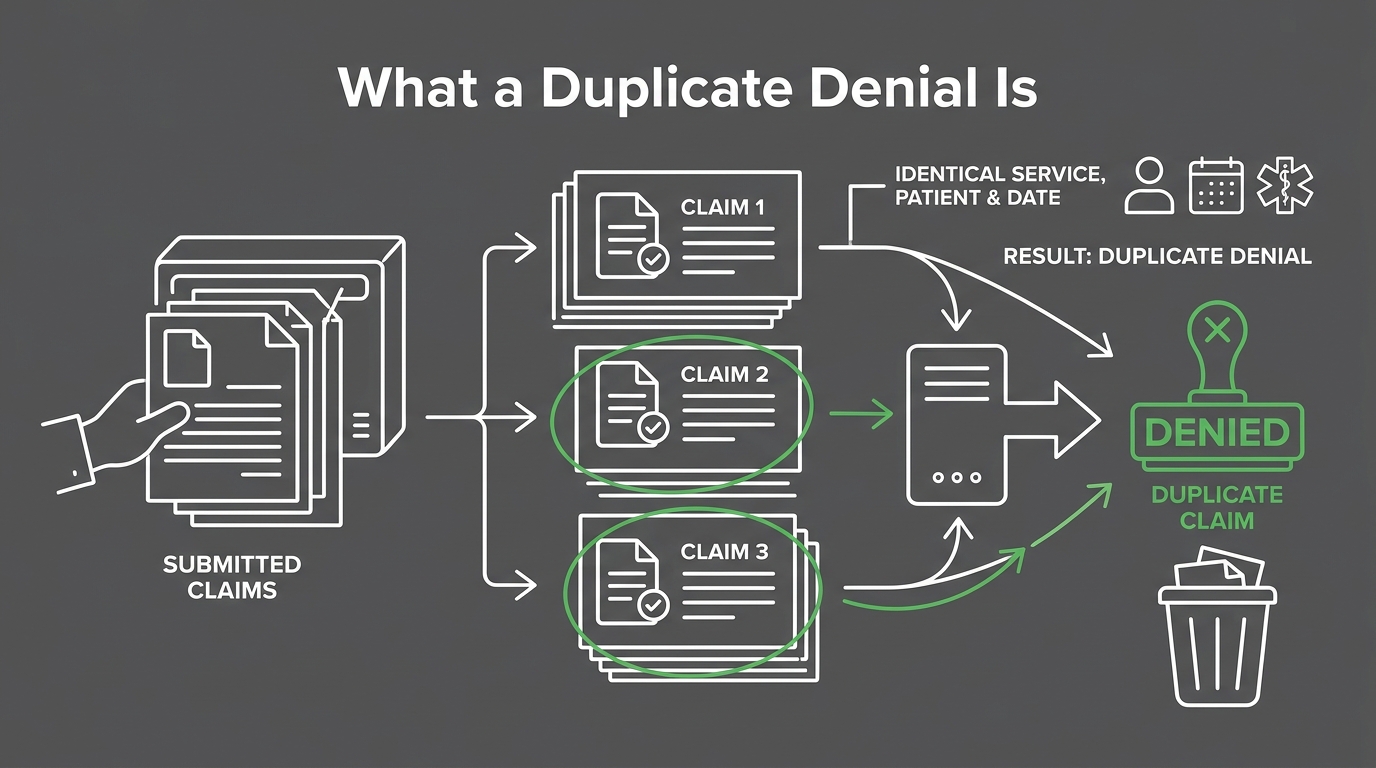
A duplicate denial means more than one claim was sent for the same service, the same patient and the same date of service. The American Institute of Healthcare Compliance says that in most cases, the claim was already processed and paid. You can read that on its page, Root Cause of Medicare Claim Denials.
According to eClaims.com, Claim Adjustment Reason Code (CARC) 18 means the claim or service is an exact duplicate.
The American Institute of Healthcare Compliance says duplicate claim denials keep showing up as one of the top billing mistakes across all Medicare Administrative Contractors (MACs). MACs are the companies that process Medicare claims. eClaims.com points to Medicare claim-denial data from First Coast Service Options for April through June 2026. In that data, CARC 18 was listed as the number one claim denial.
eClaims.com adds that the exact information used to spot a possible duplicate can be different for each payer and each type of claim.
If denials keep coming back to your practice, see How to Find the Root Cause Behind Recurring Payer Denials.
Why Payers Deny the Same Claim Again
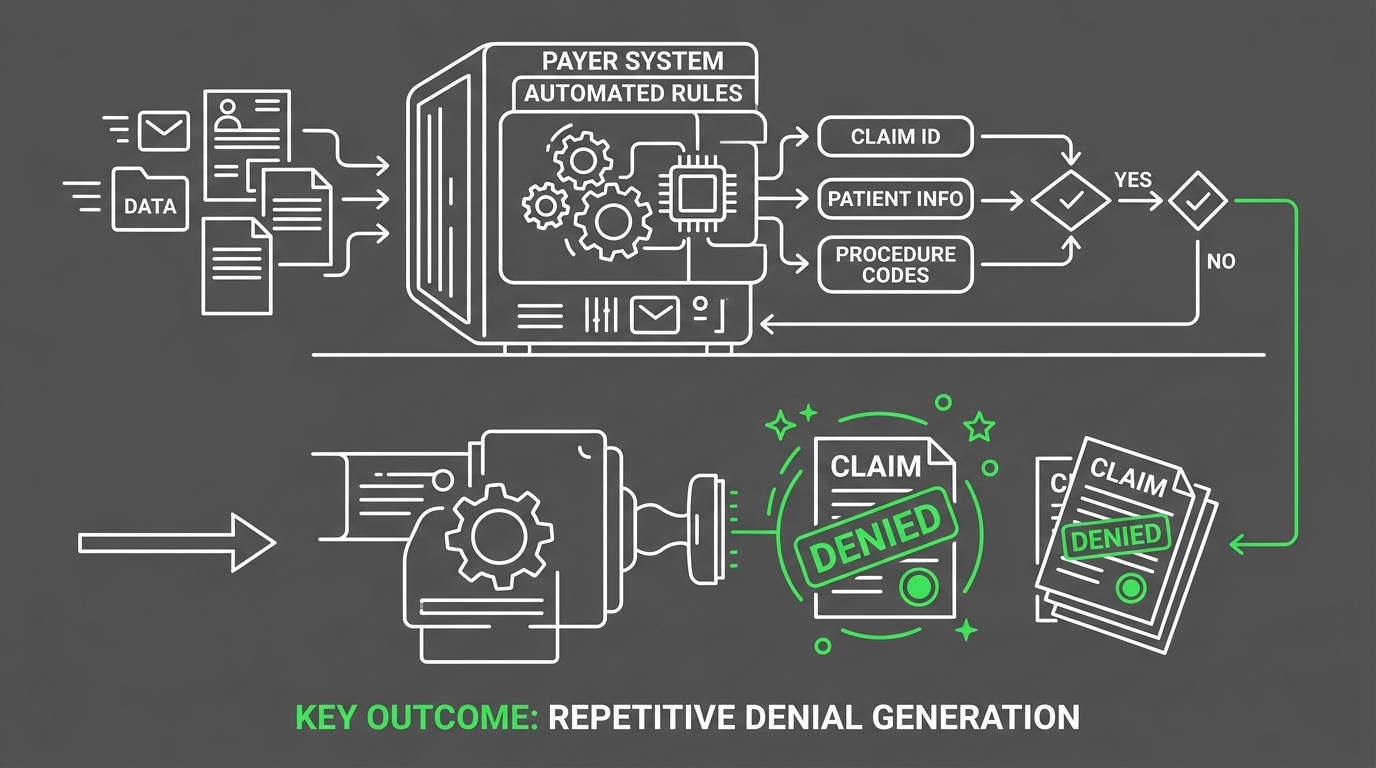
AAPC quotes Coleman on how a payer’s system handles a match. If the system already has a claim that is processed or in process with the same elements, the new claim is either going to be held up, suspended, or denied as a duplicate. AAPC covers this in Fix Your Duplicate Claim Denial Problem with Modifiers.
Medicare rejects duplicate electronic claims with a front-end edit, which is an early check before the claim is fully processed. AAPC says Medicare uses one of several status codes on an electronic reply it calls the 5010 277 CA.
eClaims.com says sending a claim a second time does not necessarily make the first claim go faster. The second submission may create another claim that the payer’s duplicate-detection logic has to check.
eClaims.com also says the absence of payment does not tell you what happened to the claim.
Say a claim was already denied as a duplicate. eClaims.com says sending the same claim again and again may simply bring more duplicate responses. And if you send another Original Claim without checking the status of the first one, you can create an extra claim instead of fixing the original problem.
Denied vs. Rejected: Different Problems, Different Fixes
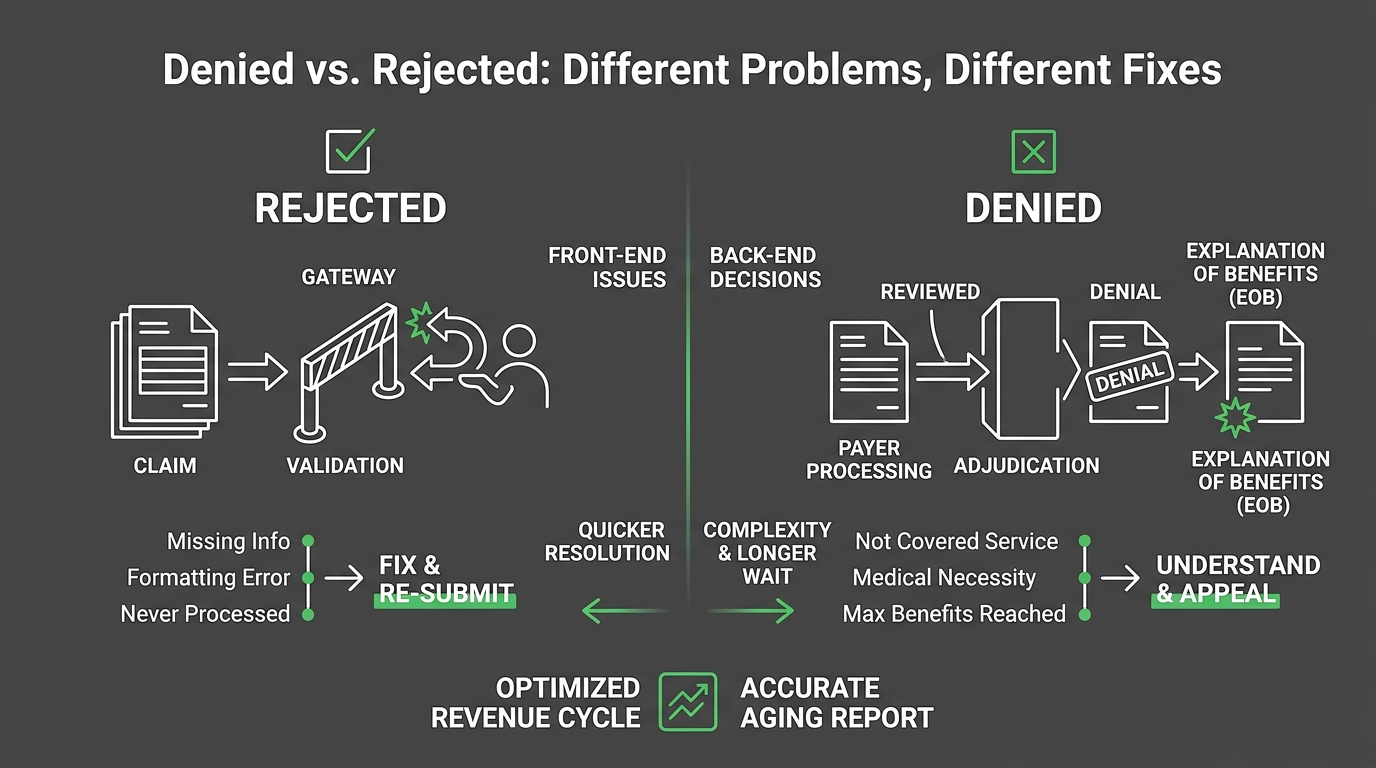
A rejected claim is not the same as a denied claim. AAPC says you can’t appeal a rejected claim. There’s only one way to fix it: correct it and send it in again as a new claim.
A denied claim works differently. AAPC says not to just send it again, because that will cause a duplicate denial. Instead, you should appeal or ask for a reopening of the original denial. AAPC lays out more steps in Follow This Advice for Clean Medicare Claims. Tip 2 is to verify the reason the first claim was denied. Tip 3 is to not just resubmit to correct a denial.
The American Institute of Healthcare Compliance gives the same direction: investigate the reason for the denial rather than simply resubmitting the claim. Some physicians and other providers refile a claim to correct one that was denied before. If the first claim processed correctly, that resubmission can cause an unnecessary duplicate denial.
So the fix depends on the label. You correct a rejected claim and send it again. You investigate a denied claim, then appeal it or ask for a reopening.
Reopening vs. Redetermination: Picking the Right Correction Path
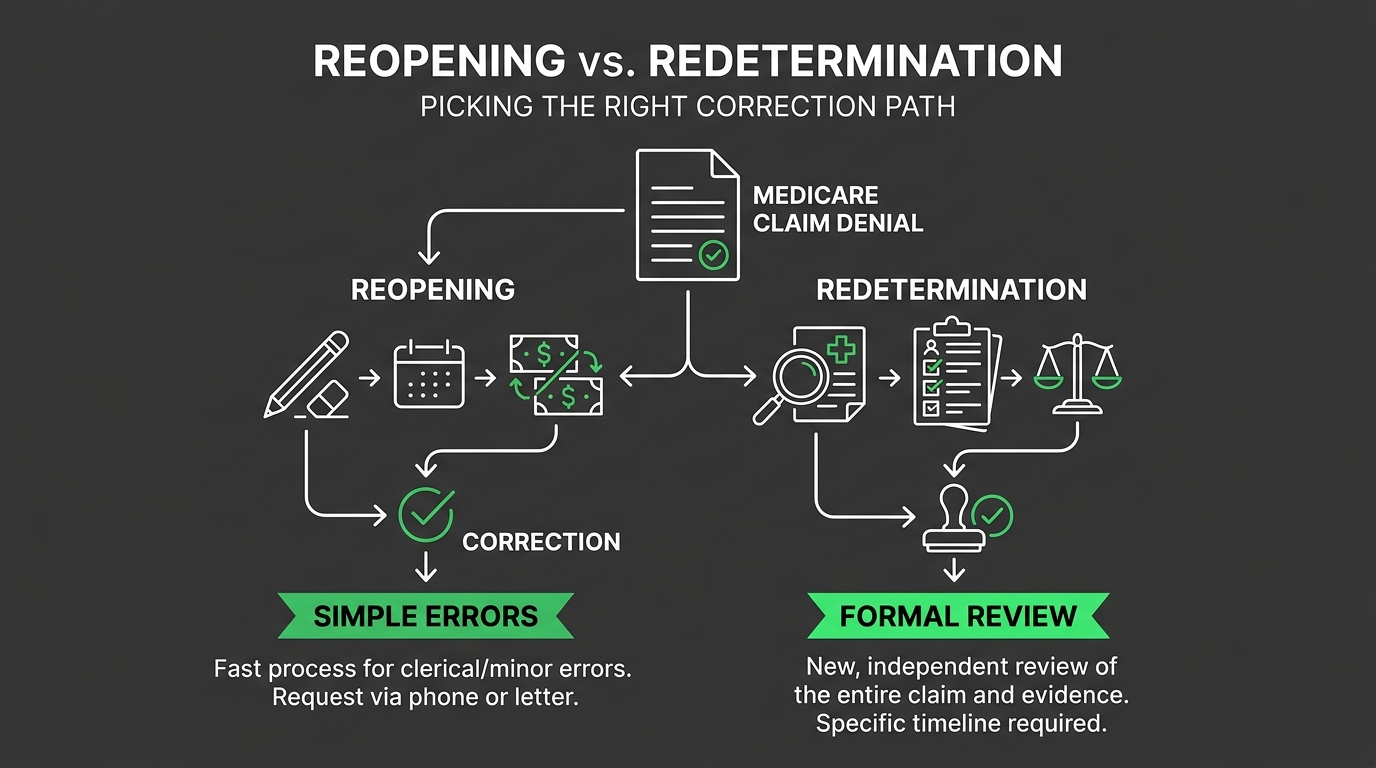
When Medicare denies your claim, you have two correction paths. One is a reopening. The other is a redetermination, which is an appeal.
AAPC says that to fix a small clerical mistake, such as numbers switched around, a reopening is all you need. A redetermination is for harder issues that need a look at medical records.
National Government Services, a Medicare contractor, describes a reopening as a reprocessing of a claim to fix minor mistakes. A redetermination, it says, is an examination of a claim that includes a look at the documents. Its page is Reopenings for Minor Errors and Omissions.
CMS says requests for a redetermination must be in writing. Requests for a reopening can be made by phone or in writing. CMS covers clerical reopenings in FAQ Clerical Reopenings IOM 100-4 Ch. 34.
The table below puts the two paths side by side.
| Correction path | When to use it | Key requirement |
|---|---|---|
| Reopening | Clerical errors, including minor errors and omissions | Can be requested by phone or in writing |
| Redetermination | More complex issues that require review of medical documentation | Must be in writing; National Government Services requires documentation for it to review |
If you want a longer walk through appeals, see Handling Denied Chiropractic Claims and Appeals: A Complete Guide.
When a Reopening Is Enough
CMS says clerical errors, which include minor errors and things left out, are to be treated as reopenings.
National Government Services says that if your situation meets the rules for fixing a clerical error, you should send a reopening instead of an appeal (a redetermination). It calls reopening the quickest way to correct a claim that had errors.
National Government Services also sets limits. Its telephone reopening unit will reopen a duplicate denial only when no modifier is needed for two exact services that were sent in as the same services. And you can’t add another date of service to a claim, because doing that makes it a new claim.
CMS says a party can request, or a Medicare contractor can choose, to reopen and revise an initial determination or redetermination within 1 year of its date for any reason, or within 4 years for good cause.
When a Redetermination Is Required
If the issue is more than a clerical error, the path is a redetermination. National Government Services says your redetermination request must include documents for the contractor to review.
How to Correct a Claim Instead of Resending It
If you want the full breakdown of replacement claims and Original Claims, eClaims.com covers it in Duplicate Medical Claim Denials: Causes & How to Avoid Them.
Some rejections do need a new claim. National Government Services says that if a claim rejects with code MA130 because the referring or ordering provider number or name is incomplete, missing or invalid, you must send a new claim with the correct referring or ordering name and number.
National Government Services also covers Medicare Secondary Payer (MSP) denials, which turn on the order of who pays first. Say a claim was fully denied for MSP, Medicare is now the first payer, and 45 days have passed since the denial date. In that case you must send the claim again instead of contacting Telephone Reopenings.
Replacement Claims and Original Claims
eClaims.com says a claim that was already decided can get you into trouble if you send it again as another Original Claim when the payer expected a replacement. The new claim may be treated as a separate or duplicate claim, not as a fix to the existing one.
For professional claims, some health plans use Claim Frequency Type Code 7 to show that a claim replaces one that was already processed.
In many workflows, you fix the rejection and send the claim again as an Original Claim with Claim Frequency Type Code 1.
If the required original claim identifier or correction information is missing, the payer may be unable to link the submission to the earlier claim you meant.
Repeated and Same-Day Services
AAPC (the American Academy of Professional Coders) quotes Dunphy on this. When you send claims for more than one instance of a service or procedure, include the right modifier to show that the service or procedure is not a duplicate.
The American Institute of Healthcare Compliance says all services given to the same patient, by the same physician or other practitioner, on the same date of service should go on the same claim.
It also says that when you repeat a procedure, you should add a written note giving the reason in item 19 of the 1500 claim form, or in the electronic version of that item.
Timing and Automatic Rebilling
The American Institute of Healthcare Compliance says to allow 30 days from the claim receipt date before you submit a subsequent claim for the same service or services.
AAPC adds a tip about your own system. To avoid duplicate bills and delays you didn’t mean to cause, check whether your billing system is set to send a bill again on its own after 30 days.
Why Repeated Duplicates Get Noticed, and the Usual Cause
AAPC, quoting Coleman, lists what duplicate claims can cause. Payment gets delayed, Medicare’s administrative costs go up, you can be seen as an abusive biller, or you can be investigated for fraud if a pattern of duplicate billing is found.
Coleman is a Medicare contractor’s representative quoted by AAPC. He says they get a report once a month listing the top 100 providers who sent in the most duplicate claims.
The same contractor says it tries to work with providers. Most of the time, the cause is a system glitch the provider had no idea was happening.
Where Software Stops and a Person Has to Decide
Bushido Billing uses computers to check and double-check every insurance claim to make sure it is right.
We don’t treat electronic health record (EHR) software as a full billing operation. We let it get claims out the door. When a denial comes back, we don’t let software simply resend the claim. We have a person work out why it was denied, and we leave denials, appeals and unpaid accounts to human judgment.
We’re happy to let automation handle routine claims with no errors. When a claim needs someone to explain why care was medically necessary, or needs a tailored appeal after a denial, we put a skilled person on it. Technology gets a real role, and we keep that role limited.
If your claim information was already correct and you disagree with the duplicate decision, eClaims.com says the payer may instead require reconsideration, claim review, a dispute or an appeal. You can see how we do this work on our Medical Billing Services page.
Frequently Asked Questions
Does asking for a reopening pause the appeal deadline?
No. CMS does not want providers to mistakenly think that asking for a reopening stops the 120-day clock for requesting a redetermination, which is an appeal.
Should claim details be changed just to clear a duplicate denial?
No. eClaims.com says not to add or change claim information just to get around a duplicate denial.
How long should a practice wait before following up on a claim?
AAPC’s Tip 5 says to allow 30 days from the receipt date before you address a concern.
Can a refusal to reopen a claim be appealed?
No. CMS says a Medicare contractor’s refusal to reopen a claim is not an initial determination, so it is not appealable.
Let a Person Review Your Denied Claims
Don’t just resend a denied claim. The American Institute of Healthcare Compliance says to investigate the reason for the denial instead, because a resubmission can cause an unnecessary duplicate denial when your first claim processed correctly. If your information was already correct and you disagree, eClaims.com says the payer may require reconsideration, claim review, a dispute or an appeal. So you investigate first, then correct or appeal.
We don’t count a claim as done when it leaves your office. We count it done when the money lands in your account, and we judge billing by what gets collected, not by how many claims went out.
Bushido Billing does full-service insurance billing for chiropractic practices, and we fix and appeal denied claims. Would you like a person to review your denied claims? Book a Call