

How to Resolve ChiroHD Ledger Sync Issues and Patient vs Insurance Balance Discrepancies
Learn why ChiroHD patient vs insurance balances drift out of sync and the disciplined process that keeps your ledger accurate.
Resolving ChiroHD ledger sync issues starts with a question, not a keystroke: is this discrepancy a data entry error, a delayed payment posting, or an unresolved insurance adjustment? Once you know, you correct the source record. You never manually override the displayed balance. A ledger sync issue happens when the system recording clinical encounters stops communicating accurately with the system tracking financial transactions. The result is a patient balance or insurance balance that no longer matches what was billed, paid, or adjusted. The first move is to isolate the discrepancy to a specific claim or date of service. That means comparing the practice management ledger against the matching insurance explanation of benefits, line by line. Most patient versus insurance balance discrepancies fall into three categories. A payment or adjustment posted to the wrong claim line. A contractual write-off that was never applied. A manual balance transfer that happened before the insurance response was final. Each one takes a different correction path. Payments posted to the wrong place get reversed and reapplied to the correct line item. Missing contractual adjustments get entered by hand, using the payer's explanation of benefits as the source. Premature balance transfers get reversed until the insurance determination is confirmed. When discrepancies keep surfacing across many accounts instead of one, the settings that govern automatic payment posting, adjustment codes, and claim status updates need a review for misconfiguration. A single discrepancy is usually a data entry error. A pattern across many accounts signals a process or configuration failure, and it will keep producing mismatches until the underlying workflow is fixed.
What a ChiroHD Ledger Sync Issue Actually Is
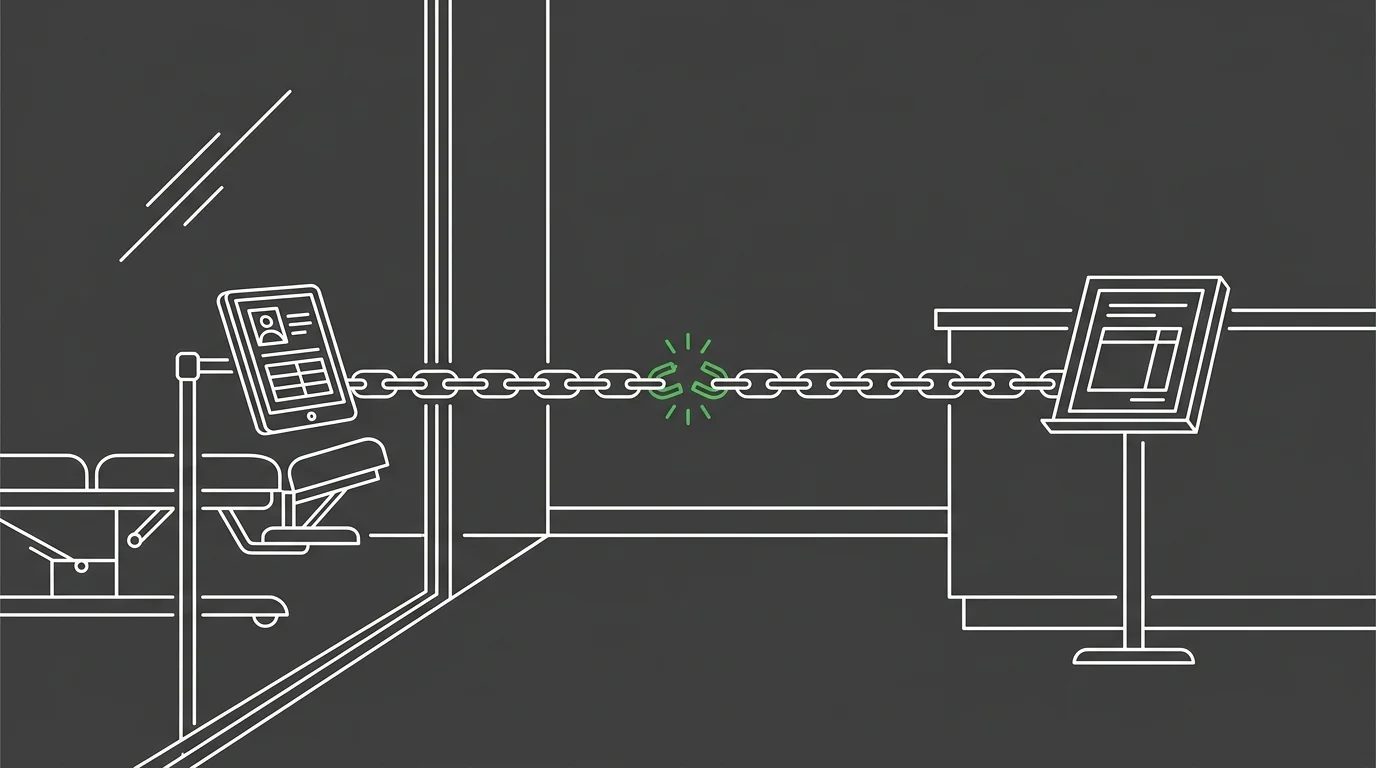
A ledger sync issue is not a bug living inside a single screen. It describes a failure of communication between the system recording patient care and the system managing financial claims, and the mismatch on screen is only the visible output of that broken conversation.
So read the ledger as a diagnostic instrument, not a spreadsheet to be cleared. A mismatch is a symptom being reported, not an error to be dismissed. Software like what EHR billing features leave unmanaged hits the same structural gap between clinical and financial systems, which is why the failure repeats across platforms instead of belonging to any one vendor.
Where the Sync Actually Breaks
A ledger sync issue is never a single event. It's the tail end of a chain that started upstream — at a claim, a payment, a posted adjustment — where two systems quietly stopped agreeing on the same fact.
Here's the part most people miss: a ledger discrepancy is rarely a one-off glitch. It's a symptom of a broken revenue cycle workflow, and clearing the symptom leaves the break exactly where it was.
| Sync Failure Point | What Breaks | Where It Shows Up in the Ledger |
|---|---|---|
| Encounter Closing | Clinical documentation finalizes before the financial system captures the corresponding charge, creating a gap between what happened and what gets billed. | A visit appears in the chart but the charge never posts, or posts with the wrong procedure or date of service. |
| Payment Posting | A payment or adjustment applies to the wrong claim line or the wrong patient account instead of the one the insurer actually paid. | Patient balance looks unpaid even though insurance already responded, or the wrong claim shows as satisfied. |
| Adjustment Entry | A contractual write-off from the explanation of benefits never gets entered, leaving the full billed amount sitting on the account. | Patient balance appears inflated by the exact amount the payer already adjusted off contractually. |
| Balance Transfer Timing | A balance moves from insurance responsibility to patient responsibility before the insurance determination is actually finalized. | Patient is billed for an amount insurance may still cover, and the transfer has to be reversed once the real determination arrives. |
Why Chasing Individual Claim Errors Never Fixes the Ledger
Most chiropractic practices get stuck in a reactive loop, chasing individual payment errors instead of auditing the root cause of their ledger imbalances. Fixing one balance at a time closes the ticket without closing the gap that created it.
And the same pattern turns up anywhere claim data has to travel between systems. How to Overcome ChiroFusion Claim Tracking Limitations and Clearinghouse Rejections walks through an identical breakdown on a different platform, which is exactly why the fix has to target the workflow, not the software.
What the Numbers Say About Denials and Discrepancies
The numbers make the pattern impossible to ignore. Once a practice stops treating each denial as an isolated accident, denial rates and discrepancy types start clustering in ways you can predict.
Reading the ledger as a diagnostic instrument means reading it for clusters, not single tickets. The cluster is the signal. The individual denial is just where it happened to surface first.
| Claim Category | Denial Rate | Ledger Impact |
|---|---|---|
| Balance-line mismatch (patient versus insurance responsibility) | Elevated, and recurring across the same handoff point | Ledger shows an open balance that no longer reflects the actual payer determination |
| Contractual adjustment never applied | Moderate, concentrated among specific payers or plan types | Patient appears to owe a balance that should have been written off |
| Payment posted to the wrong claim line | Low individually, but compounding when left uncorrected | Two claims show incorrect balances instead of one, doubling the reconciliation work |
| Premature balance transfer before insurance determination | Situational, tied to staff workflow timing rather than payer behavior | Patient is billed before the practice actually knows what insurance will pay |
How Patient and Insurance Balances Get Crossed
The precise line between what a patient owes and what insurance is contracted to pay is the most frequent point of failure in chiropractic financial records. That line shifts with every adjudicated claim, and a practice tracking it by memory will eventually lose the thread.
None of this belongs to one platform. The same crossing point breaks on other scheduling and billing systems too, a failure documented in Why Jane App Insurance vs Patient Portion Math Leaves Revenue Uncollected, which confirms the problem lives in the process, not the software.
How Credentialing Errors Surface as Ledger Discrepancies

Credentialing failures don't announce themselves. A payer database can carry the wrong provider type or specialty for months before anyone catches it.
Incorrect provider type or specialty information in payor databases can cause adjudication systems to incorrectly deny specialty-associated procedure codes. Research published through this published analysis found incorrect provider type or specialty information in payor databases can cause adjudication systems to incorrectly deny specialty-associated procedure codes — one expert assessment rather than a study finding. That denial does not read as a credentialing problem on screen. It reads as an insurance shortfall, so the ledger points staff toward the wrong fix. Adjusting the balance treats the symptom. Correcting the payer record is the actual repair, and credentialing and payer enrollment support covers what that repair looks like in practice.
Reading ChiroHD Reports the Right Way
Knowing where a discrepancy starts means nothing without a report built to isolate it. Reports are where the diagnostic instrument actually gets read.
Most practices default to the same summary screen every time, regardless of what they are actually trying to find. That habit is why the same reactive loop described earlier keeps repeating: the report chosen never matches the question being asked.
Building a Routine Ledger Audit Into Practice Operations
A routine audit is not a single report pulled once a quarter. It is a fixed sequence run on a fixed schedule, so drift gets caught while it is still one account instead of forty.
Weekly review catches posting errors before they compound. Monthly review catches the credentialing and configuration failures that only show up in aggregate. A ledger checked on a schedule stops being a mystery and starts being a measurement.
The Nine-Point Self-Audit Checklist Applied to Ledger Discipline

A discrepancy that keeps coming back isn't random. It's a specific process failure wearing a generic symptom as a disguise.
| Checklist Criterion | What It Verifies | Ledger Discrepancy It Prevents |
|---|---|---|
| Level of service supported by documentation | Whether the chart justifies the complexity billed for that encounter | An insurance shortfall billed against a code the documentation cannot support |
| CPT and HCPCS code accuracy | Whether the codes entered match the service actually performed | A denial that posts as an unexplained insurance balance weeks after the visit |
| Modifier application | Whether a modifier attached to a claim has matching chart support | A delayed, hard-to-trace denial that surfaces long after the encounter closed |
| Patient identification accuracy | Whether the claim is tied to the correct patient record | A technical denial that reads as an insurance problem but is a records problem |
| Provider signature presence | Whether every required signature is on file for the service billed | A denial on a technicality that has nothing to do with the clinical service itself |
Matching Documentation to Billed Codes and Modifiers
So a self-audit checklist for a medical practice should run on nine criteria: whether the documentation supports the level of service billed, the codes used, the modifiers applied, the patient identification, and the provider signatures. Run against every chart, those nine points turn the ledger from a screen you react to into an instrument you read on schedule.
Documentation either supports the billed level of service or it does not, and the ledger cannot tell the difference on its own. A code billed without matching documentation will get denied eventually, and that denial lands on the ledger as an unexplained insurance shortfall. Published trade reporting reports a self-audit checklist for medical practices should include nine criteria to evaluate whether documentation supports the level of service billed, codes used, modifier application, patient identification, and provider signatures.
Verifying Patient Identification and Provider Signatures
Patient identification errors and missing provider signatures sit lower on most audit lists, but they carry the same downstream cost. A claim tied to the wrong patient record or missing a required signature gets denied on a technicality, not a clinical dispute.
Frequently Asked Questions
A handful of mechanical questions surface the moment the diagnostic-instrument approach meets a live ledger. Here are the specific answers, not the theoretical ones.
What is the first step to take when a ChiroHD patient ledger doesn't match the insurance EOB?
Pull the payer's explanation of benefits before touching anything on screen. Compare the adjustment and payment lines against what ChiroHD actually posted, one line at a time. The source document tells you which side moved, not the ledger.
How can I differentiate between a patient-responsible balance and an insurance adjustment error in ChiroHD?
A patient-responsible balance traces to a deductible, copay, or coinsurance the payer contract already defines. An insurance adjustment error shows a contractual write-off missing, reversed, or posted to the wrong line. If the explanation of benefits does not support the number on screen, treat it as an error rather than a balance owed.
Are there specific reports in ChiroHD that are best for identifying patient vs. insurance balance discrepancies?
Reports built around aggregate denial patterns and account-level aging beat a single summary screen every time. Isolate accounts by discrepancy type, not just dollar amount. The type tells you which handoff broke.
Can third-party payment processing integrations cause sync issues with the ChiroHD ledger?
Yes. A payment processor posting automatically can misapply an amount before staff ever lay eyes on the transaction. Any integration writing straight to the ledger earns the same scrutiny as a manual entry, because the silent overwrite happens the same way either way.
What daily or weekly checks can my staff perform to prevent ChiroHD ledger discrepancies before they escalate?
Check same-day postings against the day's payment batch before you close out. Then run a weekly pull of new discrepancies, not a cumulative total, so a fresh process failure gets caught before it compounds across accounts.
What does an 'other' denial reason on a claim typically mean for the patient ledger?
An "other" denial reason means the payer never coded a specific rejection cause. On the ledger it lands as an unexplained insurance shortfall. That makes it look like a patient balance problem when the real cause is still sitting unidentified upstream.
Where This Leaves Your Ledger
A ledger sync issue is never really about the software. It is about whether a practice reads its ledger as an instrument or reacts to it as an inconvenience.
Every discrepancy this article has walked through traces back to the same choice: fix the number on screen, or fix the process that produced it. Only one of those choices stops the pattern from repeating. A practice that runs its checklist on a schedule, corrects source records instead of overriding balances, and treats credentialing as upstream of billing turns its ledger into a predictable measure of its own health, not a recurring surprise.
That is the disciplined process this thesis has argued for from the start. If your practice is still chasing individual mismatches instead of reading what the pattern is telling you, talk it through with us.