

Why Jane App, ChiroFusion, and ChiroHD Cannot Automate Chiropractic Revenue Cycle Management
Jane App, ChiroFusion, and ChiroHD manage patients well but leave revenue cycle gaps. See where automated chiropractic RCM actually breaks down.
Jane App, ChiroFusion, and ChiroHD cannot fully automate chiropractic revenue cycle management because each platform was built as a clinical documentation and patient management system, not a dedicated financial operating system. These electronic health records handle scheduling, charting, and basic claim submission well, but revenue cycle management demands continuous, specialized work that clinical software was never architected to perform. Revenue cycle management covers eligibility verification before a visit, accurate procedure and diagnosis coding specific to chiropractic services, claim submission, denial identification and correction, appeals, accounts receivable follow-up on unpaid claims, and patient billing reconciliation. Chiropractic claims carry unique coding requirements, including modifiers that separate active treatment from maintenance therapy, and a claim submitted without the correct modifier is processed differently by the payer than one submitted correctly. Standard EHR billing modules usually stop at claim generation and basic submission tracking. They do not provide the ongoing denial management workflows, aged accounts receivable escalation protocols, or payer-specific coding audits that a complete revenue cycle system requires. The gap exists because the software's core purpose is supporting clinical care delivery and documentation, not managing the full financial lifecycle of a claim from the moment a patient is scheduled to the moment a balance reaches zero. A dedicated revenue cycle management function, separate from the clinical record, is needed to monitor denials as they occur, pursue unpaid claims through the accounts receivable cycle, and apply the specialized coding knowledge chiropractic billing demands. This distinction between a clinical system with billing features and a comprehensive revenue cycle management operation explains why practices using these platforms often see preventable revenue loss despite having functional software in place.
Articles in this cluster
- Auto-Posting and Claim.MD Reconciliation Gaps — How to Fix Jane App ERA Auto-Posting and Claim.MD Reconciliation Gaps
- Tracking Limitations and Clearinghouse Rejections — How to Overcome ChiroFusion Claim Tracking Limitations and Clearinghouse Rejections
- Patient vs Insurance Balance Discrepancies — How to Resolve ChiroHD Ledger Sync Issues and Patient vs Insurance Balance Discrepancies
- Portion Math Leaves Revenue Uncollected — Why Jane App Insurance vs Patient Portion Math Leaves Revenue Uncollected
- App vs ChiroFusion vs ChiroHD — Jane App vs ChiroFusion vs ChiroHD: Which EHR Handles Insurance Billing Best in 2026?
- Jane App and ChiroFusion — How to Audit Clearinghouse Error Logs in Jane App and ChiroFusion
- Ledger Mismatches in Non-ChiroTouch EHRs — How to Prevent Silent Write-Offs and Ledger Mismatches in Non-ChiroTouch EHRs
- Billing in Modern EHR Software — The Myth of Automated Chiropractic Medical Billing in Modern EHR Software
- Will Not Solve Billing Leakage — Why Staff Billing Training on Jane App or ChiroFusion Shortcuts Will Not Solve Billing Leakage
- Find Lost Insurance Revenue — How to Run a Chiropractic EHR Ledger Audit to Find Lost Insurance Revenue
- Outperforms Built-In EHR Billing Services — Why Platform-Agnostic Human Revenue Cycle Management Outperforms Built-In EHR Billing Services
When Billing Features Aren't the Same Thing as Revenue Cycle Management
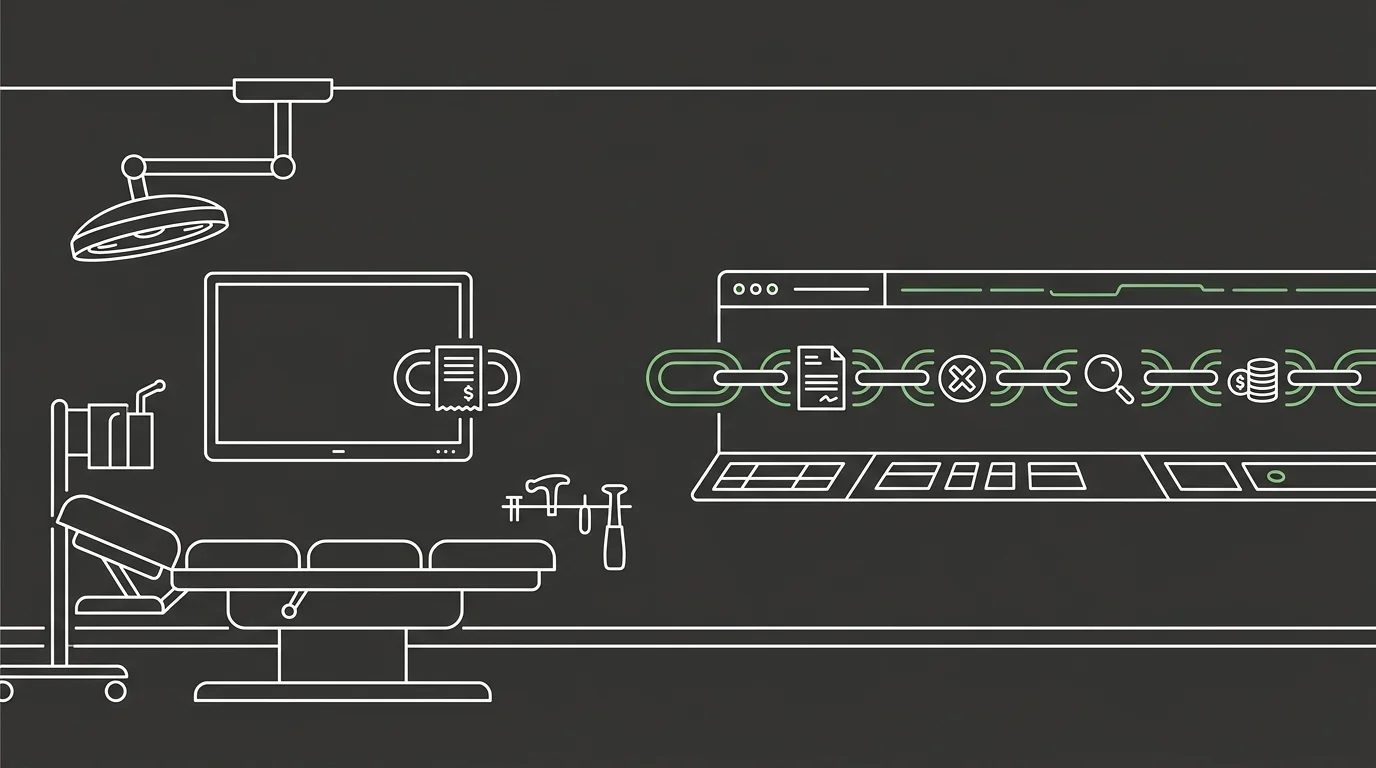
Jane App, ChiroFusion, and ChiroHD have changed how chiropractors manage patients and document care. But ask most chiropractors what their software does well, and the answer stops at scheduling, charting, and getting a claim out the door.
And that answer points to a real gap. There's a costly misunderstanding hiding in plain sight: a software's billing features are not the same thing as a true, automated revenue cycle management system.
| Function | EHR Billing Module | Full RCM System |
|---|---|---|
| Claim Submission | Generates the claim and sends it to the payer once a visit is documented | Verifies eligibility before the visit, then confirms the claim was accepted rather than just transmitted |
| Denial Handling | Flags a denial as a status change with no built-in correction path | Identifies the denial reason, corrects the claim, and resubmits or appeals it |
| Coding Accuracy | Applies the code and modifier the staff member enters at checkout | Audits chiropractic-specific coding and modifier use against payer rules on an ongoing basis |
| Accounts Receivable | Shows an unpaid balance sitting on a report | Actively works aged claims through a follow-up cycle until the balance reaches zero |
| Patient Billing | Produces a statement based on the adjudicated claim | Reconciles patient responsibility against payer activity before a statement goes out |
What a Billing Module Actually Does
A billing module inside a clinical EHR does one job: it turns a completed visit into a submitted claim. It captures the code, attaches the modifier, and sends the file to the payer.
Then the claim leaves the system, and most modules go quiet. They track whether it was sent, not whether the payer intends to pay it, deny it, or bounce it back for correction.
What Full Revenue Cycle Management Covers
Revenue cycle management isn't a single task. It's an entire financial ecosystem that starts before the patient visit and ends long after, covering eligibility checks, coding accuracy, denial correction, appeals, and accounts receivable follow-up until the balance is zero.
So a clinical system can generate a claim and never manage what happens to it. That difference is the whole subject of our chiropractic revenue cycle management, because closing it takes a financial engine built to run alongside the clinical one, not inside it.
Where Clinical Software Was Built to Stop
About those billing modules: they were an afterthought. Clinical software vendors built their platforms to solve a documentation problem, and billing got bolted on later, onto a system already designed around the patient chart.
The Design Priority Behind Jane App, ChiroFusion, and ChiroHD
You can see that priority in where the engineering hours go. Scheduling, charting, and patient communication get refined again and again, because clinicians ask for it.
Billing gets just enough functionality to generate a claim and call it done. These EHRs have revolutionized patient management and clinical documentation, but that same investment was never mirrored on the financial side. The result is a system that excels at care delivery and stalls at collections.
The Point Where Financial Tools Hand the Problem Back to Staff
Once a claim ships, the module's job is basically over. Denial correction, appeal drafting, and aged accounts receivable escalation all land back on staff, with no dedicated workflow to guide the work. Anyone who wants to build that missing piece on purpose, instead of patching it together after the fact, is better off studying the cluster hub.
Why a Missing Modifier Sinks an Entire Claim
One missing modifier can sink an entire claim. And that's not some rare edge case. It's a structural weak point in every chiropractic claim that runs through a clinical EHR.
How a Coding Omission Reclassifies an Entire Visit
On Medicare chiropractic claims submitted after October 1, 2004, the AT modifier is what tells the payer this is active treatment, not maintenance care. CMS reports claims for chiropractic services that omit the AT modifier may be denied as maintenance therapy rather than processed as active treatment. So a billing module will transmit a claim missing that modifier and never flag it, because its job ends at submission, not interpretation.
What the Data Says About Where Claims Actually Die

A single missing modifier is one failure point. The industry-wide pattern behind it is bigger, and the numbers behind it are worth sitting with.
| Encounter Type | Staff Minutes on Billing Tasks |
|---|---|
| Primary Care Visit | 13 minutes |
| Emergency Department Visit | 32 minutes |
| General Medicine Inpatient Stay | 73 minutes |
| Ambulatory Surgical Procedure | 75 minutes |
| Inpatient Surgical Procedure | 100 minutes |
How Much of a Denial Is Actually Preventable
Most denials are not inevitable. Healthcare practices may lose more than 83% of claim denials through avoidable inefficiencies in billing management. As this published analysis reports, more than 83% of claim denials may be avoidable through preventive billing management — a finding from an industry survey. That figure comes from a vendor surveying its own market, not a controlled study. Even so, a billing module that stops watching a claim at submission cannot correct the errors driving that loss.
The Staff Time Every Denial Quietly Consumes
Every denial also consumes staff time that never appears on a claim report. Published trade reporting reports billing and insurance-related activities required 13 minutes of staff time for a primary care visit, 32 minutes for an emergency department visit, 73 minutes for a general medicine inpatient stay, 75 minutes for an ambulatory surgical procedure, and 100 minutes for an inpatient surgical procedure. That range came from one academic health system across five encounter types. A billing module with no denial workflow leaves staff absorbing that time manually, claim by claim.
How Denial Management Actually Has to Work
So what does a real denial management system actually take? Structure, not effort. A defined sequence that catches a denial the day it lands, not the month someone finally gets around to the aging report.
Why Most Practices Never Build a Real Appeals Process
Most practices never build a formal appeals process, and the reason is simple: nothing in the software forces one into existence. Denials pile into a queue, staff triage by whatever feels urgent instead of by protocol, and the oldest, most recoverable claims quietly age past the point of getting paid.
The Sequence a Working Denial System Follows
A working system spots the denial the moment it happens, names the reason, and routes it to the right correction path in days, not weeks. It follows the appeal all the way to resolution, then feeds that failure pattern back into coding and eligibility checks. That feedback loop is the financial engine a clinical chart was never built to run.
What A/R Follow-Up Requires That a Patient Portal Doesn't Track

A patient portal shows a balance. It does not chase one.
| A/R Age Bracket | Typical Follow-Up Action | Risk if Ignored |
|---|---|---|
| Early aging (recently past submission) | Confirm payer receipt, verify claim status, correct any coding or eligibility issue before it hardens into a denial | A correctable error goes unnoticed and matures into a formal denial that costs more time to reverse |
| Mid-range aging (well past submission, no resolution) | Escalate to the payer directly, document every contact, and open an appeal if the claim has already been denied | The claim drifts past the payer's own appeal window and becomes effectively unrecoverable |
| Extended aging (long overdue, no payer response) | Run a final recovery attempt, then formally decide whether to keep pursuing or write the balance off | Staff keep tracking a balance nobody is actively working, which quietly wastes more time than writing it off |
| Patient-responsibility balances left unpaid | Send structured reminders, then move to a defined next step once the initial follow-up window closes | The balance sits visible on a portal indefinitely with no one accountable for closing it out |
Aging Buckets and Why They Get Ignored
Unpaid claims sort naturally into aging buckets — thirty, sixty, ninety days past submission. A patient portal displays that number without acting on it. Nobody gets alerted when a claim crosses from recoverable into unlikely. Left alone, the oldest balances simply age out of practical reach.
The Coding Specificity Chiropractic Claims Demand
That same blind spot compounds around coding. Chiropractic claims carry modifier and diagnosis requirements that shift by payer and by visit type, the same specificity behind the AT modifier distinction described earlier. A billing module built to submit a claim has no reason to police that accuracy after the fact. Correcting it requires a financial engine deliberately built to catch what the clinical chart never watches.
Frequently Asked Questions
So where does that leave the practical questions? Here are the ones that come up most once the line between clinical software and a financial engine gets clear.
What is the actual difference between the billing my EHR does and revenue cycle management?
Your EHR's billing feature generates and submits a claim. Revenue cycle management follows that claim until it's paid, correcting denials, chasing aging balances, and auditing coding the whole way.
Why don't Jane App, ChiroFusion, or ChiroHD build full RCM automation into their platforms?
Because the engineering hours go toward charting and scheduling, the tools clinicians touch every day. Denial workflows and accounts receivable escalation don't sell subscriptions, so they stay thin.
How does the AT modifier affect whether a chiropractic claim gets paid?
On Medicare chiropractic claims, the AT modifier tells the payer the visit was active treatment, not maintenance. Leave it off, and the payer processes the claim as maintenance therapy instead.
What counts as an avoidable claim denial versus an unavoidable one?
An avoidable denial traces back to a fixable input — a missing modifier, a stale eligibility check, a coding mismatch. An unavoidable one reflects a real coverage exclusion the payer was always going to enforce.
What does a complete accounts receivable follow-up process actually track?
It tracks every unpaid claim by age, flags the point where recovery odds drop, and escalates before that point instead of after. A patient portal balance does none of that on its own.
Does adding a dedicated revenue cycle system mean re-entering data already in the EHR?
No. A dedicated revenue cycle system works from the data already inside your EHR rather than duplicating it, so the clinical record stays the single source of truth.
The Financial Engine Your EHR Was Never Built to Be
A clinical EHR was built to run the exam room, not the aging report. Jane App, ChiroFusion, and ChiroHD do that job well — charting, scheduling, and getting a claim out the door.
But a submitted claim is not a paid claim. Denial correction, appeals, accounts receivable follow-up, and modifier-specific coding demand a system built to watch the money after the chart closes, and that system is not the one managing the visit.
The clinical engine and the financial engine are two different machines. One documents care. The other has to chase every dollar that care is owed, and building that second engine deliberately is the work behind a conversation with Bushido Billing.