

What Are the Formal Steps to Appeal a Spinal Adjustment Denial?
Learn the formal steps to appeal a Medicare spinal adjustment denial, from redetermination to hearing, and why a missing AT modifier causes denials.
A Medicare appeal has levels. At the first level, a Medicare Administrative Contractor (MAC) redetermines the decision. At the second level, a Qualified Independent Contractor (QIC) reconsiders it. At the third level, the Office of Medicare Hearings and Appeals (OMHA) makes a decision. Medicare change request CR 3449 says every chiropractic claim with code 98940, 98941, or 98942 and a date of service on or after October 1, 2004 must include the Acute Treatment (AT) modifier if active or corrective treatment is being done. The modifier must not be on the claim when maintenance therapy was given. Claims without it are treated as maintenance therapy and denied.
Why Medicare Denies Spinal Adjustment Claims Without the AT Modifier
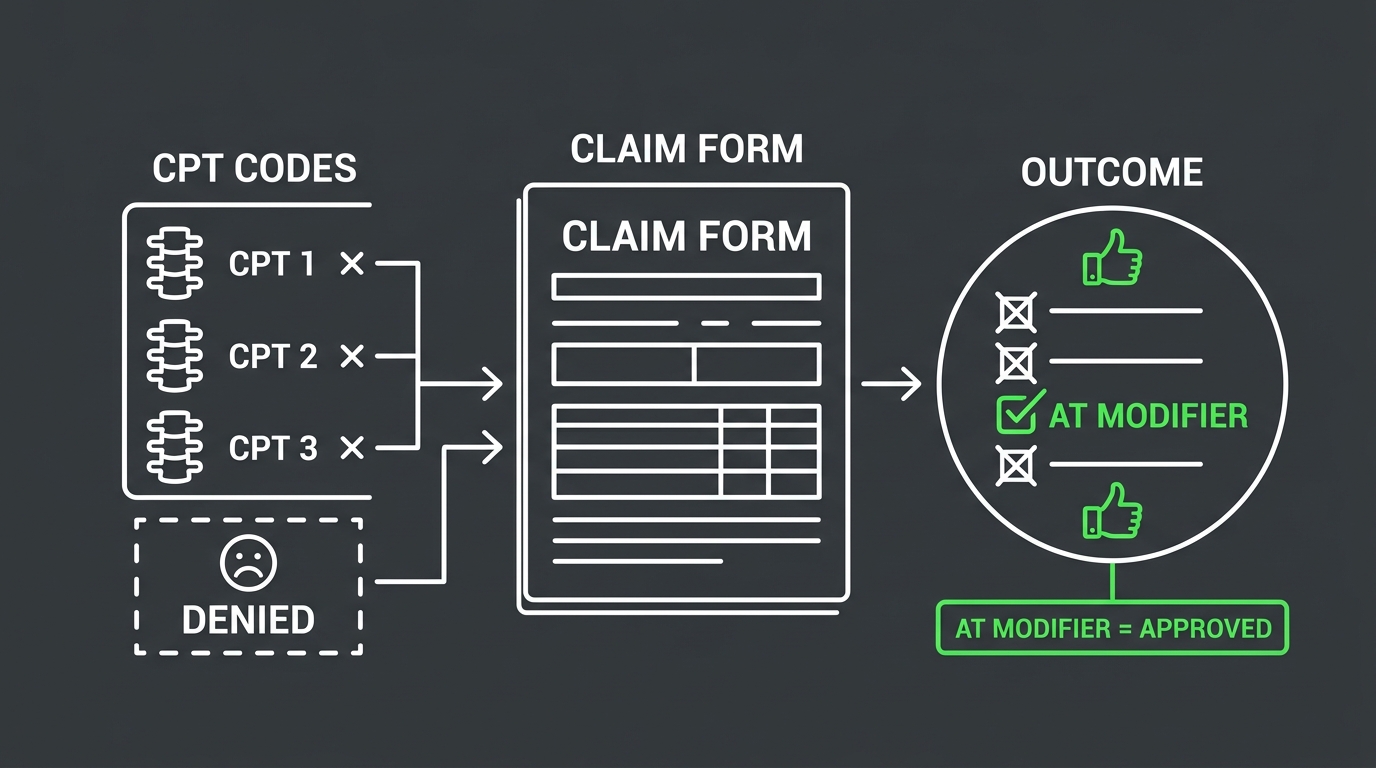
Under Medicare, you can bill only three Current Procedural Terminology (CPT) codes as a doctor of chiropractic. Code 98940 covers spinal manipulation of one to two regions. Code 98941 covers three to four regions, and code 98942 covers five regions.
On manipulation claims, you must use the Acute Treatment (AT) modifier. It shows the service is active or corrective treatment of an acute or chronic subluxation. Used the right way, it shows you expect functional improvement, even if the problem is long-lasting or keeps coming back.
A Medicare change request, CR 3449, sets the rule for claims with a date of service on or after October 1, 2004. If you gave active or corrective care, the claim must carry the AT modifier. If you gave maintenance therapy, the modifier stays off. A claim with no AT modifier is treated as maintenance therapy and denied.
Don’t leave the AT modifier rule to just any billing firm. Treat it as specialty knowledge, along with documenting maintenance care versus active care in your notes.
Keep a chiropractic denial like this with a specialist who sees it every day. Don’t hand it to a biller who covers every specialty.
If the claim is denied and the appeal moves up, the Centers for Medicare & Medicaid Services (CMS) explains the third level in Third Level of Appeal: Decision by OMHA.
The Five Levels of a Medicare Claim Appeal
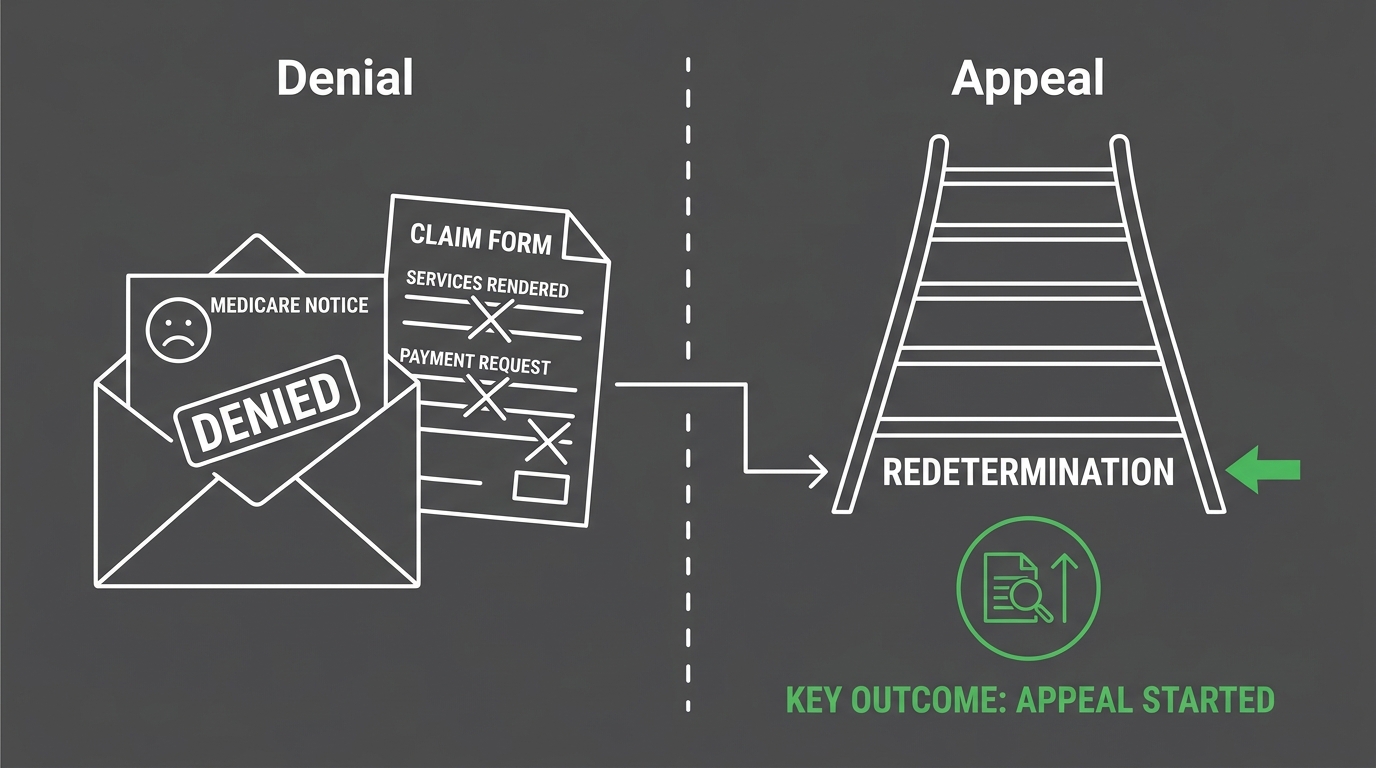
The ladder starts with a redetermination. The first three levels are:
- First Level of Appeal: a Medicare Administrative Contractor (MAC) redetermines the decision.
- Second Level of Appeal: a Qualified Independent Contractor (QIC) reconsiders it.
- Third Level of Appeal: the Office of Medicare Hearings and Appeals (OMHA) makes a decision.
Each level starts fresh. CMS says the person deciding at each level takes a new, independent and thorough look at the claim. They do not have to follow what an earlier decision-maker found or decided.
The table below shows who decides at the levels named here.
| Level | Who decides |
|---|---|
| Level 1: Redetermination | Medicare Administrative Contractor (MAC) |
| Level 2: Reconsideration | Qualified Independent Contractor (QIC) |
| Level 3: Hearing | Office of Medicare Hearings and Appeals (OMHA) |
Want more on this path? See Handling Denied Chiropractic Claims and Appeals: A Complete Guide. CMS covers appeals in the Medicare Claims Processing Manual, Chapter 29 (Appeals).
Level 2: Reconsideration by a Qualified Independent Contractor
A Qualified Independent Contractor (QIC) is an entity that has a contract with the Secretary under the Act to do Level 2 appeals. These are called reconsiderations, and expedited reconsiderations.
Level 3: Requesting a Hearing Before an Administrative Law Judge
An appeal may be filed by mail. It may also be filed online through the OMHA e-Appeal Portal at https://hhs-ecape-portal.entellitrak.com.
The request must state why you disagree with the QIC’s reconsideration or other decision you are appealing.
Send notice of your hearing request to all other parties who were sent a copy of the QIC’s reconsideration. Include proof that you told them with your request for a hearing or review.
These hearings are held by telephone. If there’s good cause, the judge can allow another way, like a video teleconference or an in-person hearing.
How Medicare Counts the Days in an Appeal
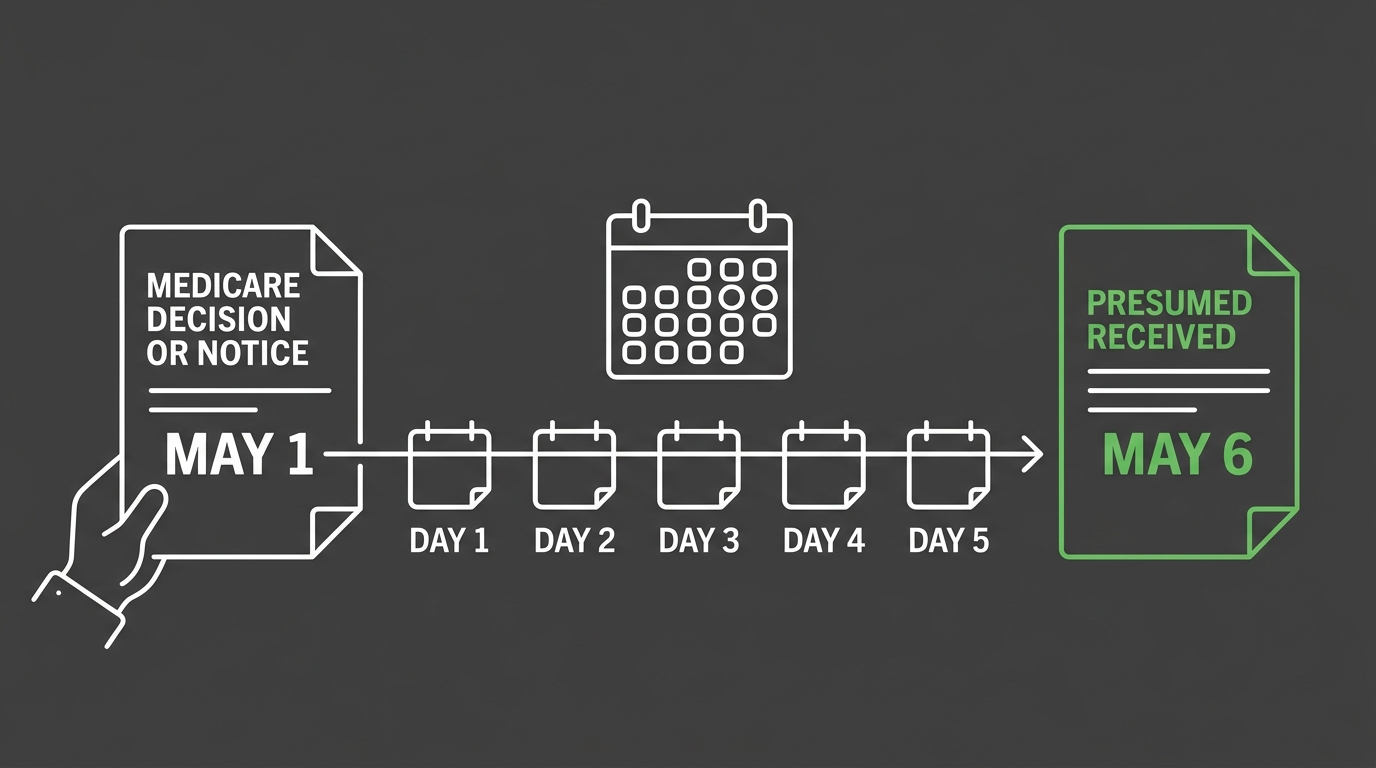
A decision or notice is presumed to have been received five days after the date written on it. The only exception is when there is evidence that shows otherwise.
For more on timing, see How Long Do Payers Have to Respond to a Written Appeal?
Put Every Piece of Evidence In by the Reconsideration Level
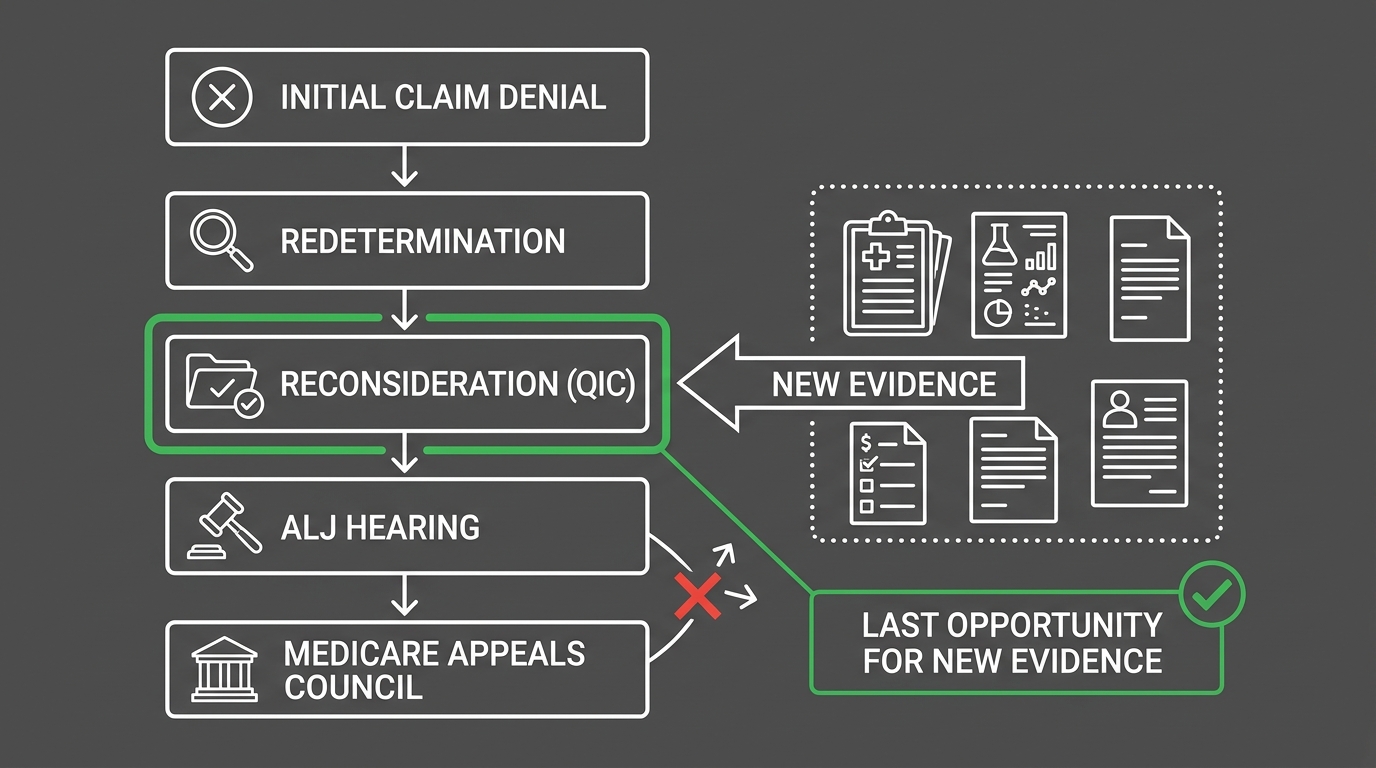
Find-A-Code notes that reconsideration by the Qualified Independent Contractor (QIC) is the last level where you can send in new evidence to support your case.
So I have the whole file built by the time the reconsideration goes in. I don’t hold good records back for later. I let software handle routine claims with no errors. I put a skilled person on anything that takes judgment, like showing why care was medically necessary or writing an appeal for one specific denial. That person builds the evidence.
To see how to put that file together, read How to Build a Defensible Appeal File Before You Submit It. You can also see how the work is done on the Medical Billing Services page.
Frequently Asked Questions
Which spinal manipulation codes must carry the AT modifier?
For services on or after October 1, 2004, when you give Medicare patients acute or chronic active or corrective treatment, you must add the Acute Treatment (AT) modifier to every claim that uses code 98940, 98941, or 98942. Leave it off and Medicare considers the care maintenance therapy and denies it. That’s because Medicare doesn’t consider maintenance chiropractic therapy medically reasonable and necessary.
How long does an appointed appeal representative’s authority last?
The appointment of representative is valid for one year. The year starts on the date it has the signatures of both the party and the appointed representative.
How does a practice appoint a representative for a Medicare appeal?
You can fill out the Appointment of Representative Form, CMS-1696. Or you can write a notice that has all the elements listed in 42 CFR 405.910, which is rule 405.910 of title 42 of the Code of Federal Regulations.
What happens if an appeal is abandoned or withdrawn?
The appeal may be dismissed. A request for appeal can be dismissed for any number of reasons. Two of them are you abandoning the appeal or asking to withdraw it.
Get Your Denied Spinal Adjustment Claims Appealed
The formal path is a ladder. A Medicare Administrative Contractor (MAC) redetermines the claim first. A Qualified Independent Contractor (QIC) reconsiders it next, and that’s the last level for new evidence. Then the Office of Medicare Hearings and Appeals (OMHA) decides at the third level. Each level takes a fresh look.
For me, sending an appeal isn’t the finish line. I count the job done only when the money lands in your practice’s account, and I judge billing by what’s collected, not by how many claims went out.
Bushido Billing offers denial management and appeals. In plain words, that’s fixing and appealing denied claims for chiropractic practices. Want to talk through your denied spinal adjustment claims with us? Book a Call.