

How an External Review Differs From a Standard Payer Appeal
Learn how an external review differs from a standard payer appeal: who decides, deadlines, cost, binding results and access by coverage type.
An internal appeal is handled by the plan or insurer. It is a full and fair review of its own denial (adverse benefit determination), and it ends in a final internal decision. An external review is handled by an Independent Review Organization. It reviews the plan’s or insurer’s denial, and it ends in a final, binding decision issued by that organization. If your insurance company still denies you the service or payment for a service, you can ask for an external review. The insurer’s final determination must tell you how to ask for one.
Who Decides: The Core Difference
The core difference is who makes the call. In an internal appeal, your plan looks at its own decision again. In an external review, an outside organization decides.
CMS and HHS guidance says internal appeals are conducted by a plan or issuer. They involve a full and fair review of its own denial, and they end in a final internal determination. External review is conducted by an Independent Review Organization, or IRO. The IRO reviews the plan’s or issuer’s denial, and its decision is final and binding. You can read the details in Internal Claims and Appeals and the External Review Process Overview (Oct 2024 webinar).
You have the right to an internal appeals process. In it, you ask your insurance company to do a full and fair review of its own decision.
Then comes the outside step. Consumers may choose to have an independent review organization, an outside independent decision-maker, decide whether to uphold (keep) or overturn (reverse) the plan’s decision. This extra check is often called an “external review.” With it, the insurance company no longer gets the final say about your benefits, and patients and doctors get a greater measure of control over health care. CMS explains this in Affordable Care Act: Working with States to Protect Consumers.
Want to see how denials move through the whole process? Read Handling Denied Chiropractic Claims and Appeals: A Complete Guide.
When a Denial Qualifies for External Review

If your insurance company still denies the service or the payment for it, you can ask for an external review. The insurer’s final decision has to tell you how to ask for one. HealthCare.gov covers this on its Internal appeals page.
External review also covers any denial that involves medical judgment, where you or your provider may disagree with the health insurance plan.
That’s where I draw my line. I let software handle routine, error-free claims. When a denial turns on medical judgment, like why care was medically necessary, I put a skilled person on the tailored appeal. Tech gets a real role in the work, but a limited one.
If a payer has already upheld a denial, see What to Do After a Payer Upholds a Denial on Appeal.
Internal Appeal Levels and What the Denial Notice Must Say
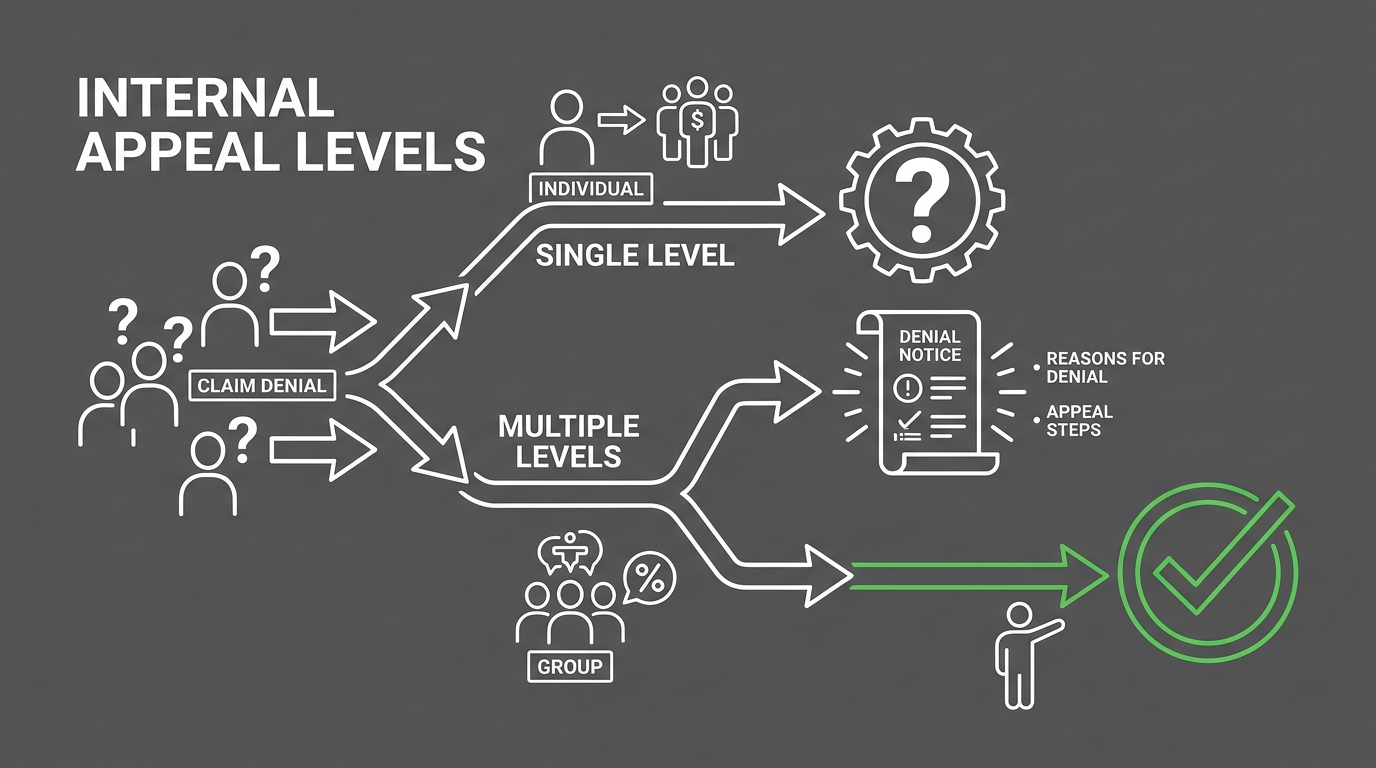
How many internal levels you get depends on the market. Group market plans have one or two levels of internal appeal. Individual market plans have one.
Your denial notice has to give the specific reasons for the denial. That includes the denial code and what it means, along with a description of the plan’s or insurer’s standard.
To see how the levels compare, read First-Level vs. Second-Level Appeals: What Is the Difference?
Deadlines: Internal Appeal vs. External Review
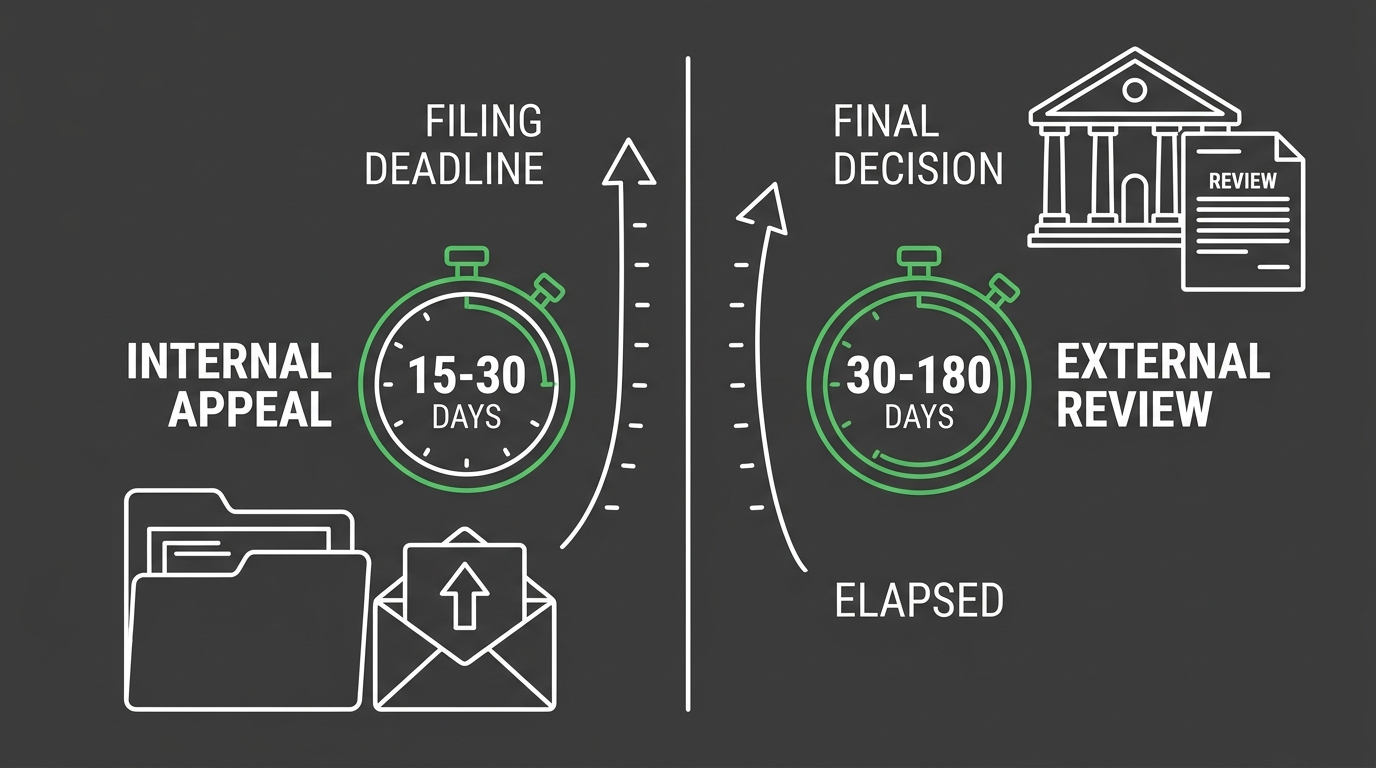
Each route runs on its own clock. For an internal appeal, you have to file within 180 days (6 months) of getting notice that your claim was denied. The plan then has to finish the appeal within 30 days if it’s for a service you haven’t gotten yet, or within 60 days if it’s for a service you’ve already gotten.
For an external review, you have to file a written request within 4 months after the date you get a notice or final decision from your insurer that your claim was denied. A standard external review has to be decided as fast as possible, and no later than 45 days after the request was received. A fast (expedited) external review has to be decided as soon as possible, and no later than 72 hours, or less, depending on the medical urgency of the case, after the request was received. HealthCare.gov lists these deadlines on its External Review page.
CMS and HHS guidance adds one more clock. The claimant, meaning the person asking for the review, has five business days to send more information.
This table puts the filing and standard decision times side by side.
| Deadline | Internal appeal | External review |
|---|---|---|
| Time to file | Within 180 days (6 months) of receiving notice that the claim was denied | Within 4 months after the date you receive a notice or final determination that the claim was denied |
| Standard decision | Within 30 days for services not yet received; within 60 days for services already received | No later than 45 days after the request was received |
External Review Decisions Are Binding
An external review either keeps your insurer’s decision in place or decides in your favor. Either way, the law requires your insurer to accept what the external reviewer decides.
The insurer also has to hand over its file quickly. After MAXIMUS gets an external review request, it contacts the health insurance issuer. The issuer must send MAXIMUS all the documents related to the denial within five business days. CMS describes this in HHS-Administered Federal External Review Process for Health Insurance Coverage.
What an External Review Costs
If your health insurance company uses the federal external review process run by the U.S. Department of Health and Human Services (HHS), you pay nothing.
If your insurer uses an independent review organization or a state external review process, you may be charged. If you are, the charge can’t be more than $25 for each external review.
CMS and HHS guidance sets four rules for a filing fee to count as nominal (small):
- It must not exceed $25 per filing.
- It must be refunded to the claimant if the denial (or final internal denial) is reversed through external review.
- It must be waived if paying it would impose an undue financial hardship.
- The annual limit on filing fees for any claimant within a single plan year must not exceed $75.
Those rules come from Internal Claims and Appeals and the External Review Process Overview (Oct 2024 webinar).
External Review Access by Coverage Type
Insurance companies in all states must offer an external review process that meets the federal consumer protection standards.
Some states’ processes aren’t considered to meet that standard. In those states, insurers that offer non-grandfathered plans and policies must provide external review another way. They can use the federal external review process run by HHS. Or they can hire accredited independent review organizations to review external appeals for them.
Medicare Advantage works differently. If the plan keeps its original denial, the case goes automatically to an independent review entity. Medicaid managed care and the Affordable Care Act (ACA) Marketplace don’t work that way. There is no automatic external medical review of denials the plan upholds.
In Medicaid managed care, if the plan upholds the original denial, states have the option to offer an external medical review but are not required to. As of July 1, 2024, at least one-third of responding states with managed care plans (15 of 39) gave enrollees access to an independent external medical review process to review a managed care plan’s decision to uphold a denial. KFF reports this in Prior Authorization Metrics Provide New Insights into Insurer Practices, but Gaps Remain.
This table shows access for each coverage type.
| Coverage type | External review access |
|---|---|
| Medicare Advantage | If the plan upholds its original denial, the case is sent automatically to an independent review entity |
| ACA Marketplace | No automatic external medical review of upheld denials |
| Medicaid managed care | No automatic external medical review of upheld denials; states have the option to offer one but are not required to |
| Medicaid managed care states, July 1, 2024 | At least one-third of responding states (15 of 39) provided enrollees access to independent external medical review of a plan’s decision to uphold a denial |
How Often Appealed Prior Authorization Denials Are Overturned
Prior authorization denials are rarely appealed. When they are, a considerable share get overturned.
KFF found that a little over two-thirds (67%) of prior authorization denials were overturned on appeal in Medicare Advantage. In Medicaid managed care, almost half (47%) were overturned on appeal. In the federally facilitated Marketplace, the one the federal government runs, a little over four in ten (43%) were overturned. You can read more in KFF’s Prior Authorization Process Policies in Medicaid Managed Care.
Our Medical Billing Services page explains how we handle denial management and appeals.
Frequently Asked Questions
Can an external review run at the same time as an internal appeal?
Yes, but only in urgent situations. In those cases, you can ask for an external review even if you haven’t finished all of the health plan’s internal appeals steps.
Does external review cover disputes over how a claim was coded?
Yes, it can. The question is whether a claim for care received is coded correctly and accurately reflects the treatments received. That counts because deciding the claim involves medical judgment.
Can external review ever be requested at the initial denial?
Sometimes. Consumers may ask for an external review of a final internal denial. In some cases, they may ask for one when the first denial is made.
When is the internal appeal treated as finished even if it isn’t?
In three cases, an internal appeal is treated as exhausted, so you can move to external review without completing the internal appeals process. The first is when the plan or insurer waives (gives up) the internal appeal. The second is urgent-care situations, where an expedited external review may start at the same time as an expedited internal appeal. The third is when the plan fails to comply with all requirements of the internal appeals process.
Is there any further review after a federal external review decision?
No. Decisions made by MAXIMUS are final. Once a claimant receives a decision, no further review is available under the HHS-Administered Federal External Review Process.
Get Help Building Your External Review Case
An internal appeal is handled by the plan or insurer and ends in a final internal decision. An external review is handled by an Independent Review Organization and ends in a final, binding decision, and your insurer is required by law to accept it. Bushido Billing does full-service insurance billing and fixing and appealing denied claims for chiropractic and allied health practices, and we help practices build the case behind each appeal. Would you like to talk through a denied claim with us? Book a Call